
How to Measure Creativity and Innovation in Candidates



Measuring creativity and innovation in candidates requires more than asking whether they consider themselves creative. Employers need evidence of how applicants generate ideas, respond to unfamiliar problems, evaluate alternatives, and turn promising ideas into practical improvements.
CVs and conventional interviews may provide useful background, but job-relevant exercises and structured questions can show how candidates apply these capabilities. This guide explores how to assess and score creativity and innovation during hiring.
In this guide, we will explore the most effective ways you can use to assess your candidates for creativity and innovation.
Contents
- What are creativity and innovation?
- Why do creativity and innovation matter in the workplace?
- How to measure creativity and innovation in candidates?
- How to score creativity and innovation accurately?
- What to avoid when assessing creativity and innovation?
- Why do top companies choose Assess Candidates to assess creativity and innovation?
Now that we’ve summarized what this article covers, let’s explore what creativity and innovation are.
1. What are creativity and innovation?
Creativity
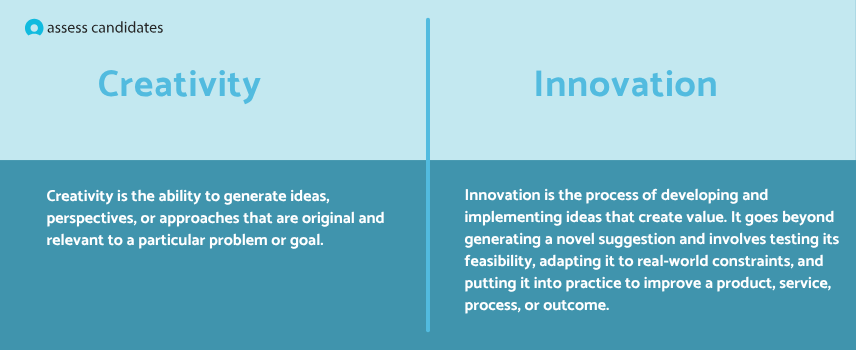
Creativity is the ability to generate ideas, perspectives, or approaches that are original and relevant to a particular problem or goal. In the workplace, it may involve questioning assumptions, connecting existing concepts in new ways, or developing alternative solutions within practical constraints.
Innovation
Innovation is the process of developing and implementing ideas that create value. It goes beyond generating a novel suggestion and involves testing its feasibility, adapting it to real-world constraints, and putting it into practice to improve a product, service, process, or outcome.
Strengthen your hiring strategy with our science-backed creative and innovative assessments. HIRE FOR FREE
The following section covers why creativity and innovation are essential in your organization.

2. Why do creativity and innovation matter in the workplace?
Creativity and innovation are two key skills that matter in the workplace. They will help you solve problems more swiftly, adapt to change easily, and improve the ways in which the work gets done.
The following are the 5 reasons why creativity and innovation matter in the workplace:
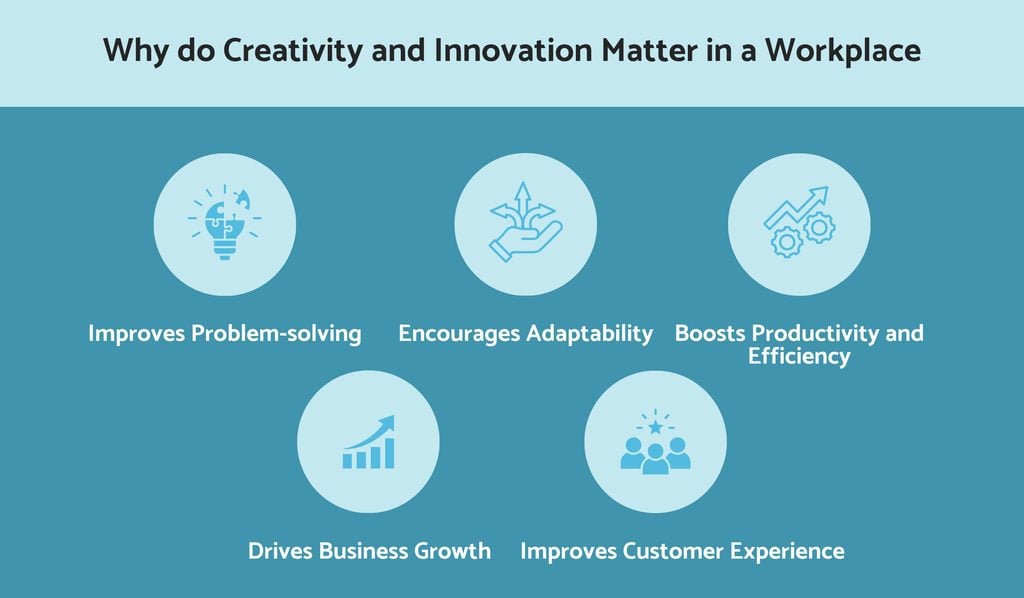
- Improves Problem-solving
Employees who are creative and innovative look at problems from different perspectives rather than relying on conventional solutions. This helps organizations identify more effective and practical ways of overcoming challenges, thereby improving problem-solving.
- Encourages Adaptability
Through the constant changes in the workplace from new technologies and market conditions, creativity and innovation help employees adapt to these changes swiftly. Therefore, creativity and innovation encourage adaptability, helping organizations stay relevant in the industry.
- Boosts Productivity and Efficiency
Employees with strong innovative thinking and creativity come up with better ways to complete everyday tasks more efficiently. This further helps organizations boost their productivity and efficiency.
- Drives Business Growth
Employees with excellent creative ideas often lead to the development of business opportunities, new products, services, and markets. Organizations can further turn these new ideas into practical solutions and create long-term growth and new sources of revenue.
- Improves Customer Experience
Employees who are creative and innovative understand what customers need and identify effective new ways to meet their expectations. This further helps to improve overall customer experience by developing new products and services in line with customer demands.
Our pre-employment assessments accurately assess creativity and innovation in candidates. LEARN MORE
So, how do organizations measure creativity and innovation when hiring candidates?
3. How to measure creativity and innovation in candidates?
Creativity and innovation involve related but distinct capabilities. Employers can assess idea generation through open-ended, job-relevant tasks and evaluate innovative thinking through candidates’ ability to test, refine, and implement workable solutions. The most useful method depends on the demands of the role.
A creative answer is not necessarily an innovative solution. Recruiters need to understand whether candidates can generate relevant ideas, evaluate their practical value, and take sensible steps toward implementation.
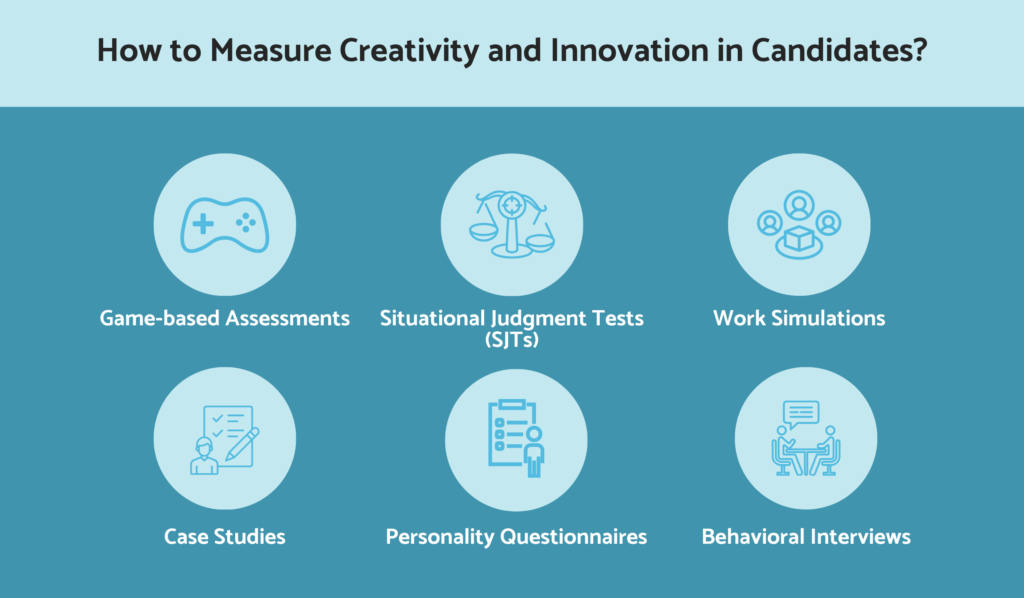
- Game-based Assessments
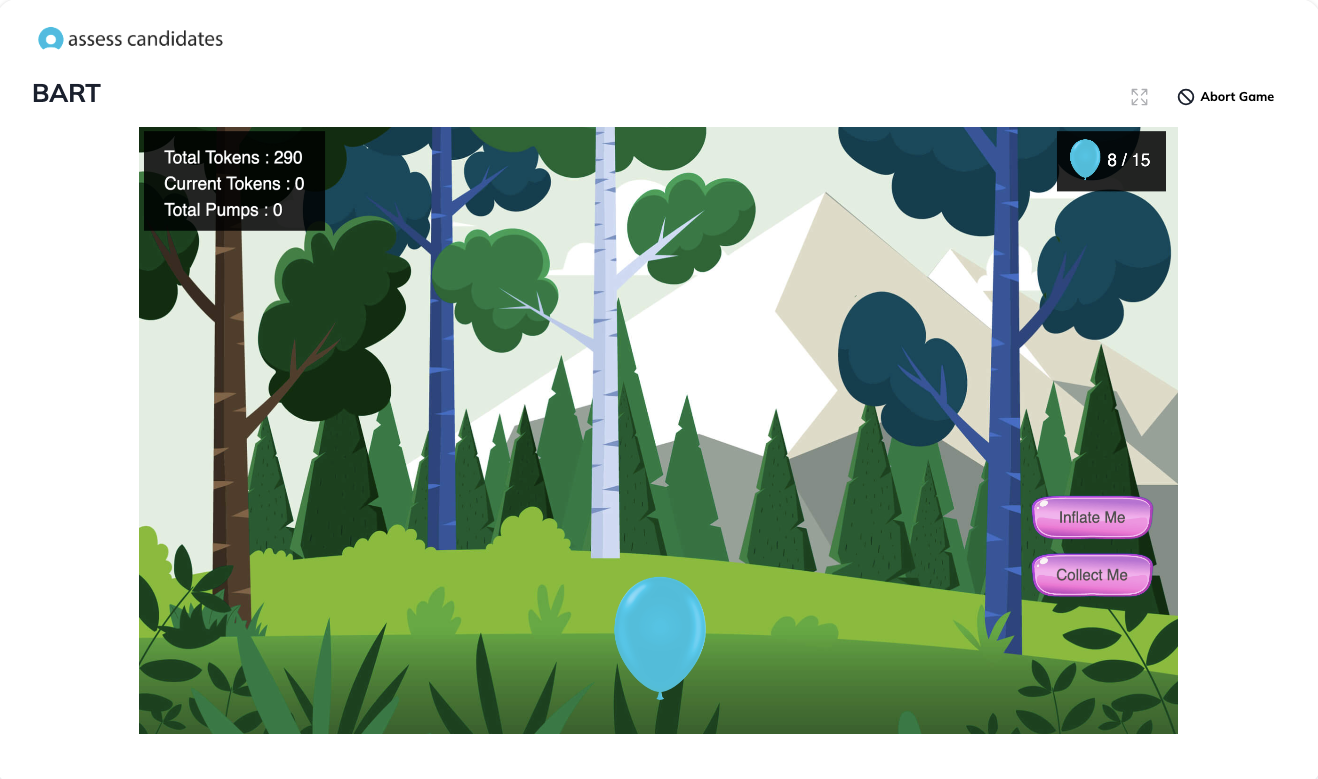
Game-based assessments can provide evidence of specific cognitive or behavioral capabilities such as problem-solving, cognitive flexibility, and decision-making, depending on their design and validation. To assess creativity directly, use game assessments that require candidates to generate or evaluate alternative ideas.
Example: Candidates are required to select the direction of the center fish using their arrow keys or left and right buttons.
- Situational Judgment Tests
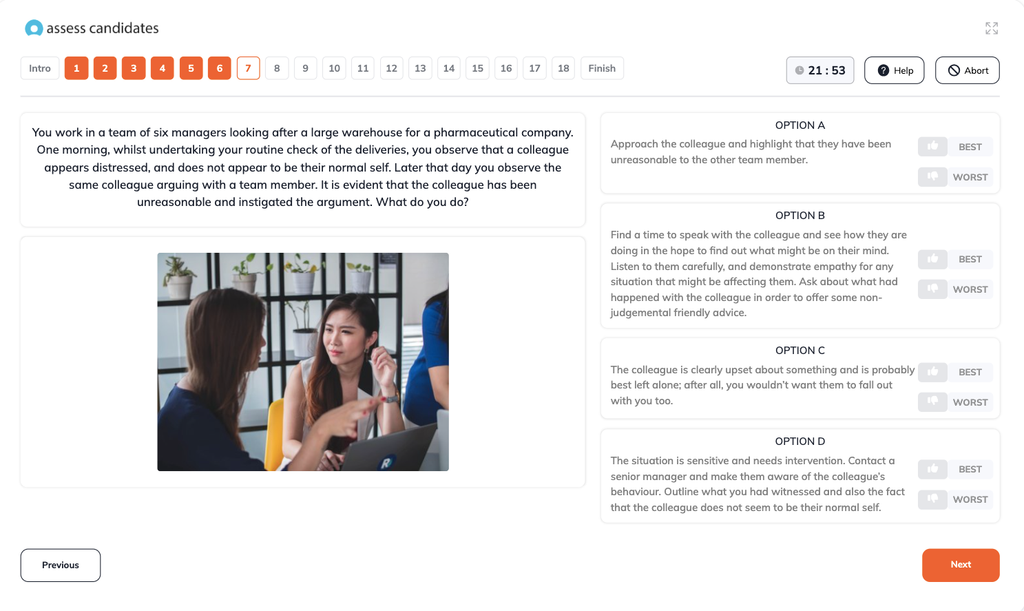
Situational judgment tests can explore how candidates respond to opportunities for workplace improvement. For example, a scenario may ask them to evaluate different approaches to changing an inefficient process. This provides evidence of their judgment about innovation, however this can be used alongside an open-ended task that observes original idea generation.
Example: “Your team has been using the same process for several years, but it is causing delays. Your manager is reluctant to change it because the existing system is familiar. What would you do?”
- Continue using the existing process because it is already established.
- Immediately replace the process without consulting the team.
- Identify the problems with the existing process, propose alternatives, and test a small-scale improvement.
- Ask another team to solve the problem.
- Work Simulations
Work simulation exercises measure how candidates generate ideas, respond to constraints, and redesign inefficient team processes. For instance, a marketing candidate might be asked to come up with a campaign for a new product launch.
Example simulation exercise: A marketing agency has a branding challenge and analytics task. Candidates receive information about the target audience, competitors, and available resources and have 60 minutes to develop a campaign concept.
- Case Studies
Case study assessments will help you assess how candidates identify problems, generate possible solutions, evaluate risks, and develop innovative approaches. This will help you avoid recruiting candidates who lack creative thinking and struggle to solve unfamiliar problems in real-world workplace situations.
- Personality Questionnaires
Personality questionnaires may provide supporting evidence about traits associated with curiosity, openness to experience, or willingness to try new approaches. However, they should not be treated as direct measures of creativity or innovation. Where these capabilities are central to a role, combine relevant questionnaire evidence with practical, job-specific exercises.
Example: “I like building on the ideas of others”
- Strongly Disagree
- Disagree
- Neither Agree nor Disagree
- Agree
- Strongly Agree
- Behavioral Interviews
Structured behavioral interviews can explore how candidates have generated ideas, challenged assumptions, or implemented improvements in previous roles. Ask follow-up questions about the problem, their individual contribution, the alternatives considered, and the outcome.
For candidates with limited work experience, use equivalent examples from education, volunteering, or personal projects.
Example: “Tell me about a time when you introduced a new idea or approach at work.”
Discover the potential of creative and innovative assessments and boost your hiring accuracy. HIRE FOR FREE
Let’s look at proven ways to accurately score creativity and innovation.
4. How to score creativity and innovation accurately?
Score creativity and innovation against predefined, role-relevant criteria. For creativity, consider originality, relevance, and the range of ideas generated. For innovation, consider feasibility, evaluation of constraints, testing, refinement, and the ability to translate an idea into a practical outcome.
The following are the 5 ways to score creativity and innovation effectively:
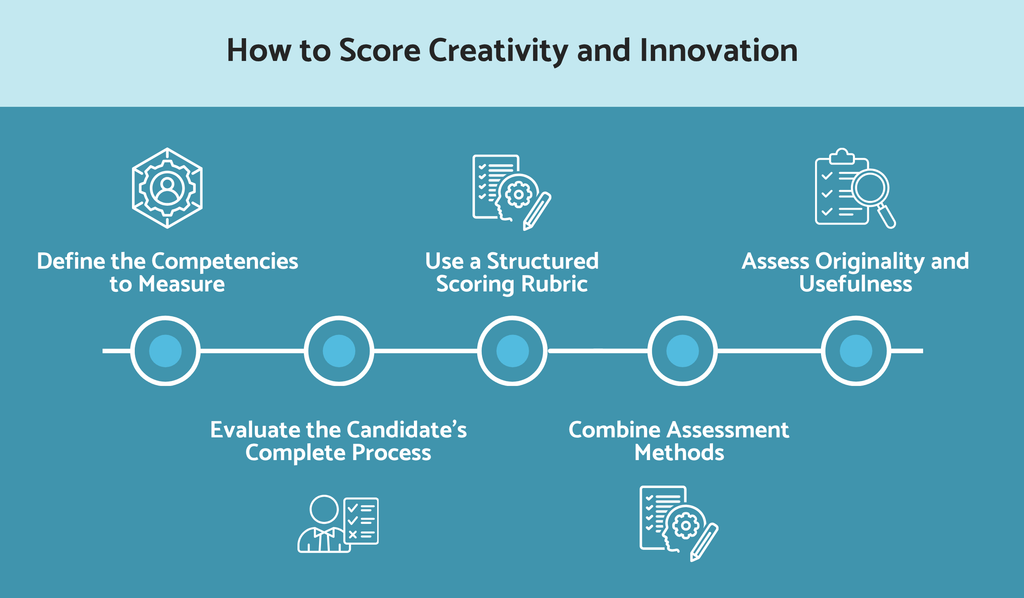
1. Define the Competencies to Measure
Before scoring an assessment, identify the specific aspects of creativity and innovation that are relevant to the role. These aspects could include originality, problem-solving, adaptability, and experimentation. Defining the competencies clearly makes it easier to evaluate candidates consistently.
2. Use a Structured Scoring Rubric
Create a structured scoring rubric with clearly defined criteria rather than relying on an interviewer’s overall impression. Each criterion can be measured using a consistent scale such as 1 to 5. This helps evaluate candidates fairly.
3. Assess Originality and Usefulness
While scoring creativity and innovation, it is essential to consider a candidate’s originality as well as usefulness. Scoring must consider whether the idea is new or unique and relevant to the situation. This helps identify whether a candidate can come up with not only unique but also effective, practical ideas.
4. Evaluate the Candidate’s Complete Process
For open-ended assessments, it is important to consider how the candidates arrived at their solutions. Assess if they considered different possibilities, questioned assumptions, evaluated alternatives, and adapted their approach when faced with new information.
5. Combine Assessment Methods
Since creativity and innovation involve several different behaviors, it is crucial to rely on multi-assessment methods to get a more comprehensive picture. Combine assessments such as work simulations, case studies, SJTs, behavioral interviews, game-based assessments, and personality questionnaires to gather evidence in a scientific way from different contexts.
Leverage our candidate assessment platform to identify creative and innovative candidates. LEARN MORE
But what is important to consider when measuring creativity and innovation in candidates?
5. What to avoid when assessing creativity and innovation?
The main assessment risk is confusing a confident or unconventional answer with a genuinely useful idea. Employers should avoid subjective impressions, vague criteria, unrealistic exercises, and scoring approaches that reward novelty without considering relevance or feasibility.
Given below are some assessment mistakes to avoid while measuring creativity and innovation in candidates.
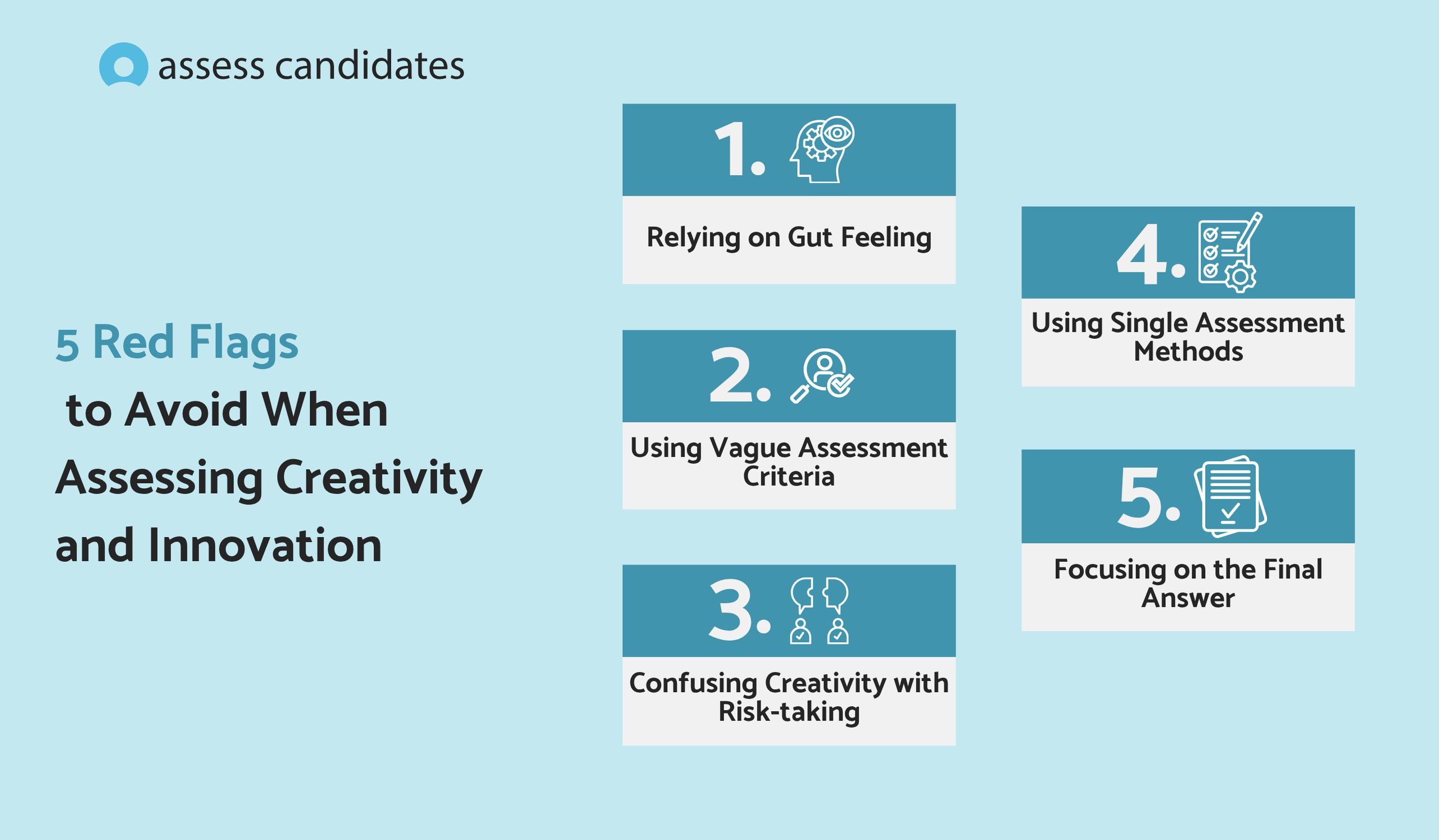
- Relying on Gut Feeling: Judging creativity solely based on whether an assessor likes the candidate’s personality, communication style, or ideas can lead to mis-hires.
Solution: Use structured scoring rubrics with predefined criteria to evaluate every candidate.
- Using Vague Assessment Criteria: Using vague assessment criteria to define the role can lead to assessors risking analyzing the job role inaccurately.
Solution: Clearly define what creativity and innovation mean for the specific role.
- Confusing Creativity with Risk-taking: Effective innovation requires evaluating risks and consequences. Candidates who take risks must not automatically receive higher scores for coming up with innovative and risky ideas.
Solution: Assess whether candidates can balance experimentation with risk evaluation.
- Using Single Assessment Methods: Using a single evaluation method like a structured interview or simply a personality questionnaire might only provide a limited overview. This may further lead to mis-hires.
Solution: Combine methods such as case studies, work simulations, SJTs, behavioral interviews, game-based assessments, and personality questionnaires to assess creativity from different perspectives.
- Focusing on the Final Answer: Since two candidates may arrive at similar solutions but use very different approaches, focusing only on the candidate’s final answer may risk bias while hiring.
Solution: Ask candidates to explain how they identified the problem, generated alternatives, evaluated options, and arrived at their final solution.
Partner with Assess Candidates to integrate a range of psychometric tests into your hiring process. VIEW PLANS
6. Why do top companies choose Assess Candidates to assess creativity and innovation?
Assess Candidates offer structured pre-employment assessments that can provide evidence of competencies relevant to creative and innovative work. Select assessments based on your hiring needs and combine them with practical exercises that further allows candidates to demonstrate evidence of idea generation or implementation.
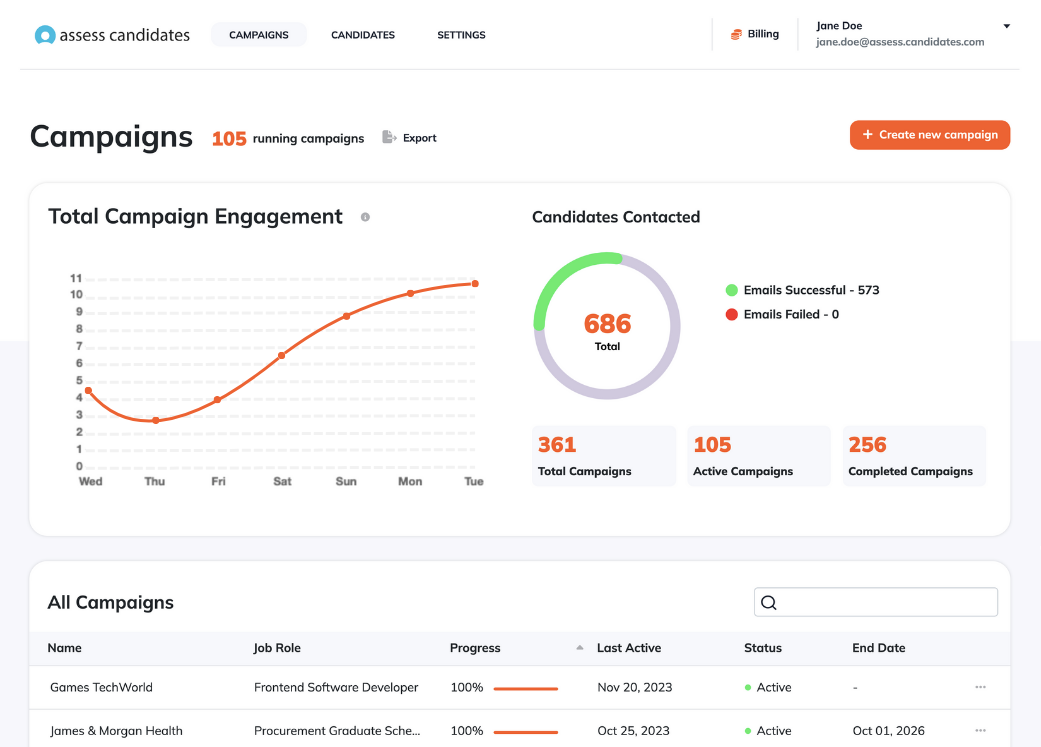
Here is an example of our campaign reporting dashboard available on Assess Candidates.
Here are 4 reasons why you should use Assess Candidates for measuring creativity and innovation in candidates:
- Scientifically Designed by Expert Psychologists: Assess Candidates’ assessments are developed by experienced Psychologists and Psychometricians with expertise in designing assessments for global leaders such as SHL and IBM Kenexa.
Each assessment undergoes rigorous validation to measure key capabilities such as creative thinking, idea generation, problem-solving, and adaptability, helping you identify candidates who can approach challenges in new and effective ways.
- Advanced Reporting: Our intuitive platform provides clear reports highlighting candidates’ creative thinking, problem-solving, adaptability, and idea-generation capabilities. Recruiters can compare results, identify strong performers, and make faster, data-driven hiring decisions.
- Positive Candidate Experience: Our assessments are intuitive, engaging, and accessible across devices. Clear instructions and smooth navigation allow candidates to focus on generating ideas and solving problems, while custom branding helps maintain a consistent employer identity.
- Candidate Accessibility Support: We support an inclusive assessment experience with features such as extended time, screen-reader compatibility, adjustable colour contrast, and Zoom functionality, helping candidates demonstrate their creative capabilities fairly.
Assess Candidates provides science-backed tools to measure creativity and innovation, helping organizations identify candidates who can generate ideas, solve problems, and adapt to change. Explore our complete range of assessments or start identifying candidates today.
Not sure which creative and innovative assessments to choose? Contact us for a free analysis of your hiring needs.
Conclusion: Key Takeaway
Measuring creativity and innovation in candidates requires evidence of both idea generation and practical judgment. Define what each capability means for the role, use relevant work samples or structured questions, and score originality, usefulness, feasibility, and implementation separately where appropriate. This gives hiring teams a clearer basis for comparing candidates than relying on confidence or unconventional answers alone.
Interested in learning more about effective candidate assessment? Continue reading for frequently asked questions, and sign up with your email to get started.
Frequently Asked Questions
Should creativity and innovation be measured separately?
Yes, creativity and innovation should be measured separately because they are different capabilities. While creativity is the process in which candidates generate new ideas, innovation is the process of turning these ideas into practical solutions. Measuring both these skills separately will help you get a more comprehensive view of a candidate’s ability to think out of the box and put those ideas into action.
Can creativity and innovation be measured without asking candidates to complete a test?
Yes, you can measure creativity and innovation without asking candidates to complete a test. Integrate behavioral interviews and case studies in your hiring process. For example, you can present candidates with realistic workplace scenarios as a case study exercise and observe how they approach these problems.
How to assess creativity and innovation in different job roles?
Begin by identifying what creativity and innovation look like in the specific role. Use assessments based on realistic workplace challenges candidates would encounter on the job and score them based on the position’s creative and innovative requirements.
How to reduce bias when assessing creativity and innovation?
You can reduce bias when assessing creativity and innovation in candidates by using standardized assessments with clear scoring rubrics and multiple assessors. Evaluate candidates based on observable evidence such as the quality of their reasoning, originality, relevance, adaptability, and ability to turn ideas into workable solutions.
How to measure creativity and innovation in existing employees?
You can measure creativity and innovation in existing employees by tracking measurable objectives like process improvements, new ideas, experimentation, and implemented solutions. Use manager feedback, project reviews, and employee self-assessments to observe how consistently each employee contributes to the organization’s long-term efforts to boost innovation and creativity.


 English
  Arabic