
How to Design an Assessment Process for Effective Recruitment



This guide explains how to design an assessment process for recruitment that is fair, effective, and relevant to the role. It covers what to consider when building the process, which psychometric pre-employment assessments to include, and which tools can support better hiring decisions.
If you are reviewing your current hiring process, this article will help you design an assessment process that improves candidate quality, supports a better candidate experience, and reduces bias.
You will also learn:
Contents
- What is an assessment process?
- How do you design an assessment process?
- What are the advantages of designing assessment processes?
- Challenges of designing an assessment process
- What are the tools for designing an assessment process?
- Best practices to design an assessment processes for recruitment
- What roles require an assessment process?
- Client stories of successfully designing assessment processes
- Why do companies prefer Assess Candidates when designing an assessment process?
- The future of recruitment with assessment process design
Without further ado, let us see what it takes to design an assessment process!
1. What is an assessment process?
An assessment process is a structured method for evaluating candidates during recruitment. It measures job-relevant skills, cultural fit, work behaviors, and role fit so employers can make more objective, data-driven hiring decisions.
Understanding the meaning of the assessment process, you must have many questions, and we will answer them below. Keep reading!

2. How do you design an assessment process?
It is important to consider a few key factors when designing a candidate assessment process, as they can affect the candidate experience and, in turn, the employer brand. When designing a recruitment assessment process for recruitment, it is best to allow an expert to determine what to consider.
Elements to consider when designing an assessment process.
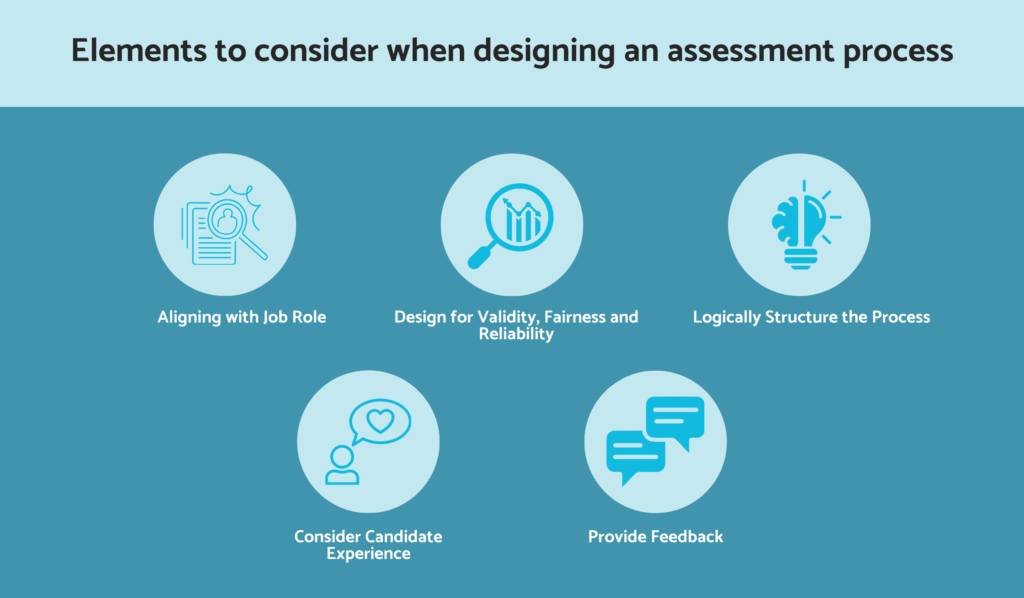
1. Aligning with Job Role
Map out the required competencies for the role you are recruiting for, not just the job description. Ensure that you collaborate with the top performers and their managers to identify what truly matters for the role, and distinguish between skills people need on day one and what they can learn.
2. Design for Validity, Fairness, and Reliability
When designing an hiring assessment process for recruitment, monitor the procedure and ensure that each assessment predicts the candidates’ performance rather than irrelevant factors. It is important that there are no barriers, such as individual bias, and they are trained on a consistent evaluation criteria.
3. Logically Structure the Process
Arrange your assessments from least to most intensive, so that the early stage of recruitment can be screening to cover basic qualifications, then move on to assessments to test personality, workplace behaviour, and cognitive abilities, and finally to time-consuming interviews and exercises.
4. Consider Candidate Experience
Candidate experience should be a core part of the process design. Long or unclear assessments can frustrate strong applicants and increase drop-off. Be clear about timelines, explain each stage, and tell candidates how decisions will be made.
5. Provide Feedback
Feedback matters before, during, and after the hiring process. Clear communication helps candidates understand where they stand, protects employer brand perception, and creates a more professional experience.
Develop the perfect assessment process for your recruitment with our psychometric assessments. HIRE FOR FREE
Are you thinking about the advantages of designing an assessment strategy? Read on as we explore the key benefits of designing your assessment process.
3. Advantages of designing an assessment process for recruitment
Well-designed assessment processes help employers make more consistent hiring decisions, reduce time spent screening unsuitable applicants, and improve confidence in final selections.
According to the Society for Human Resource Management (SHRM), approximately 82% of companies use psychometric pre-employment assessment tests in their recruitment process. This is done to filter the eligible and qualified candidates from the rest, reducing the time spent on the selection process.
Key Advantages of designing an assessment process
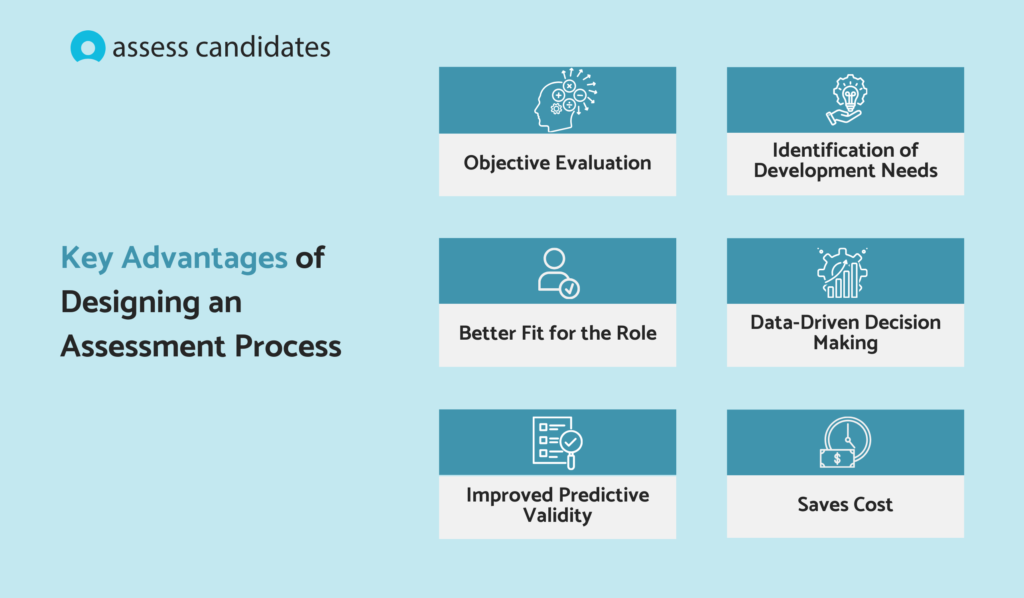
- Objective Evaluation
Talent assessments often provide a standardized way to assess candidates, as well as reducing biases that might come up during interviews or resume screening.
- Better Fit for the Role
Role-relevant assessments help identify candidates with the skills and capabilities needed for success. This improves selection quality and can support stronger retention by matching candidates more closely to job demands and culture.
- Improved Predictive Validity
Cognitive abilities and work sample assessments are usually strong predictors of a job’s success across multiple industries, and this will provide you with confidence in the candidates that you are recruiting.
- Identification of Development Needs
Through recruitment assessment, you can identify gaps in your candidates’ skills and offer relevant training or professional development to help them grow and meet your company’s demands and those of their teams.
- Data-Driven Decision Making
You can reduce costs and save time by making data-driven decisions rather than relying on intuition or guesses. Data collected from assessments will provide you with concrete evidence that supports your hiring decisions.
- Saves Cost
You want to avoid making bad hires, as the initial design of assessment processes can be slightly expensive. That is why we recommend ensuring that you have the right job description goals and demands for the candidates applying, so the assessments can be well-tailored to suit your search.
Having seen the advantages, are you worried about the challenges of designing assessment processes in recruitment? We have you covered as we have solutions to these!
4. Challenges of designing an assessment process
According to SHRM, companies often struggle to hire because they do not receive enough suitable applicants. In 58% of cases, roles remain hard to fill as candidates lack the required skills or qualifications.
These challenges are common, but they are manageable with the right design choices. Addressing them early helps improve fairness, efficiency, and the quality of hiring decisions.
Top challenges of designing an assessment process
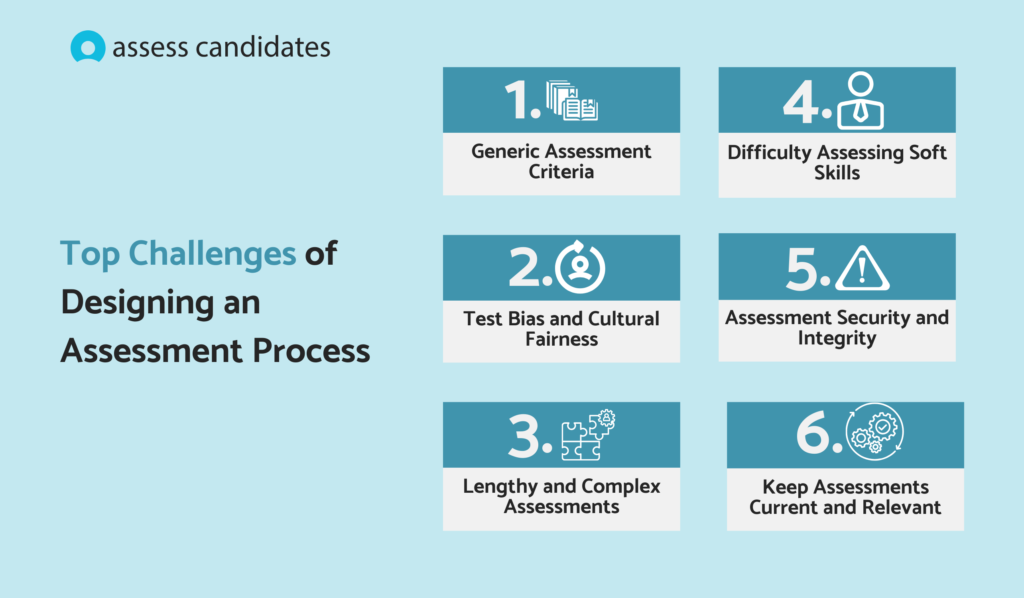
1. Generic Assessment Criteria
Most companies fail to achieve their recruitment goals when designing an assessment process because they often use a one-size-fits-all approach to candidate assessment rather than tailoring the process to the role they are applying for and what they are looking for in an applicant.
Solution: Customize the assessment process for each role so it measures the specific skills, behaviors, and competencies required for success.
2. Test Bias and Cultural Fairness
Candidates have complained of bias during the recruitment process, as certain assessment tests do not cater to them or their demographic, and they have encountered cultural differences in the selection process.
Solution: Review assessments for adverse impact, remove culturally specific language where possible, and provide reasonable accommodations so the process is accessible and fair.
3. Lengthy and Complex Assessments
Making your recruitment assessment process too long or complex will result in losing out on good candidates who will inadvertently grow tired of attempting your organization’s assessments. Candidates should not feel like they have to spend so much time on assessments.
Solution: Keep assessments focused, relevant, and easy to follow. Give clear instructions, explain expectations, and avoid unnecessary stages that add time without improving decision quality.
4. Difficulty Assessing Soft Skills
Usually, traditional interviews fail in effectively assessing significant soft skills, such as teamwork, collaboration, communication, adaptability, and problem-solving.
Solution: Use structured behavioral interviews and scoring criteria to evaluate communication, teamwork, adaptability, and problem-solving with more consistency.
5. Generic Assessment Criteria
As the global trend of employers conducting online talent recruitment assessments grows, more employers are concerned about preventing cheating, ensuring assessment security, and verifying that candidates completed their assessments without external assistance.
Solution: For high-stakes assessments, use safeguards such as time limits, question randomization, and appropriate proctoring tools to protect test integrity.
6. Keep Assessments Current and Relevant
You may have to update your assessment process often, as job requirements will continually evolve and to keep the pre-employment assessment process fair, you will be required to update them, which can be expensive, as many organizations do not have the resources.
Solution: Review assessments regularly against job requirements, hiring outcomes, and feedback from hiring managers to keep them aligned with current role demands.
Use relevant pre-employment tests in your hiring process with Assess Candidates. LEARN MORE
Once these risks are understood, it becomes much easier to choose the right tools and structure. Take a look at the tools you can use to design your recruitment process.
5. What are the tools for designing an assessment process?
Hiring candidates is not just about posting the job vacancy on websites along with the role’s description; every candidate must be screened for their qualifications to ensure they are the right fit for the company, whether in terms of skills, culture fit, or behaviour.
Employers have to rely on recruitment tools to make the right hiring decisions during the recruitment process, and we have highlighted and listed a few of the tools needed to design an assessment process.
8 Tools to use in designing an assessment strategy
- Skills Assessment Tools
Platforms like Assess Candidates, HackerRank, and Codility offer skills assessment tools to examine if your candidates can actually do the work you are recruiting them for. The skills assessment takes an unbiased look at the candidates’ skills, judging them based on their skills rather than their CV.
- Psychometric Tests
Assess Candidates, SHL, and Talent Q offer psychometric assessments to employers looking to test the cognitive abilities of their candidates. The psychometric pre-employment assessment tests evaluate the candidates knowledge on numerical, verbal, logical, and critical reasoning tests, and are set based on the role that they are applying for and how much these assessments are required in their field.
- Personality and Behavioral Tests
Platforms such as Kenexa, Assess Candidates, and DiSC Personality Assessment will provide you with personality and behavioral tests like situational judgment tests and workplace personality questionnaires to aid you in gauging the behaviors and personalities of your candidates at work, using work-related simulations to examine the candidates.
- Video Interviews
Video interviewing platforms such as Assess Candidates, Hirevue, and Spark Hire can support structured interviews at scale. They help employers assess communication, role fit, and response quality in a consistent format.
- Game-Based Assessments
You can use game-based assessments in your assessment process, as they are interactive and break away from the traditional assessment method that employers use in today’s hiring process. The game-based assessments work just like traditional assessments, except they are more engaging and interactive. Platforms like Assess Candidates, Pymetrics, and Arctic Shore offer gamified assessments.
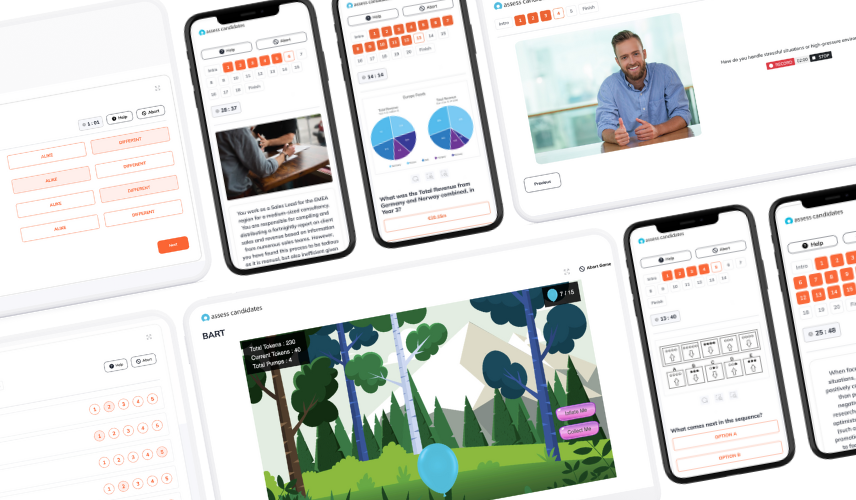
Explore our extensive range of science-backed pre-employment assessments LEARN MORE
Now that you know the tools to consider using, you should also know about the best practices in designing the recruitment process.
6. Best practices to design an assessment process for recruitment
According to HR Examiner, organizations that prioritize proficient recruitment assessments are well-positioned to achieve their goals while maintaining a leading edge in the industry.
In a competitive hiring market, employers need assessment processes that are accurate, efficient, and candidate-friendly. These best practices help create a process that supports better hiring decisions without adding unnecessary complexity.
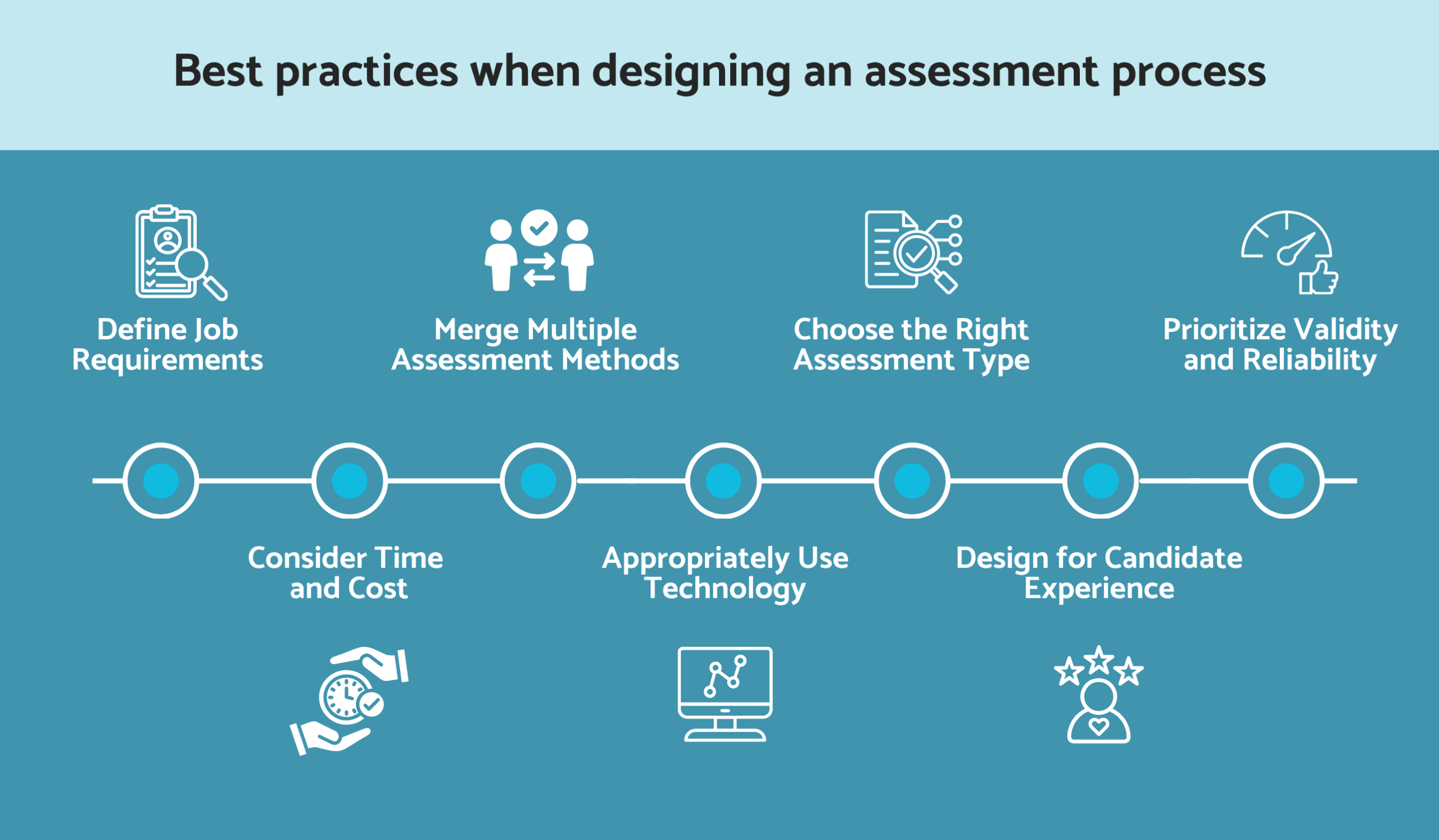
7 Best practices when designing an assessment process
1. Define Job Requirements
Having a practical pre-employment assessment is the basis of every recruitment process; therefore, endeavor to collaborate with experts in the field that you are recruiting for before you set the hiring assessment process. Make all the necessary findings, as they will help you in properly setting the assessments to fit the evaluation of the candidates.
2. Merge Multiple Assessment Methods
Merging job knowledge assessments with work sample tests will create a comprehensive assessment process that examines both the candidates’ knowledge and practical skills. Using a single assessment method will likely not fully capture your applicants’ skills and abilities.
3. Choose the Right Assessment Type
Ensure that when designing a pre-employment assessment process, you keep in mind that each job is unique. Therefore, each vacant role is likely to require different abilities, which cannot all be tested with a single assessment type. It is important that you align the assessment type to the job roles that you are recruiting for.
4. Prioritize Validity and Reliability
There are many things to consider when designing a recruitment assessment process; however, it is crucial that you keep factors such as validity, reliability, fairness, technology, and legal context in mind. This way, your assessment strategy actually predicts job performance and provides consistent results.
5. Consider Time and Cost
It is necessary to consider how long it would take candidates to complete the recruitment assessment and the cost of designing an effective talent assessment process. Balancing these two will ensure that the evaluations are not cumbersome to you or the candidates.
6. Appropriately Use Technology
Technology such as ATS platforms and video interviewing tools can improve efficiency, but it should support rather than replace human judgment in areas such as context, cultural fit, soft skills, and final decision-making.
7. Design for Candidate Experience
Creating a positive candidate experience should be a core consideration when developing an assessment strategy, as it will help candidates feel valued and respected throughout the recruitment process and improve the company’s brand image.
Ensure a positive candidate experience in your hiring process with Assess Candidates. LEARN MORE
If you are an employer looking to design an assessment process for your upcoming recruitment, you can reach out to us for an evaluation of your assessment strategy.
The roles below show where structured assessment adds the most value.
7. What roles require an assessment process?
Assessment processes are used across many sectors where employers need a more objective way to evaluate job readiness, capability, and potential.
Check out a few sectors that use assessment in their selection.
Sectors that use an assessment process in recruitment
- Legal
Law firms such as Linklaters, Simmons & Simmons, and Allen & Overy often use logical and verbal reasoning tests, along with situational judgment tests, to assess candidates’ talents before offering them positions.
- Technology and IT
Tech firms like Google, Microsoft, and Amazon also use coding and logical and numerical reasoning tests to examine how well candidates can perform coding tests or technical-related problems in real time.
- Finance and Banking
Firms such as HSBC, Citigroup, and Goldman Sachs often use numerical, logical, verbal reasoning, and situational judgment tests to evaluate the candidates’ analytical, decision-making skills and numeracy.
- Engineering
Organisations like General Electric, Siemens, and Boeing use technical tests, logical and numerical reasoning tests, and personality questionnaires to gauge their candidates’ abilities and readiness to work and collaborate with other staff.
- Retail and Customer Service
Employers such as Walmart, Tesco, and Starbucks use recruitment assessments, such as personality questionnaires, situational judgment tests, and verbal reasoning tests, to assess candidates’ customer service and problem-solving skills in situational contexts.
- Sales and Marketing
Companies like Coca–Cola, HubSpot, and Unilever employ assessments such as numerical and logical reasoning tests and situational judgment tests to assess whether applicants have the skills needed to flourish in their departments.
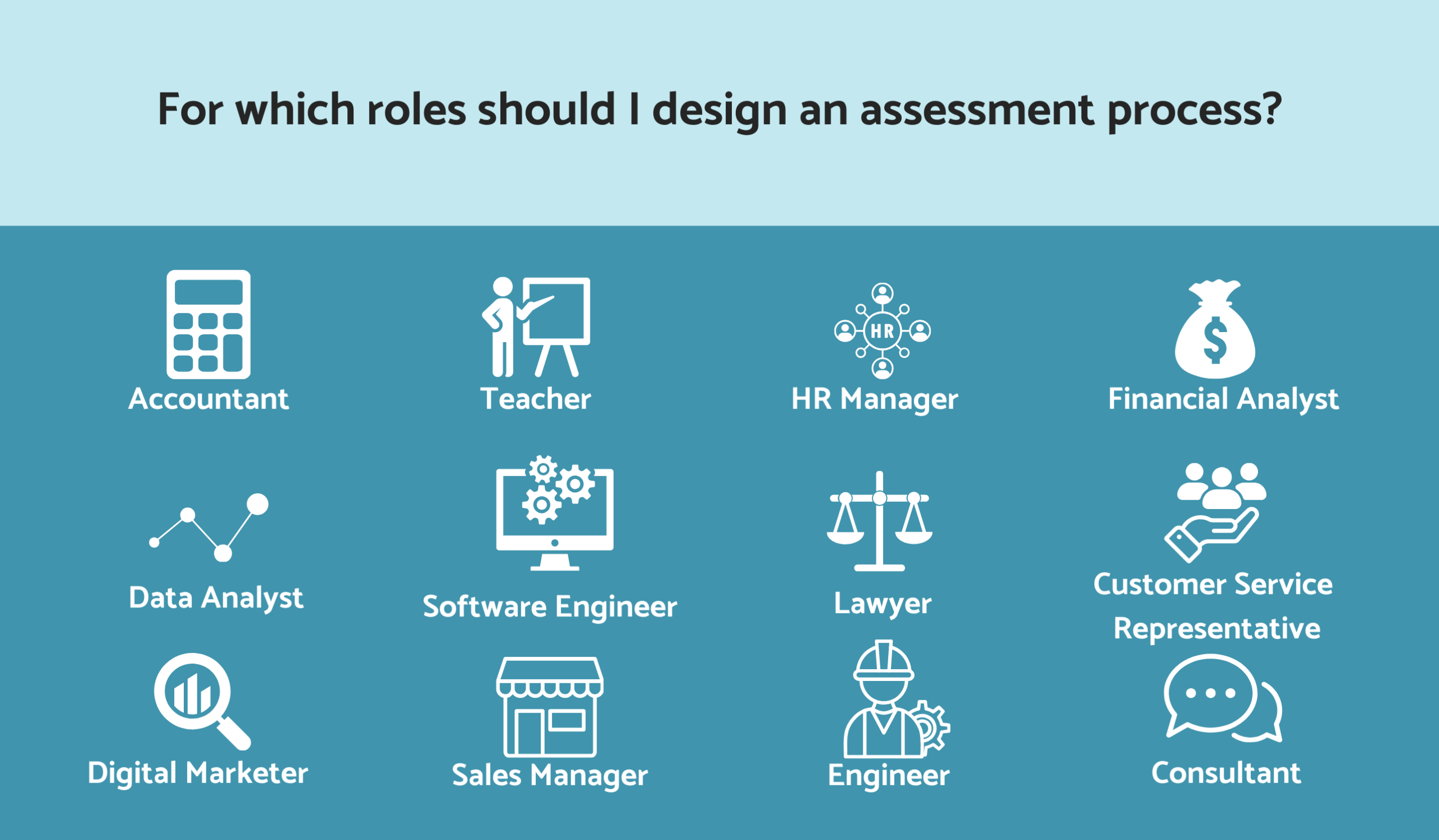
Roles that Use Assessment Processes
- Lawyer
- Customer Service Representative
- Digital Marketer
- Sales Manager
- Accountant
- Financial Analyst
- Data Analyst
- Software Engineer
- Engineer
- HR Manager
- Teacher
- Consultant
Are you struggling to decide how to design your hiring assessment process? You can reach out to us for a breakdown of the necessary pre-employment psychometric assessment tests for the job vacancies and the level of difficulty for each role you are recruiting for.
Wondering what companies use assessment processes in their recruitment? There are many organizations across the globe that install assessment strategies in their talent recruitment stage to ensure that each candidate is aptly skilled to perform in their specific roles..
- Goldman Sachs
- Deloitte
- Unilever
- Coca-Cola
- HubSpot
- Apple
- Microsoft
- Siemens
- Avery & Overy
- Simmons & Simmons
Explore credible assessments used by top recruiters to hire the right talent. VIEW PLANS
Check out some client success stories about designing an assessment process for their talent acquisition.
8. Client stories of successfully designing assessment processes
Many employers have improved hiring outcomes by redesigning their assessment process around structure, consistency, and role relevance. The examples below show how clearer evaluation methods can improve both speed and quality.
1. Google
Challenge:
Google faced inconsistent hiring decisions across their teams and long recruitment cycles, which cost more than expected. The interviewers relied heavily on unstructured interviews, which led to bias and made it difficult to predict job performance.
Solution:
The Big-tech company redesigned its assessment process by including structured interviews, a standardized scoring rubric, work-sample tests, and data-driven hiring metrics that are focused on role-related competencies.
Results:
- Enhanced consistency and fairness in hiring decisions
- Reduced bias through structured assessment tests
- Increased connection between assessment scores and on-the-job performance
- Shorter hiring timeline without reducing candidate quality
2. Unilever
Challenges:
Unilever received a large number of graduate applications, making it difficult to screen the candidates reasonably and efficiently while maintaining a positive candidate experience throughout the recruitment process.
Solution:
Unilever introduced a digital assessment process using game-based psychometric assessments, situational judgment tests, and AI-based video interviews that aligned with the role’s requirements.
Results:
- Significant reduction in recruitment hiring time
- Accurate identification of highly skilled graduate applicants
- Increased diversity in shortlisted candidates
- Improved candidate engagement and recruitment completion
This is where Assess Candidates comes in, as we can assist in regulating and designing a role-specific, comprehensive assessment process that fairly judges candidates’ skills.
9. Why do companies prefer Assess Candidates when designing an assessment process?
Employers choose Assess Candidates because the platform supports fair, structured, and data-driven hiring. It helps teams assess skills and potential beyond the resume while improving consistency across the process.
Why companies prefer using Assess Candidates to design assessment processes
- Science–Backed Reliability and Predictive Power: The assessments are developed by a team of Chartered Scientists, Psychologists, and recruitment experts who are thoroughly validated to make sure that they have reliability and predictive power.
- Comprehensive Assessment Library: The Assess Candidates platform is built to provide you with data-driven insights through its pre-employment assessment library, which is designed to ensure you have confidence in your candidates’ skills and talents before hiring them.
- Innovative Technology with Human Touch: The assessments are built on established neuroscience and enhanced with advanced AI technology, combining human insight with machine precision to identify the top candidates faster and more accurately.
- Fair and Easily Accessible: Assess Candidates’ pre-employment assessments are designed to ensure inclusivity and fairness for all candidates, which invariably improves your company’s brand image.
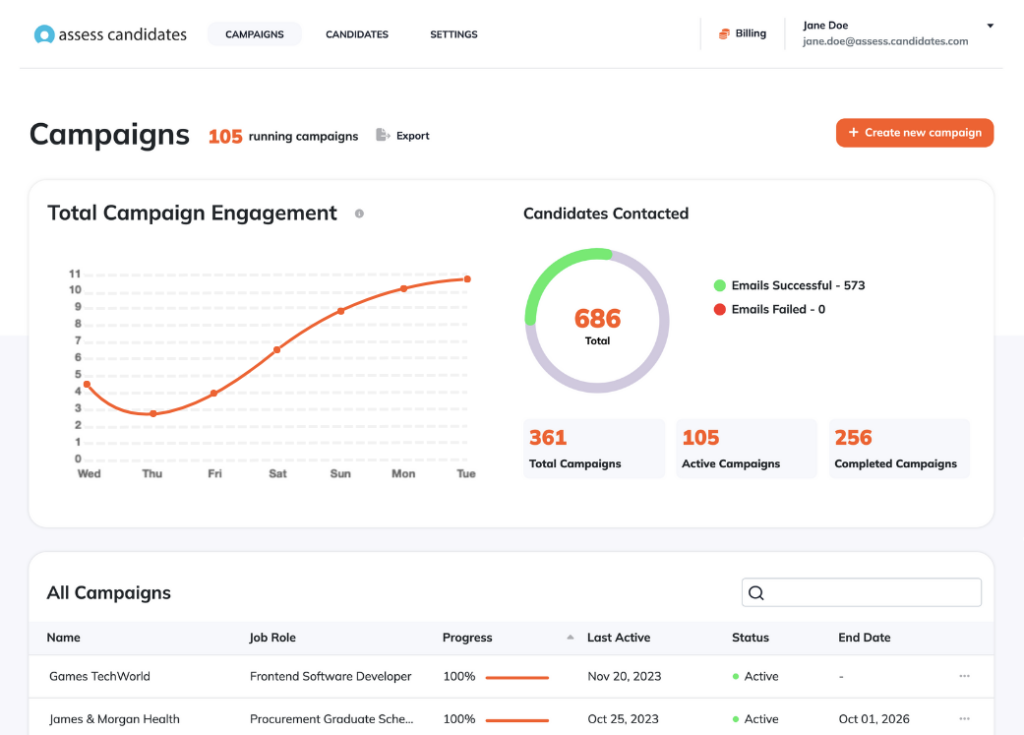
- User–Friendly Interface: It is easy to set up your campaign with Assess Candidates, then invite your candidates to take tests on an accessible, easy-to-use platform via email or a public link shared with them.
- Anti–Cheating Technology: The platform also includes a cheat-detection technology that captures certain candidates’ behaviors during their assessments, including attempts to copy and paste, switch windows, or move away from the device.
Use our pre-employment assessment platform to ensure top talent recruitment. LEARN MORE
With our platform, you can attract and retain top talent with confidence through a pre-employment psychometric assessment. Discover our top hiring assessments and start making informed hiring decisions today!
But what does the future hold for designing assessment processes? Let’s conclude this article as we explore the future of hiring when assessment processes are designed to fit the recruitment requirements.
10. Future of recruitment with assessment process design
According to Aberdeen Group, organizations that use pre-employment assessments are 36% more likely to be satisfied with the quality of their hires.
What will the future of recruitment look like with adequate assessment process design?
- AI-Driven Assessment in Recruitment
The role of AI will shift from solving for volume to solving for efficiency, as AI agents become an integral part of the recruiting process, with many employers planning to include AI agents on their teams in 2026.
- Skills-Based Hiring Resurfaces
Employers will focus more on prioritizing adaptable skills over job titles, encouraging diversity, and preparing for enhancing the workforce requirements.
According to RecruiterFlow, skills-based hiring increased to 81% in 2024 as recruiters focused more on competencies rather than formal education.
- Asynchronous or Remote Assessments
Asynchronous video interviewing platforms will allow candidates to film themselves answering a set of questions, which builds a positive candidate experience and also sheds more positivity toward the employer’s brand image.
- Diversity, Equity, and Inclusion (DEI) Integration
The future of recruitment will use AI to avoid unconscious bias that might creep into hiring decisions by flagging potential red flags in your process, ultimately building a diverse and inclusive team for you.
- Flexible Work Assessment
Recruitment assessments will now focus on virtual collaboration and capability testing, whereby employers like yourself will be able to assess your candidates remotely, as this will benefit you and the candidates by providing adequate time management and independence during the assessment process.
Want to learn more about designing an assessment process? Explore the FAQs below, or enter your email to get started.
Having learned all there is to know about designing an assessment process, if you have any more questions, you may look below to find the answers you need!
Frequently Asked Questions
Why is an assessment process design important?
Incorporating an assessment process in your recruitment process ensures that it is fair, unbiased, objective, and all candidates are evaluated with consistency.
How do you choose the right assessment tools?
When choosing the right assessment tools, you can review the job role’s requirements, collaborate with the department’s team lead, and monitor the activities of your best employees to ensure that you are sure of what to look out for in your candidates.
Are assessment processes legally compliant?
If the assessment strategies are related to jobs, and they are fair, non-discriminatory, and consistently applied, then they are legally compliant. All companies are expected to comply with employment and equal opportunity laws.
How long should an assessment process take?
This will mostly depend on the role you are recruiting for; however, you should take note of the following: keep it long enough to assess candidates’ competencies, but short enough not to dissuade candidates from completing it; keep it efficient and relevant.
Can assessments be designed for different roles?
You can design your assessment process to fit any role you are recruiting for, setting the types of assessment methods and the level of difficulty required to fully understand candidates’ talents and competencies before offering them an employment letter.


 English
  Arabic