
How to Hire Top Talent in the Legal Industry in 2026



Hiring top legal talent requires more than evaluating technical expertise and legal qualifications. Employers must also assess communication, analytical thinking, ethical judgment, attention to detail, negotiation ability, and time management to identify candidates who can succeed in demanding legal environments.
Did you know? According to research conducted by Robert Half, 58% of legal leaders planned to add permanent employees in 2026.
Understanding the skills, roles, and assessment methods that drive success in legal recruitment can help employers make more confident hiring decisions.
Contents
- What is the legal industry?
- What are some of the major roles in the legal industry?
- What top skills to look out for when hiring in the legal industry?
- What are the best tools to measure legal skills during the recruitment process?
- Best practices to hire in the legal industry
- Law: Client Success Story
- Why top law firms use Assess Candidates to hire candidates
1. What is the legal industry?
The legal industry includes law firms, corporate legal departments, courts, government agencies, and compliance functions that provide legal advice, representation, dispute resolution, and regulatory support to individuals, businesses, and governments.
ddress it independently.

2. What are some of the major roles in the legal industry?
In general, the legal industry is a broad term that encompasses a wide range of roles, including law firms, corporate legal departments, government agencies, courts, and regulatory bodies. These roles support individuals, businesses, and governments in navigating laws, regulations, disputes, and compliance requirements.
The following are some of the most common roles in the legal industry, across various sectors:
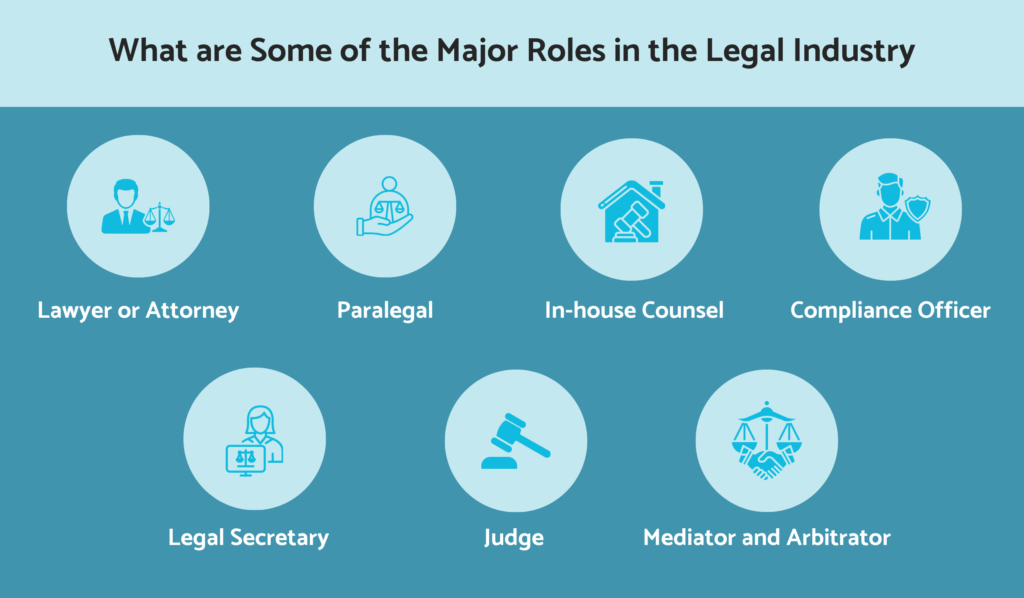
- Lawyer or Attorney
Lawyers, also known as attorneys or advocates, are the legal professionals qualified to advise clients on legal matters and represent them in transactions, negotiations, and court proceedings.
The main responsibilities of lawyers or legal attorneys are to conduct legal research, analyze laws and regulations, draft legal documents, and formulate legal strategies to protect the clients they represent.
- Paralegal
The main role of paralegals is to support lawyers or attorneys by conducting legal research, preparing legal documents, organizing case files, and managing administrative tasks. However, they are not qualified to provide legal advice or represent clients independently.
- In-house Counsel
In-house counsel is a legal professional hired directly by the organization to handle its internal legal requirements. Their main responsibilities are advising business leaders on regulatory compliance, ensuring business operations comply with the law, managing legal risks, and overseeing legal disputes.
- Compliance Officer
Compliance officers are legal professionals who make sure organizations comply with applicable laws, regulations, and internal policies. They monitor regulatory changes, conduct audits, investigate potential violations, provide employee training, and develop compliance programs.
- Legal Secretary
The main role of a legal secretary is to provide administrative support to legal teams by managing schedules, organizing documents, coordinating meetings, and maintaining records. A legal secretary is not the same as a paralegal.
Candidates with strong organizational skills, attention to detail, and a solid understanding of legal terminology are often well suited to this role.
- Judge
A judge oversees court proceedings and makes sure legal disputes are resolved fairly and impartially. The main responsibilities of a judge are to interpret laws, evaluate evidence, make rulings, and issue judgments based on legal principles.
- Mediator and Arbitrator
Mediators and arbitrators assist parties in resolving disputes outside traditional court proceedings through alternative dispute resolution methods. Mediators stimulate discussions to help parties reach mutually satisfactory agreements, while arbitrators analyze evidence and issue binding or non-binding decisions.
Evaluate legal skills with our wide range of pre-employment assessment tests. HIRE FOR FREE
But what skills should you assess when hiring in the legal industry?
3. What top skills to look out for when hiring in the legal industry?
When hiring for roles in the legal industry, it is important to focus on a candidate’s technical legal expertise, analytical abilities, communication skills, and professional ethics.
The following are the 5 major skills to be measured when hiring in the legal industry:
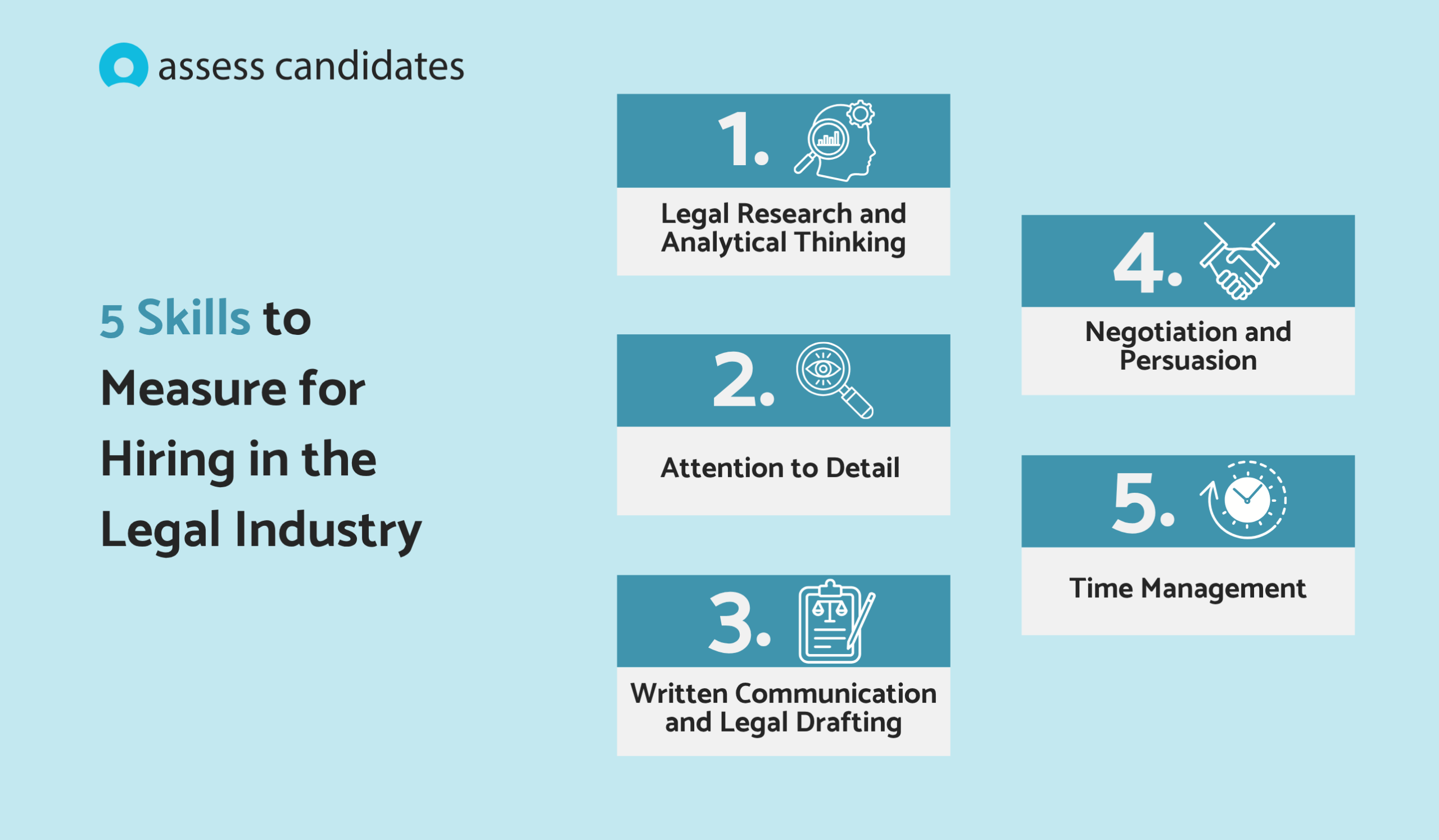
1. Legal Research and Analytical Thinking
One of the major skills to look for when hiring in the legal industry is a candidate’s analytical thinking and ability to conduct legal research. Legal professionals must be able to accurately interpret laws, complex documents, case precedents, and regulations.
Moreover, they need strong analytical thinking skills to analyze information, build arguments, identify risks, and develop effective legal strategies.
2. Attention to Detail
Attention to detail is yet another important skill to measure when hiring in the legal industry. Even a minor error in legal documents or compliance processes can lead to hefty financial, operational, or reputational consequences. Thus, hire candidates who showcase exceptional accuracy when reviewing documents, interpreting regulations, or managing case files.
3. Written Communication and Legal Drafting
Written communication and legal drafting are essential skills for strong legal professionals. Clear and precise writing is vital in court filings, legal opinions, contracts, and compliance reports.
Moreover, a legal professional should also be able to draft well-structured legal documents that are legally accurate, easy to decipher, and free from obscurity.
4. Negotiation and Persuasion
Negotiation and persuasion are critical competencies for many legal professionals, particularly those involved in litigation, dispute resolution, contract negotiations, and client representation.
5. Time Management
In the legal industry, multiple cases, stakeholders, and deadlines have to be managed simultaneously. Hence, strong organizational and time management skills are critical for prioritizing tasks, managing large volumes of documentation, and producing high-quality work under pressure.
Explore our talent assessment platform to hire the top candidates in the legal industry. LEARN MORE
Selecting the right assessment tools allows legal employers to evaluate candidates consistently while reducing reliance on subjective hiring decisions.
4. What are the best tools to measure legal skills during the recruitment process?
A standardized, structured, and observable candidate hiring process will help you assess candidates objectively. The most effective results come from combining multiple assessments to get a more comprehensive view of the candidate.
High-performing legal hiring processes typically combine multiple assessment methods to evaluate both technical expertise and professional competencies objectively.
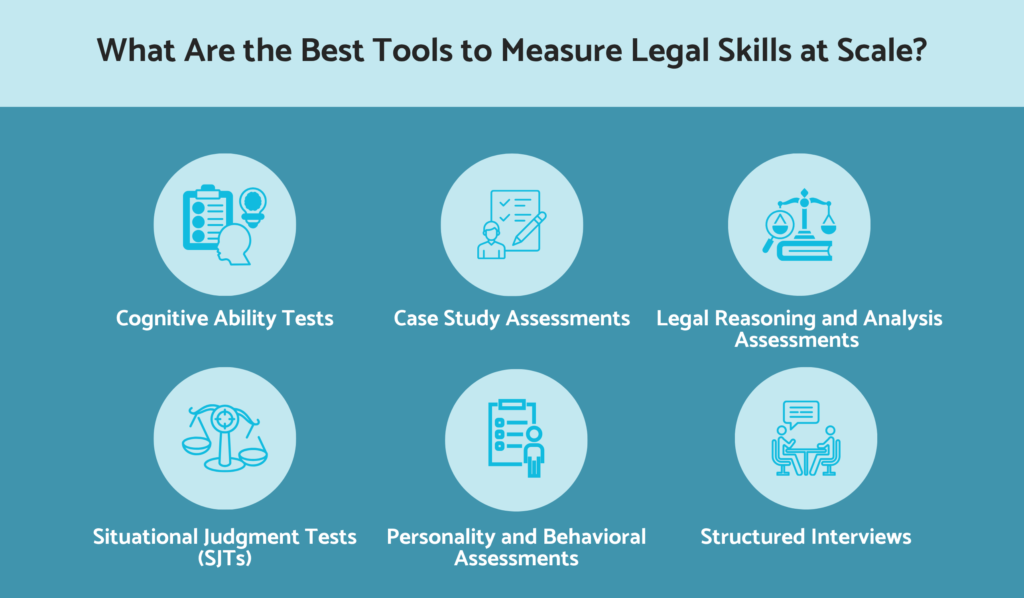
- Cognitive Ability Tests
Cognitive ability tests, also known as aptitude tests, help measure a candidate’s verbal reasoning, critical thinking, logical reasoning, problem-solving abilities, and attention to detail, all of which are essential skills required in a strong legal professional.
- Case Study Assessments
Case study assessments simulate real-world legal scenarios and help measure a candidate’s problem-solving and attention to detail abilities. In these case study assessments, candidates may be asked to analyze legal risks, assess a dispute, resolve a compliance issue, or recommend a course of action.
- Legal Reasoning and Analysis Assessments
Legal reasoning and analysis assessments are among the most important tools for measuring a candidate’s ability to understand and interpret legal principles, case law, and statutes.
This further helps identify a candidate’s ability to apply legal reasoning to diverse scenarios, pinpoint applicable legal issues, and draw logical conclusions.
- Situational Judgment Tests (SJTs)
Situational judgment tests (SJTs) present candidates with real-world workplace scenarios to measure their behavioral competencies. They measure a candidate’s ethical decision-making, client management skills, communication skills, teamwork and collaboration, and conflict resolution.
- Personality and Behavioral Assessments
Personality and behavioral assessments are some of the most accurate predictors of whether a candidate can meet the demands of a legal role and align with the organization’s culture. These tests offer insights into a candidate’s communication skills, emotional stability, attention to detail, collaboration, client management, and conflict resolution.
- Structured Interviews
Structured interviews improve consistency and fairness by assessing all candidates against predefined competencies, role requirements, and evaluation criteria. The questions are usually focused on technical expertise, behavioral competencies, and role-specific skills.
What are the most common interview questions for legal roles?
While interview questions for legal roles vary depending on the organization and the type of role, the following are some of the most common interview questions as identified by Harvard Law School:
- Basic Questions
- What qualities do you think a good lawyer should have?
- Why did you choose law?
- What constitutes success in your mind?
- Why do you want to work at our office?
- Why do you want to work in our office, as opposed to other offices that do similar work?
- What did you particularly like/dislike about that work?
- Why did you leave your prior jobs?
- Behavioral Questions
- Tell me about a time when you made a mistake and how you dealt with it.
- Tell me about a time you had to make a quick decision.
- Tell me about a difficult experience you had in a clinic or internship and how you overcame it.
- Tell me about a time you had too many things to do and had to prioritize.
- What did you do the last time things didn’t go according to plan?
- Tell me about a situation where you failed. Why did you fail, and what did you learn from it?
- Tell me about a time you had to work with someone who did things very differently from you.
Gain deeper insights into candidates’ legal expertise with our science-backed assessment tools. HIRE FOR FREE
The following hiring practices can help legal employers improve selection accuracy while maintaining a fair and efficient recruitment process.
5. Best practices to hire in the legal industry
Hiring objectively and efficiently in the legal industry requires a structured approach that evaluates both technical expertise and professional competencies.
The following are the 5 major steps to recruit in the legal industry:
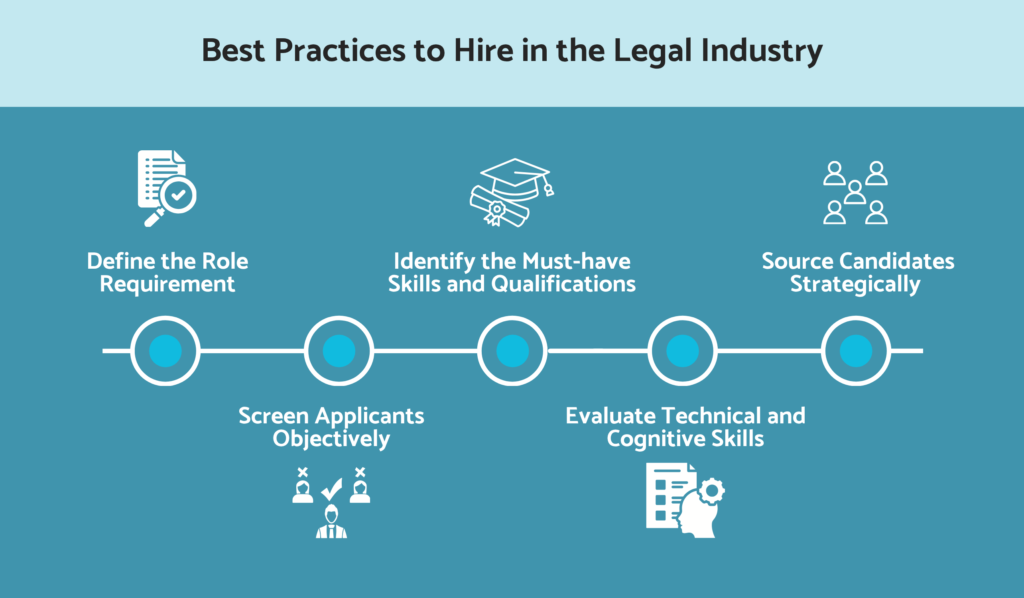
1. Define the Role Requirement
Before setting out to look for candidates, start by clearly outlining the role responsibilities. Identify and specify the practice area, required years of experience, workload expectations, reporting structure, and any other additional requirements.
2. Identify the Must-have Skills and Qualifications
Identify and determine the key skills and qualifications required for the role. This may include educational requirements, legal research and drafting capabilities, active bar membership or legal licenses, and client management experience.
3. Source Candidates Strategically
Incorporate a combination of sourcing channels to attract qualified legal professionals. These could include employee referrals, professional associations, law school career centers, industry events, online job boards, and legal recruitment agencies.
Moreover, highlighting opportunities for career development, flexible work arrangements, and mentorship can further help strengthen your employer brand and attract top talent.
earsed one.
4. Screen Applicants Objectively
Screen applicants objectively and systematically using pre-defined evaluation criteria. This ensures consistency and fairness. Verify the candidates’ legal experience, educational background, industry specialization, licensing status, and more through qualifications and references.
5. Evaluate Technical and Cognitive Skills
Integrate role-specific assessments to assess candidates objectively and reduce reliance solely on resumes and interviews. Legal knowledge tests, case study analyses, situational judgment tests, and critical thinking assessments can offer practical insights into a candidate’s abilities, allowing you to hire better.
Discover our wide range of standardized assessments to boost your skills-based hiring. LEARN MORE
6. Law: Client Success Story
Client Problem Statement
Suppose a growing law firm is struggling to hire corporate lawyers who can interpret complex regulations accurately, draft error-free contracts, and provide practical legal advice to clients under tight deadlines. As the firm’s client base expands, inconsistencies in contract reviews begin to increase, compliance risks become more frequent, and senior attorneys spend significant time correcting avoidable mistakes.
The firm now requires a more reliable way to assess whether candidates can analyse legal issues effectively, exercise sound judgment in high-pressure situations, and communicate complex legal concepts clearly to clients and internal stakeholders.
Assess Candidates’ Proposal
At Assess Candidates, we recommend incorporating legal knowledge assessments, legal research exercises, cognitive and critical thinking tests, and situational judgement tests early in the hiring process to identify top legal talent.
When combined with structured behavioural interviews, case study presentations, and personality assessments, these tools provide deeper insights into a candidate’s ability to interpret regulations, identify legal risks, manage competing priorities, and deliver practical, client-focused solutions in real-world scenarios.
Result
By adopting a data-driven hiring approach that evaluates both technical expertise and behavioural competencies, the firm can confidently identify candidates who demonstrate strong analytical thinking, attention to detail, ethical judgment, and communication skills.
This leads to higher-quality legal work, reduced compliance risks, more efficient case management, and stronger client relationships, enabling the firm to scale its operations with confidence.
Partner with Assess Candidates to use a range of role-specific assessments in your hiring process. VIEW PLANS
7. Why top law firms use Assess Candidates to hire candidates
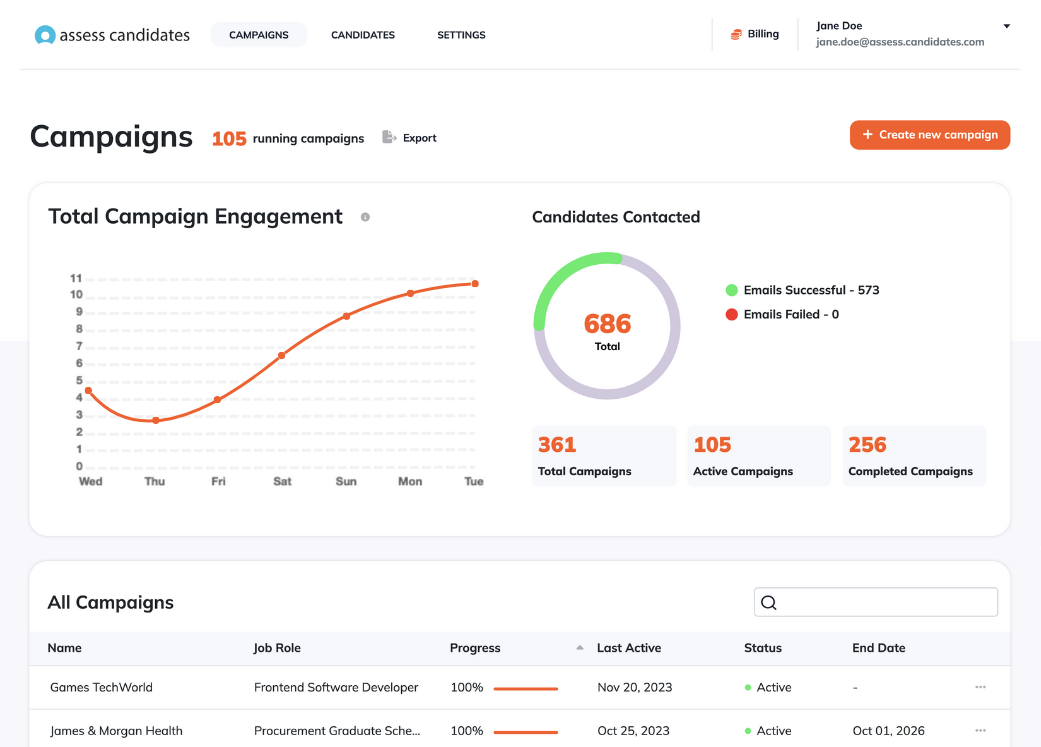
At Assess Candidates, we offer a wide range of pre-employment assessments and create recruitment campaigns customized to each organization’s unique hiring needs.
Here is an example of our campaign reporting dashboard available on Assess Candidates.
Here are 4 reasons why use Assess Candidates for measuring legal skills in candidates:
- Scientifically Designed by Expert Psychologists: Assess Candidates’ pre-employment assessments are developed by experienced psychologists, psychometricians, and legal subject matter experts with extensive experience designing evidence-based evaluation tools for global assessment leaders such as SHL and IBM Kenexa.
Each assessment undergoes rigorous scientific validation to measure role-critical competencies, such as legal reasoning, analytical thinking, attention to detail, ethical judgment, communication, and risk assessment, using realistic legal scenarios.
- Advanced Reporting: Our intuitive platform delivers clear, in-depth reports that highlight candidates’ strengths, development areas, and performance across key legal competencies. Employers can quickly compare candidates’ legal knowledge, research capabilities, drafting skills, critical thinking abilities, and ethical decision-making using objective, structured insights.
With seamless ATS integration, evaluation workflows become faster, more consistent, and easier to manage across high-volume hiring processes while maintaining fairness, compliance, and transparency throughout the legal recruitment lifecycle.
- Positive Candidate Experience: Our role-specific assessments are designed to be engaging, practical, and accessible across devices, enabling candidates to demonstrate their capabilities through realistic, job-relevant scenarios rather than relying solely on resumes or traditional interviews.
Custom branding options also help organizations maintain a professional and consistent candidate experience throughout the hiring journey.
- Candidate Accessibility Support: We support inclusive hiring by providing accessibility features that enable candidates to demonstrate their legal skills fairly and confidently. These include extended time options, screen-reader compatibility, adjustable visual settings, keyboard navigation support, and zoom functionality.
All assessments align with WCAG accessibility standards, ensuring an equitable experience for all applicants regardless of their individual needs.
Assess Candidates provides reliable, science-based tools that help organizations evaluate legal talent accurately. Explore our full range of assessments to identify candidates with the technical expertise and professional competencies required for success across legal roles.
Not sure which legal assessments best match your hiring needs? Contact us for a free analysis of your role requirements.
Conclusion: Key Takeaway
A structured assessment process enables law firms and legal employers to improve hiring quality, reduce compliance risks, and build stronger legal teams. To find the best talent, prioritize critical skills, define role requirements clearly, source candidates strategically, and verify licenses and qualifications thoroughly.
Frequently Asked Questions
How to attract top legal talent in a competitive market?
In a competitive market, to attract top legal talent, you need to create compelling job descriptions, offer attractive compensation packages, and provide opportunities for career growth, mentorship, and ongoing legal education. Moreover, you can strengthen your employer brand by presenting your workplace culture, flexible work arrangements, and commitment to high-quality legal work.
How to assess ethical judgment during the legal hiring process?
You can assess ethical judgment during the legal hiring process through situational judgment tests, structured interviews, and reference checks. This offers insights into the candidate’s decision-making process and their ability to uphold professional standards.
What to prioritize when screening legal candidates?
Prioritize relevant legal experience, practice area expertise, jurisdiction-specific licenses, and communication skills. Make sure to also review writing samples, evidence of commercial awareness, and notable case study outcomes. This further helps hire more qualified candidates efficiently.
How long should a legal hiring process typically take?
A legal hiring process should take 6 to 12 weeks, depending on the role’s complexity and seniority level. You can streamline the hiring process by scheduling assessments and interviews, maintaining clear communication, and avoiding unnecessary interview rounds.
Why should we verify licenses and professional credentials before making an offer?
You should verify a candidate’s licenses, professional credentials like bar memberships, educational qualifications, and employment history before making an offer to uphold your organization’s reputation and minimize compliance risks. Thorough background checks help verify these credentials.


 English
  Arabic