
Structured vs. Unstructured Interviews: A Practical Guide for Employers



Interviews remain one of the most important stages in the hiring process because they directly influence who gets hired. To make better hiring decisions, employers need an interview format that fits their goals, role requirements, and level of hiring risk. The two most common approaches are structured and unstructured interviews.
While unstructured interviews have long been valued for their flexibility and conversational flow, recruiters increasingly prefer structured interviews as they support more reliable, fair, and evidence-based hiring decisions.
This guide explains what structured and unstructured interviews are, how they differ, when each approach is appropriate, and why many employers now favor structured interviews.
Contents
- What Is A Structured Interview?
- What Is An Unstructured Interview?
- Key Differences Between Structured And Unstructured Interviews
- What Are The Pros And Cons Of Structured Interviews?
- What Are The Pros And Cons Of Unstructured Interviews?
- Why Are Employers Moving Towards Structured Interviews?
- When Should Employers Use Structured Interviews?
- When Might An Unstructured Interview Be Appropriate?
- How To Implement Structured Interviews Effectively?
- Why Do Top Companies Prefer Assess Candidates’ Video Interviews?
Let’s start with the basics: what makes an interview structured?
1. What Is a Structured Interview?
A structured interview is a method in which every candidate is asked the same job-related questions and evaluated using the same scoring criteria. This reduces subjectivity and helps employers make more consistent, evidence-based decisions.
Discover data-driven hiring made simple with our pre-employment assessments. HIRE FOR FREE
What are the Key Characteristics of Structured Interviews?
Structured interviews are designed to be applied consistently, so they have some characteristics specific to them. Find these structured assessment features below:
1. Pre-defined questions
Structured interviews make use of questions that have been prepared before the interview. These questions align directly with the skills, competencies, and behaviors required for the role. Each candidate is asked the same set of questions and completes psychometric tests.
2. Consistent scoring criteria:
The interviewees’ responses in structured interviews are scored using standardized rating scales. Interviewers score candidates based on clear performance indicators to ensure objective assessment across all candidates.
3. Same process for all candidates:
In a structured interview, each candidate goes through the same core process and are equally assessed against the same evaluation standards. This improves consistency and makes comparison fairer.
What Are the Examples of Structured Interview Formats?
Popular examples of structured interview formats include the behavioral interview, which assesses how candidates handled specific situations in the past, and the competency-based interview, which focuses on skills such as communication, leadership, and teamwork. Another type is the panel interview, in which multiple interviewers assess candidates using scoring rubrics.
Public-sector and professional hiring guidance consistently shows that more structured interviews deliver higher validity, greater scoring consistency, and lower adverse impact than less structured formats.
In the next section, let’s learn about the unstructured interview format.

2. What Is an Unstructured Interview?
An unstructured interview does not follow a fixed set of pre-determined questions or standardized scoring criteria. Interviewers often rely on open-ended questions to learn more about a candidate’s background and personality, which gives the interview a natural and conversational style.
An unstructured interview does not follow a fixed set of questions or standardized scoring criteria. It is more conversational and allows the interviewer to adapt questions based on the candidate’s responses.
So, what popular features of unstructured interviews stand out? Find out below.
What are the Key Characteristics of Unstructured Interviews?
Unstructured interviews have some specific elements that set them apart from their structured version. The characteristics of unstructured interviews are the following:
- Flexible, open-ended questioning: In unstructured interviews, recruiters do not plan questions in advance and may change significantly based on the candidates. Interviewers often ask follow-up questions based on responses rather than a predefined framework.
- Interviewer-led conversation: Unstructured interviews allow the recruiter to control the flow of the interview. The direction and focus of the interview depend heavily on the interviewer’s judgment, interests, and personal perceptions, and these values can vary widely.
- Lack of standardized evaluation criteria: In unstructured interviews, interviewers assess candidates based on their responses and overall impressions rather than on scoring scales, making comparisons between candidates more difficult.
As you have learnt above, unstructured interviews are flexible and conversational. However, here are some popular interview questioning styles.
What are the Common Questioning Styles in Unstructured Interviews?
Unstructured interviews use different questioning styles at the interviewer’s discretion. These questions in unstructured interviews can be in the following formats:
Top Question Styles in Unstructured Interviews
- Informal or exploratory interviews: The interviewer begins with probing questions to elicit the candidate’s experiences and skills. The candidate’s response will guide the interviewer in determining which follow-up questions to ask.
- Early-stage conversations to understand a candidate’s background: The interviewer starts the interviewer by asking questions that probe into the candidate’s background; their educational history, work experience, and other relevant information.
- Culture or personality fit discussions: Unstructured interviews can take the form of discussions that reveal candidates’ cultural or personality characteristics to the interviewer. Interviewers ask candidates questions that dive into these areas of their lives.
- Questions on skills and competencies: Unstructured interviews are used for senior or customer relations roles to allow candidates express the skills and competencies that they are going to contribute to the organization in the role they are applying for.
Even though an unstructured interview format helps build rapport with the interviewer, unstructured interviews are weaker predictors of job performance and can be biased. This is why many employers now use unstructured interviews to complement more structured assessment methods.
Find the right global talent faster with our automated, online assessments. LEARN MORE
The next section compares both formats directly.
3. Key Differences Between Structured and Unstructured Interviews
Structured and unstructured interviews aim to assess candidates, but they do so in very different ways. Understanding those differences helps employers choose the approach that best supports fair and effective hiring.
Structured interviews prioritize consistency, fairness, and evidence-based decision-making, while unstructured interviews tilt more towards flexibility and conversation.
Discover our expert-backed psychometric tests to support your global recruitment hiring strategy. HIRE FOR FREE
In the next section, let’s take a look at the pros and cons of structured interviews.
4. What Are the Pros and Cons of Structured Interviews?
Pros of Structured Interviews
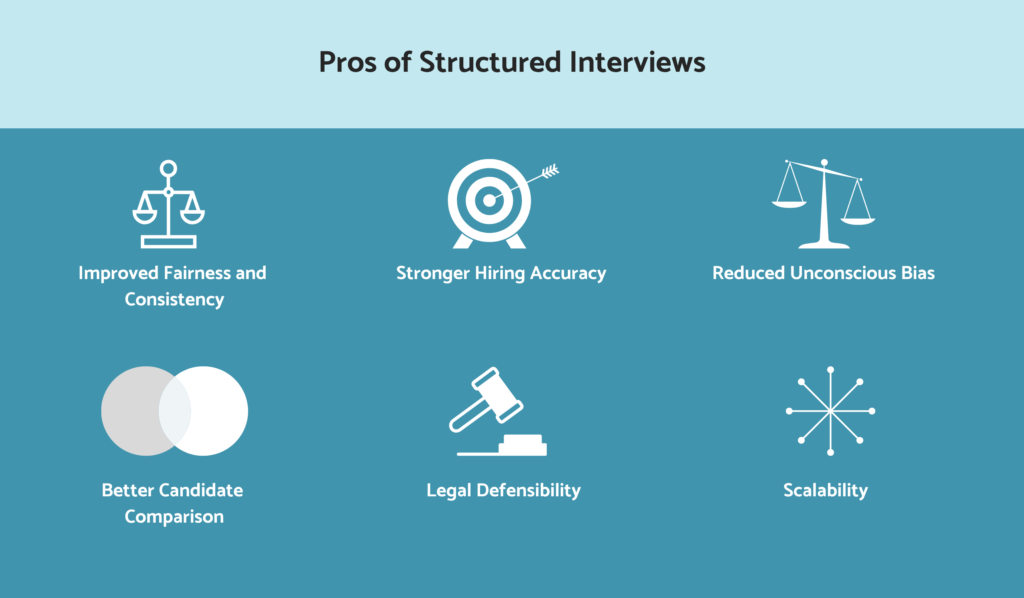
1. Improved fairness and consistency:
In a structured interview, interviewers assess all candidates using the same criteria and score sheet. This way, there is a reduction in unequal treatment and bias.
2. Stronger hiring accuracy:
Structured interviews are more reliable predictors of job performance because they focus on job-related competencies.
3. Reduced unconscious bias:
Structured interviews use standardized questions, which limit the influence of interviewers’ personal preferences and first impressions.
4. Better candidate comparison:
A structured interview can make it easier for recruiters to objectively compare candidates using measurable data and scores based on a standard rating or percentile.
5. Legal defensibility:
Structured interviews are easier to defend in hiring disputes because they use documented, job-related evaluation criteria.
6. Scalability:
Structured interviews work well for high-volume applications and make it easier to replicate and repeat the hiring process as required.
Cons of Structured Interviews
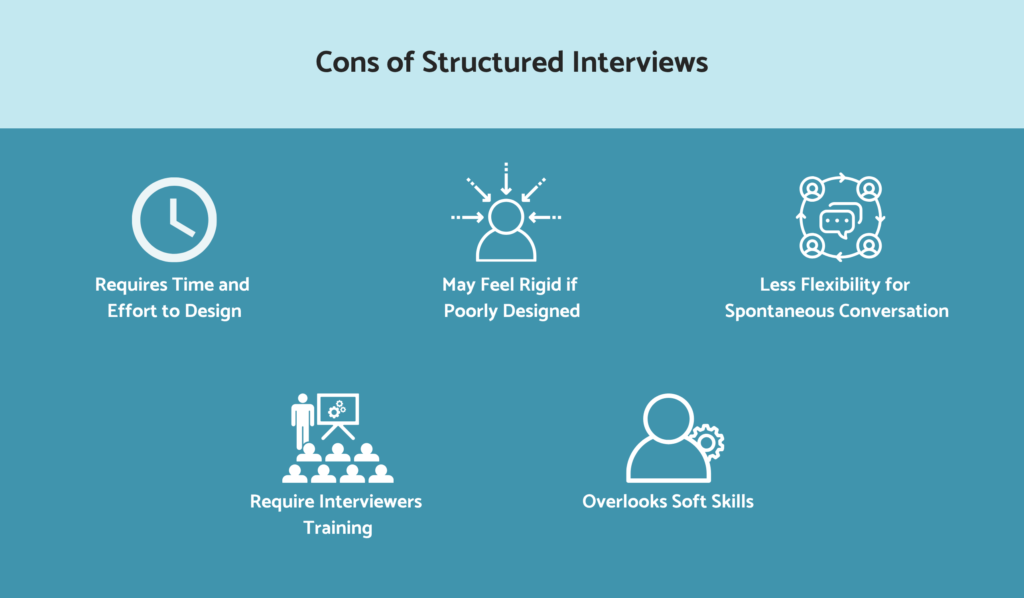
1. Requires time and effort to design upfront:
Structured interviews usually require significant effort and time to put together because they use standardized tests and grading systems, which require careful calculation and planning to ensure reliability and validity.
2. May feel rigid if questions are poorly designed:
A structured interview can limit the expression of candidates’ skills and competencies, especially when interview stages are poorly designed or poorly sequenced.
3. Less flexibility for spontaneous conversation:
Structured interviews rarely give interviewers or interviewees the opportunity to kick-start unplanned discussions that the interview has not been designed to assess or inquire about.
4. Require interviewers’ training:
In structured interviews, interviewers must be trained to apply scoring criteria consistently and to generate recruitment results based on them.
5. Tend to overlook soft skills:
Structured interviews have the tendency to miss interpersonal nuance, creativity or cultural contribution if the interview is not properly designed.
With this, you know what structured interviews contribute to the interview process in terms of predictability, reliability, and validity.
Discover our expert-backed psychometric tests to support your global recruitment hiring strategy. LEARN MORE
Now, let’s go on to discuss the pros and cons of unstructured interviews in the next section.
5. What Are the Pros and Cons of Unstructured Interviews?
Pros of Unstructured Interviews
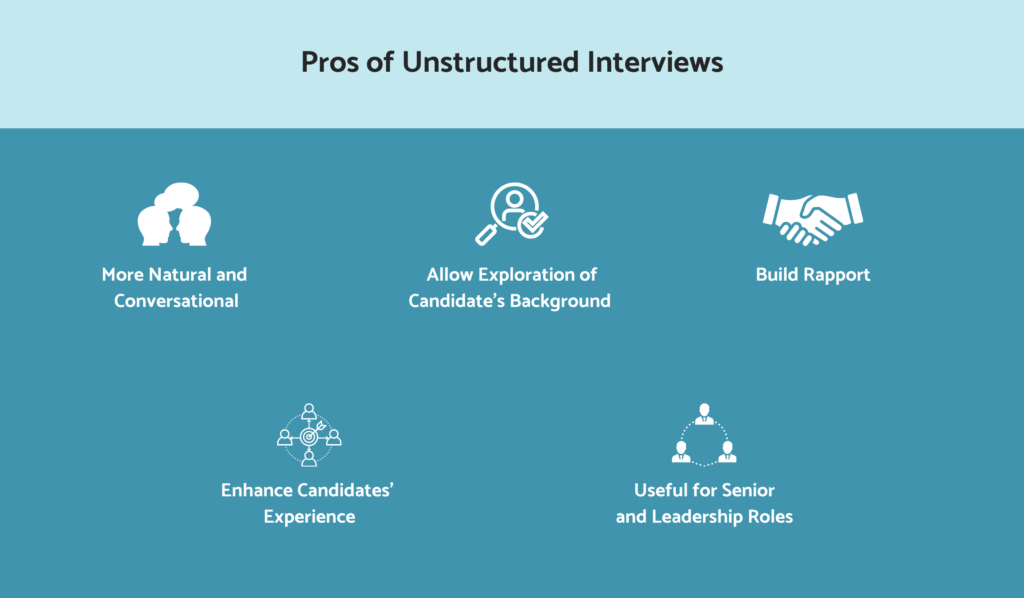
1. More natural and conversational
Unstructured interviews are conversational because questions are not fixed, and interviewers can respond in real time to a candidate’s answers. This conversational flow can encourage candidates to share insights that may not surface in a rigid interview format.
2. Allows deeper exploration of a candidate’s background
Unstructured interviews allow interviewers to gain access to a candidate’s personal experiences, motivations, and career journey. Interviewers can also ask follow-up questions based on these responses for a deeper understanding of the candidates.
3. Can help build rapport between interviewers and the candidate
Unstructured interviews help reduce candidate anxiety by creating a less formal environment. This rapport-building can be particularly useful in later interview stages or roles where relationship-building is a key requirement.
4. Enhances candidate experience:
Candidates often perceive unstructured interviews as less intimidating. This leads to more authentic responses.
5. Useful for senior or relationship-based roles:
Unstructured interviews are particularly effective for leadership, client-facing, or strategic roles. This interview format can reveal interpersonal dynamics that structured interviews may miss.
Cons of Unstructured Interviews
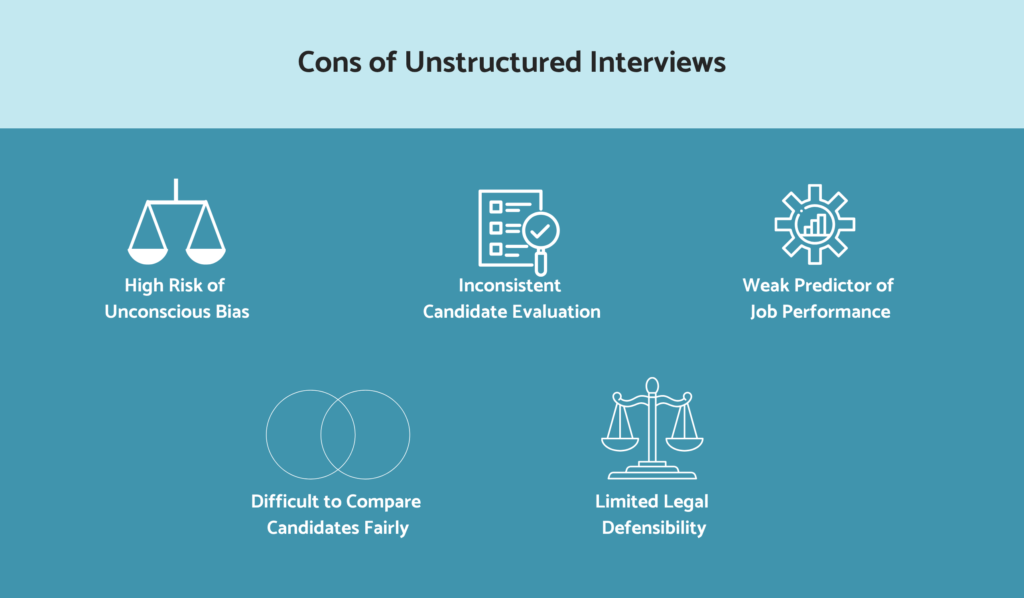
1. High risk of unconscious bias
Unstructured interviews rely heavily on personal judgment and first impressions, which increases the influence of unconscious bias. Interviewers may unintentionally favor candidates who share similar backgrounds rather than those best suited for the role.
2. Inconsistent candidate evaluation
Unstructured interviews may lack consistency because the questions and interview flow vary from one candidate to another. Interviewers evaluate candidates based on what was discussed rather than job-related standards.
3. Weak predictor of job performance
Unstructured interviews are less effective at predicting how well a candidate will perform on the job. Interviewers may focus on personality or confidence rather than on the skills and behaviors that actually drive performance.
4. Difficult to compare candidates fairly
In unstructured interviews, interviewers ask candidates different questions and evaluated informally, which makes comparisons difficult. Hiring decisions are often based on overall impressions rather than objective evidence.
5. Limited legal defensibility
Unstructured interviews provide minimal documentation and lack clear evaluation criteria. In the event of a hiring dispute, it can be difficult for employers to justify selection decisions, especially if candidates were treated differently during the interview process.
In the next section, we will explain why employers are using structured interviews.
6. Why Are Employers Moving Towards Structured Interviews?
Employers are increasingly adopting structured interviews because they support consistency, fairness, documentation, and stronger hiring decisions.
5 Benefits that Employers get from Structured Interviews
As we discussed earlier, more employers and recruiters are shifting toward structured interviews in their hiring processes. This shift is a result of the benefits this interview approach offers; here are 5 of them.
1. Fairness, accountability, and data-driven hiring:
Employers can make hiring decisions based on data collected during the interview process. This data also makes it easy to accurately compare the candidates’ performances.
2. Balance application of diversity, equity, and inclusion:
Employers can operate hiring processes that minimize bias and promote inclusion by ensuring equal opportunity for candidates regardless of their backgrounds.
3. Objective and job-related evidence for employment:
Structured interviews support the goal of focusing on objective, job-related evidence rather than subjective impressions when hiring candidates.
4. Seamless alignment with modern AI recruitment technologies:
Structured interviews integrate more effectively with modern recruitment technologies such as applicant tracking systems (ATS) and AI-powered assessment tools.
5. Trackable records and easy documentation:
Employers can gather accurate data, providing clear documentation that is critical in regulated industries and competitive labor markets.
Empower your hiring decisions with our proven, science-based assessment platform. LEARN MORE
Let’s move on to discuss when employers should use structured interviews in the interview process.
7. When Should Employers Use Structured Interviews?
Structured interviews are most effective when fairness, consistency, and accurate candidate comparison are important.
Situations Where Employers Should Use Structured Interviews
There are situations where the best interview approach for your organization is the structured interview method. We have listed some of these scenarios for you below:
- High-volume hiring like for early and mid-career roles.
- Roles with clearly defined competencies and skills.
- Early and Organizations prioritizing fairness, diversity, equity, and inclusion.
- Regulated or high-risk industries.
- Data-driven recruitment environments.
Overall, structured interviews are best used when employers need reliable, defensible hiring decisions, especially when consistency and quality of hire must not be compromised.
8. When Might An Unstructured Interview Be Appropriate?
Unstructured interviews have a place in the hiring process when used appropriately. The flexibility can be valuable for exploring areas that are difficult to capture through standardized questions alone.
5 Situations Where Unstructured Interviews are Appropriate
Unstructured interviews are appropriate in the following situations:
- Final stages of the hiring process after structured screening.
- Senior leadership roles, e.g., executive or highly strategic positions.
- Values-alignment conversations.
- Relationship-based roles, e.g., customer service and marketing.
- Candidate engagement and rapport building.
However, for the best hiring decisions, you should combine an unstructured interview format with structured interviews or other objective assessment methods to maximize the benefits of both.
So, how should structured interviews be conducted? Find out below.
9. How to Implement Structured Interviews Effectively
To implement structured interviews successfully, you need to carefully design clear evaluation criteria and train interviewers to ensure consistency. When done well, structured interviews improve hiring accuracy while still allowing meaningful candidate interaction.
7 Tips to Implement Structured Interviews Effectively
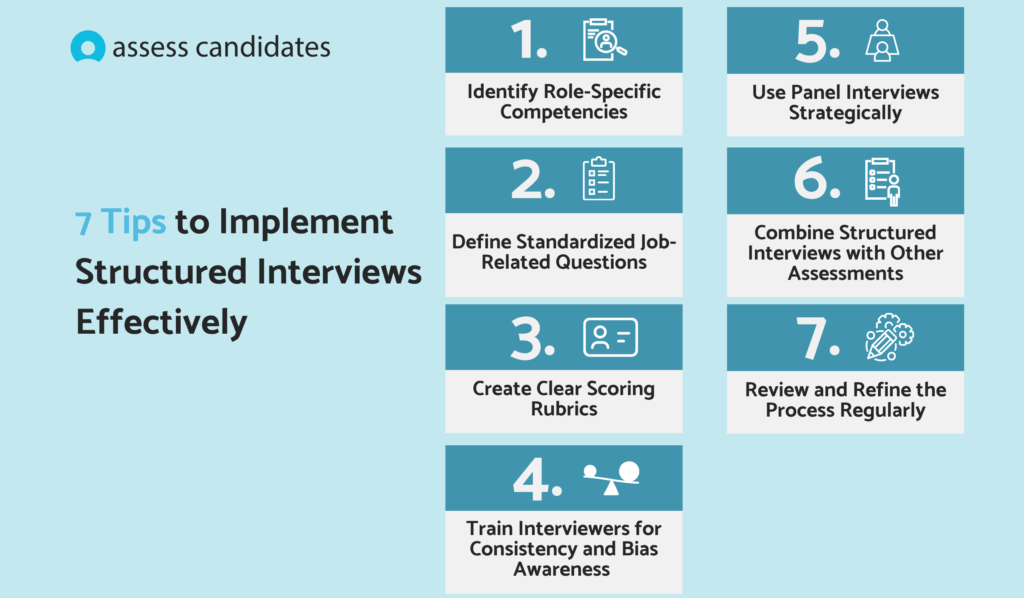
1. Identify role-specific competencies:
To implement structured interviews, begin by clearly defining the skills, behaviors, and knowledge required for success in the role. These competencies should be based on job analysis, performance expectations, and business needs rather than assumptions.
2. Design standardized, job-related questions:
Develop interview questions that directly assess each competency. Use behavioral and situational questions as they are effective in prompting candidates to demonstrate how they have handled or would handle real work scenarios.
3. Create clear scoring rubrics:
Create rating scales with defined performance indicators for each question. A clear scoring criterion will help you evaluate responses consistently and reduce subjective judgment.
4. Train interviewers for consistency and bias awareness:
Interviewers should be trained on how to ask questions as written, apply scoring rubrics accurately, and recognize unconscious bias. Consistency across interviewers is crucial for reliable results.
5. Use panel interviews strategically:
Multiple interviewers can be brought in, and individually assigned specific competencies to assess. Panel interviews help balance perspectives and strengthen evaluation accuracy when combined with a shared scoring system.
6. Combine structured interviews with other assessments:
Structured interviews are most effective when used alongside other selection tools such as skills tests, work samples, or job simulations. This creates a more comprehensive view of candidate capability.
7. Review and refine the process regularly:
Ensure to collect feedback from interviewers and candidates, analyze hiring outcomes, and adjust questions or scoring criteria as roles evolve. Continuous improvement will help to keep the interview process relevant and effective.
When structured interviews are designed carefully and used consistently, they help employers balance fairness, accuracy, and human judgment more effectively.
For employers, the challenge is not choosing between structure and human judgment. It is building a process that uses both effectively.
Here is where Assess Candidates fits in.
10. Why do Top Companies Prefer Assess Candidates’ Video Interviews?
Assess Candidates supports employers with pre-recorded video interviews and assessment tools designed to make structured hiring more consistent and scalable.
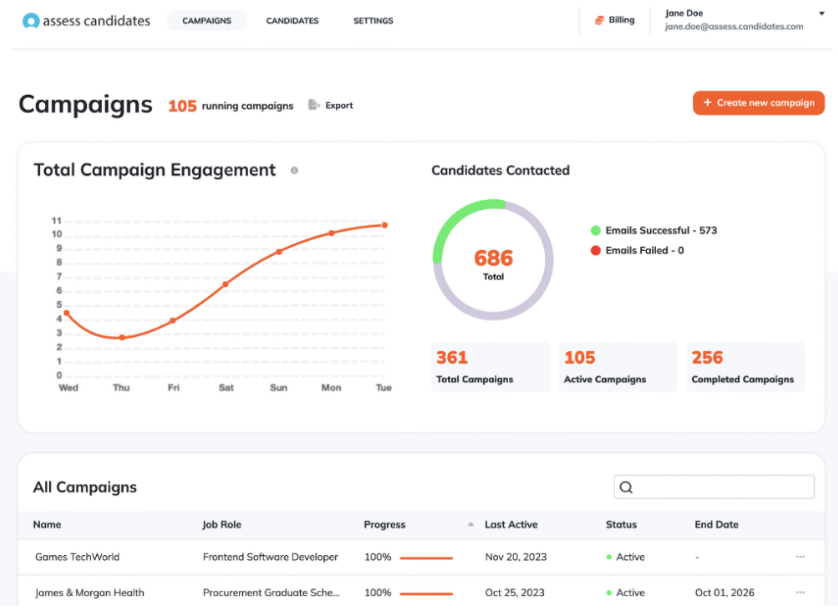
Here is an example of the campaign reporting dashboard that you will come across on the Assess Candidates platform.
Here are 7 reasons why employers prefer the Assess Candidates video recruitment platform:
- Science-Backed Accuracy: Developed by Chartered Scientists and occupational psychologists, we ensure that every assessment is grounded in proven research. More reliable predictions of job performance give employers the confidence to select the right candidates for long-term success.
- Bias Reduction: Assess Candidates is built to create a fairer recruitment process by minimizing unconscious bias. With standardized video interview structures and objective scoring, employers can compare candidates on their abilities rather than subjective impressions, leading to more equitable hiring decisions.
- Inclusive Hiring: Accessibility features, such as zoom adjustments, extra time options, and screen reader compatibility, ensure that candidates with different needs can participate fairly. This commitment to inclusivity enables employers to tap into a broader and more diverse pool of talent.
- Data-Driven Insights: The platform offers detailed reports and dashboards that enable recruiters to filter, rank, and shortlist candidates based on their performance. These insights facilitate the identification of top talent quickly, while maintaining transparency in the decision-making process.
- Flexible Assessments: Assess Candidates offers a wide range of video interview formats to measure competencies, communication skills, cultural fit, strengths, and technical knowledge. This flexibility with automated format allows employers to tailor their approach to the specific role and sector for which they are hiring.
- Trusted Globally: Organizations across industries, from finance and healthcare to retail and education, rely on Assess Candidates to deliver consistent results. Its global use highlights its credibility as a reliable recruitment tool for companies of all sizes.
In conclusion, when used well structured interviews give employers a more reliable alternative to unstructured interviews when fairness and consistency matter.
Want to learn more about effective recruitment procedures? Explore the FAQs below and subscribe with your email to get started.
Frequently Asked Questions
What is the difference between structured and unstructured interviews?
Structured interviews use standardized, job-related questions and consistent scoring for all candidates, which enables fair and objective evaluation. Unstructured interviews are flexible and conversational, with questions and assessments tailored to the interviewer’s judgment and personal impressions.
Why are structured interviews considered more effective?
Structured interviews are more effective because they reduce bias, ensure consistent evaluation, focus on job-related competencies, and better predict job performance through standardized questions and objective scoring methods.
What are the main drawbacks of unstructured interviews?
The main drawbacks of unstructured interviews include a higher risk of unconscious bias, inconsistent candidate evaluation, poor comparability across candidates, limited predictive power for job performance, and limited legal defensibility due to the lack of standardized questions and scoring criteria.
When should employers use unstructured interviews?
Employers should use unstructured interviews in later hiring stages, for senior or leadership roles, and for values and relationship-focused discussions. This interview format should be used as a complement to structured interviews, not as the primary hiring method.
What is best practice: structured or unstructured interviews?
Best interview practice is a hybrid approach: you should use structured interviews for fair, objective competency assessment and unstructured interviews to add depth through culture, values, and leadership discussions, ensuring both accuracy and human insight in hiring decisions.


 English
  Arabic