
Everything You Need to Know About Hiring in the Construction and Engineering Industry in 2026



Hiring top talent in construction and engineering requires more than verifying qualifications and certifications. Employers must assess the technical, cognitive, and behavioural skills that enable professionals to deliver safe, efficient, and high-quality projects.
Keep reading to explore the most common construction and engineering roles, major skills to evaluate in candidates, and the best practices for hiring talent in the construction and engineering industry.
Contents
- What are the construction industry and the engineering industry?
- What are some of the major roles in construction and engineering?
- What top skills to look out for when hiring in the construction and engineering industry?
- What are the best tools to measure construction and engineering skills during the hiring process?
- Best practices for hiring in construction and engineering
- Construction and Engineering: Client Success Story
- Why top construction and engineering firms use Assess Candidates to hire candidates
1. What do the construction and engineering industries involve?
Construction Industry
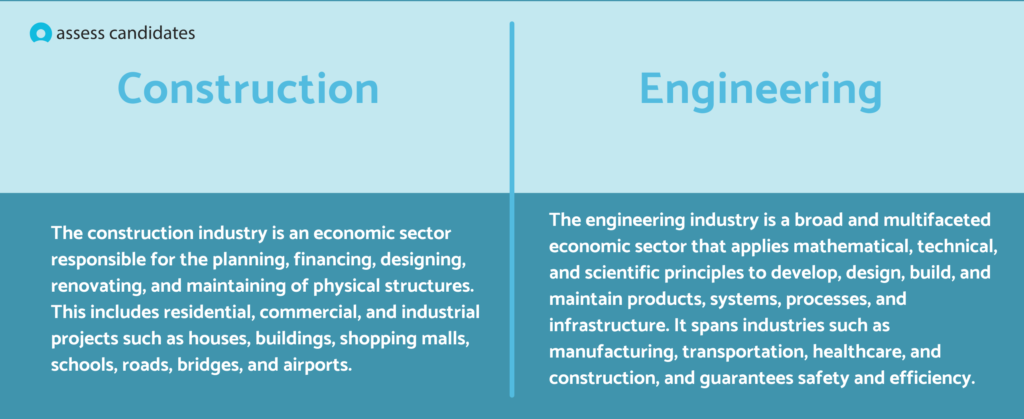
The construction industry is an economic sector responsible for the planning, financing, designing, renovating, and maintaining of physical structures. This includes residential, commercial, and industrial projects such as houses, buildings, shopping malls, schools, roads, bridges, and airports.
Engineering Industry
The engineering industry is a broad and multifaceted economic sector that applies mathematical, technical, and scientific principles to develop, design, build, and maintain products, systems, processes, and infrastructure. It spans industries such as manufacturing, transportation, healthcare, and construction, and guarantees safety and efficiency.
Evaluate workplace competencies with our wide range of pre-employment assessment tests. HIRE FOR FREE
The following section covers the major roles in construction and engineering.

2. What are some of the major roles in construction and engineering?
The construction and engineering industry relies extensively on a diverse workforce of professionals who design, build, maintain, and deliver infrastructure projects that support our modern society.
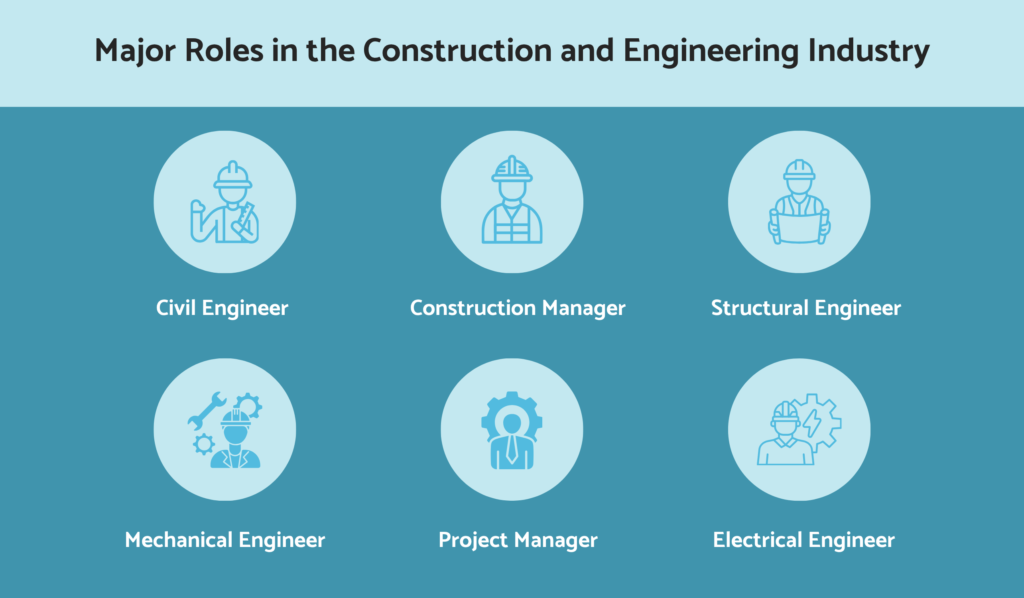
The following are some of the major roles in construction and engineering, across various sectors:
- Civil Engineer
A civil engineer is an umbrella term that includes construction engineers and numerous other disciplines. Their main role is to design, plan, and oversee the construction of infrastructure such as roads, airports, buildings, and more.
- Construction Manager
A construction manager is the foundation of any construction project. They supervise the entire construction process from planning to completion and coordinate workers, contracts, materials, and budgets.
- Structural Engineer
The main role of a structural engineer is to design and analyze the frameworks of buildings, bridges, and other structures. They ensure that the structures can safely withstand loads, earthquakes, bad weather conditions, and other environmental conditions while maintaining stability and durability.
- Mechanical Engineer
The primary function of a mechanical engineer is to design, build, and maintain mechanical systems used in industrial facilities and buildings. These include HVAC systems, elevators, plumbing, manufacturing equipment, and energy systems.
- Project Manager
A project manager is a goal-oriented professional who oversees the entire planning, execution, and delivery of engineering and construction projects. They are responsible for managing timelines, budgets, resources, risks, and communication between clients, engineers, contractors, and other stakeholders.
- Electrical Engineer
The main responsibility of an electrical engineer is to design, develop, and oversee electrical systems for residential, commercial, industrial, and infrastructure projects. They work with power distribution, lighting, communication systems, automation, and electrical safety, providing dependable and efficient operation of electrical networks.
But what skills should you assess when hiring in the construction and engineering industry?
3. What top skills to look out for when hiring in the construction and engineering industry?
When hiring for roles in construction and engineering, it is essential to look for candidates with strong technical skills, cognitive abilities, and workplace competencies, such as communication and teamwork.
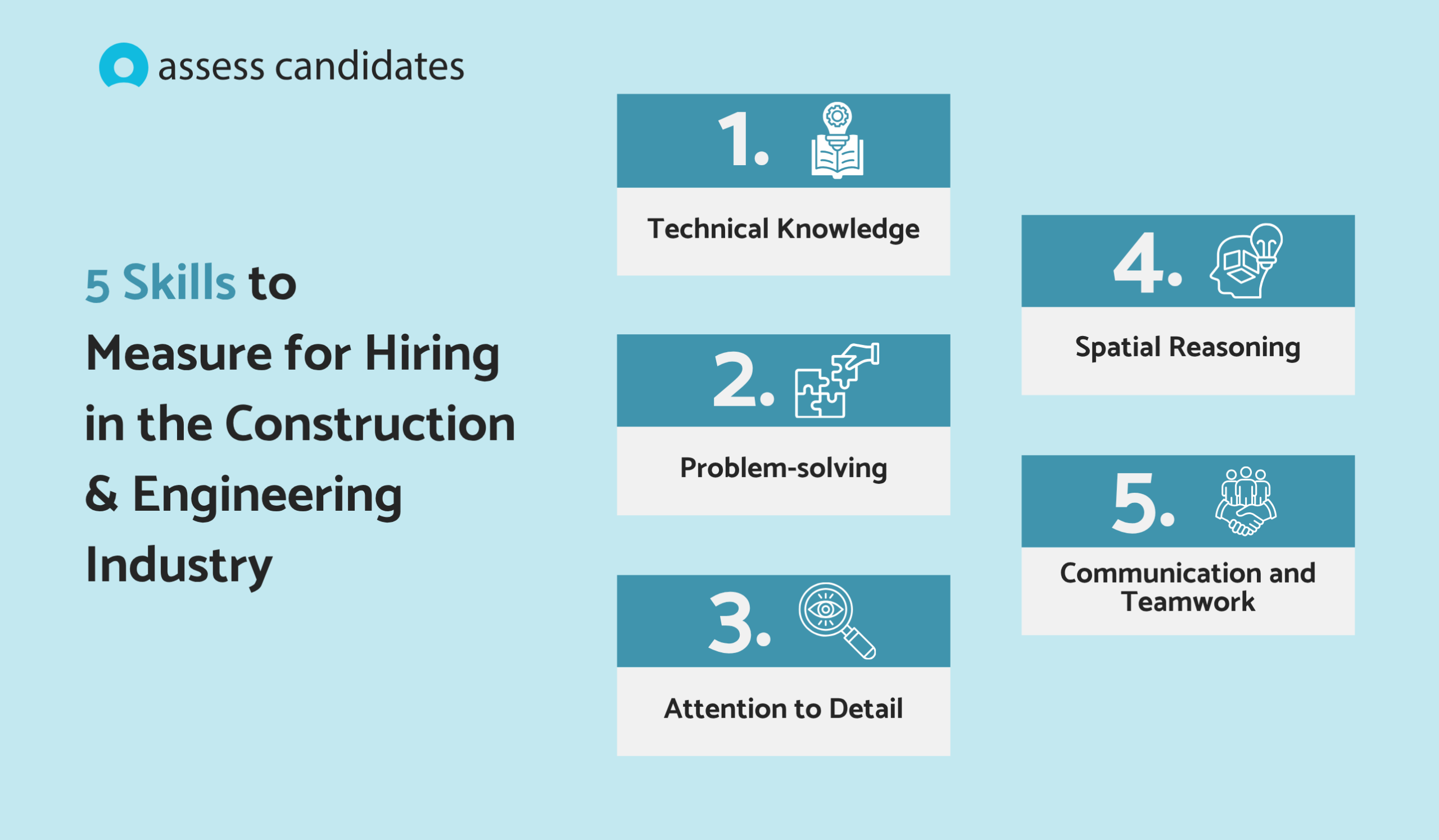
The following are the 5 major skills to be measured when hiring in construction and engineering:
1. Technical Knowledge
One of the major skills to look for when hiring in construction and engineering is a candidate’s technical knowledge. Engineers must possess a strong understanding of engineering principles, industry regulations, construction methods, and relevant tools or software.
2. Problem-solving
Problem-solving skills are essential to look for when hiring in construction and engineering. Since construction projects often involve unexpected challenges or emergencies, such as site constraints or material shortages, strong problem-solving skills help assess situations, evaluate solutions, and make sound decisions under pressure.
3. Attention to Detail
Attention to detail is yet another essential skill to look for when hiring construction and engineering professionals. Candidates with strong attention to detail skills can quickly identify inaccuracies, follow specifications, and maintain compliance with industry standards.
4. Spatial Reasoning
Spatial reasoning is one of the most significant skills when hiring for top engineering professionals. These skills help professionals study blueprints, identify design issues, and plan construction activities effectively.
5. Communication and Teamwork
In construction and engineering, communication and teamwork play a very important role. These projects mostly require close collaboration between engineers, contractors, architects, clients, and site workers. Candidates with effective communication and teamwork skills ensure enhanced coordination and meeting project objectives efficiently.
Explore our talent assessment platform to hire top construction and engineering professionals. LEARN MORE
Let’s take a look at the best tools that you can effectively use to measure construction and engineering skills.
4. What are the best tools to measure construction and engineering skills during the hiring process?
To assess these technical roles efficiently, a combination of pre-employment assessments with structured interviews is the top choice. This helps you evaluate the candidates holistically on both job-specific capabilities and behavioral skills.
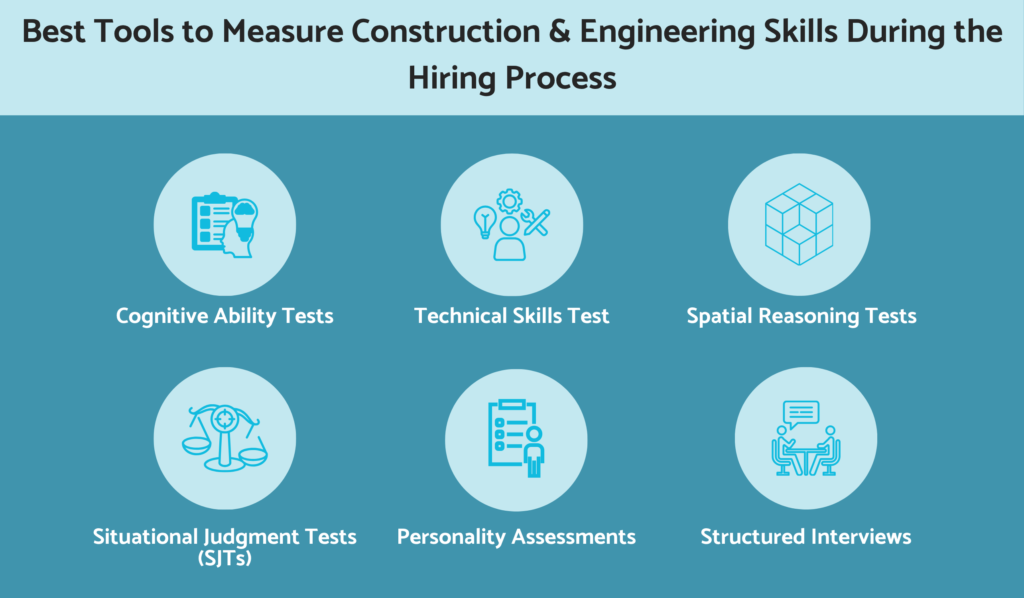
The following are some of the best methods for measuring construction and engineering competencies accurately:
- Cognitive Ability Tests
Cognitive ability tests, also known as aptitude tests, help measure a candidate’s critical thinking, logical reasoning, learning agility, and problem-solving skills. These assessments further predict how quickly candidates can understand complex problems, make sound decisions under pressure, and adapt to new situations.
On complex projects, these styles of assessment are useful in hiring civil engineers and project managers.
- Technical Skills Test
Integrating technical skills tests in the hiring process is crucial when recruiting candidates in construction and engineering. In practice, these assessments help measure job-specific knowledge including engineering principles, construction methods, building codes, project planning, and industry regulations.
These assessments are especially useful in hiring civil engineers and electrical engineers.
- Spatial Reasoning Tests
Spatial reasoning tests help assess a candidate’s ability to visualize, manipulate, and interpret two-dimensional and three-dimensional objects. These assessments help choose those candidates who can work smoothly with blueprints, technical drawings, and structural layouts.
These assessments are vital in hiring structural engineers and architects.
- Situational Judgment Tests (SJTs)
Situational judgment tests (SJTs) present candidates with real-world workplace scenarios. These tests help assess a candidate’s decision-making skills, communication and teamwork, safety awareness, and problem-solving.
These assessments are vital in hiring site managers and construction managers.
- Personality Assessments
Personality assessments help evaluate a candidate’s behavioral traits and work styles that influence job performance. These tests help identify candidates who possess qualities including conscientiousness, resilience, adaptability, accountability, and teamwork.
Employers are increasingly using these assessments are important in hiring project managers and construction managers.
- Structured Interviews
Structured interviews allow candidates in the construction and engineering professions to be evaluated objectively and fairly. They help assess a candidate’s practical experience, technical thinking, communication skills, and cultural fit.
What are the most common interview questions for construction roles?
While interview questions for construction roles vary depending on the organization, the following are some of the most common interview questions as identified by Morson Jobs:
- Tell us about a time you handled stress successfully?
- What do you think you can bring to this construction role?
- What do you know about this company?
- What has been your biggest construction project to date?
What are the most common interview questions for engineering roles?
While interview questions for construction roles vary depending on the organization and the sector, the following are some of the most common interview questions as identified by Indeed:
- Tell us more about your educational background.
- Why did you apply for this particular position? What appeals to you about our company?
- Describe the steps you take when developing plans for a project.
- How do you handle unforeseen issues that may arise when working on a project?
- What may be your biggest challenge in this position?
Gain deeper insights into candidates’ technical skills with our science-backed assessment tools. HIRE FOR FREE
The next section highlights the best practices you need to follow for hiring the best engineers.
5. Best practices for hiring in construction and engineering
Successful construction and engineering hiring depends on identifying candidates who can combine technical expertise with sound judgement, safety awareness, and effective collaboration under project pressures.
The following are the 5 major steps to recruit in the construction and engineering industry:
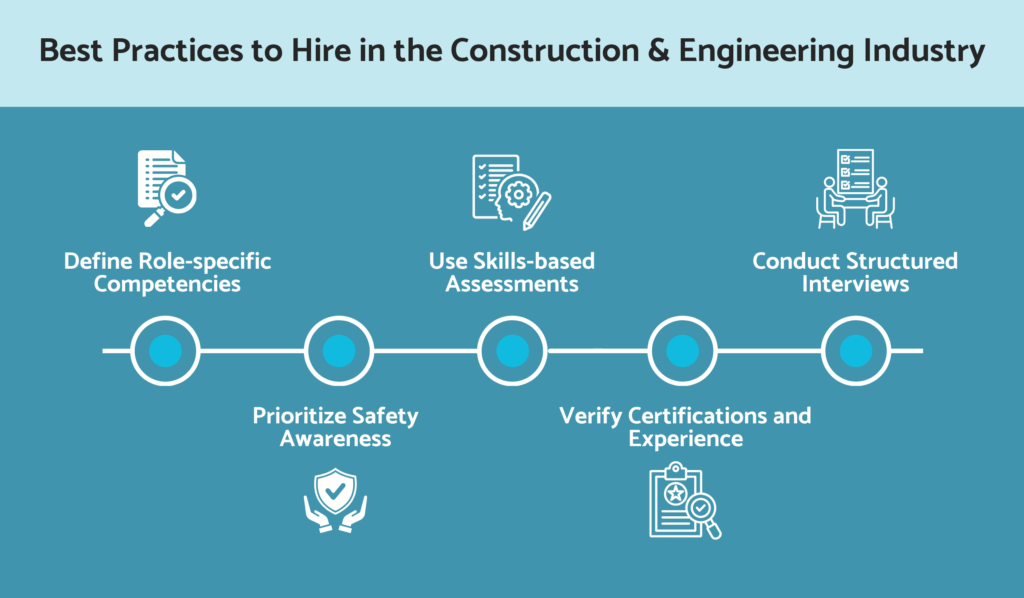
1. Define Role-specific Competencies
Before you begin sourcing candidates, start by clearly identifying the technical skills, certifications, and soft skills required for each role. This will help attract candidates with the right qualifications and reduce mis-hires.
2. Use Skills-based Assessments
Incorporate hiring assessments, including cognitive ability, technical skills, spatial reasoning, and situational judgement tests early in the hiring process. Standardised assessments provide measurable evidence that complements interviews and reduces reliance on subjective judgement.
3. Conduct Structured Interviews
Conduct structured interviews with standardized questions that focus on testing a candidate’s technical knowledge, problem-solving, safety awareness, teamwork, and past project experience. These interviews help improve consistency, reduce bias, and make it easier to compare candidates fairly.
4. Prioritize Safety Awareness
Safety awareness is the most important skill for engineers. Therefore, it is essential to measure candidates’ understanding of safety regulations, risk management, and workplace compliance through assessments, interviews, and scenario-based questions.
5. Verify Certifications and Experience
Verifying a construction and engineering candidate’s professional licenses, certifications, qualifications, and previous project experience before hiring is essential. This helps evaluate their expertise and ensures they meet industry standards.
Discover our wide range of standardized assessments to strengthen your skills-based hiring. LEARN MORE
6. Construction and Engineering: Client Success Story
Client Problem Statement
Suppose a growing infrastructure company is struggling to hire qualified civil engineers who can accurately interpret engineering drawings, perform structural calculations, and manage construction projects while ensuring compliance with safety and regulatory standards.As the company secures more large-scale infrastructure projects, design inaccuracies, project delays, and costly rework become increasingly common, forcing senior engineers to spend valuable time reviewing and correcting junior engineers’ work.
The company now requires a more reliable way to identify candidates who possess the technical knowledge, analytical thinking, and problem-solving skills needed to deliver safe, high-quality infrastructure projects.
Assess Candidates’ Proposal
At Assess Candidates, we recommend incorporating cognitive ability tests, technical skills assessments, spatial reasoning tests, and situational judgement tests early in the hiring process to identify high-performing civil engineers.
When combined with structured technical interviews, engineering case studies, work sample assessments, and personality assessments, these tools provide deeper insights into a candidate’s ability to interpret technical drawings, perform engineering calculations, solve real-world construction challenges, make sound decisions under pressure, and collaborate effectively with project teams.
Result
By implementing a data-driven hiring process that evaluates both technical expertise and workplace competencies, the company can confidently identify civil engineers who are capable of delivering accurate designs, maintaining compliance with engineering standards, and managing complex construction projects effectively.
This leads to improved project quality, fewer design errors, reduced rework, stronger safety compliance, faster project delivery, and lower construction costs, enabling the company to execute infrastructure projects more efficiently and at scale.
Partner with Assess Candidates to use a range of role-specific assessments in your hiring process. VIEW PLANS
7. Why top construction and engineering firms use Assess Candidates to hire candidates
At Assess Candidates, we offer a wide range of pre-employment assessments and create recruitment campaigns customized to each organization’s unique hiring needs.
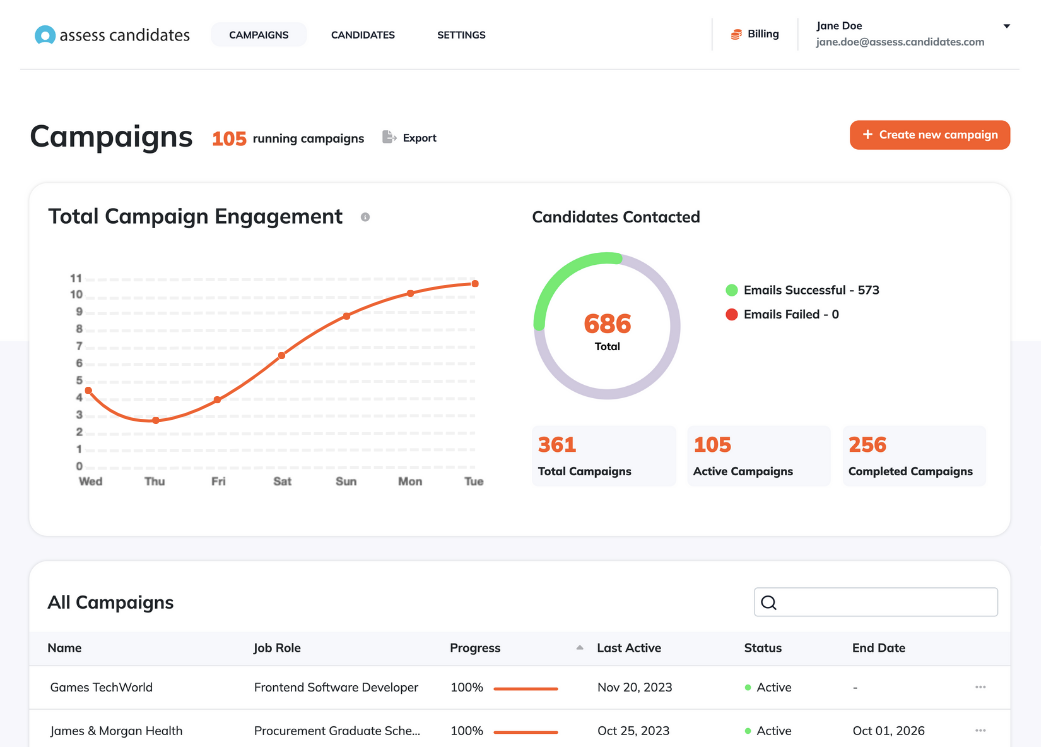
Here is an example of our campaign reporting dashboard available on Assess Candidates.
Here are 4 reasons why use Assess Candidates for measuring construction and engineering skills in candidates:
- Scientifically Validated Assessments: Assess Candidates’ assessments are developed by expert psychologists, psychometricians, and construction and engineering subject matter experts to measure the competencies that matter most for the job. From technical knowledge and spatial reasoning to safety awareness and problem-solving, each assessment is scientifically validated to help identify high-performing candidates.
- Data-Driven Hiring Insights: Our intuitive platform quickly compares candidates using objective reports that measure technical proficiency, cognitive ability, and workplace decision-making. This enables hiring teams to make faster, more accurate hiring decisions while reducing bias and improving consistency.
- Realistic Candidate Experience: Candidates complete role-relevant assessments that mirror real construction and engineering challenges, providing a more accurate picture of their job readiness than resumes or interviews alone. Custom branding options also help construction and engineering firms maintain a professional and consistent candidate experience throughout the hiring journey.
- Candidate Accessibility Support: Our assessments are fully accessible, ATS-compatible, and designed for high-volume recruitment, helping construction and engineering employers hire efficiently while maintaining a fair and inclusive selection process.
Assess Candidates provides reliable, science-based tools that help construction and engineering firms evaluate talent accurately.Explore our full range of assessments to identify candidates with the critical thinking and professional competencies required for success across these roles.
Not sure which construction and engineering assessments best match your hiring needs? Contact us for a free analysis of your role requirements.
Conclusion: Key Takeaway
Hiring success in the construction and engineering industry depends on evaluating beyond technical expertise. Employers should assess role-specific competencies such as problem-solving, spatial reasoning, attention to detail, communication, and safety awareness using a combination of pre-employment assessments and structured interviews.
Frequently Asked Questions
How to reduce costly hiring mistakes in construction and engineering?
To reduce costly hiring mistakes in construction and engineering, combine structured interviews with pre-employment assessments. Combined, they evaluate a candidate’s technical skills, problem-solving, attention to detail, and safety awareness. This further helps identify candidates who will be able to perform reliably on-site and adapt to project demands.
How to hire candidates who can maintain high safety standards?
Evaluate candidates for risk awareness, attention to detail, decision-making skills, and the ability to follow protocol under pressure. This will help you hire candidates in the construction and engineering industry who can maintain high safety standards.
How do hiring assessments improve employee retention in construction and engineering roles?
Hiring assessments improve employee retention in engineering roles. They improve role fit, minimize early turnover, boost team performance, and build a more stable workforce over time.
Can hiring assessments help recruit for specialized engineering roles?
Yes, hiring assessments can help recruit for specialized engineering roles.This is done by tailoring assessments to evaluate competencies relevant to specific engineering and construction roles. Role-specific assessments help identify candidates with the technical capabilities and workplace competencies required for the role.
How to identify candidates who will succeed in fast-paced project environments?
You can identify candidates who will succeed in fast-paced construction and engineering project environments by assessing candidates’ adaptability, critical thinking, time management, and resilience. This helps recruit candidates who remain productive under pressure and contribute effectively throughout every project phase.


 English
  Arabic