
Everything You Need to Know About Measuring Hard Skills During Hiring



Hiring the right talent depends in part on whether candidates can perform the technical work the role requires. Hard skills matter because they shape how employees contribute, how quickly they become productive, and how confidently hiring teams can assess job readiness.
Did you know? NACE reported that 64.8% of employers were already using skills-based hiring practices for new entry-level hires in its 2025 report, and 70% reported using it in the 2026 survey.
Read on below as we explain what hard skills are, how they develop, when they matter most in hiring, how to assess them accurately, and which mistakes hiring teams should avoid.
Contents
- What are hard skills?
- How do hard skills develop over time?
- When do hard skills matter most in hiring?
- How to assess hard skills accurately?
- Common mistakes when evaluating hard skills
- Hard skills: Client Success Story
- Why top companies use Assess Candidates to evaluate hard skills
First, let’s explore what hard skills are.
1. What are hard skills?
Hard skills are specific, teachable, and measurable abilities that enable someone to perform the technical parts of a role. They are typically developed through education, training, certification, or hands-on experience.
Measure hard skills with our wide range of pre-employment assessment tests. HIRE FOR FREE
Top hard skills in the workplace
Hard skills can be grouped into several categories based on the kind of work they support in the workplace. The following are the 7 major types of hard skills in the workplace:
1. Technical and IT Skills
Technical and IT skills involve the use of technology, systems, and software to perform specific tasks. They directly impact productivity and technical output.
Examples include programming, Microsoft Excel, cloud computing, cybersecurity, WordPress publishing, and software testing.
2. Data Analytical Skills
Data analytical skills help employees interpret information, identify patterns, and support better decisions.
Examples include data analysis, data visualization, SWOT analysis, market research, forecasting, and statistical analysis.
3. Accounting Skills
Accounting skills involve managing money, budgets, and financial records. They are critical in finance, operations, and leadership roles.
Examples include accounting, financial modeling, budgeting, auditing, payroll, and tax compliance.
4. Marketing And Sales Skills
Marketing and sales skills focus on promoting products, generating demand, and driving revenue. They directly affect growth and market reach.
Examples include Google Analytics, SEO, digital marketing, CRM tools, social media marketing, and lead generation.
5. Engineering Skills
Engineering skills relate to building, maintaining, or operating physical systems and machinery. They often require certifications or formal training.
Examples include mechanical engineering, electrical work, CAD design, manufacturing processes, and equipment maintenance.
6. Language and Communication Skills
Language and communication skills involve proficiency in specific languages or formal communication systems. These skills support accuracy, compliance, and global operations.
Examples include foreign language fluency, technical writing, grant writing, copywriting, legal documentation, and medical transcription.
7. Project and Operations Management Skills
Project and operations management skills focus on planning, executing, and managing work efficiently. These skills help teams deliver on time and within scope.
Examples include project scheduling, risk management, process optimization, supply chain management, and tools such as Jira and Microsoft Project.
Did you know? Studies show that hard skills are often the baseline filter used in applicant screening, with employers typically not advancing candidates who lack core technical skills.
Now that we understand what hard skills are, let’s explore how you can actively develop and strengthen these skills across your workforce.

2. How do hard skills develop over time?
Hard skills grow through education, structured training, on-the-job experience, certifications, and continuous learning. They often start with classroom instruction or online courses and deepen as individuals apply them in real work situations.
Did you know? Hard skills are quantifiable and can be measured through tests, certifications, or performance tasks at different career stages.
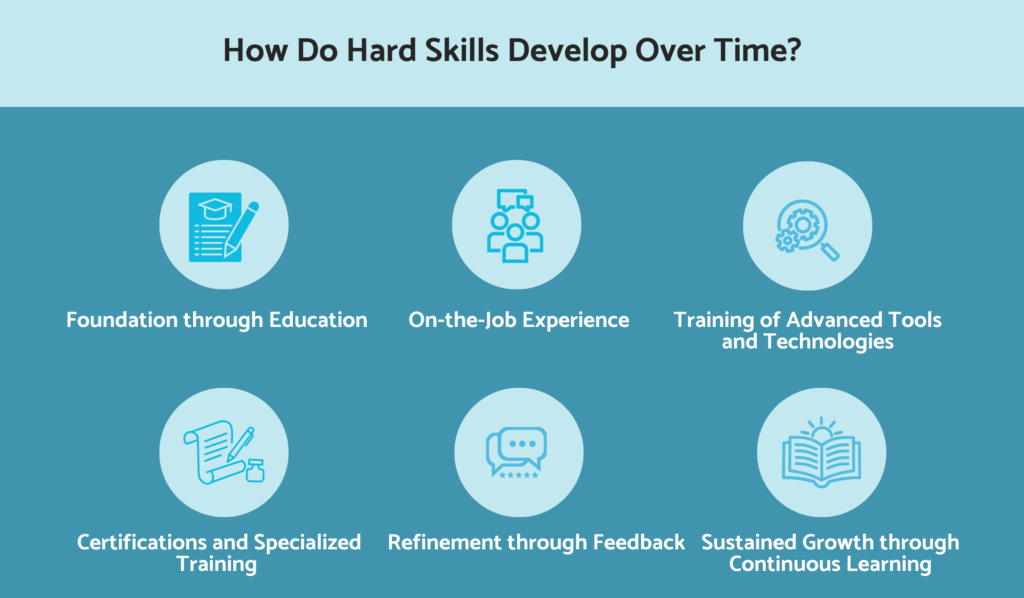
- Foundation through Education
Most of the hard skills begin with formal learning, such as school and college subjects, professional degrees, technical writing, and certification programs.
Example.1:
- A marketing specialist may learn SEO basics in a course and later master analytics tools after real campaign work.
- A software engineer might study computer science, then continuously adopt new programming frameworks on the job.
- On-the-Job Experience
Hard skills improve when you support a candidate’s growth through real assignments and operational exposure. On-the-job experience transforms knowledge into professional capability.
Example.2: An employee with basic Excel knowledge will gradually learn dashboard creation, automation, and reporting through daily workplace use.
- Training of Advanced Tools and Technologies
As industries evolve, you can help candidates strengthen their hard skills by offering them new tools, platforms, and technical approaches relevant to their own roles.
Example.3: In engineering roles, with the right training, an employee’s skill progression may quickly move from basic calculations to simulation software, system modeling, and project-level technical decision-making.
- Certifications and Specialized Training
Encourage your employees to pursue certifications, attend workshops, and participate in upskilling programs. This will help deepen their expertise and develop their hard skills over time.
- Refinement through Feedback
Structured feedback mechanisms will help you ensure that the employee’s technical skills continue improving over time. Performance reviews, coaching, and workflow optimization will further help employees refine how effectively they apply knowledge in real workplace scenarios.
- Sustained Growth through Continuous Learning
Since hard skills do not remain static, you need to keep your teams current by supporting continuous growth aligned with emerging technologies, evolving job responsibilities, and long-term organizational goals. This will further help build a skilled, future-ready workforce over time.
Uncover our talent assessment platform to hire the best candidates with job-relevant skills. LEARN MORE
The next question is when hard skills matter most in hiring.
3. When do hard skills matter the most in hiring?
Hard skills matter most when employers need evidence that a candidate can perform role-specific tasks accurately, quickly, and with minimal ramp-up time.
These skills matter the most in hiring when:
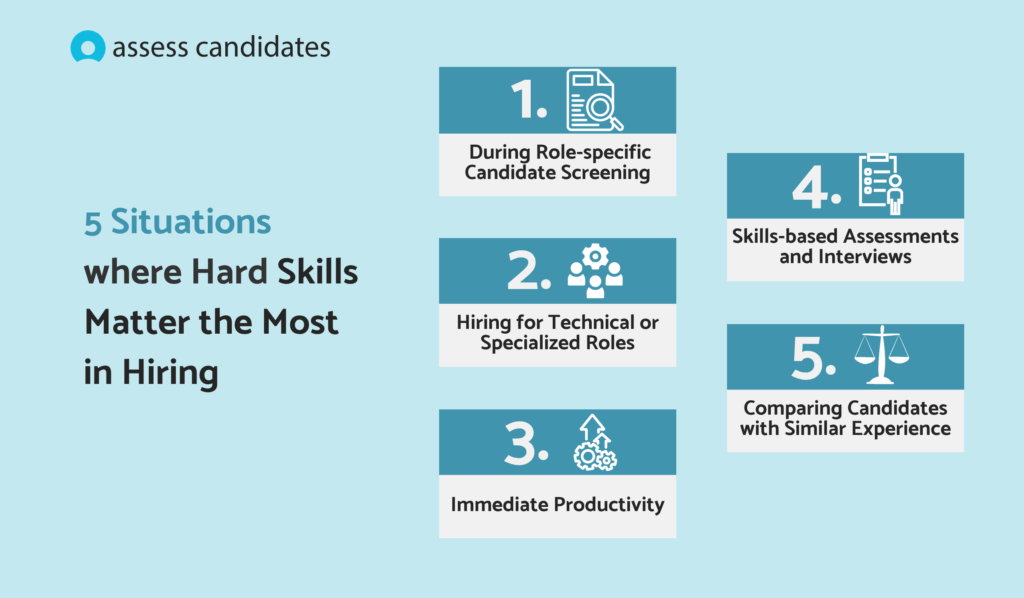
1. During Role-specific Candidate Screening
Hard skills matter the most during the initial screening stage, where candidates are evaluated based on whether they meet the minimum technical requirements. For instance, a candidate’s software proficiency, subject expertise, certifications, and technical skills are measured at this stage.
2. When Hiring for Technical or Specialized Roles
Hard skills are also critical in roles that require specialized training and measurable technical capability, such as engineering, digital marketing tools, finance and accounting, and data analysis.
3. Immediate Productivity
Hard skills are also critical in organizations that require their employees to deliver results quickly. Such occurrences usually arise when project timelines are tight, teams are understaffed, or roles are client-facing.
4. During Skills-based Assessments and Interviews
Hard skills are also critical when evaluating candidates through assessments such as technical tests, case studies, work simulations, and certification verifications. These assessments further help confirm whether candidates can apply their knowledge in practical scenarios.
5 .Comparing Candidates with Similar Experience
Hard skills usually become a deciding factor when multiple candidates have comparable qualifications, educational background, and years of experience. In these cases, you can differentiate the top performers from the rest by measuring their proficiency with tools, platforms, or methodologies.
Now, let’s look at the best methods for accurately assessing hard skills.
4. How to assess hard skills accurately?
The most accurate hard-skills assessment methods are structured, role-relevant, and based on direct evidence of performance. The most effective results come from combining multiple assessment approaches that measure both knowledge and practical application.
The following are some of the best methods for assessing hard skills accurately:
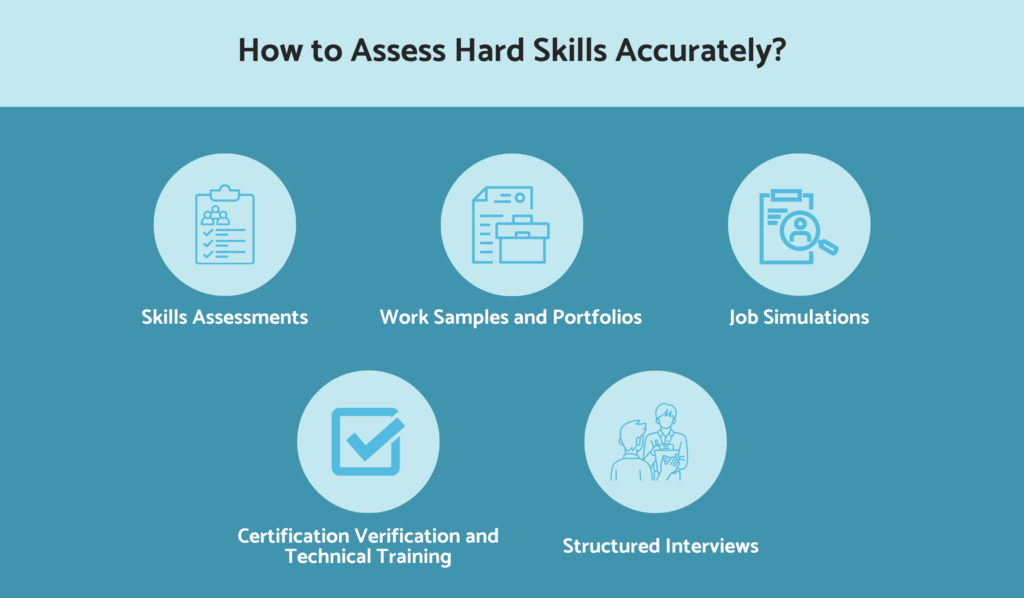
- Skills Assessments
One of the most effective ways to assess hard skills is through role-specific skills tests that mirror real work. These may include coding exercises for developers, spreadsheet tasks for analysts, written assignments for content roles, and financial modeling exercises for finance roles.
- Work Samples and Portfolios
Reviewing work samples and portfolios is yet another effective way to measure hard skills in candidates. This is because portfolios provide direct evidence of an applicant’s technical and execution ability.
Through this, you can evaluate a candidate’s accuracy, complexity of the work handled, problem-solving ability, tool proficiency, and consistency of output.
- Job Simulations
Since job simulations closely mirror workplace responsibilities, they are the most accurate predictors of job performance. These include analyzing a sample report, debugging code, editing a document, and interpreting customer data.
These tests will help you measure both technical ability and decision–making under realistic conditions.
- Certification Verification and Technical Training
Verifying certifications is yet another effective method for assessing candidates’ hard skills, as it helps confirm exposure to standardized learning frameworks and specialized knowledge areas. However, certifications are most effective when they are combined with practical testing.
- Structured Interviews
Conducting structured interviews also helps measure hard skills in candidates during recruitment. These interviews must include task-based and scenario–based questions aligned with job responsibilities. This improves evaluation consistency across candidates.
Gain deeper insights into candidates’ hard skills with our science-backed assessment tools. HIRE FOR FREE
Even with the right tools, you might end up making some common mistakes while evaluating hard skills.
5. Common Mistakes When Evaluating Hard Skills
Hard-skills evaluation becomes unreliable when hiring teams rely on indirect signals, inconsistent assessment methods, or credentials without proof of application.
The following are the 5 most common mistakes made when evaluating hard skills:
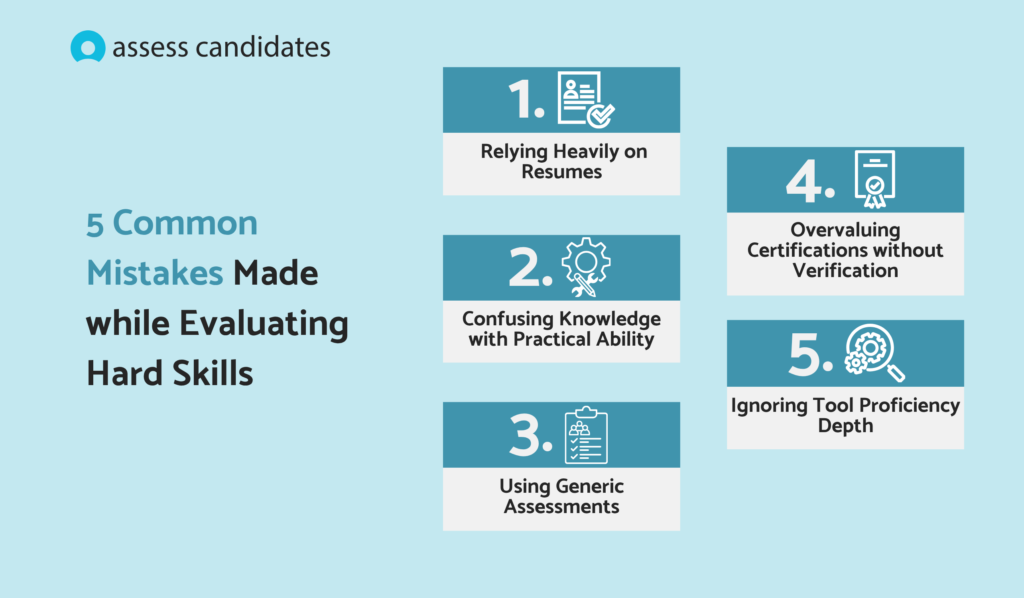
1. Relying Heavily on Resumes
One of the most common mistakes made while evaluating hard skills during the recruitment process is relying too heavily on a candidate’s resume. Assuming that the listed certifications, technical skills, or tools mirror real proficiency can lead to mis-hires.
Solution: Confirm skill claims through task-based testing or simulations for better results.
2. Confusing Knowledge with Practical Ability
Another common mistake made during the hiring process is confusing knowledge with practical ability. This is because candidates may understand concepts theoretically but struggle to apply them in real-world workplace scenarios.
Solution: Incorporate job-relevant assessments that measure application.
3. Using Generic Assessments
Generic assessments often fail to reflect the actual technical responsibilities of a role. Hence, relying too heavily on generic assessment may lead to the hiring of candidates who perform well on abstract tests but struggle with practical workplace requirements.
Solution: Incorporate assessments that closely mirror the tools, outputs, and workflows required in a role.
4. Overvaluing Certifications without Verification
Although certifications can demonstrate initiative and exposure, they do not always guarantee practical proficiency. Overvaluing certifications with out any verification and treating them as the standalone proof of competence may lead to overestimation of a candidate’s technical capability.
Solution: Use certifications as supporting evidence rather than using them as the final indicator of job readiness.
5. Ignoring Tool Proficiency Depth
Another common mistake made during assessing hard skills during the recruitment process is ignoring the depth of tool proficiency. While the majority of candidates may have exposure to industry tools, their level of proficiency may vary significantly.
Hence, not assessing the depth of usage may lead to a misjudgment about how quickly a candidate can perform role-specific responsibilities.
Solution: Evaluate the level at which candidates use tools in practice. Ask candidates to complete short tool-based exercises or describe projects where they applied specific features.
Explore our wide range of standardized assessments to boost your skills-based hiring. LEARN MORE
6. Hard Skills: Client Success Story
Client Problem Statement
Suppose a growing logistics company is struggling to hire operations coordinators who have the practical technical skills to manage shipment tracking systems, maintain accurate documentation, and update scheduling dashboards efficiently. As a result, the delivery time will be harder to monitor, reporting errors will increase, and communications gaps will begin to affect coordination across teams.
The organization now needs a more reliable way to measure whether a candidate can use spreadsheet tools, manage workflow documentation, and support operational tracking in real-world scenarios.
Assess Candidates’ Proposal
At Assess Candidates, to hire the right operations coordinator, we recommend incorporating role-specific skills assessments, job simulation tasks ,and tool-based evaluations early in the hiring stage.
Moreover, when combined with structured technical interviews and sample reviews, the organization can gain deeper insights into the candidate’s ability to apply their knowledge in practical situations, maintain time accuracy under pressure, and support smooth coordination across logistics teams.
Result
By adopting assessments that specifically measure hard skills, the logistics company can confidently identify candidates who demonstrate strong technical readiness, accuracy in documentation, and familiarity with essential coordination tools.
This will lead to more reliable shipment tracking, improved reporting accuracy, and better communication across operations teams.
Partner with Assess Candidates to incorporate a range of hard skills tests into your hiring process. VIEW PLANS
The value of hard-skills hiring comes from measuring real capability, not just inferred competence from a CV.
7. Why top companies use Assess Candidates to evaluate hard skills
At Assess Candidates, we offer a wide range of pre-employment assessments and create recruitment campaigns customized to each organization’s unique hiring needs.
Here is an example of our campaign reporting dashboard available on Assess Candidates.
Here are 4 reasons to use Assess Candidates to evaluate hard skills accurately:
- Scientifically Designed by Expert Psychologists: Assess Candidates’ hard-skills assessments are developed by experienced psychologists and psychometricians with a strong track record of building evaluation tools for global assessment leaders such as SHL and IBM Kenexa.
Each assessment undergoes rigorous scientific validation to measure role-relevant technical abilities, tool proficiency, and task accuracy in realistic work scenarios. This evidence-based approach helps organizations confidently identify candidates who can apply their technical knowledge effectively and contribute from day one.
- Advanced Reporting: Our intuitive platform delivers clear, in-depth reports that highlight candidates’ technical strengths, skill gaps, and performance across specific job-related tasks. Employers can quickly compare proficiency levels, identify role-ready candidates, and shortlist applicants using objective, data-driven insights. With seamless ATS integration, evaluation workflows become faster, more consistent, and easier to manage across the hiring process.
- Positive Candidate Experience: Our hard-skills assessments are designed to be practical, engaging, and accessible across devices, allowing candidates to demonstrate their technical capabilities in structured and realistic task environments. Clear instructions and job-aligned exercises help candidates focus on applying their knowledge without unnecessary complexity. Custom branding options also help organizations maintain a professional and consistent assessment experience throughout the hiring journey.
- Candidate Accessibility Support: We support inclusive hiring by providing accessibility features that enable candidates to demonstrate their hard skills fairly and confidently. These include extended time options, screen-reader compatibility, adjustable visual settings, and zoom functionality. All assessments align with WCAG accessibility standards, ensuring an equitable experience for all applicants.
Assess Candidates provides reliable, science-based tools that help organizations evaluate hard skills accurately and make hiring decisions that are smarter, faster, and more consistent. Explore our full range of assessments to identify candidates with the technical capabilities required for success in your roles.
Not sure which hard-skills assessments best match your hiring needs? Contact us for a free analysis of your role requirements.
Conclusion: Key Takeaway
Hard skills are measurable, role-specific abilities that help employers assess whether someone can do the work required. When hiring teams evaluate them through structured, job-relevant methods, they improve hiring accuracy and reduce the risk of costly mis-hires.
Frequently Asked Questions
What is the difference between hard skills and soft skills?
Hard skills are measurable technical abilities that candidates need to perform specific job tasks, such as Excel, coding, or writing reports. Soft skills, on the other hand, are interpersonal traits like communication or teamwork that determine how they work with others, manage time, and solve problems.
How often should hard skills be reassessed?
Hard skills should be reassessed regularly as tools and job requirements change quickly. Regular reassessments help ensure that candidates stay effective, accurate, and aligned with current workplace demands.
Can hard skills be trained on the job?
Yes. Hard skills can be trained on the job through structured learning, mentoring, workshops, and real project experience. This helps employees become more productive while adapting to the company workflows.
Are certifications proof of hard skills?
No, certifications alone are not proof of a candidate’s hard skills or practical proficiency. Certifications signal structured learning but should be paired with performance tests such as work samples, technical assessments, or job simulations for accuracy.
How do skills-based assessments reduce hiring bias?
Skills-based assessments reduce hiring bias by relying on objective performance data rather than subjective impressions or credentials alone. They focus on what candidates can actually do rather than who they know, where they studied, or how confident they appeared in interviews.


 English
  Arabic