
7 Common Interview Mistakes Hiring Managers Make (And How to Avoid Them)



Interviews can look simple on the surface. You ask questions, candidates answer, and you decide whether they are right for the role. In practice, interviewing is one of the hardest parts of hiring because managers are trying to predict future performance from a short, high-pressure interaction.
Interview errors cost companies millions every year in bad hires, turnover, and lost productivity. These mistakes happen even with experienced managers.
This guide takes you through the most common interview mistakes, why they occur, and exactly how to correct them. You will discover practical strategies to help improve your hiring outcomes.
Contents
- What are interviews meant to measure?
- 7 common interview mistakes hiring managers make
- Why is interviewing harder than it looks?
- Why do hiring managers make interview mistakes?
- What are the costs of interview mistakes?
- How to fix common interview mistakes
- How better interviewing improves hiring outcomes
Let’s dive in.
1. What are Interviews Meant to Measure?
The main objective of an interview is to anticipate job performance by obtaining evidence related to a candidate’s job skills, experience, and cultural fit. Interviewers ask questions, observe behaviors, and evaluate responses to see if candidates are able to successfully perform the responsibilities of the position and contribute to the team.
Based on research published by the U.S. Office of Personnel Management, structured interviews that ask all applicants the same, pre-defined questions and use benchmarked scoring have been shown to have higher validity, reliability, and agreement among raters when compared to unstructured approaches.
Effective interviews combine behavioral questions about past performance, situational scenarios relevant to the role, and opportunities for candidates to ask questions. Modern interviews can be conducted face-to-face, by phone, or via video conferencing, with structured formats proving most effective at predicting future job success.
Eliminate guesswork in hiring with interviews that measure job-relevant skills HIRE FOR FREE
Unfortunately, many interviews miss the mark completely. Here’s what they measure instead.
What interviews measure instead
In plenty of interviews, recruiters measure something entirely different. They measure interview performance, but not job performance.
Some common metrics interviews can mistakenly measure includes how well candidates handle pressure in artificial situations, how articulate they are in formal conversations, how closely candidates match the interviewer’s background, and how confident candidates look when nervous.
These traits are sometimes correlated with job success, but they’re not the same thing. Plenty of great employees are horrible at interviews, and plenty of smooth interviewees struggle once hired.
This mismatch presents a certain problem worth looking closely at.
Why interviews reward confidence more than competence
Confident candidates get hired more than competent candidates. Confidence is easy to identify during interviews. It presents itself through good eye contact, smooth responses, and assertive body language. Competence is more difficult to determine. It involves digging into the work from the past, asking follow-up questions, and evaluating specific examples.
When managers lack specific criteria for evaluation, they use confidence as a surrogate for ability. This presents a systematic bias toward candidates that present well but may not deliver results.
Studies from VidCruiter report that structured interviewing is twice as predictive of job performance as unstructured interviews.
So why do interviews measure the wrong areas? Let us take a closer look at specific mistakes that cause interviews to become less effective.

2. 7 Common Interview Mistakes Hiring Managers Make
When measuring the wrong criteria, interviews become less effective at predicting job performance. This is most often due to one or a combination of the below 7 key mistakes:
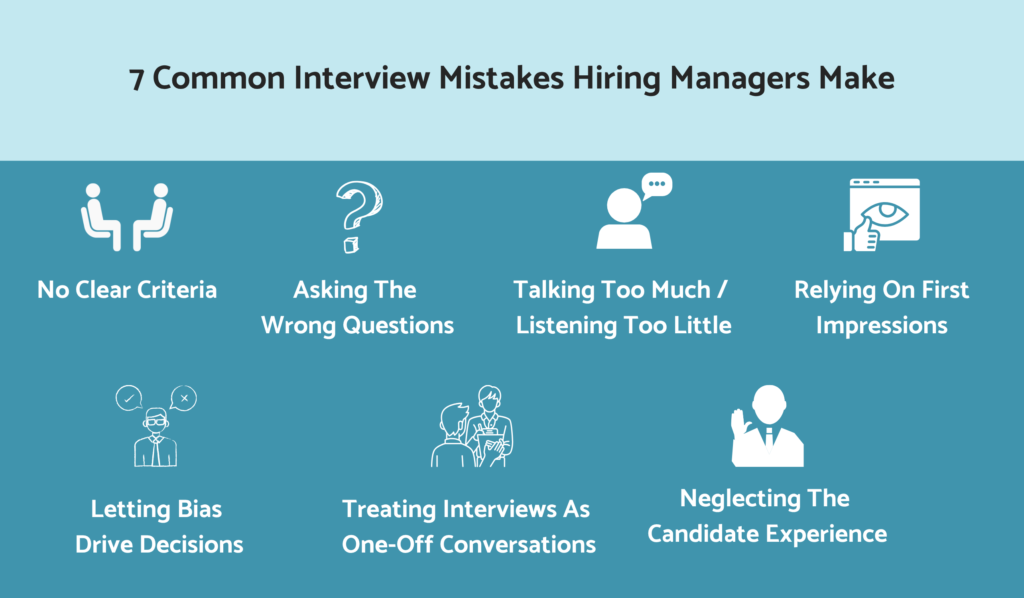
1. Going into interviews with no clear criteria
This is the fundamental error that worsens the situation going forward. How can you rate candidates when you don’t know what you’re rating them against?
Many managers go into interviews with little or no idea of what they want. They know what the job title is and what the basic job responsibilities are, but they haven’t described what success looks like or what the skills in that job really are.
Vague job descriptions lead to vague interviews. When the role requirements are constantly changing, candidates can’t be prepared, and interviewers can’t be consistent in their evaluations. Each interviewer ends up assessing different things, making it impossible to compare the candidates fairly.
Companies love to talk about hiring for the right culture fit, but few can give a definition. Without explicit criteria, culture fit is code for “people I like” or “people like me.”
2. Asking the wrong questions
Some interview questions predict job performance well while others waste everyone’s time.
Generic questions such as “Where do you see yourself in five years?” or “What’s your greatest weakness?” reveal almost nothing. The candidates have rehearsed these answers. You’re testing their preparation, not their capabilities.
Hypothetical questions are almost as bad. Asking “What would you do if…” allows candidates to elaborate on their ideal response. This has little to do with what they’ve done in similar situations.
The best interview questions involve specific experiences in the past. “Tell me about a time when…” Examples, not theoretical answers, are required of candidates. These behavioral questions help to determine patterns of actual behavior.
Many interview questions also favor talkers, not doers. People that are able to articulate the process they are using sound more capable than people that just do it well. For technical/ hands-on jobs, this is a systematic bias.
3. Talking too much and listening too little
Interviewers should largely listen. If you’re talking more than 20% of the time, you’re doing it wrong.
Many managers spend half the interview selling the position and the company. This is backwards. You can’t evaluate candidates when you are busy pitching to them. Save the sell for after you have evaluated them.
Interrupting candidates is another problem. Silence is actually a very powerful interview tool. When you ask a question and wait quietly, candidates continue to talk. More often than not, they give more information after they’ve given their prepared answer, feeling compelled to fill the silence.
4. Relying on first impressions
Research consistently shows that interviewers form opinions in the first few minutes. Then they spend the remaining part of the interview searching for evidence that supports those opinions.
According to 2025 research, interviewers usually form their opinion about a candidate within the first 10 minutes. Many recruiters make their decision on the candidate early within the interview.
This happens unconsciously. You meet a candidate, and they remind you of a great employee, and suddenly, everything that they say sounds smarter. Or someone is late because of traffic, and their answers are not as good as they believe.
Likeability biases decisions to a greater degree than most managers realize. Candidates who are friendly, attractive, or share your interests are rated more highly, even if their qualifications are identical to those of less personable candidates.
The halo effect makes this problem even worse. When you like one thing about a candidate, you assume he or she is good at everything. One impressive answer makes them generally appear to be impressive. The horns effect has the opposite effect. One slip-up and everything else is questionable.
5. Letting bias drive decisions
Everyone has biases. However, the issue is not recognizing your bias and managing it.
First, similarity bias is especially insidious. We naturally like people who remind us of ourselves. Same school, same hometown, similar work background, similar hobbies. These commonalities have the feeling of being an indicator of fit, but they’re really just an indicator of similarity.
This results in teams populated with people of the same backgrounds and views. It is a comfortable homogeneity that limits your team’s problem-solving ability.
Prestige bias influences the ways in which we assess credentials. Candidates from famous companies or elite schools get more benefit of the doubt. Their answers sound better even when the content is similar to those of candidates with less prestigious backgrounds.
Confirmation bias can be observed in the follow-up questions. And once you’ve formed an opinion, you ask questions that support that opinion.
6. Treating interviews as one-off conversations
Every candidate should have a similar experience in the interview. Not exactly the same, but based on the same core questions and evaluation criteria. Without structure, each and every interview is a unique conversation. This makes comparing candidates fairly an impossibility.
Many managers also forego proper documentation. They rely on their memories to compare candidates who are interviewed weeks apart. Memory is unreliable and one-sided.
Structured scoring frameworks avoid this problem. When you are evaluating candidates against defined criteria using clear ratings, you can make objective comparisons.
7. Neglecting the candidate experience
Interviews work both ways. While you are assessing candidates, they are assessing you and your organization.
Bad communication hurts your employer brand. Excessive time between stages of the interviews with no communication indicates disorganization. Candidates take this as your treatment of employees, not just applicants.
Disorganized interviews leave terrible impressions. Interviewers who haven’t read the resume or don’t know what job they’re hiring for, or ask duplicate questions, make the company look incompetent. Top candidates refuse offers from companies that can’t even run basic interviews well.
According to Criteria Corp’s 2024 report, 54% of candidates have walked away from a job due to poor communication during the hiring process.
Standardize your interview evaluation process with our customizable assessment tools. LEARN MORE
But why is this the case?
3. Why Is Interviewing Harder Than It Looks?
Most people assume that interviewing is a simple task. You speak to candidates, evaluate their skills, and make a hiring decision. Simple, right?
In reality, it is far more complex than it appears.
Interviewing is difficult because managers have to evaluate several things at once: capability, communication, judgment, potential, and fit with the demands of the role. They also have to do that while managing time pressure, incomplete information, and their own bias.
According to Criteria Corp’s 2024 Candidate Experience Report, more than one in four candidates had experienced bias during interviews.
Let’s start by examining what makes interviewing so complex in the first place.
The hidden complexity of interviews
Interviews require you to assess many dimensions at the same time. You’re evaluating technical skills, cultural fit, ability to communicate, and growth potential. All while the candidate is understandably nervous and not showing their normal behavior, you are also fighting your own biases.
Research indicates that interviewers form their opinions within the first five minutes and spend the rest of the interview trying to confirm their first impressions.
Add in time pressure, unclear role requirements, and the natural human inclination to like people similar to ourselves, and you have a recipe for hiring mistakes.
Beyond the inherent complexity, there’s another misconception that makes interviewing more difficult.
Why “experience as a manager” doesn’t mean “interviewing skill”
Interviewing skills and job expertise are completely different skill sets. Being good at your job does not automatically make you good at hiring for it.
You may be a great engineer who knows exactly what good code should look like. But is it possible to reliably tell which candidates will write that good code? Can you tell the difference between candidates that interview well and candidates that perform well?
Management experience is helpful in reading people and asking questions. But it doesn’t teach you how to structure interviews, recognize bias patterns or evaluate candidates against clear criteria, not gut feelings.
This brings us to the question of how most managers, in fact, learn to interview.
How most hiring managers have learned to interview
Here’s how most managers learn to do interviews: they get promoted, HR schedules them for interviews, and they show up and wing it. Maybe they copy questions from their colleagues or remember what they were asked when they were interviewed?
Some companies conduct short courses in interviewing, which include legal compliance and basic dos and don’ts. While that is helpful, it is incomplete. You would not expect that someone could turn into a competent negotiator or project manager after a two-hour session.
This leads to most hiring managers developing their own style of interviewing by trial and error. They try to figure out what does work by trying what doesn’t work. That often leads to inconsistent hiring decisions until better systems are put in place.
Use our structured video interview platform to ask consistent, job-relevant questions. LEARN MORE
While you now know what these mistakes are, let us find out why they persist and how this helps companies address the systemic causes.
4. Why Do Hiring Managers Make Interview Mistakes?
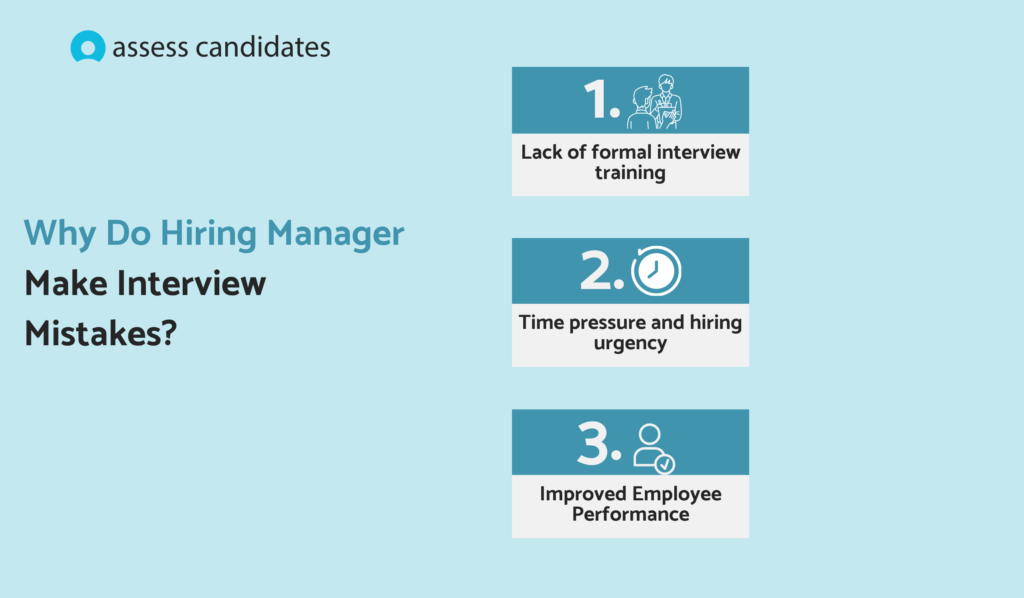
1 . Lack of formal interview training
Most managers never have actual training for conducting interviews. They get basic legal compliance information, and maybe a list of questions that they can ask. Organizations spend a lot of money on technical training, leadership skills, and project management skills.
Good interviewing involves understanding bias patterns, knowing how to frame behavioral questions, knowing when you’re making assumptions, and being systematic about your data evaluation. You must train and practice to become good at this.
However, training is not the only reason why these mistakes happen. Time pressure also plays a major role.
2 . Time pressure and hiring urgency
Most hiring decisions happen under pressure because the team is either short-staffed or they want someone hired in a rush. This hurry prevents managers from taking important steps. There is no time to clearly define the criteria and develop structured questions.
Ironically, this haste increases time to hire. Poor interviews make for bad hires, which means starting the process over. Taking the time upfront to interview properly actually moves the needle faster in the long run on hiring.
There’s also a mental aspect that does not allow for improvement.
3 . Overconfidence
Overconfident hiring managers often assume that they have mastered interviewing after a few successful hires. They trust their gut instinct simply because it worked before. They ignore that even at random, hiring would occasionally yield good results. Past success does not mean that your interview process is sound.
Overconfidence is also a factor that will not allow for improvement. Why change what seems to work? This results in a cycle of managers making the same mistakes in their interviews for years and not realizing they’re missing better candidates.
Improve your hiring process with our user-friendly and candidate-focused video interview platform. LEARN MORE
It is important to understand why mistakes happen, but even better to know their impact and how to fix them.
5. What Are the Costs of Interview Mistakes?
1 . The financial cost of bad hires
According to SHRM, the average cost per hire in the United States is approximately $4,700. But that’s only the cost of hiring. The total cost of a bad hire is far greater.
Direct costs are the salary(s) paid during their time of employment, recruiting costs, onboarding costs, and the cost to replace them. For a mid-level position, this easily surpasses $50,000.
Indirect costs hurt more. Lost productivity while the position is unfilled, poor quality work output from the wrong person, mistakes that need fixing, and time other team members need to compensate for poor performance.
Some estimates have put the total cost of a bad hire at 1.5 to 2 times their annual salary. For a $100,000 role, that’s $150,000 to $200,000. Interview mistakes cost real money.
The financial costs are huge, but they’re not the only way bad hires are damaging organizations.
According to the U.S. Department of Labor, a bad hire can cost your business 30% of the first year’s earnings of the employee.
2 . The performance cost on teams
Poor performers from bad hiring decisions negatively impact entire teams. Team productivity and morale decline when underperforming employees cannot pull their weight. Top performers become frustrated about having to compensate, and resentment is built as others work harder to make up for gaps.
Managers waste disproportionate time on underperformers. Time spent managing someone that shouldn’t have been hired is time not spent developing high performers or executing strategy. This creates a double loss.
Missed opportunities are a different cost. What could your team have achieved with the right person in the right role? What projects were stalled or failed due to capability not being there? These opportunity costs are impossible to quantify but very real.
Individual team impacts add up to overall organizational issues in the long run.
Studies estimate that up to 80% of employee turnover is as a result of bad hiring decisions that thus create a self-reinforcing cycle of costly recruitment.
3 . The long-term organizational cost
Poor interviewing develops systemic problems that compound over time. Increased turnover becomes self-reinforcing. Bad hires leave quicker, and that means more hiring pressure, more rushed interviews, and more bad hires. The cycle continues.
Growth slows down when hiring fails. Companies that rely on adding talent to scale are stuck. They can’t execute growth plans, because they can’t reliably hire people that succeed. Bad experiences with interviews get shared across platforms like Glassdoor. Poor interviewing will make it difficult to attract future candidates.
Now that we have identified the problems and the cost of the problems, let us focus on solutions. If you want to know how to systematically improve your interview process, read on.
6. How to Fix Common Interview Mistakes
1 . Designing better interviews
The most effective interviews begin before any interaction with a candidate. You need to have clear role requirements, success criteria, and structured frameworks for evaluation.
Define what it looks like to succeed in the particular role. Not generic qualities such as “team player” or “good communicator.” Specific outcomes like “closes 8 enterprise deals quarterly” or “shipping features with a <3% bug rate.”
Link interview questions directly to these outcomes. Every question should help you to evaluate whether the candidate can deliver specific results. Structured interview formats use the same questions for all candidates. This makes fair comparisons and eliminating prejudice possible. However, structure doesn’t mean you have to be rigid.
A study published in the Journal of Applied Psychology found that behavioral description interviews show greater validity for complex work such as professional and managerial positions.
2 . Asking better questions
Behavioral questions let you know how candidates have actually performed, not how they think they would perform. The format is simple. Ask questions such as “Tell me about a time when you…”
Good behavioral questions are specific to situations that are relevant to the role. “Tell me about a time you had to deliver bad news to a stakeholder.” “Walk me through how you debugged the most complicated technical problem you have had.”
Role-relevant case questions are tests of real skills. Give data to analysts to analyze. For writers, have them critique writing samples. These types of exercises are better at predicting performance than hypothetical discussions.
When candidates describe an experience, get more in-depth. What kind of specific role did you play? What were the alternatives you considered? What do you wish you had done differently now?”
3. Training hiring managers
Interviewing is a skill that needs training and practice, and organizations have to treat it accordingly.
Core interviewing skills include structuring questions well, active listening techniques, and not interrupting, being aware of and managing bias patterns, taking objective notes, and evaluating the evidence against defined criteria.
Bias awareness training helps managers to recognize their default biases. When you know that you have a natural preference for candidates like yourself, you can consciously fight against that tendency. Awareness doesn’t get rid of bias, but it makes it less influential.
Interview calibration sessions help teams to agree on evaluation standards. Multiple interviewers evaluate the same candidate’s interviews and compare their ratings and reasoning. This helps to identify inconsistencies and helps to establish shared understandings of what is good.
4. Improving evaluation and decision making
Consistent scoring frameworks make it possible to change subjective impressions into objective assessments. Rate candidates according to certain criteria on certain scales. This produces similar data amongst candidates.
Use evidence-based comparisons instead of vague impressions. When choosing between candidates, refer back to documented examples, ratings, and role criteria rather than relying on how confident or familiar someone felt in the room.
Separate interview feedback and gut feel by documenting both. Often they are aligned, but if they are not, it is good to have both so that you understand why.
5. Developing an interview system that scales
Building scalable interview systems ensures lasting organizational change, whereas individual improvements provide only temporary benefits. Repeatable hiring processes deliver consistent results across your entire organization.
According to a Criteria Corp research, 7 in 10 candidates prefer interviews where the questions are the same from candidate to candidate, debunking the myth that standardization hurts candidate experience.
Discover how our assessment tools can elevate your interview quality and reduce hiring bias. LEARN MORE
6. Creating repeatable interview playbooks
Interview playbooks detail the precise way in which interviews should be conducted for each role. They include question sets, evaluation criteria, scoring frameworks, and decision guidelines.
Good playbooks have consistent criteria and are not mechanical. They provide structure with enough room to adapt based on different candidates.
Playbooks can also be used for knowledge transfer. New managers do not have to start from scratch. They build on what has been proven by your organization’s experience.
7. Standardizing interviews without being rigid
The best interview systems make what matters consistent, but leave room for human judgment.
Standardize your basic questions, evaluation criteria, and score. These elements should be the same for all candidates so that comparisons can be made fairly.
Then you can leave room for flexible follow-up questions, flow of conversation, and exploring unique candidate experiences. However, balance is key. Too much structure is robotic, and too little makes you inconsistent.
8 . Logical Reasoning Tests Using Data to Improve Interviews Over Time
Interview effectiveness tracking reveals which approaches predict successful hires. Review interview assessments when new hires underperform to identify what interviewers missed and patterns across failed hires.
Organizations that track hiring effectiveness can become much better. When you measure which elements of the interview are correlated with successful hires, you can constantly tweak your process.
This same data-driven approach applies to the effectiveness of interviews. Monitor time to hire, offer acceptance rates, new hire performance ratings, and retention. See correlations between interview scores and actual job performance.
Now, let’s look at the tangible benefits of optimizing your interview process in several dimensions.
7. How Better Interviewing Improves Hiring Outcomes
1 . Higher quality hires
Structured interview processes lead to better hiring decisions. Systematically evaluating candidates against concrete criteria helps you identify people who actually succeed in the role.
Quality of hire is notoriously difficult to measure, but the effects are obvious. New hires hit the ground running, perform at a higher level, and make a greater contribution in less time. They require less hand-holding and cause less managerial overhead.
Quality hires also stay on longer, which leads us to the next benefit.
2 . Faster ramp-up and increased retention
Employee retention improves dramatically when candidates undergo rigorous interview processes. Accurate job representations during interviews eliminate surprises and keep new hires longer. Candidates are aware of what they’re getting into.
Better interviews also mean better job fit. When you match candidates to roles based on actual capability rather than interview performance, they’re more likely to succeed and feel fulfilled. Success breeds retention.
Reduced turnover saves money in recruiting and onboarding. It also helps retain institutional knowledge and keeps the team together. Both factors increase overall team performance. Individual benefits add up to team-level advantages.
3 . Strong teams and leadership trust
Improved hiring processes build high-performing teams where every employee has the right skills. Better candidate selection ensures each team member can excel in their specific role. Collaboration becomes better as people complement each other in strength.
Leaders can have more trust in their teams when the hire is reliable. This helps to reduce micromanagement and allows leaders to focus on strategy as opposed to constantly trying to fix performance problems.
Strong teams also become self-reinforcing. Top performers want to work with other top performers. Your successful hiring makes it easier to hire in the future.
Finally, there’s an external benefit which adds up over time.
4 . More credible employer brand
Well-run interviews demonstrate professionalism and organizational competence to candidates. Structured interview processes show you value people’s time and take hiring seriously. Even candidates you don’t hire go away with good impressions.
Positive candidate experiences compound over time as candidates share their interview experiences and recommend your company. Strong employer reputation leads to referrals and repeat applicants for future roles.
Candidates share interview experiences quickly, and those patterns shape employer reputation over time. You get better pools of applicants, and the hiring gets even easier.
Reducing common interview mistakes helps hiring managers improve hiring quality, reduce turnover, and build stronger teams.
Explore our tailored assessment bundles designed to improve interview accuracy and hiring outcomes. VIEW PLANS
Get expert insights on effective interview techniques and data-driven hiring strategies delivered to your inbox. Browse FAQs and sign up below.
Frequently Asked Questions
Why do hiring managers make mistakes when interviewing?
Being experienced doesn’t mean you are good at something. Most managers learn interviewing by trial and error without proper training. They develop habits that feel natural, but which aren’t effective. Without feedback on the quality of the interviews or training on bias patterns, these habits go on for years.
Are structured interviews better than informal interviews?
Consistent research finds structured interviews to be a better predictor of job performance than unstructured interviews. Structure means having consistent evaluation criteria and core questions, but at the same time, adapting to individual candidates. This way, comparisons can be made fairly, and the bias is reduced. Structured interviews also give better legal protection if hiring decisions are challenged.
How many interviewers should be assessing a candidate?
Three to five interviewers are usually enough to get the right perspective. Each interviewer must evaluate different competencies so that they do not duplicate each other. More interviewers don’t necessarily make better decisions if everyone is evaluating the same things. Panel interviews with several interviewers together can be efficient, but will require careful coordination. Make sure that each member of the panel has a specific evaluation responsibility, and not everyone is evaluating everything.
What mistakes made during interviews contribute to the highest turnover?
Misrepresenting the role in interviews leads to the quickest turnover. When the real job is significantly different from what was talked about, then new hires quit faster. Be honest about challenges, work environment, and expectations. Poor cultural assessment is the second major factor. Hiring talented people who do not belong to your environment is a recipe for mutual dissatisfaction. Define what cultural fit really means to your organization and take a systematic assessment.
How can companies teach managers to interview better?
There are several components of good interview training. Start with the basics: framing questions, listening, identifying bias, and making evidence-based judgments. Follow-up training with calibration sessions in which managers score the same interview recordings and compare their scores. This helps to reveal inconsistencies and help establish shared standards. Make interview quality part of ongoing performance management, and not a one-time training event.


 English
  Arabic