
Myers-Briggs Personality Test: What It Is and How It Works



Have you ever hired someone who looked strong on paper, interviewed well, and still struggled to fit into the team? The issue is often not skill or motivation. It is how people communicate, make decisions, and work with others, which does not always show up on a CV or in an unstructured interview.
The Myers-Briggs personality test (MBTI) helps explain how people communicate, make decisions, and work with others, but it should not be used as a standalone hiring tool.
Research published by the Myers & Briggs Foundation shows that the MBTI is designed to explain personality preferences in how people perceive information and make decisions, not to measure ability or predict job performance.
In this guide, we’ll explain what the Myers-Briggs Personality Test is, how it works, and how it is (and isn’t) used in recruitment, so you can avoid common pitfalls and apply personality insights responsibly.
Contents
- What is the Myers-Briggs personality test?
- What does the Myers-Briggs personality test measure?
- How does the Myers-Briggs Personality Test work?
- How is the Myers-Briggs Personality Test used in recruitment?
- Myers-Briggs vs other personality tests
- What are the best practices for using the Myers-Briggs Personality Test in hiring?
- Why choose Assess Candidates?
To understand whether Myers-Briggs can genuinely support better hiring decisions, it’s important to start with what the test actually is.
1. What is the Myers-Briggs Personality Test?
The Myers-Briggs Type Indicator (MBTI) is a personality framework designed to explain how people prefer to perceive information, make decisions, and interact with the world. Rather than measuring skills or intelligence, it focuses on psychological preferences that influence behavior, communication, and work style.
Originally developed by Katharine Cook Briggs and Isabel Briggs Myers, the MBTI is based on Carl Jung’s theory of psychological types. Today, it remains one of the most widely recognized personality assessments used in workplaces, education, and personal development.
What the MBTI is designed to do
At its core, the Myers-Briggs framework explains why people approach work differently: how they process information, respond to structure, interact with others, and make decisions. It provides a shared language for understanding differences rather than judging whether someone is capable or incapable.
According to the Myers & Briggs Foundation, the MBTI was created to help people understand normal differences in personality, not to evaluate ability, mental health, or job competence.
What the MBTI is not
Importantly for recruiters, the MBTI is not a predictive hiring test. It does not assess intelligence, technical skill, motivation, or performance potential. Using it as a screening or pass-fail tool can lead to misleading conclusions and unfair hiring outcomes.
Guidance from occupational psychology research emphasizes that the MBTI describes preferences, not competencies, and should be used for development and communication rather than selection decisions.
Start hiring with clarity by combining personality insights with skills-based assessments. HIRE FOR FREE
Understanding what the Myers-Briggs test is, and what it is not, sets the foundation for applying it carefully.
In the next section, we’ll break down what the MBTI actually measures, how the 16 personality types are formed, and what this framework leaves out entirely.

2. What does the Myers-Briggs Personality Test measure?
The Myers-Briggs Personality Test measures preferences, not abilities. It explains how people tend to think, communicate, and make decisions, rather than how well they perform tasks. This distinction is critical for recruiters to understand before using MBTI results in hiring.
What the MBTI measures
The MBTI is built around four preference pairs, which combine to form the well-known 16 personality types:
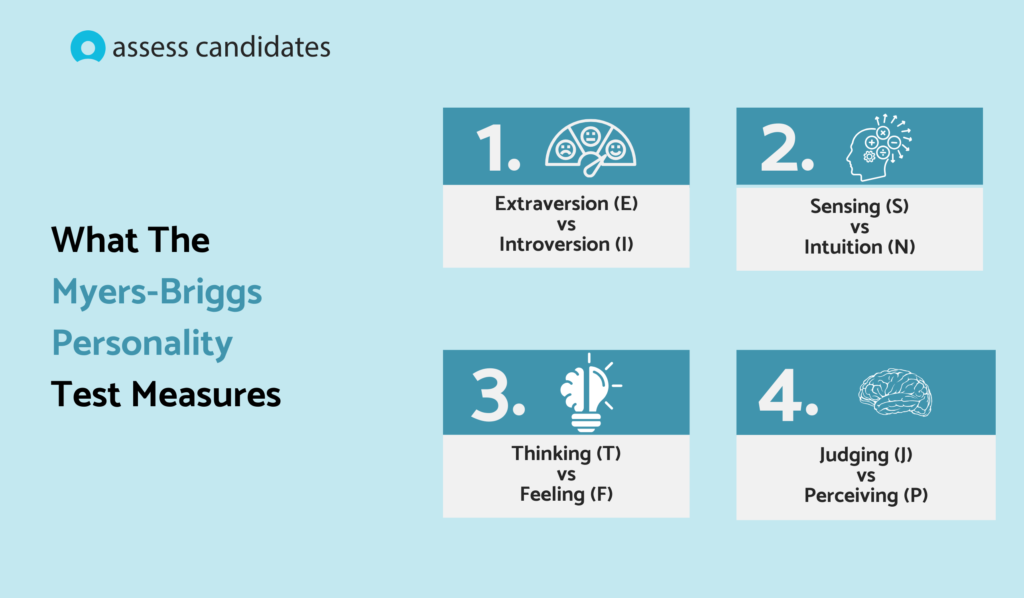
- Extraversion (E) vs. Introversion (I): Where individuals prefer to focus their energy, outwardly with people and activity, or inwardly through reflection.
- Sensing (S) vs. Intuition (N): How people prefer to take in information, through concrete facts and details or patterns and possibilities.
- Thinking (T) vs. Feeling (F): How decisions are typically made, using logical analysis or personal and social values.
- Judging (J) vs. Perceiving (P): How individuals prefer to organize their lives, with structure and planning or flexibility and adaptability.
Together, these preferences describe behavioral tendencies such as communication style, decision-making approach, response to change, and comfort with structure in the workplace.
The Myers & Briggs Foundation explains that MBTI preferences describe natural tendencies in perception and judgment, helping individuals understand differences in communication and work styles.
What the MBTI does not measure
It does not measure intelligence, technical skill, motivation, or job performance. For recruiters, that distinction matters. Used as a screening or pass-fail tool, MBTI can lead to weak decisions and unfair outcomes.
Because MBTI categorizes preferences into types rather than measuring traits on a scale, it should not be used to rank candidates or determine suitability for a role.
Research summarized by the American Psychological Association notes that personality type indicators describe preferences rather than performance capability and should not be used as standalone selection tools.
Explore how personality insights fit into a fair, skills-based hiring process with us. LEARN MORE
Understanding what MBTI measures, and where it stops, helps avoid overreliance and misinterpretation.
Keep reading as we look at how the Myers-Briggs Personality Test actually works, including question formats, scoring, and why results are presented as types rather than scores.
3. How does the Myers-Briggs Personality Test work?
The Myers-Briggs Personality Test works by identifying an individual’s preference patterns across four psychological dimensions. Rather than assigning scores or rankings, it classifies responses into one of 16 personality types, each representing a combination of preferences.
Question format
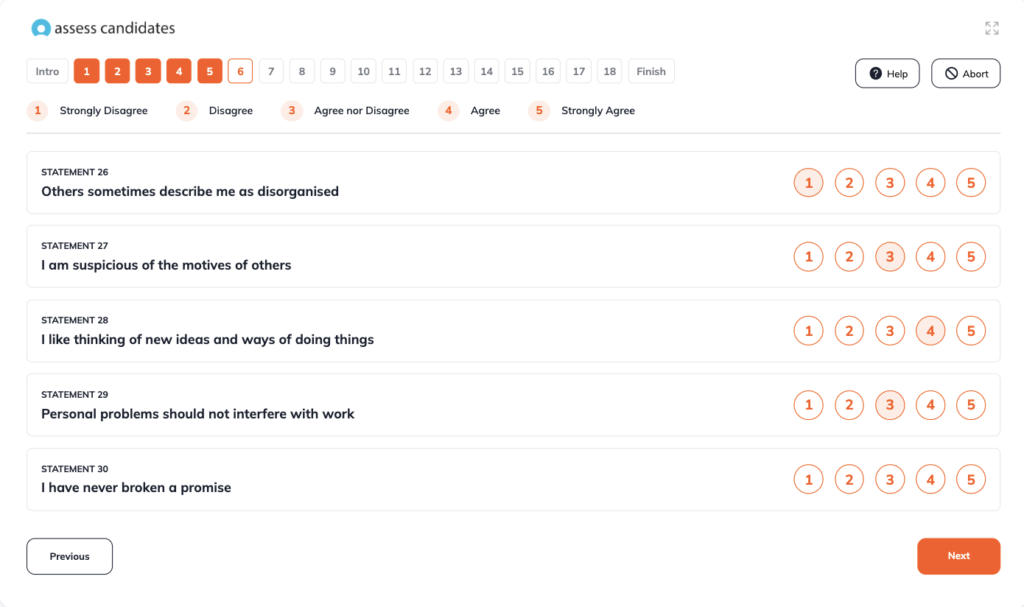
MBTI assessments typically use forced-choice or preference-based questions, asking candidates to choose between two options that reflect different ways of thinking or behaving. There are no right or wrong answers, and questions are designed to surface natural tendencies rather than learned skills.
Examples often explore:
- How someone prefers to focus attention
- How they approach decisions
- How they respond to structure or deadlines
- How they interact with others in work settings
The Myers & Briggs Foundation explains that MBTI questions are designed to identify psychological preferences, not measure knowledge, ability, or experience.
Scoring and type assignment
After completion, responses are grouped into the four preference pairs: E–I, S–N, T–F, and J–P. The test then assigns a four-letter type, such as ISTJ or ENFP, based on the respondent’s reported preferences.
Importantly, MBTI does not measure how strongly a trait is expressed. Individuals close to the midpoint of a preference can display flexibility, even though results still place them into a single category.
Occupational psychology research notes that MBTI results reflect categorical preferences rather than continuous personality traits, which limits their precision for comparison or ranking.
Why Interpret the results?
Because the MBTI places people into fixed types, results can appear more definitive than they really are. Without context, recruiters may assume certain types suit certain roles better. That is why MBTI works best as an insight and discussion tool, not a hiring rule.
This is why best practice is to use MBTI as a discussion and insight tool, not as a decision rule.
Guidance from the Chartered Institute of Personnel and Development (CIPD) cautions against using personality type tools as selection filters and recommends combining them with structured, job-related assessments.
Compare preference data alongside structured data to make balanced hiring decisions. VIEW PLANS
Now that we understand how the Myers-Briggs test works, the next step is practical application.
So how is the MBTI actually used in recruitment? Continue reading as we explore where it adds value, and where recruiters need to be cautious.
4. How is the Myers-Briggs Personality Test used in recruitment?
In recruitment, the Myers-Briggs Personality Test is most commonly used as a supporting insight tool, not a selection filter. When interpreted in context, it helps recruiters and hiring managers better understand how candidates are likely to communicate, collaborate, and approach work, rather than whether they are capable of doing the job.
In hiring, the real question is not “What type is this person?” but “What does this information help us understand more clearly?”
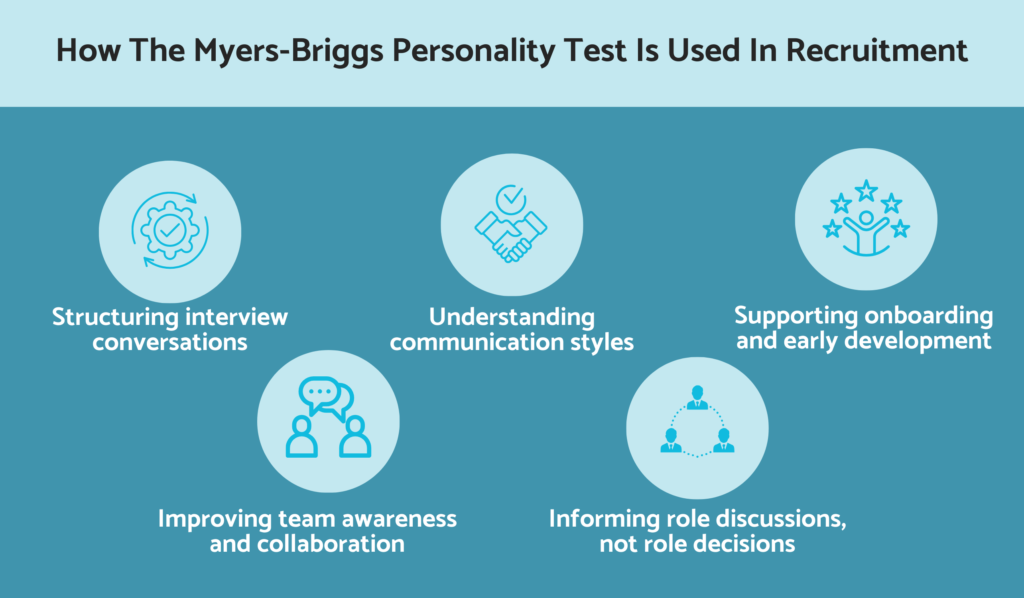
Structuring interview conversations
MBTI insights can guide more focused interview questions around decision-making, communication, and work preferences. This helps interviewers move beyond generic questions and explore how candidates are likely to approach collaboration, feedback, and problem-solving in real work situations.
The Chartered Institute of Personnel and Development (CIPD) notes that personality tools are most effective in recruitment when used to support structured interviews rather than replace them.
Understanding communication styles
Recruiters and hiring managers use MBTI to anticipate how candidates prefer to communicate, whether they lean toward reflection or discussion, facts or possibilities, logic or values. This can reduce misunderstandings during interviews and early working relationships.
Supporting onboarding and early development
MBTI is often introduced after hiring to support onboarding. Understanding a new hire’s preferences can help managers tailor feedback, learning approaches, and expectations, especially for early-career or apprenticeship roles.
Research summarized by the Myers & Briggs Foundation highlights the use of MBTI in improving communication, teamwork, and self-awareness in workplace settings.
Improving team awareness and collaboration
Some organizations use MBTI to increase awareness of team dynamics rather than to assess individuals. When shared appropriately, it can help teams appreciate different working styles and reduce friction caused by miscommunication.
Informing role discussions, not role decisions
MBTI can contribute to conversations about how a role is approached, but it should never be used to decide who is “fit” or “unfit” for a position. Behavioral insights must always be interpreted alongside skills, experience, and job requirements.
The Chartered Institute of Personnel and Development (CIPD) recommends using personality tools to inform interviews and development discussions rather than as selection or screening instruments.
What MBTI should not be used for
Despite its popularity, you should not use MBTI to:
- Screen candidates in or out
- Predict job performance or retention
- Match people to roles based on “ideal” personality types
If you use MBTI this way, you risk oversimplifying candidates and introducing unintended bias.
Occupational psychology guidance emphasizes that personality type tools should not be used as standalone selection methods due to limited predictive validity for job performance.
Combine behavioral insights with skills-based, role-relevant assessments to improve hiring decisions. LEARN MORE
Read on as we’ll compare the Myers-Briggs Personality Test with other personality frameworks to highlight its strengths, limitations, and where it fits best within a modern hiring process.
5. Myers-Briggs vs other personality tests
The Myers-Briggs Personality Test is one of the most recognizable personality frameworks, but it is not the only option used in recruitment. Comparing the Myers-Briggs assessment with other commonly used personality assessments helps clarify where it adds value and where its limitations become more pronounced.
How Myers-Briggs differs from trait-based models
Unlike trait-based assessments such as the Big Five, which measure personality on continuous scales, MBTI categorizes individuals into distinct personality types. This makes results easier to understand and communicate, especially for non-technical audiences, but reduces precision when comparing candidates.
Personality research published in the Journal of Applied Psychology notes that trait-based models provide stronger predictive validity for job performance than typological models.
Strengths of Myers-Briggs compared to other tests
Myers-Briggs is often favored in workplace settings because it:
- Uses accessible language that is easy for candidates and managers to understand
- Encourages self-reflection and discussion rather than evaluation
- Supports communication, team awareness, and development conversations
- Is widely recognized and familiar across industries
These strengths make MBTI particularly useful for training, onboarding, and team development, rather than selection.
The Myers & Briggs Foundation emphasizes that the MBTI is intended to support understanding and development, not to predict performance or rank individuals.
Limitations compared to other personality assessments
When you compare it to models like the Big Five or validated occupational personality inventories, MBTI has several limitations:
- It assigns categorical types rather than measuring traits on a spectrum
- Individuals near preference midpoints may be over-classified
- It has weaker evidence for predicting job performance
- Results can appear more definitive than the underlying data supports
For these reasons, many hiring frameworks prefer trait-based tools when personality data is needed for selection decisions.
Reviews by the American Psychological Association highlight concerns around typological personality tests when used for hiring decisions.
Where Myers-Briggs fits best in hiring
In modern recruitment, MBTI works best as a complementary insight tool, not a core assessment. It can enhance understanding of communication and work preferences, but should always be paired with skills assessments, structured interviews, and job-relevant criteria.
Compare personality insights together with skills, role requirements, and structured hiring data. VIEW PLANS
While understanding the strengths and limits of Myers-Briggs is important, applying it responsibly matters even more. Next, we’ll outline best practices for using the Myers-Briggs Personality Test in hiring to avoid common mistakes and improve decision quality.
6. What are the best practices for using the Myers-Briggs Personality Test in hiring?
The Myers-Briggs Personality Test can add value in hiring when used carefully. The key is to treat MBTI as contextual insight, not as a decision rule.
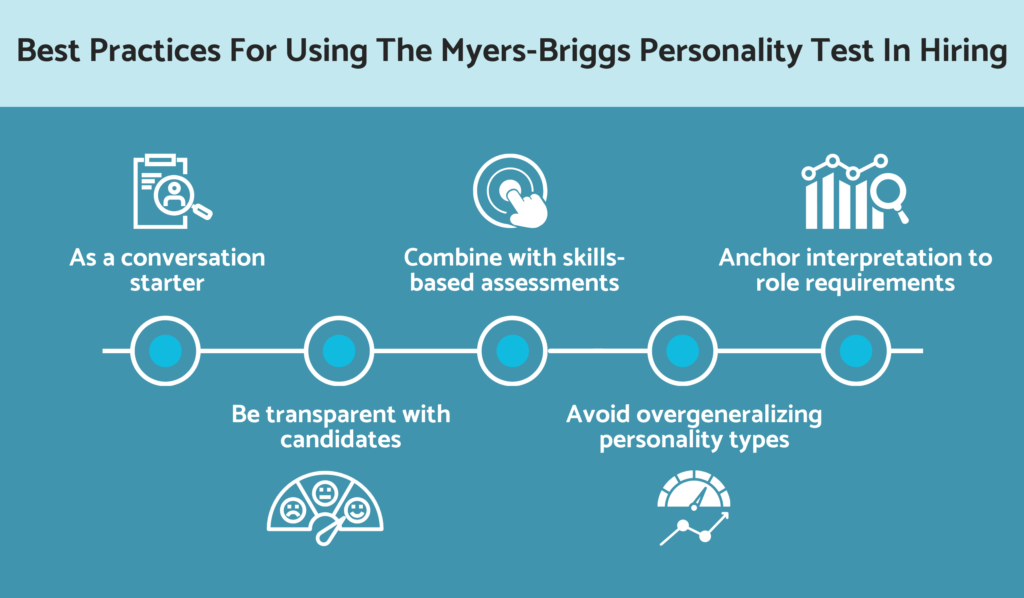
Use MBTI as a conversation starter, not a screening tool
The Myers-Briggs assessment should never be used to screen candidates in or out. Instead, use results to guide structured interview discussions around communication style, decision-making, and work preferences. This keeps hiring decisions focused on job-relevant criteria while still benefiting from personality insight.
Combine MBTI with skills-based assessments
Personality preferences do not indicate capability. Always pair MBTI with skills assessments, work samples, or job simulations to evaluate whether a candidate can actually perform the role. This combination reduces bias and ensures hiring decisions remain evidence-based.
The Chartered Institute of Personnel and Development (CIPD) advises that personality assessments should support structured interviews and skills-based evaluations, rather than being used as standalone hiring tools, to improve fairness and decision quality in recruitment.
Anchor interpretation to clear role requirements
MBTI insights should be interpreted in the context of the role, not against an “ideal” personality type. Define what the job requires in terms of communication, structure, and collaboration before reviewing personality results to avoid stereotyping or oversimplification.
Guidance from the American Psychological Association emphasizes that personality tests measure preferences and tendencies, not job competence or ability, and should be interpreted within clear role requirements and combined with other assessment methods.
Be transparent with candidates
Candidates should understand why the MBTI is being used, how results will be interpreted, and what decisions it will (and will not) influence. Transparency builds trust and reduces the risk of candidates responding in socially desirable ways rather than honestly.
Avoid overgeneralizing personality types
Individuals are more flexible than personality labels suggest. Recruiters should avoid assuming behavior based solely on a four-letter type and instead explore how candidates adapt their preferences in different work situations.
Research summarized by the Society for Human Resource Management (SHRM) highlights that transparent communication about assessment use improves candidate trust and reduces bias, particularly when personality tools are used for development and discussion rather than selection decisions.
Focus on development and onboarding, not just selection
MBTI is often more valuable after hiring than before. Sharing insights during onboarding can help managers tailor communication, feedback, and learning approaches, improving early engagement and reducing friction within teams.
Apply personality insights responsibly within a structured, skills-first hiring framework built for fair decisions. VIEW PLANS
In practice, recruiters need personality context without letting personality dominate the decision.
With these best practices in place, the final question becomes how to apply them consistently at scale.
In the next section, we’ll explain why recruiters choose Assess Candidates to combine preference data, skills assessments, and role-specific criteria into one responsible hiring process.
7. Why choose Assess Candidates?
Personality insight is only useful if it leads to better and fairer hiring decisions. Assess Candidates helps recruiters use tools like MBTI without turning personality into a shortcut or a filter.
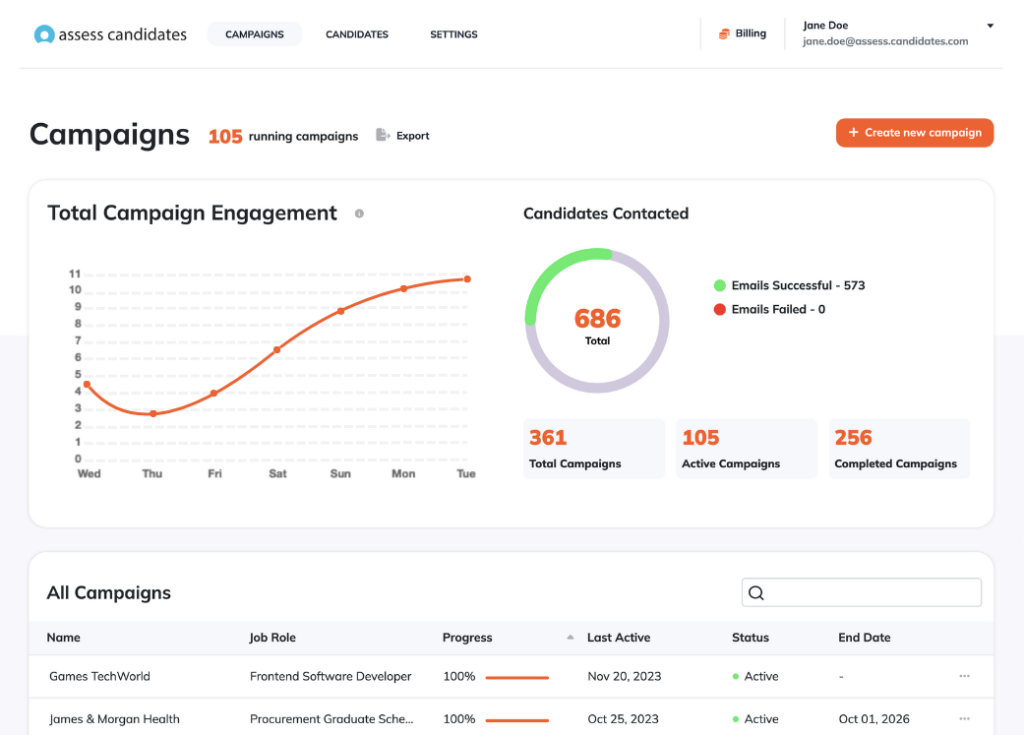
Built for skills-first, fair hiring
Assess Candidates prioritizes skills, potential, and role requirements before personality insights. Personality data is treated as supporting context, never a gatekeeper, ensuring candidates are evaluated for what actually matters: their ability to do the job and grow in the role.
Personality insights without oversimplification
Rather than relying on rigid personality labels, Assess Candidates helps recruiters interpret behavioral preferences alongside real hiring data. This reduces the risk of stereotyping candidates or assuming performance based on personality type alone.
Structured, consistent decision-making
Unstructured interviews and gut-feel decisions introduce bias and inconsistency. Assess Candidates provides a structured hiring framework where behavioral insights, skills assessments, and job criteria work together, making decisions clearer, more defensible, and easier to explain to stakeholders.
Designed for early-career and apprenticeship hiring
For apprenticeships and early-career roles, traditional signals like experience are often limited. Assess Candidates supports fair evaluation by focusing on potential, learning ability, and behavioral tendencies, rather than relying on CVs or personality tests in isolation.
Responsible use backed by science
Assess Candidates is built on evidence-based hiring principles. Personality frameworks such as MBTI are used where they add value, mainly to support communication, development, and structured discussion, while keeping final decisions anchored to skills, job criteria, and fair assessment practice.
Key Takeaways
The Myers-Briggs Personality Test can help you understand how candidates prefer to think, communicate, and make decisions, but it was never designed to measure skills, intelligence, or job performance. The 16 personality types describe preference patterns, not fixed behaviors, which means candidates often adapt their style based on the role, the team, and the environment you place them in.
In hiring, MBTI works best when you use it as a lens, not a label. It can guide better interview conversations, highlight collaboration styles, and surface potential team dynamics, but it should never replace skills assessments or structured evaluations. When you rely on it alone, you risk oversimplifying people and missing what actually predicts success on the job.
That is why modern, fair hiring requires more than personality insights alone. Platforms like Assess Candidates help you combine personality context with skills-based assessments, structured evaluations, accessibility features, and anti-cheat safeguards, so you can hire with clarity, fairness, and confidence, not guesswork.
That approach makes the Myers-Briggs personality test more useful in hiring by keeping personality insight in context rather than using it as a shortcut.
Want to apply personality tests responsibly without compromising fairness? Talk to our experts. CONTACT US
Curious about how personality tests like Myers-Briggs fit into fair, skills-first hiring? Explore the frequently asked questions below to understand best practices, limitations, and responsible use, and sign up with your email to get started with Assess Candidates.
Frequently Asked Questions
Is the Myers-Briggs Personality Test reliable for recruitment?
The Myers-Briggs Personality Test is reliable for understanding personality preferences and communication styles, but not for predicting job performance. Its value in recruitment comes from a consistent interpretation of how individuals prefer to think and interact. When combined with structured interviews and skills assessments, it can support more informed and balanced hiring discussions.
Can the Myers-Briggs Personality Test predict job performance?
No. The Myers-Briggs test is not designed to predict job performance, intelligence, or competence. Instead, it explains preferences in decision-making and information processing. Research shows that job performance is better predicted when personality insights are combined with skills assessments, structured interviews, and clearly defined role requirements.
What does the Myers-Briggs test measure, and what does it not measure?
The Myers-Briggs test measures personality preferences across four dimensions, such as how people gather information and make decisions. It does not measure technical ability, motivation, emotional intelligence, or job readiness. Because of this, it should be used as a complementary insight tool rather than a hiring filter.
Is the Myers-Briggs test suitable for apprenticeship and early-career hiring?
Yes, when handled appropriately. For early-career and apprenticeship hiring, Myers-Briggs can help explain learning preferences and communication styles where experience is limited. However, it should always be paired with skills-based assessments and clear role criteria to ensure candidates are evaluated fairly and objectively.
Should the Myers-Briggs test be used as a pass-or-fail assessment?
No. Best practice strongly advises against using Myers-Briggs as a pass-or-fail tool. Personality types are not indicators of suitability or success. Instead, results should inform interview discussions, onboarding, and development, while final hiring decisions are based on skills, potential, and role-specific requirements.
How does Assess Candidates support the responsible use of Myers-Briggs testing?
Assess Candidates embeds personality insights within a structured, science-backed hiring framework. This ensures Myers-Briggs results are interpreted alongside skills data, job criteria, and structured interviews. By preventing overreliance on personality types, Assess Candidates helps recruiters make fairer, more defensible, and more confident hiring decisions.


 English
  Arabic