
The Big 5 Personality Test: What It Is And How It Works



Have you ever hired someone who checked every skills box, only to realize a few weeks later that something was off? The work quality is fine, but they struggle with feedback, clash with teammates, or can’t handle pressure. Before long, the hire starts to feel like a mistake.
This happens more often than most recruiters admit. And it usually isn’t a skills problem; it’s a personality fit problem. When hiring decisions rely only on CVs and interviews, critical personality traits are often overlooked.
This is where the Big 5 personality test comes in. It helps you understand how candidates are likely to behave at work, from how organized and dependable they are, to how they interact with others, adapt to change, stay open to new ideas, and cope with pressure, before you make the hire.
According to research summarized by the American Psychological Association (APA), personality traits measured by the Big 5 framework are reliably linked to important work outcomes, including job performance, teamwork, and stress management.
In this guide, we’ll explain…
Contents
- What is the big 5 personality test?
- Why recruiters use the Big 5
- What does the big 5 personality test measure?
- How does the big 5 personality test work?
- How is the big 5 personality test used in recruitment?
- The big 5 personality test vs other personality tests
- What are the best practices for using the big 5 personality test in hiring?
- Why choose Assess Candidates?
To understand whether the Big 5 can actually help reduce hiring surprises, it’s important to first understand what it is.
1. What is the Big 5 personality test?
The Big 5 personality test, also known as the Five Factor Model, is a research-backed assessment that helps you measure how people typically behave, think, and respond in everyday situations, including at work. Rather than labeling candidates into rigid “types,” it evaluates personality across five broad traits that exist on a spectrum.
Unlike many popular personality tests used in hiring, the FFM is grounded in decades of psychological research. That’s why it’s often described as a trait-based model, not a typology. Candidates aren’t boxed into categories; instead, recruiters gain a clearer picture of behavioral tendencies that influence how someone works with others, manages tasks, and responds to pressure.
Confident hiring starts with better insight. Make science-backed decisions from the start. HIRE FOR FREE

2. Why recruiters use the Big 5
For hiring teams, the value of the Big 5 lies in its practical relevance to workplace behavior. The test helps move hiring conversations beyond “culture fit” as a vague concept and toward observable, job-related traits.
Used correctly, the Big 5 supports more structured, evidence-based decisions by helping recruiters anticipate how a candidate may:
- approach responsibilities and deadlines
- interact with colleagues and managers
- adapt to change and new ideas
- handle stress and emotional demands
What makes the Big 5 different from personality “types”
Many personality tests assign candidates to fixed categories, which can oversimplify human behavior. The Big 5 takes a different approach.
Each trait is measured along a continuum, meaning candidates may score higher or lower on each dimension rather than being labeled as one thing or another. This makes the results more flexible, nuanced, and suitable for hiring contexts where there is rarely a single “ideal personality”.
For recruiters, this means the Big 5 isn’t about finding the perfect personality; it’s about understanding fit for a specific role and work environment.
Research published in the Journal of Applied Psychology shows that Big 5 traits, particularly conscientiousness, are consistently related to important workplace outcomes such as job performance and teamwork across roles and industries.
Now that we’ve clarified what the Big 5 personality test is, the next step is to look at what it actually measures, and just as importantly, what it doesn’t. Knowing this difference is key for using personality data responsibly in hiring.
3. What does the Big 5 personality test measure?
The Big 5 personality test measures stable personality traits that influence how people tend to think, feel, and behave at work. These traits don’t predict whether someone can do the job; they help explain how they’re likely to do it.
The Big 5 framework is one of the most widely accepted models of personality, supported by decades of cross-cultural and longitudinal research
Top 5 traits that the Big 5 personality test measures:
The test assesses 5 broad trait dimensions or factors, each of which sits on a spectrum rather than a fixed category.
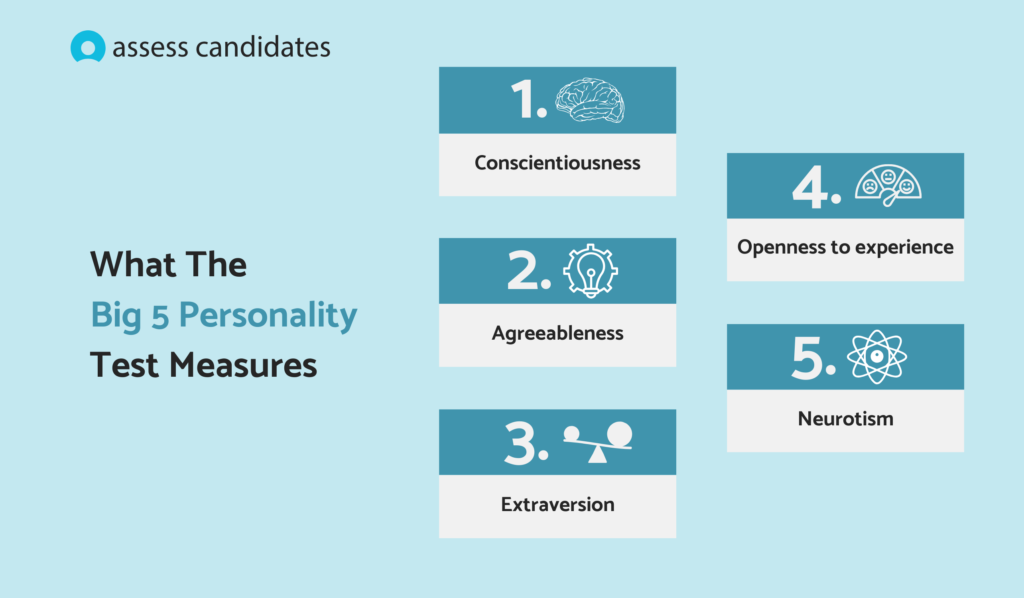
These five traits are commonly summarized using the acronyms OCEAN or CANOE, both referring to the same Big 5 personality framework.
1. Conscientiousness (C)
Reflects how organized, dependable, and goal-oriented a person is. In work settings, this trait is often linked to reliability, attention to detail, and follow-through on tasks.
2. Agreeableness (A)
Indicates how cooperative, empathetic, and considerate someone tends to be. This trait influences how candidates work in teams, handle conflict, and respond to feedback.
3. Extraversion (E)
Describes where a person draws energy from and how they typically engage with others. Higher scores may suggest comfort with collaboration and communication, while lower scores may align with more independent or reflective work styles.
4. Openness to experience (O)
Relates to curiosity, creativity, and openness to new ideas. This trait can be relevant in roles that require problem-solving, adaptability, or learning in fast-changing environments.
5. Neurotism (N)
This simply means emotional stability; it reflects how well someone manages stress and emotional pressure. It can offer insight into resilience, composure, and reactions under demanding conditions.
What the Big 5 personality test does not measure
Just as important as what the Big 5 measures is what it doesn’t.
- It does not measure skills or technical ability
Personality traits don’t indicate whether a candidate has the required knowledge, experience, or competencies to perform a role.
- It does not measure intelligence or cognitive ability
The Big 5 is not an IQ test and should not be used as a proxy for problem-solving capacity or learning speed.
- It does not predict job performance on its own
While certain traits are associated with workplace outcomes, personality data alone cannot determine success. Context, role requirements, and skills still matter.
Guidance from occupational psychology research highlights that personality tests predict patterns of behavior at work but do not directly measure job skills or task performance. This reinforces the need to pair them with structured interviews and skills-based evaluations.
Why this distinction matters in hiring
Misusing personality tests is a common pitfall in the recruitment process. The Big 5 is most effective when used as one input, not a decision-maker. When combined with skills assessments, structured interviews, and clear job criteria, it helps reduce blind spots, not replace judgment.
Used responsibly, the Big 5 supports better-informed, fairer hiring decisions without over-reliance on subjective impressions.
Understand candidate behavior beyond CVs with science-backed personality assessments. LEARN MORE
Once you understand what the Big 5 does and doesn’t measure, the next question is how these insights are actually generated. That starts with understanding how the assessment itself works.
4. How does the Big 5 personality test work?
At its core, the Big 5 personality test works by asking candidates to respond to a series of standardized statements designed to capture consistent behavior patterns. The goal isn’t to judge or rank candidates, but to understand how they are likely to behave at work over time.
Question format: simple, structured statements
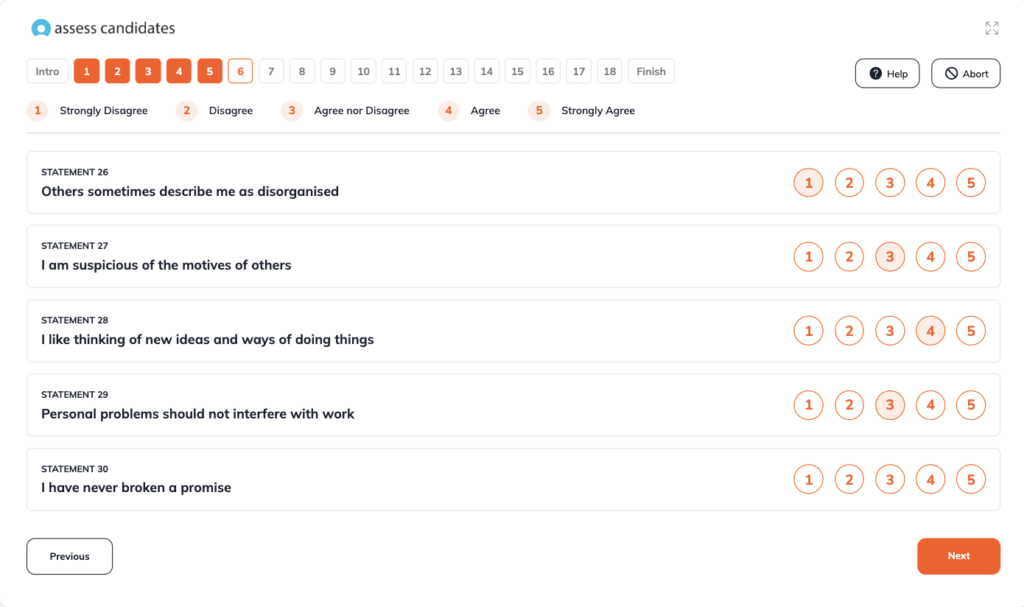
Most Big 5 assessments use self-report questionnaires made up of short statements. Candidates indicate how strongly they agree or disagree using a fixed response scale.
Typical response scales include:
- Strongly disagree
- Disagree
- Neutral
- Agree
- Strongly agree
This consistent structure helps reduce ambiguity and makes responses easier to interpret across candidates.
According to the Society for Human Resource Management (SHRM), most personality assessments used in hiring today are based on standardized questionnaires with consistent response scales, ensuring fair comparison across candidates.
Example Big 5 personality test questions
While exact wording varies by provider, questions are designed to reflect everyday behaviors rather than abstract personality labels.
Examples include:
- “I follow through on tasks even when they become challenging.”
- “I remain calm under pressure.”
- “I enjoy working with others to solve problems.”
- “I like exploring new ideas and approaches.”
These types of statements map back to the five core traits without explicitly naming them, helping candidates respond naturally.
How scoring works
Big 5 results are trait-based and continuous, not pass-or-fail.
Each response contributes to a score for each trait, typically shown as:
- low
- moderate
- high
Importantly, there is no “ideal” Big 5 profile. A higher or lower score isn’t inherently good or bad; it only becomes meaningful when interpreted in the context of a specific role and work environment.
Research summarized by Harvard Business Review notes that trait-based personality models like the Big Five assess behavior on a continuum rather than fixed categories, making them better suited for workplace decision-making than type-based tests.
What recruiters actually receive
For hiring teams, results are usually presented as:
- a visual trait profile (e.g., bars or scales)
- brief behavioral descriptions tied to each score
- guidance on how traits may show up at work
This allows recruiters to compare candidates consistently without relying on gut feeling or subjective impressions.
Why standardization matters in hiring
Because the Big 5 uses the same structure and scoring logic across candidates, it supports fairer and more consistent evaluation. Everyone answers the same types of questions under the same conditions, which helps reduce bias introduced by unstructured interviews alone.
That said, accuracy still depends on how the results are interpreted and used, which is why the Big 5 works best as part of a broader assessment strategy, rather than in isolation.
A report by the Chartered Institute of Personnel and Development (CIPD) explains that standardized scoring in personality tests helps recruiters reduce subjectivity and improve consistency when evaluating candidate behavior.
See how science-backed assessments turn personality data into clear hiring insights. LEARN MORE
Understanding how the Big 5 works is only part of the picture. What matters most is how these insights are applied in real hiring scenarios, from screening to final decisions.
5. How is the Big 5 personality test used in recruitment?
In recruitment, the Big 5 personality test is most effective when used to support decision-making, not replace it. Hiring teams use it to add structure and behavioral insight at key stages of the hiring process, especially where interviews and CVs fall short.
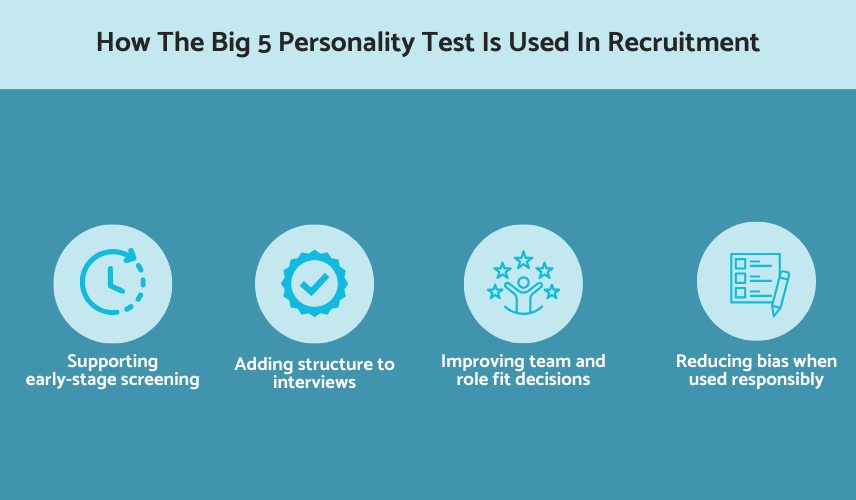
Supporting early-stage screening
At the screening stage, the Big 5 helps recruiters identify behavioral tendencies that may align with the demands of a role. For example, roles that require close attention to detail may benefit from higher conscientiousness, while customer-facing roles may place more emphasis on agreeableness or emotional stability.
According to the Society for Human Resource Management (SHRM), personality assessments are commonly used early in the hiring process to complement automated CV screening by highlighting behavioral traits that are difficult to assess through resumes alone.
Adding structure to interviews
One of the most practical uses of the Big Five is guiding structured interviews. Rather than using generic questions, recruiters can tailor follow-up questions based on a candidate’s trait profile.
For example, asking about stress management when neuroticism scores are lower or exploring collaboration style when agreeableness varies between candidates, helping validate assessment results with real, job-relevant behavior.
This leads to more consistent, job-relevant conversations.
Research highlighted by Harvard Business Review shows that structured interviews informed by assessment data are more predictive of job success than unstructured interviews based on intuition alone.
Improving team and role fit decisions
Beyond individual performance, the Big 5 is often used to support team composition and role fit. Hiring managers can better anticipate how a candidate might interact with existing team dynamics, communication styles, and leadership approaches.
Importantly, this isn’t about hiring “one personality type,” but about understanding how different traits complement specific roles and teams.
A report by the Chartered Institute of Personnel and Development (CIPD) notes that personality data can help organizations make more informed role-fit decisions when interpreted in the context of job requirements and team environments.
Reducing bias when used responsibly
When applied consistently, the Big 5 can help reduce reliance on gut feeling and first impressions. Because all candidates are assessed using the same framework, recruiters gain a more standardized and defensible basis for comparison.
That said, results should always be reviewed alongside skills assessments, experience, and structured interviews.
Guidance from the UK Equality and Human Rights Commission emphasizes that fair hiring practices rely on consistent, job-related assessment criteria rather than subjective judgments.
Compare personality insights alongside skills using structured, science-backed assessments. VIEW PLANS
While the Big 5 offers clear advantages, it isn’t the only personality framework used in hiring. Comparing it with other tests helps clarify where it works best.
6. The Big 5 personality test vs other personality tests
With so many personality assessments available, it’s natural for recruiters to ask how the Big 5 personality test compares to other commonly used tools. While several tests aim to describe behavior, they differ significantly in scientific grounding, structure, and suitability for hiring decisions.
Big 5 vs MBTI
The Myers-Briggs Type Indicator (MBTI) groups individuals into fixed personality “types.” While popular in team-building and self-reflection contexts, it is less suited to recruitment because it categorizes people rather than measuring traits on a spectrum.
The Big 5 takes a different approach. Instead of labeling candidates, it evaluates behavioral tendencies along continuous scales, making it more flexible and job-relevant.
Harvard Business Review notes that trait-based models like the Big Five are generally more reliable for workplace decision-making than type-based tools such as MBTI, which can oversimplify behavior.
Big 5 vs DISC
DISC focuses on observable behavior styles, particularly communication and interaction patterns. While useful for sales or leadership development, it does not provide the same depth or research backing as the Big 5.
The Big 5 covers a broader range of traits, including emotional stability and openness, which are often critical in complex or high-pressure roles.
According to the Chartered Institute of Personnel and Development (CIPD), broader personality frameworks grounded in psychological research offer more consistent insight for hiring decisions than behavior-only models.
Strengths of the Big 5 in hiring compared to the other personality assessments
Compared to many other personality assessments, the Big 5 is often favored in recruitment because it is:
- backed by decades of research
- applicable across roles and industries
- measured on continuous scales rather than fixed categories
- easier to combine with other structured hiring tools
A review published by the Society for Human Resource Management (SHRM) highlights the Big Five as one of the most scientifically supported personality models used in employment assessments.
Limitations to keep in mind
Despite its strengths, the Big 5 is not a complete hiring solution. First, it relies on self-reported responses, which can be influenced by how candidates perceive themselves or wish to be perceived.
Another limitation is that the Big 5 does not measure skills, experience, or job competence, and it should never be used as a standalone screening or pass-fail tool.
And thirdly, without clear role definitions and proper guidance on interpretation, results can be misapplied or overemphasized, leading to poor hiring decisions rather than better ones.
SHRM guidance emphasizes that personality tests should support, not replace, skills evaluation, structured interviews, and job-related assessments.
Understanding how the Big 5 compares to other personality tests helps clarify its value, but effectiveness ultimately depends on how it’s used. In the next section, we’ll focus on best practices for applying the Big 5 responsibly and effectively in real hiring decisions.
7. What are the best practices for using the Big 5 personality test in hiring?
When applied correctly, the Big 5 personality test can significantly improve hiring accuracy. However, its effectiveness depends less on the test itself and more on how recruiters interpret and integrate the results into the broader hiring process.
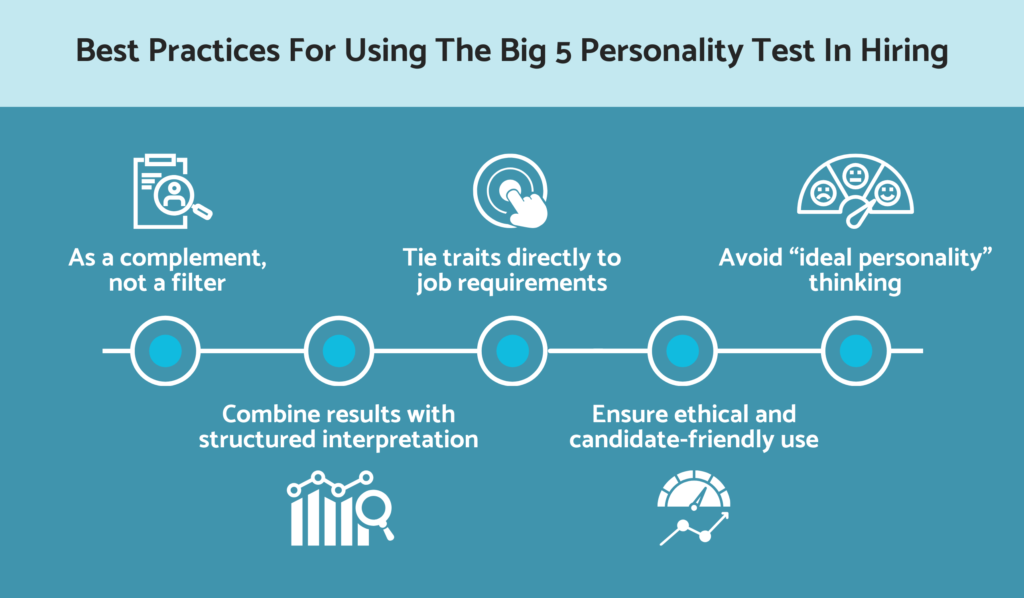
Use the Big 5 as a complement, not a filter
The Big 5 should support hiring decisions, not replace core evaluations like skills testing or structured interviews. Personality traits explain how someone works, not whether they can do the job.
Tie traits directly to job requirements
Before administering the assessment, recruiters should clearly define which traits matter for success in the role. For example, high conscientiousness may be critical for compliance-heavy roles, while openness may matter more in innovation-driven teams.
Research published in the Journal of Applied Psychology shows that aligning personality traits with job-specific criteria significantly improves predictive validity in hiring.
Avoid “ideal personality” thinking
There is no universally “best” personality profile. Overvaluing certain traits can unintentionally exclude strong candidates who perform well through different working styles.
Combine results with structured interpretation
Personality data should be interpreted using standardized benchmarks and clear scoring frameworks, rather than intuition. This reduces bias and ensures consistency across candidates.
Ensure ethical, transparent, and candidate-friendly use
Candidates should understand why the Big 5 personality test is being used, how their data will be evaluated, and how it fits into the overall hiring decision. Transparency builds trust and improves candidate experience, especially for early-career and apprenticeship applicants.
The British Psychological Society states that ethical use of personality assessments requires transparency, informed consent, and clear communication of how results will be used in employment decisions.
With these best practices in mind, the next question is how to apply the Big 5 Personality Test in a way that’s structured, ethical, and practical at scale. In the next section, we’ll look at how Assess Candidates helps employers turn personality insights into confident, job-relevant hiring decisions.
8. Why choose Assess Candidates?
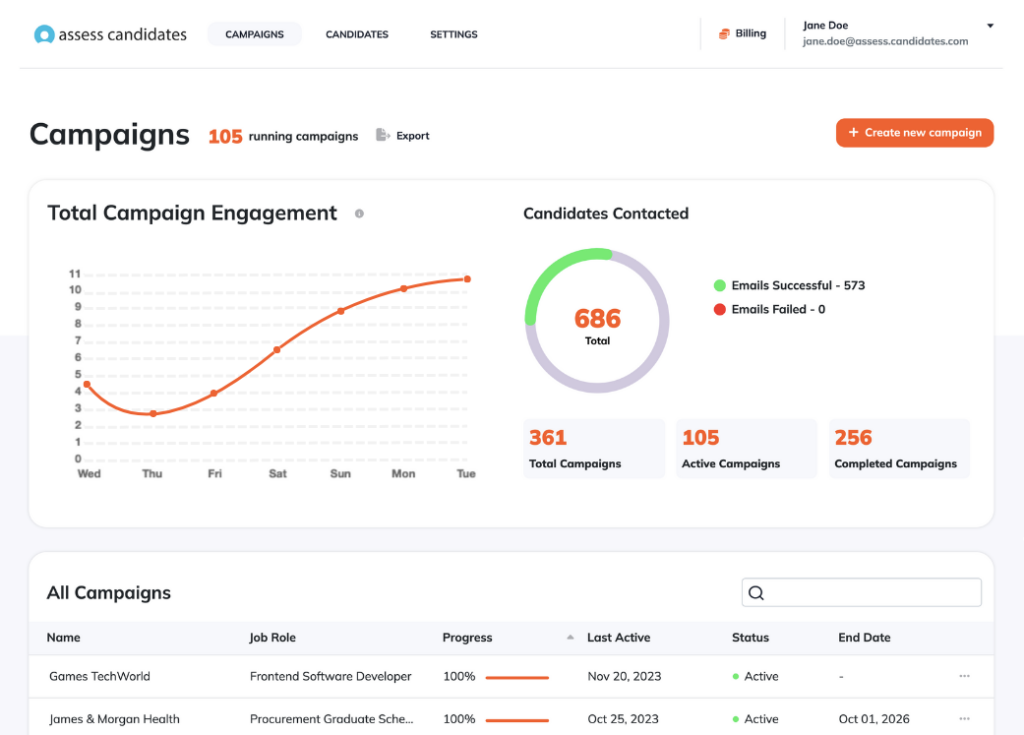
Hiring with personality data only works when the assessment is job-relevant, scientifically grounded, and easy to use. That’s where Assess Candidates stands out.
Assess Candidates helps employers use the Big 5 Personality Test responsibly, translating complex psychological insights into clear, practical hiring signals. Instead of raw trait scores, you see how candidates are likely to collaborate, respond to feedback, manage pressure, and stay organized on the job; exactly what matters in real work environments.
Our assessments are built to support fair, structured, and bias-resistant hiring, especially for apprentices and early-career roles where traditional CVs reveal very little. Personality insights are never used in isolation, but combined with skills, motivation, and role requirements to give you a well-rounded view of candidate potential.
The Society for Industrial and Organizational Psychology emphasizes that personality assessments are most effective when they are job-related, standardized, and interpreted within a structured hiring framework.
At Assess Candidates, our personality tests are:
Built for real hiring decisions, not personality labels
Understanding personality is only useful if it translates into better hiring decisions. Assess Candidates focuses on job-relevant behavioral insights, not abstract personality labels, helping recruiters understand how candidates are likely to perform, collaborate, and adapt in real workplace situations.
Science-backed and recruitment-ready
Our assessments are grounded in validated personality research and designed specifically for hiring. Results are structured, consistent, and easy to interpret, so hiring teams can compare candidates fairly and make defensible decisions without relying on gut instinct.
Supports responsible and fair use
Personality data should never be used in isolation. At Assess Candidates, we encourage best practice by integrating personality insights with skills, experience, and structured interviews, helping reduce bias while improving long-term fit and retention.
Simple to use, easy to scale
Whether you’re hiring for a single role or across multiple teams, Assess Candidates fits seamlessly into existing recruitment workflows, allowing you to assess personality consistently without adding complexity or slowing down hiring.
Build better teams using science-backed assessments for fair hiring decisions. CONTACT US
Curious about how to assess personality fit more effectively in hiring? Explore the frequently asked questions below, and sign up with your email to start using Assess Candidates.
Frequently Asked Questions
What is the Big 5 personality test used for in hiring?
The Big 5 personality test is used to understand how candidates are likely to behave at work, such as how they collaborate with others, manage stress, stay organized, adapt to change, and approach tasks. Recruiters use it to complement skills and experience, not replace them.
Is the Big 5 personality test reliable for recruitment?
Yes. The Big 5 model is one of the most widely researched and validated personality frameworks in psychology, supported by decades of empirical studies. When used correctly and alongside other hiring tools, it provides consistent, job-relevant behavioral insights that help recruiters make fairer, more structured, and defensible hiring decisions.
Can the Big 5 personality test predict job performance?
The Big 5 personality test does not predict job performance on its own. However, research shows that certain traits, particularly conscientiousness, are consistently associated with stronger job performance across roles. Its real value comes when personality insights are combined with skills assessments, structured interviews, and job-specific criteria.
Should personality tests be used as a pass-or-fail tool?
Personality tests should never be used as a pass-or-fail hiring tool. They work best as one data point alongside skills assessments, experience, and structured interviews. Using this balanced approach helps recruiters avoid unfair exclusions while making more informed, job-relevant, and defensible hiring decisions.
Is the Big 5 personality test fair to candidates?
When designed and administered responsibly, the Big 5 personality test is considered fair and relatively low-biased. Ensuring transparency, informed consent, and clear communication about how results will be used is essential. When combined with other assessments, it supports more consistent and equitable hiring decisions.
How does Assess Candidates support responsible use of personality testing?
Assess Candidates supports responsible personality testing by embedding the Big 5 insights within a structured, science-backed hiring framework. This approach helps recruiters interpret results correctly, avoid overreliance on personality data, and combine insights with skills assessments, experience, and structured interviews for fair, job-relevant decision-making.


 English
  Arabic