
How to Reassess Cognitive Abilities in Assessment Centers



Reassessing cognitive abilities during assessment centers can help employers investigate differences between earlier test results and performance under supervised conditions. However, repeat testing is not always necessary, and differences in scores do not automatically indicate misconduct.
This guide explains when psychometric reassessment may be useful, how to select appropriate verification tests, and how to interpret results fairly without adding unnecessary steps to recruitment.
Contents
- Why reassess cognitive abilities in assessment centers?
- Top 5 challenges of reassessing cognitive ability in assessment centers
- Key strategies for assessing cognitive ability in assessment centers
- Employer examples of psychometric reassessment
First, let us see the significance of testing cognitive ability in assessment centers.
1. Why reassess cognitive abilities in assessment centers?
Employers may consider reassessing cognitive abilities when earlier test conditions were unsupervised, results require clarification, or candidates have not completed comparable assessments. The decision should depend on the role, the purpose of testing, and whether a follow-up assessment will provide meaningful additional evidence.
Importance of reassessing cognitive skills in assessment centers
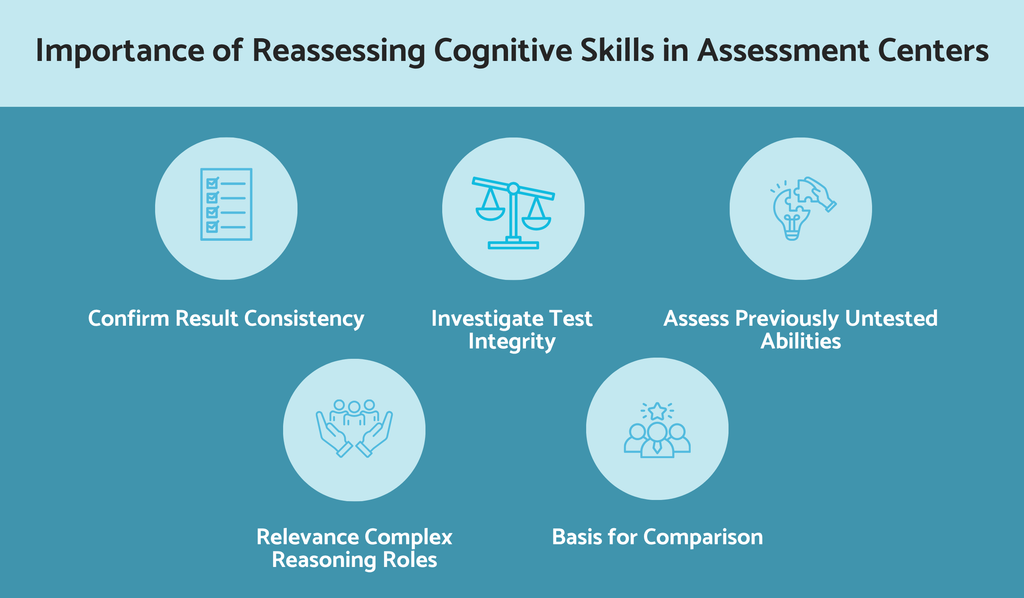
1. Confirm Result Consistency
A follow-up assessment may help employers explore whether an earlier result is consistent with performance under different testing conditions. Differences should be interpreted in light of test reliability, score comparability, candidate circumstances, and other relevant evidence.
2. Investigate Test Integrity
When candidates complete assessments remotely, employers may have questions about whether the stated test conditions were followed. A supervised follow-up test can provide additional evidence, but differences between results may also reflect anxiety, fatigue, test familiarity, or measurement variation. Employers should investigate discrepancies rather than treating them as proof of cheating.
3. Assess Previously Untested Abilities
Some organizations do not use psychometric tests during initial screening, but they rely on CV reviews, phone screens, or early interviews instead. In these cases, the assessment center is the first opportunity to formally measure the candidates’ cognitive ability.
4. Relevance for Roles Requiring Complex Reasoning
Reassessing your candidates’ cognitive skills may be necessary for roles that require strong analytical thinking, problem-solving, or decision-making under pressure, as these skills are key predictors of job performance. CIPD states that standardized tests of cognitive ability can be good predictors of job performance, especially for occupations that require complex thinking.
5. Basis for Comparison
When candidates have completed different earlier assessments, employers may need a more consistent evidence base. A common, job-relevant assessment can help, but this is a new standardized evaluation rather than verification of a previous score.
Recruit skilled candidates with our psychometric assessment tests. HIRE FOR FREE
Should the candidate’s reassessed score differ from the initial test, here is what the recruiter can do.
What should employers do if the scores are different?
Differing results should not be viewed as an immediate basis for rejecting a candidate. Instead, when considering both sets of scores, the recruiter should:
- Check whether both tests measure the same ability and have comparable scoring.
- Consider measurement error, testing conditions, and reasonable adjustments.
- Review the discrepancy with an appropriately qualified assessor.
- Investigate concerns fairly and avoid automatic rejection.
Reassessment can resolve some uncertainties, but it can also introduce new ones if employers choose unsuitable tests or interpret score differences too quickly.

2. Top 5 challenges of reassessing cognitive ability in assessment centers
Reassessing cognitive ability at assessment centers offers clear benefits. However, it also presents challenges that you must manage carefully, or you risk losing skilled candidates.
Challenges of reassessing skills in assessment centers
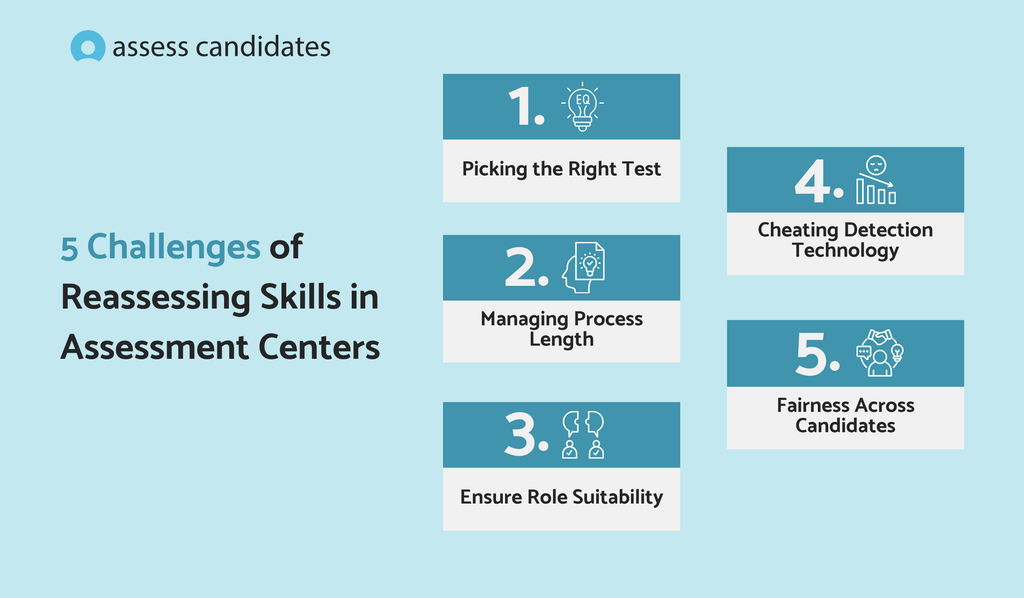
1. Picking the Right Test
Not all psychometric tests are suitable for every role or hiring stage. Therefore, it is key to decide which skills to measure and whether the test chosen aligns with your role’s requirements.
Solution: Pinpoint the cognitive skills that matter the most for the role before selecting a suitable test. Ensure you use validated, job-relevant assessments rather than generic tests.
2. Managing Process Length
Your assessment centers already include several group exercises, interviews, and on-the-job activities. Adding psychometric tests can extend the day and increase candidate fatigue. This can risk candidate drop-off in the hiring process.
Solution: Use short verification tests rather than repeating the full original assessment. You can also schedule your tests strategically within the day and allow breaks between complex exercises.
3. Ensure Role Suitability
A test designed for graduates will likely not test the skills of experienced professionals, and vice versa. We recommend that you ensure the test difficulty and format match the candidate level that you are assessing.
Solution: Implement role-specific or level-appropriate tests for your candidates in the recruitment process. Ensure your test aligns with the actual demands of the role; otherwise, you may get a skilled candidate for the wrong role.
4. Cheating Detection Technology
Having proctored testing can help you flag unusual behavior, though not all flags indicate cheating. Technical issues, anxiety, or unfamiliarity with the platform can also cause unusual patterns in your candidates’ answers.
Solution: Use proctoring data as a signal but do not accuse your candidates based on one single flag. Give them the opportunity to explain unusual results, while combining proctoring data with other evidence before making a hiring decision.
5. Fairness Across Candidates
Psychometric tests can often introduce cultural bias or disadvantage to some of your candidates from different backgrounds if not designed carefully.
Solution: Ensure that your validated psychometric tests have been checked for cultural fairness. Provide candidates with clear instructions to avoid unnecessary errors. You can then monitor the results across candidate groups to identify and address any patterns of disadvantage.
Discover assessments created by Chartered Scientists to hire top candidates. VIEW PLANS
The most effective approach begins with a simple question: what additional evidence would a second assessment provide?
3. Key strategies for assessing cognitive ability in assessment centers
Reassessment is most useful when it answers a specific question about earlier cognitive test results. Employers should choose an appropriate assessment, consider whether the additional evidence is necessary, and explain the process clearly to candidates.
Practices for reassessing cognitive ability in assessment centers
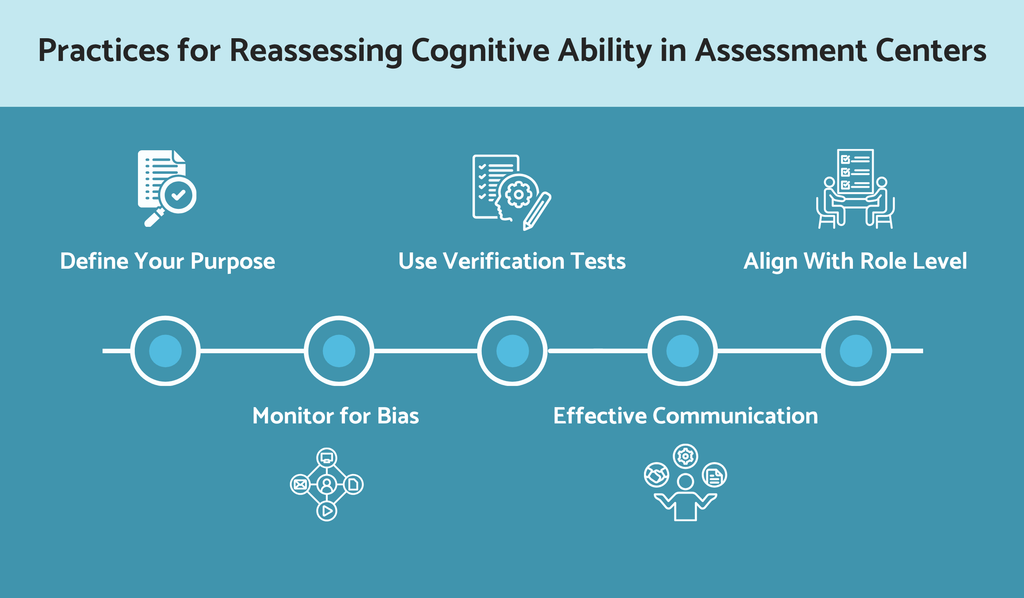
- Define Your Purpose
Clarify why you are reassessing cognitive ability before choosing a test in your assessment center. Ask yourself if you are confirming earlier results, detecting cheating, assessing untested skills, or creating a consistent baseline. Having a clear purpose helps guide your selection of psychometric tests, format, and communication with your candidates.
- Use Verification Tests
Where verification is justified, use a short, appropriately designed follow-up assessment that measures the same relevant ability as the original test. Check that the scores can be interpreted meaningfully together, and avoid assuming that any shorter test will provide reliable verification.
- Align With Role Level
Cognitive ability assessments may provide useful evidence for roles involving complex analysis and reasoning. Employers should select tests based on the actual job requirements and consider whether repeating an earlier assessment adds enough value to justify the additional candidate burden.
- Monitor for Bias
Review whether the selected assessment is appropriate for the role and candidate population. Provide reasonable adjustments where required, monitor for patterns of disadvantage, and investigate whether test design or administration may be contributing to unfair outcomes.
- Effective Communication
Explain why candidates are being reassessed, what the follow-up test measures, and how the results will be considered. Make clear that a score difference does not automatically indicate misconduct or disqualify a candidate. Provide information about the format, timing, and any available reasonable adjustments.
Recruit your best-fit candidates with our assessment tool platform. LEARN MORE
The next section looks at case studies of companies that reassessed candidates’ cognitive ability.
4. Employer examples of psychometric reassessment
Employers that reassess cognitive ability at assessment centers often do so to confirm the earlier results, protect test integrity, and create a consistent basis for comparison. This recruitment practice is common across consulting, financial services, technology, the public sector, and large-scale graduate recruitment.
The following fictional scenarios illustrate how employers might approach cognitive ability reassessment. They are not accounts of actual organizations or verified recruitment outcomes.
1. Financial Services Graduate Recruitment
Challenge:
A global financial services firm struggled with inconsistent cognitive test results between its early-stage online screening and final-stage assessment centers. This raised concerns within the organization about the test integrity and candidate authenticity.
Solution:
The firm launched short verification tests at the assessment center, combining numerical and verbal reasoning assessments with video interviews and case study exercises. This helped them validate the candidates’ earlier results and detect inconsistencies.
Results:
- Boosted confidence in the integrity of cognitive test results across the graduate pipeline.
- Reduced time spent investigating candidates’ suspicious score discrepancies.
- Maintained a consistent candidate experience by using brief verification tests and avoiding repeated full assessments.
2. Senior Leadership Recruitment
Challenges:
A large consultancy organization sought to validate the cognitive abilities of senior leadership candidates who had completed unsupervised online tests during initial screening. However, the firm lacked confidence in the results due to the possibility of external assistance.
Solution:
The firm required candidates to complete critical reasoning and situational judgment tests in person at the assessment center, alongside panel interviews and leadership simulations. This helped confirm cognitive capability under controlled conditions, aided by the assessment platform’s anti-cheat technology.
Results:
- Increased confidence in cognitive ability data for senior leadership candidates through in-person, proctored testing
- Strengthened the defensibility of hiring decisions by combining psychometric reassessment with interviews and leadership simulations
- Improved candidate trust by clearly communicating that reassessment is a standard part of the senior hiring process
Assess Candidates provides pre-employment assessments that employers can use as part of a structured hiring process. Where reassessment is appropriate, recruiters should select a suitable test and interpret the results alongside the original assessment and other relevant evidence.
Partner with Assess Candidates to use a range of role-specific assessments in your hiring process. VIEW PLANS
Conclusion: Key Takeaway
Reassessing cognitive abilities in assessment centers can be useful when employers have a clear reason to verify earlier test results. Choose appropriately designed assessments, explain the process to candidates, and interpret differences carefully. Reassessment should add meaningful evidence to the hiring decision without creating unnecessary burden or unfair assumptions.
Want to know more about the right tests to include when reassessing candidates’ cognitive ability in your assessment center to ensure you hire the most skilled candidates? Keep reading to see our frequently asked questions, and enter your email to get started today.
Frequently Asked Questions
What is a verification test?
A verification test is a follow-up assessment used to examine whether an earlier result is consistent with performance under different testing conditions. It should measure a comparable ability and be interpreted with appropriate attention to test reliability, measurement error, and candidate circumstances.
How do proctored tests detect cheating?
Proctoring systems may use identity checks, supervision, or activity monitoring to help employers review whether assessment conditions were followed. Available features vary by provider. An unusual result or monitoring flag should trigger proportionate review, not an automatic conclusion that a candidate cheated.
How long should a reassessment test take?
A reassessment should be no longer than necessary to obtain reliable, relevant evidence. The appropriate duration depends on the assessment’s design, purpose, and validation evidence. Employers should avoid shortening an existing test unless the shorter version is suitable for verification.
Should I tell my candidates they will be reassessed?
You should explain to your candidates that the reassessment aims to validate earlier results, protects fairness, and supports a more reliable hiring decision. Clear communication reduces anxiety and builds trust among your candidates, and framing it as a standard part of the process helps them understand what to expect.
How do I choose the right psychometric test for reassessment?
Define the cognitive skills that matter most for the role you are recruiting for, then select a validated, job-relevant test that matches the candidate level. Choose a job-relevant assessment with suitable reliability and validity evidence, and confirm that its results can be interpreted appropriately alongside the earlier test.


 English
 Arabic