
Top Tips for Recruiting in the Finance Sector in 2026



Hiring in the finance sector is increasingly difficult as employers compete for technical talent in a market shaped by tighter compliance requirements, changing skill needs, and stronger candidate expectations. Recruiters need a process that identifies analytical ability, judgment, and role fit without slowing hiring down unnecessarily.
Keep reading as we cover which skills matter most in finance recruitment, which tools support better hiring decisions, which challenges firms face, and which strategies improve hiring outcomes.
Contents
- What is the finance industry?
- Skills to measure in the finance industry
- Best tools for recruiting in the finance sector
- Common finance recruitment challenges
- Top hiring strategies for the finance sector
- Common roles employers hire for in finance
- Client success stories of recruiting in the finance industry
- Future of recruitment in the finance sector
- Why do employers use Assess Candidates when hiring finance talent?
Let us take a look at the successful ways to hire candidates in the finance industry!
1. What is the finance industry?
The finance industry includes the institutions and organizations involved in managing money, capital, investment, lending, risk, and financial advice for individuals, businesses, and governments.
Begin your finance hiring process with our psychometric assessments. HIRE FOR FREE
Want to know more about the skills to measure when recruiting candidates for the finance sector?
The next section covers the skills that matter most.

2. Skills to measure in the finance industry
Finance hiring requires more than technical knowledge alone. Employers increasingly need candidates who can combine analytical ability with sound judgment, communication, and adaptability.
According to GrowCFO, the finance industry is gradually evolving, and employers are looking not only to recruit candidates with technical finance skills but also with soft skills. These skills are necessary for long–term career growth.
Top skills to measure when recruiting finance talent
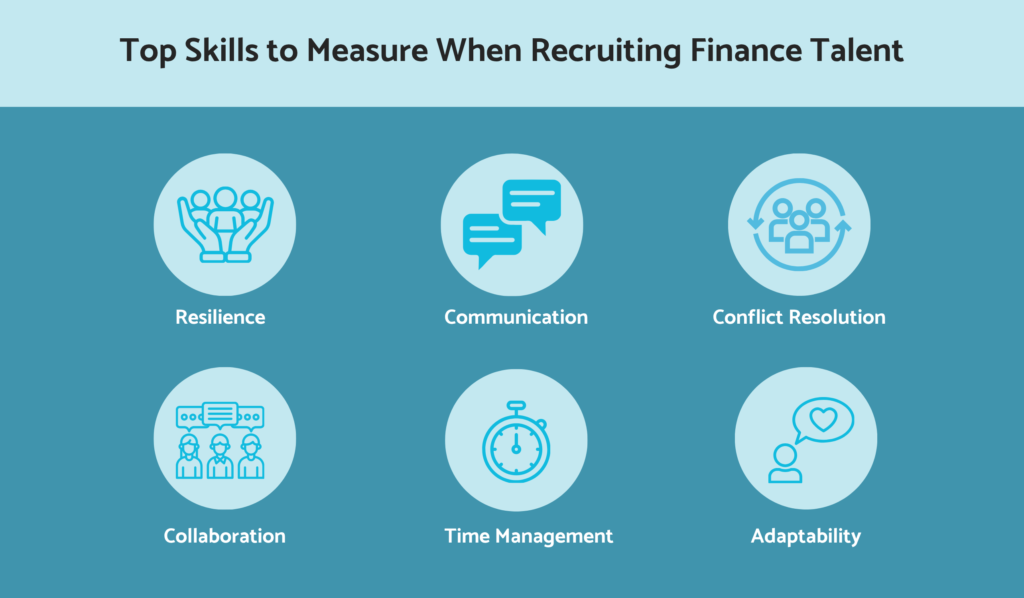
- Resilience
The finance industry can be high–pressure, as it is a high–stakes environment where you can expect to deal with setbacks such as a lost deal or failed investment. In such cases, recruiters often look for candidates who are resilient and able to recover from disappointments, learn from mistakes, and maintain top performance.
- Communication
Finance candidates are often required to translate complex financial information into clear and concise language for an audience without a financial background. Employers look for communication skills in candidates, including the ability to deliver strong written communication, such as reports and proposals.
- Conflict Resolution
Almost every workplace experiences disagreements, and the finance industry is no exception. When recruiting, it is in your best interest that you look out for candidates who possess conflict resolution skills and are able to constructively navigate conflict and de–escalate tension without damaging relationships.
- Collaboration
Collaboration matters in finance as employees and teams often work across legal, operations, risk, and compliance departments rather than in isolation.
- Time Management
As a recruiter in the finance sector, you often handle multiple tasks and ongoing projects, which is why it is important to recruit candidates with strong time management skills. Ensure that these finance candidates can effectively manage their time, prioritize high–impact tasks, and consistently deliver under pressure.
- Adaptability
Since the finance sector is constantly evolving due to newly enforced regulations, emerging technologies, and shifting markets, employers are seeking candidates with adaptability skills. These finance candidates must be able to quickly adjust, be open to learning new tools, and take on unfamiliar responsibilities.
What tools can you use to assess if your finance candidates have these skills? Keep scrolling to learn more below.
3. Best Tools for Recruiting in the Finance Sector
Finance-sector hiring usually relies on a mix of assessment, workflow, screening, and interviewing tools to improve consistency and reduce hiring friction.
According to Boutique Recruiting, 59% of financial organizations have expressed interest in using recruitment tools, such as talent intelligence platforms, to enhance hiring.
6 Best tools to use when recruiting finance candidates
1. Psychometric Assessment Tools
Pre-hire assessment platforms such as Assess Candidates, Clevry, and Test Dome enable finance recruiters to evaluate candidates’ skills during the recruitment process. As the industry involves analytical thinking, numerical calculations, regulatory understanding, and report presentations, psychometric assessment platforms can provide insights into your candidates’ cognitive abilities.
Some of the assessment tests that you should use to test your candidates in the finance industry are:
- Verbal Reasoning Test
- Numerical Reasoning Test
- Logical Reasoning Test
- Critical Reasoning Test
- Game-Based Assessments
2. Skills-based Assessments
Skills-based assessments are designed to directly measure your finance candidates’ technical and soft skills, as well as job-relevant knowledge. The rise of skills-based hiring has ensured that employers focus on candidates’ skills beyond their credentials and CVs. Platforms like Assess Candidates, iMocha, and Vervoe offer recruiters skills–based tests.
3. Applicant Tracking System
Recruiters in the finance industry use applicant tracking systems (ATS) such as Workday, Greenhouse, and Lever to manage the entire recruitment pipeline, from posting job adverts to reviewing CVs, scheduling interviews, and storing candidate records.
4. Behavioral Assessments
Assess Candidates, HireVue, and Pymetrics offer behavioral skills tests that evaluate candidates’ interpersonal behaviors, values, motivations, and how they act in the workplace and with colleagues.
Some of the behavioral assessments are
5. Video Interviewing Platforms
Platforms such as Assess Candidates, HireVue, and Spark Hire allow employers to conduct asynchronous or live video interviews with the selected candidates during the recruitment process. These video interviews are usually conducted to bridge the gap between recruiting organizations and candidates who are not in the same geographic location.
Types of Interview Questions to Ask a Finance Candidate
There are various types of questions that you can ask a finance candidate during the interview stage, depending on the skills you want to assess. These include the following:
- How would you evaluate the creditworthiness of a new corporate borrower?
- Tell me about how you handled a significant error that you identified in a financial report, and what was the outcome?
- How would you handle a client who is pressing you for an investment recommendation when you do not have enough information to make a confident call?
- Give an example of when you identified a financial risk that no one else recognized.
- What would you do if you became aware that a colleague was manipulating financial data?
Hire the right finance candidates with our assessment platform. LEARN MORE
The next section looks at the main finance hiring challenges and how to reduce them.
4. Common Finance Recruitment Challenges
Finance hiring is difficult not just because of volume, but because firms need candidates who combine technical competence, reliability, and judgment in a highly competitive market.
According to Recruiter.com, many finance employers have spoken about the recruitment process for prospective candidates in the industry and the scarcity of suitable candidates.
Top 5 challenges of recruiting in the finance industry
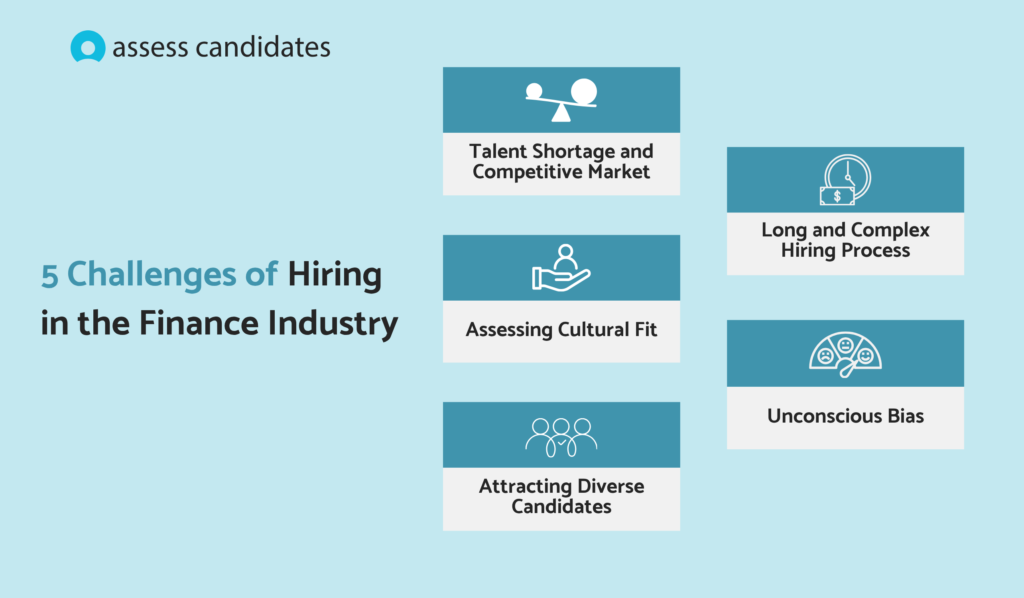
- Talent Shortage and Competitive Market
The finance industry consistently faces a shortage of highly skilled candidates, especially in areas such as financial technology, risk management, and investment banking. Ideal finance candidates are usually already employed, have received several offers, or are selective about where they want to work.
Solution: As a recruiter for a finance organization, we recommend that you build a strong, unique employer brand that clearly explains why working for your company is compelling beyond salary. To do this, you should highlight career growth opportunities, purpose, culture, and flexibility.
- Assessing Cultural Fit
Every company in the finance industry has its own culture; therefore, recruiting a candidate with the right skills who does not align with the culture can lead to poor performance and team conflict. Cultural misalignment can often be difficult to detect compared to skill gaps because candidates are prepared to say the right things during the interview process.
Solution: We suggest that you clearly define your culture and values and enforce them in every stage of the recruitment process. To do this, you would need to design your assessment process to include an interview, psychometric tests, and behavioral assessments. Also, offering realistic job previews can help you evaluate your candidates’ cultural fit.
- Attracting Diverse Candidates
The finance sector has long struggled with diversity and inclusion, particularly in senior roles, with a well-documented underrepresentation of women, ethnic minorities, and finance candidates from non–traditional educational backgrounds. The lack of diversity in the finance workforce reduces the talent pool that should be available to your company.
Solution: As a finance recruiter, we recommend auditing your job descriptions, assessment criteria, and sourcing channels for inclusive language and requirements. Doing this will reveal whether or not you have intentionally promoted job descriptions that exclude diverse candidates. To achieve optimal results, you should also partner with diversity–focused recruitment agencies that help broaden your talent pipeline to include minority groups.
- Long and Complex Hiring Process
Many senior finance roles often require extensive background checks, reference verifications, multiple interview rounds, and more. This lengthy hiring process can be tiring and frustrating for your candidates, increasing your chances of losing top talent. Your candidates may accept another company’s offer letter while you are assessing their skills and credentials.
Solution: We suggest regularly reviewing your hiring process to identify and eliminate unnecessary steps without compromising essential assessment processes. You can set timelines at the start and regularly interact with candidates to help manage expectations and maintain engagement.
- Unconscious Bias
Hiring managers may be unconsciously biased toward finance candidates who either attended certain universities or come from a familiar socioeconomic background or race, and these factors weaken the talent pool.
Solution: Introduce structured interviews with standardized scoring guidelines to help in reducing the possibility of unconscious bias in the recruitment process. We also recommend using blind CV screening, in which candidates’ personal information is hidden before shortlisting. Lastly, you should train your hiring managers to recognize bias in the interview process, helping them address it during recruitment.
Now that you have seen ways to avoid obstacles in finance recruiting, check out the strategies to implement below!
5. Top hiring strategies for the finance sector
The strongest finance hiring strategies combine structured assessment, targeted sourcing, strong candidate communication, and a process that moves fast enough to keep top talent engaged.
According to Boutique Recruiting, the finance industry is characterized by a highly competitive talent market, strict regulatory compliance, and constantly evolving skill requirements.
However, to make the most of your recruitment in the sector, follow our strategies to implement.
Best strategies to hire in the finance industry

1. Talent Pipeline
Rather than having to restart the job vacancy posting and recruitment processes. We suggest building a pipeline to help you identify, engage, and nurture relationships with potential finance candidates when the role becomes available. Maintaining a database of prospective candidates you have interacted with through previous hiring processes, networking, and referrals is an active way to build your talent pipeline.
2. Structured Hiring Process
We recommend that you include competency frameworks that clearly define the skills, behaviors, and knowledge required for each role you are recruiting for. Ensure that all your interviewers are trained in structured interviewing techniques and are regularly evaluated to maintain consistent scoring.
3. Diversity and Inclusion
Research has consistently shown that organizations with diverse teams are more likely to make better decisions, manage risks, and outperform firms that are fully homogeneous. To ensure you have a diverse team, we suggest auditing your job descriptions for exclusionary language and removing unnecessary requirements that do not align with your recruitment goals. Introduce blind screening and diverse interview panels to minimize bias in the selection process.
4. Competitive and Transparent Compensation
Conduct a survey to compare market compensation rates before constructing a competitive package for all your finance candidates, and market your company’s compensation package as unique. Doing this will help manage the candidate’s expectations when applying for a role in your organization. Ensure you also include internal pay equity across gender and ethnicity, as this will promote a peaceful work environment and cordial relationships among all staff.
5. Use Tech and Data in Recruitment
By using recruitment technology, data analytics, and AI. With an ATS, you should be able to manage the recruitment pipeline so that you do not miss out on any of the potential candidates. All technology and recruitment tools should be regularly audited to ensure they function fairly and without bias.
6. Build an Employer Brand
Invest in displaying your culture through employee testimonials and an active social media presence on platforms like LinkedIn. Building your employer brand will help you reduce time–to–hire and recruitment costs while organically attracting high-quality candidates. Focus on delivering on the internal promises you made to promote a positive work environment.
Explore assessments created by Chartered Scientists to hire the right finance candidates. VIEW PLANS
Curious to know about the roles that you can employ candidates in the finance sector? We have mentioned a few below.
6. Common Roles Employers Hire for in Finance
According to Investopedia, the projected growth rate of all occupations in the United States of America from 2024 to 2034 is about 3.1%.
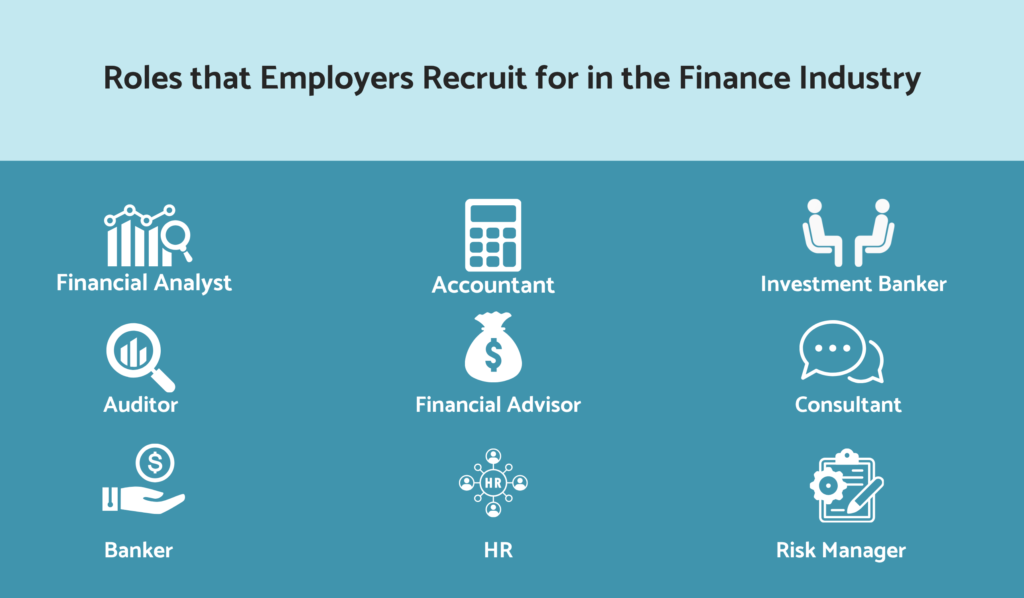
Roles that Employers Hire for in the Finance Industry
- Financial Analyst
- Accountant
- Investment Banker
- Auditor
- Financial Advisor
- Consultant
- Banker
- HR
- Risk Manager
Are you looking to attract and recruit finance candidates in your company? Not sure about what pre-employment psychometric assessment tests you should use to assess your candidates to ensure you hire the ideal talent? You can contact us for a thorough evaluation of your hiring assessment design, and we will ensure you hire the ideal finance candidates.
Top Employers that hire finance talent
- McKinsey & Company
- KPMG
- Deloitte
- PwC
- Bank of America
- JPMorgan Chase
- Goldman Sachs
- Standard Chartered
Want to know what recruiters have to say about recruiting into the finance industry?
7. Client success stories of recruiting in the finance industry
Employers and financial institutions have shared their experiences discovering and implementing strategies that have helped them hire the ideal finance candidates without wasting resources in the hiring process.
1. Investment Bank
Challenge:
An investment bank was struggling with a lengthy hiring process and the soaring costs of roles that demand strong relationship-building. Employers were looking for tools to evaluate client networking skills without burdening interview teams.
Solution:
The company, through a third-party recruiting tool, deployed a situational judgment test and video interviews tailored to evaluating customer-centric skills. The automated platform allowed customized campaigns and reserved human interactions for the final stage of assessments.
Results:
- Hiring costs significantly dropped due to efficient pre-screening
- Recruiting teams noticed a higher satisfaction with candidate fit and quality
- Finance candidates experienced improved engagement in the assessment process
2. BDO Australia
Challenge:
BDO Australia experienced an increase in assessment center exercises and low conversion rates due to candidates’ lack of interest. Manual screening also slowed recruitment for finance professionals amid rising applications.
Solution:
The financial institution employed a recruiting tool that pre-assessed candidates, reducing the number of advanced candidates and optimizing assessment center days. The hiring platform improved the application volume while filtering for committed candidates.
Results:
- Conversion rates rose from 55% to 71%
- Assessment center days were halved, seeing the increment in onboarding
- The number of candidates advanced to centers was reduced to 44%
This is where Assess Candidates comes in: we help ensure your candidates are well-qualified, as our pre-employment psychometric assessments measure skills and provide data-driven analytics to inform your hiring decisions.
8. Future of recruitment in the finance sector
Recruitment in finance is likely to become more skills-led, more technology-enabled, and more shaped by flexibility, candidate experience, and compliance expectations.
What is the future of recruitment in the finance industry?

- Hybrid and Flexible Work
The widespread adoption of hybrid and remote work has changed how finance organizations source talent. Roles that once required their candidates to be geographically located in the office’s region can now be filled by professionals anywhere else in the world. Finance companies that adopt flexible working arrangements will have access to a larger, more diverse talent pool.
- Candidate Experience
Candidates are increasingly demanding a recruitment experience that is respectful, personalized, and transparent. In an industry where finance candidates often receive offers from many companies, situations like poor candidate experience and slow communication will most likely make you lose out on a potentially talented candidate. Investing in the quality of your candidate experience, ensuring timely, concise communication, and providing transparent information at every stage of your recruitment process will help improve your recruitment in the industry.
- Evolution of Recruiter Role
One of the most critical shifts in the future of finance recruitment is the transformation of the recruiter’s role. While AI and automation handle the transactional and administrative aspects of recruiting, the employer’s value will also lie in strategic thinking, relationship–building, and decision–making about candidate fit and potential.
- Skills-Based Over Credentials
Leading finance organizations are starting to remove degree requirements for certain roles, as they recognize that the ability to do the job is more important than a candidate’s educational background. Focusing on this approach significantly broadens the talent pool, opening certain roles to candidates with non-traditional educational backgrounds who possess the right skills.
In finance hiring, the real challenge is not just finding applicants. It is identifying which candidates combine technical ability, judgment, and reliability quickly enough to hire them before competitors do.
So, why use Assess Candidates to hire your finance talent in 2026?
9. Why do employers use Assess Candidates when hiring finance talent?
Assess Candidates helps finance employers assess reasoning ability, behavioral tendencies, and job-relevant skills more consistently through structured pre-employment testing.
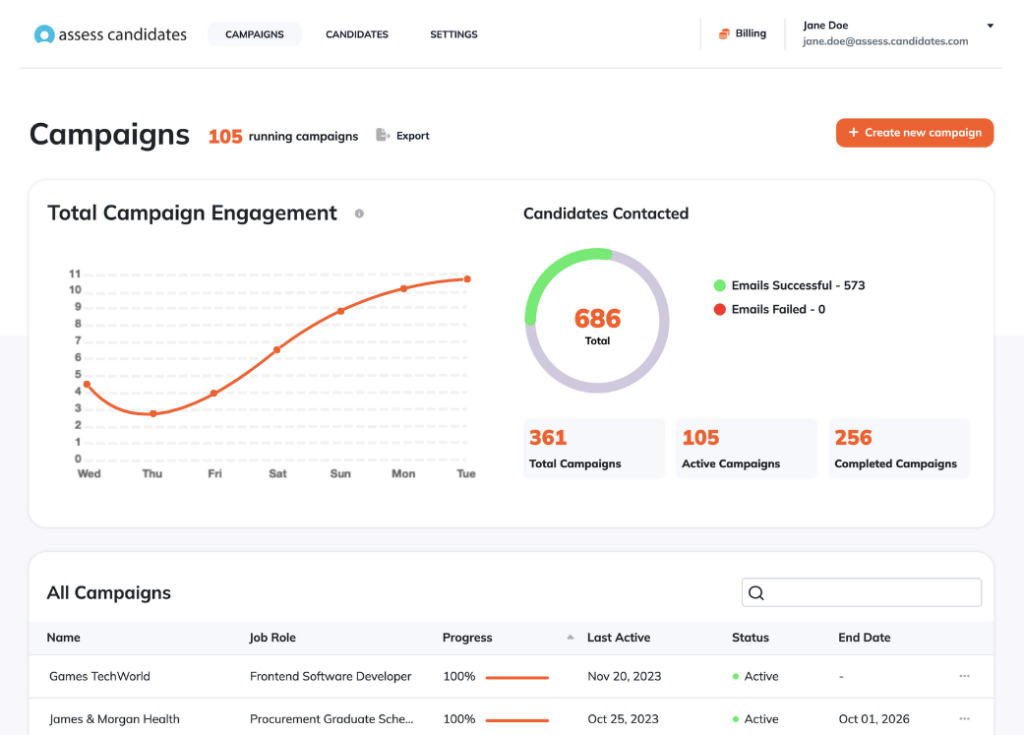
- Rigorous Science: Assess Candidates is trusted by many employers because of our scientific credibility. The assessments we offer on the platform are developed by a team of chartered scientists, psychologists, and recruitment experts. Our assessments are rigorously validated to ensure reliability.
- Smarter and Faster Shortlisting: Finance candidates often receive a large number of applications, and Assess Candidates helps address this by providing data–driven results that make shortlisting efficient and defensible. Our platform includes an intuitive dashboard that enables you to easily rank, filter, and shortlist the perfect candidates for the role you are recruiting for.
- Fairness and Inclusive Hiring: Fairness and inclusion are built into all of our assessment tests on the platform, which helps minimize bias and provide candidates with equal opportunity. We also offer accessibility features, such as additional time and screen–reader compatibility, to create a seamless candidate experience.
- Strong Candidate Experience: Our assessment platform is designed to feel smooth and engaging from the moment your candidates receive their invite, featuring realistic workplace scenarios, short test times, and AI–driven technology. These features help your candidates stay engaged and complete the assessment process, resulting in a positive candidate experience.
- Innovative Assessment Formats: Assess Candidates offers formats that go beyond engaging candidates to reveal behavioral insights. The platform’s assessments include, but are not limited to, game-based assessments, behavioral skills and personality assessments, and cognitive tests. These formats reflect the direction in which recruitment in the finance industry is moving toward greater candidate engagement and assessment innovation.
Hire the right finance candidates with our assessment tool platform. LEARN MORE
Conclusion: Key Takeaway
The best recruiting strategies in the finance sector combine structured assessment, faster decision-making, and a candidate experience that reflects the standards of the firm.
Curious to know more about using assessment tests to hire the perfect candidates in the finance industry? Keep scrolling to explore our frequently asked questions, and enter your email to get started today.
Frequently Asked Questions
How long is the recruitment time for finance candidates?
Recruiting in the finance industry can take an average of 5-6 weeks, and it can be longer for senior roles due to additional compliance checks. During the recruiting process, candidates will receive regular feedback.
What skills should I prioritize in finance candidates?
When recruiting finance candidates, focus on skills such as data analytics, AI literacy, regulatory knowledge, and soft skills like adaptability that extend beyond traditional finance. You can use scenario-based assessments to evaluate your candidates’ technical proficiency and cultural fit.
How can I reduce bias in finance recruitment?
Implementing structured interviews, psychometric assessments, and diverse sourcing for your hires will ensure a fair, inclusive hiring process free of bias. Train your hiring managers to also recognize bias in the interview process and eliminate it.
What role does compliance play in finance recruitment?
Compliance plays a big role in finance hiring, with background checks verifying qualifications, certifications, and regulatory history. Collaborating with recruiters in finance-focused verifications will help you avoid certain risks.
How is finance recruitment different from other industries?
Finance recruitment is often more structured, competitive, and calendar-driven than in most other industries. Large banks and asset managers run formalized cycles, especially for graduate and internship roles, as these offers are made months ahead.


 English
  Arabic