
The Complete Guide on How to Recruit in the Consulting Industry in 2026



Recruiting in the consulting industry is demanding as firms need candidates who can solve complex problems, communicate clearly, work well with clients, and perform under pressure. In a competitive market, employers need a hiring process that identifies those strengths reliably and quickly.
This guide explains which skills matter most in consulting recruitment, which tools and assessment methods support better hiring, which challenges firms face, and which strategies improve results.
Contents
- What is the consulting industry?
- Skills to measure when recruiting for a consulting firm
- Best recruitment tools for hiring in the consulting industry
- Challenges to avoid when recruiting for the consulting industry
- Best strategies to hire in the consulting industry
- Common consulting roles firms hire for
- Client success stories of hiring in the consulting industry
- Future recruitment trends in the consulting industry
- Why do employers use Assess Candidates when recruiting consulting talent?
Let’s start with the basics: what consulting firms actually need to assess.
1. What is the consulting industry?
The consulting industry is a professional services sector that helps organizations solve problems, improve performance, and make better strategic or operational decisions through expert advice and delivery support.
Start your consulting recruitment process with our psychometric assessments. HIRE FOR FREE
Curious about what skills to measure when hiring in the consulting industry? We have highlighted them below.

2. Skills to measure when recruiting for a consulting firm
Consulting firms usually require a combination of analytical, interpersonal, and commercial skills because success depends on more than technical knowledge alone.
According to Student Circus, employers are on the lookout for a range of soft skills that play a key role in employees’ performance at the company. These skills include:
Top skills to measure when recruiting consulting talent
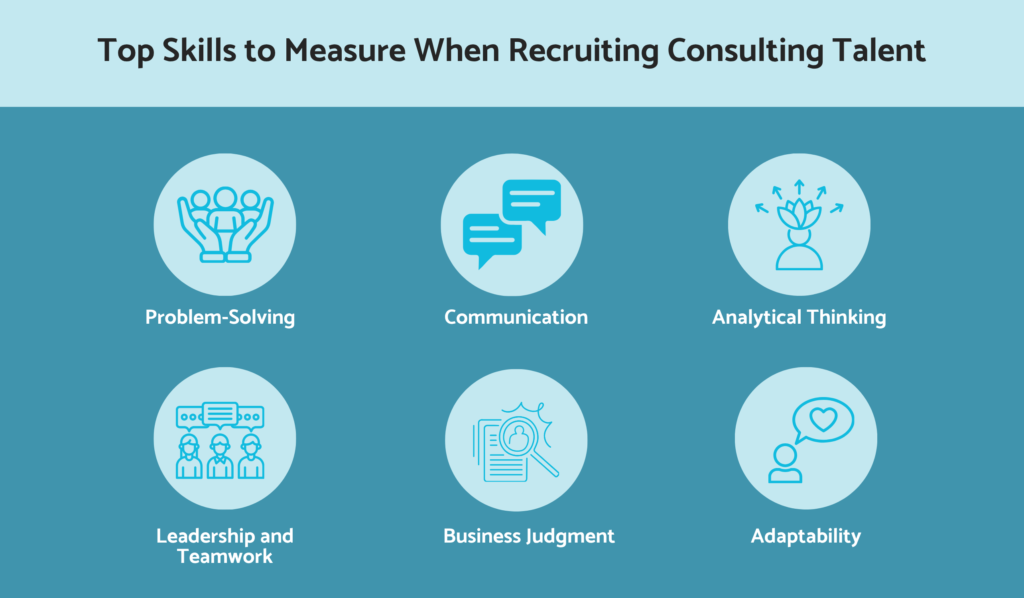
- Problem-Solving
Consulting candidates need to break down ambiguous business problems into structured, workable parts. Strong problem-solvers combine logic, creativity, and commercial awareness.
- Communication
Communication matters because consultants are expected to explain complex ideas clearly to clients, colleagues, and stakeholders with different levels of expertise.
- Analytical Thinking
Your candidates with analytical thinking skills will interpret data, identify trends, and draw insightful conclusions from imperfect information. The consulting industry requires candidates who excel at prioritizing significant metrics and avoiding analysis paralysis.
- Leadership and Teamwork
We suggest hiring people who can lead and collaborate, as these skills will be evident in how they lead teams, motivate colleagues, and deliver results, even when they come from diverse backgrounds. As a recruiter, it’s best for the company if you look for candidates who can work well with others, are assertive, and have empathy in roles that involve clients.
- Business Judgment
Business judgment helps candidates move beyond analysis and toward practical recommendations. In consulting, that means knowing which trade-offs matter and which actions are realistic.
- Adaptability
Assessing your candidates’ adaptability skills is important, as they will be expected to deliver comprehensive results across industries, adjust priorities, and meet tight deadlines. Ensuring your candidates possess this skill demonstrates sustained performance.
What tools can you use to test if your candidates possess these skills? Continue reading to find out below.
3. Best Recruitment Tools for Hiring in the Consulting Industry
Consulting recruitment usually relies on a mix of sourcing, assessment, interviewing, and workflow tools to improve accuracy and reduce screening time.
6 Best tools to use when recruiting consulting candidates
1. Applicant Tracking System (ATS)
Employers use tools like Recruit CRM and iCIMS when recruiting candidates for the consulting industry, as these tools help automate resume screening, track candidates, and schedule interviews. The ATS platforms are used when companies sort through a large number of applications and select the top applicants in high-volume recruitment processes.
2. Pre-Employment Assessment Tests
Psychometric assessment platforms like Assess Candidates, TestGorilla, and Testlify offer customized tests to evaluate candidates’ problem-solving skills and cultural fit. Employers use these tests for initial screening and to ensure fairness and accuracy throughout the assessment process. The platforms also help minimize bias and identify analytical thinkers early.
Some of the assessment tests that you should use to test your candidates in the consulting industry are:
- Verbal Reasoning Test
- Numerical Reasoning Test
- Logical Reasoning Test
- Critical Reasoning Test
- Situational Judgment Test
- Game-Based Assessments
- Personality Questionnaire Test
3. Video Interviewing Platforms
Platforms like Assess Candidates, HireVue, and Pymetrics offer consulting firms a video-interviewing platform, allowing you to conduct interviews with candidates either within or beyond your region. They are affordable and widen your search for top consulting talent, strengthening diversity and your employer brand.
Types of Interview Questions to Ask a Consulting Candidate
There are types of questions that you can ask a consulting candidate during the interview stage. These include the following:
- Walk me through how you would approach a client who has experienced a 20% decline in profits over the last two years.
- Tell me about a time when you had to solve a complex problem with little information.
- How would you explain a complex financial model to a client with no background in finance?
- Narrate how you had to make an ethical decision under pressure.
- What industry trends do you believe will impact our clients in the next five years?
4. HR and Management Software Tools
Consulting recruiters use platforms such as Paycor, Zoho People, and BambooHR to handle onboarding, performance monitoring, and compliance for consulting teams. These platforms offer you data-driven insights on turnover, DEI practices, and strategic hiring decisions.
5. Skills Assessment Tests
Skills assessment test platforms such as Assess Candidates, TestGorilla, and SHL assess and track your consulting candidates’ skills. They ensure you hire the right fit for your company who will easily align with your company culture and staff. A well-strategized selection of psychometric assessments will not only provide you with a thorough performance index for all your applicants but also strengthen your confidence in hiring decisions.
Hire the right consulting candidates with our assessment platform. LEARN MORE
If you are thinking about the challenges to avoid in consulting recruitment, we have some solutions for you.
The next section covers the main hiring challenges and how to reduce them.
4. Challenges to avoid when recruiting for the consulting industry
Consulting firms face hiring challenges that go beyond volume. The real difficulty is finding candidates who combine analytical ability, client readiness, and cultural fit in a highly competitive market.
According to studies, recruiters often face multiple hurdles when recruiting candidates; these challenges can unfold in stages, and can include challenges such as:
Top 5 challenges of hiring in the consulting industry
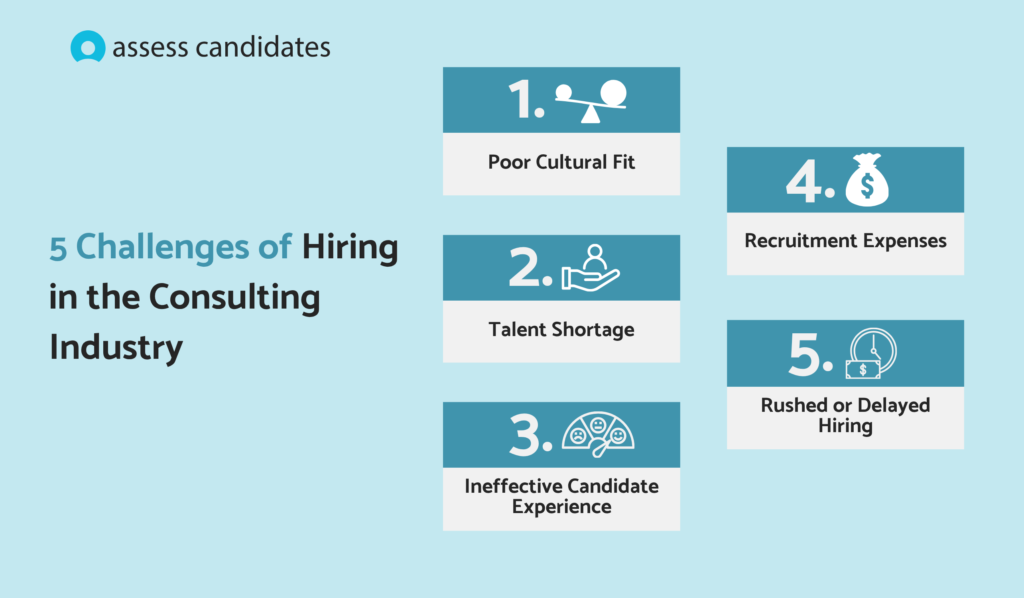
1. Poor Cultural Fit
Consulting firms often prioritize technical skills over candidates’ alignment with client–focused, high–pressure cultures, leading to turnover and unhealthy relationships between teams. Ignoring values and collaborative styles puts the firm in an uncomfortable position when staff are not aligned.
Solution: We recommend including behavioral interviews and team panel sessions when recruiting consulting candidates to examine their values and interpersonal dynamics. This can be done using personality assessment tools.
2. Talent Shortage
Consulting hiring often requires candidates to be equipped with analytical, communication, and collaboration skills, which further reduces the candidate pool between tech and finance. Companies have reported struggling with recruitment due to skill gaps, as specialized experience is often difficult to come by quickly.
Solution: Our experts suggest focusing on building your employer brand through LinkedIn and other social media, alumni networks, and campus career events to attract passive top talent.
3. Ineffective Candidate Experience
If your candidates encounter slow feedback, vague recruitment processes, and rigid interviews, these can frustrate them and lead to a negative candidate experience. A bad candidate experience will damage your reputation in a referral-driven industry.
Solution: We recommend automating updates with ATS and maintaining a certain level of transparency with your candidates from application to offer acceptance. You should also streamline the hiring process with personalized communications to help candidates feel a sense of commitment to your company.
4. Recruitment Expenses
Budgeting for premium services from recruitment agencies or tools will only yield poor ROI if your recruitment processes are longer than necessary or show signs of bias, which deters consulting candidates from completing the application. This can be a bigger challenge for small and medium–sized organizations.
Solution: Investing in an applicant tracking system (ATS) and pre-employment assessment test tools will minimize manual screening time by at least 50%. We also suggest that you monitor your time-to-hire and retention to identify and address issues in your hiring process.
5. Rushed or Delayed Hiring
Beginning your recruitment process late will inevitably lead to rushed assessments, and providing vague requirements will result in mis-hires for roles at the consulting firm.
Solution: You should consider defining your roles with clear skills requirements and maintain a talent pipeline through your ongoing outreach. We also suggest using psychometric assessments for fast and data–driven hiring.
Having seen the challenges of hiring in the consulting industry, check out the best strategies to hire in the consulting industry.
5. Best strategies to hire in the consulting industry
The strongest consulting recruitment strategies combine employer brand, skills-based assessment, targeted sourcing, and a hiring process that respects candidate time.
Best strategies to hire in the consulting industry
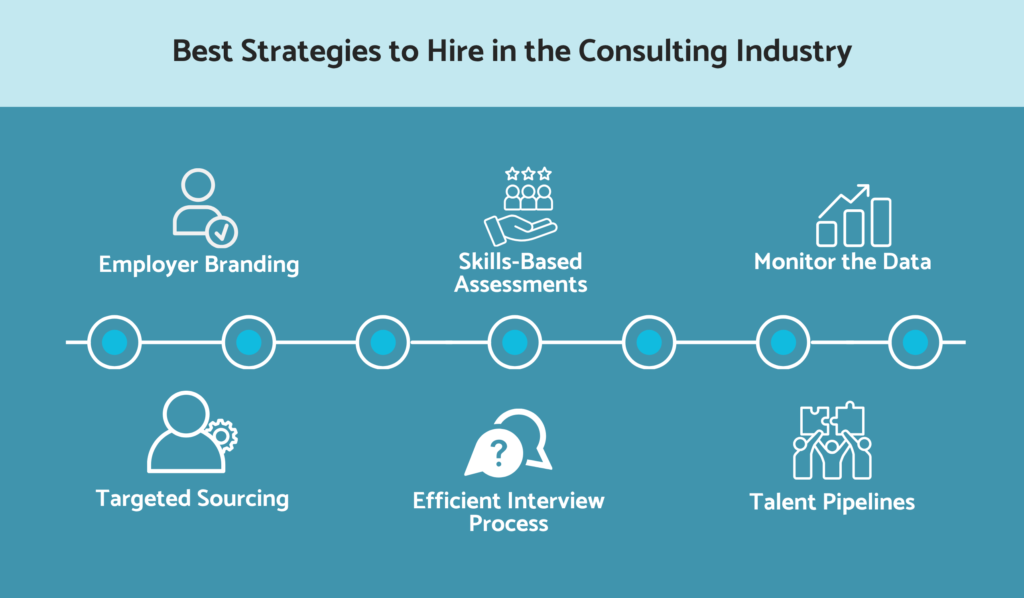
- Employer Branding
Consulting is a highly competitive industry, and a compelling employer brand will help your firm stand out from competitors. Highlighting your culture, projects, and growth paths through authentic storytelling is one of the most effective strategies for recruiting. Showcase these stories to shape how you are perceived and include career pages to pull in passive candidates.
- Skills-Based Assessments
We recommend shifting from credentials to skills-based assessments and evaluating your candidates with aptitude tests, gamified assessments, job simulations, and interviews to fully understand their skills. By enlisting the help of a pre-hiring assessment platform like Assess Candidates, you will reduce bias and your screening time, while simultaneously improving the candidate experience.
- Monitor the Data
Tracking metrics such as offer acceptance rates, source of hire, time-to-fill, and first-year performance by recruitment method will help you refine your recruitment process. Treating your hiring as a discipline rather than a process will open your company to a diverse range of quality candidates.
- Targeted Sourcing
To attract and hire more consulting candidates, consider expanding your reach by leveraging campus hiring, niche job boards, and industry events to connect with prospective candidates. Employee referrals also provide higher–quality hires at a low cost.
- Efficient Interview Process
The goal of your interview process is to be thorough enough to make confident hiring decisions while respecting your candidates’ time. Having a well-designed assessment process with three to four stages is often sufficient to help you make the right hiring decisions.
- Talent Pipelines
You should consider maintaining your ongoing relationships with prospective consulting candidates through newsletters, mentorship programs, and webinars. Doing this will also help address the talent shortage in your organization.
Explore assessments created by Chartered Scientists to hire the right consulting candidates. VIEW PLANS
Want to know about the roles that you can employ candidates in the consulting industry? We have highlighted a few mentioned below.
6. Common Consulting Roles Firms Hire For
According to CaseBasix, consulting teams usually follow a hierarchy, and while each hierarchy varies per firm, each role is integral to the tasks and projects.
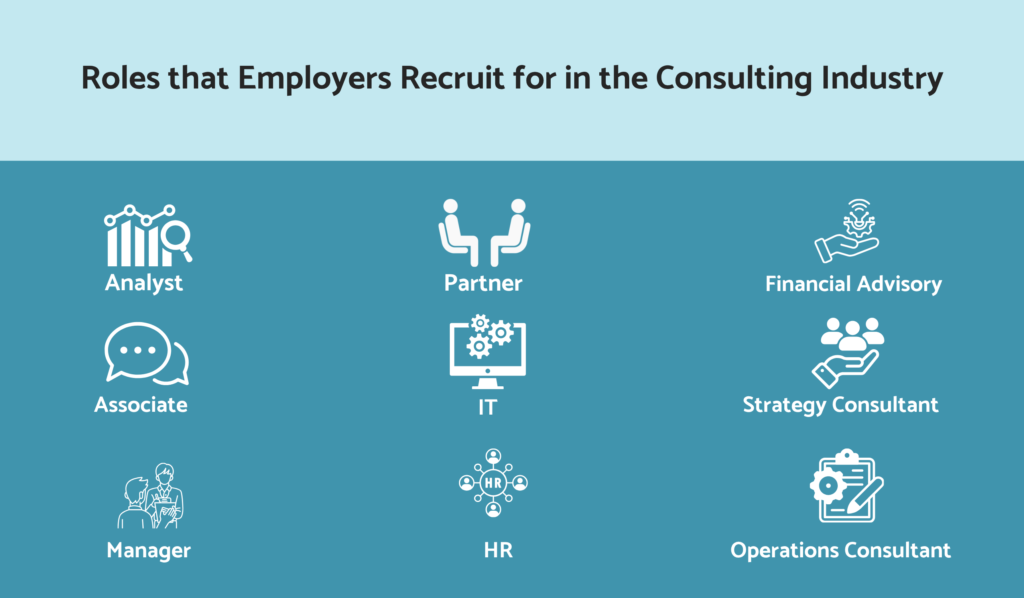
Roles that Employers Hire for in the Consulting Industry
- Analyst
- Associate
- Manager
- Partner
- IT
- HR
- Financial Advisory
- Strategy Consultant
- Operations Consultant
Are you looking to attract and hire consulting candidates in your company? Uncertain about what pre-employment psychometric assessment tests you should use to assess your candidates to ensure you hire the right talent? You can reach out to us for a thorough examination of your recruitment assessment design, and we will ensure you hire the ideal consulting candidates.
Top Employers that hire consulting talent
- McKinsey & Company
- KPMG
- Deloitte
- PwC
- EY
- Boston Consulting Group
- Bain & Company
- Accenture
Curious to see what recruiters have to say about recruiting into the consulting industry?
7. Client success stories of hiring in the consulting industry
Recruiters and companies have shared their experiences with adjusting strategies that have helped them recruit consulting talent without losing time or money in the recruiting process.
1. Neurelis
Challenge:
Neurelis required more territory managers within two months post-product approval to target people living with epilepsy. The company was looking for CNS-experienced candidates who demonstrated integrity under tight deadlines.
Solution:
The company hired a consulting firm that recommended a hybrid approach, including recruiter networks, referrals, and hub events, and subsequently received a large number of applications. This way, Neurelis was able to screen its candidates, manage the logistics, and pivot to virtual interviews to manage all successful candidates.
Results:
- Recruited all territory managers within the two-month deadline
- Achieved 100% retention rate after 90 days
- Successfully screened hundreds of candidates using 12 recruiters
2. Triple V
Challenge:
Triple V lacked a centralized system to monitor the multiple applications it received during its expansion, and it required constant updates to its job description. These challenges led to disorganized recruitment and inefficient candidate management.
Solution:
A consultant recommended that the company use an ATS tool to customize workflows and recruiting teams for seamless collaboration. Triple V created a career page to make job postings easier on platforms like LinkedIn and Indeed.
Results:
- Established candidate pipelines and enhanced the employer branding
- Achieved 28-day average time-to-fill per position
- Improved candidate experience with automated updates and positive phone screenings.
This is where Assess Candidates comes in: we help ensure your candidates are well-qualified, as our pre-employment psychometric assessments measure skills and provide data-driven analytics to inform your hiring decisions.
8. Future Recruitment Trends in the Consulting Industry
The next question is how consulting recruitment is likely to change.
Recruitment in consulting is likely to become more skills-based, more global, and more tightly shaped by AI governance and candidate expectations.
What is the future of recruitment in the consulting industry?
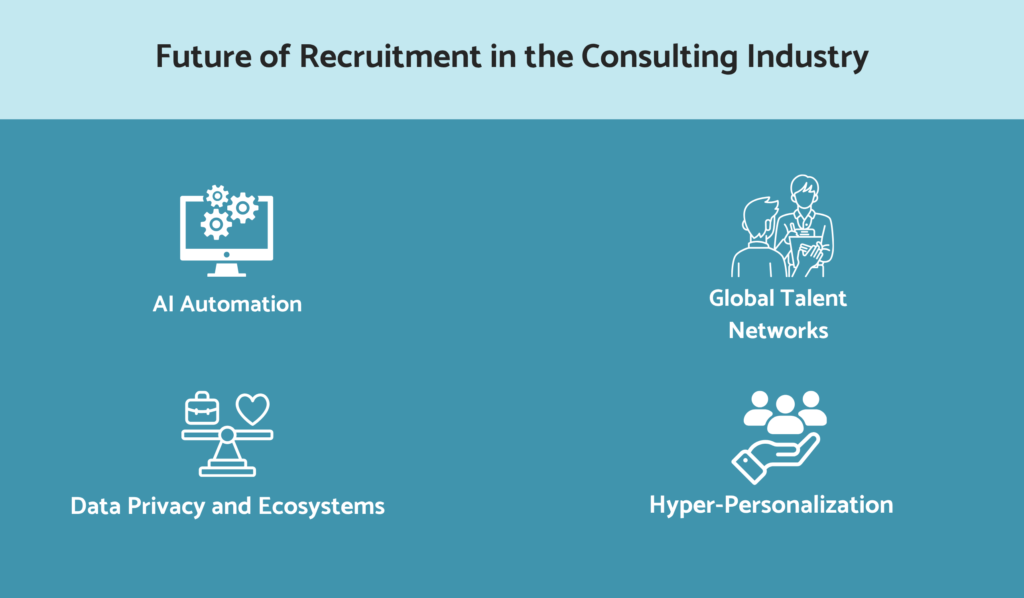
- AI Automation
The future of recruitment will see AI agents handling talent sourcing, screening, and candidate matching, freeing up employers to focus on strategic advisory roles. Consulting companies will prioritize recruiting AI-literate candidates who can blend tech with the client’s insights.
- Data Privacy and Ecosystems
There will be stricter regulations enforced, such as the EU AI Act, which will make compliance a differentiator. Employers will begin to leverage commercial intelligence for niche outreach, thereby building trust and maintaining pipelines in regulated industries.
- Global Talent Networks
Consulting companies will expand their reach beyond campuses to virtual global talent pools through blockchain-verified certificates and remote assessments. Hybrid work will also provide employers with a constant pipeline, reducing bias and improving the ratio of diverse hires.
- Hyper-Personalization
The future will record AI-driven tools creating tailored candidate journeys, from customized case prompts to real-time feedback loops that are based on individual strengths. Recruiters in the future will use behavioral assessment data to improve engagement, aiming to raise the offer acceptance rate.
In consulting hiring, the real risk is not volume. It is mistaking interview polish for consulting capability.
So, why use Assess Candidates to hire your consulting talent in 2026?
9. Why do employers use Assess Candidates when recruiting consulting talent?
Assess Candidates helps consulting employers assess core problem-solving, reasoning, and behavioral skills more consistently through structured pre-employment testing.
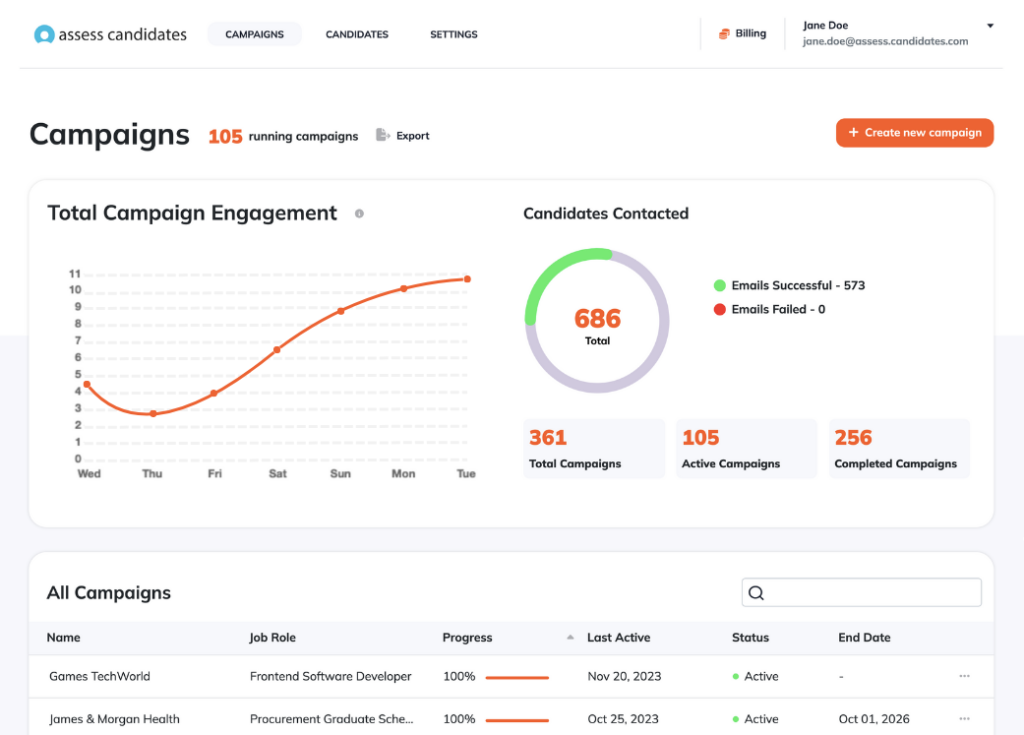
- Predictive Accuracy: Assess Candidates offers employers assessments like numerical reasoning, verbal reasoning, logical reasoning, and situational judgment tests to evaluate core consulting skills like data interpretation and problem solving. The pre-employment assessment tests are developed by chartered psychologists who ensure that the assessments provide you with a reliable insight to predict candidates’ success beyond resumes.
- Bias Reduction and Inclusivity: Our platform comes equipped with a built-in fairness that actively reduces unconscious bias and accessibility features like extra time. We also offer game-based assessments to make your candidates’ assessment process more engaging and interactive.
- Improved Candidate Experience: Assess Candidates delivers a professional, transparent assessment process that leaves applicants with a positive candidate experience and collects valuable feedback. The platform also comes equipped with a video-interviewing tool that examines communication skills along with culture fit.
- Bespoke Service: Employers and recruiters are able to tailor the assessment tests on Assess Candidates to suit the consulting roles, combining personality and cognitive modules. This customization feature ensures that you match the assessment tests to the roles you are recruiting for, fully evaluating your candidates’ skills in the recruitment process.
- Efficient Interaction: Assess Candidates is designed with an intuitive dashboard that ranks candidates instantly, filtering out the least performing candidates. Our assessment tests are time-limited, so your consulting candidates can complete them without fatigue.
Hire the right consulting candidates with our assessment tool platform. LEARN MORE
Conclusion: Key Takeaway
Recruiting the right talent is an ongoing challenge in the consulting industry. The best way to recruit in the consulting industry is to combine structured assessments, targeted sourcing, and a candidate experience that reflects the standards of the firm.
Curious to know more about using assessment tests to hire the perfect candidates in the consulting industry? Keep scrolling to explore our frequently asked questions, and enter your email to get started today.
Frequently Asked Questions
What are the main stages of consulting recruitment?
The consulting recruitment process usually involves the following:
What is an Applicant Tracking System (ATS) and why does it matter?
An Applicant Tracking System (ATS) is recruitment software that scans resumes for keywords matching those in job descriptions. It filters most applications before human review, selecting only the top applicants who appear to be a good fit for the role.
Should I prioritize culture fit or technical fit?
You can prioritize both culture and technical fit when recruiting in the consulting industry. However, the weight assigned to each category should depend on the role you are recruiting for. When hiring for analyst and associate roles, we recommend prioritizing technical and analytical abilities. If you are recruiting for senior roles, cultural alignment should be more important.
How do I reduce bias in my consulting hiring process?
You can minimize bias in your recruitment process by implementing standardized interview scoring rubrics that reduce the influence of unconscious bias. You can also introduce blind resume reviews and a diverse interview panel, allowing interviewers to compare notes before making hiring decisions.
How do I handle candidate feedback and rejection?
Candidates who are rejected well, with clear communication and constructive feedback, often tend to reapply, refer others, or eventually become clients. However, a poor rejection experience can damage your company’s brand image.


 English
  Arabic