
How to Identify Skills Gaps to Improve Your Quality of Hire



Recruiters need reliable ways to identify skills gaps in candidates before those gaps lead to poor hiring decisions.
According to Calibr (2024), approximately 69% of employers have revealed that they see major skills gaps in candidates, with direct consequence to competitiveness, productivity, and innovation.
In this guide, we explain how to identify skills gaps during recruitment, assess them objectively, and address them before they affect quality of hire.
Contents
- What is a skills gap?
- What common skills gaps do employers miss in traditional hiring?
- How can assessments help identify skills gaps?
- Best strategies to avoid skills gaps
- Client success stories of testing skills gaps in recruitment
- Why do employers use Assess Candidates to identify skills gaps?
First, it is important to define exactly what employers mean by a skills gap.
1. What is a skills gap?
A skills gap is the difference between the competencies a candidate currently has and those required to perform a role successfully. Identifying skills gaps during recruitment helps employers determine where candidates meet role requirements, where development may be needed, and whether an applicant is likely to succeed in the position.
Start your hiring process with our top assessments. HIRE FOR FREE
Wondering about the common skills gap in traditional hiring? Here, we will explain some of them.

2. What common skills gaps do employers miss in traditional hiring?
According to Aptitude Research (2024), about 82% of employers in the United States have identified skills as a priority, and 61% of candidates revealed that the skills required for their jobs have changed after the pandemic.
Common skills gaps missed in traditional recruitment
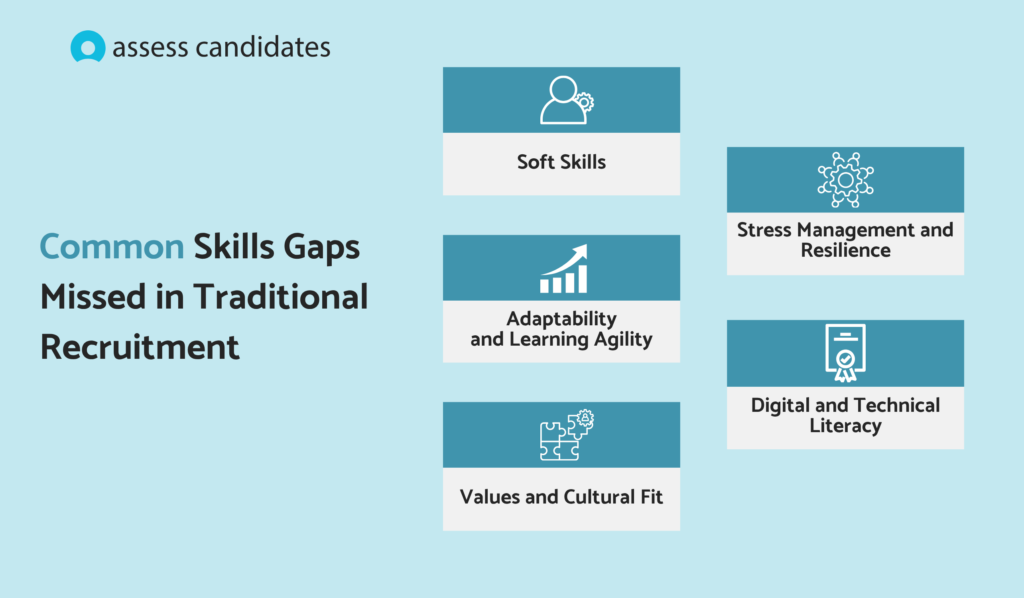
- Soft Skills
CVs can provide evidence of candidates’ technical qualifications and experience, but they rarely show the full picture of their soft and interpersonal skills. A candidate’s interview can be good, but they may still find it difficult to give feedback, manage conflict, and work effectively with a team at your company.
- Adaptability and Learning Agility
Traditional hiring methods do not always reveal how quickly candidates can learn new skills, adopt unfamiliar tools, or adjust to changing ways of working. This gap is increasingly important as roles evolve alongside AI, automation, and changing business requirements.
- Values and Cultural Fit
Your candidates’ qualifications and experience will not determine how good their working style is or whether their values align with those of your organization. Any such mismatches in your recruitment process indicate a risk of early attrition.
- Stress Management and Resilience
Stress management and resilience are often missed in traditional interviews because they only become visible under real pressure. This is something that a CV or standard interview cannot reveal without further evaluation of your candidates before offering them an employment letter.
- Digital and Technical Literacy
During traditional recruitment, a CV might show that a candidate knows a specific software package, but not whether they can adapt to new digital tools or troubleshoot basic technical issues. These capability gaps often only surface a few weeks into the role.
Identify candidate skills gaps before the interview stage with science-backed assessments. LEARN MORE
There are assessments that can identify competency gaps in the recruitment process. Check them out below!
3. How can assessments help identify skills gaps?
According to McKinsey & Company, readjusting your recruitment processes to match your skill requirements will help improve employee engagement by 50%, curb training development programs by 50%, and increase productivity by 40%.
Assessments to identify skills gaps
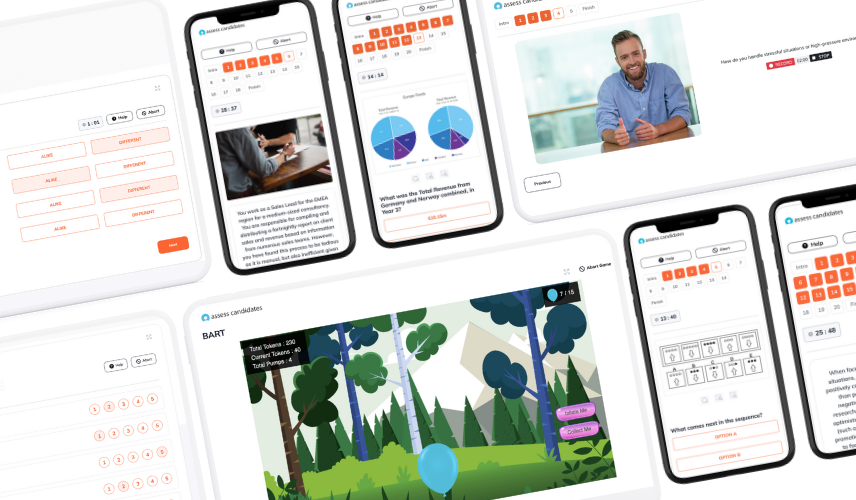
1. Skills-based Assessments
Skills–based assessment platforms like Assess Candidates, TestGorilla, and iMocha offer recruiters practical exercises that mirror actual job tasks. They examine whether your candidates can perform their skills rather than reviewing them based on their certifications and work experience.
2. Job Simulation Tasks
Job simulation tasks assess candidates by putting them in a realistic daily version of the role you are recruiting for and asking them to handle tasks related to their roles and skills. The job simulation tasks provide you with real–time insight into your candidates’ behaviors so you can see how they act and react under pressure.
3. Personality Questionnaires
Personality questionnaire platforms such as Assess Candidates, SHL, and TestTrick help employers understand the candidates’ behavioral traits, tendencies, and emotional stability. These skills are necessary for recruiters who prioritize collaboration in a work environment or are hiring for a customer service role.
4. Situational Judgment Tests
Platforms such as Assess Candidates, TestGorilla, and SHL can present candidates with realistic workplace scenarios and ask them to choose responses ranging from the most extreme to the least extreme options. Situational judgment tests help identify skills gaps in decision–making, judgment, and interpersonal skills by observing how your candidates reason in situations unfamiliar to them.
5. Psychometric Assessments
Psychometric assessment platforms such as Assess Candidates, SHL, and Cubiks offer assessment tests that measure personality traits, cognitive ability, and behavioral tendencies through standardized questionnaires. These tests compare your candidate’s profile against traits known to predict success in a role.
Some of the assessment tests that you should use to evaluate your candidates are:
Hire your perfect candidates with our pre-employment assessment platform. LEARN MORE
Up next, we will take a look at the best practices to avoid skills gaps before they become hiring problems.
4. Best strategies to avoid skills gaps
Avoiding competency gaps in the early stage of your recruitment can save your company from accumulating hiring costs, wasting resources, and going through mis–hires.
According to ManpowerGroup Research, about 74% of recruiters are struggling to find the right skilled candidates for operational success.
Top strategies to avoid skills gaps in recruitment
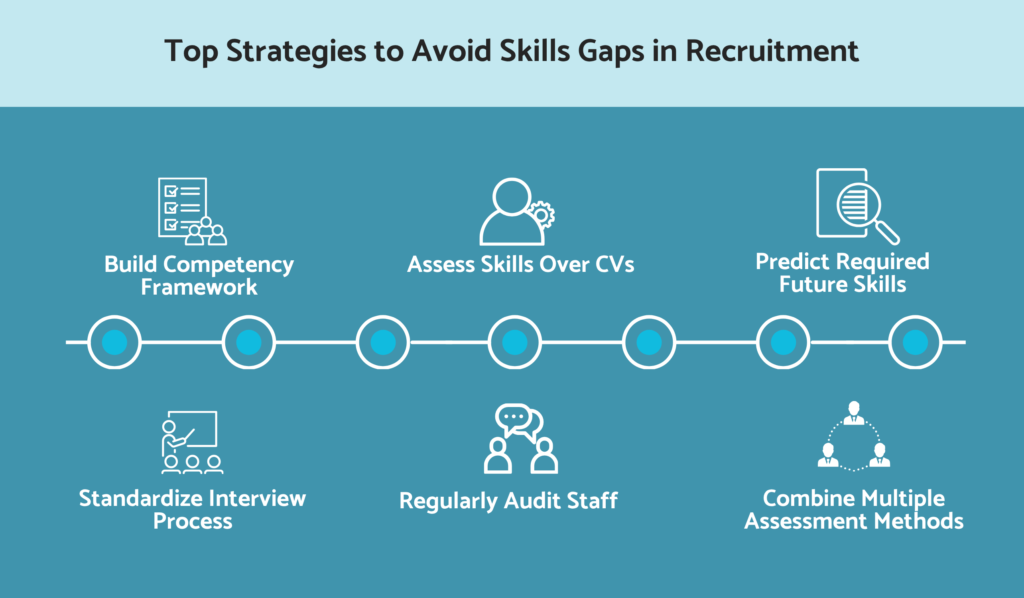
- Build Competency Framework
Address skills gaps in your organization by first defining the specific skills, behaviors, and knowledge each role requires before you write the job description. This will give your hiring team a shared standard to assess with. This gives your hiring team a shared, objective standard for evaluating candidates rather than relying on intuition.
- Assess Skills Over CVs
CVs and resumes show what candidates have done, but they do not always demonstrate what candidates can do. Skills-based assessments, practical exercises, technical tests, and work samples provide direct evidence of ability and can expose skills gaps earlier in the recruitment process.
- Predict Required Future Skills
Roles in a company often change quickly, particularly with the rise of automation and technological advancements. Adding anticipated skill requirements to your recruitment criteria, rather than evaluating what the roles need today, will help reduce the risk of mis–hiring candidates who are unable to adapt to the skills needed tomorrow.
- Standardize Interview Process
Unstructured interviews will likely result in bias and inconsistency during the interview process, risking competency gaps going unnoticed. Using structured, behavioral, or scenario–based interview questions for all candidates makes it easier to compare and spot them in the recruitment process.
- Regularly Audit Staff
We recommend regularly auditing your existing staff against evolving role requirements through periodic reassessment and feedback. Regular reviews help your organization identify emerging skills gaps before they begin to affect performance.
- Combine Multiple Assessment Methods
There is no single assessment method that fully captures your candidates’ skills, which is why we suggest pairing a cognitive test with practical exercises or structured interviews. This helps build a more complete profile of your candidates’ strengths and weaknesses before they become hiring problems.
Want to know what employers have to say about testing for capability gaps in recruitment?
5. Client success stories of testing skills gaps in recruitment
Many employers and companies have shared their experiences handling candidates who claimed to possess the skills listed on their CVs. Below are two practical hypothetical examples on how companies can test and prevent hiring problems.
1. Stripe
Challenge:
Stripe, a growing fintech company, was rapidly recruiting for technical roles, but it kept discovering that weeks later, after onboarding, new hires were unable to meet the practical demands of the job. The company recorded employee turnover in the first ninety days of employment as well as significant losses in hiring resources.
Solution:
The company introduced a combination of technical work, cognitive ability assessments, and work sample tests into its recruitment process. By doing this, they replaced the sole reliance on CV screening and unstructured interviews.
Results:
- 90-day attrition among the new technical recruits reduced within two hiring cycles
- Time to identify unqualified candidates decreased from weeks to during the last stage of recruitment
- Hiring teams reported confidence in the candidates that reached the final interview stages
2. Forever 21
Challenge:
Forever 21 was expanding into new locations and discovered that its customer-facing employees were struggling with stress management and conflict resolution once on the shop floor. This challenge was discovered despite the fact that the employees were successful in their interview process; therefore, customer complaints and turnover were often seen in the industry.
Solution:
The fashion company implemented situational judgment tests alongside personality questionnaires to help determine candidates’ skills, such as resilience and interpersonal traits. These would be applied consistently across all customer-facing recruits.
Results:
- Customer complaints linked to staff conduct reduced across newly assessed recruits
- 68% improved retention among new hires compared to the previous set
- Store managers reported fewer chances of staff requiring informal performance support
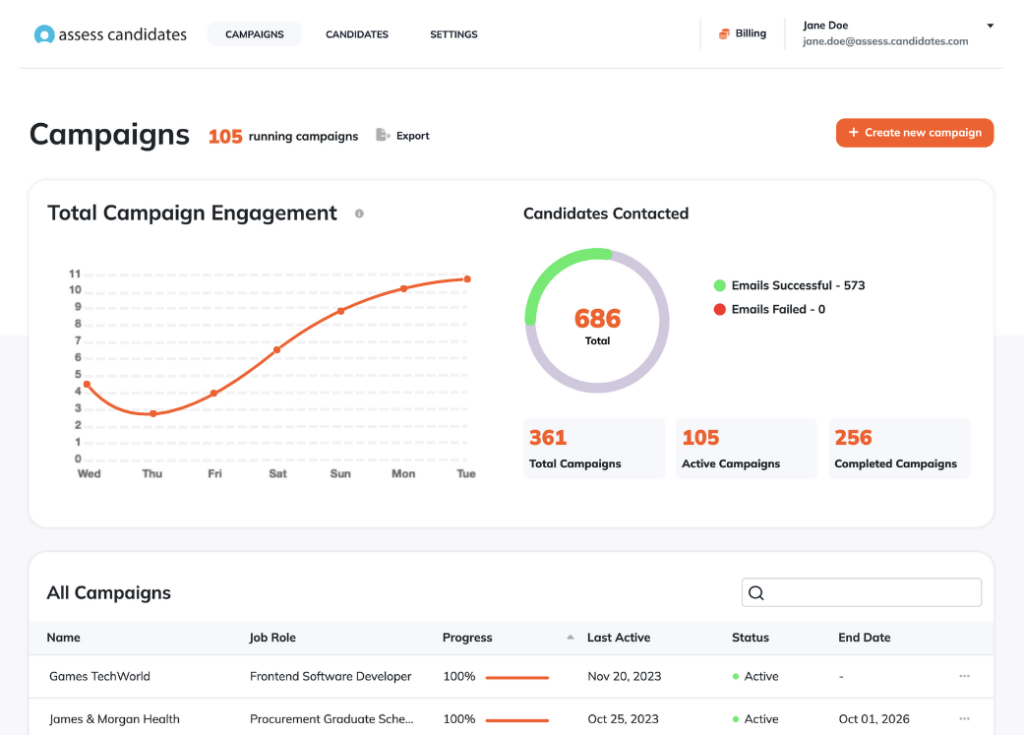
Assess Candidates helps recruiters evaluate candidates and identify competency gaps during the recruitment process. With our psychometric assessment tools, behavioral skills tests, and personality questionnaires, we can accurately test your candidates for the skills they possess.
So, why use Assess Candidates to identify skills gaps in candidates in 2026?
6. Why do employers use Assess Candidates to identify skills gaps?
Employers often use Assess Candidates to identify competency gaps because the platform combines scientific rigour with practical, rankable results, rather than relying on subjective screening.
- Scientifically Backed Assessments: Assess Candidates’ assessments are developed by a team of chartered scientists and psychologists with experience at leading firms. Each assessment undergoes rigorous validation to measure both role-specific competencies and practical, on-the-job skills. This gives organizations confidence that any skills gap flagged by our platform reflects a genuine and measurable lack rather than an interviewer’s impression.
- Detailed Reporting: Our assessment platform offers clear, intuitive reports after test completion, allowing recruiters to view individual candidates’ performance on each assessment or their overall score, with candidates automatically ranked for easy filtering and shortlisting.
- Candidate Experience: We provide employers with mobile–friendly, interactive, and accessible assessments designed to engage candidates in a tone that represents the company’s employer branding.
- Fair and Inclusive Assessments: Every assessment is designed with accessibility in mind, with features such as extended time options, Zoom functionality, and screen reader compatibility to ensure a fair and supportive experience for candidates. This helps ensure that identified capability gaps reflect genuine differences in competency rather than unnecessary accessibility barriers.
- Reduces Reliance on CVs and Resumes: Assess Candidates is widely known for using its data–driven, situational judgment tests to evaluate candidates’ potential without reliance on resumes. The platform’s support of skills-based hiring makes it difficult for candidates to pass the recruitment process with just their CVs and resumes, as their skills gap will be tested and identified.
Hire the right candidates with our assessment tool platform. LEARN MORE
Conclusion: Key Takeaway
Identifying skills gaps early helps employers address capability risks before they become costly hiring problems. Define the skills each role requires, use relevant assessments alongside structured interviews, and prioritize demonstrated ability over CV claims to make stronger, evidence-based hiring decisions.
Curious about which assessments can help you identify candidate skills gaps? Explore the FAQs below, or enter your email to get started today.
Frequently Asked Questions
When should employers identify skills gaps during recruitment?
You can identify skills gaps early in the recruitment process with the right assessments, such as job simulation tasks, situational judgment tests, cognitive ability tests, and work samples. Such combinations will help you ascertain evidence of necessary fundamental abilities during the recruitment process, before the employment offer is made.
Can you identify skills gaps in existing employees?
You can identify capability gaps in existing employees with regular skills audits, 360-degree feedback, and periodic reassessments before they affect productivity in your organization. Catching these gaps early allows you to address them through targeted training or mentoring rather than discovering them only when a project has gone wrong already.
What happens if a skills gap is identified late?
Catching a skills gap after hiring, or after a role has already changed beyond your employee’s current capability, will most likely be far more costly to fix. These risks include missed deadlines, client dissatisfaction, increased turnover, or the expense of replacing and retraining a hire who could not perform under real conditions.
Why do traditional CVs and interviews rarely catch capability gaps?
CVs and resumes confirm what your candidates have done, not what they can actually do. Interviews are usually low-pressure with well-rehearsed scenarios that reveal little about how a candidate handles real workplace demands. Skills like resilience, adaptability, and sound judgment under pressure rarely surface in a conversation, since there is no genuine pressure to respond to.
Can AI or automation help accurately identify skills gaps?
AI-powered tools can help you analyze assessment results, video interview responses, and even patterns across a wider candidate pool to flag gaps that might go missed by human reviewers. Automation works best as a support to human judgment rather than a replacement for it.


 English
  Arabic