
Emerging AI Job Roles Employers Are Hiring for in 2026



AI is reshaping how organizations work, but many employers are still deciding which AI roles they actually need, which skills to assess, and how to balance automation with human judgment. As adoption grows, recruitment teams need clearer role definitions, stronger skills-based assessment, and more transparent hiring processes.
According to Globalization Partners’ report, 49% of employers believe AI will be a useful tool for predicting challenges companies may face in new markets. This highlights the importance and reliance on artificial intelligence for maintaining and enhancing productivity in organizations.
This guide explains how AI is changing the workforce, which AI roles employers are hiring for, which skills matter most, and how recruiters can assess AI talent more effectively.
Contents
- How AI is boosting the workforce
- Skills employers are looking for in candidates for these AI roles
- Challenges of recruiting for AI roles
- Top strategies to recruit for AI roles
- Emerging AI roles employers are hiring for
- Client success stories of hiring AI roles
- Future of recruitment for AI roles
- Why recruiters use Assess Candidates to hire AI roles
To understand this, let’s start with how AI is changing work.
1. How AI is boosting the workforce
AI can support the workforce by automating routine tasks, improving access to data, accelerating decision-making, and helping employees focus on higher-value work.
According to McKinsey, employees are prepared to adopt AI to assist with daily, repetitive tasks in your organization. The survey states that at least 94% of employees and 99% of C-suite leaders are somewhat familiar with gen AI tools.
Ways AI is boosting the workforce
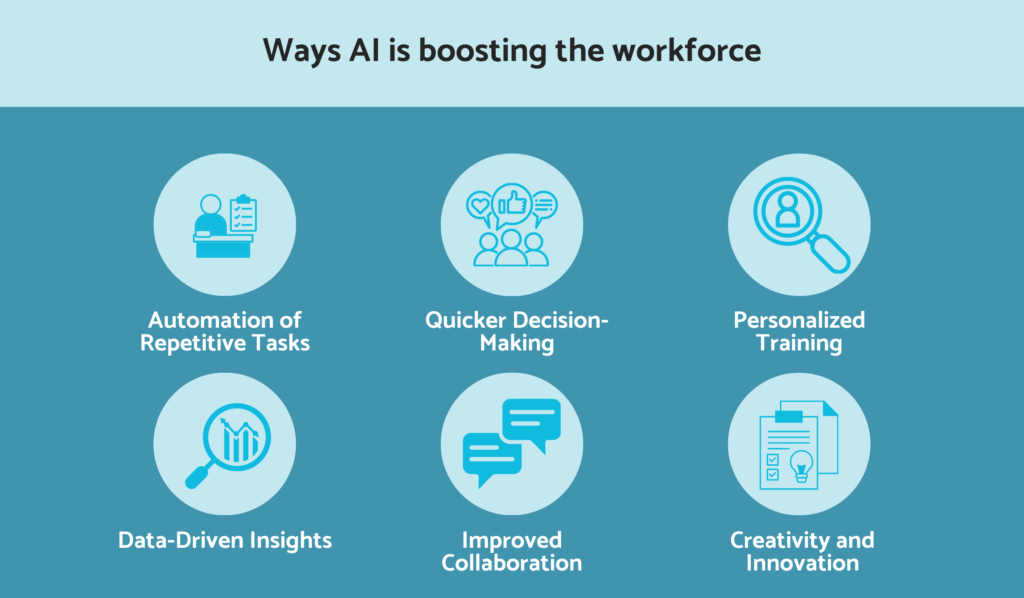
- Automation of Repetitive Tasks
Artificial Intelligence (AI) helps with tasks such as data entry, scheduling, basic customer inquiries, and document processing. The technology helps reduce the time spent on these daily tasks, allowing your workers to focus on more creative problem-solving.
- Quicker Decision-Making
AI can scan large datasets, flag priorities, identify patterns, and predict results. With AI, recruiters can choose resources or formulate strategies within a shorter timeframe. It offers predictive maintenance to help you avoid breakdowns.
- Personalized Training
It evaluates skill gaps and recommends custom learning paths, such as courses and simulations, to speed up onboarding for new candidates. Artificial Intelligence also enhances engagement by matching content to roles, helping your new candidates adapt to new tools faster, and strengthening retention.
- Data-Driven Insights
AI tools can analyze large datasets to identify trends, customer behaviors, and potential risks that your employees may miss. They provide data-driven insights into reports that may take your employees considerably longer to complete.
- Improved Collaboration
AI tools allow teams to communicate seamlessly and across borders, providing real–time translation and meeting summaries. You will find it easier to communicate more quickly across languages and time zones, speeding up your project and minimizing misunderstandings among your employees.
- Creativity and Innovation
Generative AI tools like Claude, ChatGPT, and others help most recruiters brainstorm, create content, and design prototypes much faster. With the help of AI, workers can produce higher–quality results, such as custom reports or product concepts, without having to do all the work from scratch.
Begin your hiring process with our psychometric assessments. HIRE FOR FREE
Ready to learn more about the skills to look out for when hiring for AI job roles? Keep reading!

2. Skills employers are looking for in candidates for these AI roles
Employers hiring for AI roles need candidates with both technical expertise and strong human skills. The best candidates can build, use, evaluate, and explain AI systems responsibly.
Top skills recruiters measure when hiring for AI roles
1. Technical Skills
Technical skills are the foundation of AI roles within an organization, enabling your candidates to create, train, and optimize AI systems from start to finish. These include:
- Programming: Familiarity with key programming languages like Python, R, and Java is necessary for an AI role. Python is well-suited for AI due to its clean syntax and extensive libraries, such as NumPy and Pandas, which are used for data tasks. Candidates should be able to write clean and efficient code for model training.
- Machine/Deep Learning: Machine learning includes algorithms that learn from data to make certain predictions. Deep learning makes use of neural networks for complex pattern recognition. Ensure that your recruiters look for proven experience with key frameworks, such as TensorFlow, for building scalable models.
- Data Analysis: Ensure your candidates possess this skill, as it includes cleaning datasets, running statistical tests, and visualizing insights to validate AI results. This is important because poor data will lead to flawed results, and your candidates must be able to identify these biases.
2. Soft Skills
Soft skills focus on interpersonal skills such as human behavior, judgment, collaboration, and responsibility, all of which are vital when ensuring that AI creates value and remains harmless. These include:
- Problem–Solving: Candidates should be able to assess AI limitations, debug unexpected results, and creatively adopt solutions. AI cannot replace human judgment, so this ensures a reliable outcome.
- Communication: Look for candidates who can simplify technical AI concepts for executives or clients with no knowledge of AI. This builds trust, as strong communicators can effectively bridge tech and business, turning models into realistic strategies.
- Adaptability: AI advances rapidly; therefore, candidates are expected to quickly learn new tools and approaches through online courses or hands-on experimentation. This will keep your team up to date with trends and skills that can improve the company’s productivity.
Balanced recruitment is important for every recruiter looking to hire the most talented candidates for AI roles in their organization.
Many recruiters are asking about the challenges of recruiting an AI–skilled workforce; let’s take a look at them below.
3. Challenges of recruiting for AI roles
Recruiting for AI roles is difficult because demand is growing quickly, skills are changing fast, and many organizations are still defining what AI capability means in practice.
This gives employers a clearer vision of how companies transform and the need for upskilling and reskilling.
Top 5 challenges of recruiting for AI roles
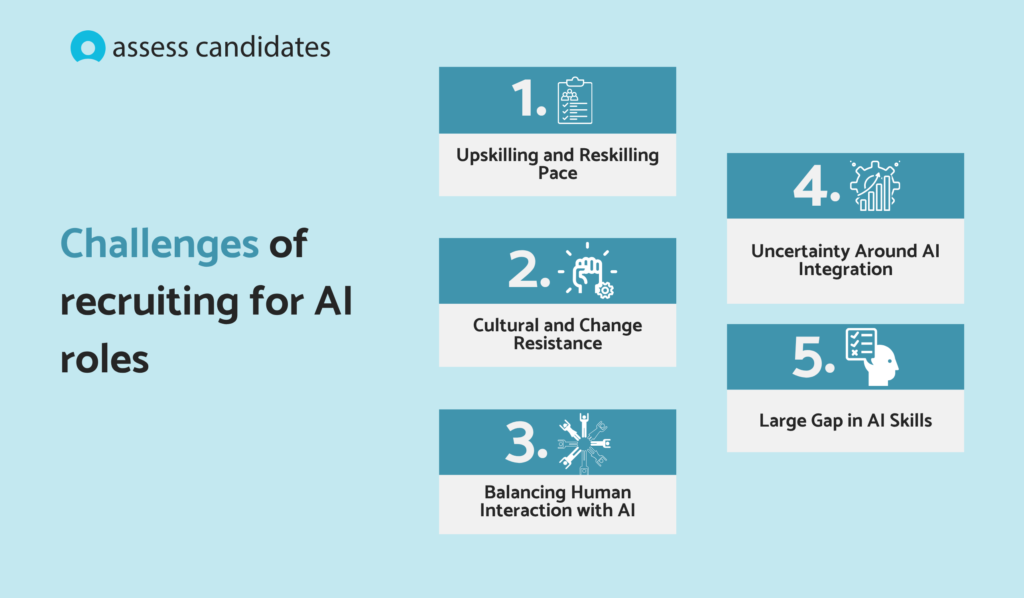
1. Upskilling and Reskilling Pace
Employers are likely to find it difficult to recruit candidates who can keep up with constant upskilling and reskilling, as AI skills often require frequent updates to keep pace with trends. Traditional employees are unable to keep up with the constant demand for AI-related techniques, which weakens your organization’s productivity and growth.
Solution: We suggest that you include “AI learning as a job requirement” in your recruiting roles when creating your job descriptions. Create internal “AI guilds” in which candidates mentor themselves and the new hires, improving the company’s capabilities.
2. Cultural and Change Resistance
Non-tech departments and teams view AI integrators as threats or as an additional, complex skill, citing skill barriers or digital shifts. This slows cross-functional adoption in departments like sales and operations, as candidates’ resistance to learning AI skills often leads to turnover among new hires.
Solution: Consider targeting candidates who possess strong communication skills and are capable of taking initiatives that turn out to be quick wins. Most companies have begun positioning candidates as enablers instead of disruptors.
3. Balancing Human Interaction with AI
According to Incruiter, 93% of recruiters have admitted that human interaction is necessary in the workforce, even as dependence on AI usage continues to grow. However, finding a balance in a candidate who knows how to use AI tools and when to override them is difficult.
Solution: We suggest that during the interview stage, you look for instances where candidates have questioned or overridden an AI suggestion or identified a gap in an AI outcome. You want candidates who confidently use AI to amplify their judgment and not replace it.
4. Uncertainty Around AI Integration
Several companies are recruiting for AI roles without a well–defined internal AI strategy, which ultimately leads to vague job descriptions and high turnover. Many candidates interested in driving AI adoption in your company may be disappointed to find outdated infrastructure or encounter internal resistance.
Solution: Before you start hiring, we recommend that you clearly define how AI will be utilized in the role you are recruiting for, the tools involved, and a vision of what success looks like. Promoting transparency in your job ads about your organization’s AI maturity level builds trust and will attract the ideal candidates.
5. Large Gap in AI Skills
The demand for candidates who can use, integrate, and monitor AI tools in their daily tasks has far exceeded the current talent pool. This is because nearly half of recruiters claim that candidates lack relevant expertise, and some struggle to evaluate candidates’ self–taught AI skills.
Solution: Shifting to skills-based recruitment instead of using the traditional hiring approach will aid you in sourcing the right candidates. Look out for candidates who can demonstrate their skills through project portfolios and practical assessments, rather than their degrees.
Having seen the challenges and potential solutions to avoid these cases, let us now look at strategies for recruiting for AI roles.
4. Top strategies to recruit for AI roles
The strongest AI hiring strategies combine clear role design, skills-based assessment, faster hiring timelines, and transparent communication about how AI is used in the organization.
According to Veris Insights Research, software engineering job postings were up 11% year over year, largely driven by C-suite programs focused on acquiring future skills to develop internal AI capabilities.
Best strategies to recruit for AI roles
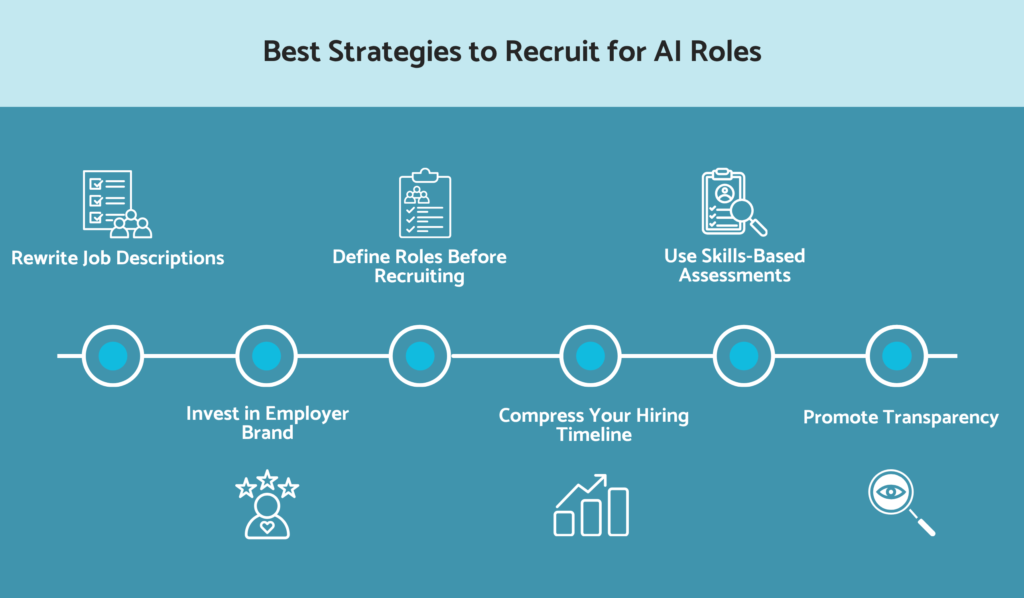
- Rewrite Job Descriptions
Having generic job descriptions will barely attract strong AI candidates, as exclusionary language will discourage them from applying to your company. We suggest that you use tools like Textio to optimize your job postings and focus on results and proven skills rather than degree certificates.
- Define Roles Before Recruiting
Before you begin your AI recruiting process, you should answer a few necessary questions about the roles that you are recruiting for and the number of applicants the role requires. Having answered these questions, you will have a clearer insight into your recruitment decision-making. Employers often treat AI hiring as software hiring, which in turn leads to expensive mis–hires and misaligned expectations.
- Use Skills-Based Assessments
Introduce skills-based assessments with practical, role-specific tasks, such as AI workflow audits, tool integration challenges, and prompt challenges. These tasks and many more will expose the real-time skills your candidates possess that cannot be detailed in their CVs.
- Invest in Employer Brand
The talented AI candidates will always have options, and they often choose organizations based on more than the salary they are offered. Expressly and publicly showcase your AI infrastructure, your team’s quality, and your innovation pipeline to gain a competitive advantage in attracting top candidates.
- Compress Your Hiring Timeline
Speed is considered a recruitment strategy for AI roles because top talent moves quickly, and lengthy, multi–stage processes lead to higher drop–off rates. AI automation tools can streamline sourcing, candidate screening, and scheduling, allowing your recruitment team to have high–value discussions that win candidates.
- Promote Transparency
According to Deloitte’s 2026 Human Capital Research, the biggest differentiator in HR AI projects is how the human teams understand, utilize, and collaborate with AI systems.
Candidates seeking AI–integrated roles are interested in knowing which tools are in place and how decisions are made. Being transparent about your organization’s current AI maturity will help your candidates develop more trust in you and in your authenticity.
Explore assessments created by Chartered Scientists to hire the right candidates. VIEW PLANS
Next, look at the roles employers are hiring for.
5. Emerging AI Roles Employers Are Hiring For
Emerging AI roles are jobs created or reshaped by the need to build, manage, monitor, govern, or apply AI systems in business workflows.
Employers are looking at crucial roles across sectors that can help candidates and employees reduce their workload through AI integration.
Sectors that Employers Hire for AI Roles
- Technology
Technology companies like NVIDIA, Google, and OpenAI recruit candidates skilled with AI tools, as these tools help them spot technical issues and provide rapid analysis, speeding up repair times.
- Finance
Finance companies like Bank of America, JPMorgan Chase, and Goldman Sachs use artificial intelligence in the finance sector to automate trading, detect fraud, and perform risk analysis.
- Healthcare
Healthcare service providers such as Mayo Clinic, Cleveland Clinic, and Epic Systems all use AI in strategic and leadership roles to power diagnostics and to analyze clinical data to support treatment decisions.
- Legal
Firms like Relativity, Kira Systems, and the SEC use AI to review contracts, extract significant clauses from documents, and label case documents for AI–powered legal research tools.
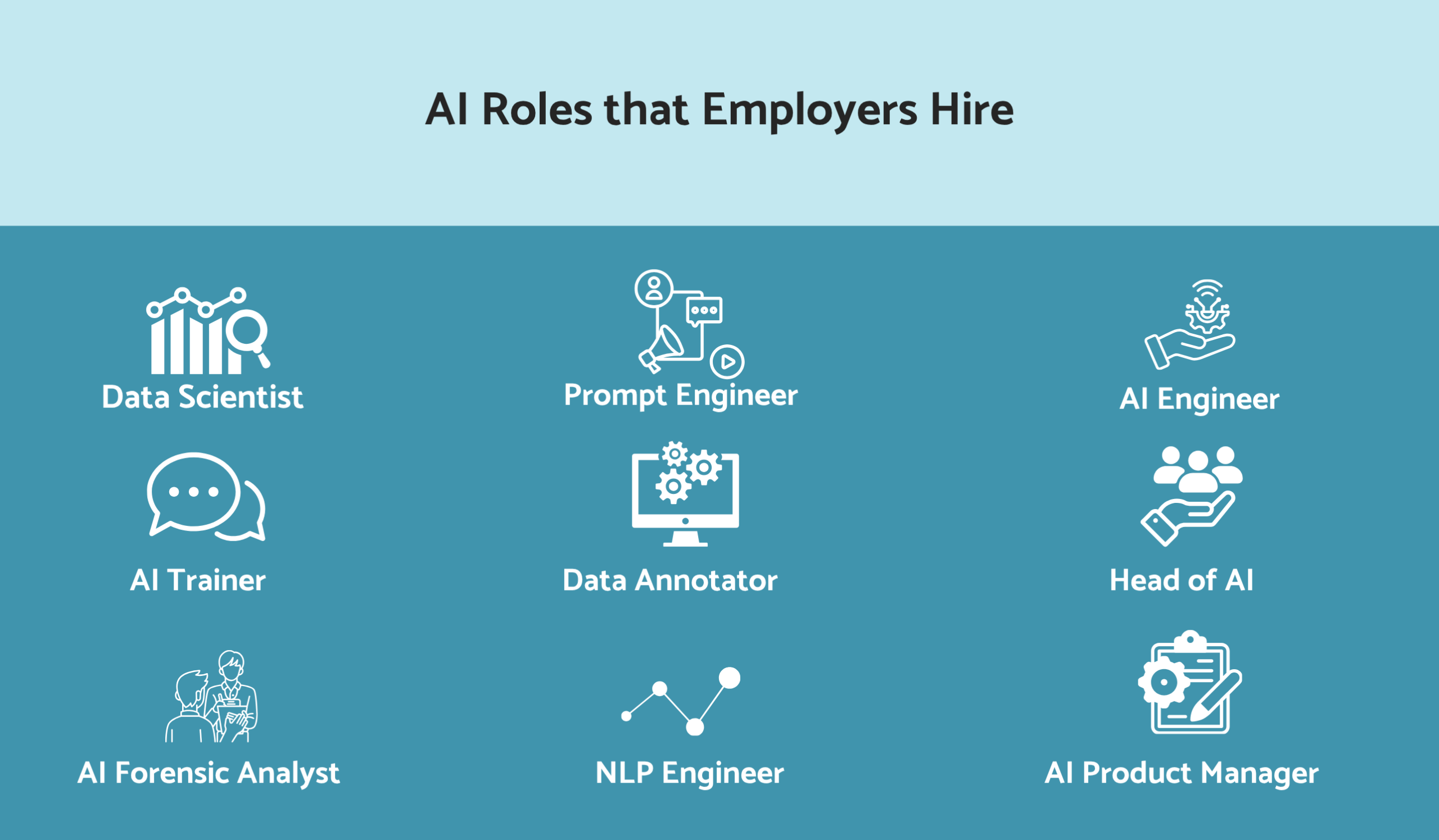
AI Roles that Employers Hire
- Data Scientist
- AI Trainer
- AI Forensic Analyst
- Prompt Engineer
- Data Annotator
- NLP Engineer
- AI Engineer
- Head of AI
- AI Product Manager
Are you looking to attract and recruit candidates with AI skills for your company? Not sure about what pre-employment psychometric assessment tests you should use to assess your candidates to ensure you hire the ideal talent? You can contact us for a thorough evaluation of your hiring assessment design, and we will ensure you hire the ideal talent.
Want to know what recruiters have to say about recruiting candidates for AI roles?
6. Client success stories of hiring AI roles
Employers today have shared their experiences and knowledge on attracting and successfully recruiting candidates for AI roles in their organization. Here are a few of them and how they solved the challenges they faced.
1. Unilever
Challenge:
Unilever was struggling to find recruiters who could use and manage AI screening tools while ensuring human judgment and cultural fit as the organization faced high-volume hiring. The traditional hires lacked the prompt engineering and analytical skills Unilever required, slowing talent acquisition.
Solution:
The organization partnered with AI platforms for skills assessments and recruited hybrid recruiters who were trained in tool chaining and bias tracking. Unilever also introduced internal bootcamps to upskill candidates from diverse backgrounds.
Results:
- Unilever achieved 40% faster screening while enhancing quality scores by 25%
- Reduced onboarding time for new recruiters by 30% via AI-driven training modules
- Increased internal promotion rates to AI roles by 35%
2. PwC
Challenge:
PwC required consultants capable of deploying LLMs across client projects, but the company faced skill mismatches, as many candidates claimed to possess skills they did not have. Top companies had also driven salaries up by 60%, making it difficult to recruit qualified talent.
Solution:
The consulting company launched a take-home AI integration project and collaborated with bootcamps for verified prompt engineering certifications. They then offered candidates equity and client–facing career tracks.
Results:
- Minimized time-to-productivity for new recruits from 5 months to 8 weeks
- Accomplished 92% client satisfaction on AI implementations
- Delivered 45% more customer AI projects in the first year with an expanded team
This is where Assess Candidates comes in: we help ensure your candidates are well qualified, as our pre-employment psychometric assessments measure skills and provide data-driven analytics to inform your recruiting decisions.
7. Future of recruitment for AI roles
Recruitment for AI roles is likely to become more skills-based, more regulated, and more focused on human-AI collaboration.
What is the future of recruitment for AI roles?
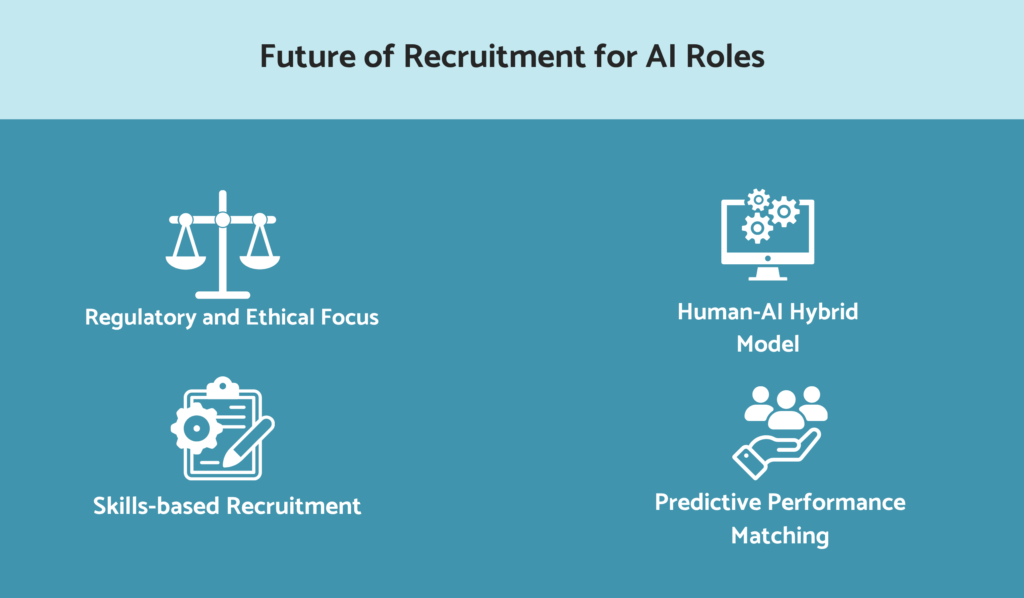
- Regulatory and Ethical Focus
Global rules and regulations will require a more transparent AI recruitment, requesting audits for bias in AI role sourcing. Most of the recruiters and employers will be required to use explainable systems in the future.
- Skills-based Recruitment
AI platforms will evaluate hands-on skills through simulations rather than resume screening, as multiple large–scale companies are already taking this approach to skill assessment over CV screening. Taking this route will also spotlight self-taught talent who have not undergone traditional training.
- Human-AI Hybrid Model
You will eventually evolve into a strategist by using AI data tasks as you judge your candidates’ soft skills, like communication, collaboration, and more. When recruiting for AI roles, your interview process will also include live AI integration demos by prospective candidates.
- Predictive Performance Matching
AI tools will now predict your candidates’ success in their roles using their past data and skills graphs, improving match accuracy and identifying gaps ahead of time. This will work in favor of candidates with AI ethics or integration experience.
AI hiring is risky when employers rely on claimed experience alone. Practical assessment helps show whether candidates can actually use, evaluate, and explain AI in role-relevant situations.
So, why use Assess Candidates to hire for your AI roles in 2026?
8. Why recruiters use Assess Candidates to hire AI roles
Assess Candidates helps employers and recruiters meet their top talent through rigorous skills evaluations to make data–driven hiring decisions.
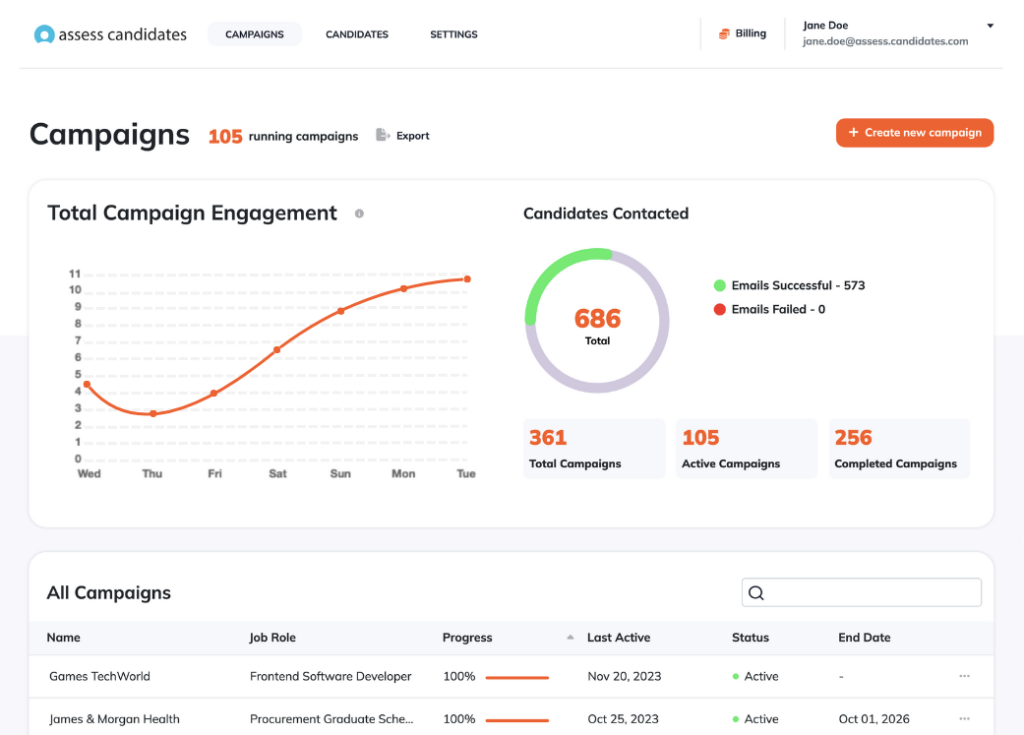
- Real–time Insights and Analytics: Assess Candidates provides you with instant data on your candidates’ strengths, enabling you and your recruiters to prioritize top performers early in the recruitment process. This helps you speed up your hiring decisions for high-demand AI roles, with a dashboard that shows candidates’ fit scores.
- Objective Skill Evaluation: Our platform assesses real competencies through personality, psychometric, cognitive, behavioral, and game–based assessments. These tests are tailored to AI proficiency and will help you in minimizing unconscious bias in your recruitment process.
- Improved Candidate Experience: Assess Candidates offers your candidates a smooth, engaging assessment process and provides clear feedback that boosts completion rates. Prospective candidates are motivated to complete the assessment process, and this simultaneously improves your employer branding.
- Structured Hiring Insight: Assess Candidates helps employers compare candidates using assessment data, behavioral indicators, and role-relevant evidence, supporting more consistent hiring decisions for AI-related roles.
- Ethical AI compliance: Assess Candidates is widely chosen for recruiting AI roles because it installs ethical safeguards and compliance across all assessments. Our platform can detect bias and protect candidates’ data.
Hire the right candidates for your AI roles with our assessment tool platform. LEARN MORE
Conclusion: Key Takeaway
The best hiring strategy to attract, recruit, and retain the perfect candidates for your AI-forward organization is to use skills–based assessments. This is to verify your candidates’ skills and authenticity and improve your employer branding so that candidates understand your goals and vision.
Curious to know more about using assessment tests to hire the perfect candidates for your AI roles? Keep scrolling to explore our frequently asked questions, and enter your email to get started today.
Frequently Asked Questions
What are the biggest challenges for hiring AI roles?
Recruiting candidates for AI roles can be especially challenging when you face a talent shortage, rapidly obsolescent skills, and intense competition, all of which increase the costs of assessing candidates.
Will AI be used to fully automate hiring for these roles?
No, AI should not fully automate recruitment. It can support screening, scheduling, skills evaluation, and candidate communication, but final hiring decisions should involve human judgment, especially where fairness, context, and accountability matter.
How can small-sized companies compete for AI talent?
Small-sized companies can offer flexibility and career growth paths. These can be achieved by building strong employer branding through success stories to reach passive candidates.
Are there any legal risks in AI role recruitment?
There are legal risks, and these can arise in screening tools: you may detect bias, or a lack of transparency can violate certain laws and regulations in your country. Ethical assessments are important because they help ensure fair recruitment of diverse candidates.
What roles does upskilling play in AI roles?
Choosing to upskill your employees and candidates means that you are addressing and prioritizing the pace of AI evolution in your organization. With the inclusion of AI, structured programs with minimal credentials provide long-term return on investment.


 English
  Arabic