
Customer Service Recruitment: How to Build a Reliable and Efficient Team
Customer service recruitment has evolved from a staffing function into a strategic driver of customer satisfaction, brand trust, and long-term loyalty. As customer expectations rise and support channels expand, organizations need to hire people who can deliver fast, empathetic, and consistent service.
A strong customer service hiring strategy helps companies build teams that communicate clearly, solve problems calmly, and represent the brand professionally across phone, email, live chat, and social channels. Done well, it can improve CSAT, reduce escalations, and strengthen retention.
Did you know? According to the U.S.Bureau of Labor Statistics, oStatistics, customer service representative roles are projected to generate about 341,700 openings per year on average in the United States.
Effective customer service hiring demands structured evaluation methods, behavioural assessments, and criteria based on the roles you are hiring for. By following this approach, organizations reduce turnover, scale teams with confidence, and build support functions that can manage peak demand without sacrificing service quality.
This guide explains why customer service hiring matters in 2026, which roles employers typically recruit for, what skills to assess, and how to build a more effective hiring strategy.
Contents
- What is customer service?
- Top Customer Service Roles Employers Hire For
- Top Skills to Assess in Customer Service Recruitment
- What challenges do organizations face when hiring for customer service?
- What are the best tools for hiring in customer service?
- How to build an efficient customer service team
- Customer Service Recruitment: A Success Story
- Why top companies choose Assess Candidates to hire customer service teams
To begin, let’s first find out what customer service is.
1. What is customer service?
Customer service is the support a business provides before, during, and after a purchase. It includes answering questions, solving problems, and helping customers use products or services successfully, with the goal of improving satisfaction, trust, and long-term loyalty.
Every customer service interaction is an opportunity to help you grow your business, especially when queries are resolved quickly and efficiently. It drives brand loyalty and recognition.
Boost your customer service recruitment strategy with scientifically validated pre-employment tests. HIRE FOR FREE
Why is customer service important for an organization?
Strong customer service builds loyalty, improves brand reputation, and supports revenue growth. It helps customers feel heard, respected, and supported, which increases trust and encourages long-term relationships.
5 major reasons why customer service helps your organization:
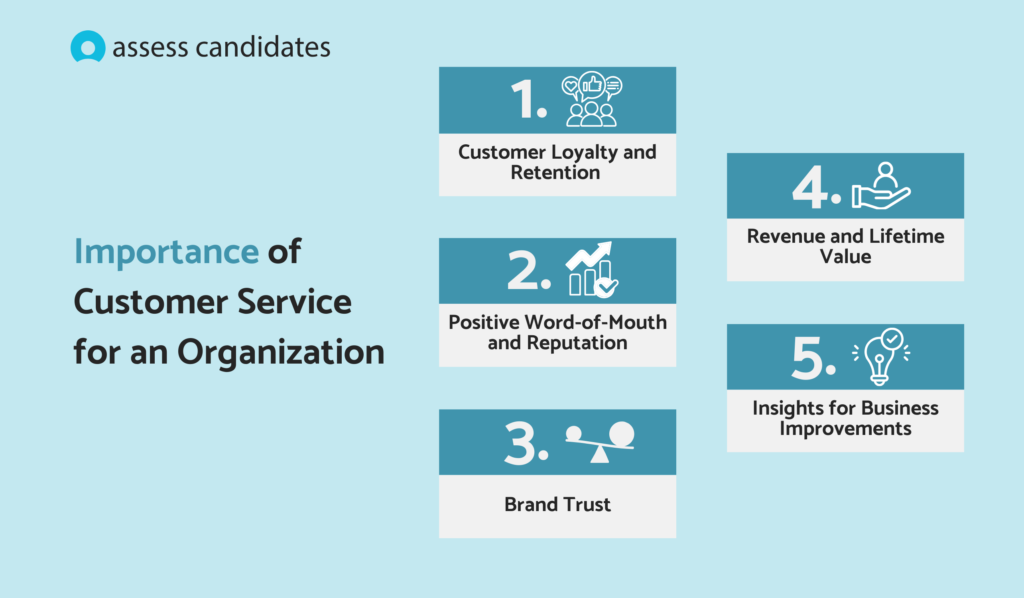
1. Builds Customer Loyalty and Retention
Strong customer service motivates customers to return and stay loyal to the brand, even when competing companies offer similar products or pricing. When customers feel understood and valued, they develop a sense of loyalty for your brand that goes beyond transactional interactions.
Moreover, retaining satisfied customers is also more cost-effective than acquiring new ones. It’s because customer acquisition often requires significantly more time, resources, and marketing investment.
2. Drives Positive Word-of-Mouth and Reputation
Satisfied customers share their positive experiences with friends, family, and online communities, boosting the brand’s credibility and reputation. By delivering excellent services and generating positive interactions, companies turn customers into advocates who promote the brand organically.
3. Strengthens Brand Trust
Customer service plays a key role in developing brand trust as it humanizes the company. When customers feel heard, respected, and supported, especially during any product issues or challenges, they become more confident in the brand. Moreover, a consistent and empathetic interaction over time develops genuine brand trust, establishing a positive long-term customer relationship.
4. Helps Increase Revenue and Lifetime Value
Great customer service contributes directly to revenue growth. Customers who receive reliable support are more likely to continue purchasing, renew subscriptions, and upgrade their products or services. This behaviour increases Customer Lifetime Value (CLV), helping your business generate more revenue from your existing customer base.
5. Provides Insights for Business Improvements
Customer service representatives gather real-time feedback from users, giving companies valuable insight into customer expectations, recurring frustrations, and product limitations. These insights highlight opportunities for improvement, especially in product development, internal processes, or overall customer experience.
Now that you understand the basics, in the following section, we will look into the common roles in the customer service industry.

2. Top Customer Service Roles Employers Hire For
Companies hire a wide range of customer service roles based on their size, industry, and service requirements. These roles support every stage of the customer journey by answering inquiries, resolving technical issues, managing long-term relationships, and handling escalations.
Top customer service roles employers hire for:
- Frontline Customer Support Representatives
Frontline customer support representatives act as the first point of contact between your business and customers. They answer questions, resolve basic issues, process orders, and guide customers through channels like phone, email, chat, or social media. These professionals ensure customers feel supported and experience a smooth interaction throughout their journey with the company.
- Technical Support Specialists
Technical support specialists support companies that offer digital products, IT services, or advanced solutions, like cloud platforms or cybersecurity tools . They troubleshoot technical problems, provide product-specific advice, and help customers resolve issues that require advanced system knowledge. When cases become highly complex, they escalate them to senior technical teams to ensure accurate resolution.
- Customer Success Managers
Customer success managers operate mainly in subscription-based or service-driven industries such as SaaS. They work proactively by building long-term relationships, onboarding customers, monitoring product usage, and ensuring consistent value delivery. By improving engagement and customer satisfaction, they reduce churn and strengthen customer loyalty.
- Helpdesk or Service Desk Analysts
Helpdesk or service desk analysts support your internal teams or external clients by assisting them with access issues, software or hardware errors, and technical disruptions. They manage ticket systems, diagnose system problems, and deliver timely solutions that ensure smooth and uninterrupted operations.
- Call Center Agents
Call center agents work in your service centers and handle inbound or outbound customer communication. Inbound agents assist customers with queries, billing issues, or service requests. However, outbound agents conduct follow-ups, collect feedback, promote renewals, or manage upselling based on business goals.
- Escalations or Complaints Specialists
Escalations or complaints specialists handle sensitive and complex grievance and customer complaint cases that frontline support teams cannot resolve. They use strong communication, negotiation, and problem-solving skills to address dissatisfaction and rebuild trust. Their work protects the company’s reputation and improves maintain customer confidence during challenging situations.
Find the right customer service talent faster with our automated, online assessments. LEARN MORE
Now, let’s dive into the skills you should look for when hiring in the customer service industry.
3. Top Skills to Assess in Customer Service Recruitment
In customer service hiring, technical ability matters, but how someone communicates under pressure often matters more.
Customer service requires candidates who can communicate clearly, stay calm under pressure, and create positive customer experiences. The right professional with the required skillset enables consistent, empathetic, and solution-focused support in every interaction.
6 major skills to look out for when hiring customer service professionals:
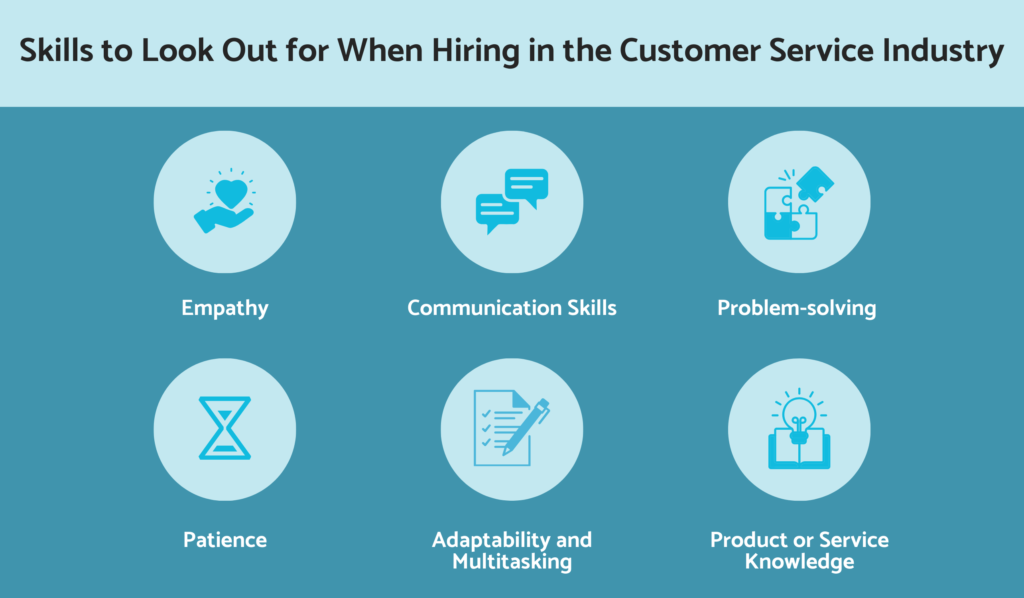
1. Empathy
One of the most important skills to look out for when hiring customer service representatives is empathy. Empathy is the ability to understand how others feel. The foundation of providing a great customer service experience often begins with being empathetic towards the customers, understanding their needs, and actively listening and acknowledging their concerns while being patient and respectful.
2. Communication Skills
Communication is another essential skill when hiring customer service professionals. Good customer service relies on clear, concise, and professional communication. Candidates should be able to explain products or services in simple language, guide customers confidently, and maintain a positive tone throughout the interaction.
3. Problem-Solving
To make sure your organization’s customer service is great and efficient, look out for hiring candidates who think logically, diagnose issues quickly, and propose effective solutions rather than reading scripts word-for-word. The fundamental reason why customer service is a part of every business is to solve problems.
Hence, employers must hire candidates who can quickly identify the source of a customer’s problems and provide the best solutions for solving them.
4. Patience
Customer inquiries can often be repetitive and frustrating. Hence, it is essential to look out for candidates who can keep their cool even in heated situations. A customer service professional who can be patient and provide effective solutions to customers without any irritation creeping into their tone or behavior ensures quality interactions and improves brand trust.
5. Adaptability and Multitasking
For a great customer service experience, it is important to have a customer service team that is adaptable. With shifting priorities, channels between phone, live chat, email, and tools, customer service staff must stay flexible and efficient.
6. Product or Service Knowledge
Employers must look out for candidates with strong product or service knowledge and the ability to learn it quickly. This supports them to handle customer queries with confidence and accuracy, explain features, troubleshoot issues, and guide customers effectively. Hence, it strengthens brand trust and establishes a long–term customer relationship.
Explore how our psychometric tests support your customer service hiring strategy. HIRE FOR FREE
But what challenges do organizations face when hiring for customer service?
4. What challenges do organizations face when hiring for customer service?
Hiring for customer service talent often becomes difficult when organizations need to balance communication quality, channel fit, retention, and scale.
Common challenges and considerations while hiring for customer service:
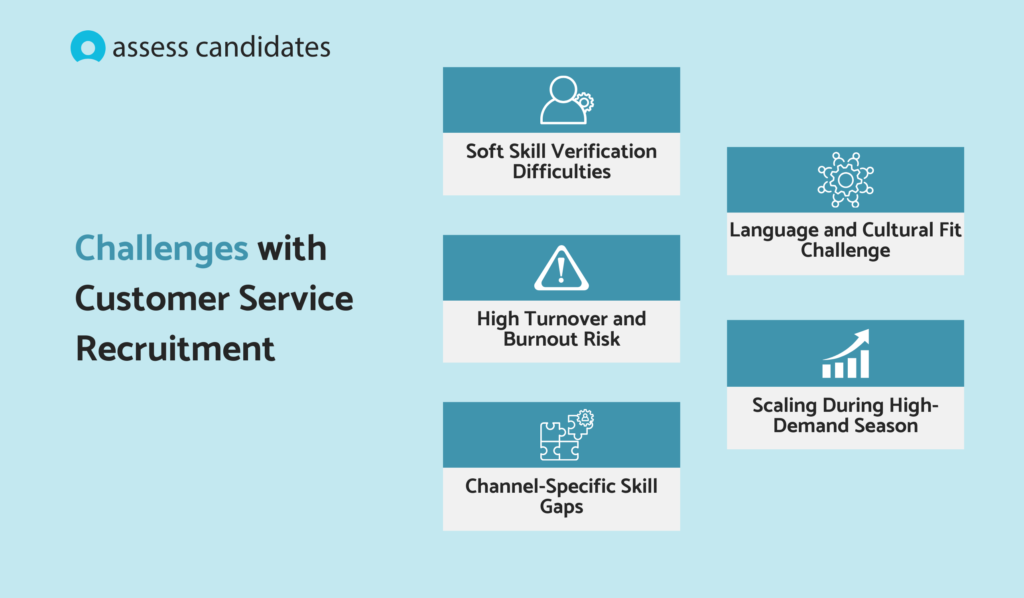
- Soft Skill Verification Difficulties: Many candidates claim strengths in empathy, patience, and communication, but these traits are difficult to validate through resumes alone.
Solution: Use behavioral interviews, role-play simulations, and situational judgment tests to assess real-world responses, emotional intelligence, and service mindset.
- High Turnover and Burnout Risk: Customer service roles can be repetitive, stressful, and emotionally demanding, often resulting in low retention and increased hiring costs.
Solution: Set realistic job previews, establish clear growth paths, and assess candidates for resilience and motivation early in the hiring process.
- Channel-Specific Skill Gaps: Skills required for voice support differ from live chat, email, and social channels, making it difficult to find candidates who excel across platforms.
Solution: Create channel-specific hiring criteria and use tailored assessments such as typing speed tests, call simulations, or written communication evaluations.
- Language and Cultural Fit Challenges: Miscommunication, tone misunderstandings, or a lack of cultural awareness can negatively affect customer satisfaction, especially in global support teams.
Solution: Assess language proficiency with fluency tests and score written and verbal tone. Offer training in cultural sensitivity and brand voice guidelines.
- Scaling During High-Demand Seasons: Customer service teams often need to hire in bulk during peak periods, which can overwhelm recruitment teams and slow down hiring timelines.
Solution: Use automation tools such as chat-based screening, skill assessments, and ATS workflows. Build an ongoing talent pipeline to mobilize candidates quickly.
Next up, we will take a look at the best tools employers use for hiring in the customer service industry.
5. What are the best tools for hiring in customer service?
Employers get the best results when they combine assessments, structured interviews, and practical simulations to evaluate how candidates think, communicate, and perform under pressure.
Top tools employers use for hiring in customer service:
- Pre-Employment Assessments
Pre-employment assessments help employers objectively measure the essential skills and behaviors needed for customer-facing roles. These tools create a fair and consistent way to compare candidates based on ability, not assumptions or first impressions.
- Communication and Language Skills Tests
Communication and language skills tests evaluate a candidate’s ability to communicate clearly and professionally. Employers assess grammar, tone, clarity, and writing structure. These skills are especially critical for roles that rely on email, live chat, or written customer interactions.
- Situational Judgment Tests (SJTs)
Situational judgment tests (SJTs) measure how candidates respond to realistic customer service scenarios, such as dealing with frustrated customers or requests outside policy. These assessments reveal a candidate’s problem-solving skills, empathy, and judgment under pressure. This helps predict how they will behave in real-world interactions.
- Personality or Behavioural Assessments
Personality or behavioural assessments help identify behavioural traits that align with customer service success. Employers evaluate qualities such as patience, emotional stability, adaptability, and agreeableness. These insights help determine whether a candidate’s temperament aligns with the demands of the role and the workplace culture.
- Typing and Multitasking Tests
Typing and multitasking tests measure a candidate’s ability to work efficiently in fast-paced environments. These assessments may include typing accuracy and speed, navigating multiple screens or systems, and entering data quickly. They are especially useful for chat support, ticketing platforms, and call centre roles.
- Technical or Product Simulation Tests
Technical or product simulation tests simulate real work tasks, making them valuable for roles in IT support, SaaS platforms, or technical service environments. Candidates may walk through troubleshooting steps or solve product-related inquiries, allowing employers to evaluate practical competence and problem–solving ability.
- Structured Interviews
Structured interviews play a key role in ensuring fairness and consistency during the hiring process. Employers ask every candidate the same set of questions and score their responses using predefined criteria. This approach minimizes bias and allows you to evaluate candidates based on performance.
What are some interview questions to ask during the customer service hiring process?
Asking the right interview questions helps you understand how candidates think, communicate, and respond in realistic customer scenarios. Common examples include:
- Where do you see yourself in the next five years?
- Why do you believe customer service is important, and what skills or qualities does it require?
- Can you recall a time when you experienced poor customer service? What would you have done differently to improve the situation?
- What does empathy mean to you in the context of customer service?
Strengthen your customer service hiring process with our pre-employment assessments. LEARN MORE
Now that we have an idea of the type of questions asked in an interview, let’s look into the different ways employers use to develop an efficient customer support recruitment strategy.
6. How to build an efficient customer service team
Building an effective customer service hiring strategy means developing a clear, structured plan to attract, assess, and hire service-focused talent. This ensures alignment with your company’s brand, customer expectations, culture, and compliance requirements.
5 effective strategies employers use to build an efficient customer service team:
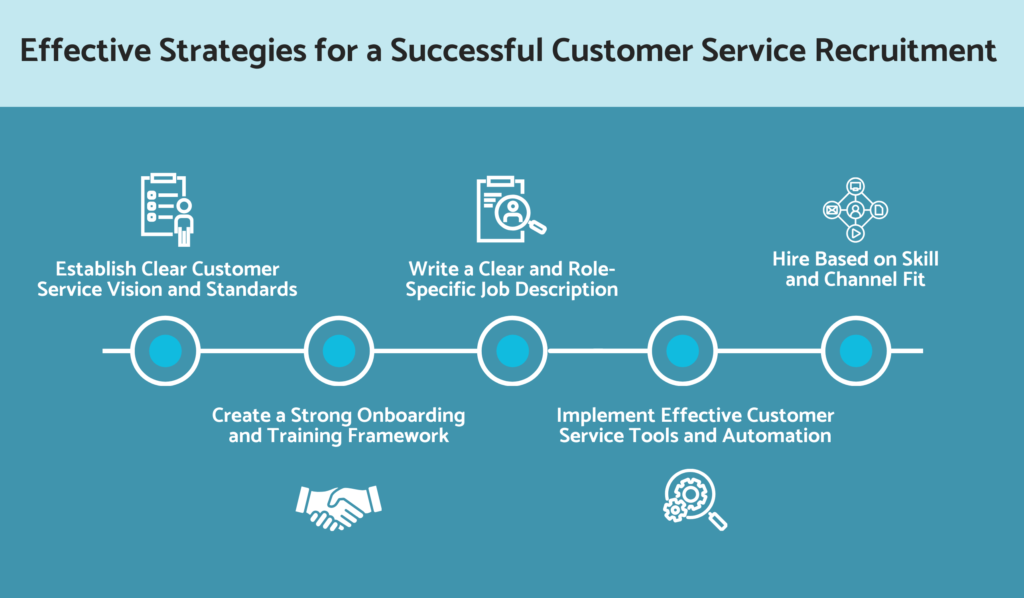
1. Establish a Clear Customer Service Vision and Standards
Start building an efficient customer service team by defining what excellent service means for your organization. Outline tone guidelines, core values such as responsiveness, empathy, or accuracy, and set measurable expectations for response times and resolution deadlines.
Solution: Document customer service values, tone guidelines, SLAs, and escalation policies before hiring or training.
2. Write a Clear and Role-Specific Job Description
Write a well-defined customer service job description to attract the right candidates and filter out unsuitable applicants early. Clearly state the role’s responsibilities, required skills, preferred experience, and communication channels, that is, phone, chat, and email.
Include proficiency expectations for tools such as CRMs or ticketing systems. Highlight soft skills like empathy, patience, and a customer-first mindset to support customer-focused hiring. When job expectations are clear, candidates can accurately assess whether they are a good fit.
Solution: Create a job description that clearly defines responsibilities, required skills, tools, expectations, and communication channel focus.
3. Hire Based on Skill and Channel Fit
Hire talent based on capability and communication strengths. Assess behavioural traits, communication style, and the ability to remain calm and professional during customer interactions. Use structured assessments and interviews to place candidates in the channels where they perform best.
Solution: Use assessments, video interviews, assessment centres, and role-based hiring criteria to match candidates with the right customer service channels.
4. Create a Strong Onboarding and Training Framework
Deliver tailored onboarding, even for experienced hires. Train new team members on product knowledge, brand voice, communication scenarios, and platform usage. Use live shadowing, simulated scenarios, and supervised practice to build confidence and readiness for customer interactions.
Solution: Build a repeatable onboarding program supported by continuous learning and role-based training.
5. Implement Effective Customer Service Tools and Automation
Use technology to improve speed, organisation, and scalability. Implement platforms such as helpdesk systems, CRMs, automation tools, and dashboards to simplify workflows and eliminate repetitive tasks. Automate common inquiries, routing, and FAQs to allow agents to focus on complex or emotionally sensitive cases that require human understanding and judgment.
Solution: Adopt CRM, ticketing systems, and automation tools to streamline processes and reduce repetitive manual effort.
Discover our talent assessment platform to assess and hire top customer service professionals with us. LEARN MORE
7. Customer Service Recruitment: A Success Story
Client Problem Statement:
A rapidly growing e-commerce brand faced a sharp increase in customer inquiries across multiple regions. As demand surged, the company struggled to hire qualified support agents quickly enough to manage phone, live chat, and email channels.
Despite ongoing recruitment efforts, candidates showed inconsistent communication skills, limited multilingual ability, and uneven levels of empathy, active listening, and problem-solving. This increased time to hire, lengthened response queues, and reduced customer satisfaction scores.
Assess Candidates’ Proposal:
At Assess Candidates, we recommended implementing a tailored customer service recruitment framework supported by role-specific assessments and standardized hiring criteria. This approach will help the organization identify high-potential service talent efficiently and consistently across multiple regions.
Additionally, we proposed integrating mobile-friendly personality evaluations, language proficiency tests, typing and multitasking assessments, and realistic situational judgment scenarios to measure how candidates respond to real customer challenges.
By leveraging candidate analytics and regional sourcing insights, the organization could build targeted talent pipelines, streamline high-volume hiring, and ensure alignment with brand voice, service standards, and cultural expectations.
Result:
By adopting a tailored customer service recruitment framework, the company will now access a wider pool of qualified customer service professionals and significantly reduce time-to-hire. Hiring managers will benefit from deeper insights into each candidate’s communication style, tone, service mindset, and long-term fit, resulting in stronger hiring decisions.
As a result, the organization will build a scalable, high–performing customer support team capable of delivering consistent customer experiences across languages, time zones, and service channels. Over time, this will strengthen customer loyalty, improve operational efficiency, and position the company as a leader in customer experience excellence.
Build an efficient customer service team using our pre-employment tests. VIEW PLANS
So, why choose us?
8. Why top companies choose Assess Candidates to hire customer service teams
Assess Candidates provides scientifically validated assessments and tailored recruitment support for organizations hiring customer service talent at scale.
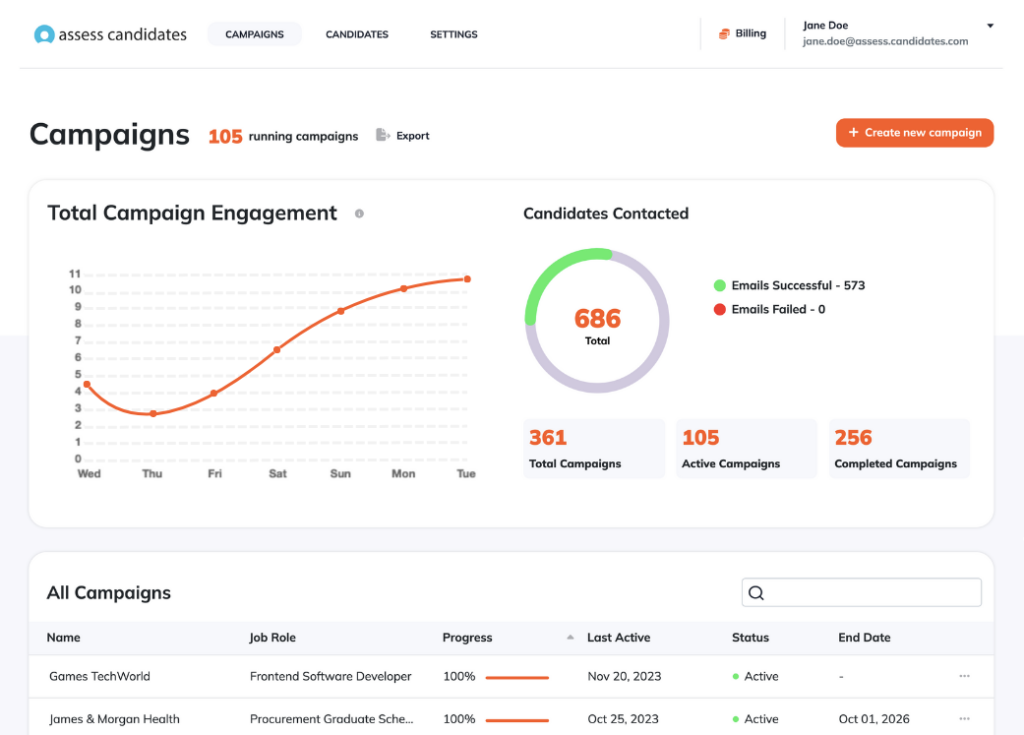
Here is an example of our campaign reporting dashboard available on Assess Candidates.
The top 4 reasons why you should use Assess Candidates for your customer service recruitment:
- Scientifically Designed and Validated by Expert Psychologists: Leading organizations trust Assess Candidates to strengthen their customer service hiring strategy because our assessments are built by Chartered Psychologists and Psychometricians with decades of experience designing industry-leading evaluations for companies like SHL and IBM Kenexa.
Every assessment undergoes rigorous validation to ensure it measures essential customer service skills, such as communication, empathy, resilience, and problem-solving, with scientific accuracy. Our globally adaptable platform delivers consistent and reliable results, whether candidates complete their assessment on a phone, tablet, or desktop.
- Expert Reporting: Our intuitive talent assessment platform enables hiring teams to evaluate candidates with ease using behavioral analytics, communication skill scoring, personality insights, and customer service–specific benchmarks. Real-time scoring and structured reporting help recruiters quickly identify candidates with the right tone, service mindset, and channel-specific abilities.
With seamless ATS integration and centralized reporting dashboards, hiring managers can manage high-volume and multi-region recruitment campaigns efficiently, ensuring faster, smarter, and more consistent decisions.
- Positive Candidate Experience: Every assessment is designed to feel engaging, mobile-friendly, and relevant to real customer interactions. With multilingual options, brand-aligned interfaces, and short, scenario-based test formats, candidates can complete assessments easily and confidently, from any location.
This candidate-centric approach enhances your employer branding, reduces drop-off rates, and improves engagement across global talent pools, especially important for roles with large applicant volumes.
- Candidate Accessibility Support: Inclusivity is core to our platform. We adhere to global WCAG accessibility standards and support features such as adjustable contrast, screen reader compatibility, zoom capability, and extended time options. These measures ensure every applicant, regardless of ability, language, or device, is evaluated fairly.
Assess Candidates empowers organizations to build high-performing customer service teams through scientifically validated assessments, actionable insights, and a seamless hiring experience.
Ready to improve your customer service hiring strategy? Connect with us to explore the right assessment solution for your hiring needs.
Key Takeaways
- Customer service enhances satisfaction, loyalty, and overall brand experience.
- Strong customer service drives trust, business loyalty, and revenue growth.
- Hiring the right customer service talent requires strong communication, empathy, and problem-solving abilities.
- Retaining satisfied customers is more cost-effective than acquiring new ones.
- Assessments, structured interviews, and simulations help verify real customer service skills.
- Clear onboarding and continuous training improve confidence, consistency, and service quality.
In conclusion, a stronger customer service recruitment strategy supports you in hiring more effectively and builds a team that improves customer satisfaction over time.
Interested in learning more about effective candidate assessment? Continue reading for frequently asked questions, and sign up with your email to get started.
Frequently Asked Questions
How can we assess whether a candidate is the right fit for a customer-facing role?
You can assess fit for a customer service role by using behavioural interviews, role-play simulations, and predictive assessments that reflect real customer interactions. Tools like situational judgement tests, typing assessments, and personality assessments help in evaluating communication style, conflict-handling ability, and customer-focused mindset.
How can we reduce high turnover in customer service roles?
Customer service roles often see higher turnover because the work is fast-paced and emotionally demanding. You can reduce turnover by offering realistic job previews, assessing resilience early, and providing structured onboarding and clear growth paths. Recognising performance, investing in upskilling, and fostering a supportive environment also improve motivation and retention.
Should customer service hiring criteria differ by channel?
Yes, each support channel requires unique strengths. Phone support requires confident verbal communication and tone control, live chat demands fast typing and multitasking, and email support relies on clear, concise writing. Tailor assessments and interviews to each channel while ensuring every candidate demonstrates empathy, consistency, and professionalism.
How important is multilingual capability when hiring customer service staff?
Multilingual capability plays a key role when supporting diverse or global customer bases. Bilingual or multilingual representatives help in personalizing service, reducing wait times, and increasing accessibility. However, you should also assess cultural sensitivity, tone, and emotional intelligence to ensure service quality remains reliable across languages and regions.
How can we ensure a positive candidate experience during customer service hiring?
You can create a positive experience during the customer service hiring process by simplifying the application process, using mobile-friendly assessments, and communicating clearly at every stage. By responding quickly, removing unnecessary steps, and respecting candidate time, you can boost engagement, strengthen your employer brand, and increase acceptance rates, especially during high-volume hiring.


 English
  Arabic