
How to Assess Soft Skills During Hiring



Hiring top talent requires more than checking technical ability. Soft skills shape how candidates communicate, collaborate, adapt, solve problems, and grow in the role over time. These skills are especially important in roles where teamwork, customer interaction, leadership potential, and change management affect performance.
Did you know? According to LinkedIn’s Global Talent Trends research, 92% talent professionals consider soft skills as important as or more important than technical skills when hiring candidates.
This guide covers what soft skills are, why they predict long-term success, how to measure them accurately at scale, and the most common mistakes you should avoid during evaluation.
Contents
- What are soft skills?
- Why do soft skills predict long-term success?
- Why are soft skills harder to fake when assessed properly?
- What are the best ways to measure soft skills at scale?
- What are the common mistakes when evaluating soft skills?
- Soft skills: Client Success Story
- Why top companies use Assess Candidates to evaluate soft skills
Now that we’ve summarized what this article covers, let’s explore what soft skills are.
1. What are soft skills?
Soft skills are transferable workplace capabilities that shape how effectively someone communicates, collaborates, solves problems, adapts, and works with others.
Some examples of soft skills in a workplace include active listening, creativity, communication, and strategic thinking.
Evaluate soft skills with our wide range of pre-employment assessment tests. HIRE FOR FREE
Top soft skills in the workplace
Soft skills can be grouped into several categories based on what you do day-to-day in the workplace. The following are the 5 major types of soft skills in the workplace:
1 . Communication Skills
Communication is one of the top soft skills in the workplace. Strong communication is necessary for an organization’s success, as it allows employees to share their ideas clearly and work seamlessly with others.
Examples include active listening, conflict resolution, giving and receiving feedback, clear verbal communication, and networking.
2 . Teamwork and Collaboration
Teamwork and collaboration are essential to build productivity in your organization. This skill helps employees work effectively and naturally with their coworkers across roles and departments.
Examples include cooperation, reliability, respectfulness, and building trust.
3 . Problem-solving Skills
Problem-solving skills involve the ability to utilize knowledge, facts, and data to effectively solve workplace problems. These skills help employees respond to workplace challenges and make practical decisions.
Examples include critical thinking, analytical thinking, risk management, innovation and creativity, and decision-making.
4 .Leadership Skills
Strong leadership skills account for setting clear expectations, maximizing workplace productivity, and setting a positive work environment for everyone. This skill is useful even for non-managerial roles.
Examples include taking initiative, motivating others, building trust, accountability, and supporting team performance.
5 . Adaptability and Flexibility
Adaptability and flexibility relate to an employee’s ability to adapt to the ever-changing work environment and adjust to different challenges and situations.
Examples include open-mindedness, handling surprise tasks, patience, critical thinking, and proactiveness.
Now that we understand what soft skills are, let’s explore why they successfully predict long-term success.

2. Why do soft skills predict long-term success?
Soft skills can support long-term success because they influence how well employees learn, adapt, build relationships, respond to feedback, and contribute across different roles and environments.
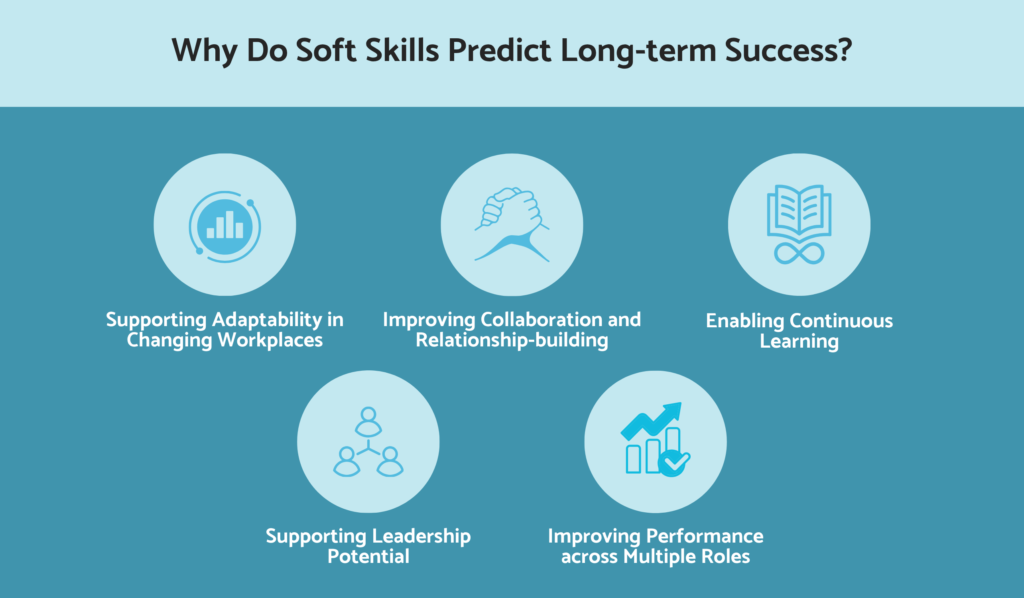
- Supporting Adaptability in Changing Workplaces
Soft skills play a vital role in helping employees adapt to evolving workplace demands. Hence, employees with strong soft skills can learn new tools and systems faster, respond proactively to feedback, remain consistent and effective during uncertainty, and adjust to changing priorities.
- Improving Collaboration and Relationship-building
Long-term success in the workplace heavily relies on how effectively employees work with other team members. Soft skills help employees communicate effectively and clearly, collaborate smoothly across teams, resolve and manage conflict constructively, and build trust with managers and clients.
- Enabling Continuous Learning
Soft skills influence how employees grow beyond their current expertise. Curiosity, openness to feedback, resilience, and self-awareness all help people keep developing as role expectations change.
- Supporting Leadership Potential
Leadership potential is strongly associated with strong soft skills. Even in non-managerial roles, employees who display emotional intelligence, adaptability, creativity, and sound decision-making often stand out as future leaders. These skills also help predict whether someone can eventually guide teams and manage responsibilities.
- Improving Performance across Multiple Roles
Since soft skills are transferable across multiple roles, industries, and career stages, they are useful in improving performance across multiple roles. Soft skills such as communication, problem-solving, flexibility, teamwork, and leadership potential are relevant in almost every professional context.
Explore our talent assessment platform to hire the best candidates with top soft skills. LEARN MORE
The next question is why these skills matter over time.
3. Why Are Soft Skills Harder to Fake When Assessed Properly?
Soft skills are harder to fake when they are assessed through behavior, real-time interaction, and consistent evidence across multiple stages of the hiring process.
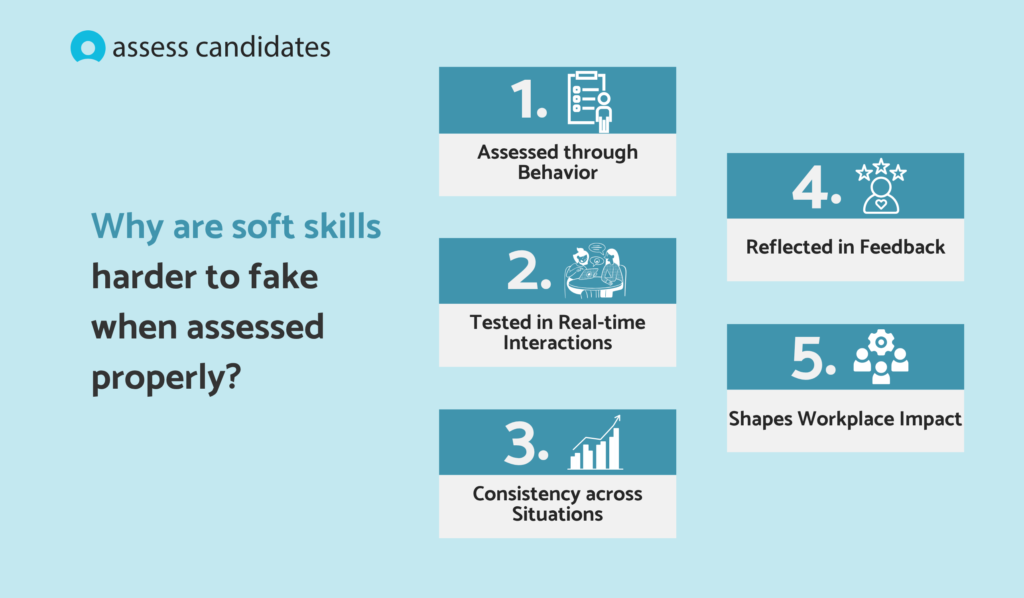
1 . Assessed through Behavior
Soft skills are analyzed through a candidate’s behavior instead of unreliable claims in a resume. These skills are reflected through observable actions during interviews, group discussions, and workplace interactions. Hence, soft skills are harder to fake than hard skills.
2 . Tested in Real-time Interactions
Soft skills are also tested during real-time interactions, including conversations, team discussions, presentations, and problem-solving meetings. Hence, these spontaneous situations make it difficult to fake soft skills.
3 . Consistency across Situations
Soft skills appear consistently across multiple situations in a workplace. Hence, if a candidate claims to have soft skills like emotional intelligence, communication, and teamwork, they need to showcase them during interviews, teamwork exercises, group discussions, and feedback sessions.
4 . Reflected in Feedback
Soft skills are also reflected through feedback sessions. Since soft skills influence how individuals interact with their colleagues, managers, and clients, they are often reflected in peer feedback, references, and performance evaluations. This makes soft skills harder to exaggerate or fake.
5 . Shapes Workplace Impact
Soft skills determine how effectively individuals contribute to team performance and organizational culture. Since these qualities affect day-to-day work environments, they are harder to fake and become visible soon after hiring.
Now, let’s look at the best methods for accurately measuring soft skills.
4. What are the best ways to measure soft skills at scale?
An accurate soft skills assessment includes standardized, observable, and comparable methods. The most effective results come from combining multiple assessment approaches that consistently measure communication, teamwork, adaptability, leadership potential, and decision-making.
The following are some of the best methods for measuring soft skills accurately:
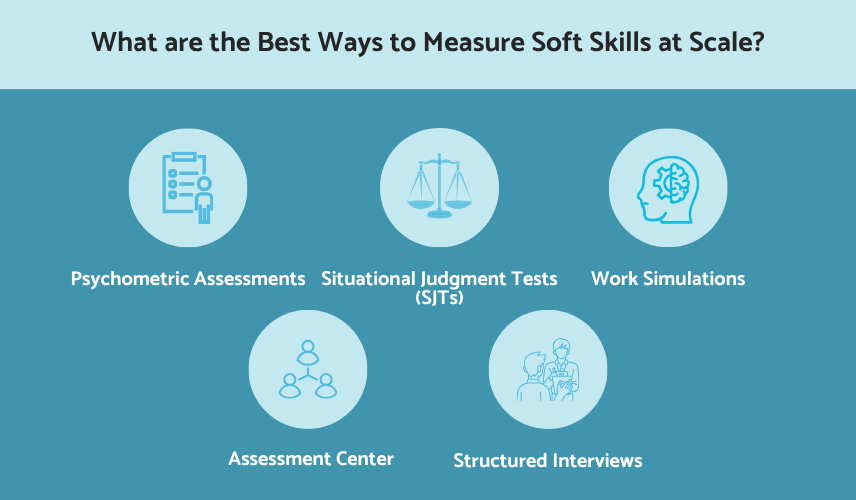
- Psychometric Assessments
One of the most effective ways to assess soft skills is through psychometric assessments, as they measure workplace-relevant behavioral tendencies, including performance. At scale, they will help you compare candidates objectively, predict long-term workplace fit, and identify strengths and areas for development.
- Situational Judgment Tests (SJTs)
Situational judgment tests (SJTs) present candidates with real-world workplace scenarios and ask them to choose or rank the most practical responses. They measure how individuals are likely to behave in real environments.
At scale, they will also help you reduce interview bias and assess decision-making and interpersonal judgment.
- Work Simulations
Since work simulations closely mirror workplace responsibilities, they are the most accurate predictors of job performance. They help measure decision-making, prioritization, adaptability, and problem-solving.
Work simulations also help reduce reliance on self-reporting.
- Assessment Center
Assessment centers simulate real workplace tasks through group discussions, case studies, presentation exercises, and role-play exercises. They are especially strong in assessing influence, leadership behavior, and problem–solving approach.
- Structured Interviews
Structured interviews use the same competency-based questions and scoring criteria for each candidate. This improves fairness and makes soft-skill evaluation more consistent.
Gain deeper insights into candidates’ soft skills with our science-backed assessment tools. HIRE FOR FREE
Even with assessment methods in place, you might still make common mistakes when evaluating soft skills.
5. What are the common mistakes made when evaluating soft skills?
Without using a structured assessment method, the measurement of soft skills might become subjective, inconsistent, or misleading. Avoiding these common mistakes helps improve hiring accuracy and the employer brand.
The following are the 5 most common mistakes made when evaluating soft skills:
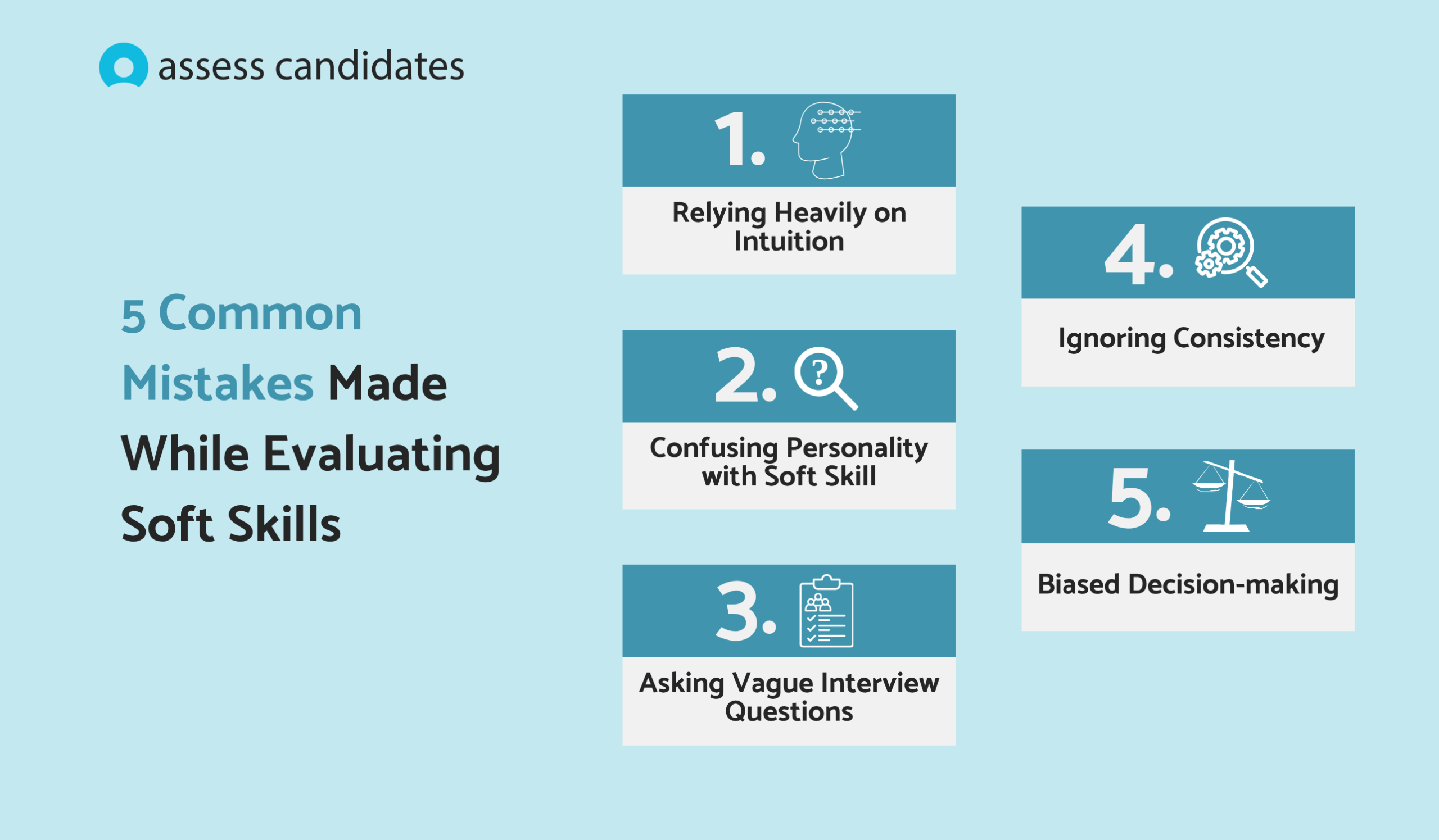
1 . Relying Heavily on Intuition
One of the most common mistakes made while evaluating soft skills during the recruitment process is relying too heavily on intuition or gut feeling. Assuming that a candidate is a good communicator just because they appear confident leads to mis-hires.
Solution: Use a structured evaluation framework with predefined competency frameworks.
2 . Confusing Personality with Soft Skills
Another common mistake made during the hiring process is confusing personality with soft skills. While soft skills are learnable workplace capabilities, personality reflects natural tendencies. Hence, you may often confuse a candidate’s assertiveness and extroversion with good communication skills. This will often lead to mis-hires.
Solution: Introduce structured assessments like situational judgment tests to measure responses to real workplace scenarios.
3 . Asking Vague Interview Questions
Asking unstructured and vague interview questions, such as “Are you a team player?” often produces unreliable insights. Since candidates often respond with rehearsed or widely accepted answers, it does not reflect actual behavior.
Solution: Replace general questions with structured behavioral interview questions.
4. Ignoring Consistency
Since soft skills are demonstrated through patterns, hiring might take place based on one interview rather than relying on consistent evidence across exercises, references, and assessments. This often leads to mis-hires.
Solution: Collect evidence from several assessment points instead of relying on a single interaction.
5 . Biased Decision-making
Since soft skills assessment involves interpreting behavior, they become especially vulnerable to bias. Without a structured scoring criterion, you may hire candidates who feel familiar rather than those demonstrating the strongest competencies.
Solution: Reduce bias by utilizing structured scoring rubrics, standardized questions, and multiple evaluators during the assessment process.
Uncover our wide range of standardized assessments to strengthen your skills-based hiring. LEARN MORE
6. Soft Skills: Client Success Story
Client Problem Statement
Imagine a rapidly expanding customer support organization is struggling to hire team supervisors who can communicate clearly with agents, handle escalations calmly, and coordinate effectively across shifts. As a result, unresolved customer complaints begin to increase, misunderstandings between teams become more frequent, and morale within support teams starts to decline.
The organization now needs a more reliable way to measure whether a candidate can manage challenging conversations, support team collaboration under pressure, and showcase sound judgment when resolving service issues in real-world situations.
Assess Candidates’ Proposal
At Assess Candidates, to hire the right customer support supervisors, we recommend incorporating situational judgment tests, role-based communication simulations, and structured behavioral assessments early in the hiring stage.
Moreover, when combined with competency-based interviews and scenario-driven evaluation exercises, the organization can gain deeper insights into the candidate’s ability to respond constructively to customer escalations, guide team members through challenges, and maintain clear coordination across support functions during high-pressure periods.
Result
By adopting assessments that specifically measure soft skills, the organization can confidently identify candidates who demonstrate strong communication, emotional regulation, and collaborative leadership behaviors.
The result is a more consistent, responsive support team.
Partner with Assess Candidates to include a range of role-specific skills tests in your hiring process. VIEW PLANS
Soft-skills assessment works best when employers measure behavior consistently rather than relying on confidence, charisma, or interview impressions.
7. Why top companies use Assess Candidates to evaluate soft skills
At Assess Candidates, we offer a wide range of pre-employment assessments and create recruitment campaigns customized to each organization’s unique hiring needs.
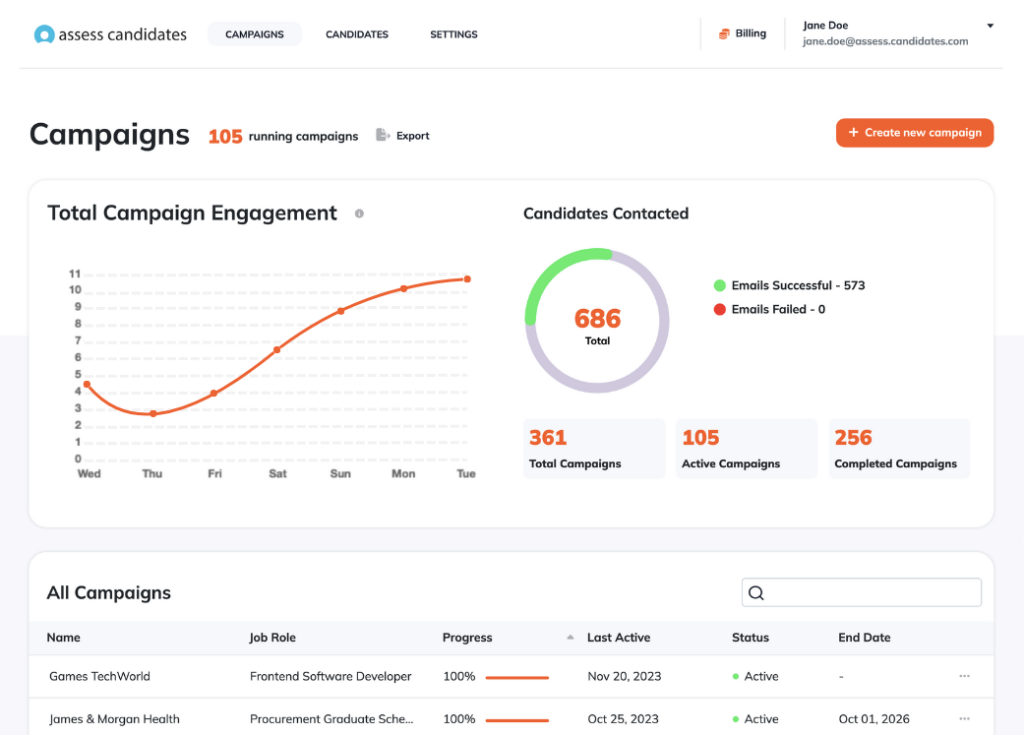
Here is an example of our campaign reporting dashboard available on Assess Candidates.
Here are 4 reasons employers use Assess Candidates to evaluate soft skills:
- Scientifically Designed by Expert Psychologists: Assess Candidates’ soft-skills assessments are developed by experienced psychologists and psychometricians with a strong track record of designing behavioral evaluation tools for global assessment leaders such as SHL and IBM Kenexa.
Each assessment undergoes rigorous scientific validation to measure role-relevant competencies such as communication, collaboration, decision-making, adaptability, and leadership potential in realistic workplace scenarios.
- Advanced Reporting: Our intuitive platform delivers clear, in-depth reports that highlight candidates’ behavioral strengths, development areas, and performance across key soft-skill competencies. Employers can quickly compare candidates’ decision-making approaches, collaboration styles, and communication effectiveness using objective, structured insights.
With seamless ATS integration, evaluation workflows become faster, more consistent, and easier to manage across large-scale hiring processes while maintaining fairness and transparency in soft-skill assessment.
- Positive Candidate Experience: Our soft-skills assessments are designed to be engaging, practical, and accessible across devices, allowing candidates to demonstrate how they would respond to realistic workplace situations rather than relying on abstract self-report questions.
Custom branding options also help organizations maintain a professional and consistent assessment experience throughout the hiring journey.
- Candidate Accessibility Support: We support inclusive hiring by providing accessibility features that enable candidates to demonstrate their soft skills fairly and confidently. These include extended time options, screen-reader compatibility, adjustable visual settings, and zoom functionality. All assessments align with WCAG accessibility standards, ensuring an equitable experience for all applicants.
Assess Candidates provides reliable, science-based tools that help organizations evaluate soft skills accurately and make hiring decisions that are smarter, faster, and more consistent. Explore our full range of assessments to identify candidates with the behavioral capabilities required for success across your roles.
Not sure which soft-skills assessments best match your hiring needs? Contact us for a free analysis of your role requirements.
Conclusion: Key Takeaway
Soft skills are transferable workplace capabilities such as communication, collaboration, problem-solving, leadership, and adaptability. When assessed through structured, role-relevant methods, they help employers identify candidates who can work well with others, respond to change, and grow over time.
Frequently Asked Questions
How to assess soft skills objectively during recruitment?
Soft skills can be assessed objectively during recruitment by combining structured interviews, situational judgment tests, and job simulations. These tools help in observing how candidates respond to realistic workplace scenarios, leading to fair hiring decisions.
How do soft skills needs change across different career stages?
Soft skills need to evolve depending on an employee’s progress in their career. Entry-level roles essentially require soft skills, including communication, adaptability, and teamwork. Mid-level employees require stronger collaboration, problem-solving, and leadership skills. In senior roles, however, strategic thinking, decision-making, mentoring, and emotional intelligence become more important.
Can soft skills be developed after hiring?
Yes, you can support soft skills development after hiring through structured training, mentoring, and feedback-driven development programs. Since soft skills are essentially learnable workplace capabilities, they can be strengthened with the right guidance, experience, and development opportunities.
How do soft skills influence team performance?
Soft skills heavily influence team performance as they directly shape how teams communicate, resolve conflicts, and collaborate on team projects. Over time, these skills improve productivity, reduce misunderstandings, and contribute to a more stable and cooperative team environment.
Which soft skills are most valued across roles?
Soft skills, including communication, teamwork and collaboration, problem-solving, and adaptability, are some of the most valued across various roles. Employees who demonstrate these soft skills adjust smoothly to new responsibilities, collaborate effectively with stakeholders, and maintain productivity under pressure.
How do soft skills support leadership potential in employees?
Soft skills, including emotional intelligence, accountability, decision-making, and collaboration, often reflect leadership potential in employees. Employees who demonstrate these skills and support team performance in the early stages are more likely to be successful in supervisory roles.


 English
  Arabic