
How to Personalize the Candidate Experience in Your Recruitment Process



Personalizing the candidate experience means making recruitment feel relevant, respectful, and clear at every stage. For employers, this can improve engagement, reduce drop-off, strengthen employer brand, and help candidates feel valued even when they are not hired.
According to Tribepad research, about 43% of candidates were ghosted by potential employers during the recruitment process last year, thereby affecting the candidate experience and employer branding.
In this guide, we will discover some of the best ways to personalize your candidate experience during recruitment and secure the most talented candidates for your organization.
Contents
- What is a personalized candidate experience in hiring?
- Why does a personalized candidate experience matter?
- At what stages can you best personalize the recruitment experience?
- Challenges of personalizing the candidate experience
- Best strategies to personalize the candidate experience
- Client success stories of personalizing candidate experience
- Future of recruitment with personalized candidate experience
- Why do companies use Assess Candidates to personalize candidate experience?
Without further ado, let us see what a personalized candidate experience means.
1. What is a personalized candidate experience?
A personalized candidate experience is a recruitment process that tailors communication, guidance, assessments, and follow-up to the candidate’s role, stage, background, and needs while keeping evaluation criteria fair and consistent.
Begin your hiring process with our psychometric assessments. HIRE FOR FREE
Now that we know the essence of what personalized candidate experience means, let us understand why it matters in recruitment.

2. Why does a personalized candidate experience matter?
A personalized candidate experience matters because it shapes how candidates judge your organization before they ever become employees.
Why is a personalized candidate experience important?
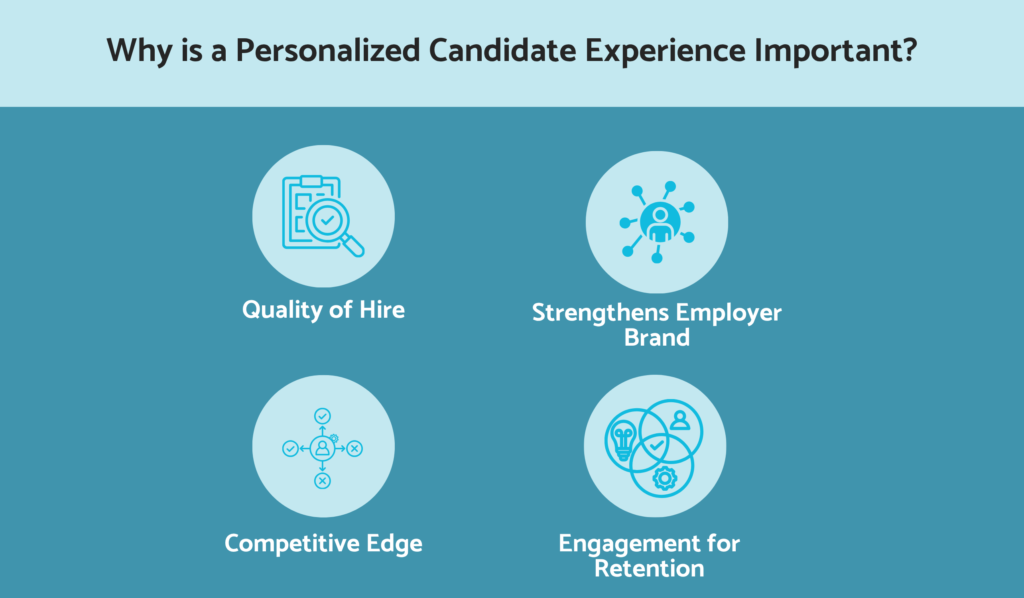
- Quality of Hire
Candidates who are made to feel respected and are clearly informed during the recruitment process are most likely to accept the job offers and retain their roles in your company. Having a personalized candidate experience during your hiring process helps you increase your offer acceptance and improve your quality of hire.
- Strengthens Employer Brand
During recruitment, your candidates may publicly share every experience they encounter; a negative experience can harm your reputation and clientele, while a positive one can turn rejected candidates into future applicants or referrers. Therefore, personalizing your candidate experience helps strengthen your reputation.
- Competitive Edge
Making your recruitment process feel human and transparent will attract strong candidates who will choose you over employers who disregard their experience and emotions. Taking into account the personalization of your candidate experience gives you a competitive edge for talent.
- Engagement for Retention
Your candidates’ journey is often seen as an examination of your organization, as they are also assessing whether both your values and goals align with long-term retention. This is why a thoughtful and personalized hiring process informs candidates about the culture they can expect, which promotes engagement and retention.
Up next, let us look at where you can personalize the candidate experience during hiring.
3. At what stages can you best personalize the recruitment experience?
Candidate experience can be personalized across the full hiring journey, from first outreach to rejection, offer, and onboarding.
According to McKinsey & Company, 73% of consumers and candidates expect personalization in their interactions with organizations, as they want to be seen and understood. This requires abandoning the one–size–fits–all approach that most employers and recruiters consider when interacting with candidates.
Stages to personalize the recruitment process
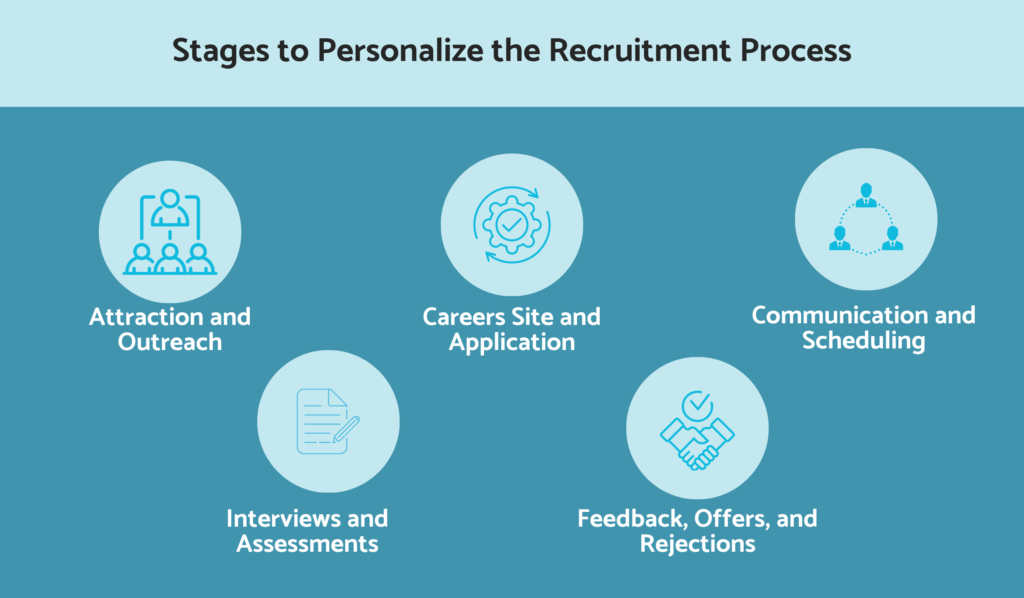
1 . Attraction and Outreach
This is the start of the recruitment journey, and you can tailor your job ads to speak directly to specific candidates and highlight the benefits they will gain based on their skills and motivation to work at your company. You can use personalized sourcing messages via email and LinkedIn that reference your candidates’ backgrounds, portfolios, and locations.
2 . Careers Site and Application
You can tweak your careers page to recommend roles based on the candidates’ profiles, skills, or browsing behavior. Having clear, role-focused information on culture, growth, and benefits for each candidate’s persona will demonstrate your attention to detail and consideration of what matters to them.
3 . Communication and Scheduling
Customizing emails and SMS with candidates’ names, roles, and stages, along with a realistic and transparent timeline, will help boost your candidates’ experience during the recruitment process. You can also include flexible interview scheduling options that display respect for your candidates.
4 . Interviews and Assessments
Ensure that your interview questions align with the roles you’re recruiting for and your candidates’ experience, rather than asking the same random questions to everyone. You can also personalize your candidate experience by tailoring your assessments to the roles, especially for in-demand or senior talent.
5 . Feedback, Offers, and Rejections
Offering your candidates clear and concise feedback instead of repetitive rejection messages by framing them in the context of what the candidates value will be respectful and strengthen your brand image.
Explore assessments created by Chartered Scientists to hire the right candidates. VIEW PLANS
Seeing where you can apply the personalization in the hiring process, check out the challenges of personalizing candidate experience.
4. Challenges of personalizing the candidate experience
Personalizing candidate experience is difficult when hiring teams manage high application volumes, limited time, inconsistent communication, and fairness concerns.
According to Software Advice, a negative candidate experience will lead 59% of candidates to spread the word, discouraging prospective candidates from applying to a company, and 42% will go so far as to no longer purchase any products or services from them.
Top challenges of personalizing candidate experience
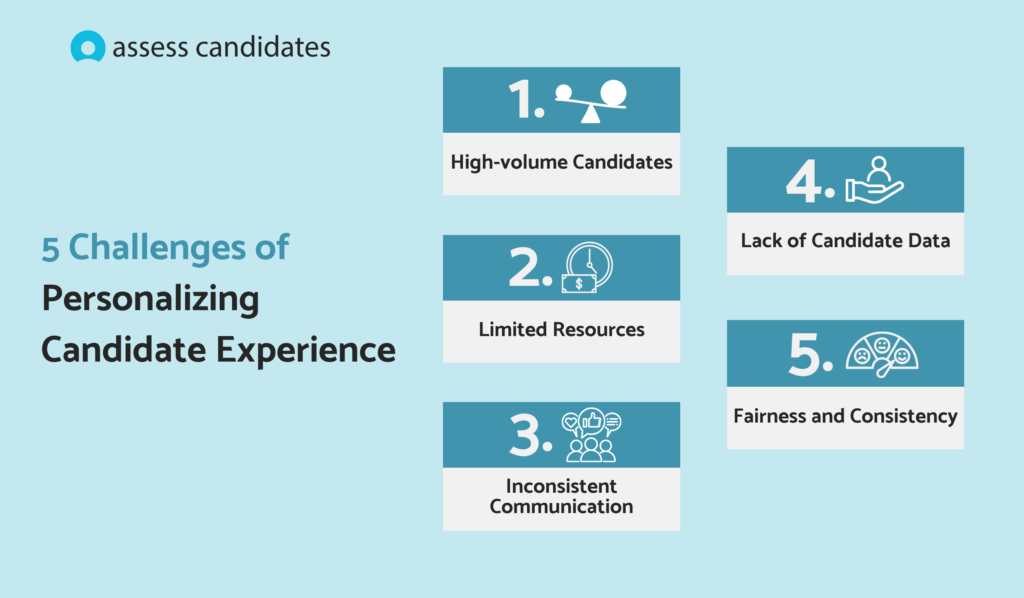
- High-volume Candidates
Employers and recruiting teams have shared their experiences on managing multiple roles and hundreds of applications during a recruitment process. This makes it nearly impossible to cater to each candidate’s experience, which is why candidates may receive generic emails or no responses at all.
Solution: We recommend using an ATS and automation for acknowledgments and status updates, freeing up time for human interactions with shortlisted candidates. You can also build a few candidate personas or roles and create a semi–personalized messaging template for each.
- Limited Resources
HR teams in small- and medium-sized companies often struggle to respond quickly, personalize communications, or prevent negative candidate experiences, ultimately damaging the employer’s brand.
Solution: We suggest that you begin with a low–cost personalization that includes using the candidates’ names, referencing the role they applied for, providing clear timelines, and writing specific notes for everyone interviewed.
- Inconsistent Communication
Many candidates have shared their negative experiences with companies that either ghosted them or sent mixed signals. This information has spread and produced preconceived ideas about how most organizations run their recruitment processes.
Solution: You can set clear response standards and make them a rule for the recruiting team. You can also use standardized yet personalized templates to ensure both HR and hiring managers adhere to them, making the process more consistent.
- Lack of Candidate Data
Without ensuring that hiring teams and recruiters gather feedback from candidates during the recruitment process, you will likely personalize it based on guesses. This will lead to repeated mistakes and slow damage to your employer’s brand.
Solution: Send short surveys after applications or interviews, asking about candidates’ experiences at every stage of the hiring process, to gain an external perspective.
- Fairness and Consistency
Many recruiters have shared their worries about tailoring the experience and how it could lead to inconsistencies or perceived bias among candidates. Employers are expected to be flexible and treat candidates fairly, so the selection process can be impersonal.
Solution: The best approach is to keep your structure and criteria standard across all candidates while personalizing your communication throughout the process. Doing this will ensure that your recruitment process is fair and makes every candidate feel individually valued.
Ready to begin recruiting candidates with the best strategies to personalize your candidate experience? Keep reading!
5. Best strategies to personalize the candidate experience
The best personalization strategies combine structured hiring, clear communication, appropriate automation, and human follow-up at the moments that matter most.
According to an IBM study, candidates were 38% more likely to accept a job offer if they had a positive candidate experience during the recruitment process.
Top strategies to personalize the candidate experience
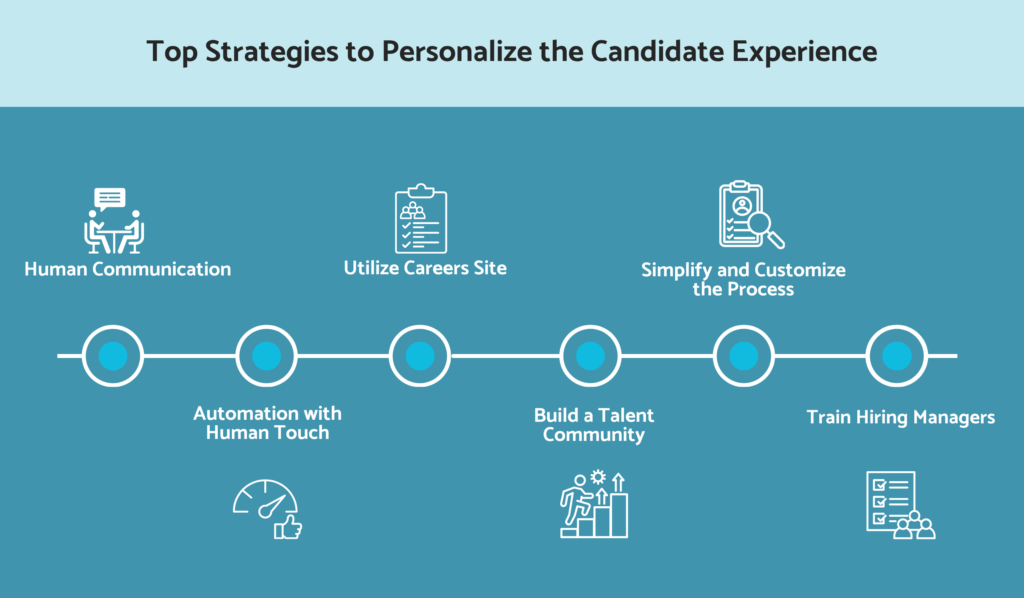
1 . Human Communication
Rather than mass-distributing cold messages to your candidates, make every touchpoint in the hiring process sound like it came from a recruiter who understands and respects the candidates’ time. Refer to candidates by name and the roles they applied for, and provide realistic timelines for the next phase in the recruitment process.
2 . Utilize Careers Site
Use your careers page as a landing page and display what matters to different talent segments in your company, as this will attract prospective candidates. Ensure you also use clear, audience–specific language in your job ads.
3 . Simplify and Customize the Process
Not every role you are recruiting for will require the same hiring stages and assessment tests. Which is why we suggest that you consider simplifying and customizing the recruitment process to fit the roles you are hiring for. This will hasten the recruitment process, provide candidates with clarity, and reduce the drop–off rate.
4 . Automation with Human Touch
Using automation in your recruitment process is a helpful tool for companies, as it helps you acknowledge applications, share status updates, and send reminders to your candidates. You can personalize your candidate experience by using the time saved from utilizing automations to send tailored notes to your shortlisted candidates and offer specific feedback after interviews.
5 . Build a Talent Community
Rather than let go of the strong candidates you did not select in the hiring process, use a simple CRM or a talent pool to identify the candidates, then send them occasional updates about open roles. Reaching out to these candidates with a role that matches their skills will make them feel remembered.
6 . Train Hiring Managers
Train your hiring managers to communicate with candidates effectively, reference the applicant’s CV, and explain the role the candidate applied for and how it links to the business. Provide your recruiters with a structured interview guide so they know what to ask while connecting with each candidate’s individual background.
Hire the right candidates with our assessment tool platform. LEARN MORE
Next, let’s find out how other employers personalized their candidate experience.
6. Client success stories of personalizing candidate experience
Many recruiters have shared their experiences personalizing the candidate experience during their recruitment processes. Here are a few real-world samples and solutions on how they solved their challenges.
1 . BlueStack Technologies
Challenge:
A mid-sized software company noticed that it was losing its senior engineering candidates halfway through the hiring process due to poor communication, while its competitors were faster at recruiting. The HR team realized they needed a more personal, transparent experience without creating additional unsustainable manual tasks for themselves.
Solution:
BlueStack introduced a structured, personalized email update at every stage of its recruitment process through its applicant tracking system (ATS), alerting candidates to their progress and milestones. The company also trained its hiring managers to reference applicants’ individual CVs and portfolios during interviews, helping candidates feel more connected to the company.
Results:
- Increased referrals from engineering candidates, including referrals from rejected candidates who had a positive experience
- Candidate satisfaction score from BlueStack’s post-interview surveys improved, particularly with the communication and tech company
- Time-to-accept for the vacant senior engineering roles reduced by 25%
2 . GlobalMart
Challenge:
A large multinational retailer was looking to fill hundreds of frontline roles each quarter, but it struggled with a high volume of applications and inconsistent treatment of candidates across its stores. Many of the candidates expressed their displeasure and dropped out of the recruitment process due to the organization’s lack of provision of guidance.
Solution:
GlobalMart introduced processes such as automatic acknowledgment and status emails delivered to all applicants, SMS reminders or interview notifications, and personalized short rejection messages. The store managers were also provided with interview guides to keep conversations structured and personable.
Results:
- Increase in response rates to interview invitations as messages became clearer and friendlier, and were tailored to specific locations.
- Negative feedback about the recruitment process on review platforms like Glassdoor decreased, while positive feedback about GlobalMart’s communication increased.
- The company established a reusable talent pool of past applicants interested in reapplying after a positive candidate experience.
This is where Assess Candidates comes in: we help ensure your candidates are well qualified, as our pre-employment psychometric assessments measure skills and provide data-driven analytics to inform your recruiting decisions.
7. Future of recruitment with personalized candidate experience
The future of recruitment will see many strategies that will change the hiring landscape for companies and candidates alike. By personalizing the candidate experience, recruiters will boost their employer’s brand, and candidates will leave the recruitment process with positive feedback about the organization.
How will companies handle the future of recruitment with personalized candidate experience?
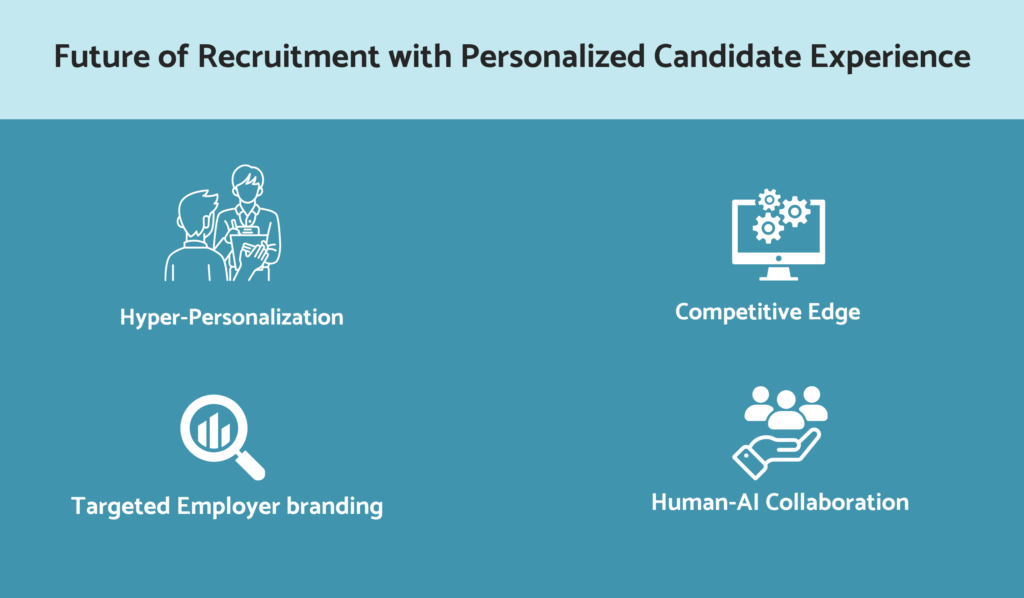
- Hyper-Personalization
The future of recruitment will likely see more employers using AI and data to tailor almost every touchpoint of their hiring process, creating experiences based on each candidate’s history, skills, and interests.
- Competitive Edge
Candidate experience will become more of a major determinant in the recruitment industry, just as customer experience is. In the job market where skills are scarce, recruiters who offer candidates a fast, transparent hiring process will likely attract the most skilled talent in the industry over those with a lengthy, one-size-fits-all process.
- Targeted Employer Branding
Employer branding is becoming increasingly targeted across almost every organization seeking to hire the best candidates. Companies are learning how to speak differently to each candidate rather than broadcasting a simple generic message. Virtual reality is starting to enable applicants to experience a company’s culture and work environment before applying.
- Human-AI Collaboration
The evolution of AI is not erasing the human element; it is elevating it. As AI takes over the repetitive tasks during the recruitment process, humans will be able to focus on relationship–building and empathy that AI cannot replicate.
Personalization works best when candidates receive a clear, branded, accessible, and role-relevant assessment experience without compromising fairness.
So, why use Assess Candidates to personalize your candidate experience in 2026?
8. Why do companies use Assess Candidates to personalize candidate experience?
Assess Candidates helps employers and interviewers identify their top talent through rigorous skills evaluations, enabling data–driven hiring decisions.
- Science–backed Assessments: Assess Candidates’ psychometric assessment tests are developed by chartered psychologists, and the platform is built on neuroscience that combines human insight with machine precision to help select the right candidates.
- Seamless Portal Experience: Our assessments are delivered through a fully branded portal, providing a seamless, professional experience for your candidates. We also provide them with a realistic workplace scenario, a short test time, and AI–driven technology to keep candidates engaged from start to finish.
- Inclusive and Accessible Design: The Assess Candidates platform takes candidate experience seriously, and personalizing this means being fair to every candidate in your recruitment process. The platform minimizes bias and gives every candidate an equal opportunity to succeed regardless of their diverse backgrounds.
- Engaging Assessment Format: The platform boasts a bespoke assessment process designed to combat candidate drop-off from a monotonous hiring process by offering a wide range of assessment tests. The platform includes AI video interviews, psychometric assessments, situational judgment tests, personality questionnaires, and game–based assessments.
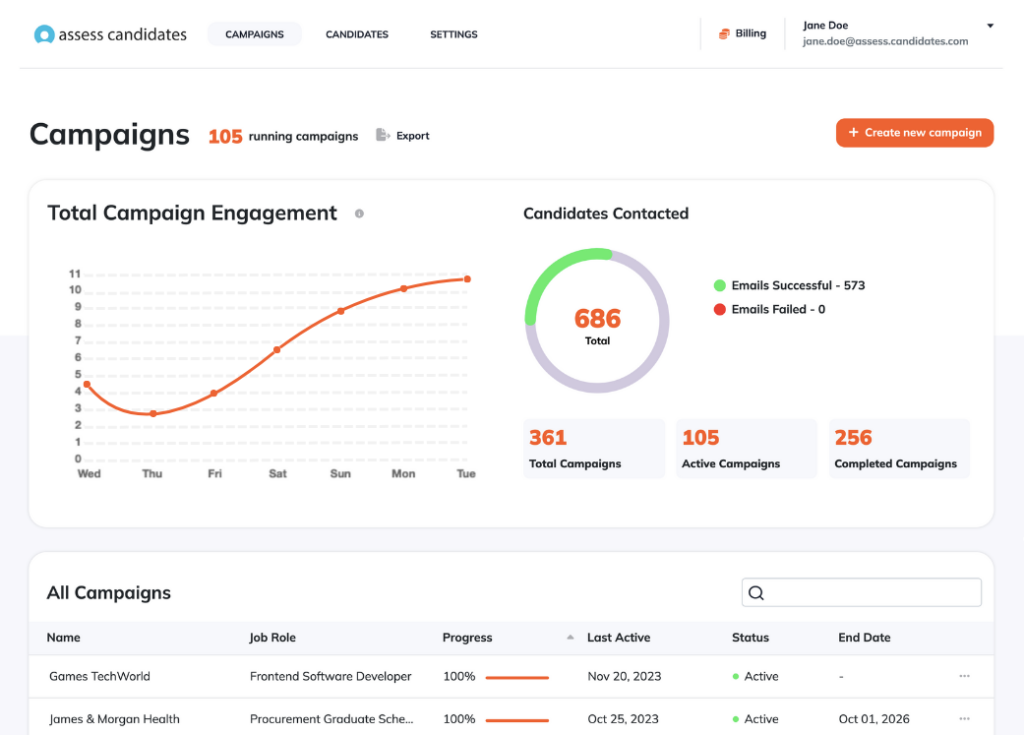
- Clear Data Reporting: For employers and recruiters, the personalization does not stop at the candidate’s point of view. With Assess Candidates’ intuitive dashboard and comprehensive reports, you can make data–driven hiring decisions.
Explore assessments created by Chartered Scientists to hire the right candidates. LEARN MORE
Conclusion: Key Takeaway
Personalizing the candidate experience means combining consistency with relevance. Employers should keep assessment criteria fair and standardized while tailoring communication, timelines, feedback, and role information to each candidate’s journey.
Curious to know more about how you can personalize the candidate experience for your recruitment process? Explore the FAQs below and sign up with your email to get started.
Frequently Asked Questions
Why is personalizing the candidate experience important?
Personalizing the candidate experience is important because first impressions matter greatly in recruitment, and how you treat candidates during the hiring process directly reflects your company’s culture and values. A personalized candidate experience reduces your candidate drop-off rates and increases the quality of applicants you hire.
How do you personalize at scale without losing quality?
You can personalize at scale by using platforms such as Assess Candidates, which allow you to create branded, tailored assessments for your recruitment process. These assessments can be deployed to thousands of candidates at once, and the platform offers fair and inclusive features that ensure all candidates are treated equally.
What happens to the candidate experience after rejection?
A personalized candidate experience does not end after you send a rejection letter to unsuccessful candidates. Providing timely, respectful, and constructive feedback will leave all candidates, rejected or shortlisted, with a positive impression of your company. These candidates may reapply once again in the future or speak positively about your company.
How early in the hiring stage should I personalize the candidate experience?
Candidate experience personalization should begin before candidates submit their applications, starting with the job advertisement your organization puts out. When a job ad is seen, the tone, message, and content it conveys can make or break your ability to recruit top candidates in your industry.
How does personalization affect the speed of recruitment?
Personalizing the candidate experience affects recruitment speed: when your candidates are matched to the right roles from the start and the assessment tests are relevant to the roles you are hiring for, fewer drop out. This way, you will have the clear data you need to make the right hiring decisions.


 English
  Arabic