
DISC Personality Test: What It Is and How It Works In Hiring



Have you ever hired someone who looked perfect on paper but struggled once they joined the team?
They may have had the right skills, but their communication style, pace, or decision-making approach didn’t align with the role or team. These mismatches often lead to friction, poor collaboration, and early turnover.
Many recruiters face this challenge as traditional hiring methods focus heavily on experience and technical ability while overlooking how candidates actually behave and interact at work. Interviews alone usually do not reveal whether someone is more task-driven, people-focused, empathetic, or cautious than others.
This is where the DISC personality test can help. It provides insight into candidates’ behavioral styles: how they communicate, respond to challenges, influence others, and operate in team environments.
According to the Society for Human Resource Management (SHRM), behavioral and personality assessments are widely used in hiring to better understand how candidates are likely to interact with others and perform in workplace environments, beyond what resumes and interviews can reveal.
In this guide, we’ll explain what the DISC personality test is, how it works, and how to use it responsibly in recruitment so you can align candidates more effectively with roles and reduce costly hiring mismatches.
Contents
- What is the DISC personality test?
- What does the DISC personality test measure?
- How does the DISC personality test work?
- How is the DISC personality test used in recruitment?
- DISC vs other personality tests
- Best practices for using DISC in recruitment
- Why choose Assess Candidates?
To see how the DISC personality test for hiring supports better decisions, it helps to start with what the assessment actually is.
1. What is the DISC personality test?
The DISC personality test is a behavioral assessment that helps recruiters understand how candidates tend to communicate, make decisions, respond to challenges, and interact with others at work. Instead of measuring intelligence or technical ability, it focuses on observable behavior patterns that shape day-to-day performance and team dynamics.
At its core, DISC groups behavior into 4 main dimensions: Dominance, Influence, Steadiness, and Conscientiousness. Most candidates have a mix of these traits, but one or two usually stand out more than the others based on how they naturally deal with tasks, people, and stress.
According to the Society for Human Resource Management (SHRM), behavioral assessments like DISC are commonly used in recruitment to better understand candidates’ communication styles, work preferences, and interpersonal behavior beyond what resumes and interviews reveal.
Reduce guesswork in hiring by understanding candidates’ behavioral fit with personality testing. HIRE FOR FREE
What DISC is designed to do
DISC is designed to help you answer practical hiring questions such as:
- How does this candidate prefer to communicate with others?
- Are they more fast-paced or methodical in how they work?
- Do they thrive in structured environments or flexible ones?
- How might they respond to pressure or conflict at work?
These insights help you move beyond surface-level impressions from interviews and better anticipate how a candidate may fit into a specific role or team.
What DISC is not designed to do
It’s important to note that DISC is not a measure of skill, intelligence, or job competence. It does not determine whether someone can do the job. Instead, it highlights how they are likely to approach the job, work with others, and adapt to workplace demands.
The American Psychological Association (APA) notes that personality and behavioral assessments are designed to measure consistent patterns in how individuals think, feel, and behave, making them useful for understanding workplace behavior when applied appropriately.
Now that we’ve clarified what the DISC personality test is, let’s look at what it actually measures.

2. What does the DISC personality test measure?
The DISC personality test focuses on observable behavioral tendencies: how people prefer to act, communicate, and respond in work situations. This is how a candidate is likely to approach their role, not whether they are capable of doing it.
DISC Personality Dimensions
DISC measures 4 core behavioral dimensions:
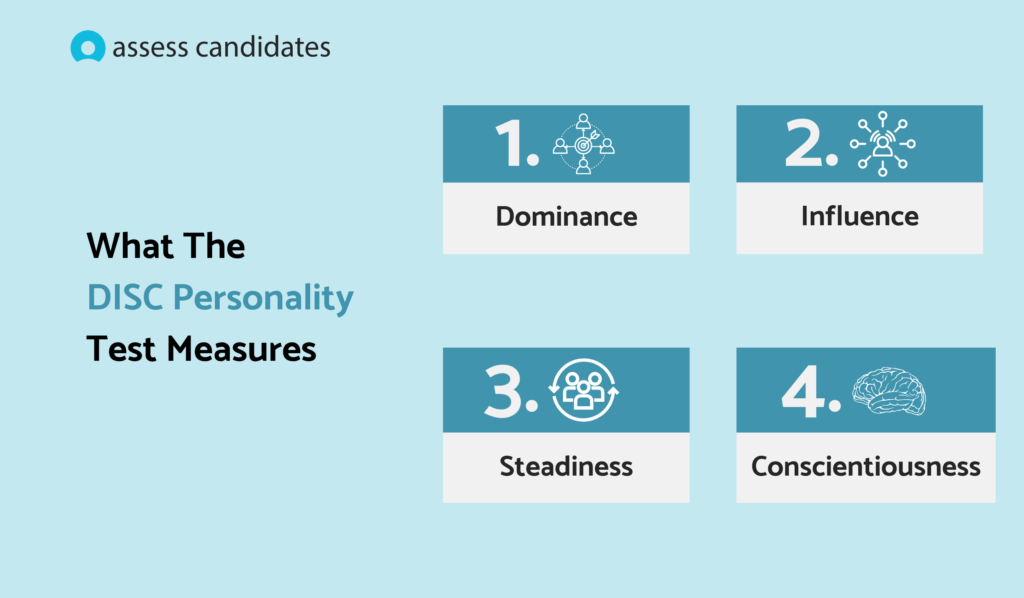
1. Dominance (D)
This trait highlights how individuals approach problems and decision-making, especially in fast-paced or results-driven environments.
2. Influence (I)
Influence focuses on how individuals communicate and interact with others, especially in social or team-based settings.
3. Steadiness (S)
Steadiness highlights how individuals respond to pace and change, including their preference for stability and cooperation.
4. Conscientiousness (C)
Here, the focus is on how individuals approach rules, structure, accuracy, and quality, including their attention to detail and process.
These dimensions help recruiters understand communication style, work pace, response to pressure, and collaboration preferences, all critical factors in role and team fit.
According to the Society for Human Resource Management (SHRM), DISC assessments are designed to evaluate behavioral styles related to communication, work approach, and interpersonal interaction, rather than technical skills or intelligence.
Challenges with the DISC personality test
DISC does not measure skills or job competencies
One major limitation you should be aware of is that DISC does not tell you whether a candidate can actually do the job. It focuses on behavioral tendencies, not technical skills, experience, or job-specific competence. So, someone may look like a great behavioral fit but still struggle to perform in the role technically.
Solution:
The smart way to use DISC is to pair it with skills assessments, work samples, or structured interviews. This allows you to evaluate both how a candidate behaves and whether they can perform the role effectively.
Personality and behavioral assessments should be used alongside job-related skill evaluations and structured interviews to support more accurate and defensible hiring decisions.
Results are based on self-reported behavior
Another challenge is that DISC relies on how candidates describe themselves. In hiring situations, people may unintentionally exaggerate positive traits or answer in ways they believe employers want to see.
Solution:
You should treat DISC results as conversation starters, not fixed truths. Use them to guide deeper behavioral interview questions and ask candidates to share real examples from their past work experience.
The American Psychological Association (APA) explains that self-report personality assessments are most effective when their results are interpreted carefully and validated through additional data sources, such as behavioral interviews and observed performance.
Behavior can change across situations
DISC captures behavioral preferences, but human behavior is not static. How a candidate behaves can change depending on the work environment, leadership style, stress level, or role expectations.
Solution:
To work around this, you should always interpret DISC results within the context of the role you’re hiring for. Ask candidates how they adapt their behavior under pressure, in team settings, or when priorities shift.
Harvard Business Review notes that workplace behavior is highly influenced by situational factors, meaning personality assessments should be interpreted within the specific context in which an individual is expected to perform.
Overreliance can lead to oversimplification
If you rely too heavily on DISC, it’s easy to start labeling candidates instead of understanding them. This oversimplification can cause you to overlook strong candidates who don’t fit neatly into a specific DISC profile.
Solution:
You should avoid using DISC as a screening or elimination tool. Instead, combine DISC insights with role requirements, performance criteria, and multiple evaluation methods to support balanced, fair hiring decisions.
The British Psychological Society cautions that personality and behavioral assessments should not be used in isolation, as they do not assess competence, ability, or job-specific skills.
Why this distinction matters in hiring
Understanding the limits of DISC matters just as much as understanding its value. Used well, it adds useful behavioral context to hiring decisions. Used poorly, it can lead to oversimplified judgments. Recruiters should treat DISC as one input and a supporting tool within a broader, job-relevant assessment process.
The American Psychological Association notes that personality assessments are most effective in employment contexts when combined with other structured evaluation methods.
Want to understand how workplace personality tests could fit into your structured hiring process? LEARN MORE
Now that we’ve clarified what this test does and doesn’t measure, let’s examine how recruiters use the DISC personality test.
3. How does the DISC personality test work?
The DISC personality test asks candidates a series of structured questions designed to reveal behavioral preferences, not right or wrong answers. The goal is to understand how individuals naturally tend to act in work-related situations, rather than how they think they should behave.
Question format
Most DISC assessments use forced-choice or rating-scale questions, where candidates select statements that best describe their typical behavior. Questions often present contrasting behaviors, encouraging respondents to choose the option that feels most natural to them.
This format helps reduce socially desirable responses and provides a clearer picture of consistent behavioral patterns.
According to Wiley, a leading provider of DISC assessments, these questionnaires are designed to measure behavioral preferences through self-reported responses to structured prompts rather than ability-based questions.
Scoring and interpretation
DISC results are scored by mapping responses across the 4 dimensions: Dominance, Influence, Steadiness, and Conscientiousness. Candidates typically receive a behavioral profile showing their primary and secondary tendencies rather than a single “type”.
Recruiters then interpret these profiles in relation to job requirements, team dynamics, and communication needs, rather than using them as pass-or-fail outcomes.
The Society for Human Resource Management notes that personality and behavioral assessment results should be interpreted contextually and aligned with job-related criteria to support fair hiring decisions.
Example of how DISC insights are used
DISC is most useful when it sharpens judgment rather than replaces it. In a stakeholder-facing role, stronger Influence traits may help, while a compliance-focused role may benefit from stronger Conscientiousness traits. The value is not in matching candidates to a perfect profile, but in asking better, more targeted follow-up questions.
Discover how a work personality test complements a structured, science-backed hiring process. HIRE FOR FREE
With a clear view of how DISC works, the next step is seeing how recruiters apply these insights in real hiring situations and where it helps or falls short in hiring decisions.
4. How is the DISC personality test used in recruitment?
You primarily use the DISC personality test in recruitment to support better role fit, team alignment, and communication planning. Rather than predicting performance, it helps you understand how candidates are likely to behave in day-to-day work situations and how that behavior aligns with your job demands.
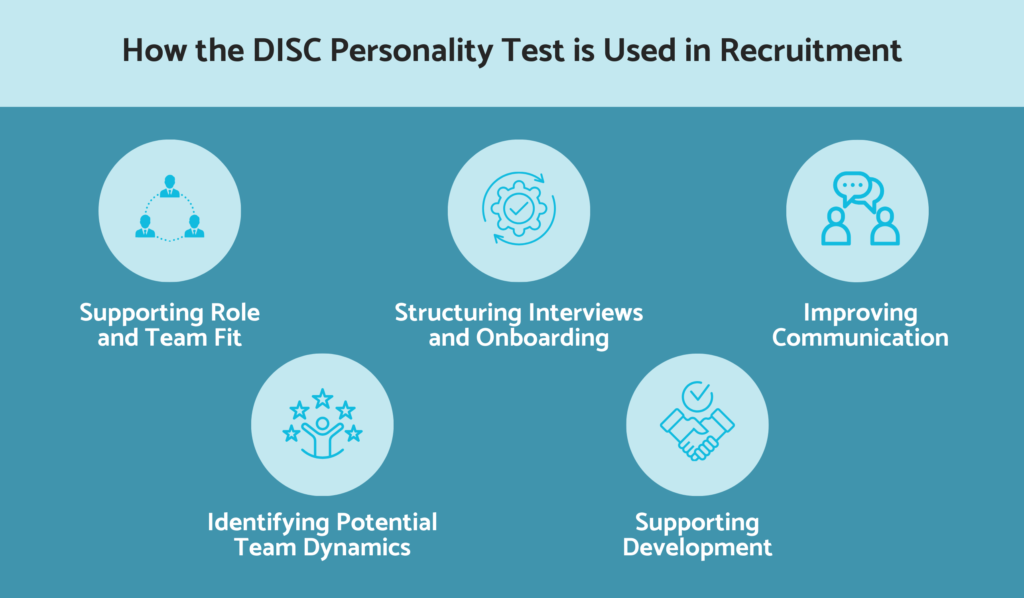
1. Supporting role and team fit
You can use DISC to assess whether a candidate’s behavioral style aligns with the pace, structure, and interaction level of a role. For example, candidates with stronger Dominance traits may suit fast-moving, decision-heavy roles, while candidates with stronger Steadiness may be a better fit for collaborative, stability-focused environments.
Behavioral assessments are commonly used to evaluate person-job and person-team fit, helping organizations improve collaboration and reduce early turnover.
2. Structuring interviews and onboarding
DISC results are often used to inform structured interview questions and onboarding plans. You can probe how candidates handle conflict, feedback, or change, while managers can tailor onboarding and communication styles to support faster integration and engagement.
The American Psychological Association notes that personality assessments are most effective in hiring when they are used to guide follow-up evaluation and development conversations rather than act as standalone decision tools.
3. Improving communication and management alignment
DISC helps hiring managers understand how to communicate and manage new hires effectively. Knowing a candidate’s preferred communication style can help you reduce misunderstandings, improve feedback delivery, and support stronger working relationships from the start.
Research summarized by Harvard Business Review highlights that understanding behavioral and communication styles can improve team effectiveness and manager-employee relationships.
4. Identifying potential team dynamics and gaps
You also use DISC to anticipate team dynamics, such as where a team may lack assertiveness, structure, or collaboration. This insight supports more balanced team composition, especially when hiring into established teams.
The Chartered Institute of Personnel and Development (CIPD) notes that behavioral assessments can help organizations understand team composition and interaction patterns when used appropriately.
5. Supporting development and retention after hiring
DISC is frequently used beyond selection to support employee development and retention. When managers understand how individuals prefer to work and respond to feedback, they can adjust leadership approaches, reducing friction and improving engagement.
Gallup research indicates that employees who feel understood and well-managed are more likely to be engaged and remain with their employer longer.
While DISC can offer valuable behavioral insights, it is not the only personality framework used in hiring. In the next section, we’ll compare DISC with other personality tests, highlighting its strengths, limitations, and where it fits best within a broader assessment strategy.
5. DISC vs other personality tests
The DISC personality test is just one of several personality frameworks used in hiring. Recruiters can choose the right assessment for your hiring goal by understanding how it compares to other tools, instead of relying on a uniform approach.
DISC vs the Big Five Model (OCEAN)
DISC focuses on observable behavior and communication style, making it easy to interpret and apply in interviews, onboarding, and team interactions. The Big Five personality test, by contrast, provides deeper insight into stable personality traits and is more strongly linked to long-term behavioral tendencies across roles.
DISC is often preferred for practical hiring conversations, while the Big Five is better suited for broader personality analysis and research-backed prediction models.
Example of a Big Five Work Personality Test

The American Psychological Association notes that while trait-based models like the Big Five offer strong empirical support, behavioral models such as DISC are commonly used for applied workplace decision-making.
DISC vs Myers-Briggs Type Indicator (MBTI)
Unlike MBTI, which categorizes individuals into fixed types, DISC presents behavior on continuous dimensions, allowing for more flexibility and nuance. This makes DISC easier to adapt to different job contexts and less likely to oversimplify candidate behavior.
The British Psychological Society highlights that typology-based assessments like MBTI have limitations in employment decision-making compared to dimensional models.
DISC vs Hogan personality assessments
Hogan personality assessments are designed specifically for recruitment and leadership evaluation. They measure everyday personality, derailers under stress, and values. The Hogan Personality Inventory (HPI) generally offers stronger predictive validity for job performance, but it also requires more careful interpretation.
DISC is simpler and more accessible, which makes it more useful for communication and team-fit discussions than for standalone selection decisions.
DISC vs SHL personality questionnaires
SHL personality assessments like the Occupational Personality Questionnaire (OPQ) are job-focused and statistically validated for hiring, often integrated into broader assessment batteries.
The OPQ supports selection decisions, while DISC is better positioned as a complementary behavioral insight tool rather than a standalone hiring assessment.
Strengths of DISC in hiring compared to the other personality assessments
DISC is:
- Easy to understand and explain to hiring managers
- Highly practical for communication, team fit, and onboarding
- Quick to administer and interpret
- Useful for development and management conversations beyond hiring
These strengths make DISC particularly valuable in fast-paced recruitment environments.
According to SHRM, hiring teams are more likely to consistently adopt assessment tools that are easy to interpret and clearly job-related.
Choose the right work personality assessment for your hiring needs from our extensive library. LEARN MORE
Understanding the strengths and limitations of DISC is just one part of the equation. In the next section, we’ll outline best practices for using the DISC personality test effectively in hiring, so you can apply it ethically, fairly, and successfully.
6. Best practices for using DISC in recruitment
Using the DISC personality test effectively requires structure, context, and restraint. When applied responsibly, DISC can support better role fit and communication. When misused, it can oversimplify candidates and weaken hiring decisions.
5 Strategies To Effectively Use a DISC Personality Test for Hiring
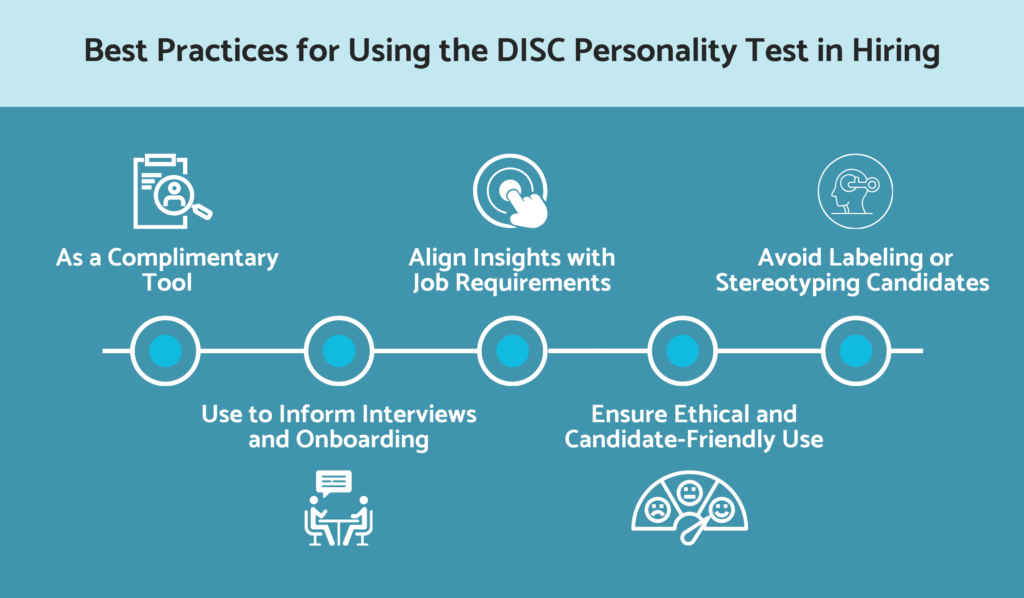
- Use DISC as a complementary tool, not a decision-maker
DISC should never replace skills assessments, experience reviews, or structured interviews. It works best as one data point within a broader, evidence-based hiring process.
- Align DISC insights with job requirements
Before using DISC, recruiters should clearly define the behavioral demands of the role. Results should be interpreted only in relation to job context, team environment, and communication needs.
- Avoid labeling or stereotyping candidates
DISC profiles reflect tendencies, not fixed traits. Recruiters should avoid using labels to make assumptions about capability, motivation, or potential, especially across different roles or environments.
- Use DISC to inform interviews and onboarding
DISC insights are most valuable when they guide structured interview questions and onboarding conversations, helping managers tailor communication, feedback, and support from day one.
- Ensure ethical, transparent, and candidate-friendly use
Candidates should understand why DISC is used and how results will influence decisions. Transparency, informed consent, and responsible data use are essential for fairness and trust.
But understanding the DISC personality test is not just about knowing how it works. It’s about applying it in the right context.
DISC is most effective when it complements structured hiring methods, helping you interpret behavior alongside skills, experience, and role requirements. When used this way, it improves role fit, supports better interviews, and strengthens decision-making rather than replacing it.
The next step is choosing a platform that helps you apply DISC insights consistently, fairly, and at scale.
7. Why choose Assess Candidates?
Personality data can add value in hiring, but only when it is interpreted carefully and kept in context. Assess Candidates helps employers use DISC insights as part of a wider, skills-first process so hiring decisions stay balanced, consistent, and grounded in the actual demands of the role.
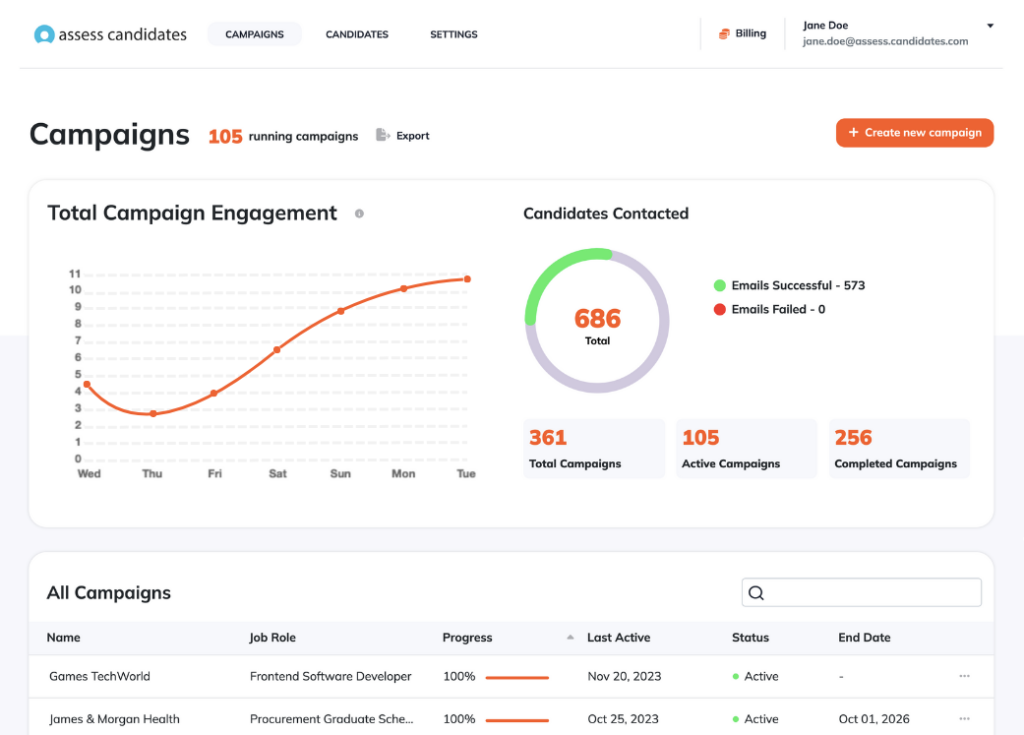
Built for responsible, skills-first hiring
Assess Candidates is designed to help employers use personality insights without over-relying on them. DISC results are positioned as behavioral context, not hiring verdicts, so decisions remain grounded in skills, role requirements, and fair evaluation criteria.
Built-in assessment integrity
To protect fairness, Assess Candidates includes anti-cheat and test integrity measures that help ensure results reflect genuine candidate responses. This reduces the risk of coached answers, impersonation, or test misuse that can undermine hiring decisions.
Science-backed, structured assessments
Rather than offering standalone personality tests, Assess Candidates integrates DISC insights into a broader, evidence-based hiring framework. This ensures personality data is interpreted consistently, reducing bias and minimizing subjective guesswork during screening and interviews.
Accessibility and neurodiversity inclusion
Assess Candidates is designed with accessibility in mind, supporting candidates with different cognitive and communication needs. Clear instructions, organized formats, and less confusing language make sure that neurodivergent candidates are not unfairly disadvantaged.
Designed for early-career and apprenticeship hiring
DISC can be especially helpful when candidates lack formal work experience. Assess Candidates helps employers apply DISC results appropriately, focusing on communication style, collaboration tendencies, and workplace behavior, without penalizing candidates for limited resumes.
Clear, recruiter-friendly insights
Results are presented in a practical, easy-to-interpret format that hiring teams can actually use. Instead of abstract labels, recruiters receive actionable guidance on how DISC traits may show up in day-to-day work situations.
Fair, transparent candidate experience
Assess Candidates emphasizes transparency and ethical assessment use. Candidates understand how their results are used, and employers are guided to combine DISC with structured interviews and skills assessments, supporting fairness, trust, and compliance.
Want to implement a work personality test in your hiring process? CONTACT US
Key Takeaway
The DISC personality test provides you a clearer view of how candidates communicate, collaborate, and approach their work. On its own, it does not determine performance or suitability.
When combined with structured interviews, skills assessments, and clear job criteria, DISC becomes a valuable tool for improving role fit, reducing hiring risk, and supporting more balanced decisions.
Used correctly, it helps you move beyond instinct and toward a more consistent, evidence-based hiring process.
Explore the most frequently asked questions below to learn more about the DISC personality test, and sign up with your email to get started with Assess Candidates.
Frequently Asked Questions
Is the DISC personality test reliable for recruitment?
The DISC personality test is widely used to understand workplace behavior and communication styles. Its reliability in recruitment comes from consistent measurement of behavioral tendencies. When used alongside structured interviews and skills assessments, DISC provides dependable insights that support fairer, more informed hiring decisions rather than subjective judgment alone.
Can the DISC personality test predict job performance?
The DISC test does not directly predict job performance or competence. Instead, it explains how individuals are likely to behave at work, such as how they communicate, respond to challenges, and collaborate with others. DISC becomes most valuable when combined with skills evaluations and structured hiring methods to support balanced decision-making.
What does the DISC test measure, and what does it not measure?
DISC measures behavioral and communication tendencies, including pace, assertiveness, and response to structure or change. It does not assess intelligence, technical skills, motivation, or job readiness. Because of this, DISC should be used as a complementary insight tool rather than a standalone measure of candidate suitability.
Is DISC suitable for apprenticeship and early-career hiring?
DISC is particularly useful for apprenticeship and early-career hiring, where candidates often lack extensive work experience. It helps employers understand communication styles, learning preferences, and teamwork behaviors. When used responsibly, DISC supports fair evaluation of potential without relying solely on past roles or credentials.
Should DISC be used as a pass-or-fail hiring tool?
Never use DISC as a screening tool that determines success or failure. Personality assessments are designed to inform hiring discussions, not eliminate candidates. Best practice is to combine DISC insights with skills assessments, structured interviews, and clear role requirements to ensure hiring decisions remain balanced and objective.
How does Assess Candidates support responsible DISC testing?
Assess Candidates integrates DISC insights into a structured, science-backed hiring framework. This ensures results are interpreted accurately and aligned with role requirements. By combining behavioral data with skills assessments and job criteria, Assess Candidates helps employers reduce bias, improve hiring consistency, and make more confident decisions.


 English
  Arabic