
How to Use Personality Tests Fairly and Ethically in Hiring



Personality tests are widely used in hiring to understand how candidates think, communicate, and behave at work.
When applied well, they can support fairer, more structured decisions. When applied poorly, they can introduce bias, oversimplify candidates, and unintentionally exclude qualified people.
Many hiring issues stem not from pre-hire personality assessments themselves, but rather from their application and interpretation. Treating personality results as decision-makers, screening tools, or shortcuts to “culture fit” can undermine fairness and expose organizations to legal and reputational risk.
Guidance from the Chartered Institute of Personnel and Development (CIPD) emphasizes that personality assessments should support hiring decisions, not replace job-related criteria, and must be used carefully to avoid bias and unfair exclusion.
In practice, fair and ethical personality testing is less about the test itself and more about the standards around it. Recruiters need clear job relevance, consistent interpretation, transparency with candidates, and enough restraint not to let one assessment outweigh stronger evidence.
In this guide, we’ll explain what the fair and ethical use of personality tests in hiring actually looks like, where misuse commonly occurs, and how recruiters can apply personality insights responsibly without compromising fairness or inclusion.
Contents
- What does fair and ethical use of personality tests in hiring mean?
- Why does the fair and ethical use of personality tests matter in recruitment?
- What are the risks of misusing personality tests in hiring?
- What are the common forms of bias and unintentional exclusion?
- How to use personality tests ethically in hiring
- What are the best practices for fair personality testing in hiring?
- Why choose Assess Candidates?
Before discussing risks and best practices, it’s important to clarify what fair and ethical use of personality tests in hiring actually means and what it does not.
1. What does fair and ethical use of personality tests in hiring mean?
Using personality tests fairly and ethically in hiring means using them as decision-support tools, not decision-makers. They should add additional insight about candidates’ work style and behaviors while remaining secondary to job-relevant criteria such as skills, experience, and potential performance.
Start hiring with clarity, not guesswork. Combine personality insights with skills-based assessments. HIRE FOR FREE
Using personality tests to inform, not decide
Ethical use means personality assessments inform conversations, not outcomes. Results can guide interview questions, highlight areas to explore further, or support onboarding and development. They should never be used to automatically screen candidates in or out of a role.
The Chartered Institute of Personnel and Development (CIPD) states that personality assessments should complement structured interviews and job-related criteria, rather than be used as standalone selection tools.
Focusing on job relevance
Fair use requires a clear link between what a personality test measures and what the role actually demands. Using personality traits as a proxy for performance, motivation, or fit without defined job criteria creates subjective and inconsistent decisions.
Ethical hiring begins with the requirements of the job and only uses personality insights when they add useful context.
Guidance from occupational psychology research emphasizes that personality measures describe behavioral tendencies, not competence or capability, and must be interpreted within specific job contexts.
Avoiding labels and stereotypes
Ethical use also means avoiding rigid labels. Personality results describe tendencies, not fixed identities. Recruiters should recognize that individuals adapt their behavior across situations and should not be boxed into narrow expectations based on test outcomes.
Ensuring transparency and candidate respect
Candidates should understand why a personality test is being used, how results will be interpreted, and what influence they will have on the hiring process. Transparency is a core ethical requirement, not an optional best practice.
The Society for Human Resource Management (SHRM) highlights transparency and informed consent as essential principles when using assessments in hiring.
With a clear understanding of what ethical use looks like, the next step is to understand why it matters so much in recruitment and what’s at stake when personality tests are applied carelessly.

2. Why does the fair and ethical use of personality tests matter in recruitment?
Personality tests can be powerful, but only when you use them responsibly. When applied ethically, they help you make clearer, more consistent hiring decisions. When misused, they can quietly introduce bias, exclude capable candidates, and expose your hiring process to legal and reputational risks.
Here’s why getting this right really matters.
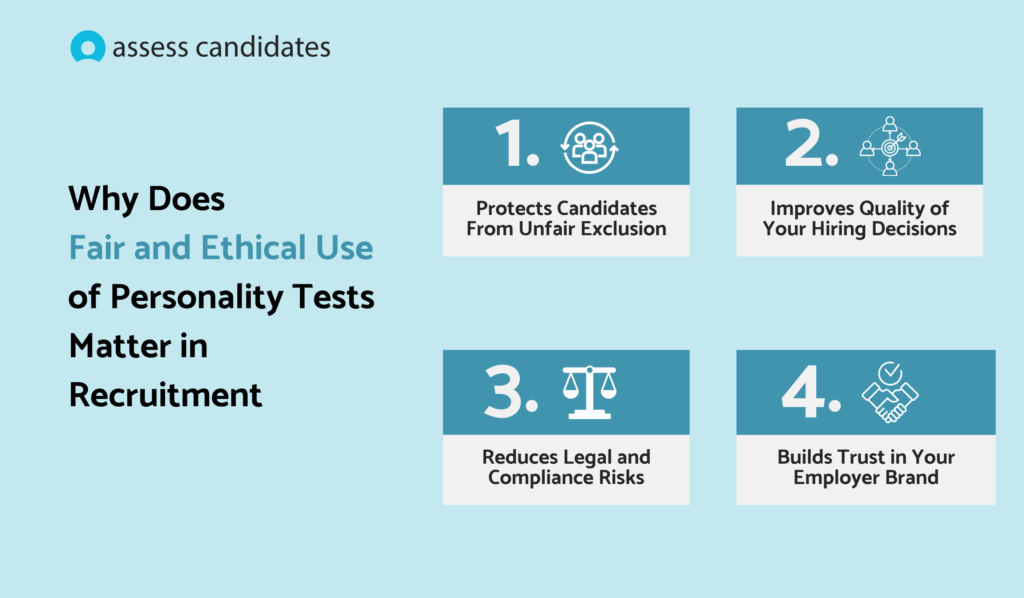
Protects candidates from unfair exclusion
When you rely too heavily on personality results, you risk screening people out for reasons unrelated to their ability to do the job. Ethical use ensures you’re evaluating candidates on job-relevant behaviors, not penalizing them for personality differences that don’t impact performance.
Occupational psychology research consistently emphasizes that personality assessments should be used as supporting tools, not elimination criteria, to avoid unfair adverse impact in hiring
Improves the quality of your hiring decisions
When you use personality tests fairly, you gain context rather than conclusions. You can ask better interview questions, explore working styles more effectively, and understand how someone may collaborate or respond to pressure without over relying on a single score.
This leads to more balanced decisions that combine skills and behavioral insights.
Reduces legal and compliance risks
Personality tests sit under employment and anti-discrimination laws in many regions. Ethical use helps ensure your assessments are job-related and defensible if your hiring process is ever challenged.
The U.S. Equal Employment Opportunity Commission (EEOC) states that employment tests must be job-related and consistent with business necessity to comply with anti-discrimination laws
Builds trust in your employer brand
Candidates talk. When people feel assessed fairly and transparently, they’re more likely to trust your process, even if they’re not selected. Ethical testing signals that your organization values people, not just profiles.
That trust directly impacts candidate experience, referrals, and long-term employer reputation.
Research published in the Journal of Occupational and Organizational Psychology highlights that inclusive assessment design improves both fairness and predictive validity in recruitment
Discover our range of structured, science-backed personality assessments and other psychometric tests. LEARN MORE
Even with good intentions, personality tests can easily be misapplied. To use them fairly, you first need to understand where things commonly go wrong. In the next section, we’ll look at the key risks of misusing personality tests in hiring and why they matter.
3. What are the risks of misusing personality tests in hiring?
Only when used carefully can personality tests support better hiring decisions. When misapplied, they introduce risks that can undermine fairness, accuracy, and even legal compliance. Below are the most common pitfalls you should actively watch out for.
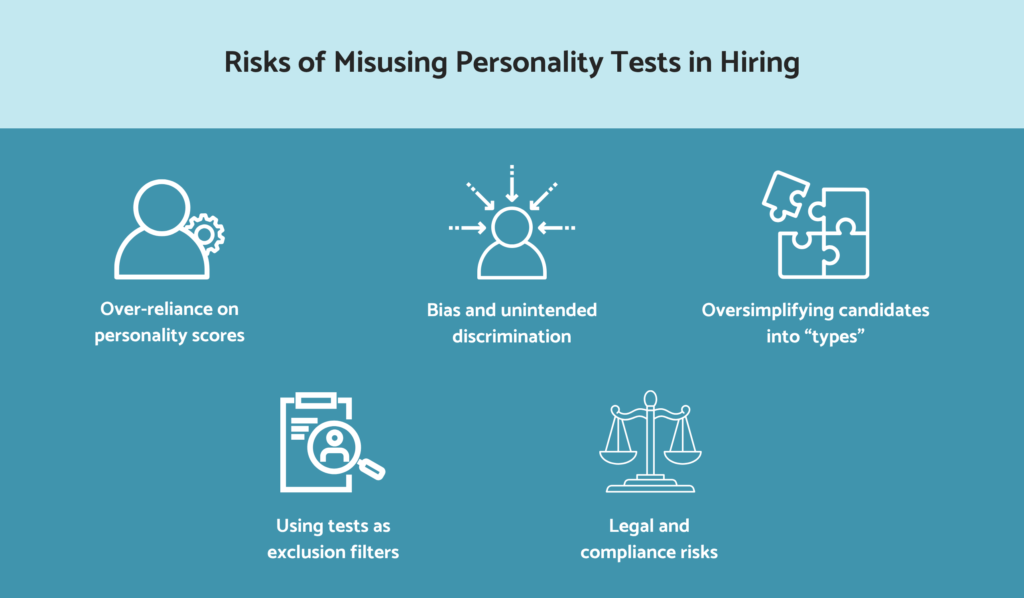
Over-reliance on personality scores
One of the greatest risks is treating personality results as a shortcut to hiring decisions. When you rely too heavily on scores, you can overlook real skills, experience, and job capability. Personality tests indicate tendencies, not performance, so they should support rather than replace structured interviews and skills assessments.
Bias and unintended discrimination
If personality tests are not validated for job relevance, they can unintentionally disadvantage certain groups. Cultural norms, language interpretation, and neurodiversity can all influence how candidates respond, even when they are equally capable of performing the role. Employment research indicates that assessments must be job-related and consistently applied to avoid adverse impact.
Oversimplifying candidates into “types”
Reducing candidates to labels or personality “types” can lead to shallow conclusions. People adapt their behavior based on context, leadership, and team dynamics. When you box candidates into fixed categories, you risk ignoring adaptability and growth potential, two qualities that matter deeply in real workplaces.
Using tests as exclusion filters
Personality tests are sometimes misused as set screening tools, automatically excluding candidates who don’t match a perceived “ideal profile”. This practice can lead to personality cloning and reduce diversity of thought within teams. Best-practice hiring frameworks warn against using personality data as a pass/fail gate.
Legal and compliance risks
Legal and compliance risks increase when personality assessments lack transparency, accessibility, or clear job relevance. If a hiring decision is ever questioned, you must be able to explain why the test was used, what it measures, and how it directly relates to the role. Fair hiring standards expect documented, defensible assessment practices.
Reduce hiring risk by combining personality insights with a structured hiring assessment process. HIRE FOR FREE
When you understand where personality tests can go wrong, the next step is recognizing how bias and exclusion actually show up in real hiring decisions. That’s exactly what we’ll break down in the next section.
4. What are the common forms of bias and unintentional exclusion?
Even with sincere intentions, personality tests can introduce bias if you’re not careful about how they’re selected, administered, and interpreted. The key is knowing where these risks show up so you can actively design around them.
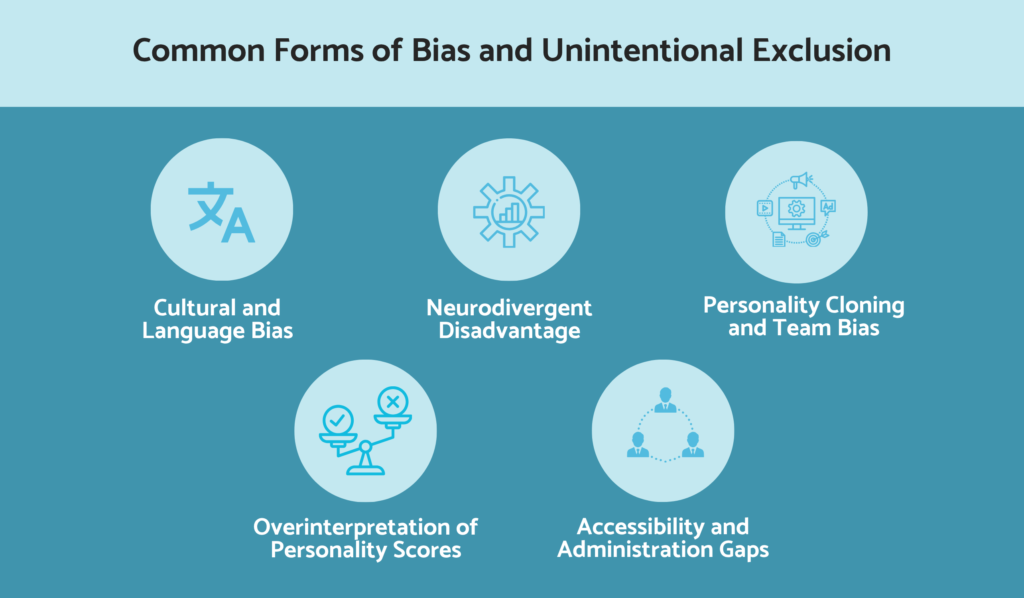
Cultural and language bias
Many personality assessments rely heavily on language, tone, and culturally specific expressions. If a test isn’t properly localized or validated across cultures, candidates from different backgrounds may interpret questions differently than intended. That doesn’t mean they lack certain traits; it means the test was built without them in mind.
Research from the American Psychological Association (APA) highlights that cultural context can significantly influence how individuals interpret and respond to personality assessment items, potentially affecting fairness if not properly addressed.
Neurodivergent disadvantage
Standard personality tests often assume “typical” cognitive processing, communication styles, and social preferences. For neurodivergent candidates, this can unintentionally penalize differences in expression rather than reflect real workplace capability. Without accessibility options or alternative formats, you risk excluding strong talent.
Guidance from the Chartered Institute of Personnel and Development (CIPD) emphasizes that inclusive assessment design is essential to avoid disadvantaging neurodivergent candidates during hiring.
Personality cloning and team bias
It’s easy to fall into the trap of favoring candidates who “feel like a good fit” because they resemble your existing team. Over time, this leads to personality cloning, hiring people who think and behave the same way, and reducing diversity of thought, problem-solving, and innovation.
Harvard Business Review notes that overemphasis on cultural or personality fit can unintentionally reinforce homogeneity and bias in hiring decisions.
Overinterpretation of personality scores
Personality results can feel precise, but they’re not absolute truths. Treating scores as fixed labels rather than tendencies can lead you to dismiss candidates prematurely. This is especially risky when results aren’t tied back to actual job behaviors or role requirements.
The Society for Human Resource Management (SHRM) cautions that personality assessments should be interpreted as indicators of behavioral tendencies, not definitive predictors of job success.
Accessibility and administration gaps
Bias doesn’t always come from the test itself; it often comes from how it’s delivered. Lack of accommodations, rigid time limits, or inaccessible platforms can unintentionally exclude qualified candidates before their abilities are even considered.
The UK Equality and Human Rights Commission emphasizes that fair recruitment practices must account for accessibility and reasonable adjustments throughout the assessment process.
By recognizing these forms of bias early, you put yourself in a much stronger position to use personality tests as they were intended: as supportive tools, not silent gatekeepers.
Now that you’ve seen where bias and unintentional exclusion can creep in, the next step is knowing how to use personality tests responsibly so they support better decisions instead of creating new risks.
5. How to use personality tests ethically in hiring
Using personality tests ethically isn’t about avoiding them altogether. It’s about how you use them, where they fit in your process, and what decisions they affect. When used correctly, they can support fairer hiring. When misused, they can quietly introduce bias.
Personality tests should not replace hiring decisions. They should support structured hiring frameworks by adding behavioral context to skills, experience, and interview evidence.
How to maintain compliance when personality testing
- Use personality tests as decision-support tools, not decision-makers
Personality assessments should never be used to pass or fail candidates on their own. Treat the results as additional context, not conclusions. They work best when they combine with other pre-employment tests to ask better interview questions, not when they replace interviews or skills evaluations.
Occupational psychology research consistently emphasizes that personality tests are most effective when combined with structured interviews and job-related assessments, rather than used as standalone selection tools
- Anchor every personality insight to role-relevant criteria
Ethical use starts with clarity. Before administering any test, you should already know which behaviors actually matter for the role. Avoid vague interpretations like “good fit” or “wrong personality”. Instead, map traits directly to job requirements, work environment, and team dynamics.
The Society for Industrial and Organizational Psychology (SIOP) advises that assessment tools must be clearly linked to job-related competencies to support fair and defensible hiring decisions
- Be transparent with candidates about why and how you use tests
Being transparent about how you use personality tests helps candidates understand what they’re being assessed on and why it matters. Ethical hiring means you clearly explain that personality assessments are just one input among many, not a hidden filter or final decision-maker. This transparency builds trust and reduces unnecessary anxiety around assessment outcomes.
The American Psychological Association highlights transparency and informed consent as key principles in the ethical use of psychological assessments, including in employment contexts
- Validate results through conversation, not assumptions
Personality scores don’t explain why someone behaves a certain way; you uncover that through dialogue. Use results as prompts during interviews to explore real experiences, examples, and context. This keeps you from turning abstract scores into rigid labels.
- Ensure accessibility and consistency across candidates
This includes accessible test formats, consistent administration, and equal interpretation standards across candidates. Small inconsistencies can quickly turn into fairness issues if left unchecked. Responsible use also means ensuring everyone gets the same opportunity to perform.
When you approach personality testing this way, you’re not just reducing risk; you’re actively building a more thoughtful, inclusive, and defensible hiring process.
Build a fairer hiring process with Hogan’s personality insights designed for clarity, consistency, and compliance. LEARN MORE
Personality tests are ethical hiring assessments when used responsibly. To truly reduce bias in personality testing and improve hiring outcomes, you must follow a set of best practices.
6. What are the best practices for fair personality testing in hiring?
Using personality tests fairly isn’t about doing more; it’s about doing a few things consistently and intentionally. The practices below help you reduce bias, protect candidates, and still get meaningful insights from personality data.
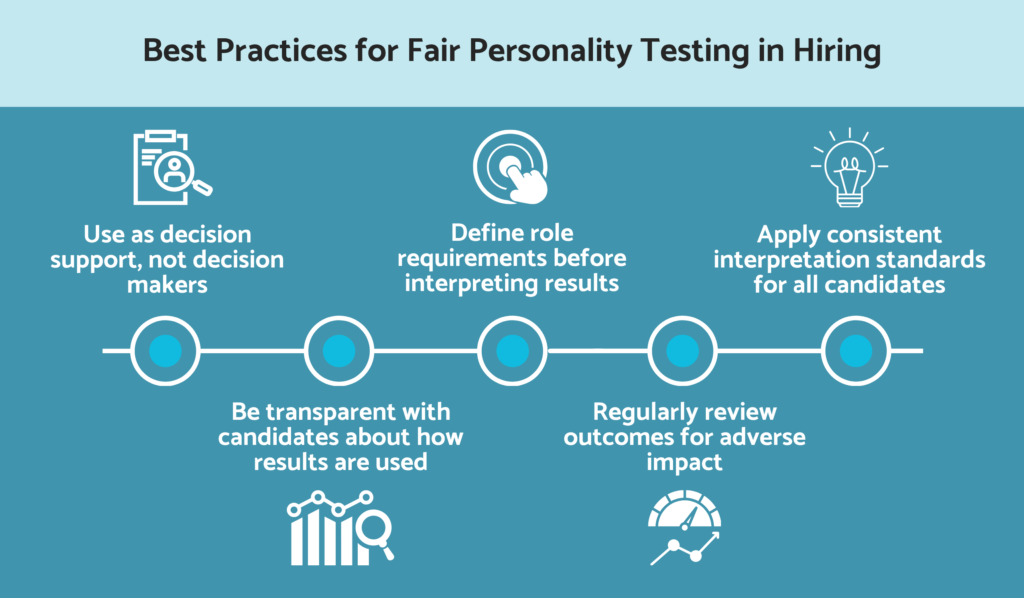
Top Strategies to Ensure Fair Personality Testing
1. Use personality tests as decision support, not decision makers
Personality assessments should inform your thinking, not replace it. Research in occupational psychology consistently emphasizes that personality tests measure behavioral tendencies, not ability. Intelligence, or job competence, is most effective when combined with structured interviews and skills-based evaluations. Treat results as one data point, not a final verdict.
Combining personality assessments with other hiring tools like structured interviews and skills tests leads to more balanced and equitable decisions, reducing the risk of overemphasizing any single factor.
2. Define role requirements before interpreting results
Defining clear role requirements is where fair and ethical use of personality tests truly begins. Before you look at any assessment results, you need to be clear about what success looks like in the role and the required skills, behaviors, and work context. When you interpret personality test results against these job-relevant criteria, you reduce bias and avoid subjective “culture fit” judgments that are not tied to actual performance.
3. Apply consistent interpretation standards for all candidates
Applying consistent interpretation standards is essential if you want to use personality tests fairly. You need shared benchmarks, clear scoring guidance, and structured follow-up questions so every candidate is assessed on the same basis.
Consistent and fair application of personality assessments, administering the same tests and conditions to all candidates, helps reduce bias and create a level playing field in hiring.
4. Be transparent with candidates about how results are used
Ethical testing requires openness. Candidates should understand why the assessment is used, what it measures, and how results will factor into decisions. Transparency improves trust, candidate experience, and compliance with fairness principles outlined in international testing guidelines.
5. Regularly review outcomes for adverse impact
Fair hiring is not a one-time event. You should periodically review assessment outcomes to ensure no group is being unintentionally disadvantaged. Monitoring for adverse impact and updating processes when patterns emerge is a core recommendation in responsible assessment practice.
Ethically using personality tests requires ensuring they are reliable, valid, and used in a way that doesn’t discriminate against candidates based on protected characteristics such as race, gender, or disability.
Using personality tests fairly and ethically is not just about avoiding risk. It’s about building a hiring process that is consistent, defensible, and trusted by both candidates and hiring teams.
To do this at scale, you need more than good intentions. You need systems that standardize how assessments are applied, interpreted, and combined with other hiring evidence.
The next step is choosing a platform that helps you apply these principles consistently across every role and candidate.
7. Why choose Assess Candidates?
Personality testing can play a helpful role in hiring, but only if it’s used responsibly, transparently, and as part of a structured process.
Assess Candidates is built around the idea that personality insights should support hiring decisions, not drive them alone. By combining behavioral insights with skills assessments and structured evaluation, the platform gives you a more balanced view of each candidate and helps keep decisions grounded in role requirements rather than assumptions.
Designed for fair and ethical hiring
You want tools that support, not replace, your judgment. Assess Candidates combines personality insights with skills assessments and structured evaluation, giving you a balanced, practical view of each candidate rather than a single score or label. This helps you make decisions grounded in role requirements, not assumptions.
Research on talent assessments shows that combining structured tests with interviews and skills evaluations improves hiring quality and fairness.
Built-in integrity and assessment security
Assessments should be trustworthy. Features like proctoring controls, integrity checks, and secure delivery help ensure that results reflect genuine candidate responses, reducing risk from test misuse, impersonation, or coaching behavior. These safeguards help protect your process and candidate data.
Modern assessment platforms often include anti-cheating mechanisms to maintain integrity and reliability in hiring.
Accessible and inclusive by design
Hiring fairly means accounting for different candidate needs. Assess Candidates helps ensure that assessments are easy to use for everyone, allowing candidates with various thinking, cultural, or communication styles to complete them without facing extra obstacles.
Inclusive assessment design is linked to reduced bias and better fairness outcomes in recruitment.
Structured, consistent hiring workflows
Fair use isn’t just about the test; it’s about how you interpret it. Assess Candidates provides standardized interpretation, clear benchmarks, and structured hiring frameworks so every candidate is evaluated the same way, which helps reduce bias and makes your process easier to justify internally.
Data-driven, transparent insights
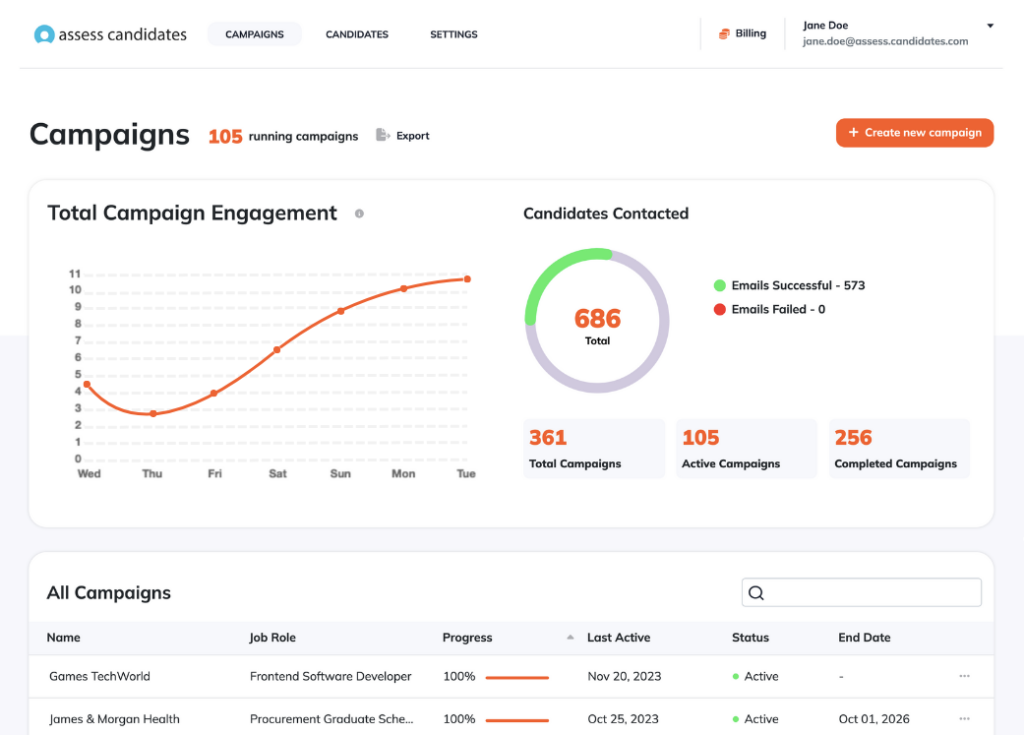
You deserve confidence in your people’s decisions. Assess Candidates offers clear visualizations and data summaries that help you compare candidates objectively, communicate decisions to stakeholders, and support fair hiring outcomes that align with business goals.
Ready to hire ethically and effectively with structured, balanced insights? CONTACT US
Key Takeaway
The fair and ethical use of personality tests in hiring is ultimately about control and clarity.
When used correctly, personality assessments improve consistency, reduce bias, and support more structured decision-making. When misused, they introduce risk, weaken fairness, and make hiring harder to justify.
By anchoring personality insights to job requirements, applying consistent standards, and combining them with skills-based evidence, you create a hiring process that is more reliable, more defensible, and more trusted by candidates.
That is what turns personality testing from a risk into a competitive advantage.
Curious about how to use personality tests fairly and ethically in hiring? Explore the frequently asked questions below to understand best practices, common risks, and responsible use, and sign up with your email to get started with Assess Candidates.
Frequently Asked Questions
Are personality tests legal to use in hiring?
Yes, personality tests are legal in many regions, but how you use them matters. You must apply them consistently, ensure they are job-relevant, and avoid using results as automatic pass-fail filters. When combined with skills assessments and structured interviews, personality tests are more likely to support fair and compliant hiring decisions.
Can personality tests introduce bias into recruitment?
They can if used incorrectly. Bias often arises when tests are treated as labels or when results are over-interpreted without context. To reduce this risk, you should use validated tools, apply consistent evaluation criteria, and treat personality insights as one data point, not a final verdict on candidate suitability.
Should personality tests be used as screening tools?
No. Personality tests are best used as decision-support tools, not screening mechanisms. Using them too early or in isolation can unfairly exclude qualified candidates. A more ethical approach is to introduce personality insights later in the process, alongside skills evaluations and structured interviews, to deepen understanding rather than eliminate candidates.
How do you ensure fairness for neurodivergent candidates?
Fair hiring requires an accessible and flexible assessment design. This includes clear instructions, reasonable time expectations, inclusive language, and alternative formats where possible. You should also focus on job-relevant behaviors rather than “ideal” personality profiles, ensuring candidates are evaluated on capability and fit, not conformity.
How can Assess Candidates support ethical personality testing?
Assess Candidates helps you apply personality testing within a structured hiring framework. You can combine behavioral insights with skills assessments, maintain consistent evaluation standards, support accessibility needs, and rely on secure assessment delivery. This approach helps you reduce bias in personality testing, improve transparency, and make hiring decisions you can confidently stand behind.


 English
  Arabic