
Apprenticeship vs Graduate Hiring: When Should Employers Use Each?



How can employers decide whether formal education or practical work experience is more important when they are faced with an apprentice vs. graduate hiring situation?
This article will help you distinguish between apprentice and graduate hiring. You will also understand when to consider graduate hiring over apprentice hiring and vice versa.
Contents
- What is apprenticeship hiring?
- What are the benefits of hiring an apprentice?
- What are the challenges of hiring an apprentice?
- What is graduate hiring?
- What are the benefits of hiring a graduate?
- What are the challenges of graduate hiring?
- Apprenticeship vs. graduate hiring: key differences
- How to decide between hiring an apprentice or a graduate?
- How to assess candidates for apprentice and graduate hiring
- Why companies use Assess Candidates to hire
Now, without further ado, let’s start with understanding what apprentice and graduate hiring are.
1. What is Apprenticeship Hiring?
Apprentice hiring is an approach that combines paid work with practical training, helping employers grow skilled employees tailored to their company’s operational needs. It allows organizations to hire individuals to learn and earn simultaneously while developing them into fully competent in-house employees over time.
When you hire a candidate as an apprentice, your organization commits to paying them while systematically building the role-specific skills that your business requires. You provide candidates a defined pathway to attain full employee status.
Hire the right apprentices for your company with our cognitive assessments. HIRE FOR FREE
What are the stages of Apprentice Hiring?
Apprentice hiring has the following major core elements:
- Job and structured learning combination
Although apprentice employees are not yet full employees, they contribute to your company’s productivity. However, while they work for your company, you train them on the relevant skills needed to improve their productivity. An apprentice’s training must be intentional, progressive, and structured to ensure their suitability for that role upon completion of their training period.
- A defined training period
One of the defining features of an apprenticeship recruitment program is its training period. Usually, it ranges between 6 months to 4 years, depending on the role, giving your apprentices time to learn. During the training period, apprentices develop their skills from beginner through intermediate to advanced levels.
- Mentorship and supervision
During the training period, a supervisor, senior employee, or trainer guides your apprentice. They assess your apprentices’ skills, observe their development, and provide constructive feedback when necessary. Note that skill assessment, feedback, and corrections are continuous throughout the training period.
- Earn while learning
Although you are training your apprentices and helping them improve their skills, you must also pay them. Why? With the skillset and work potential they possess, they contribute to your company’s productivity.
- Clear outcome
Apprentice hiring has an objective: to transform individuals from beginners to advanced-level users of skills, within the same organization. As an apprentice employer, you expect that your apprentice candidates become full employees who use their learned skills for your company’s productivity. You also hope they will remain with your company for the long term.
So, what are the benefits of recruiting an apprentice? Let’s find out below.

2. What are the Benefits of Hiring an Apprentice?
Hiring an apprentice offers your organization numerous benefits. Some of them are cost-related, while the others are related to skills availability and employee loyalty. Regardless of which means more to you, consider these apprentice hiring benefits:
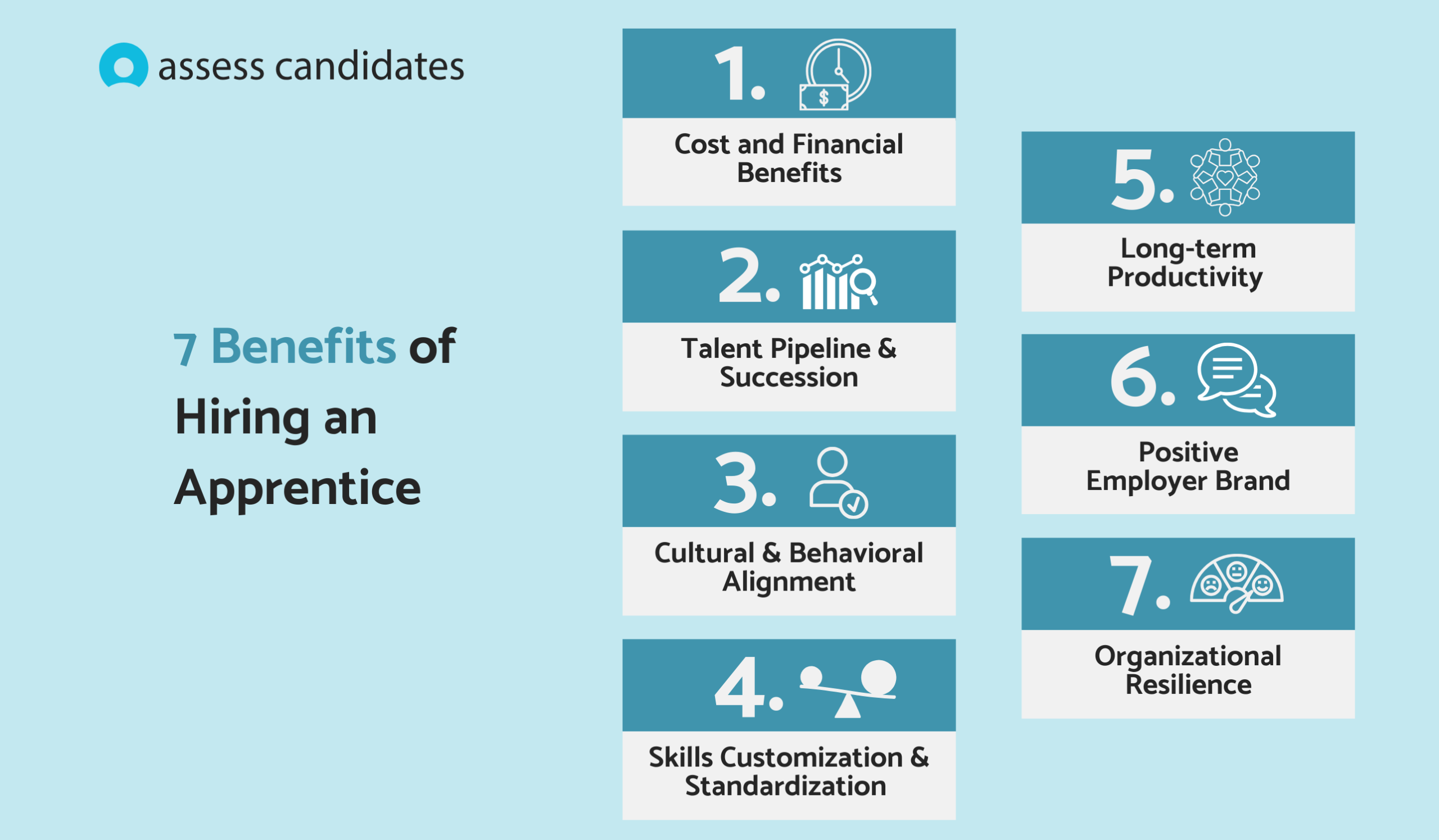
Some of the benefits associated with apprentice hiring include the following:
1. Cost and financial benefits
As an employer, your thoughts will be on the financial investment you’re making in your apprentices. However, your investment brings financial and cost benefits, chiefly reduced recruitment costs. These include lower starting wages, reduced turnover costs, and a better return on investment in training.
2. Talent pipeline and succession
With apprentice hiring, your organization has a consistent talent pipeline to choose from for different roles. Trained apprentices are future-ready professionals to assume company-standard supervisory, specialist, and leadership roles.
3. Cultural and behavioral alignment
Instead of going through time and cost-intensive early-talent hiring for cultural fit for your organization, apprentice hiring lets you align candidates with your company’s cultural and behavioral inclinations. Apprentices absorb your company’s culture during their training period. Thus, making them more loyal and committed to your company.
4. Skills customization and standardization
Apprentice hiring lets you tailor apprentices’ training to your organization’s standards. It helps you to focus on aspects of the core skills that differentiate your company from your competitors, encouraging customized training. Hence, your apprentices’ skills are tailored to your operations, enhancing safety and compliance in your company.
5. Long-term productivity
Your apprentices’ productivity improves as their competency grows. Their motivation to become full employees creates a positive team morale and higher engagement that increases their productivity. Ultimately, this contributes to long-term productivity, as continuous apprentice hiring ensures a sustained, motivated workforce.
6. Positive employer brand
Your reputation as an employer improves as candidates see you as a talent developer as well as an hirer. Apprentices will spread the word about their income while learning, encouraging other candidates to gravitate towards your company. Also, your reputation as a talent developer can give you access to support from the government and relevant bodies.
7. Organizational resilience
Your company will remain productive in the face of challenges such as labor shortages and unexpected staff departures. As you have trained your apprentices to suit your organization’s operations, they can fill vacant roles easily. Also, you will keep your operational knowledge in-house, improving your organizational resilience compared to your competitors.
Despite the significant benefits that apprentice hiring offers your business, it has its challenges. Continue reading to discover.
3. What are the Challenges of Hiring an Apprentice?
Like every other recruitment approach, apprentice hiring presents some challenges. These challenges can come from you, your candidates, or your competitors. These include:
- High training and supervision demands
Apprentice hiring requires that you train and supervise your apprentices for a long period, depending on their skills and roles. These require significant financial and human resources that can hamper your company’s productivity if you don’t have the capacity for it.
Solution: Use structured training plans, shared supervisors, and digital tools to reduce supervision and mentorship time.
- Slow return on productivity
Due to their lengthy training period, apprentices contribute their productivity to your company at a later time. Expect to get a slow return on investment as your apprentices’ competencies and productivity grow. Usually, the first 3 to 6 months may feel like a loss.
Solution: Design your apprenticeship program to allow your apprentices take early task ownership and phase responsibilities to help them contribute value sooner.
- Poaching risk
A common challenge in apprentice hiring is the risk of losing trained apprentices to competitors, which can affect your company’s productivity. You can also lose in-house knowledge to your competitors.
Solution: Create clear competitive post-completion roles and career progression pathways to increase your employee retention.
- Quality inconsistency
Apprentices often have varying learning rates, leading to uneven quality in their work. Some apprentices become effective with their skills before others. This challenge causes your organization to experience a productivity level that is lower than projected.
Solution: Use standardized skills benchmarks, assessments, and feedback cycles to ensure consistent capability development among your apprentices.
- Limited suitability for some roles
Although your apprentices will eventually reach skill competence, you can not use the same hiring approach for all the roles in your company. Apprentice hiring is suitable for roles that require a gradual increase in productivity. Such roles include electrician, IT support, procurement, and hotel operations.
Solution: Reserve apprenticeship for your teachable, low-risk roles.
Does apprentice hiring seem right for your organization so far? If not, let’s move on to graduate hiring!
4. What is Graduate Hiring?
Graduate hiring allows your company to hire candidates with tertiary education degrees for full-time professional roles that require quick value delivery. It is the best hiring approach if your company needs to fill a role that prioritizes theoretical knowledge, a short learning curve, and quick productivity.
Assess and hire high-quality graduates using our scientifically validated pre-employment assessments. LEARN MORE
5. What are the Benefits of Hiring a Graduate?
Considering the level of education that graduates have, their employment in your organization’s workforce usually comes with some benefits.
7 Top Benefits of Graduate Recruitment:
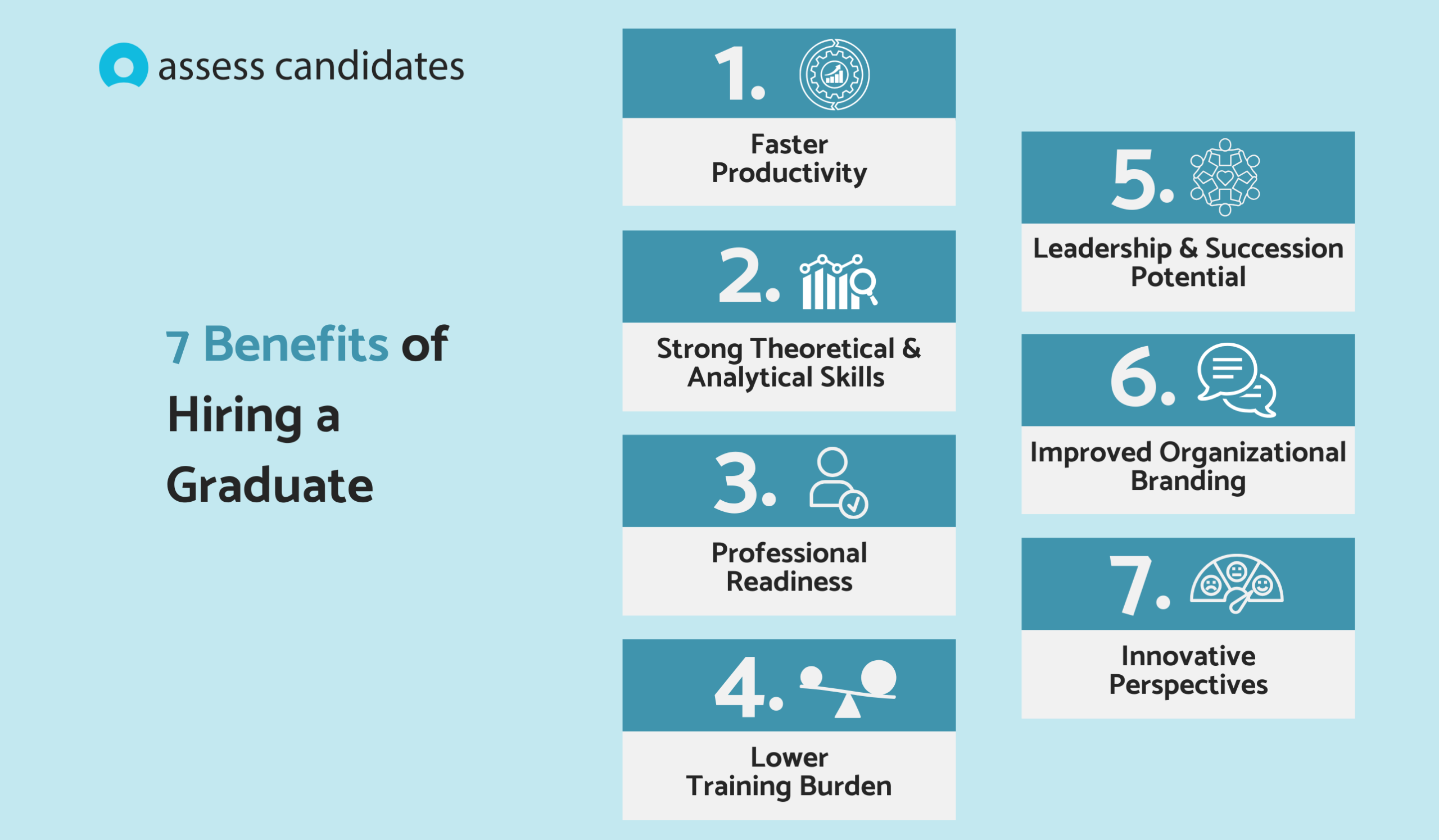
1. Faster productivity
Graduates have been taught the core skills needed to function in the roles they are applying for from their various institutions. Therefore, their learning curve is short, and they begin showing productivity within a few weeks or a few months of being employed. Also, they reduce the workload pressure on senior staff with their productivity readiness.
2. Strong theoretical and analytical skills
The graduate roles in your company usually require analytical and theoretical skills. Graduates are equipped with up-to-date theories, tools, and methods that aid in work-process design and problem-solving. Their analytical skills help them to succeed in roles that require critical thinking and planning. Their theoretical skills are useful for reports, compliance, and audits.
3. Professional readiness
Graduate hiring is the best fit for some roles, such as in accounting, policy, engineering, and health. Graduates have the necessary credentials to demonstrate their knowledge and competence. Their academic qualifications also help you gain stakeholders’ and clients’ confidence in your company’s ability to deliver.
4. Lower training burden
Although you still have to train your graduate employees to upskill or reskill, the burden is low. Since graduates have the foundational knowledge to function in their roles, you only have to train them on systems. Thus, managers and supervisors have an easier time training graduates as they can skip the basics and focus on specific work systems.
5. Leadership and succession potential
Many graduate employees aspire to ascend the organizational ladder, making them available for leadership roles. Their leadership ambition makes it easier for you to groom them for such positions. This provides your organization with a robust management pipeline. You also get a healthy level of cross-functional capability from graduates due to their adaptability and growth potential.
6. Improved organizational branding
One way to improve your company’s branding is to hire competent graduates. Your graduate workforce, signalling professionalism, strengthens your corporate image before investors and stakeholders. They also improve your employer brand through their career growth and help your company attract top academic talent.
7. Innovative perspectives
With graduates’ extensive academic knowledge, they can introduce new methods of achieving goals to your company. As they have developed their critical thinking and analytical skills during their academic years, they introduce new perspectives, ideas, and technological fluency to your company. An example is in the use of digital tools and automation by the Gen Z workforce.
Unlock the benefits of sourcing high-quality graduates with our user-friendly, reliable hiring platform. HIRE FOR FREE
6. What are the Challenges of Graduate Hiring?
Despite the benefits you stand to gain from graduate hiring, it has some challenges that you must pay attention to. These challenges present themselves at different stages of recruitment, and they include the following:
- Higher initial cost
A graduate’s remuneration is higher than an apprentice’s, causing you to incur more initial cost after recruitment. You will also spend more on their onboarding and, if applicable, initial training.
Solution: Use targeted onboarding where training applies and hire for graduate roles with short-term ROI.
- Skills-job mismatch
Many graduates are theoretically able but unable to solve problems in practice. The gap between their academic qualifications and skills proficiency usually necessitates training to avoid skills-job mismatch.
Solution: Validate your candidates’ skills with role-specific assessments before hiring them.
- Lower early loyalty
Graduates undergo a short learning curve before becoming full employees. Therefore, they don’t have enough time to imbibe the company’s culture yet. Thus, their loyalty in the early stages of employment is low.
Solution: Increase your employee retention with regular career check-ins and clear development pathways.
- Limited cultural fit
Graduates imbibe workplace cultures more slowly than apprentices because they have a pre-formed view of success and performance. This makes their alignment with company culture slower than that of apprentices.
Solution: Assess your candidates’ values and behaviors before hiring them.
- Credential inflation
The disparity in the quality of graduates across institutions shows that degrees do not guarantee competence. Some graduates inflate their capabilities on their CVs, exposing you to the risk of mis-hiring based on the CV alone.
Solution: Shift your focus to demonstrable skills and job-relevant performance indicators.
If you are still confused about hiring a graduate or an apprentice, let their key differences guide you.
Hire the right candidates for your graduate roles with our pre-employment assessments. LEARN MORE
7. Apprenticeship vs. Graduate Hiring: Key Differences
Whether you hire an apprentice or a graduate, your expectation is that they will become productive and help your company meet its objectives. However, such expectations depend on hiring the right fit for the right roles.
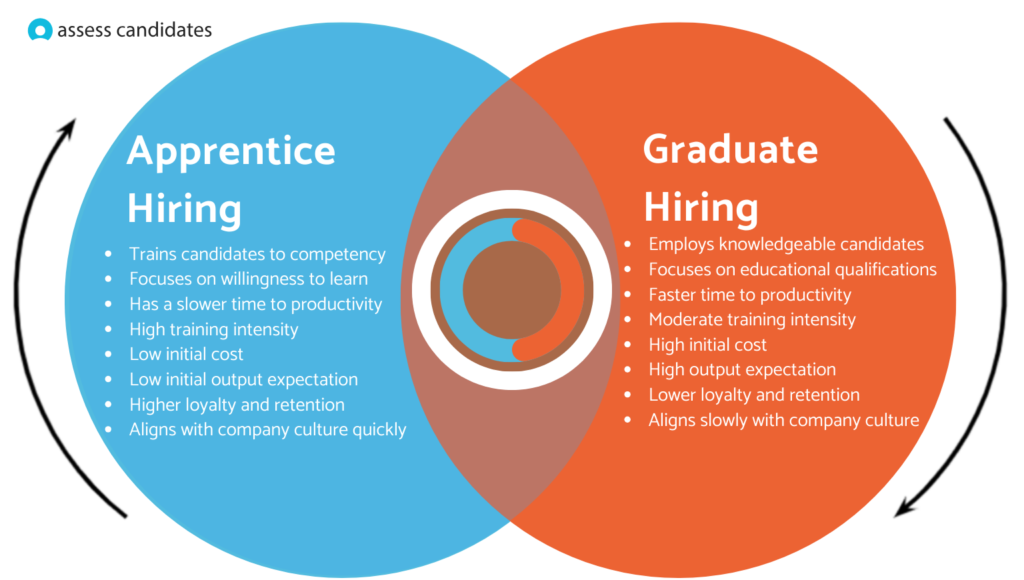
Despite their similarities in organizational performance, apprentices differ from graduates in many ways. Some of their key differences include the following:
Want to know what factors determine the right choice between apprentice and graduate hiring? Read on!
8. How to Decide Between Hiring an Apprentice or a Graduate?
Graduates and apprentices have their strengths and weaknesses. But your choice between graduate and apprentice hiring should depend on factors that determine whether it suits your company and the available positions.
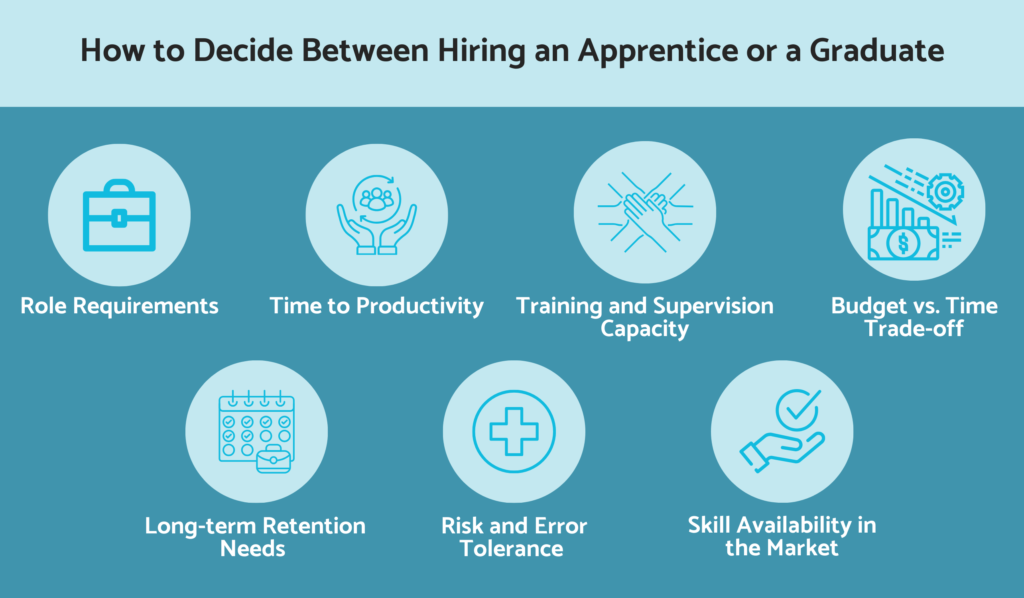
Some of the factors you must consider before deciding between hiring an apprentice or a graduate include the following:
- Role requirements
Not all roles require a formal education or allow candidates to learn on the job. The nature of the role and the skills needed to succeed in that role should inform your decision about hiring an apprentice or a graduate. If the vacant role in your company requires theoretical knowledge gained through formal education and certifications, graduate hiring is your best approach. However, if the role leans toward on-the-job learning, apprentice hiring is a better option.
- Time to productivity
Ask yourself, “How quickly must this role deliver value?” Your answer to this question will help you choose between an apprentice-hiring and a graduate-hiring approach. If the vacant role at your company needs to deliver value and productivity as fast as possible, hiring a graduate serves the purpose. However, if you can allow 6 to 12 months for the role to deliver full value, apprentice hiring suits better.
- Training and supervision capacity
Consider the human resources you currently have at your company and determine whether they can train and mentor beginners. If you have enough manpower to maintain your company’s productivity while training apprentices simultaneously, go with the apprentice-hiring route. Conversely, if dedicating personnel to training and mentoring apprentices will reduce your productivity, hire a graduate.
- Budget vs time trade-off
Compare your company’s budget and timeline to determine whether to hire an apprentice or a graduate. If you have more time, that is, the vacant role can remain relatively dormant without negatively impacting your company’s productivity, hire an apprentice. However, if the role is so critical that you need a candidate to come in and deliver value quickly and have the budget to support that, graduate hiring is the right path.
- Long-term retention needs
Another thing to consider is how important long-term retention is to the role you’re hiring for. Although apprentice hiring requires a lower initial cost, your apprentices learn some company-specific secrets during their training. Therefore, it is more suited to long-term core roles in your company. Graduate roles, on the other hand, often involve personnel changes, making them better suited to short-term needs.
- Risk and error tolerance
Errors often happen on the job; however, different roles tolerate errors to varying degrees. Apprentice roles are more lenient toward errors as they can be corrected and cause low risk to your business. Therefore, use apprentice hiring for low-risk, error-tolerant roles. Conversely, use graduate hiring for high-risk, client-critical, and regulated roles.
- Skill availability in the market
Your choice between apprentice and graduate hiring also depends on the availability of talent in the market. Where the market has an abundance of talent with the skills your vacant role requires, employ graduates. This gives you a competitive edge due to high market supply. However, where the skill is scarce, hire apprentices and train them. Thus, you have personnel with that scarce skill for the long term.
Whichever hiring approach suits your company’s vacant role, ensure that you consider all these factors to make the best apprentice vs graduate hiring decision. Now, how do you know which candidates to choose for either apprentice or graduate hiring?
Determine the right candidates for your company with our science-backed assessments. HIRE FOR FREE
9. How to Assess Candidates for Apprentice and Graduate Hiring
If you think educational qualifications and certifications are enough to distinguish candidates you should hire for apprenticeship or graduate roles, you are heading for a hiring mistake. To accurately hire the right candidates through the right approach, you must assess them with evidence-based tools. The methods to assess candidates for apprentice and graduate hiring include the following:
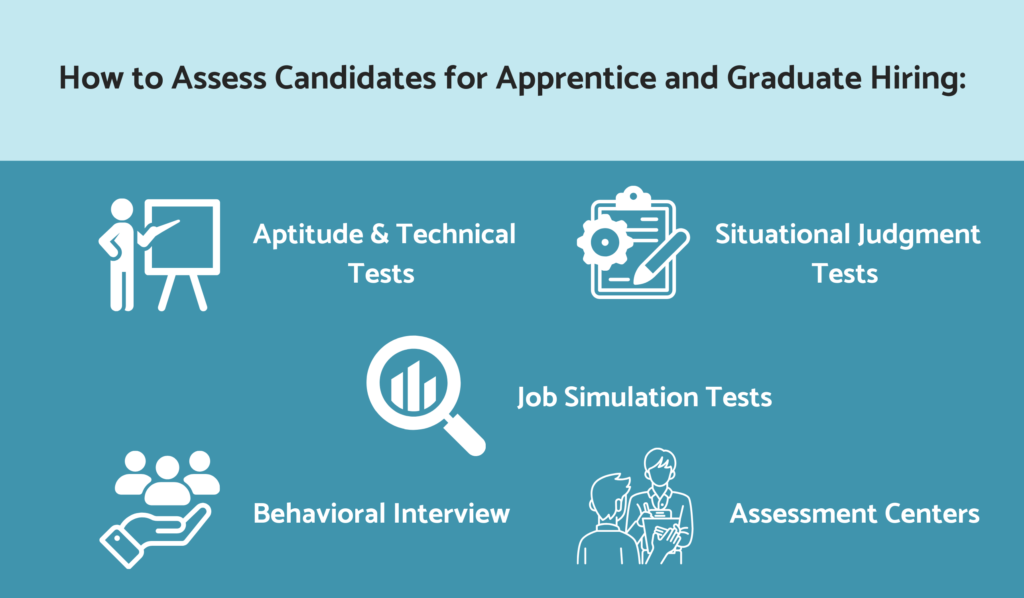
1. Aptitude and technical tests
Aptitude tests are designed to assess candidates’ basic numerical literacy, logical reasoning, and pattern recognition. However, it also tests graduates’ application of theory and analytical depth.
Use aptitude assessments, such as numerical, verbal, and logical reasoning tests, to evaluate apprenticeship candidates’ cognitive readiness for learning. For example, for graduate hiring, our Cognition-M game-based assessment and the Passcode game-based assessment are useful for assessing memory and resilience skills for data-related and coding roles. They help you highlight your candidates’ problem-solving and critical thinking skills.
2. Situational judgment tests
Situational judgment tests put candidates in hypothetical situations that require them to use their problem-solving skills. This assessment works for both apprentices and graduates but tests for different proficiencies.
For apprentices, focus on their ethical instincts, coachability, and risk awareness. However, when applying situation judgment tests to graduates, observe their accountability, maturity, and independent thinking.
3. Job simulation tests
With job simulation tests, your aim is to check how candidates perform real work. Applying it to graduate hiring helps you to evaluate your candidates’ time management, quality of output, and practical competence. It allows you to observe your apprenticeship candidates’ learning behaviors, responses to stress, and adherence to instruction.
Set time-bound independent or semi-independent tasks relating to their roles for your graduate candidates. For your apprenticeship candidates, give them short, guided simulations, like tool handling, and observe them.
4. Behavioral Interview
Behavioral interviews give you an insight into candidates’ past behaviors and predict their future reaction to certain on-the-job situations. It can help you predict your apprentice’s reliability, discipline, handling of mistakes, and responsiveness to feedback. It explores your graduate candidates’ leadership skills, pressure and conflict management, and problem-solving skills.
To get the most from your behavioral interviews, design structured interviews for each candidate category. Ensure the questions for your apprenticeship candidates test their work ethic and coachability. And for graduate hiring, ascertain their professional growth target and accountability.
5. Assessment Centers
Assessment centers are suitable for evaluating numerous candidates, whether apprentices or graduates, usually in a group setting. They give the most accurate assessment of the important skills your employees must have. For evaluating apprentice or graduate candidates, tailor the tests to suit their roles.
Assess your apprenticeship candidates’ communication basics, teamwork, and learning behavior with simple role plays and group tasks. Evaluate graduate candidates’ analytical ability, leadership potential, and decision-making skills using suitable role-playing scenarios.
Don’t know how to assess your candidates for apprentice or graduate hiring? Continue reading to find out how Assess Candidates helps other companies with theirs.
Improve your hiring quality and productivity with our talent assessment platform. LEARN MORE
10. Why Companies Use Assess Candidates to Hire
Many companies understand that executing candidate assessments requires expertise and experience; that is why they trust Assess Candidates to evaluate candidates for apprenticeships and graduate hiring. You should also use Assess Candidates as your candidate assessment platform, as it offers the following:
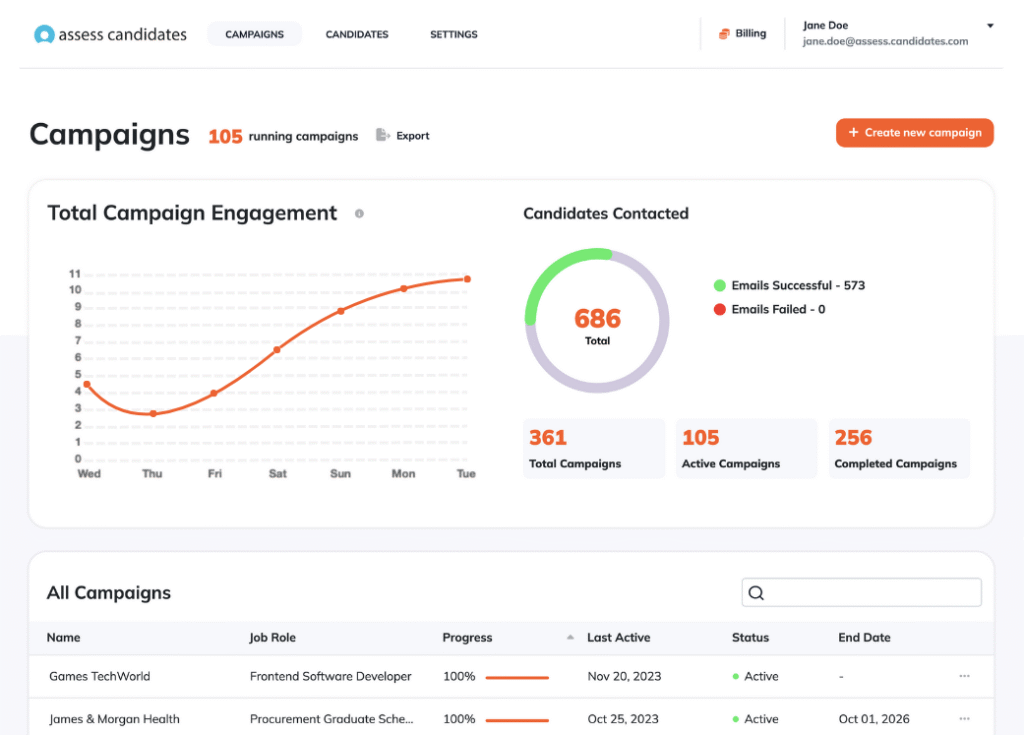
- Expert-designed assessments
The accuracy of your candidates’ assessments depends on the tests you have chosen to evaluate their skills. Another factor is how the chosen tests are designed. Scientists, psychologists, and career experts design our assessments to showcase candidates’ skills that can help your business achieve its goals.
- Data-backed, predictive measurements
You can only hire the right candidate if you use the candidate assessment data to guide your hiring decisions. With the aid of Assess Candidates’ pre-employment tests, you will get predictive insight into your job applicants’ behaviors. They will ensure you can determine the candidates that are suitable for apprentice or graduate hiring, helping you save costs.
- Clear and Simple reporting
Your candidates’ assessment is as important as your choice of assessment. An assessment result that is difficult to understand will cause you to make the wrong hiring decision. To avoid such mistakes, Assess Candidates provides your candidates’ results in a clear and simple format that makes confident hiring decisions easier and faster.
- Immersive assessment methods
It is common for candidates to leave their assessment sessions due to poor engagement. This causes you to lose out on potential quality hires and reduces the number of quality talent available for hire. With Assess Candidates’ immersive game-based assessments, your candidates will interact fully with the system and retain your access to the best talent in the pool.
- Role-tailored assessments
It is difficult to ascertain which candidates are suited for apprentice or graduate roles without role-tailored assessments. These types of assessments allow you to predict how your candidates will function in their preferred roles. You will also gain insight into their ability to apply the core skills required for their roles. With Assess Candidates’ role-tailored assessments, you can easily distinguish between apprentice and graduate hiring candidates.
Explore our expert-designed pre-employment assessments for apprentice and graduate hiring. VIEW PLANS
Conclusion: Key Takeaways
- Apprentice hiring is a recruitment approach in which individuals earn while they learn within an organization. Graduate hiring recruits recent first-degree graduates to roles that require fast value delivery.
- The key differences between apprentice and graduate hiring include their core purposes, hiring focus, and time-to-productivity. Others are their training intensity, cost structure, output expectations, loyalty and retention, and cultural alignment.
- Consider these factors when deciding between hiring an apprentice and a graduate: role requirements, time to productivity, and training capacity. Other factors include budget and time comparison, skill availability in the market, and long-term employee retention needs.
- To assess candidates for apprentice and graduate hiring roles, use aptitude and technical tests, situational judgment tests, and job simulation tests. You can also use assessment centers and behavioral interviews.
- Assess Candidates helps companies evaluate candidates for hire by offering expert-designed assessments and data-backed, predictive measurements. Their other offerings include simple reporting, immersive assessment methods, and role-tailored assessments.
Interested in knowing more about using pre-employment assessments to hire quality apprentices or graduates? Continue reading for frequently asked questions and sign up below with your email to get started.
Frequently Asked Questions
What are some of the challenges of apprenticeship?
Employers face apprenticeship challenges, including slow initial productivity, high demands for training and supervision, and inconsistent learning outcomes. Other challenges include varying legal and administrative requirements by country and the risk of attrition.
How does apprentice hiring work better for skills shortages?
Apprentice hiring addresses skills shortages more effectively than graduate hiring does. It does so by providing customized skills training and creating a continuous talent pipeline for your company. It also reduces your company’s reliance on the tight labor market. Graduate hiring, on the other hand, depends on the overpopulated labor market.
Should employers hire apprentices or graduates for entry-level roles?
Apprentices and graduates are suitable for entry-level roles. Apprentices are the best choice if you have the capacity to train and mentor, can afford the learning curve, and have a practical role that allows on-the-job learning. Graduates are better if you require quick productivity and have the budget for a high initial cost.
Can graduates be hired as apprentices, and what are the eligibility rules?
Yes, graduates can be hired as apprentices; however, eligibility rules vary by country. You can hire a graduate as an apprentice as long as their training introduces them to new skills not covered by their formal education.
What industries are best suited for apprentice vs graduate hiring?
Apprentice hiring is best for industries such as manufacturing and engineering, hospitality and tourism, and IT support and technical operations. Others include construction, skilled trades, logistics, supply chain, and operations. Graduate hiring best suits finance, banking, and accounting, data science and analytics, and policy, research, and regulatory roles.


 English
  Arabic