
The Importance of Role-Play Exercises in Assessment Centers



Role-play exercises in assessment centers give employers an opportunity to observe how candidates respond to realistic workplace interactions. Depending on the scenario, they can provide evidence of communication, problem-solving, conflict resolution, adaptability, and leadership behaviors.
This guide explains what role-play exercises assess, when to use them, practical examples, common challenges, and how to design and score them consistently.
Contents
- What are role-play exercises in assessment centers?
- What skills do role-play exercises measure in assessment centers?
- Why use role-play exercises in assessment centers?
- What are some role-play exercise examples in assessment centers?
- What to consider before using role-play exercises in assessment centers
- Effective strategies to implement role-play exercises in assessment centers
- Why leading companies choose Assess Candidates’ pre-employment assessments
1. What are role-play exercises in assessment centers?
A role-play exercise is a structured assessment activity in which a candidate responds to a simulated workplace interaction. An assessor or trained role-player may act as a customer, colleague, or employee. Employers evaluate the candidate’s observable actions against predefined, job-relevant criteria rather than judging personality or presentation style alone.
Boost your hiring accuracy with our scientifically validated pre-employment tests. HIRE FOR FREE
A realistic scenario is only the starting point. The real value of a role-play assessment comes from what employers observe, how consistently they score it, and whether those behaviors matter for the role.
Let’s dive into the core skills observed by role-play exercises in assessment centers.

2. What skills do role-play exercises measure in assessment centers?
Role-play exercises can assess different competencies depending on the scenario and scoring criteria. For example, a customer complaint may provide evidence of communication and conflict resolution, while a management conversation may reveal how a candidate explains decisions and responds to concerns.
Below are the 5 major skills measured by role-play exercises in an assessment center:
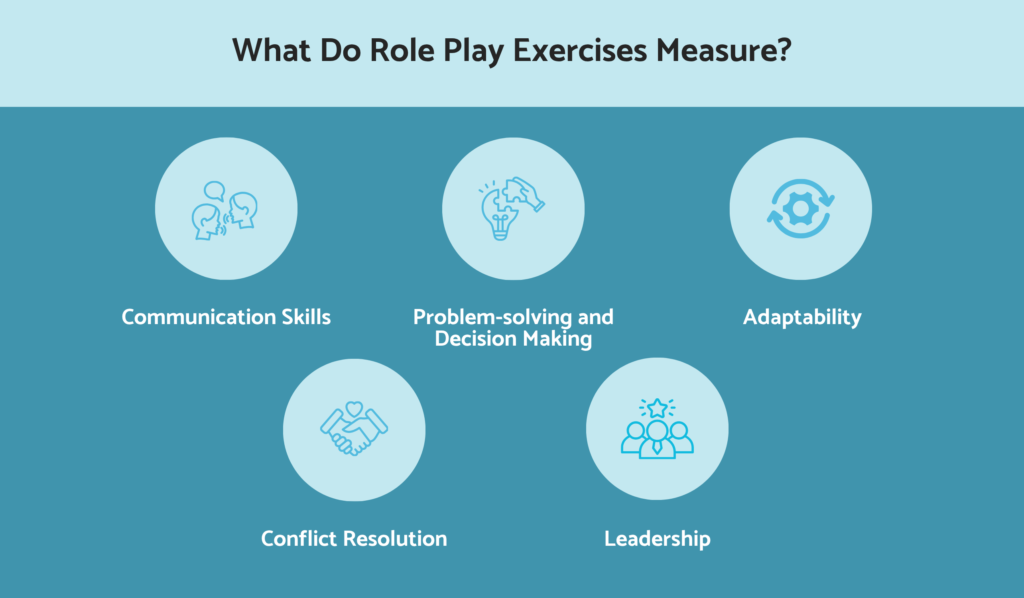
1. Communication Skills
One of the major skills measured by role-play exercises in an assessment center is communication skills. These exercises measure communication skills by evaluating how clearly candidates express ideas, listen actively, and respond appropriately to others.
It is particularly valuable for roles that involve client interactions and team collaboration.
2. Problem-solving and Decision Making
Role play exercises assess candidates’ problem-solving and decision-making skills by examining how they analyze situations, weigh different options, and choose appropriate solutions. A candidate may be asked to resolve a workplace issue, make a decision with limited information, and respond to an urgent matter.
This is essential in roles that require critical thinking and quick decision-making.
3. Adaptability
Role play exercises evaluate a candidate’s adaptability and emotional intelligence by analyzing how they respond to unexpected changes, manage their emotions, and handle challenging interactions.
This skill plays a key role in dynamic work environments that require flexibility and empathy.
4. Conflict Resolution
Another major skill measured by role-play exercises in assessment centers is conflict resolution. These exercises assess how candidates manage disagreements, address concerns, and negotiate mutually acceptable solutions.
This skill is key for industries involving people management and customer service.
5. Leadership
Role play exercises also measure a candidate’s leadership qualities. They evaluate how candidates collaborate with others, guide discussions, and work towards shared objectives.
This skill is particularly important for roles involving team leadership and project management.
Explore the full potential of your hiring strategy by incorporating our hiring tests. LEARN MORE
3. Why use role-play exercises in assessment centers?
Role-play exercises in assessment centers offer several benefits by helping recruiters evaluate how candidates apply their skills in simulated workplace situations. These exercises reveal key competencies, including communication, problem-solving, conflict resolution, leadership, and emotional intelligence, enabling employers to make more informed hiring decisions.
Below are some of the major benefits of using role-play exercises in an assessment center:
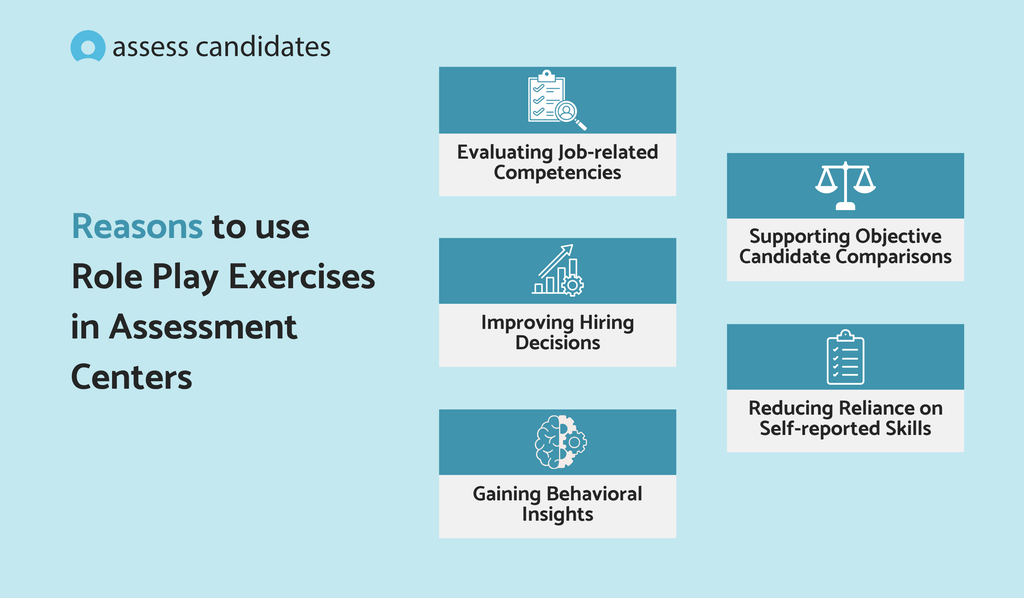
- Evaluating Job-related Competencies
Role play exercises help evaluate job-related competencies by analyzing how candidates apply their problem-solving, communication, and interpersonal skills in simulated workplace situations. This will further help you identify candidates who can handle role-specific responsibilities and face everyday workplace challenges effectively.
- Improving Hiring Decisions
Role-play exercises can add useful behavioral evidence to recruitment decisions by showing how candidates approach realistic workplace interactions. Their value depends on job-relevant scenarios, consistent scoring, and appropriate interpretation alongside other assessment results.
- Gaining Behavioral Insights
Role-play exercises allow assessors to observe how candidates communicate, respond to challenges, and interact with others in a controlled scenario. These observations can inform hiring decisions, but they should not be treated as definitive predictions of future workplace behavior.
- Supporting Objective Candidate Comparisons
Using-consistent-scenarios,-trained-role-players,-and-predefined-scoring-criteria-can-help-employers-compare-candidates-more-fairly.-Assessors-should-record-observable-evidence-and-avoid-relying-on-confidence,-personality-similarity,-or-personal-impressions.
- Reducing Reliance on Self-reported Skills
Role play exercises reduce reliance on candidates’ self-reported skills by allowing them to demonstrate their abilities through observed interactions and responses. This further enables you to observe candidates’ actual responses to simulated workplace challenges instead of depending on their claims about their competencies.
Discover our pre-employment assessments to identify talent with key competencies. HIRE FOR FREE
4. What are some role-play exercise examples in assessment centers?
Role play exercises in assessment centers simulate real workplace situations, and hence some examples include handling a customer complaint, negotiating with a client, or resolving team conflicts. These exercises reveal candidates’ practical skills and behavioral competencies.
Below are 5 role play exercise examples in assessment centers:
1. Handling a Customer Complaint
These scenarios require candidates to act like customer service representatives and respond to an unhappy customer who is dissatisfied with a product, service, or delayed delivery.
Example 1.
Scenario: A customer has received a damaged product and is frustrated and angry because customer support has failed to solve the issue even after raising two complaints. Address the concern as a customer service representative.
Task: In this role-play assessment, you will step into the role of a customer service representative and address the concern. Propose a suitable solution for the customer while following the company policies.
Assessors should use a standardized scoring rubric to assess how a candidate responds to the customer complaint. For example:
2. Resolving a Conflict Between Colleagues
For this exercise, candidates are asked to play the role of a manager who must mediate a disagreement between two employees over responsibilities, deadlines, or project decisions.
Example 2.
Scenario: Two employees disagree over how to complete a project. One believes the team should prioritize speed while the other believes they should perform additional quality checks.
Task: In this role play assessment, you will step into the role of a team manager, mediate the disagreement, listen to both sides, and come to a practical solution to move forward.
3. Conducting a Performance Review
Here, candidates will be required to act as managers conducting performance reviews with employees who have missed targets repeatedly or demonstrated poor performance.
Example 3
Scenario: An employee has been constantly missing their targets for over three months. They believe the workload is excessive and the deadlines are impractical.
Task: In this role-play assessment, you will step into the role of a manager and conduct a performance review, listen to the employee’s concerns, and establish measurable improvement goals.
4. Negotiating with a Client
To complete this exercise, candidates are required to play the role of a sales representative or account manager negotiating with a client who wants additional services, a shorter delivery time, or a lower price.
Example 4
Scenario: A client wants a 15% discount on a project proposal and expects the delivery 3 days earlier than the agreed deadline. The company, however, cannot process both requests without additional costs or resources.
Task: In this role-play assessment, you will step into the role of a sales representative, negotiate with the client, explain all the available options, and come to an agreement that considers both the client’s needs and the company’s limitations.
5. Delegating Tasks Under Tight Deadlines
Here, candidates are required to act as team leaders who must allocate tasks among team members when a project faces unexpected delays or limited resources.
Example 5.
Scenario: A project must be completed within three days after an unexpected deadline change. Two members are available, but one is inexperienced, and another is handling an urgent assignment.
Task: In this role-play assessment, you will step into the role of a team leader, prioritize the remaining work, and delegate responsibilities according to each team member’s abilities.
Optimize your recruitment strategy with Assess Candidates’ scientifically validated hiring tests. VIEW PLANS
Although role play exercises are quite beneficial, they can also pose some challenges when used in assessment centers
5. What to consider before using role-play exercises in assessment centers
Before using role-play exercises in assessment centers, you should also consider the challenges that may affect the fairness and effectiveness of the evaluation.
Below are some of the challenges you may face when using role-play exercises in assessment centers:
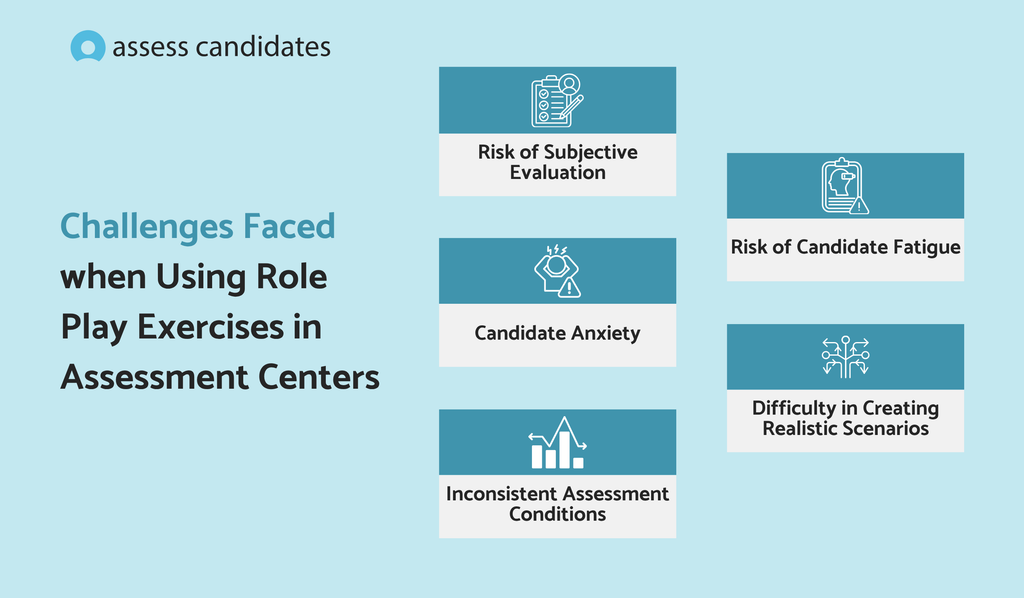
- Risk of Subjective Evaluation: Hiring teams may often interpret candidates’ responses based on their personal expectations and unconscious bias.
Solution: Use standardized scoring rubrics with clearly defined behavioral indicators.
- Candidate Anxiety: Some candidates may feel nervous and anxious when performing in front of assessors or interacting with other role players.
Solution: Explain the exercise format and expectations beforehand, provide clear instructions, and allow adequate preparation time.
- Inconsistent Assessment Conditions: Scenario difficulty or differences in role-player behavior can affect a candidate’s performance. These inconsistencies further reduce the reliability of the assessment and make fair comparisons difficult.
Solution: Standardize the scenarios, instructions, time limits, and resources provided to candidates. Train role-players to follow consistent guidelines and ensure assessors apply the same evaluation criteria throughout the process.
- Risk of Candidate Fatigue: Candidates may experience fatigue if assessment centers involve multiple role-play exercises and other evaluation criteria within a short period of time.
Solution: Schedule adequate breaks between exercises, keep activities focused and reasonably timed, and avoid placing several demanding tasks back-to-back.
- Difficulty in Creating Realistic Scenarios: Some recruiters may struggle to design role play exercises that mimic real job responsibilities and allow candidates to demonstrate their skills in real workplace situations.
Solution: Consult hiring managers and employees to identify common workplace challenges. Develop scenarios that reflect real job responsibilities and allow candidates to demonstrate relevant skills in realistic situations.
Uncover top candidates seamlessly with our advanced talent assessment platform. LEARN MORE
Now let’s address the most important topic: how recruiters can effectively implement role-play exercises in assessment centers.
6. Effective strategies to implement role-play exercises in assessment centers
Effective role-play exercises require realistic scenarios, consistent instructions, trained role-players, and clear scoring criteria. Employers should define the behaviors they want to observe before designing the activity, rather than selecting an interesting scenario and deciding afterward what it measures.
Candidates do not need to respond to a role-play in exactly the same way to demonstrate the same competency. A good scoring framework allows different reasonable approaches while maintaining consistent standards.
Below are 5 best practices you can use to implement role play exercises in assessment centers:
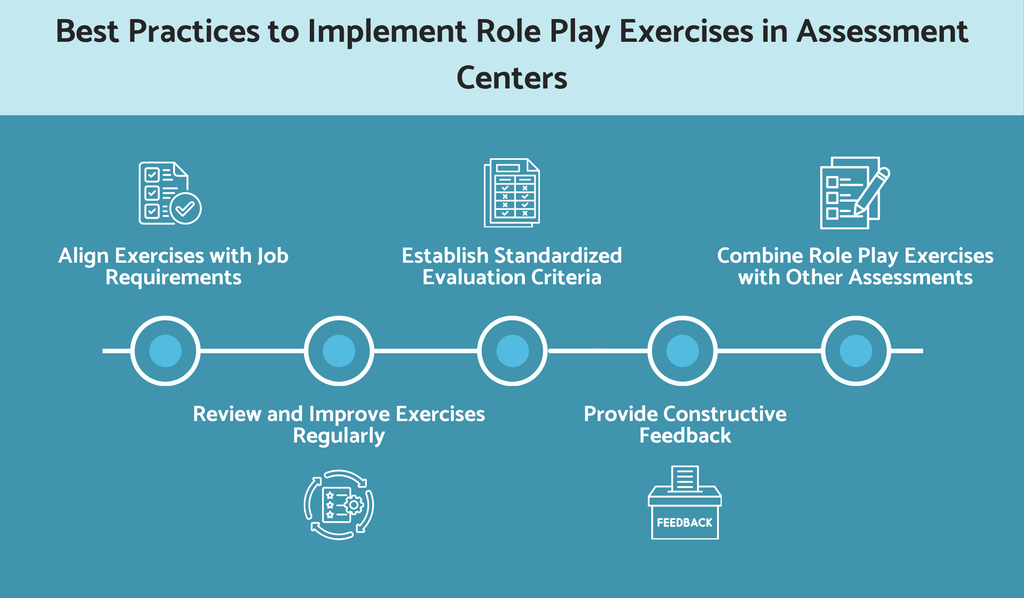
1. Align Exercises with Job Requirements
Create and design role-play exercises around the responsibilities and challenges candidates are most likely to face in their target position. This helps assess relevant competencies such as problem-solving, communication, leadership, and conflict resolution.
2. Establish Standardized Evaluation Criteria
Establish standardized evaluation criteria to make sure that assessors judge candidates fairly and objectively. Without standardized evaluation criteria, candidates may not be evaluated fairly, making candidate comparisons less reliable.
3. Combine Role-Play Exercises with Other Assessments
Combine role-play exercises with other assessments such as group discussions, presentation exercises, and case studies to get a more comprehensive overview of the candidates’ skills. This is because a single role-play exercise may not be enough to reveal every competency required for the job role.
4. Review and Improve Exercises Regularly
Review and improve role-play exercises regularly, as they may become ineffective when they no longer reflect current job requirements and organizational challenges.
5. Provide Constructive Feedback
Since feedback helps candidates understand their performance and allows recruiters to identify areas of improvement, providing constructive feedback is an essential strategy for implementing role play exercises.
7. Why leading companies choose Assess Candidates’ pre-employment assessments
Assess Candidates provide structured pre-employment assessments that can complement role-play exercises by offering additional evidence of relevant skills and abilities. Employers can combine appropriately selected assessments with practical simulations to build a more comprehensive evaluation process.
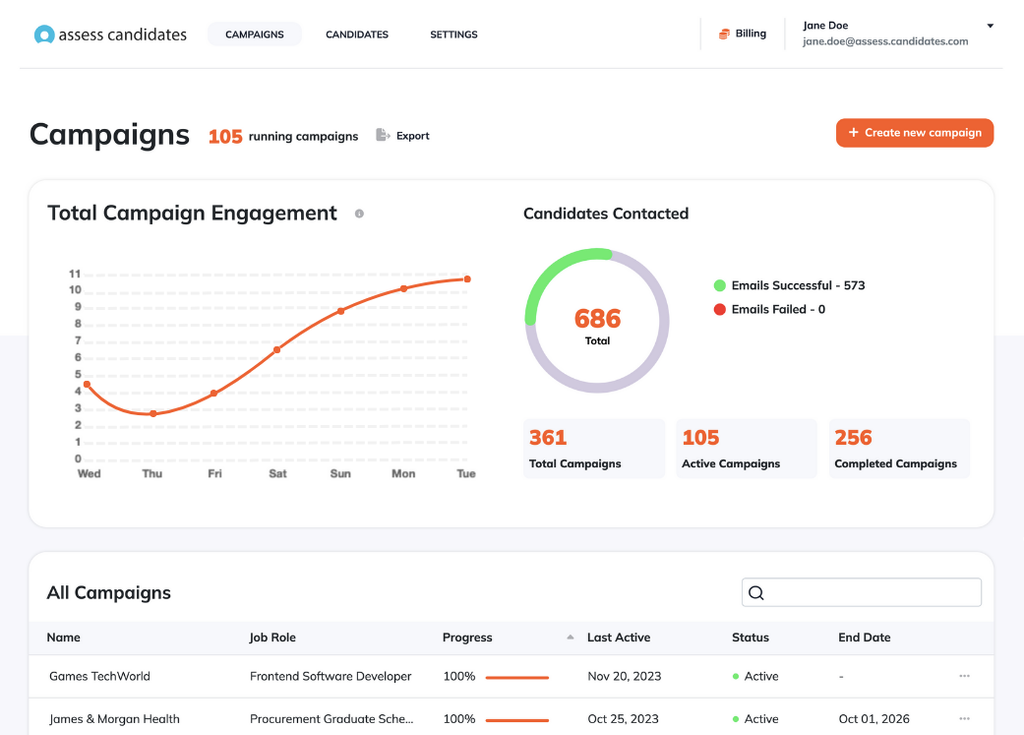
Here is an example of our campaign reporting dashboard available on Assess Candidates.
- Designed and Scientifically Validated by Expert Psychologists: Assess Candidates’ pre-employment assessments help employers evaluate job-related competencies such as communication, problem-solving, leadership, and conflict resolution through simulated workplace scenarios. These exercises provide insights into how candidates respond to challenges and apply their skills in practice.
- Expert Reporting: Our intuitive platform helps recruiters review candidate performance and make informed hiring decisions. Employers can use assessment results to compare candidates, identify strengths, and determine suitability for specific roles.
- Positive Candidate Experience: Clear instructions and realistic scenarios help candidates understand their tasks and demonstrate their abilities confidently. A structured assessment process also ensures candidates receive consistent instructions and comparable opportunities to showcase their competencies.
Assess Candidates provides reliable, end-to-end pre-employment assessment solutions for employers of all sizes. Explore our pre-employment assessments and start hiring today.
Not sure if roleplay exercises fit your recruitment process? Contact us for a free analysis of your hiring needs.
Partner with Assess Candidates for our scientifically validated pre-employment tests. VIEW PLANS
Conclusion: Key Takeaway
Role play exercises help recruiters evaluate candidates’ practical skills by simulating realistic workplace situations. They reveal how candidates communicate, solve problems, resolve conflicts, adapt to challenges, and demonstrate leadership. To improve hiring accuracy, align scenarios with job requirements, use standardized scoring criteria, and combine role-plays with other assessments for a comprehensive evaluation.
Interested in learning more about effective candidate assessment? Continue reading for frequently asked questions, and sign up with your email to get started.
Frequently Asked Questions
Can role-play exercises predict a candidate’s job performance?
Role-play exercises can provide evidence of how candidates approach job-relevant interactions, but their ability to predict future performance depends on how well they are designed and validated. Employers should interpret results alongside other appropriate assessment methods rather than relying on one simulation alone.
How to reduce bias in role-play assessments?
You can reduce bias in role play exercises by using consistent scenarios, standardized instructions, and predefined scoring criteria for every candidate. Moreover, train assessors to recognize unconscious bias and evaluate observable behaviors rather than personality.
What industries benefit the most from role-play exercises in assessment centers?
Although role-play exercises can be used across several industries, they are particularly useful in customer service, healthcare, management, and sales industries. They are mostly beneficial for roles where employees are required to communicate, solve problems, and negotiate with clients.
How long should a role-play exercise last in an assessment center?
Role play exercises in assessment centers should last for 15 to 20 minutes, depending on the complexity and competencies you want to assess. Shorter exercises work well for focused scenarios, while complex managerial simulations may require longer sessions.
How to handle candidates who take an unexpected approach during role-play exercises?
You can handle candidates who take an unexpected approach during role play exercises by evaluating the reason behind the candidate’s approach rather than expecting everyone to follow the same script. Ask follow-up questions when necessary and assess whether their decisions address the situation and align with the role’s requirements effectively.


 English
 Arabic