
How to Assess and Hire a Manager Successfully
Hiring the right manager has a direct impact on team performance and overall business success. Many candidates present strong resumes and years of experience, but not all of them have the leadership skills required to guide teams, make sound decisions under pressure, and manage complex workplace challenges.
Employers increasingly look for candidates who can communicate clearly, motivate others, solve problems effectively, and align team efforts with business goals. Resumes and traditional interviews alone rarely show how someone leads in real-world situations, which is why structured assessments are becoming more important.
To make better hiring decisions, employers now rely on structured assessment methods such as psychometric tests, situational judgment tests, job simulations, and behavioral interviews. This helps evaluate leadership skills, decision-making ability, communication skills, and strategic thinking more objectively.
Read on below as I cover what managers do, which skills matter most when hiring them, which assessment methods work best, and which mistakes employers should avoid.
Contents
- Who is a manager?
- What are the key skills to look out for when hiring managers?
- What are the best assessment methods for hiring managers?
- What are the common mistakes to avoid when hiring managers?
- Assessing and Hiring a Manager: Client Success Story
- Why top companies choose Assess Candidates to assess and hire managers
Let’s start first with the basics: what does a manager actually do?
1. Who is a manager?
A manager is responsible for planning, directing, and overseeing the work of a team to achieve defined goals. Managers also create the systems, processes, and expectations that help employees perform effectively.
Evaluate a manager’s true potential using our science-backed pre-employment tests. HIRE FOR FREE
What are the roles and responsibilities of a manager?
Managers set direction, align teams to business goals, organize work, and support performance. Their responsibilities typically include the following:
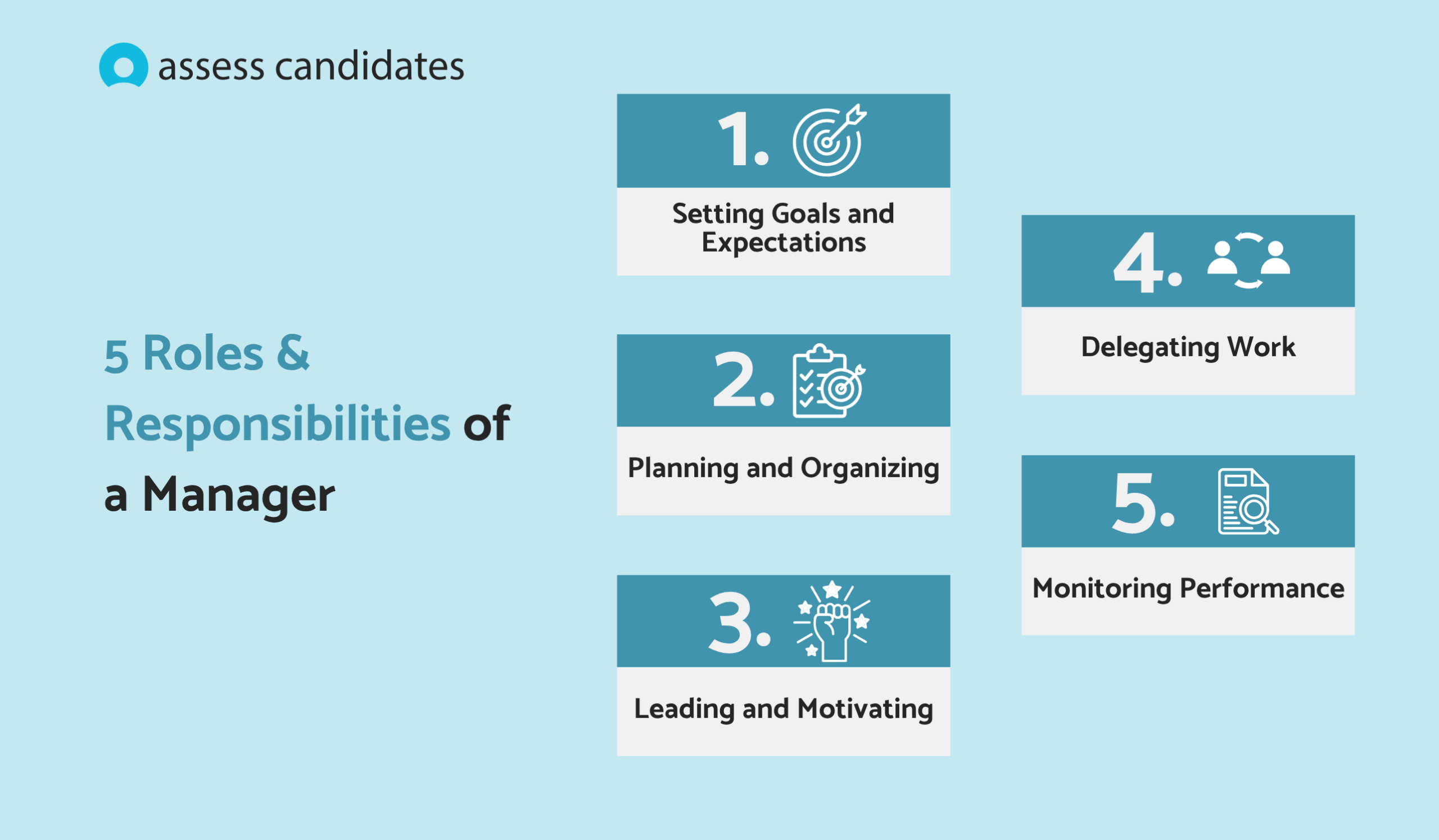
1 . Setting Goals and Expectations
A manager’s primary role is to set objectives for their team and department. They set clear priorities and establish clear, measurable, and achievable goals to ensure everyone in the organization understands what success looks like.
2 . Planning and Organizing
A manager sets priorities, allocates resources, assigns responsibilities, manages budgets, and structures workflows to keep work efficient and on track.
3 . Leading and Motivating
Another key responsibility of managers is to lead, motivate, and support team members in performing at their best. This involves building trust, creating a positive work environment, fostering open communication, and encouraging collaboration.
4 . Delegating Work
A manager delegates tasks to their team members based on the employees’ strengths and development requirements. Effective delegation builds team capability and improves productivity.
5 . Monitoring Performance
Managers track the progress of their team members towards objectives, review outcomes, gather feedback from staff members, use data and KPIs to monitor performance, and ensure standards are met. This leads to a continuous improvement in team performance.
Let’s now analyze the skills you should look for when hiring managers.

2. What are the key skills to look out for when hiring managers?
When hiring managers, you should look beyond technical expertise and focus mainly on skills that allow candidates to lead teams, make decisions, and deliver results consistently.
Given below are the major skills to look out for when starting your managerial hiring:

- Leadership Skills
Leadership is one of the most important qualities to assess in managerial candidates. Strong managers create direction, build trust, encourage accountability, and help teams perform consistently.
- Communication
Another key skill to assess when hiring managers is communication. Effective managers communicate goals, expectations, and feedback clearly. They also listen actively, address concerns, and encourage open communication.
- Decision-making Skills
Strong managers possess great decision-making skills. They analyze information, weigh different options, and make timely decisions that support business growth. By making confident, well-informed decisions, good managers help their teams move forward without unnecessary delays.
- Problem-solving
One of the most significant skills in a good manager is problem-solving. Great managers identify challenges early and take effective precautionary measures to resolve them. Their problem-solving skills allow them to maintain productivity and minimize disturbances in the workplace.
- Time Management and Organizational Skills
Good managers possess excellent time management and organizational skills. They prioritize tasks, coordinate schedules, and make sure that projects stay on track. They also manage multiple projects simultaneously while maintaining productivity and meeting deadlines.
Explore our scientifically validated psychometric test for designing managerial assessments. LEARN MORE
Next, look at the assessment methods that matter most.
3. What are the best assessment methods for hiring managers?
Hiring managers effectively requires a structured approach that evaluates both leadership potential and decision-making ability. The most useful methods combine objective assessments with realistic, role-relevant evaluation.
The following are the top 5 assessment methods used for hiring managers:
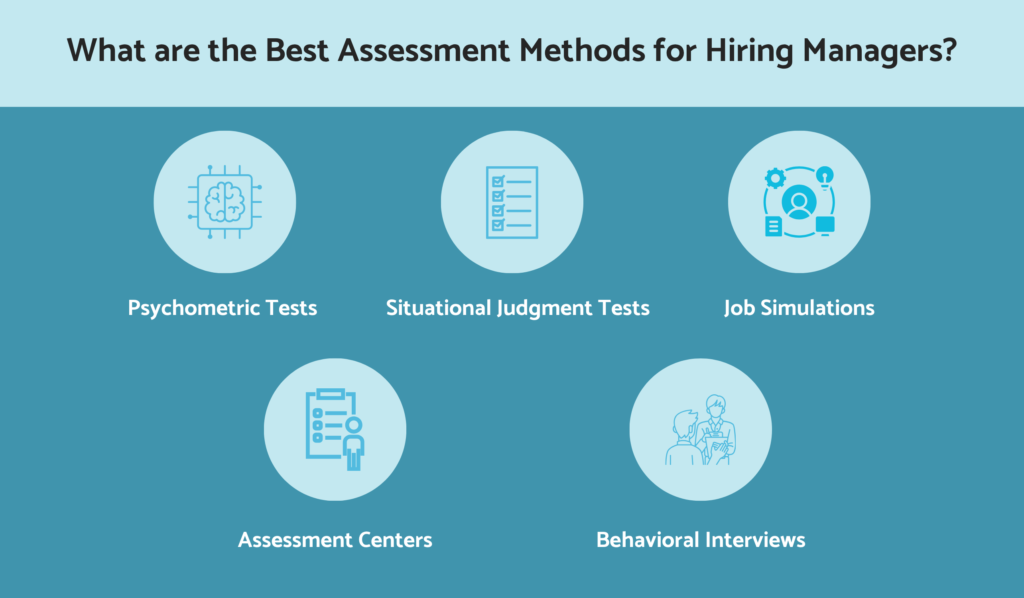
1 . Psychometric Tests
Psychometric tests measure a candidate’s behavioral tendencies, cognitive ability, and personality traits, all of which influence managerial performance. Cognitive and psychometric assessments can help measure analytical thinking, reasoning ability, and behavioral tendencies that influence managerial performance.
Example 1: “Approximately, what is the ratio of all contactless transactions in Austria and Germany to the total number of transactions in the UK and Spain?”
2 . Situational Judgment Tests
Situational judgment tests present candidates with realistic workplace scenarios and ask them to choose the most appropriate option. These tests help measure a candidate’s leadership skills and evaluate how they approach challenges, resolve conflicts, prioritize tasks, and make decisions under pressure.
Example 2: One of your top-performing employees has started missing deadlines, which affects the team’s progress. What should you do first?
- Issue a warning immediately.
- Speak with the employee privately to understand the issue.
- Reassign their work to another employee.
- Ignore the issue because the employee usually performs well.”
3 . Job Simulations
Job simulations present tasks and challenges that managers face in real life. These simulation tests help you understand how candidates think, communicate, and make decisions in realistic management situations.
Example 3: “You return from leave and find three urgent emails:
- A client requests a project update due today.
- Two team members disagree about task responsibilities.
- Senior management requests a weekly report within two hours.”
4 . Assessment Centers
Assessment centers combine multiple evaluation methods, including role-plays, group discussions, case studies, and interviews. These centers allow you to observe candidates across various tasks and interactions, giving you a comprehensive understanding of their leadership abilities and interpersonal skills.
Example 4: “What are the key issues reflected in the data, and what steps would you recommend to improve customer satisfaction?“
5 . Behavioral Interviews
Behavioral interviews mainly focus on a candidate’s past professional experiences to predict their future performance. By evaluating a candidate’s real-world experiences, you can assess their leadership style, accountability, and problem-solving ability, all of which are key managerial qualities.
Example 5: “Tell me about a time you had to prioritise two urgent tasks with similar deadlines. How did you decide what to do first?”
Discover the potential of science-backed assessments to hire strong managers. HIRE FOR FREE
Next up, let’s take a look at some common red flags to watch out for when hiring managers.
4. What Are the Common Red Flags to Watch for When Hiring Managers?
When hiring managers, it is necessary to look out for red flags that indicate poor management skills and poor leadership ability in candidates. Identifying these warning signs early in the recruitment process will help you avoid costly mis-hires.
Given below are some common red flags to look out for when it comes to managerial hiring:
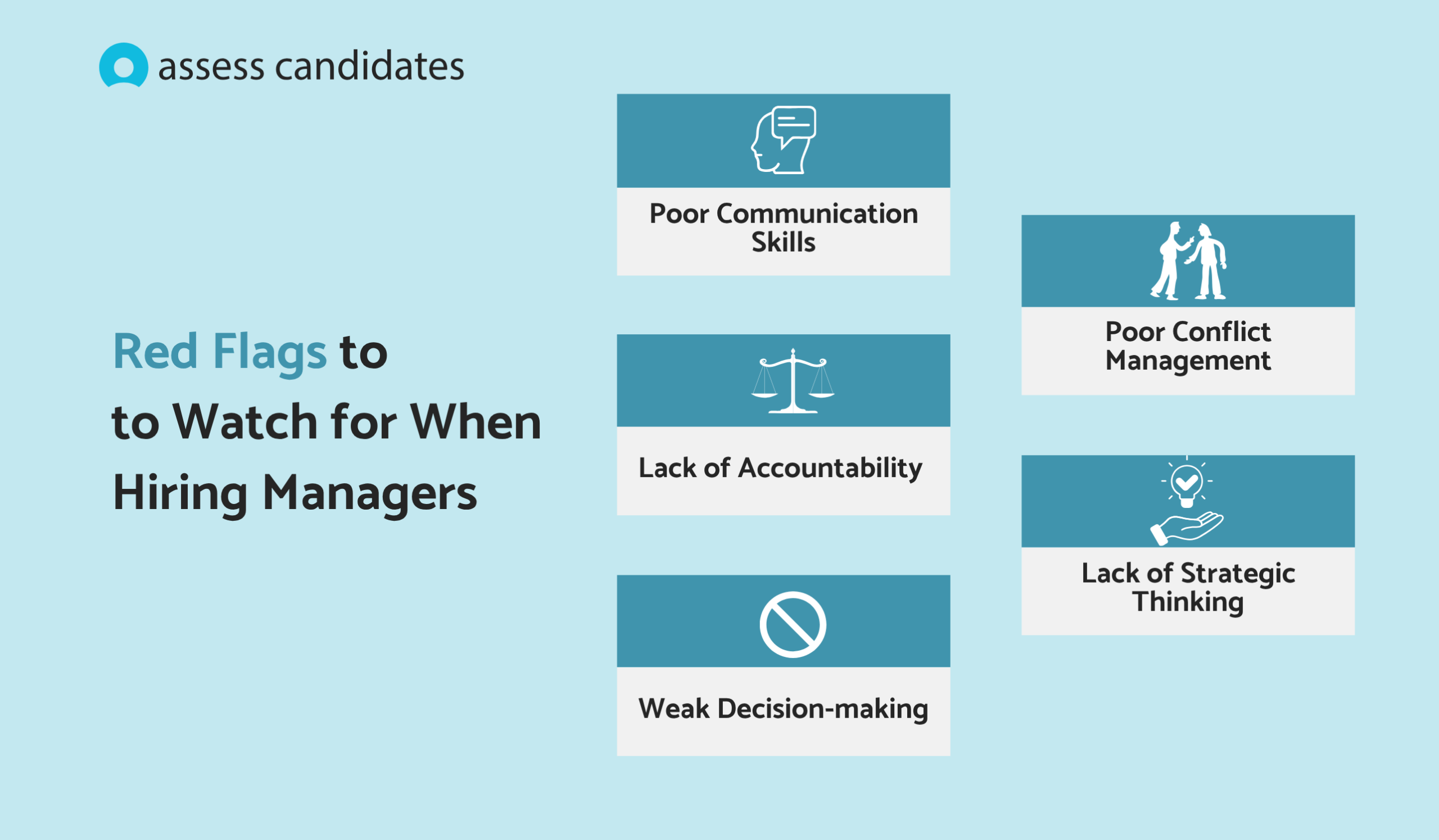
- Poor Communication Skills
The biggest red flag to watch out for when hiring managers is poor communication skills. A good manager must communicate expectations, feedback, and goals clearly. However, if a candidate struggles to explain ideas, avoids direct answers, and fails to listen actively during interviews, it may raise difficulties in handling a team.
- Lack of Accountability
Lack of accountability is yet another red flag to watch out for when hiring managers. Strong managers always take responsibility for both successes and failures. However, candidates who consistently blame others, avoid discussing mistakes, or refuse to acknowledge areas for improvement may struggle to lead a team.
- Weak Decision-making
A manager may often face complex situations that require timely decisions. However, if a candidate avoids taking responsibility for decisions or provides vague answers about past choices, it may reflect poor judgment or a lack of confidence.
- Poor Conflict Management
Handling conflicts or disagreements within the team is one of a manager’s most important tasks. Candidates who avoid conflict, escalate issues unnecessarily, or struggle to explain how they resolved team disagreements may lack the interpersonal judgment required for management.
- Lack of Strategic Thinking
Managers are required to align daily activities with broader organizational goals. However, if a candidate focuses only on short-term tasks and fails to demonstrate long-term planning or goals, they may indicate limited strategic awareness.
Utilize our pre-employment assessments to successfully assess and hire top managers. HIRE FOR FREE
5. Assessing and Hiring a Manager: Client Success Story
Client Problem Statement
A mid-sized technology services company needed to hire several managers for newly formed teams across operations and client delivery. Although many candidates had strong resumes and prior experience, the company struggled to determine who could actually lead teams, make sound decisions under pressure, and manage complex workplace challenges.
Hence, the organization needs a reliable way to assess candidates’ leadership potential, decision-making ability, and people management skills before hiring and placing them in critical managerial roles.
Assess Candidates’ Proposal
Assess Candidates recommended a structured managerial assessment process combining psychometric tests, situational judgment tests, leadership simulations, and behavioral interviews.
Result
This approach gave the organization a more reliable way to identify candidates with strong leadership potential, sound judgment, and effective people-management skills, leading to stronger team performance and better hiring decisions.
Partner with Assess Candidates to successfully assess and hire high-performing managers. VIEW PLANS
6. Why top companies choose Assess Candidates to successfully assess and hire managers
Assess Candidates helps employers assess and hire managers more effectively through structured psychometric assessments, clearer reporting, and a consistent candidate experience.
Here is an example of our campaign reporting dashboard available on Assess Candidates.
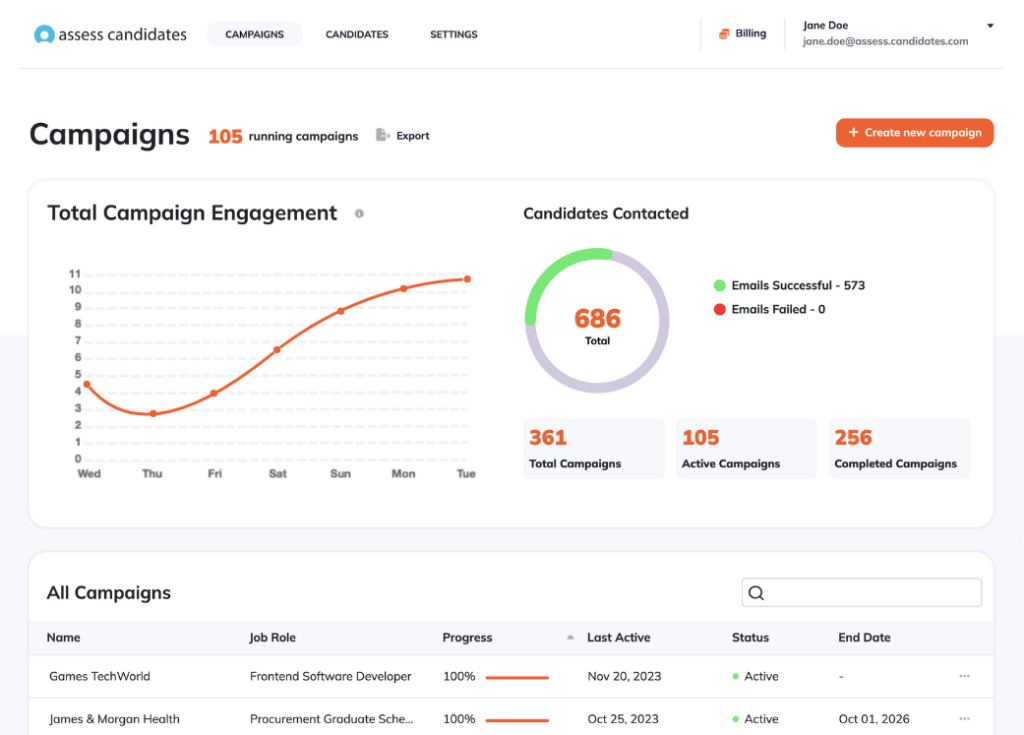
Here are 4 reasons why you should use Assess Candidates for successfully assessing and hiring a manager:
- Scientifically Designed by Expert Psychologists: Assess Candidates develops managerial assessment solutions in collaboration with experienced psychologists and psychometricians who specialise in building hiring tools for global organisations. Our experts design each assessment to measure critical managerial competencies such as leadership, decision-making, strategic thinking, communication, and problem-solving.
Through rigorous validation, we ensure that every assessment delivers reliable insights, helping employers confidently identify candidates who demonstrate strong leadership potential and the ability to manage teams effectively.
- Advanced Reporting: Our intuitive platform generates clear, easy-to-interpret reports that highlight candidate performance across key managerial competencies, behavioural indicators, and overall assessment outcomes. Recruiters can quickly compare candidates, rank results, and make informed hiring decisions using objective data. With seamless ATS integration, hiring teams can streamline evaluation and shortlisting while maintaining consistency throughout the managerial hiring process.
- Positive Candidate Experience: We design managerial assessments to feel engaging, intuitive, and accessible across devices. Candidates receive clear instructions and move smoothly between exercises, allowing them to focus on demonstrating their leadership and decision-making abilities rather than navigating complex systems. Custom branding options also help organisations reinforce their employer brand and deliver a professional, cohesive assessment experience.
- Candidate Accessibility Support: We prioritize inclusivity by offering accessibility features such as extended time options, screen-reader compatibility, accessible colour contrast, and remote assessment capabilities. Our tools comply with WCAG accessibility standards, ensuring every candidate receives a fair opportunity to demonstrate their managerial skills and potential, regardless of individual needs.
Explore our full suite of managerial hiring tools to start identifying candidates with strong leadership skills and management readiness.
Not sure how to structure your managerial assessment process? Contact us for a free consultation and tailored hiring recommendations.
Conclusion: Key Takeaway
In essence, hiring a manager requires more than reviewing experience. It requires evidence that a candidate can lead, decide, and perform in the realities of the role.
- A manager leads teams, sets goals, and ensures work systems help employees perform at their best.
- Effective managers set clear objectives, align teams with organisational goals, and guide employees toward results.
- Leadership, communication, decision-making, and problem-solving are the most important skills to assess in managerial candidates.
- Strong managers prioritise tasks, delegate responsibilities effectively, and monitor team performance using data and feedback.
- Structured hiring methods such as psychometric tests, SJTs, job simulations, and behavioural interviews improve managerial hiring decisions.
- Assessment centres allow employers to evaluate leadership potential through realistic workplace exercises.
- Avoid hiring candidates who show poor communication, lack accountability, weak decision-making, or poor conflict management.
Interested in learning more about effective candidate assessment? Continue reading for frequently asked questions, and sign up with your email to get started.
Frequently Asked Questions
How to reduce bias when hiring managers?
You can reduce bias when hiring a manager by using assessments, including psychometric and situational judgment tests, as well as standardized interview questions. Assessing candidates against the same competency framework ensures that there is a fair comparison across applicants.
How to evaluate a manager’s decision-making ability?
You can evaluate a manager’s decision-making ability through situational judgment tests, case studies, and job simulations. Since these methods present candidates with complex workplace scenarios that require analysis and quick thinking, they help evaluate candidates’ judgment and strategic thinking skills.
Why is emotional intelligence important for hiring managers?
Emotional intelligence is important when hiring managers because they interact with different categories of people every day. Hence, emotional intelligence plays a major role in their effectiveness. Moreover, candidates with strong emotional awareness communicate better, manage conflicts calmly, and develop stronger relationships with their teams.
How can you improve the success rate of managerial hires?
You can improve the hiring success of managers by using science-backed assessments, defining clear role requirements, and evaluating candidates across multiple competencies. Moreover, combining psychometric tests, simulations, and behavioral interviews helps gather deeper insights into leadership potential.
What role does cultural fit play when hiring managers?
Cultural fit plays a crucial role when it comes to managerial hiring as it ensures they align with the organization’s values, leadership style, and work environment. Recruiting managers who align with company culture helps maintain team harmony, strengthens employee engagement, and supports long-term organizational success.


 English
  Arabic