
Hogan Personality Inventory: What It Is and How It Works



Have you ever used a personality assessment and realized it did not measure the traits you actually needed for the role? Choosing the right tool is a common challenge for recruiters. The Hogan Personality Inventory helps solve that by assessing workplace personality traits linked to job performance, leadership potential, and behavioral fit.
The Hogan Personality Inventory measures everyday workplace personality traits and how they may influence job effectiveness. It helps recruiters identify candidates who fit the behavioral demands of the role, work well with others, and contribute positively to team performance.
In this article, we will learn…
Contents
- What is the Hogan personality inventory (HPI)?
- How does the Hogan personality inventory work?
- How is the Hogan personality inventory used in recruitment?
- Hogan personality inventory vs. other personality tests
- The Hogan personality inventory best practices
- Why Choose Assess Candidates for evaluating candidates’ personalities for hiring?
Now, without further delay, let’s start with understanding what the Hogan personality inventory is!
1. What is the Hogan Personality Inventory (HPI)?
The Hogan Personality Inventory (HPI) is a workplace personality assessment used to predict job performance, leadership potential, and job-relevant behavioral tendencies. It helps employers understand how candidates are likely to work with others, respond in professional settings, and approach career growth.
In practice, the Hogan personality assessment focuses on the potential to collaborate with other employees at your company and how they get ahead in your organization. Unlike the Enneagram, the HPI is a true pre-employment personality assessment tool that you can use to make hiring selection decisions.
What does the Hogan personality inventory measure?
The HPI is based on socioanalytic theory, which focuses on how people get along with others and get ahead in their careers.
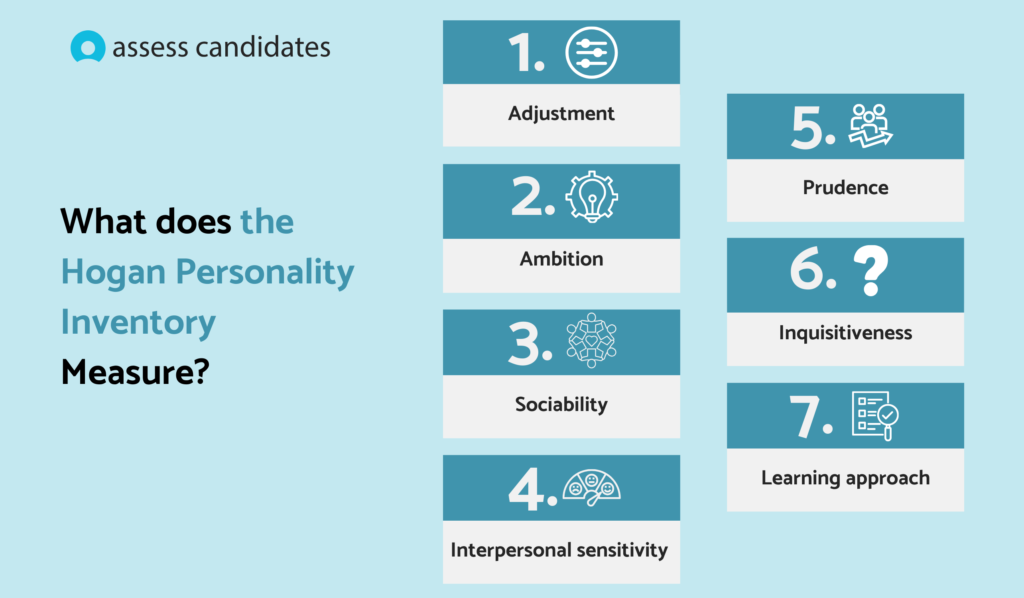
To assess your candidates’ collaborative and career advancement potential, the Hogan Personality Inventory tests 7 core personality dimensions. Each dimension links to observable work behavior, and they are:
- Adjustment
Your candidates should be adaptable to different workplace situations that can introduce stress. This is more important for those looking to fill roles that require consistency, pressure management, and decision-making under stress.
The Hogan Personality Inventory measures your candidates’ ability to tolerate stress, consistently meet your company’s required quality standards, and maintain emotional stability.
- Ambition
Not all your candidates will be suitable for leadership positions, but those roles that require leadership skills also need leadership personalities. Your candidates’ ambition helps you to determine their motivation towards success and career advancement to leadership levels.
The elements of ambition that the Hogan personality inventory measures are competitiveness, initiative, and leadership drive. Each of these helps you identify the natural leaders in your talent pool. It also enriches your managerial talent pipeline.
- Sociability
The more sociable your candidates are, the better they are suited to your teams and customers. Candidates with sociable personalities relate well with your customers and their team members, helping your business become more productive.
The HPI gauges your candidates’ social skills by assessing how they relate to others. It assesses their communication skills and outgoing nature to determine their suitability for customer-facing roles, such as sales and leadership.
- Interpersonal sensitivity
Other than being sociable, how sensitive are your candidates to their team members’ and customers’ emotions? Interpersonal sensitivity points to emotional intelligence and completes the makeup of a candidate suitable for service and customer-facing roles.
You can use the HPI to assess empathy, tact, and cooperation, which can shape teamwork, communication style, and leadership approach.
- Prudence
If your company operates in a regulated environment, this is one of the most important aspects to measure in your candidates. An insight into your candidates’ prudence helps you determine which ones will uphold company regulations and remain steadfast in their roles.
The Hogan personality inventory measures your candidates’ prudence, that is, their adherence to company rules, self-discipline, and reliability. With it, you can choose the perfect fit for your company and experience their dependability.
- Inquisitiveness
An innovative team doesn’t just accept projects and execute them; it asks questions that force each member to think strategically and use their creativity to solve problems. Your candidates’ inquisitiveness shows that they possess problem-solving and creative skills.
You can use the Hogan personality inventory to identify candidates with creativity, curiosity, and strategic thinking. Such candidates will serve your company better at technical or senior roles that require innovation and problem-solving.
- Learning approach
Some roles at your company require that new employees go through a learning curve. However, to ascertain that your candidates have the capability for learning new skills or approaches requires testing. You need to know whether the promising candidates can handle feedback and learn from it.
The Hogan Personality Inventory helps you measure your candidates’ attitudes toward learning, openness to feedback, and self-development. These metrics help you determine your candidates’ long-term growth potential and trainability.
What does the Hogan personality inventory not measure?
Although the Hogan Personality Inventory helps you measure your candidates’ personality across 7 dimensions, it does not measure certain areas. They are:
1. Job skills and technical competence
Your candidates’ previous work experience, technical expertise, and job-specific knowledge are important to their qualification for the role they want. While HPI can predict your candidates’ job performance based on their behaviors, it cannot indicate their proficiency in the hard skills required to succeed in their roles.
2. Cognitive ability
Your candidates’ success at their jobs depends not only on their skills but also on their intelligence. However, a candidate’s cognitive ability does not necessarily translate into ambition, prudence, or sociability. Although the Hogan personality inventory measures your candidates’ learning approach, it doesn’t indicate their ability to learn effectively through that approach.
3. Values, motivation, or culture fit
Your candidate’s cultural fit to your organization depends on their attitude and career motivation. The HPI does not directly assess values, core motivation, or culture fit. Recruiters should evaluate those areas separately through interviews, values-based questions, or complementary assessments.
4. Short-term performance
This Hogan personality test focuses on predicting your candidates’ consistent, long-term behavioral tendencies. It does not measure onboarding speed nor how fast your candidate can become productive. Therefore, if your goal is to assess your candidates’ speed to productivity, the Hogan personality inventory is not the right tool.
5. Integrity
Your candidates’ honesty relates to their prudence; however, the Hogan Personality Inventory measures prudence, not integrity. Your candidate can adhere to your company’s regulations while being dishonest. The Hogan personality inventory shows that your candidates follow rules. Conversely, what they do when faced with making ethical judgment decisions is beyond the HPI’s scope.
Hire the best behavior-role fit candidate with our personality assessments. HIRE FOR FREE
Now that you know what the Hogan personality inventory is and what it measures. How does it work?

2. How does the Hogan Personality Inventory work?
The Hogan Personality Inventory measures workplace personality through a standardized set of statements that candidates respond to online. Their answers are then scored across key workplace traits and interpreted against professional norm groups.
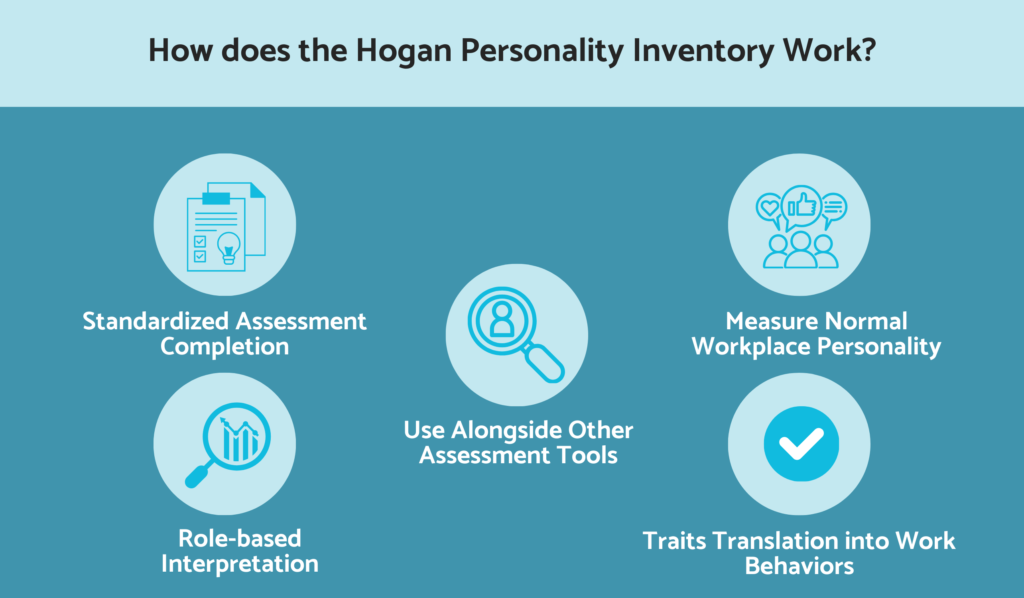
The step-by-step breakdown of how the Hogan personality inventory works is as follows:
- Standardized assessment completion
Your candidates will answer some work-relevant questions or statements during their assessment. Usually, your candidates take the standardized HPI assessment online, which lasts about 20 minutes. However, to ensure honesty and accuracy, the answers are in structured formats. You should note that there are no right or wrong answers in this personality assessment.
- Measure normal workplace personality
Your employees work at a normal pace most of the time, but only work under stress when situations that warrant it arise. This means that you must observe your candidates’ personalities when there is minimal stress to mimic the normal workplace environment. The Hogan personality inventory evaluates your candidates across 7 core traits, and they are:
- Emotional regulation
- Leadership drive
- Social engagement
- Interpersonal style
- Reliability and self-control
- Curiosity and openness to learning
- Problem-solving style
- Scoring against professional norm groups
Your candidates are scored on a percentile scale across the 7 core traits that directly link to observable workplace behaviors. The Hogan Personality Inventory accomplishes this by comparing your candidates’ answers to large, global professional norm groups. The percentile score provides a descriptive comparison of work personality traits, not a pass-or-fail result.
- Role-based interpretation
Having obtained your candidates’ general trait scores in percentile, you must isolate the role-relevant traits from their results and compare them with the desired roles. Results should be interpreted against the demands of a specific role. A single trait should never determine hiring decisions in isolation; the value comes from understanding the full trait profile in context.
- Traits translation into work behaviors
Your candidates’ work behaviors are reflected in the things that the Hogan personality inventory measures. At this stage, you must accurately translate their traits, such as social engagement, into behaviors, such as sociability, that help you predict how they will act on the job.
- Use alongside other assessment tools
Get your candidates’ whole job performance prediction. To do that, combine your candidates’ Hogan personality inventory results with their results from other assessments. While HPI provides predictive work behavior, assessments such as job simulations and the Cognition-M game-based assessment will provide predictive measures of technical and learning competencies, respectively.
Accurately predict your candidates’ job performance with our personality assessment. LEARN MORE
In hiring, personality data is most useful when it helps answer a practical question: how is this person likely to operate in the role day to day?
3. How is the Hogan Personality Inventory used in Recruitment?

The Hogan personality inventory is generally used to help you predict your candidates’ workplace behavior. However, before you can use the HPI, you must know the stage of recruitment to use it and how it can influence your hiring decision and quality. In recruitment, the Hogan personality inventory is used in the following ways:
1. After initial screening
The Hogan personality inventory is an ideal personality assessment for your candidates that have passed the CV evaluation and initial interview phase of recruitment. This ensures that your remaining candidates have the minimum skills and experience that your role requires, keeping the hiring process fair and role-focused.
2. To clarify behavioral fit for the role
Contrary to what many recruiters think, the Hogan personality inventory does not aim to categorize your candidates into types. Instead, it helps you answer the question, “Does this person’s natural work style fit the role’s demand?”
HPI assesses your candidates for job-relevant traits to determine whether they can adhere to company regulations or have the interpersonal skills to work effectively in a team.
3. To support role-based decision-making
Since your candidates’ HPI results are compared to professional group norms to give them scores, they support you in decision-making. However, such results are only usable for roles that are similar to the ones you used for comparison.
A candidate’s result cannot be used in isolation; it can only be used for specific roles. For example, higher ambition may be relevant in roles that require initiative or leadership drive, while trait patterns such as prudence or interpersonal sensitivity may matter more in roles with strong compliance or collaboration demands.
4. Improve interview quality
The Hogan personality inventory exposes your candidates’ strengths and weaknesses that can inform your approach at their next interview. Insight from HPI helps you to create target follow-up interview questions and challenge interview impressions caused by bias.
You can improve your interview quality by focusing on role-specific questions and avoiding over-reliance on your candidates’ confidence to ascertain their suitability for the role.
5. Reduce hiring risk and early attrition
The HPI can help reduce hiring risk by highlighting potential behavioral mismatches before a hire is made. Used alongside other tools, it can support better-fit decisions and improve the chances of long-term success.
6. Complement other assessment tools
Your candidate’s behavior isn’t solely responsible for their potential success at work. This is why the Hogan personality inventory is used alongside other assessment tools in recruitment. Usually, you will find HPI as a complementary tool with structured interviews, aptitude tests, and skills or technical assessments.
While the Hogan personality inventory answers your behavioral-role alignment questions, the other assessments answer the skill and technical competency and learning ability questions, respectively.
7. Across different hiring scenarios
The Hogan personality inventory is a versatile assessment tool that you can employ at different levels of employment. Whether your vacant role requires candidates with formal education, skills training, or work experience, the HPI works the same way across all recruitment scenarios.
From graduate hiring, specialist roles, management and leadership hiring, and high-potential identification, the Hogan personality inventory tells you your candidates’ traits that align with your vacant roles.
Improve your hiring quality with the Hogan personality assessment. LEARN MORE
Before you use the Hogan personality inventory in your workplace, find out how it differs from other personality tests.
4. Hogan Personality Inventory vs. Other Personality Tests

When you have to choose between different workplace personality assessment tools, you must know what each assessment option offers. A comparison of the Hogan personality inventory and other personality tests will help you identify the best one that suits your organization and its vacant roles.
The personality assessments that you can use to evaluate your candidates’ role and company suitability differ in some respects. This makes their applications in recruitment different as well. The Hogan personality inventory differs from other personality tests in the following ways:
| Aspect | Hogan Personality Inventory (HPI) | Big Five/Five-Factor Model (FFM) | SHL Occupational Personality Questionnaire (OPQ) |
|---|---|---|---|
| What it is | A workplace personality assessment | A personality model/framework | A workplace personality assessment |
| Primary Purpose | Predict job performance and leadership behavior | Describe general human personality structure | predict job fit and competency-based behavior |
| Designed for hiring? | Yes | No | Yes |
| Strengths | . Strong predictive validity for leadership and performance. . Strong legal defensibility when used correctly | . Strong scientific foundation | . Direct linkage to job competencies. . Strong in corporate recruitment |
| Limitations | Not ideal for high-volume screening | Not a hiring tool itself | Can feel complex or over-detailed |
| Interpretation approach | Role-based, contextual. | Requires HR translation | Role and competency-based |
| Ease for recruiters | Moderate (training is recommended) | Low-moderate | High |
| Best used for | Leadership, managerial, and professional roles. | Research, coaching, and personality insight. | High-volume hiring, assessment centers. |
You can explore the HPI’s strengths by using its best practices. Read on to know them.
5. The Hogan Personality Inventory Best Practices
To get the most value from the Hogan Personality Inventory, use it consistently, interpret results in context, and combine it with other selection methods.
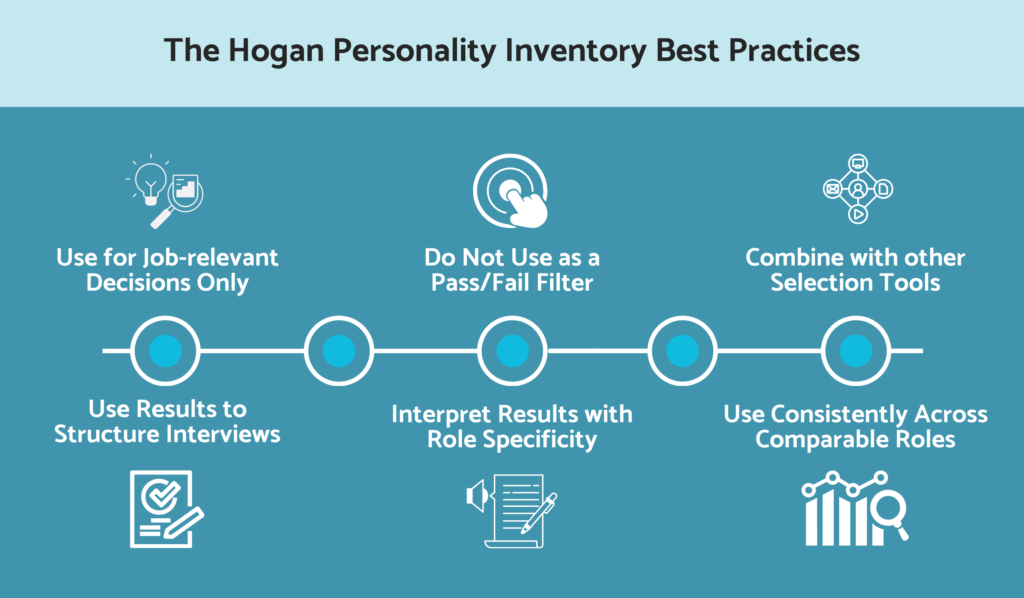
- Use for job-relevant decisions only
A clear job description helps you to easily evaluate the right candidates for the job based on its requirements. The Hogan personality inventory helps with this by measuring the behavioral traits that your vacant role needs. From the result, you can match your candidates’ traits to the clear job requirements for that role.
To achieve this, create a role profile before you have the result, and identify the traits that matter for success in that role. Match your candidates’ traits and scores to the profile and see who fits it best. Although HPI is predictive, it is most effective when aligned to the job.
- Do not use as a pass/fail filter
Yes, you have to reject most of your candidates, but the Hogan personality inventory should not decide who passes or fails. The HPI is not a pass-or-fail assessment tool; it only provides predictive information about work behavior. It is your responsibility to compare candidates’ trait scores with the role requirements.
Use the HPI to guide your decision on which candidate lands the role. However, ensure that you consider context, such as the environment and position, before strictly applying the HPI results.
- Combine with other selection tools
While the Hogan personality inventory can predict your candidates’ behavioral competence, it cannot predict their overall job performance. This means that you must combine the Hogan personality inventory with other assessment tools to have a clear understanding of your candidates’ capabilities.
As HPI tests your candidates for workplace behavior, use other tests for measuring other role success factors. You can use Cognition-M to evaluate cognitive abilities and job-simulation tasks for technical competence testing. A complete understanding of your candidates’ personality, behavioral, and technical abilities will help you make a better hiring decision.
- Use results to structure interviews
Structured interviews are a great way to evaluate your candidates’ suitability for your vacant roles. It discourages bias and promotes fairness and equity, allowing you to focus on the important aspects of your candidates’ qualifications for that role. Their HPI results can help with that.
Your candidates’ HPI results show their strengths and weaknesses, and help you form an idea about their suitability for that role. To avoid making the wrong decision, use the results to craft better interview questions. Ensure they explore your candidates’ strengths and weaknesses in relation to their preferred roles.
- Interpret results with role specificity
Workplace personality is important; however, it provides a general perspective on your candidate’s personality without tying it to a role. For the best Hogan personality inventory result, interpret your candidates’ results with the vacant role they want in mind.
The traits that HPI measures in your candidates are best used in specific roles. Also, each role has a different operational scope across organizations. Therefore, when interpreting your candidates’ results, ensure they are related to their preferred roles.
- Use consistently across comparable roles
Some organizational roles, such as Operations Manager and Facility Manager, are related and comparable. Therefore, you can apply the same interpretation framework for both roles. This helps you to reduce repetitive work on role-specific result interpretation.
Also, apply time consistency across all comparable roles. When testing your candidates for their workplace personalities, use HPI at the same stage for similar roles. It encourages fairness and helps you avoid using the tool for justifying already-made decisions.
Explore the benefits of the Hogan personality inventory best practices with us. LEARN MORE
Considering evaluating your candidates’ personalities with the Hogan personality inventory? See why you should choose Assess Candidates as other companies have.
6. Why Choose Assess Candidates for Evaluating Candidates’ Personalities for Hiring
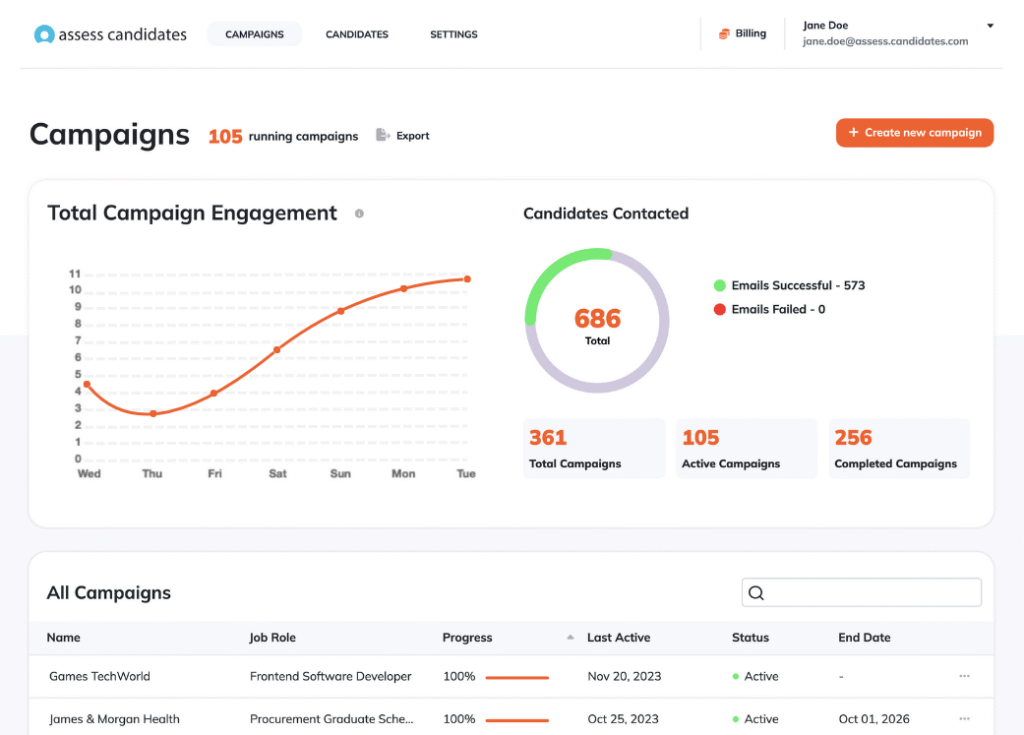
Evaluating your candidates’ personalities, among other success markers, is central to making the right hiring decision. It helps you predict their performance in their new roles as team members or leaders. While there are many candidate assessment platforms you can use for personality evaluation, many companies choose Assess Candidates for the following reasons:
1. Multi-assessment approach
The best assessment approach for accuracy is multi-assessment. Using multiple assessment methods to test a candidate’s skills gives you confidence in their competence.
You can use multiple assessment methods, including the Hogan Personality Inventory and the SHL Personality OPQ, to assess your candidates’ personalities. They will also help you decide if they fit your vacant roles and company culture.
2. Science-backed assessments
The effectiveness of an assessment exercise in helping you avoid mis-hires depends on the expertise in its design. Assessments that are designed with the guidance of scientific research and proven results will help you improve your quality of hire.
Many companies have benefited from Assess Candidates’ science-backed and expert-designed assessments. They have improved their hiring quality, increased employee retention, and saved time and cost on recruitment.
3. Bias-free and diversity-friendly evaluation process
Assess Candidates have helped many organizations improve their diversity hiring through bias-free evaluation processes. Your candidates, whose identities remain redacted, are tested for skills and behavioral competency for your roles.
Your candidates’ anonymity helps you secure quality hires and enhances creativity in your teams. Also, with personality assessments such as the personality questionnaire, you can improve conflict resolution in your company.
4. Simplified and reliable assessment results
The Hogan Personality Inventory requires that you interpret your candidates’ results in relation to their roles. However, relating those results to your candidates’ roles becomes challenging when they are complex. A simplified personality assessment result helps you link the role requirements to your candidates’ observable work behavior scores.
The clearer and easier the results are to interpret, the more useful they become in hiring decisions. Some companies have enjoyed the hiring decision speed that Assess Candidates’ simple and reliable results have given them.
5. Data-driven hiring process
To reduce personal bias in recruitment, you should embrace data-driven hiring. You can match your candidates’ personalities to their roles and use data to guide your final contextual decision on the right hire. This not only speeds up your hiring process but also makes it clearer.
The Hogan personality inventory uses data from a working professional group to determine your candidates’ behavior scores. Assess candidates will rank your candidates by their scores and help you reach a hiring decision without bias.
Make data-backed hiring decisions with our personality assessments. LEARN MORE
Conclusion: Key Takeaways
- The Hogan Personality Inventory (HPI) is a workplace assessment that you can use to predict your candidate’s behavioral competence, job performance, and leadership potential. It measures 7 core personalities: adjustment, ambition, sociability, interpersonal sensitivity, prudence, inquisitiveness, and learning approach. It does not measure skills and technical competence, intelligence, or integrity.
- The Hogan Personality Inventory works by scoring your candidates’ traits, via their answers, against a large global professional group. You will then interpret their results against the requirements of their roles for better accuracy.
- In recruitment, the Hogan Personality Inventory is used after initial screening to clarify your candidates’ behavioral fit for their roles. They also support role-based decision-making, reduce hiring risk, and complement other assessment tools.
- Compared with broader personality models and other workplace assessments, the Hogan Personality Inventory is more directly focused on predicting job-relevant behavior in professional settings.
- The Hogan Personality Inventory best practices include using it only for job-relevant decisions and not as a pass-or-fail filter. Also, combine it with other assessment tools and interpret the result with role specificity.
- You can choose Assess Candidates to evaluate your candidates’ personalities, as it employs a multi-assessment approach and uses science-backed assessments. Its evaluation process is bias-free and diversity-friendly, and it offers simple, reliable results.
In conclusion, when used correctly the Hogan Personality Inventory can improve hiring decisions by adding structured personality insight to role-based selection.
Want to know more about the Hogan Personality Inventory and how it works? Continue to the frequently asked questions section and sign up below with your email to get started.
Frequently Asked Questions
How do you interpret the Hogan test results?
For accuracy, interpret the Hogan personality test result against the requirements of a specific role. Focus on your candidates’ percentile rankings, trait patterns, and behavioral implications for the job environment. Use these considerations to determine which candidate best fits the role.
How accurate is the Hogan assessment?
The Hogan personality inventory is highly accurate when used correctly. Its accuracy is shown by scoring your candidates against large global working populations. It also shows excellent predictive validity compared to many personality tools. However, you can improve its accuracy via assessment tools, structured interviews, and clear job profiling.
What is the difference between Hogan and Myers-Briggs?
One difference between the Hogan Personality Inventory and Myers-Briggs is that while HPI is a trait-based personality assessment tool, Myers-Briggs is a type-based assessment. Other differences include that HPI is best used for hiring decisions, while Myers-Briggs is best for self-awareness. Also, while HPI predicts workplace behavior, Myers-Briggs describes preferences.
Are there right or wrong answers on the HPI?
No. There are no right or wrong answers on the Hogan personality inventory. The HPI measures normal workplace behavior, not expected workplace behavior. Therefore, it requires candidates to be as honest and realistic as possible in their answers.
How long does the Hogan personality inventory take to complete?
The Hogan personality inventory takes between 15 and 20 minutes to complete. This length of time allows for candidate engagement and stable, reliable results. It also fits well for a range of roles, from professional to managerial and leadership.


 English
  Arabic