
How To Assess Employability Skills In Students And Graduates
Employability skills are the behaviors and competencies beyond academic achievement that make students and graduates valuable in the workplace.
Employers increasingly prioritize skills such as teamwork, communication, critical thinking, adaptability, and problem-solving when hiring entry-level talent. In today’s job market, being able to assess these skills early on both improves the quality of hire and helps organizations prepare graduates for real-world workplace challenges.
A report on graduate employability indicates that only 3 in every 10 graduates in 2025 secured jobs in their field, with several graduates feeling unprepared due to skill gaps.
This guide explains what employability skills are, why they matter, the main challenges in assessing them, and the most effective ways to evaluate them in students and graduates.
Contents
- What are employability skills?
- What are the benefits of assessing employability skills early?
- What are the challenges of assessing graduate employability?
- How employers assess employability skills in early career talent
- Best practices to support students and graduates through the assessment process
Let’s start by understanding what employability skills are!
1. What Are Employability Skills?
Employability skills are the practical workplace skills, behaviors, and personal attributes that help students and graduates succeed at work, even when they have limited or no professional experience.
Employability skills go beyond subject knowledge. They shape how candidates may communicate, make decisions, and adapt to change in the workplace.
Top Employability Skills Employers Should Assess in Entry-Level Talent:
- Written and verbal communication skills
- Critical thinking
- Problem-solving
- Teamwork and collaboration
- Adaptability and resilience
- Time management and organization
- Digital literacy and basic technical skills
- Initiative and readiness to learn
- Professional behaviour and ethical conduct
According to a 2024 employer survey, approximately 90% of employers think problem-solving skills are essential when recruiting graduates, and about 80% emphasize strong teamwork skills.
Assess employability skills early and hire work-ready talent with greater confidence. HIRE FOR FREE
Now we have clearly defined what employability skills are; the next step is understanding why early assessment matters.

2. What Are the Benefits of Assessing Employability Skills Early?
Evaluating work-ready skills early in graduates gives employers a clearer view of candidate readiness. It also helps organizations identify skill gaps sooner and shape training or onboarding more effectively.
This proactive approach reduces hiring risks, improves the quality of hire, and ultimately increases productivity and retention.
6 Benefits of Evaluating Graduate Employability
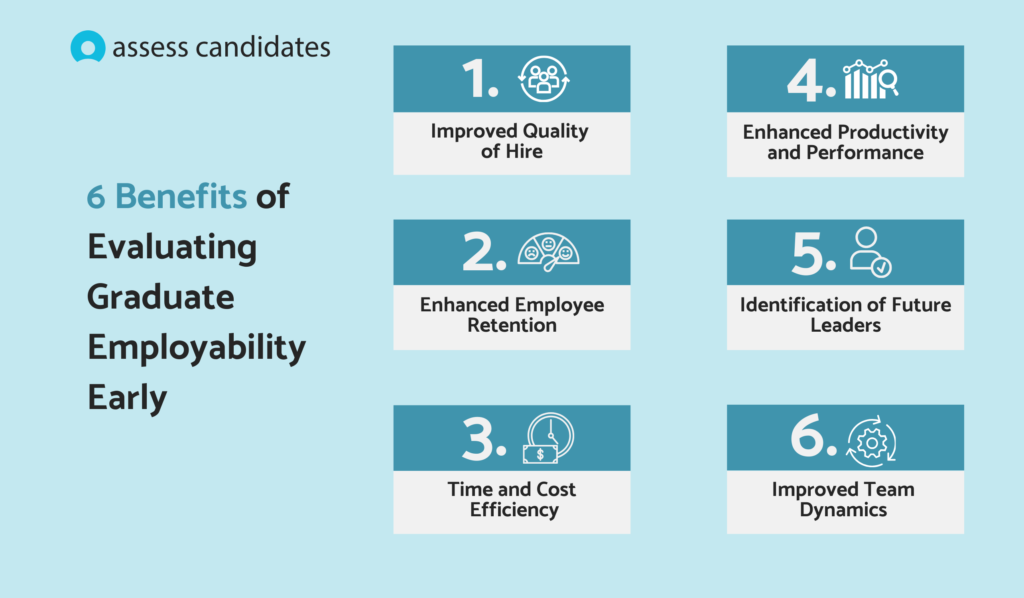
1. Better Quality of Recruits
Conducting early analysis of employability skills is one of the avenues of appraising candidates with the right technical and social skills to work in your organization.
2. Enhanced Employee Retention
Matching skills and personality to the role and culture increases engagement, reduces turnover, and keeps employees productive.
3. Time and Cost Efficiency
Screening for key skills early quickly identifies top candidates, cutting the time and resources spent on unsuitable applicants.
4. Enhanced Productivity and Performance
When employees align well with their environment and roles, they become more productive and motivated and contribute more effectively to business outcomes.
5. Identification of Future Leaders
Evaluations help discover problem-solving skills, emotional intelligence, and leadership potential in candidates, which enables you to develop the future leaders from the first day.
6. Improved Team Dynamics
Knowledge of candidates’ work styles and personalities enables you to establish balanced and effective teams that work together efficiently.
54% of employers indicate that they have difficulty finding candidates with the right skills; early assessment is useful in overcoming skills mismatch.
Measure real-world employability skills in early career candidates with our science-backed assessments. Learn More
Early assessment of career readiness skills offers clear advantages, but employers still face several practical challenges when trying to evaluate these skills consistently.
3. What Are the Challenges of Assessing Graduate Employability?
Assessing employability skills in early career candidates is not always straightforward. Employers often struggle with subjectivity, limited resources, and the challenge of measuring soft skills like teamwork, communication, and adaptability in realistic workplace settings.
5 Challenges When Assessing Employability Skills in Graduates:
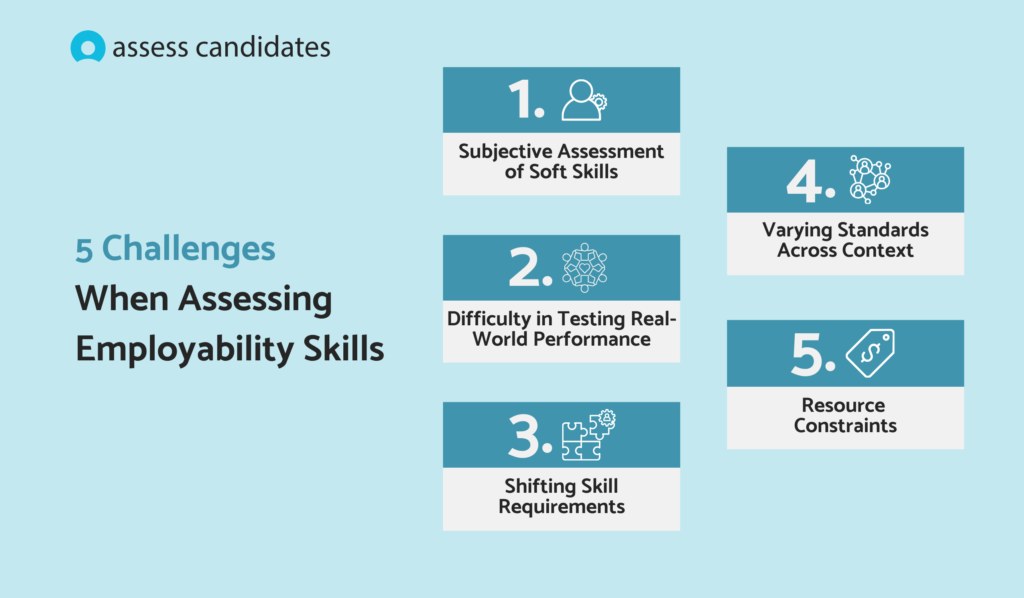
- Subjective Assessment of Soft Skills: Soft skills like communication, teamwork, and emotional intelligence are difficult to assess objectively. Their assessment can vary depending on the opinion of the assessor.
- Difficulty in Testing Real-World Performance: Standard tests do not indicate how the early-career candidates would perform under pressure or in actual working conditions.
- Shifting Skill Requirements: As technology evolves and job roles change, some skills become outdated quickly. This leaves employers with the constant task of making sure that their assessment is up-to-date with new work-ready skills.
- Varying Standards Across Context: What counts as employable changes across industries, regions, and cultures, complicating consistent assessment.
- Resource Constraints: Developing valid, performance-based assessments requires time, expertise, and, in some cases, a significant budget.
57% of companies indicate that they experience challenges when trying to measure graduate soft skills effectively.
Reduce bias and uncertainty with our data-driven assessments that accurately measure employability skills. View Plans
Despite these challenges, employers can still assess graduate employability effectively by using structured, evidence-based methods.
4. How Employers Assess Employability Skills in Early Career Talent
To effectively evaluate entry-level workplace skills, you need evidence-based methods that show how candidates think, communicate, collaborate, and perform in realistic work situations.
Structured pre-employment assessments, behavioral data, and job-related simulations allow you to paint a clear, objective picture of graduates’ true workplace preparedness.
Structured methods employers use to assess early career candidates
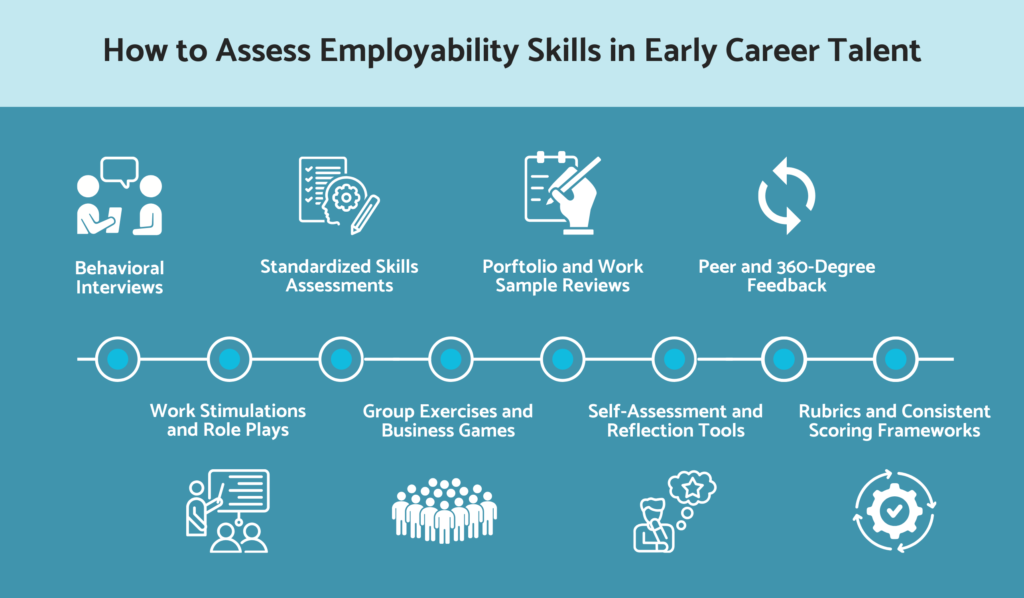
Behavioral Interviews:
Ask applicants to recount real-life situations where they demonstrated problem-solving, teamwork, adaptability, or leadership. Focus on what has been done and what has been accomplished, not on opinions and hypotheticals.
Work Simulations and Role Plays:
When simulated job tasks are used, you can observe the skills in action. Such exercises reveal the process of communication, decision-making, and performance of candidates in real-life situations at the workplace.
Standardized Skills Assessments:
Use objective tests and structured assessments to evaluate critical thinking, digital literacy, reasoning, and decision-making. Standardizing assessments ensures fair comparison among candidates.
H3 Group Exercises and Business Games:
Assess teamwork, leadership, and problem-solving through group exercises or through business simulation games. These exercises demonstrate how applicants relate to one another, influence others, and cope with conflicting priorities.
Portfolio and Work Samples Reviews:
Review projects, internships, case studies, or work samples that show applied skills. Portfolios demonstrate tangible proof of employability beyond academic achievements.
Self-Assessment and Reflection Tools:
Use questionnaires, surveys, or learning journals to understand candidates’ self-awareness and growth mindset. Combine objective techniques with self-assessment to eliminate over- or underestimation.
Peer and 360-Degree Feedback:
Request feedback from peers, mentors, supervisors, or clients. This approach provides a balanced perspective on teamwork, communication styles, and professionalism in the real world.
Rubrics and Consistent Scoring Frameworks:
Use comprehensible rubrics to grade and establish a standard method for scoring skills. Formalized systems reduce bias, improve reliability, and ensure defensible and data-driven hiring.
Studies have shown that task-based and structured assessment makes up almost 20% of employability assessment techniques.
See firsthand how our pre-employment assessments support work-ready hiring. HIRE FOR FREE
5. Best Practices to Support Students and Graduates Through the Assessment Process
Supporting students and graduates ensures assessments are fair, effective, and developmental, rather than just evaluative. You can walk candidates through the process, making them aware of what to expect and enhancing results.
7 Ways to Support Students and Graduates through your hiring process
Give Clear Instructions and Expectations
Be clear about the aim of the assessment, what will be measured, and how the results will be utilized. Proper direction assists in getting rid of nervousness and encourages genuine performance.
Provide Practice Opportunities
Before the actual assessment, students and graduates can be given simulated work, sample tests, or role-play activities to gain confidence and get used to the format of assessment.
Offer Constructive, Timely Feedback
Feedback must be precise and practical, and it must be directed toward areas of improvement and strength. This helps in the development of skills and self-awareness.
Assign Mentorship
Mentors can guide candidates on performance strategies, job expectations, and skill development opportunities, providing a supportive atmosphere of learning.
Facilitate Self-Evaluation
Have candidates evaluate themselves and identify the aspects they need to develop. This leads to independence, critical thinking, and lifelong learning.
Use Multiple, Complementary Methods
Combine self-assessments, simulations, interviews, and peer reviews to have a complete view of the employability skills in candidates. This prevents cases where a certain mode of assessment would be a disadvantage for a candidate.
Connect Assessment to Development Plans
Help students and graduates in the translation of results into individual training or learning plans. This ensures that assessments are useful in career readiness and employability.
Measure graduate employability skills with confidence using our reliable skills assessments. LEARN MORE
Conclusion: Key Takeaway
Assessing employability skills in students and graduates is now essential for closing skills gaps and hiring work-ready talent with greater confidence. A structured, evidence-based approach gives you a clear view of candidate strengths and development areas.
Using objective testing, simulations, and behavioral interviews ensures graduates can apply skills from day one. With feedback and data-driven evaluation, you improve hiring accuracy, reduce turnover, and build high-performing teams.
A strong employability skills assessment process helps organizations hire work-ready graduates with greater confidence.
Would you like to know more about assessing employability skills in students and graduates? Explore the FAQs below and sign up with your email to get started!
Frequently Asked Questions
Can employability skills be taught?
Yes. Specific workshops, project-oriented learning, internships, mentorship programs, and feedback loops can be used to cultivate skills like communication, teamwork, and problem-solving. Incorporating them into training programs makes sure that graduates do not walk out unprepared.
What’s the difference between soft skills and employability skills?
Soft skills are individual qualities such as emotional intelligence, adaptability, and communication style, while employability skills are both soft skills and work-related skills, including digital literacy, time management, and teamwork.
How do I create a rubric for employability skills assessment?
Begin by enlisting the important skills that you would like to test. Specify observable indicators of all skills, develop performance levels (e.g., beginner, proficient, advanced), and develop clear descriptions of how to score each level. Rubrics are used to ensure that assessments are consistent, objective and defensible.
Are online tests effective in assessing employability skills?
Online tests are effective as one data point, especially with knowledge-based or cognitive abilities. They should, however, be supplemented with simulations, behavioral interviews, group work, and work-based projects in order to comprehend how the applicants translate their capabilities into actual practice in a real setting.
What is the role of feedback in improving the development of employability skills?
Constructive feedback guides students and graduates to note their strengths and weaknesses. Specific, timely, and actionable feedback encourages self-awareness and lifelong learning, as well as equips candidates to address the challenges in the workplace environment.
What are the employability skills that cannot be easily measured?
Emotional intelligence, adaptability, and creativity are hard to assess because they are relative and subjective. These are better assessed through simulations, peer reviews, and behavioral observation.


 English
  Arabic