
High-Volume Hiring Strategies for 2027: How to Scale Recruitment Without Compromising Quality



High-volume hiring requires employers to process large candidate pools efficiently without weakening assessment quality or candidate experience. Whether recruitment is driven by seasonal demand, business growth, or a sudden increase in staffing requirements, hiring teams need processes that can scale while maintaining consistent criteria.
This guide explains the main challenges of high-volume recruitment as we head towards 2027, practical strategies for managing it, the role of technology, and the metrics employers can use to evaluate results.
Contents
- What is high-volume hiring?
- What are the key challenges recruiters face in high-volume hiring?
- What are the top high-volume hiring strategies?
- How is technology shaping high-volume recruitment?
- Which metrics truly matter for high-volume hiring?
- Why do top companies use Assess Candidates for high-volume hiring?
Now that we’ve summarized what this article covers, let’s explore what high-volume hiring is.
1. What is high-volume hiring?
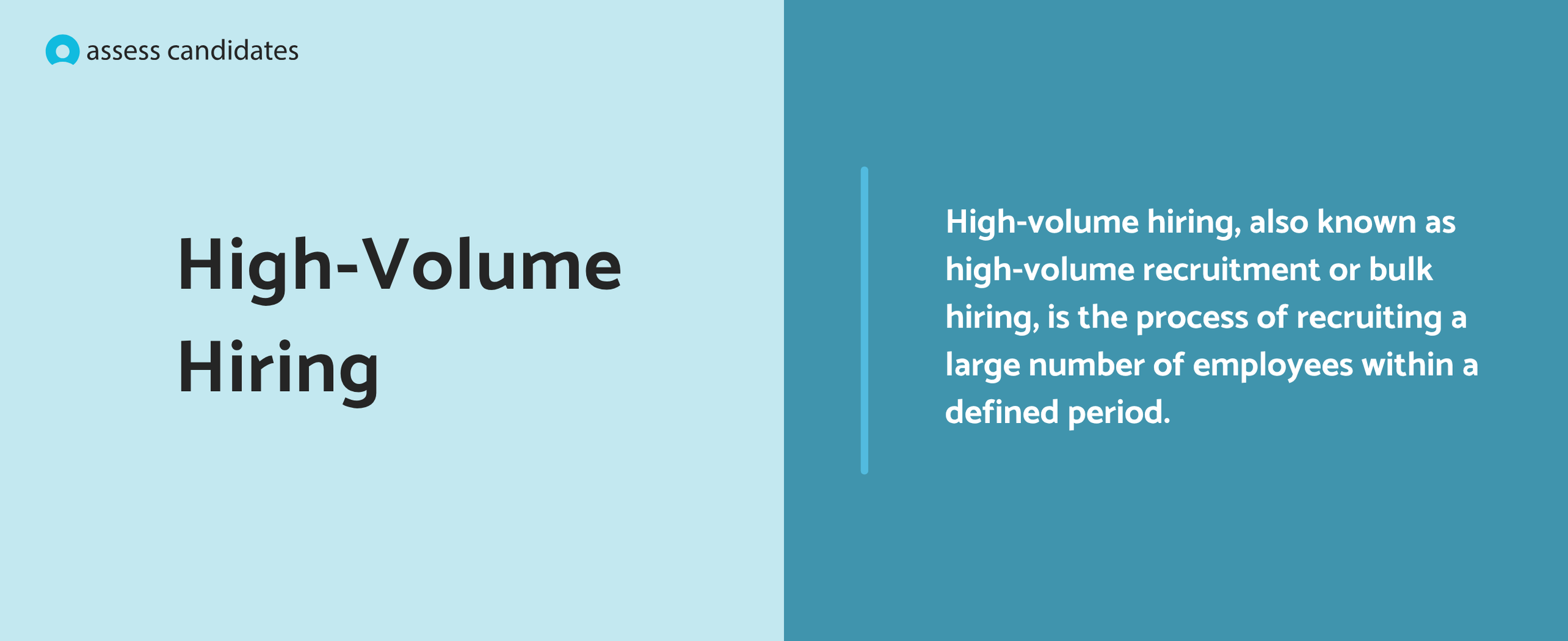
High-volume hiring, also known as high-volume recruitment or bulk hiring, is the process of recruiting a large number of employees within a defined period. It is commonly used for seasonal demand, business expansion, new locations, large operational teams, or other situations where employers need to process substantial candidate volumes efficiently.
Explore our pre-employment assessments that make data-driven hiring simple. HIRE FOR FREE
This brings us to the next important question: what are the challenges in high-volume hiring?

2. What are the key challenges recruiters face in high-volume hiring?
High-volume recruitment increases pressure on screening capacity, candidate communication, scheduling, and decision consistency. Without a structured process, employers may create unnecessary delays, overlook suitable applicants, or apply different evaluation criteria across a large candidate pool.
Given below are the 5 main challenges faced during high-volume hiring:
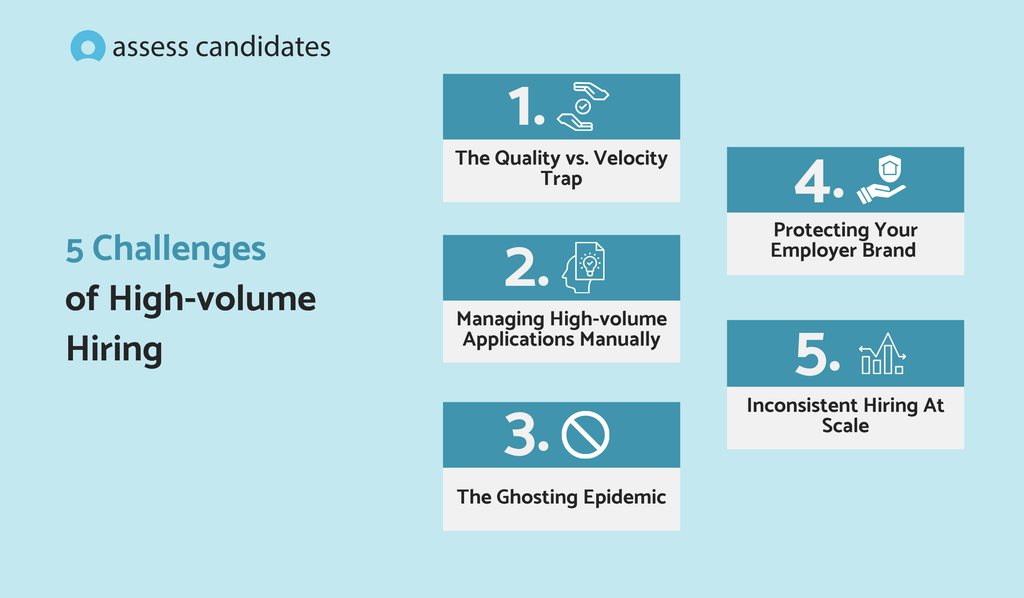
1. The Quality vs. Velocity Trap
When you’re under pressure to fill a large volume of positions by the end of the year, it is tempting to lower the bar “just this once.” But hiring the wrong people at scale can lead to bigger problems later, including lower productivity and higher turnover.
Solution: Use a structured screening process to identify qualified candidates quickly without lowering your standards.
2. Managing High-volume Applications Manually
Hiring teams can quickly become overwhelmed when thousands of applications come in at once. Reviewing each application manually can lead to hiring mistakes and increase the risk of missing qualified candidates.
Solution: Automate the first stages of screening. Use ATS filters, automated resume screening, and pre-employment assessments to identify candidates who meet your basic requirements.
3. The Ghosting Epidemic
Candidate engagement is a race against the clock. If your process has too many hoops or, worse, goes silent for three days, your best candidates will simply vanish. This becomes even more important when you are hiring for multiple roles at the same time.
Solution: Keep candidates updated throughout the process. Use automated emails to confirm applications, share assessment instructions, provide interview updates, and let them know when they can expect to hear from you.
4. Protecting Your Employer Brand
Every candidate interaction can impact how people view your company. If a thousand people have a negative experience with your application portal, that’s a thousand people telling their network that your company is a mess. In the age of instant reviews, your employer brand is only as good as your worst candidate experience.
Solution: Make the application process simple and keep communication consistent. Remove unnecessary steps, make instructions easy to follow, and give candidates timely updates.
5. Inconsistent Hiring At Scale
When you are hiring for multiple roles, different recruiters may use different screening methods. While one might focus on experience, the other might focus on qualifications. This can risk the hiring process becoming inconsistent and candidates not being assessed fairly.
Solution: Create a standardized screening process for all recruiters. Define the skills, qualifications, and assessment criteria candidates need to meet before hiring begins
That brings us to the next section: the top high-volume hiring strategies
3. What are the top high-volume hiring strategies?
Effective high-volume hiring depends on removing unnecessary manual work while keeping role requirements and assessment criteria clear. The strongest approach will vary by role and hiring volume, but employers should focus on scalable sourcing, consistent screening, candidate communication, and evidence-based decision-making.
High-volume hiring should scale the process, not lower the standard. The goal is to remove repetitive work, apply consistent criteria, and keep candidates moving without treating speed as the only measure of success.
The following are some of the most effective high-volume hiring strategies in 2026/27:
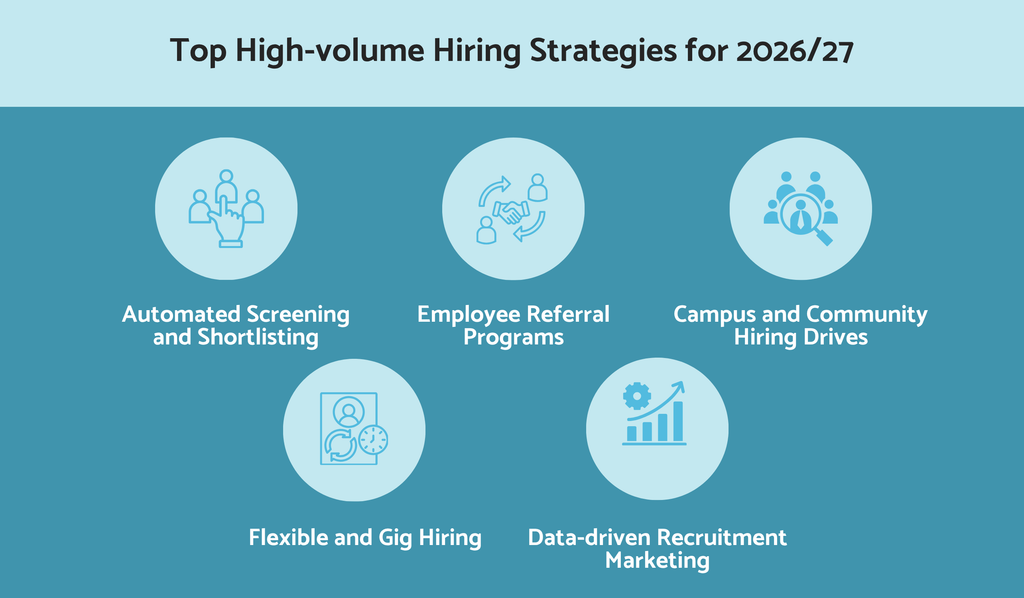
- Automated Screening and Shortlisting
Let’s be honest: nobody became a recruiter because they loved reading 500 identical resumes. AI-powered screening tools are the real deal here. AI-assisted screening tools can help process large applicant pools against clearly predefined criteria, reducing some manual review. Where AI is involved, employers should also consider accuracy, fairness, transparency, and appropriate human oversight.
- Employee Referral Programs
Employee referral programs can provide an additional source of candidates and may help employers reach people who are not actively searching job boards. Apply the same role-relevant evaluation criteria to referred and non-referred candidates, and monitor whether the program unnecessarily narrows the diversity of the candidate pool.
- Campus and Community Hiring Drives
Stop waiting for talent to find you. many successful brands are building pipelines directly within colleges, trade schools, and local community hubs. Whether it’s a flash-hiring event on campus or a structured vocational partnership, getting in front of fresh talent early gives you first pick before they even hit the open job boards.
- Flexible and Gig Hiring
The old “9-to-5 permanent hire” model is not the only way to scale anymore. Gig work and flexible contracting have become more mainstream. For seasonal spikes or project-based surges, tapping into a pool of freelancers or on-demand workers gives your business the agility to breathe.
- Data-driven Recruitment Marketing
Recruiting is now 50% marketing. In the current job market, you can’t just list a job; you have to sell it. By using data-driven recruitment marketing and targeted ads on social media or niche platforms, you can put your roles in front of the exact people you need.
Strengthen your recruitment strategy with skill assessments that deliver quality hires. LEARN MORE
Looking ahead, technology is not just a support tool. From AI-driven screening to automated interviews, understanding how technology integrates with strategy is critical for success.
4. How is technology shaping high-volume recruitment?
Technology can reduce administrative workload in high-volume recruitment, particularly in application management, scheduling, candidate communication, and reporting. However, employers should evaluate each tool according to its accuracy, relevance, fairness, and effect on the overall hiring process rather than assuming automation will automatically improve outcomes.
Automation is most valuable when it removes administrative work. It becomes riskier when convenience is mistaken for evidence that a hiring decision is accurate.
The following are the 5 major tools used for high-volume recruiting in 2026/27:
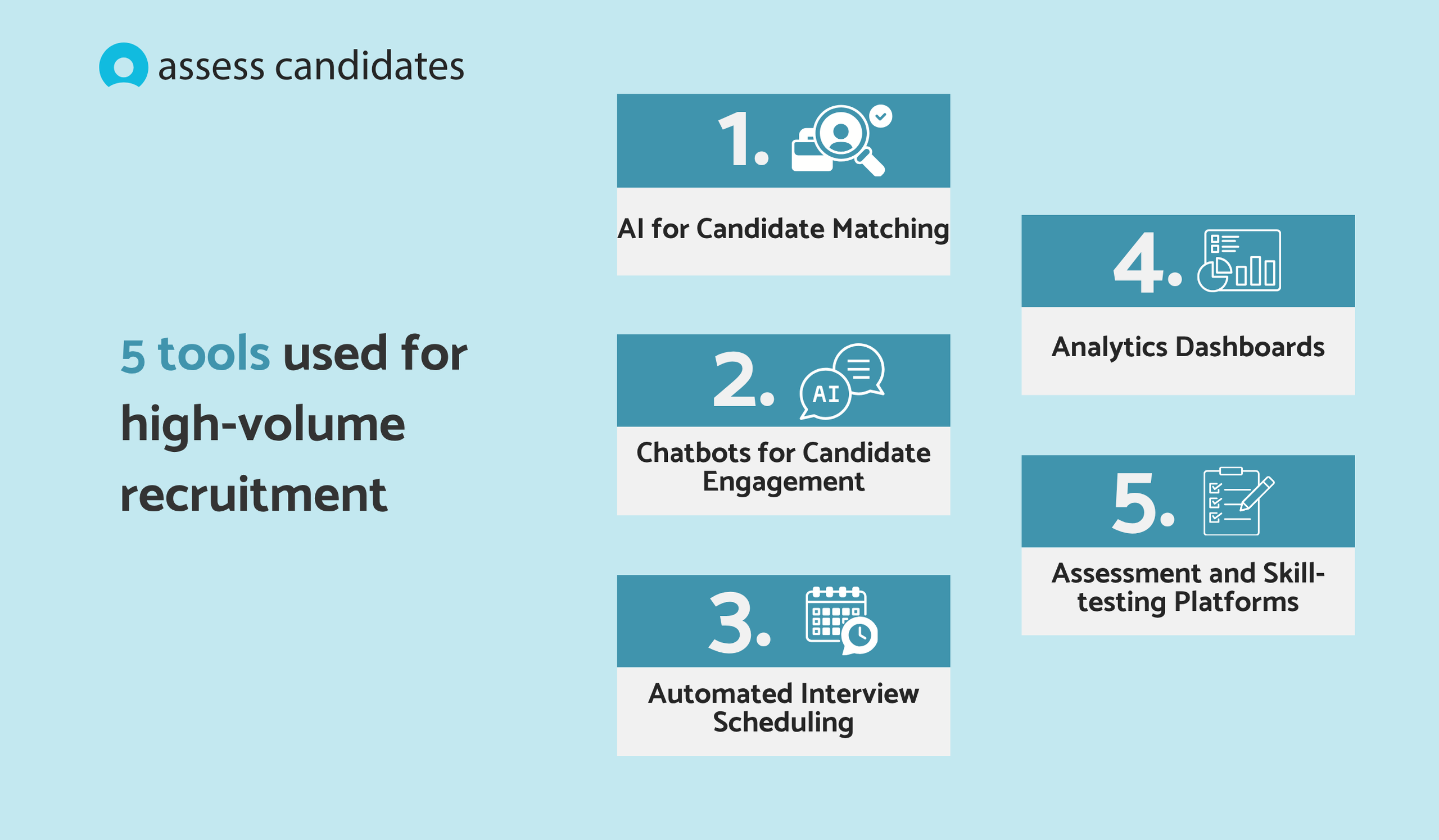
1. AI for Candidate Matching
Candidate-matching tools can compare application information with predefined job requirements and help recruiters prioritize review. Their outputs should support rather than automatically determine progression decisions, particularly where matching depends on inferred skills or AI-generated recommendations.
2. Chatbots for Candidate Engagement
Automated chatbots can handle initial queries, provide updates, and guide applicants through assessments 24/7, keeping candidates engaged and informed even in large-scale campaigns.
3. Automated Interview Scheduling
Coordinating interviews for hundreds of candidates can be a logistical nightmare. AI can now automatically schedule interviews based on availability, send reminders, and even integrate with video platforms, freeing recruiters to focus on evaluation.
4. Analytics Dashboards
Real-time dashboards allow HR teams to track application progress, monitor conversion rates, identify bottlenecks, and make data-driven decisions quickly. By spotting inefficiencies early, organizations can optimize processes and avoid delays that might cost top talent.
5. Assessment and Skill-testing Platforms
Platforms like Assess Candidates enable recruiters to evaluate skills, cognitive ability, and personality traits at scale, helping to ensure quality hires while reducing time-to-hire.
But working smarter also means knowing what to measure. Without the right metrics to track performance, even the most advanced recruitment strategy can fall short.
Let’s take a look at which key metrics help in high-volume hiring.
Make hiring smarter and simpler with our science-backed pre-employment assessments today. HIRE FOR FREE
5. Which metrics truly matter for high-volume hiring?
No single metric provides a complete measure of high-volume hiring success. Review speed and cost alongside candidate experience and post-hire outcomes, and interpret quality-of-hire indicators in the context of onboarding, management, role conditions, and other factors that affect employee performance.
Here are the key metrics that matter for high-volume hiring:
Tracking these metrics consistently allows HR teams to make data-driven decisions, adjust strategies in real time, and ensure that rapid hiring doesn’t compromise quality or candidate satisfaction.
Boost your hiring quality with Assess Candidates’ reliable pre-employment solutions. VIEW PLANS
6. Why do top companies use Assess Candidates for high-volume hiring?
At Assess Candidates, we offer a wide range of pre-employment recruitment tests that help recruiters screen and compare candidates efficiently during high-volume hiring. You can also create recruitment campaigns tailored to your organisation’s specific roles, hiring criteria, and recruitment goals.
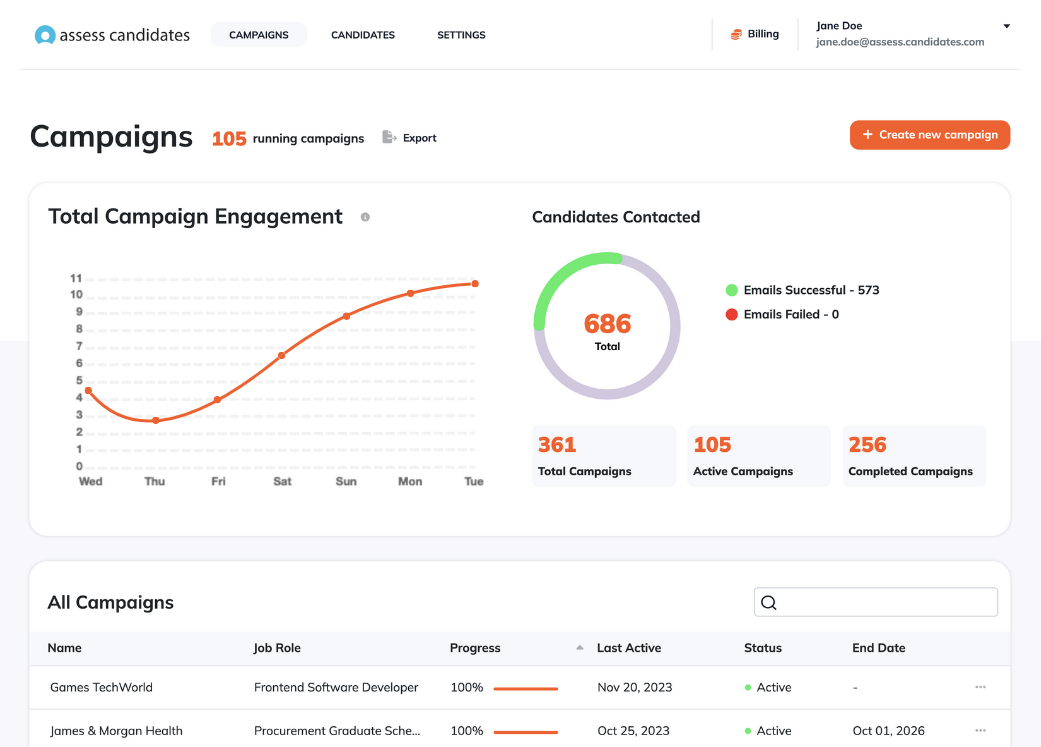
Here is an example of our campaign reporting dashboard, which helps recruiters manage and review candidate results in one place.
- Scientifically Designed Assessments: Assess Candidates’ assessments are developed by expert psychologists and psychometricians to measure the skills and competencies that matter for different roles. Each assessment is scientifically validated to help recruiters identify suitable candidates at scale.
- Data-Driven Hiring Insights: Our intuitive platform helps recruiters compare candidates using objective reports based on cognitive abilities, workplace behaviors, and job-specific competencies. This makes it easier to screen large candidate pools consistently and identify candidates who meet your hiring criteria.
- Faster, More Consistent Screening: High-volume recruitment can leave recruiters spending hours reviewing resumes and conducting initial screening. Pre-employment assessments can help automate part of this process by evaluating candidates against the same criteria before interviews.
Candidates can complete role-relevant assessments online, while recruiters can use the results to decide which candidates should move to the next stage. Custom branding options also help create a consistent candidate experience across large hiring campaigns.
- Accessible and Scalable: Assess Candidates’ assessments are accessible, ATS-compatible, and designed to support fair and inclusive hiring. This makes them suitable for organisations hiring hundreds or thousands of candidates across multiple roles or locations.
Assess Candidates provides science-based tools that can help recruiters screen candidates faster, apply consistent criteria, and manage large applicant pools more efficiently. Explore our full range of assessments to find assessments suited to your hiring needs.
Not sure which assessments fit your high-volume hiring strategy? Contact us for a free analysis of your role requirements.
Partner with Assess Candidates to use a range of role-specific assessments in your hiring process. VIEW PLANS
Conclusion: Key Takeaway
High-volume hiring works best when employers design for scale before applications arrive. Standardized screening, appropriate automation, clear candidate communication, and relevant performance metrics can help teams manage larger applicant pools without making speed the only measure of success.
Interested in learning more about effective candidate assessment? Continue reading for frequently asked questions, and sign up with your email to get started.
Frequently Asked Questions
How can employers speed up high-volume recruitment without compromising the hiring quality?
You can speed up high-volume recruitment without compromising hiring quality by automating the repetitive screening tasks. Use ATS filters, resume screening tools, and pre-employment assessments to swiftly identify candidates who best match the role requirements.
How to keep recruitment consistent during high-volume hiring?
You can keep hiring consistent during high-volume hiring by creating a standardized recruitment process that every recruiter will follow. Define the skills, qualifications, assessment criteria, and interview questions clearly before recruitment begins. Structured assessments and scoring rubrics can also help your team assess candidates against the same requirements.
How to use assessments effectively in high-volume recruitment?
You can use pre-employment assessments after your initial eligibility screening to assess candidates against the skills required for the role. Include assessment tests in your hiring process that actually measure the relevant abilities required for the role. Use these assessments alongside other hiring information to identify candidates for the next stage.
How to reduce drop-offs during a high-volume hiring process?
You can reduce candidate drop-offs during a high-volume recruitment process by keeping your application and assessment process short, clear, and mobile-friendly. Specify clearly what each stage includes and how long they would take to complete. Furthermore, track the stages where most of the drop-offs are taking place and fix them.
What to measure during high volume hiring?
To understand whether your high-volume hiring strategy is working, track key metrics such as time-to-hire to see how quickly you fill roles, candidate experience scores to understand how applicants feel about the process, source effectiveness to identify where your strongest candidates come from, and quality of hire to see whether new employees stay and perform well over time.


 English
  Arabic