
How to Measure Time Management in the Workplace



Time management can influence employee productivity, work quality, and the ability to manage competing priorities. Assessing this competency during hiring can help employers understand how candidates plan workloads, prioritize tasks, respond to changing demands, and work toward deadlines.
In this guide, we explore practical, structured ways to assess and score time management in candidates during the hiring process.
Contents
- What is time management in the workplace?
- Why is time management important in a workplace?
- How to score time management accurately in the workplace?
- How to measure time management skills when hiring?
- Time management shortcomings you should avoid in the workplace
- Why top companies use Assess Candidates to measure time management
So, without further ado, let’s start with what time management actually means.
1. What is time management in the workplace?
Time management in the workplace is the process of planning, prioritizing, and allocating time across tasks and responsibilities to meet deadlines and maintain work quality. It can involve setting priorities, estimating task duration, organizing workloads, adjusting plans when circumstances change, and balancing efficiency with accuracy.
Evaluate a graduate’s true potential using our science-backed pre-employment tests. HIRE FOR FREE
But why is time management so significant in a workplace?

2. Why is time management important in the workplace?
Effective time management can help employees organize workloads, prioritize important tasks, and work toward deadlines without unnecessarily sacrificing quality. Its value is particularly clear in roles where employees must balance competing responsibilities, respond to changing priorities, or coordinate their work with others.
The following are the top reasons why time management is important in the workplace:
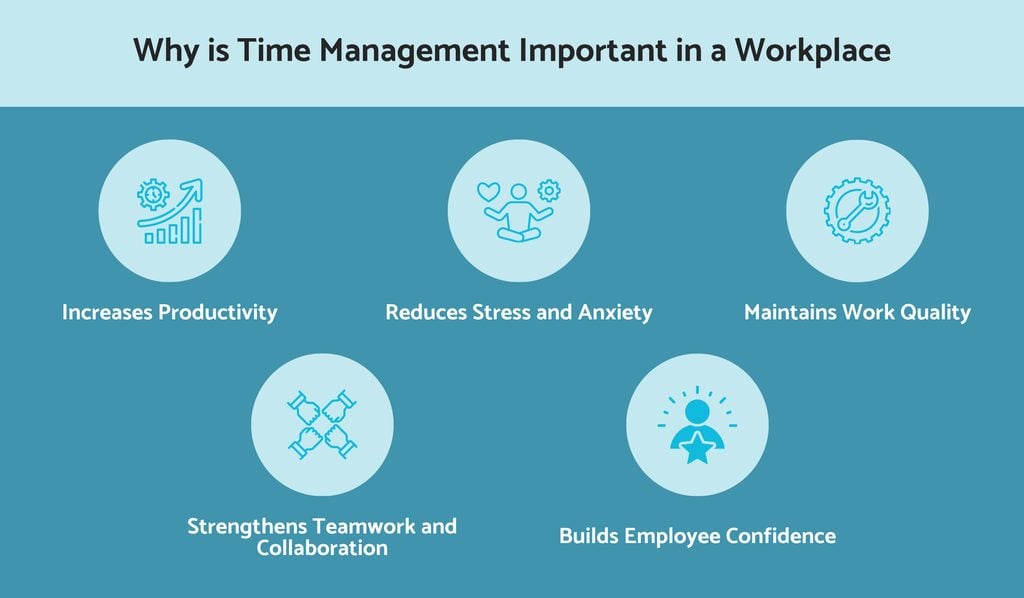
- Increases Productivity
One of the key benefits of time management in the workplace is increased productivity. It helps employees prioritize the important tasks and complete them within the available hours, increasing workplace productivity and helping employees achieve their goals.
- Reduces Stress and Anxiety
Time management in the workplace also plays an important role in reducing employees’ stress and anxiety by preventing overwork, last-minute rushes, and burnout.
- Maintains Work Quality
Strong time management in the workplace ensures high-quality work. It gives employees enough time to complete, review, and refine their work. This further helps you maintain consistent workplace standards while avoiding the costs associated with preventable mistakes.
- Strengthens Teamwork and Collaboration
Effective time management strengthens teamwork and collaboration by ensuring that employees complete their tasks within the allotted time. This further allows the rest of the team members to move forward with their responsibilities, reducing delays and bottlenecks.
- Builds Employee Confidence
Incorporating robust time management strategies in the workplace also builds employee confidence. It gives employees greater control over their workload and helps them complete their tasks in an organized manner, building their confidence.
Good time management is not simply the ability to work quickly. It is the ability to make sensible decisions about what to do, when to do it, and how to adapt when priorities change without unnecessarily compromising quality.
Optimize your hiring strategy with our timed pre-employment assessments. LEARN MORE
When hiring candidates, it’s crucial to first understand what effective time management looks like for your organization.
To explore what this may look like for your business, here are 5 key methods that you can use to score time management in the workplace.
3. How to score time management accurately in the workplace?
Score time management using predefined, job-relevant criteria rather than focusing primarily on completion speed. Depending on the role, criteria may include prioritization, deadline management, planning, adaptability, accuracy, and the quality of decisions made under time constraints.
The following are some of the best methods for scoring time management in the workplace:
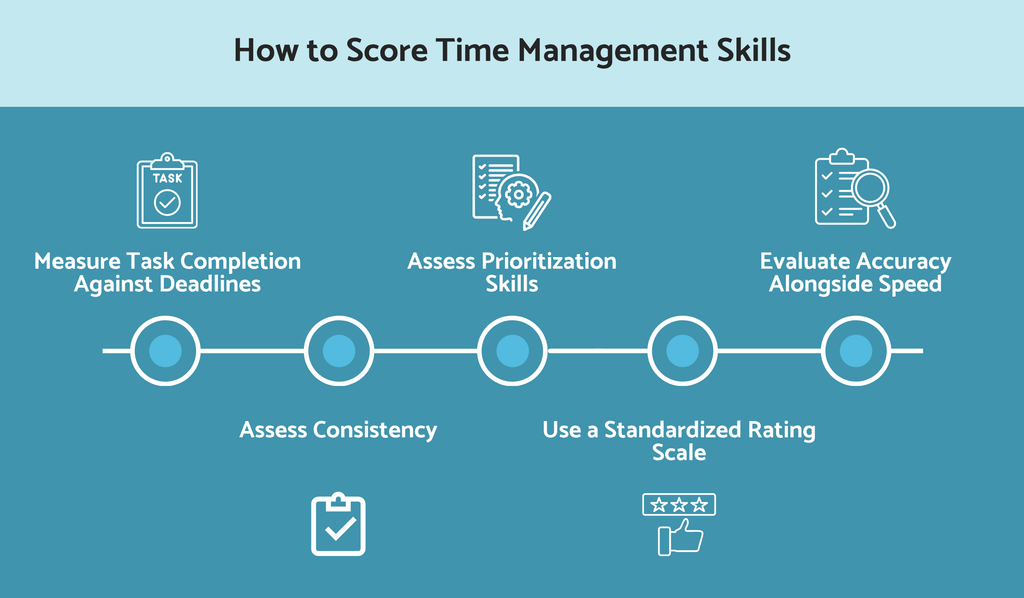
- Measure Task Completion Against Deadlines
One of the most effective ways to score time management in the workplace is by tracking whether employees have completed their tasks within the given timeframe. Assign higher scores to employees who consistently meet deadlines and lower for those missing deadlines frequently.
- Assess Prioritization Skills
Assessing an employee’s prioritization skills is yet another effective way of scoring time management in the workplace. Analyze whether they are able to distinguish between tasks that are urgent, important, and less important.
- Evaluate Accuracy Alongside Speed
Evaluate Accuracy alongside speed when scoring time management. This helps assess whether employees are maintaining the required level of accuracy while completing tasks within the allotted time. A staff member who works quickly but makes frequent errors may need to balance efficiency with attention to detail.
- Assess Consistency
Assessing consistency, i.e., evaluating time management over a period of time instead of relying on one task or project, is an effective way of scoring time management. In the long run, this helps you better identify employees that perform reliably, manage sustained workloads, and require less supervision.
- Use a Standardized Rating Scale
Using a simple standardized five-point rating scale helps measure an employee’s time management consistently. Define observable behaviors for each score. For instance, a score of one point may indicate frequently missed deadlines. On the other hand, another staff member who receives five points might indicate clear prioritization, realistic planning, and effective adjustment when circumstances change.
Gain deeper insights into candidates’ behavioral skills with our science-backed assessment tools. HIRE FOR FREE
Now that we know what effective time management looks like, how can we effectively measure the time management skills in candidates?
Read on as we explore the best tools that you can use to measure time management in the recruitment process.
4. How to measure time management skills when hiring?
You can assess time management during the hiring process by incorporating a combination of assessments and realistic workplace exercises. The following are the 6 major ways to assess time management during the hiring process:
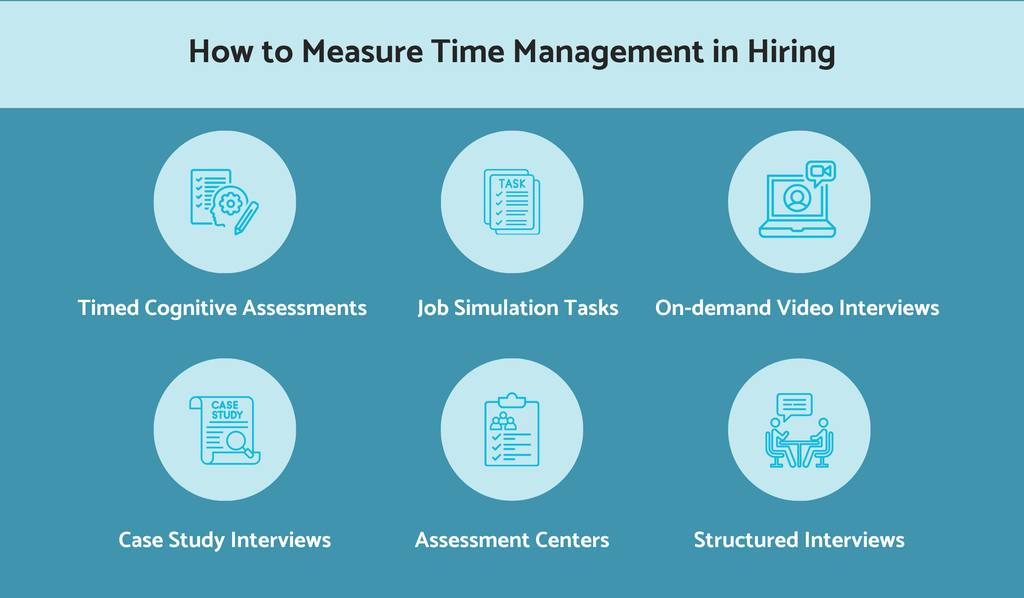
1. Timed Cognitive Assessments
Timed cognitive assessments evaluate how candidates process information, solve problems, and make decisions under defined time constraints. They can provide evidence of efficiency under time pressure, but should not be treated as a standalone measure of time management.
Example 1. Candidates will be required to solve 20 multiple-choice numerical reasoning questions within 15 minutes.
2. Job Simulation Tasks
Job simulation tasks can provide direct evidence of time-management behaviors when candidates must prioritize realistic tasks within a defined period. Assessors can observe how candidates identify urgent work, allocate their available time, respond to new information, and balance completion speed with quality.
Example 2. Ask a candidate applying for the administrative assistant role to prioritize 5 emails, respond to an urgent client within 15 minutes, and schedule 2 meetings.
3. On-demand Video Interviews
On-demand video interviews include questions specifically designed to assess how candidates manage deadlines and prioritize tasks. Their responses help you assess how effectively they adjust priorities when circumstances change, allocate their time, and stay productive under pressure.
Example 3. “Tell us about a time when you had to manage several competing deadlines. How did you decide what to prioritize?”
4. Case Study Interviews
Case study interviews help assess a candidate’s ability to analyze a complex workplace problem and arrive at a suitable solution within a fixed time. This helps you assess how candidates structure their approach, determine priorities, allocate their available time, and communicate their recommendations before the deadline.
Example 4. From the given business case, identify the most urgent issue, develop a solution, and present their recommendations within 45 minutes.
5. Assessment Centers
Assessment centers help evaluate time management alongside other workplace skills through several exercises. These include in-tray exercises, group discussions, presentations, role-play simulations, and case studies that candidates have to solve within strict timeframes.
Example 5. “Develop a marketing campaign for a product launch. You must deliver a 20-minute presentation covering objectives, messaging, channels, content strategy, and engagement tactics within 30 minutes.”
6. Structured Interviews
Structured interviews often include behavioral questions that specifically target time management. The questions may range from how candidates have handled competing deadlines or have completed an important project under pressure in their previous workplaces.
Example 6. Describe a situation where an unexpected task disrupted your schedule.
Recruit top candidates with our talent assessment platform. LEARN MORE
The next section highlights the most common time management shortcomings that you should look out for in your workforce.
5. Time management shortcomings you should avoid in the workplace
When measuring time management it is important to avoid overlooking quality, changing priorities, and most importantly, workload for your employees. However, there are various red flags that may indicate an employee has poor time management skills.
The following are the 5 major red flags that identify substandard time management in employees:
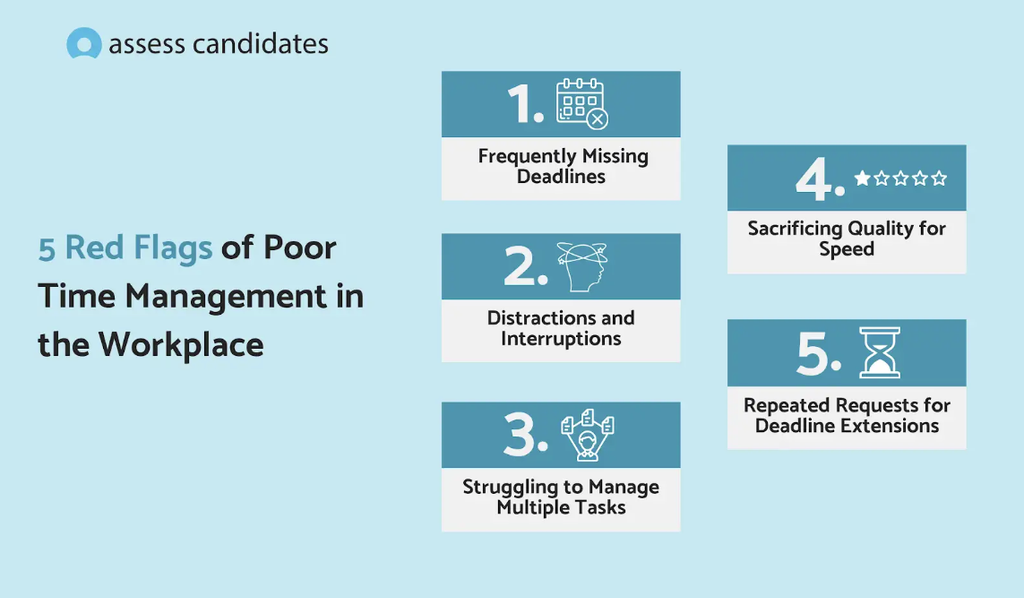
1. Frequently Missing Deadlines
Frequently missing deadlines and regularly failing to complete tasks on time can indicate that the employee has difficulty in planning and organizing work. This is a major red flag to spot when measuring time management skills in the workplace.
Solution: Set realistic deadlines, establish realistic workloads, and use regular progress check-ins to identify potential delays before they affect project delivery.
2. Distractions and Interruptions
An employee who consistently allows non-essential activities, meetings, or interruptions to interfere with important work is another sign of poor time management. It also reduces productivity and the ability to complete priority tasks within provided deadlines.
Solution: Limit unnecessary meetings, establish clear communication protocols, and encourage dedicated focus periods to help employees concentrate on high-priority tasks.
3. Struggling to Manage Multiple Tasks
Employees who struggle to manage multiple responsibilities and become disorganized usually have difficulty balancing competing priorities or switching between tasks.
Solution: Review workloads to prevent unrealistic demands, use workload management tools, and provide clear priority guidelines.
4. Sacrificing Quality for Speed
Another red flag is employees that try to complete work quickly while making frequent errors, omissions, or incomplete results. This suggests that they are focusing more on finishing tasks rather than managing them effectively.
Solution: Establish quality standards and allow sufficient time for your workers to review their work before submission.
5. Repeated Requests for Deadline Extensions
Staff who ask for frequent deadline extensions may indicate that they underestimate how long the tasks will actually take. They may also be taking on more work than they can realistically complete on time.
Solution: Improve workload estimation by discussing expected completion times, reviewing workloads, and setting realistic milestones for larger assignments.
Assess Candidates provides structured evidence of role-relevant competencies through standardized assessments and reporting.
6. Why top companies use Assess Candidates to measure time management
At Assess Candidates, we offer a wide range of pre-employment assessments and create recruitment campaigns customized to each organization’s unique hiring needs.
Here is an example of our campaign reporting dashboard available on Assess Candidates.
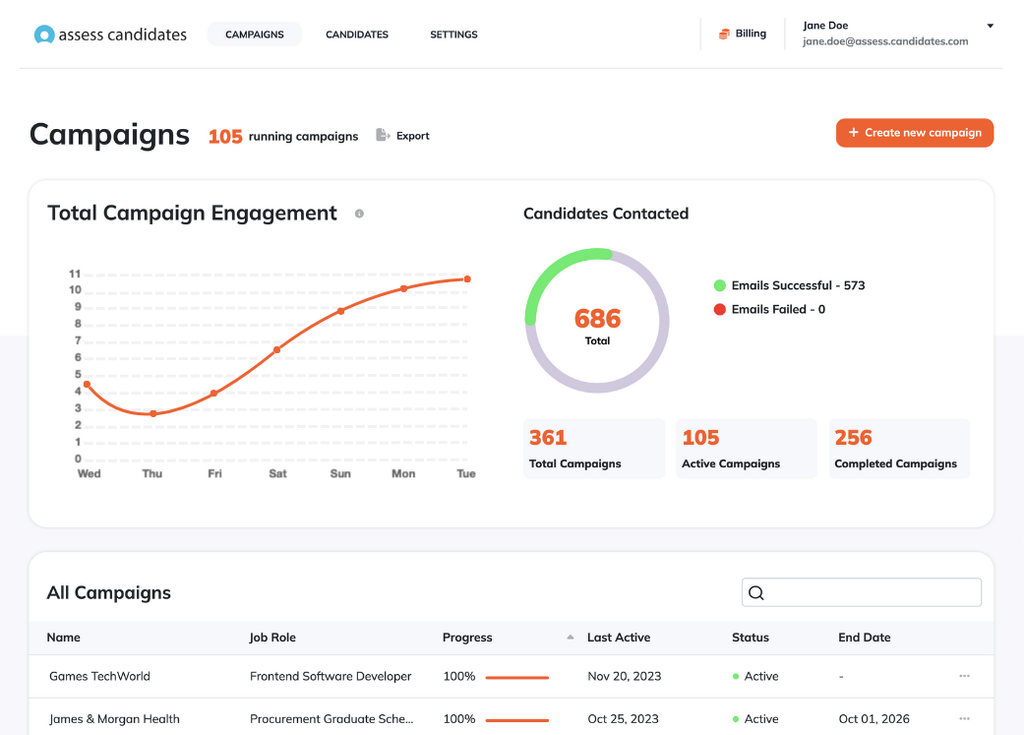
Here are 4 reasons why use Assess Candidates for measuring time management in candidates:
- Scientifically Designed by Expert Psychologists: Assess Candidates’ assessments are developed by expert psychologists and psychometricians to measure the competencies that matter most in the workplace.
From time management and problem-solving to communication, cognitive ability, and situational judgment, the assessments are scientifically validated to help employers identify candidates with the skills needed to perform effectively in their roles.
- Data-driven Hiring Insights: Assess Candidates’ hiring platform enables companies to compare candidates using objective assessment reports. Employers can evaluate candidates’ time management, cognitive abilities, workplace behaviors, and role-specific competencies to make more consistent and informed hiring decisions.
- Positive Candidate Experience: Candidates complete role-relevant assessments that can help employers evaluate how they are likely to approach workplace responsibilities, including managing priorities and working within deadlines.
Custom branding options also allow companies to provide a professional and consistent assessment experience throughout the recruitment process.
- Candidate Accessibility Support: Our assessments are accessible, ATS-compatible, and suitable for high-volume recruitment. This allows companies to assess time management and other workplace competencies efficiently while maintaining a fair and inclusive hiring process.
All assessments align with WCAG accessibility standards, helping provide an equitable assessment experience for candidates with different accessibility needs.
Assess Candidates provides science-based assessment tools that help employers evaluate time management and other critical workplace competencies more objectively. Explore the full range of assessments to identify candidates with the skills needed to succeed in your organization.
Not sure which assessments are best suited to your hiring needs? Contact Assess Candidates for a free analysis of your role requirements.
Partner with Assess Candidates to use a range of timed, role-specific assessments in your hiring process. VIEW PLANS
Conclusion: Key Takeaway
When measuring effective time-management, employers should look at how candidates prioritize work, plan against deadlines, adapt when priorities change, and maintain accuracy under realistic time constraints. Combining job-relevant exercises with structured scoring provides stronger evidence to measure time management than relying on a single timed task.
Frequently Asked Questions
How to measure time management for roles with high workloads?
To measure time management for roles with high workloads, incorporate job simulation exercises in your hiring process. These assessment exercises mirror the role’s volume and pace, helping you evaluate candidates on their key on-the-job skills. These include ability to organize their workload, respond to changing priorities, and maintain accuracy while handling multiple tasks.
How to assess time management when hiring entry-level candidates?
To assess time management when hiring entry-level candidates, focus on their approach to planning, prioritization, and meeting deadlines. Incorporate timed cognitive assessments, situational judgment tests, and job simulation exercises to analyze how candidates respond to time-sensitive situations.
How to ensure that the time management assessments are fair?
To ensure that the time management assessments included in your hiring process are fair, use the same assessments, instructions, time limits, and predefined scoring criteria for all candidates. This helps make more objective comparisons between candidates.
Should time management be assessed alongside other skills?
Yes, time management should be assessed alongside other workplace competencies, such as problem-solving, attention-to-detail, communication, and decision-making skills. These skills heavily influence how candidates handle their workloads.
Can interviews measure time management in candidates?
Yes, structured interviews can provide useful evidence of time management in candidates when questions focus on specific examples of planning, prioritization, deadlines, and changing demands.


 English
  Arabic