
Understanding percentile scores and cutoffs: Selecting candidates the scientific way!



Hiring decisions are rarely straightforward. Recruiters aren’t just looking for candidates who can technically do the job, they need people who also fit the organization’s vision and culture.
This is why employers are increasingly using psychometric assessments for modern hiring. From cognitive ability tests to game-based assessments, these tools are a popular choice for organizations to move beyond CVs and gut instinct toward consistency, fairness, and predictive accuracy.
However, interpreting the results of your psychometric tests correctly is key. A common area of confusion is understanding percentile scores and knowing how to set an appropriate cut-off for each assessment. When scores are misinterpreted, recruiters risk filtering out qualified candidates or making inaccurate decisions.
Contents
- What are psychometric tests?
- How does psychometric test scoring and interpretation work?
- How does a psychometric test cut-off work?
- What factors should influence your assessment cut-off?
- Top strategies for setting effective cut-offs in hiring
- Why do recruiters use percentile scores for hiring?
- How percentile cut-offs compare to other scoring methods
- Common challenges when using percentile cut-offs
- How to choose the right cut-off for different roles
- Why leading companies trust Assess Candidates’ pre-employment tests to hire
So, how do you set the right cut-off for diverse roles? Before discussing this, we must first understand what psychometric tests are.
1. What are psychometric tests?
Psychometric tests are norm-referenced tests that recruiters use to assess candidates on a variety of cognitive aptitude skills such as numerical reasoning, verbal reasoning, and logical reasoning. These pre-employment tests help recruiters evaluate candidates’ performance relative to the norm group through standard scores.
What is a norm group in psychometrics?
The norm or comparison group is a large, representative sample matched on key sociocultural factors such as age, grade, culture, and education level, and it represents a specific population. Recruiters use average test performance and score distributions as test norms to evaluate candidates.
For example, if an employer Y is looking to hire candidates for a senior clerical role, they will use a suitable assessment test whose norm group consists of the representative samples of clerical workers. These standard scores are then relative to the test that every test candidate will be evaluated against.
Hire top talent with our scientifically validated assessments. HIRE FOR FREE
How to interpret psychometric test score distribution?
Interpreting the score on any psychometric tests requires an understanding of the following statistical concepts:
- Normal distribution curve: It is a symmetrical bell-shaped curve formed by the scores of many human characteristics, including mental ability. It implies that most candidates score in the middle range, as evidenced by the clustering of test scores around the center, while a very few score below and above this range.
Did you know? Most cognitive ability scores, such as those of reasoning, processing speed, memory, and verbal ability, tend to follow a normal distribution.
- Mean: This is the commonest of all measures of central tendency, which is the arithmetic average, i.e., total raw scores divided by the total test items.
Did you know? Most aptitude tests use the same scoring model as IQ tests, i.e., a mean of 100 and a standard deviation of 15.
- Standard deviation: This statistical measure shows how spread out the values in a dataset are from the mean. A low standard deviation shows that the data points are closer to the mean and vice versa.
For example, suppose a candidate D scores 50 in test A with a mean of 100 and 120 in test B with a mean of 120. The candidate performed poorly on test A and averagely on test B.
To interpret psychometric test results correctly, recruiters need to understand a few key scoring concepts.

2. How does psychometric test scoring and interpretation work?
Psychometric assessment results typically include raw scores, standard scores, and percentile scores. To interpret a candidate’s results accurately, recruiters must understand how each scoring method works.
What are the different types of assessment scores in psychometric tests?
The correct psychometric test interpretation requires you to understand these 5 major types of assessment scores:
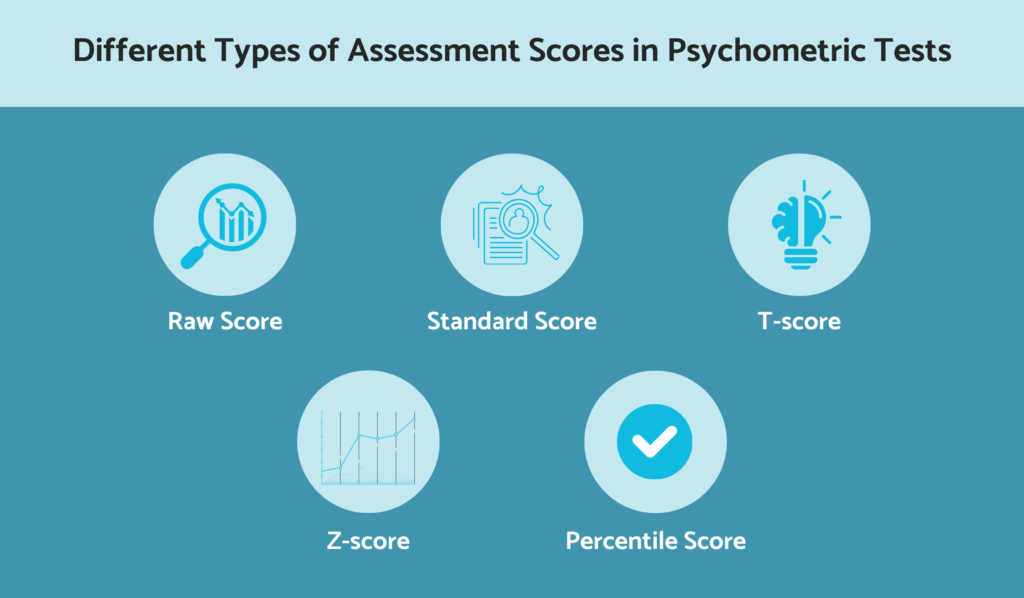
- Raw score: total number of items that candidates respond to correctly. For personality tests and value inventories, these are the total items marked for every given choice.
For example, if a candidate scores 75 in a numerical reasoning test, then it means the candidate answered 75 items or questions correctly.
- Standard score: a raw score converted using the mean and standard deviation of the specific population.
- T-score: It is one of the types of standard scores using a mean of 50 and a standard deviation of 3.
- Z-score: It is a special type of standard score obtained by converting a raw score to a value with a mean of 0 and a standard deviation of 1.
- Percentile score: It is a type of standard score in which an individual’s raw score is converted to a percentile, indicating the percentage of people in the reference group who scored below the test taker.
For example, a candidate scoring in the 70th percentile means that their score is the same as or higher than the scores of 70% of those who took the test.
Understand candidate results easily with our assessment platform’s detailed insights and scoring system. LEARN MORE
So, how does a psychometric assessment cut-off actually help recruiters?
3. How does a psychometric test cut-off work?
Psychometric cut-off scores are minimum score thresholds that help you ascertain a candidate’s level of competency, aptitude, and suitability for the role. This helps ensure you maintain a high-quality hiring process for long-term growth and business productivity.
What is the importance of cut-off scores?
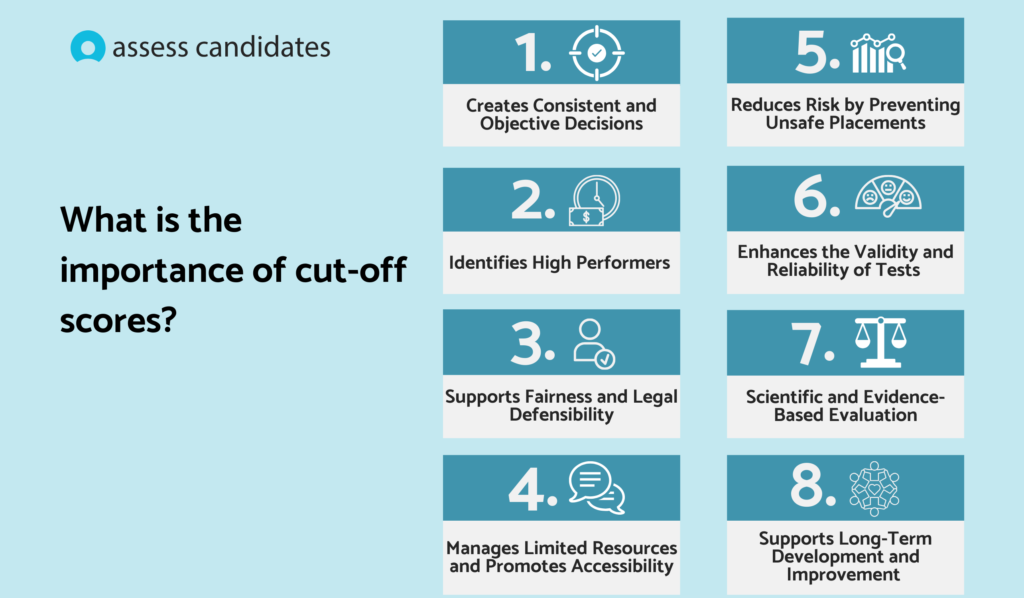
1. Creates Consistent and Objective Decisions
Cut-offs standardize decisions so all candidates are evaluated using the same rules. This reduces personal bias and increases fairness in selection systems, helping you streamline hiring among the large applicant pools.
2. Identifies High Performers
Cut-off scores can be set at the upper end to highlight exceptional ability and select top candidates with above-average skills. This ensures you hire the best talent from the pool, especially for high-stakes roles.
3. Supports Fairness and Legal Defensibility
When cut-offs are tied to job-related requirements, decisions become more defensible. Clear thresholds protect organizations from claims of unfair discrimination, demonstrating that decisions are grounded in ability rather than subjective judgment.
4. Manages Limited Resources
Cut-offs help you select the best of the pool early on, especially in low-volume hiring. This helps you make the recruitment program efficient, scalable, and manageable.
5. Reduces Risk by Preventing Unsafe Placements
Cut-offs protect organizations by preventing placements of individuals who may pose risks. Specific roles require minimum abilities to ensure safe and effective performance, and cut-offs, helping prevent future work errors or accidents.
6. Enhances the Validity and Reliability of Tests
Thoughtfully set cut-offs align decisions with real performance levels, reflecting true competence rather than chance. This strengthens both the accuracy and credibility of the assessment.
7. Promotes Accessibility in Testing
Cut-off scores help ensure assessments remain fair and reachable for all groups. These encourage test developers to remove unnecessary difficulty that disadvantages some individuals, such as neurodivergent candidates. By monitoring performance trends, organizations can adjust cut-offs to support equitable access.
8. Supports Diversity and Inclusion Goals
Thoughtfully set cut-offs prevent unintentional barriers that exclude underrepresented groups. Validated cut-offs ensure that assessments yield candidate results based on ability rather than privilege or background. Additionally, organizations can use past data to refine cut-offs, promoting more diverse participation.
9. Allows for Scientific and Evidence-Based Evaluation
Effective cut-off scores are backed by extensive research, data analysis, and validation studies. This ensures they reflect actual performance requirements rather than arbitrary decisions, especially when supported by regular evaluation by psychometric experts.
10. Supports Long-Term Development and Improvement
Cut-offs help track progress over time and identify where growth is needed. This allows employers to identify and fill any skills gaps through upskilling and reskilling initiatives. Additionally, organizations can adjust thresholds as skills, technology, or job requirements evolve.
Confidently interpret candidate results with our detailed assessment reports. LEARN MORE
So, which factors should you consider when setting the right test cut-off?
4. What factors should influence your assessment cut-off?
Purpose of the Assessment:
The right cut-off greatly depends on whether the assessment is for ranking or screening. Additionally, a selection test cut-off ensures that candidates have the minimum competency needed to perform a role effectively. For licensing or professional exams, the cut-off ensures that only those who meet safety or regulatory standards pass.
For example, A nursing licensing exam may set a cut-off at 75% to ensure all candidates have essential medical knowledge for safe practice.
Test Difficulty
Harder tests may require lower cut-offs to account for the challenge presented, while easier tests may demand higher cut-offs to maintain rigor. Test developers analyze item difficulty and discrimination to determine a fair cut-off. If a test is too hard, many competent candidates might fail, so adjustments ensure the cut-off reflects true ability. Conversely, an overly easy test may require a high cut-off to differentiate among candidates.
For example, if 90% of candidates fail an extremely challenging exam, the cut-off may be lowered to reflect competency accurately.
Distribution of Scores
Most psychometric assessments are standardized for normal distribution. Depending on their role requirements, recruiters set a meaningful and consistent threshold across populations. Norming also allows comparisons between candidates and helps maintain fairness in selection processes.
For example, an IQ test with a mean of 100 and SD of 15 may set a cut-off at 85 to identify the lower bound of average ability.
Competency Requirements
Cut-offs must align with the specific skills, knowledge, or abilities required for success. Job analysis, curriculum standards, or professional guidelines help identify the minimum performance required. Critical competencies, especially those related to safety or essential tasks, are weighted heavily in determining the threshold. The cut-off ensures candidates meet functional requirements rather than just achieving an arbitrary score.
For example, pilots need a minimum score on spatial reasoning because errors in this area directly affect flight safety and operational performance. Competency-based cut-offs make assessments practical and relevant.
Stakeholder Expectations
Stakeholders often define standards that the assessment must meet, such as industry benchmarks, legal requirements, or safety criteria. Cut-offs must reflect these expectations to ensure outcomes are credible and acceptable. This helps maintain trust in the assessment process and ensures that successful candidates meet professional norms.
For example, fire departments or police agencies use cut-offs based on physical fitness standards derived from job analysis studies. Aligning with stakeholders ensures assessments are defensible and relevant.
Legal and Fairness Considerations
Cut-offs must be fair and non-discriminatory to avoid legal challenges. Tests are reviewed to ensure test cut-offs do not unintentionally disadvantage certain demographic groups, such as those based on gender, age, or disability. Reliable psychometric test providers offer adjustments to ensure compliance with employment law, accessibility standards, or diversity policies.
For example, an employer may slightly adjust a cut-off if data shows it disproportionately affects qualified candidates with disabilities while still maintaining competency standards. Legal and fairness checks protect both candidates and organizations.
Historical Performance Data
Historical data from past candidates helps guide cut-off decisions. Trends in scores indicate what level corresponds to minimum competence or exceptional ability. By analyzing performance patterns, developers can set realistic, defensible thresholds. Historical data also helps monitor changes in difficulty or candidate preparation over time. This ensures that the cut-off remains valid as the test population evolves.
For example, if most competent candidates historically score above 70%, the cut-off can be set at 70 to reflect proven competency.
Consequences of Passing or Failing:
High-stakes assessments, such as medical licensing exams or aviation exams, require stricter cut-offs because of the serious consequences of failure. Low-stakes or formative assessments may have more flexible thresholds since mistakes do not carry major repercussions. The severity of consequences ensures that thresholds are appropriate for the risks involved.
For example, A surgical skills test may require a higher cut-off than a logical reasoning test because errors could endanger patients. Considering consequences ensures cut-offs protect both organizations and society.
Let’s now dive into the key strategies you can use to set a cutoff that best suits your hiring needs.
5. Top strategies for setting effective cut-offs in hiring
Setting the right cut-off is essential for efficient, fair, and evidence-based hiring with psychometric assessments. From using past employee performance data to job analysis, you can use either of these methods to set a relevant assessment threshold criterion.
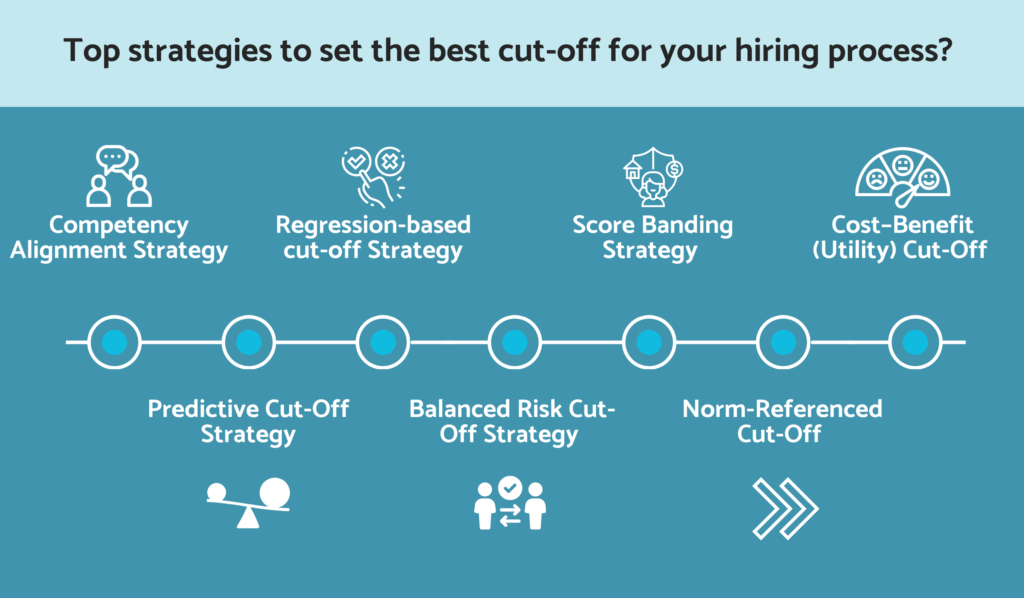
Top 7 Strategies to set the right assessment cut-off score for recruitment:
1. Competency Alignment Strategy
Recruiters determine minimum job requirements using popular data analytical techniques for each competency and job role. These include KSAOs (Knowledge, Skills, Abilities, Other traits)
Why does this strategy work?
This allows you to select candidates fairly, solely based on the job-relevant requirements. This assessment interpretation method works best when you lack outcome data but have SMEs and want defensible content-based standards.
How to implement this strategy?
- Conduct job analysis through hiring techniques such as interviews, subject matter expert (SME) workshops and critical incidents, and translate tasks into competencies and weights.
- Create task/score mapping to decide what score equals “minimally competent” for each competency based on expert estimates.
- Combine weighted competency minima to a single cut-off like a weighted sum.
- Pilot and adjust. Use the work samples or job simulations with assessments such as Behaviourally Anchored Rating Scales (BARS) to assess the candidate based on
Example:
Let’s say for a customer support role:
- English comprehension: minimally competent candidate = 60%
- Empathy rating: BARS score ≥ 3 out of 5
- Typing test: 30 WPM minimum
- Final combined cut-off = score equivalent to these minimums (e.g., 65 total).
This ensures the cut-off reflects real job requirements rather than an arbitrary number.
2. Predictive Cut-Off Strategy
Recruiters evaluate candidates using pre-employment assessment data of their past or current employee performance and expected work behaviors. This includes using assessment data from situational judgment tests (SJT), role-play with rubrics, behavioural event interviews (BEI), and competency-based interviews using the STAR scoring method.
Why does this strategy work?
This evidence-based strategy is grounded in data-driven decision-making. This ensures you hire only the candidates with the minimum acceptable behavioural performance.
How to implement this strategy?
- Look at your past hires to determine which scores belonged to employees who did well vs. employees who struggled.
- For each work behavior, create a 1-5 scale and pick the score that clearly separates good performers from poor performers.
- This assessment strategy helps you determine the
Example:
Suppose, for the same job role, the last year’s employees who scored 80+ did very well. While those who scored below 75 mostly struggled. So you set the cut-off at 78–80 because people empirically found to succeed above that score.
How does this psychometric cut-off strategy work for a role?
To use a predictive hiring strategy with a cut-off, recruiters set different cut-offs for different assessments depending on the role. For example, let’s say a recruiter has set a cut-off as ≥ 3 in each critical behaviour and an overall behavioural composite ≥ 70%, so if:
- Tone: 4
- Solutioning: 3
- Empathy: 3
- Clarity: 4
If the “minimum hire” profile = average score ≥ 3, the candidate passes, and if it averages below that, they fail the behavioral cut-off. Here, it’s 3.5, which is more than the average of 3, so the candidate passes.
3. Regression-based cut-off Strategy
This approach uses historical hiring data to determine the assessment score that best predicts successful job performance. Instead of setting a cut-off arbitrarily, recruiters analyze how past candidates’ test scores relate to their actual performance on the job.
Why does this strategy work?
This method is evidence-based. It uses real employee performance data to identify the score that separates successful employees from weaker performers. As a result, hiring decisions are based on data rather than guesswork.
How to implement this strategy?
- Collect past candidates’ assessment scores.
- Compare those scores with their job performance after 6–12 months.
- Identify the score range where successful employees consistently appear.
- Use that score as the recommended cut-off for future hiring.
Example:
Suppose your analysis shows that most employees who scored 85 or higher on an assessment later met or exceeded job expectations. Based on this pattern, you could set the assessment cut-off at around 85 to help identify candidates with a higher likelihood of success.
4. Balanced Risk Cut-Off Strategy (Sensitivity–Specificity Method)
This assessment threshold strategy helps to lower the likelihood of hiring weak candidates (false positives) and rejecting strong candidates (false negatives)
Why does this strategy work?
This threshold strategy helps create a “balanced” and fair hiring threshold.
How to implement this strategy?
- Create a simple table and list different possible cut-off scores (e.g., 70, 75, 80, 85).
- For each cut-off, calculate:
- How many good employees would it have selected
- How many bad employees would it have selected
- How many good ones would it wrongly reject
- Choose the score with the fewest mistakes
- Whichever score minimizes both types of errors becomes the cut-off.
Example:
Suppose, for a test X, at a cutoff of 70, too many weak candidates pass at 90, and too many strong candidates are rejected. So, a cut-off of, such as 78, would be the most balanced.
5. Score Banding Strategy
Score branding strategy helps allow you to hire based on score ranges or bands instead of a fixed number. This allows you to create score ranges with different actions for each.
Why does this strategy work?
This assessment interpretation system works since most test scoring is either interval or ordinal-based.
How to implement this strategy?
Divide the total assessment score into ranges, such as, say, every 10 points = 1 band.
- Set clear rules for each band, such as:
- Band A (90-100): Direct hire
- Band B (80-89): Interview
- Band C (70-79): Second screening
- Below 70: Rejected
- For tiebreakers, use assessment methods such as structured interviews or job simulations. This helps you to differentiate candidate skills based on their job performance and match them to the company’s work culture.
Example
Suppose in a work sample test, a candidate scores 86; they fall into Band B and are therefore eligible for the interview round.
6. Norm-Referenced Cut-Off
Norm-referenced hiring works best with psychometric tests, where employers hire the highest scorers. This assessment strategy helps recruiters to shortlist candidates for a limited vacancy.
Why does this strategy work?
This assessment interpretation strategy works for high-competition roles and large applicant volumes.
How to implement this strategy?
- Rank candidates by score from highest to lowest.
- Decide the number of candidates needed.
- For tiebreakers, use assessment methods such as structured interviews or job simulations.
Example:
If there are 40 vacancies, find the score of the 40th candidate, which will ultimately become the cut-off for that assessment.
7. Cost–Benefit (Utility) Cut-Off
This test cut-off strategy allows you to assess the candidate’s results to choose the score that offers the most benefit with the least hiring risk.
Why does this strategy work?
This assessment cut-off strategy works best for roles with high consequences if you hire the wrong person. This includes finance, risk, and client relations.
How to implement this strategy?
To implement the utility cut-off strategy:
- Estimate the cost of a bad hire by accounting for the resources they consume, such as training, mistakes, and lost productivity.
- Estimate the value of a strong hire through metrics such as total sales, work productivity, and customer satisfaction.
- Test different cut-off scores by calculating expected value at scores such as 70, 75, 80, 85, and 90.
- Pick the score with the maximum net advantage or gain, which will serve as your cut-off.
Example:
At a score of 80, the expected gain for the company is the highest. The cut-off for that role will be set at 80.
Set custom cutoffs using effective benchmarks on the Assess Candidates platform. HIRE FOR FREE
So, what are the benefits of using percentile scores in candidate assessment?
6. Why do recruiters use percentile scores for hiring?
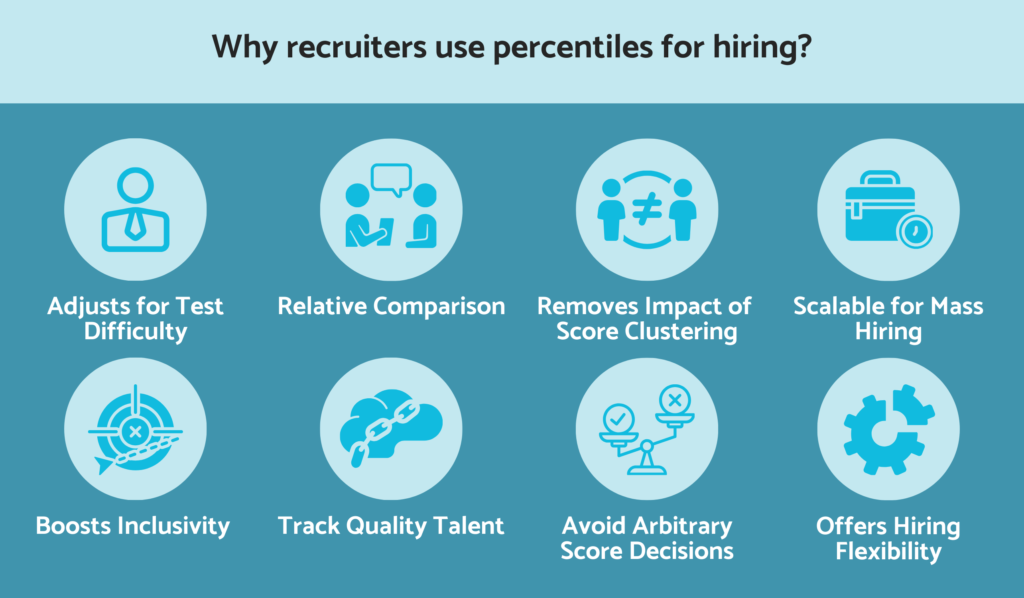
- Show where a candidate stands compared to others
Percentile scores show how a candidate performed relative to everyone else who took the assessment. Instead of relying on raw scores alone, recruiters can quickly see which candidates performed better than the majority of test takers.
- Automatically adjust for test difficulty
If a test is too hard or too easy, raw scores become misleading. Recruiters use percentile scores for shortlisting candidates. Even if everyone scores low on a hard test, the top performers still fall into higher percentiles and vice versa. This ensures the test cut-off remains fair and stable, regardless of test difficulty.
- Remove the impact of score clustering
In many tests, scores cluster, i.e., many candidates score between 65 and 75. This results in the raw score becoming unstable and unfair. Percentiles work here by spreading the candidates across a 1-100 scale, which helps avoid rejecting or accepting too many candidates due to clustering.
- Make cut-off decisions scalable for mass hiring
When 1,000 to 50,000 applicants take an exam, raw-score cut-offs become impossible to calibrate accurately. Percentiles create a clean ranking where recruiters can select the required number of candidates, making bulk hiring efficient.
- Consistent hiring quality across different test versions
Sometimes, different test batches get different test forms, and even minor variations in questions can change raw scores. Percentiles standardize that by ensuring each test batch has its own standard distribution. So, for example, the top 25% in Batch and the top 20% in Batch B are considered equivalent when the tests are a little easier and a little more difficult, respectively.
- Track talent quality
Percentiles offer a standard measure that stays meaningful across different hiring cycles. So, even if the talent pool changes year to year, the raw score and a percentile cut-off, say, the top 25%, always mean the same thing. This ensures consistent recruitment standards over time, even when the raw scores, applicant quality, and test difficulty vary.
- Avoid arbitrary score decisions
Raw cut-offs are often chosen randomly, such as “let’s set 70 as the cut-off,” which makes hiring subjective and unreliable. Percentiles eliminate guesswork by giving a data-backed reason for the cut-off, like “We are hiring from the top 35% performers.” This helps recruiters boost transparency, fairness, and audit compliance.
- Highlight standout performers clearly
Percentiles create a ranking, so you can identify top talent at the upper end, like at the 90th–99th percentile. This helps you to hire for high-stakes roles such as leadership, where recruiters can shortlist the top 10-20%. This makes the test interpretation, allowing you to separate good vs. exceptional candidates.
- Reduce bias due to unequal educational backgrounds
Raw scores often punish candidates from weaker academic environments who still have strong potential. Percentiles compare candidates within the same test, not by educational background. This helps shortlist candidates based on their performance relative to others, not their total score. In turn, boosting equity and diversity while still selecting high performers.
- Manage different hiring needs with flexibility
Percentiles allow you to be flexible when selecting the hire. So, whether you want to mass hire or for specialized roles, you can easily set a lower, strict, or mid-level cut-off to match your hiring needs through a single test. This makes the recruitment more dynamic and adaptable.
Explore our end-to-end range of scientifically validated pre-employment tests to complement your hiring. LEARN MORE
While we discussed different standard scores in hiring, why do recruiters prefer percentile scores over others?
7. How percentile cut-offs compare to other scoring methods
Percentile scores show the percentage of candidates a test taker performed better than. While other scoring methods such as z-scores or T-scores rely on statistical transformations, percentiles are easier for recruiters and hiring managers to interpret and compare across candidate groups.
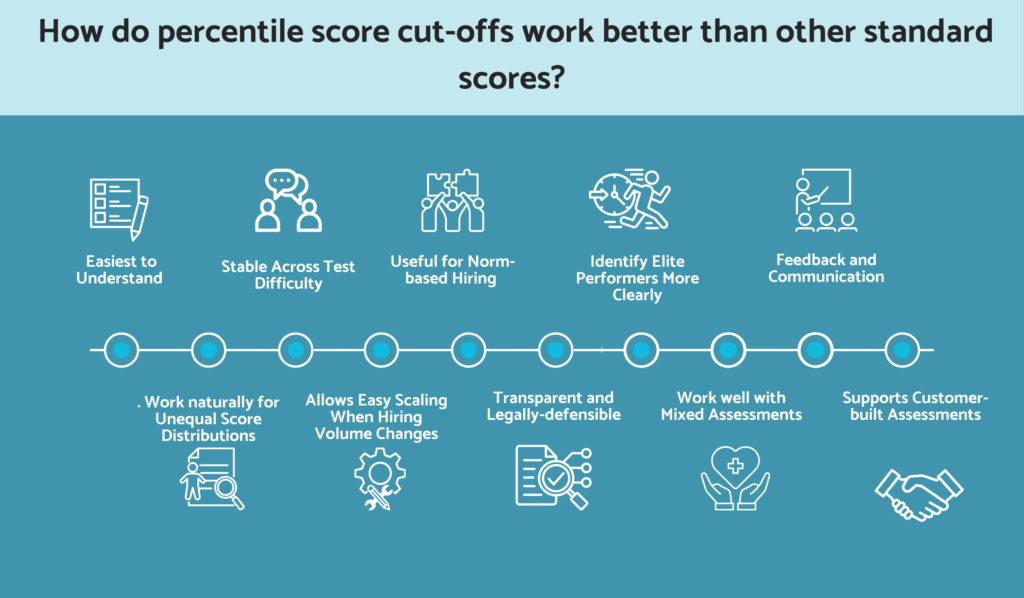
10 key advantages of using percentile score cut-offs over other standard scores:
1. Easier to Understand
Percentiles are easier to understand, thus reducing the risk of confusion and misinterpretation and speeding up decision-making.
Example: Require the top 15% of the candidates: the top 15 candidates from 100 get shortlisted.
2. Work Naturally for Unequal Score Distributions
Some tests have skewed distributions, score clusters, ceiling effects (everyone scores high), or floor effects (everyone scores low).Percentiles still help you rank candidates accurately over other scale scores that assume normal distribution, which is often not true.
Example: Suppose a test is very easy and 40 candidates out of 100 score between 92–98. Raw scores and standard scores will bunch together, failing to show who is actually better. But percentiles will still separate them clearly, for instance, even if many scored 95, only the top few will fall in the 97th-99th percentile, helping you rank them meaningfully.
3. Stable Even When Test Difficulty Changes
Other scaled scores can become misleading unless you statistically equate forms. However, percentiles automatically adjust for test difficulty and ensure score compatibility across different tests.
Example: If a raw score of 60 is 50th percentile for a difficult test A, the score of 75 on an easier test B can be 50th percentile.
4. Allows Easy Scaling When Hiring Volume Changes
Most standard scores require adjusting test scores using formulas and distribution assumptions. Percentiles allow flexible, real-time cut-off changes without recalculation based on your hiring needs.
Example: Need top 15%, so the cut-off is set at the 85th percentile.
5. Percentiles are Directly Usable for Norm-Based Hiring
Many recruitment systems want the top performers, not the “minimum raw score”. Percentiles tell you exactly who falls in that top group. By contrast, standard scores often require converting back into percentiles before they can be used in hiring decisions.
Example: If your hiring policy is to progress only the top 20% of candidates, you can simply shortlist anyone at or above the 80th percentile. That is much easier than setting a z-score or T-score threshold and then explaining what that means in practical hiring terms.
6. Transparent and Easy to Explain Legally
In audit or legal review, percentile-based decisions are simpler to justify compared to those with other standard scores. This helps improve fairness, defensibility, and documentation quality.
Example: “We selected the top 25% of performers.” is more transparent, straightforward, and legally defensible than “We selected candidates above +0.5 SD from the mean.”
7. Identify Elite Performers More Clearly
Top performers like those in the 90th-99th percentile are easily recognized. Standard scores such as T = 68 or z = +2 are harder to interpret and justify to candidates.
Example: If you want only the truly elite candidates, selecting those in the 90th percentile and above is defensible and straightforward. Saying “T-score ≥ 68” or “z ≥ +2” is more complicated to explain to panels and applicants. With percentiles, it is succinct: “We shortlisted applicants who performed better than 90% of the entire test-taker population.”
8. Work Well With Mixed Assessments
Percentiles make composite scoring with multi-assessment test methods easier. You can easily convert each component to a percentile and combine to set a cut-off. However, standard scores require equal scaling or normalization.
Example: The recruiter assessing for an engineering role can combine results of multiple test types, such as technical, cognitive, and behavioral, to make a final decision.
9. Easy Communication With Feedback
Candidates often do not understand normed scoring. Percentile ranks are much more transparent and reduce queries, appeals, and disputes by improving candidate experience and perceived fairness.
Example: Using “You scored better than 70% of candidates” helps communicate the results to candidates transparently, with no risk of confusion.
10. When the Test is Custom-Built and Has No Established Norm Group
Norm-based scores require large, validated, stable norm samples. If your assessment test is organization-specific or newly developed, norms may not exist. Percentiles help offer immediate, meaningful insights into the current applicant pool while still maintaining fairness within the batch.
Example: A company creates a custom problem-solving test for interns. No national norm group exists, so percentiles are the only interpretable metric.
Explore our range of psychometric assessments to assess candidates for effective hiring. HIRE FOR FREE
So, when should recruiters use percentile scores over other standard scores?
8. Common challenges when using percentile cut-offs
Challenge: Percentiles depend heavily on the applicant pool
Percentiles show how well a candidate performed relative to others, not how good they are in absolute skill. So, if the applicant pool is weak, someone in the 80th percentile may still not be truly skilled. Likewise, if the talent pool is extremely strong, even good candidates may fall below the cut-off.
Solution:
Use a percentile range with a minimum raw competency check and set a cut-off like: ≥60th percentile with a minimum 50% raw score. This helps ensure only above-average candidates pass, but they also meet minimum ability standards, maintaining fairness across weak/strong batches.
Challenge: Percentiles become unstable with small groups
Percentiles require a large group to create meaningful rankings. In a tiny sample, percentiles fluctuate wildly. This makes the cut-off unstable and misleading, failing to reflect the candidate’s actual ability.
Solution:
Use pooled percentiles across multiple batches by combining scores from multiple campuses or hiring cycles. Compute percentiles on the large combined pool and apply the cut-off to each group. This offers a stable and fair percentile distribution.
Challenge: Hard to communicate with managers or candidates
Recruiters understand percentiles, but many hiring managers don’t. Candidates may also get confused or feel the percentile is “unfair.” They may ask, “Why is this candidate rejected at the 59th percentile? They scored 21/30!”
Solution:
Use a simple, plain-language explanation template that provides what the percentiles mean: “You performed better than X% of the group.” Also, clarify the reason for the cut-off, like “We select the top 40% performers to maintain quality”. Give managers a ready-made explanation slide or email format to help improve acceptance and pushback.
Challenge: Percentiles hide specific strengths or weaknesses
Percentiles provide a single overall rank, not sectional insight. So, one candidate for a technical role may be great in logical reasoning but poor in coding but still could fall above the overall percentile cut-off.
Solution:
Add sectional minimum percentiles or raw-score floors. Such that if the overall percentile is say ≥ 60, the requirements are to have a cutoff in logical reasoning ≥ 40th percentile and coding ≥ 50% raw score. This ensures candidates are not “accidentally” shortlisted based on a strong single section and not a holistic overall evaluation necessary for the role.
But are there any situations where using percentiles is a big no? Let’s find out!
When not to use percentile scores in recruitment?
Percentiles are quite effective for interpreting test results when making hiring decisions. However, not always work for shortlisting over others.
- Test against an absolute skill standard
Percentiles only compare candidates to each other, not to a real-world competency level. This practice doesn’t ensure that one truly meets the required proficiency.
Example: A medical coding test where candidates must score 80%+ to ensure patient safety. Even if everyone performs poorly, the percentile ranking still produces “top performers,” which is unsafe.
- Test difficulty varies drastically across test forms
If different versions of the test have various difficulty levels, raw performance may change, but percentiles hide this. This risks fairness and hiring based on the skill requirement.
Example: Form A is very easy; Form B is very difficult. Candidates who took the difficult form may receive unfairly low percentiles even if knowledgeable.
- Predicting future performance using standardized norms
Some assessments are built with norm-based scores such as z-scores or T-scores that map directly to psychological constructs.
Example: A cognitive ability test, such as WAIS/Wonderlic, uses norms based on thousands of test-takers. These norms show how far someone’s ability deviates from the average population.
- When distributions are very skewed
Percentiles can distort meaning if most scores cluster at the top or bottom. This risks misinterpretation of performance in skewed score distributions.
Example: A coding test that is too easy, everyone scores between 85 and 100. Small score differences produce big percentile jumps, making cut-offs unfair.
- Detect small differences in high performers
Percentiles compress high scores. 90th, 95th, and 97th percentile performers might differ significantly, but percentiles hide this detail. This makes the percentile-cutoff system less precise at the higher end.
Example: If 3 candidates score 91, 93, and 97 respectively, they all might fall close in percentile rank, even though 97 shows exceptional ability.
- The group is intentionally mixed
Percentile ranking only makes sense when everyone takes the same test for the same role.
If the group is mixed, rankings become meaningless.
Example: If analysts, sales applicants, and designers are tested on a single skills test, percentile becomes irrelevant because job expectations for each role differ.
So, how to choose the right cut-off for each role? We will now discuss this here.
9. How to choose the right cut-off for different roles
The right cut-off for one role can be ineffective for the other. Therefore, a role-specific cutoff strategy is key to making assessment tests successful.
1. Cognitive-Heavy Roles (Analysts, Consulting, Finance, Data)
For roles that depend heavily on analytical reasoning, quantitative thinking, and problem-solving, a percentile cut-off at or above the 65th-80th percentile works best because these positions require candidates who genuinely outperform most of the applicant pool.
Why use it?
- These roles require being better than most of the applicant pool.
- Percentiles automatically adjust for whether the test was easy or hard.
- Norms are not needed because the competition is within the applicant batch, not the national population.
- Ensures you always take the top segment even if all raw scores shift.
Why it works?
- Highlights candidates who clearly outperform the majority.
- Neutralizes the impact of easy or hard test versions.
- Maintains fairness when applicant ability levels fluctuate.
- Let’s recruiters consistently target the top talent segment.
- Avoids misleading interpretations caused by raw score shifts.
2. Mass Hiring Roles (BPO, Customer Support, Operations, Interns)
For high-volume hiring where speed and consistency matter more than deep analytical ability, a 30th-50th percentile cut-off helps recruiters quickly filter large pools while maintaining steady intake numbers.
Why use it?
- A quick way to filter thousands of candidates.
- Automatically supplies the top X% you need.
- Helps maintain consistent intake volume even if applicant quality fluctuates.
- Raw cut-offs may reject too many in a weak batch or too few in a strong batch.
Why it works?
- Speeds up filtering for large applicant pools.
- Automatically balances intake even when candidate quality varies.
- Ensures predictable hiring numbers using fixed percentiles.
- Reduces the manual effort needed to adjust raw score cut-offs.
- Keeps screening fair across multiple test batches
3. Campus Hiring (Freshers, Trainees, Entry-Level Engineers)
In campus hiring, a 50th-70th percentile cut-off works well because student quality fluctuates significantly across institutions, and percentiles help normalize these differences.
Why use it?
- Campus student quality varies greatly between institutions.
- Percentiles equalize this variation so that a fair comparison can be made within each campus batch.
- Allows each college to produce shortlists based on relative performance, not absolute difficulty.
- Students from weaker colleges may score lower raw scores, but still outperform their batch.
- Norm-based scores may not exist for campus-level custom tests.
Why it works?
- Adjusts for major performance differences between campuses.
- Ensures fair ranking within each specific campus cohort.
- Prevents strong relative performers from being penalized by low raw scores.
- Works even when national norms are unavailable for custom campus tests.
- Simplifies shortlisting for multiple colleges using one metric.
4. Early-Career Technical Roles (Developers, IT Support, QA)
Technical positions at early-career levels benefit from a 60th–75th percentile cut-off because logical reasoning, coding aptitude, and problem-solving are core requirements, and candidates who consistently perform above the majority signal stronger potential for learning and performance.
Why use it?
- Ensures you hire candidates who perform better than the majority on logical, technical, or aptitude tests.
- Technical tests often fluctuate in difficulty; percentiles stabilize fairness.
- Good fit for volume hiring in engineering.
- Raw score cut-offs may become unfair when test difficulty changes.
- Norms are unnecessary for early-career levels.
Why it works?
- Identifies stronger logical and technical aptitude reliably.
- Maintains fairness despite fluctuating difficulty of technical tests.
- Ensures stable quality control in large-scale technical hiring.
- Helps recruiters consistently select above-average performers.
- Makes scoring comparable across multiple batches.
5. Business, HR, Marketing, Operations Roles
For functional roles that require moderate reasoning ability but not extremely high cognitive load, a 50th-65th percentile cut-off ensures that candidates have above-average problem-solving skills without being excessively exclusive.
Why use it?
- These roles need general reasoning and problem-solving ability.
- Percentiles help ensure “above average” capability without over-screening.
- Very helpful when hiring across different campuses or regions.
- Norm-based scoring gives personality deviation, not ability ranking.
- Percentiles directly show “who is better than whom”, which is more relevant.
Why it works?
- Ensures candidates have above-average reasoning ability.
- Provides consistent shortlisting across varied applicant sources.
- Easy to communicate and justify to business stakeholders.
- Requires no complex national norms for ability comparison.
- Handles differences in difficulty across test administrations.
6. Screening for Interview Shortlists (Any Role)
When recruiters use assessments simply to create an interview shortlist, a 40th-70th percentile cut-off is used. This helps recruiters control the number of candidates while ensuring that those selected perform better than the rest.
Why use it?
- Interviews are costly, so percentiles quickly produce top X% candidates.
- Maintains fairness when applicant quality shifts year to year.
- Allows easy ratio planning
- Norms don’t help with batch-to-batch variation.
Why it works?
- Helps manage interview load by selecting a specific top percentage.
- Keeps interview quality high by eliminating low performers systematically.
- Stabilizes shortlisting numbers even in unusually strong or weak years.
- Avoids unfair rejection or over-selection caused by raw score cut-offs.
- Works across roles because it measures relative performance.
7️. Competitive Internal Promotions or Lateral Movement
For competitive internal processes, choosing candidates from the top 20–35 per cent of performers ensures fairness and identifies employees who outperform their peers.
Why use it?
- Promotions require relative strength, i.e, who performs better than peers.
- Percentiles show competitive ranking within the internal employee population.
- Ensures fairness across departments.
- Raw scores may differ if the test changes.
- Norms compare against the population, not against the internal group.
Why it works?
- Directly compares employees competing for the same opportunity.
- Highlights standout performers within the internal talent pool.
- Adjusts fairly when departments or groups take different test versions.
- Removes dependency on external norms irrelevant to internal competition.
- Ensures transparent, defensible promotion decisions.
Enhance your hiring process with objective talent assessment using our pre-employment tests. VIEW PLANS
So, why choose Assess Candidates for your hiring needs?
10. Why leading companies trust Assess Candidates’ pre-employment tests to hire
At Assess Candidates, we specialize in a variety of pre-employment aptitude, psychometric tests, and video interview tools to ensure a holistic candidate evaluation for organizational culture and job role fit. With us, you can build a recruitment campaign tailored to meet the unique hiring needs of any organization.
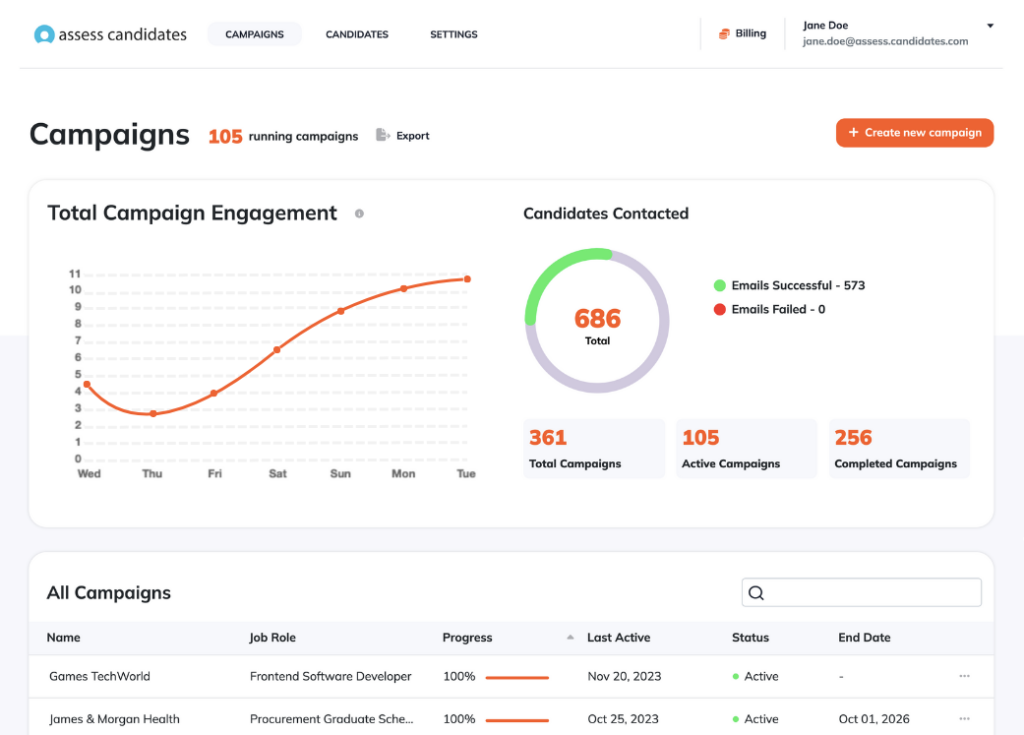
Below is an example of our campaign reporting dashboard available on Assess Candidates. This tool is accessible to hiring managers and talent acquisition professionals, providing valuable insights and easy-to-use sorting functions to streamline candidate assessment.
The top 4 reasons why you should use Assess Candidates’ pre-employment assessments:
1. Scientifically Validated Design: Assess Candidates’ pre-employment aptitude tests are developed by Chartered Scientists, Psychologists, and Psychometricians with decades of experience designing assessment solutions for companies like SHL, IBM Kenexa. Our psychometric tests have undergone rigorous testing and validation to accurately measure candidates’ cognitive abilities and personality traits. These tests have consistently proven successful in selecting and hiring top talent across various organizations and industries.
2. Expert Reporting: Assess Candidates’ user-friendly and easy-to-navigate assessment platform enables employers to analyze candidate reports in detail and make informed hiring decisions based on flexible criteria. Recruiters can easily view individual candidates’ performance on different aptitude and personality tests, and then filter, rank, and shortlist candidates. Additionally, our talent assessment platform also offers the option to integrate with your existing ATS for a seamless experience.
3. Positive Candidate Experience: Assess Candidates’ assessment platform is easily accessible from any device and features an aesthetic and easy-to-use interface for candidates. It provides clear assessment instructions and can be fully branded to match your organization. The tests are designed to require minimal clicks to complete, with the assessment automatically moving to the next question once answered. This ensures a seamless and positive candidate experience, which they will associate with your brand.
4. Accessibility Support: Assess Candidates offers support for individuals with disabilities and visual impairments. All our assessments have the option to add extra time, include zoom functionalities, and ensure the use of accessible color schemes and images in compliance with Web Content Accessibility Guidelines (WCAG) to ensure compatibility with screen readers.
Assess Candidates is one of the major pre-employment aptitude test providers proven to help small, medium, and large employers successfully hire top, best-fit candidates. Why not explore Assess Candidates’ assessments and start hiring today!
Conclusion: Key Takeaways For You
Using percentile cutoffs in recruitment provides a fair, flexible, and data-driven way to evaluate candidates across different hiring scenarios. Because percentile scores compare candidates to others who took the same test, they naturally adjust for differences in test difficulty, score clustering, and variations between candidate groups.
This makes percentiles particularly useful for campus hiring, mass hiring, and situations where national norms are unavailable. Instead of relying on raw scores that may vary across test versions or candidate pools, recruiters can focus on relative performance, such as selecting candidates in the top 30% or top 10% of test takers.
Percentile bands also make hiring decisions easier to communicate to stakeholders and improve transparency in shortlisting. However, percentiles may be less appropriate when standardized norms already exist, sample sizes are very small, or assessments require highly precise ability measurement.
Overall, percentile cutoffs help organizations maintain fairness, consistency, and clarity in candidate evaluation, especially in large-scale or variable testing environments.
Interested in getting the latest insights and advice on candidate assessment? Keep reading for frequently asked questions and to sign up with your email below to get started.
Frequently Asked Questions
Is it better to use percentiles over z-scores for campus hiring assessments?
Yes, percentile cutoffs are more effective in campus hiring assessments. They normalize the student differences across campus differences and rank candidates fairly within each campus. It works even when national norms or z-scores aren’t available for custom tests. A 50th-70th percentile cut-off ensures strong relative performers aren’t penalized by low raw scores or uneven test difficulty.
When can we not use a percentile cutoff in recruitment?
A percentile-cutoff is not suitable when using standardized tests and when the sample size is small. Additionally, in case of use of tests with varying difficulty that aim to detect precise differences between the competencies, percentile scores aren’t preferred. In such cases, absolute or scaled scores provide more precise comparisons than percentiles, which can become unstable or misleading.
What is the Angloff method in recruitment?
The Angoff method sets a cutoff score by asking subject-matter experts to judge the minimum level of knowledge a borderline-competent candidate should have. Experts estimate the probability of such a candidate answering each item correctly. These probabilities are then summed to produce a defensible, criterion-based pass mark for recruitment tests.
Are psychometric tests norm-referenced tests?
Yes, most psychometric tests are norm-referenced. Scores are compared to a comparison group to determine how well a candidate performs relative to others. This allows fair interpretation even when raw scores vary across forms, difficulty levels, or test versions, making norm-referencing standards in aptitude and personality assessments.
Which assessment providers offer percentile-based cutoff scores?
Many major providers support percentile-based cutoffs, including Assess Candidates, SHL, Talogy, HackerRank and Pearson TalentLens. These platforms allow recruiters to filter candidates by percentile bands, such as the top 20% or the top 40%. This makes shortlisting easier when raw scores or norms vary across campuses or test sessions.


 English
  Arabic