
Interpreting Candidate Assessment Results: Common Mistakes to Avoid



Correctly interpreting candidate assessment results is just as important as selecting the right assessment to hire. Misinterpretation at any stage of the recruitment process can lead to poor hiring decisions, reduced diversity, and higher turnover, affecting productivity, team dynamics, and company success.
So, what key strategies ensure accurate test interpretation? How can you validate results with the right tools and prevent costly mis-hires?
This comprehensive article offers insight into the common pitfalls and practical strategies you can use to improve your hiring decisions.
Contents
- What type of results do pre-employment tests provide?
- How do different candidate assessments help recruiters in hiring?
- Key methods for interpreting candidate assessment results
- Common pitfalls when interpreting candidate test results
- Why is accurate interpretation critical in hiring?
- Best practices for pre-employment test interpretation
- How to train recruiters to interpret multi-assessment test scores with accuracy?
- Why do top companies trust Assess Candidates’ pre-employment tests to hire?
1. What type of results do pre-employment tests provide?
Candidate assessment results provide objective data on cognitive ability, personality traits, skills, behavior, and job fit. Employers use these insights alongside interviews and experience to make more informed hiring decisions.
How are Pre-Employment Test Results Presented?
Most assessment platforms present candidate results in several formats, allowing recruiters to review both high-level summaries and detailed competency data. These include:
- Raw Scores: Direct numerical results showing how a candidate performed.
- Percentile Rankings: A numerical score comparing a candidate’s performance against a wider group or benchmark.
- Profiles or Dashboards: Visual summaries highlighting strengths, weaknesses, and overall fit.
- Detailed Reports: In-depth breakdowns of competencies, skills, or personality traits.
- Traffic Light Indicators: Quick-reference visuals like red/amber/green to simplify decision-making.
These formats help recruiters quickly identify top talent while still having the option to dig deeper into individual candidate results and reports if required.
Interpret candidate results with confidence using our detailed assessment reports and scoring system. HIRE FOR FREE
Now, let’s explore in more detail each type of pre-employment test and the results that they give.

2. How do different candidate assessments help recruiters in hiring?
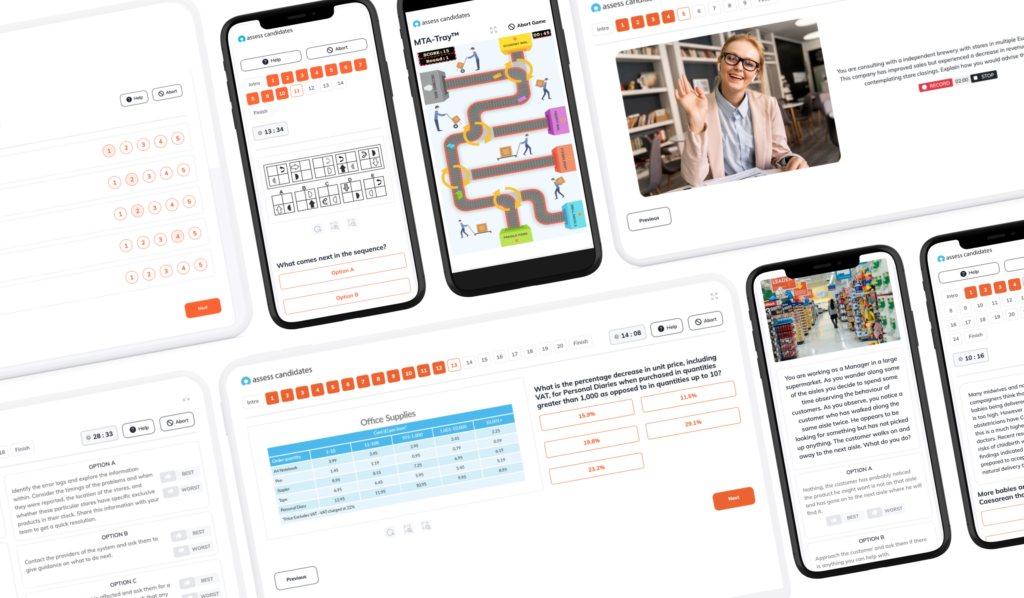
Each pre-employment candidate assessment has its own strengths for helping recruiters measure different aspects of a candidate’s potential. Depending on the role and industry, employers choose a combination of the following assessment types:
1. Cognitive Ability Tests
Cognitive aptitude tests measure reasoning, problem-solving, and analytical skills, all key predictors of job performance in data-heavy and decision-focused roles.
Common cognitive aptitude tests:
- Numerical Reasoning Test: Evaluates a candidate’s ability to understand and interpret complex numerical data. Ideal for data analysts, investment bankers, and statisticians.
- Verbal Reasoning Test: Measures verbal comprehension and language skills when interpreting written information. Recommended for customer service, digital marketing, and retail roles.
- Logical Reasoning Test: Assesses the ability to solve abstract problems and draw conclusions based on logic. Recommended for designer, engineer, and data analyst roles.
- Critical Reasoning Test: Evaluates candidates’ ability to analyze arguments, evaluate evidence, and make logical decisions under pressure. Ideal for consultant, manager, and legal analyst roles.
- Abstract Reasoning Test: Assesses the ability to identify patterns, solve complex problems, and think critically without relying on prior knowledge. Recommended for data analysts, engineers, and strategists.
- Diagrammatic Reasoning Test: Evaluates a candidate’s ability to analyze and reason based on visual patterns and diagrams. Ideal for architects, risk analysts, and system engineers.
- Spatial Reasoning Test: Assesses the ability to comprehend and manipulate spatial objects, identify patterns between shapes, and visualize movements and changes in these shapes. Recommended for air traffic controllers, game designers, and VFX testers.
- Checking Test: Assesses candidates on their attention to detail to quickly detect errors. Ideal for proofreaders, data entry clerks, and policy analysts.
- Game-based Assessments: Evaluate candidates on their problem-solving, memory, attention, and adaptability in a dynamic, engaging format. Recommended for roles such as software engineers and data analysts.
2. Personality and Behavioral Tests
Recruiters, such as those at Goldman Sachs and Airbnb, use results from personality and behavioral tests to assess candidates’ decision-making ability, leadership style, problem-solving approach, and emotional intelligence.
Common behavioral and personality pre-hire tests:
- Emotional Intelligence Test: Assesses a candidate’s ability to understand and manage emotions. Ideal when evaluating soft skills for psychologist, leadership, and sales executive roles.
- Personality Assessment: Helps determine traits, such as leadership potential, teamwork, and resilience. Useful for roles such as risk analysts, customer service representatives, and managers.
- Situational judgment test (SJT): Presents hypothetical workplace scenarios to evaluate candidates for their workplace behavior, ethical decision-making, and work style. Recommended for physicians, administrative officers, and policy advisors.
3. Skills-based Assessment Tests
Recruiters use skills-based assessment results to determine technical expertise, industry knowledge, and hands-on proficiency in job-related tasks. These tests help employers such as Morgan Stanley and Apple confirm whether candidates can apply their skills in real-world scenarios, ensuring the right fit for specialized roles.
Common skills-based assessments:
- Coding Assessment: Measures a candidate’s programming proficiency, problem-solving approach, and debugging skills. Ideal for roles in software development, machine learning, and cybersecurity.
- Financial Modeling/Excel Assessment: Assesses quantitative analysis, spreadsheet proficiency, and financial forecasting ability. Recommended for roles such as financial analysts, investment bankers, and accountants.
- Graphic Design and UX/UI Assessment: Measures creativity, layout precision, and software expertise. Ideal for designers, product illustrators, and creative directors.
4. Job Simulation and Work Sample Tests
Job simulations and work samples replicate real-world tasks, allowing recruiters to observe how candidates perform in practice, reducing hiring risks.
Popular job simulations and work samples:
- Case Study Exercises: Assess strategic thinking, market analysis, and business decision-making skills. Recommended for roles such as business analysts, management consultants, and strategy planners.
- Role-Playing Simulations: Evaluate negotiation skills, communication ability, and client-handling expertise. Ideal for sales manager, account executive, and business development professional roles.
- Writing and Editing Assignments: Assess candidates on content clarity, grammar proficiency, and storytelling ability. Recommended for roles like editors, journalists, and content strategists.
5. Integrity and Ethics Tests
Employers, like the United Nations and Deloitte, use integrity assessments to gauge trustworthiness, compliance, and ethical decision-making in roles that require high accountability.
Popular integrity and ethics assessments:
- Reid Report Integrity Test: Assesses candidates on honesty, reliability, and risk factors for misconduct. Ideal for roles such as banking professionals, compliance officers, and internal auditors.
- Overt Integrity Test: Evaluates candidates on their integrity, specifically their proneness to dishonest behaviors. Recommended for law enforcement, fraud detection, and financial regulation roles.
6. Background and Cognitive Bias Tests
Background and cognitive bias assessments identify cognitive biases, hidden prejudices, and logical consistency in workplace decision-making.
Common background and cognitive bias tests:
- Implicit Association Test (IAT): Measures proneness to unconscious biases that may impact workplace interactions. Ideal for roles such as HR professionals, diversity officers, and hiring managers.
- Cognitive Reflection Test (CRT): Evaluates candidates’ ability to distinguish between analytical vs. intuitive decision-making. Recommended for risk analysts, economic strategists, and investment consultants.
Blue citation: Most employers use a multi-assessment hiring approach, combining several assessments for a more complete and accurate evaluation of candidate potential. Ultimately, data-backed hiring decisions can be made with high predictive validity, focusing on balancing aptitude, personality and skills.
Explore our end-to-end range of scientifically validated pre-employment tests to complement your hiring. LEARN MORE
Up next: What methods do employers use to interpret candidate test results to make informed hiring decisions.
3. Key methods for interpreting candidate assessment results
Interpreting pre-employment assessment results is about more than just reading scores. It is a structured process that involves analyzing and evaluating results to determine a candidate’s suitability for a role. This means hiring decisions are objective, reliable, and aligned with the role.
Here is a 7-step process recruiters use to analyze candidate results effectively:
- Test Selection and Administration
Selecting the most relevant assessments based on the role (e.g., cognitive ability, technical skills, or personality tests) and ensuring they are administered consistently to all candidates for fairness.
- Data Collection and Scoring
Gathering candidate responses and scoring them using automated scoring platforms or structured manual evaluation to create reliable and comparable performance data.
- Benchmark Comparison
Comparing candidate scores against job-specific benchmarks, industry norms, or historical data on high-performing candidates to assess suitability.
- Behavioral and Cognitive Analysis
Analyzing personality and cognitive test results to understand problem-solving approach, interpersonal style, and cultural fit within the organization.
- Skill Validation and Consistency Check
Cross-checking test outcomes with resumes, interviews, and work samples to confirm whether candidates’ stated skills align with their demonstrated performance.
- Bias Reduction and Fair Hiring
Applying standardized scoring and structured interpretation methods to minimize recruiter bias and ensure all candidates are judged fairly on objective criteria.
- Final Decision-Making
Synthesizing interpreted test results into actionable insights that guide shortlisting, hiring, or recommending candidates for further training or development.
Explore our automated assessment platform which simplifies candidate test interpretation for you. LEARN MORE
We will now discuss the common mistakes when interpreting candidate assessment results.
4. Common pitfalls when interpreting candidate test results
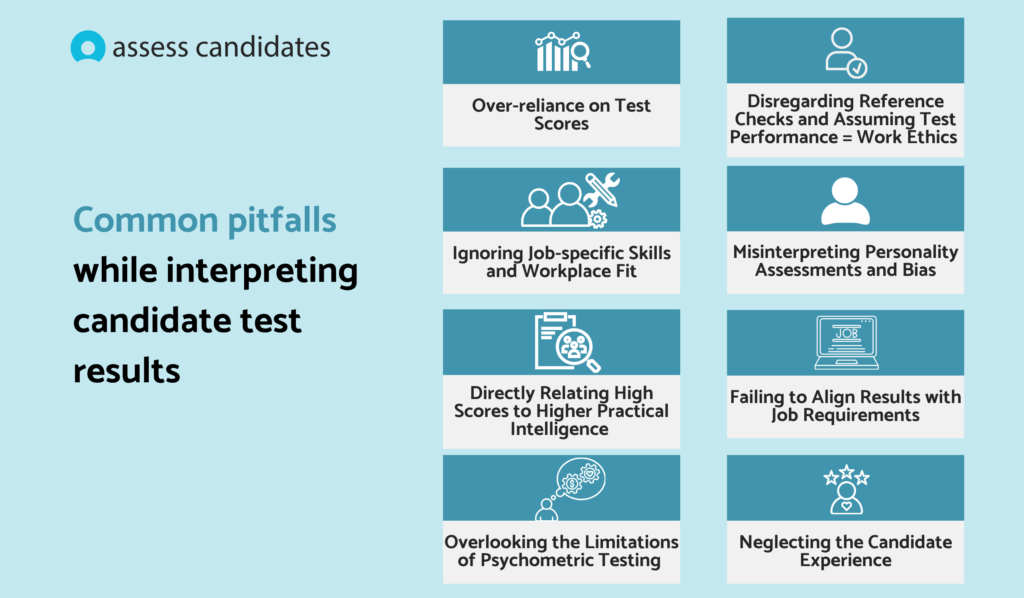
Even experienced recruiters can misinterpret assessment data when results are viewed without sufficient context or validation. Let’s understand the top reasons why recruiters end up misinterpreting candidate results in the context of our case example discussed above:
- Over-reliance on Test Scores
Assessment scores provide valuable signals, but they rarely tell the full story of how someone will perform once they enter the workplace. A holistic hiring strategy combines test scores with work experience, industry knowledge, and adaptability. Relying solely on test scores leads to hiring mistakes.
What Went Wrong?
Example: The recruiter relied solely on test scores instead of using a balanced approach with practical assessments and structured interviews. This flawed assumption led them to hire A, who excelled in tests but struggled with financial forecasting and decision-making. As a result, they selected a candidate who lacked real-world data skills.
- Ignoring Job-specific Skills
Generic problem-solving ability in aptitude tests doesn’t guarantee specialized technical expertise. Demonstrable technical problem-solving skills are essential to look for while selecting candidates to avoid hiring mis-hires.
What Went Wrong?
Example: The hiring team prioritized general aptitude over validating the candidate’s core financial expertise. They relied on numerical reasoning and job simulation tests but failed to assess critical competencies like financial modeling and data analytics. As a result, they hired A, who lacked technical proficiency and later struggled with database querying and statistical modeling, leading to inefficiencies. Meanwhile, they overlooked B, who had demonstrable financial expertise and was the stronger candidate.
- Neglecting Soft Skills and Workplace Fit
Candidate test interpretation works best when the evaluation is in the context of their ability to fit into the company culture. Cultural-fit candidates perform their best in the role, and their values align with those of the organization to ensure its long-term growth.
What Went Wrong?
Example: The recruiter downplayed the importance of collaborating, communicating, adaptability, and the ability to adapt to team dynamics. The psychometric tests and traditional interviews failed to measure these critical soft skills, leading the company to hire A, who lacked stress management and a flexible mindset and was struggling with the company’s deadline-oriented approach. Meanwhile, B had a track record of strong collaboration but was overlooked due to lower test scores.
- Directly Relating High Scores to Higher Practical Intelligence
Strong assessment performance can indicate potential, but potential and practical execution are not always the same thing. Integral factors such as stress, educational background, culture, and language can affect the performance on the recruitment test.
What Went Wrong?
Example: The recruiter directly related a high score in technical and critical reasoning tests to their potential ability to perform hands-on in the role. However, despite scoring high, candidate A struggled to use financial principles to solve real-time financial problems in the workplace. Candidate B, who had good practical problem-solving experience and hands-on experience but slightly lower test scores, could have been a better fit.
- Overlooking the Limitations of Psychometric Testing
Pre-employment assessment testing measures potential, not actual performance. Without proper testing of the candidates on problems that emulate the job role, there is a higher risk of hiring candidates who perform well in assessments but struggle to apply their skills in real workplace situations.
What Went Wrong?
Example: The company assumed A’s test results would translate into job success, but they failed to consider how A would handle real-world financial challenges. While A excelled in the case study task, in-game assessments, and aptitude testing, he was failing to keep up with the role due to their inability to apply their skills for practical financial decision-making, leading to poor job performance.
- Disregarding Reference Checks
Pre-employment test results should be validated against evidence of past performance, which remains among the strongest predictors of future success. An inconsistent history or negative feedback from the candidates’ previous employers are red flags that should never be overlooked in hiring.
What Went Wrong?
Example: The company failed to properly verify candidate A’s work history and neglected to gather insights from previous employers. B’s former supervisors could have provided critical evidence of their financial acumen and problem-solving ability, but the hiring team relied exclusively on test scores instead. This mistake resulted in hiring an underperforming candidate.
- Assuming Test Performance Equals Work Ethics
No single assessment test fully guarantees a candidate’s discipline, responsibility, or attention to detail. Overgeneralization and misinterpretations of standardized assessments result in recruiting mis-hires.
What Went Wrong?
Example: The hiring team assumed that A’s strong scores reflected a strong work ethic, but in reality, A consistently missed deadlines and produced incomplete financial reports. Meanwhile, B, who had a strong track record of accuracy and diligence, was ignored in the recruitment process as his test scores were on the lower side than those of candidate A.
- Ignoring Context in Test Scores
Candidate test results alone fail to guarantee real-world job performance without context. External factors such as test anxiety, unfamiliarity with digital formats, or even cultural differences can distort results. Ignoring these circumstances risks labeling capable candidates as underqualified.
What Went Wrong?
Example: The recruiter dismissed Candidate B’s low numerical reasoning score without considering that English was not their first language. In reality, B had strong analytical skills and years of relevant experience in logistics. By ignoring context, the recruiter overlooked a strong performer who later thrived at a competitor firm.
- Misinterpreting Personality Assessments
Personality assessments help reveal tendencies, not absolutes, and thus misinterpreting them as strict indicators of ability or cultural fit can lead to unfair exclusions. Personality data should supplement, not replace, behavioral interviews and team fit discussions.
What Went Wrong?
Example: Candidate C scored “introverted” on a personality test. The recruiter assumed this meant C would struggle in client-facing roles. However, C had a proven track record of building strong client relationships through active listening and empathy. By misreading the assessment, the recruiter lost a candidate who could have been an asset in relationship management.
- Failing to Align Results with Job Requirements
Generic benchmarks often fail to capture what success looks like in specific roles. A high test score does not necessarily mean suitability unless it’s mapped against the actual demands of the job.
What Went Wrong?
Example: Candidate D scored in the top percentile on a problem-solving test. The recruiter assumed this automatically made D the best fit for a project management role. However, the test didn’t measure stakeholder management, communication, or deadline prioritization skills, which are critical for the position. As a result, the company hired someone misaligned with the role’s actual requirements.
- Bias in Result Interpretation
Even standardized test results can be influenced by unconscious bias in interpretation. Employers may unintentionally favor candidates whose scores confirm their preconceived notions or undervalue candidates from underrepresented groups. This weakens objectivity and harms diversity efforts during the hiring process.
What Went Wrong?
Example: Candidate E, from a non-traditional academic background, performed moderately on a verbal reasoning test. The recruiter assumed the score reflected poor potential, overlooking E’s portfolio of high-quality published work. Another candidate with a similar score but from a prestigious university was advanced. Bias in reading the results cost the company a high-potential hire.
- Neglecting the Candidate Experience
Tests that are overly long, irrelevant, or poorly explained can frustrate candidates and damage employer branding. When candidates feel reduced to a score, they may withdraw early, which could risk the company’s reputation in the long term.
What Went Wrong?
Example: Candidate F withdrew after being asked to complete a 3-hour generic test unrelated to the role. They perceived the process as disrespectful and disengaged, and left the process despite being qualified for the role with a negative hiring experience. Thus, due to an ineffective recruitment process, the organization lost out on a top candidate due to an unnecessarily poor test experience.
Explore our range of psychometric assessments to assess candidates for effective hiring. HIRE FOR FREE
What is an example of misinterpreting test results in hiring?
Imagine a small-scale company using a combination of psychometric tests to hire a financial analyst. The company had two final candidates, A and B. Based on the test results, they hired A, who scored higher in cognitive ability and problem-solving. However, six months into the job, the company realized that B, the rejected candidate, was more competent in real-world financial analysis.
Despite A’s strong test performance, they struggled with key aspects of the job, such as financial forecasting, data interpretation, and strategic decision-making. Their recommendations often lacked depth, and they struggled to adapt to changing financial trends. Meanwhile, B, who was overlooked, demonstrated expertise in financial modeling, attention to detail, and practical business acumen in previous roles, which were undervalued during the hiring process.
What is the impact of misinterpreting candidate potential on businesses?
Misinterpreted assessment results rarely affect just one hiring decision. They increase recruitment costs, delay productivity, reduce team performance, and often require organizations to repeat the hiring process far sooner than expected.
After covering the process, let’s cover why it is necessary to design your recruitment process for accurate candidate evaluation of these pre-employment test results.
5. Why is accurate interpretation critical in hiring?
Accurate interpretation is what transforms assessment data into effective hiring decisions. Hiring teams who understand how to combine psychometric results with interviews, work samples, and job-specific evidence consistently make more reliable hiring decisions than those relying on any single source of information.
A well-informed recruitment strategy can assist with:
- Understanding Job Requirements: Employers must accurately interpret job descriptions and the company’s needs to find candidates who truly fit the role. Misinterpretation can lead to hiring someone who lacks the necessary skills or qualifications.
- Assessing Candidate Qualifications: Reviewing resumes and application materials requires careful interpretation. Overlooking key skills or misjudging a candidate’s experience due to inaccurate assessment results can result in hiring someone who is not the best fit.
- Interpreting Interviews: Hiring teams must accurately evaluate verbal and non-verbal cues during interviews. Misreading a candidate’s responses or body language can lead to biased assessments or missed red flags.
- Cultural and Personality Fit: Understanding whether a candidate aligns with a company’s culture requires an accurate interpretation of their values, work style, and personality traits. Poor interpretation may result in a mismatch, leading to dissatisfaction and high turnover.
- Reducing Bias and Improving Diversity: Accurate interpretation helps in minimizing unconscious bias. Employers should focus on objective criteria rather than personal perceptions to ensure fair hiring practices.
- Effective Communication: Misinterpreting a candidate’s salary expectations, career goals, or availability can lead to misunderstandings and unsuccessful hiring negotiations.
- Compliance and Legal Considerations: Inaccurate interpretation of employment laws or candidate rights can result in legal issues for the company, such as discrimination claims or contract disputes.
- Enhancing Candidate Experience: When hiring managers accurately interpret a candidate’s skills, expectations, and concerns, they can create a smoother and more respectful hiring process, improving the company’s reputation.
The next stage focuses on what factors to consider when interpreting candidate test results for maximum accuracy.
6. Best practices for pre-employment test interpretation
Pre-employment assessments provide valuable predictive insights when interpreted alongside other hiring evidence. However, as previously discussed, there are limitations to standardized testing as well. Thus, the employer should consider the following key factors while evaluating candidates for the role.
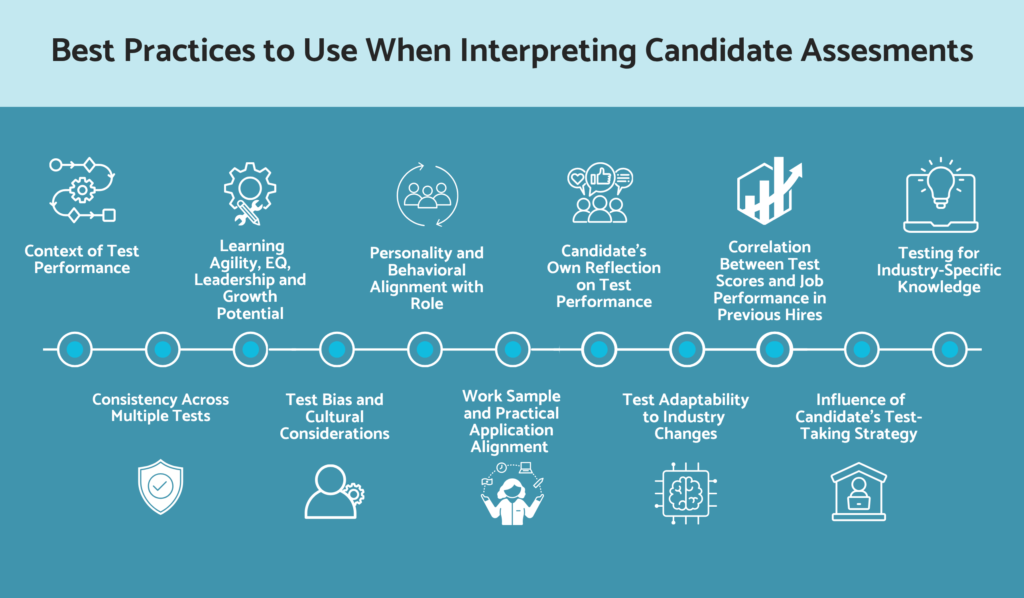
Here are the top 13 best practices employers should consider when evaluating candidate test results:
1. Context of Test Performance
Best Practice: Always consider external factors such as stress, fatigue, testing environment, and personal circumstances that may have influenced the candidate’s performance.
Scenario: An IT company administers a timed problem-solving test for a data analyst position. Candidate X scores lower than Candidate Y due to test anxiety, but performs exceptionally in hands-on case studies. The company must consider whether a high-pressure timed test accurately reflects the real work environment.
Use structured interviews and real-world case studies to assess candidates beyond test scores. Implement untimed or stress-adjusted tests to measure problem-solving ability in a realistic work environment.
2. Consistency Across Multiple Tests
Best Practice: Validate the candidate’s suitability for the role and skills using a combination of different assessments. Experienced recruiters can use multiple data points to make informed hiring decisions.
Scenario: Candidate X scores high in numerical reasoning but performs poorly in situational judgment and financial modeling tasks. If the company only focuses on the high numerical reasoning score, it might miss gaps in real-world decision-making ability.
Compare results across different test formats such as logical reasoning, situational judgment, and technical simulations. Use performance-based assessments to identify inconsistencies in decision-making skills.
3. Learning Agility and Growth Potential
Best Practice: Always check for the candidate’s ability to quickly learn and adapt to workplace challenges effectively. This means that you can assess their dedication to perform consistently at par with the expectations.
Scenario: A marketing agency hires a content strategist based on high creativity scores. However, six months later, the candidate struggles to adapt to changing digital marketing trends. The company failed to assess whether the candidate could learn and evolve with industry demands.
Include adaptive learning assessments and scenario-based tests to measure how candidates approach new challenges. Use behavioral interviews to evaluate their ability to learn and apply new concepts.
4. Test Bias and Cultural Considerations
Best Practice: Ensure that the test is standardized and culturally neutral. Train recruiters in AI and objective result analysis to help detect any bias in the recruitment process. This keeps your hiring process legally defensible while offering a fair selection process.
Scenario: A consultancy company uses a standardized psychometric test developed in one region to assess candidates from different backgrounds. Candidate B, who is highly skilled, scores lower because some questions contain cultural references that do not apply to their experience. The company should verify whether tests are fair and relevant across different demographics.
Get the right advice from top assessment providers like Assess Candidates to ensure your assessments are bias-free and discrimination-free. Conduct regular test audits to remove cultural biases and ensure fairness. Leverage AI-driven bias detection tools and data analytics to analyze test questions and provide context-neutral assessments.
5. Personality and Behavioral Alignment with Role
Best Practice: Utilize scientifically validated and industry-validated assessments to ensure you hire a candidate well-suited for both the role and the organization.
Scenario: A startup hires a financial controller who scores highly in logic and problem-solving but has low adaptability in their personality assessment. The company later struggles because the employee resists change in a fast-paced, evolving work environment. Matching personality traits to the work environment is crucial.
Administer personality assessments such as the Assess Candidates’ personality questionnaire, Big Five, or MBTI alongside structured interviews. Use role-specific behavioral simulations to see how candidates respond to workplace dynamics.
6. Work Sample and Practical Application Alignment
Best Practice: Validate the assessment scores with practical job tasks to help accurately predict the candidate’s job performance.
Scenario: A law firm administers a legal reasoning test for a junior associate position. Candidate A scores high but struggles to draft clear legal documents. Candidate B scores slightly lower but submits flawless case briefs in a practical assessment. The firm realizes that test scores alone do not capture real-world execution skills.
Include job-specific work samples, case studies, or task-based simulations. Use project-based assessments to evaluate execution skills rather than relying solely on test scores.
7. Candidate’s Own Reflection on Test Performance
Best Practice: Seek feedback from the candidates for a more accurate interpretation and ensure you both are on the same page.
Scenario: After a structured interview, the hiring team asks the candidate, “Did the test results reflect your strengths?” Candidate B, who scored lower on a logic test, explains that they misunderstood the instructions but demonstrated strong critical thinking in conversation. This additional insight helps the company reassess its decision.
Incorporate post-test debriefs where candidates explain their approach to test questions. Use self-assessment surveys to compare their perception of strengths with actual performance.
8. Test Adaptability to Industry Changes
Best Practice: Ensure the use of updated candidate assessments relevant to current industry demands to avoid risking mis-hires.
Scenario: A tech company uses a 5-year-old coding assessment to evaluate software engineers. Candidate A scores high but struggles with modern programming frameworks, not covered in the outdated test. The company recognizes the need to regularly update test materials to reflect the latest industry trends.
Update tests regularly using real-time job analysis and industry benchmarking tools. Integrate AI-driven skill assessments to ensure tests reflect current market trends.
9. Emotional Intelligence (EQ) and Leadership Potential
Best Practice: Always seek whether the candidate demonstrates self-awareness, teamwork, and emotional intelligence. These soft skills help gauge their fitness for the work culture and overall ability to perform effectively in the role in the long term.
Scenario: An engineering company hires a project manager based on high analytical and cognitive ability scores. However, they later struggle with team conflicts and leadership communication. The company failed to assess emotional intelligence (EQ), which is critical for managing people.
Use the Assess Candidates’ i-EQ™ assessment with situational judgment tests (SJTs) and role-playing exercises to evaluate EQ. Conduct structured behavioral interviews to assess leadership and conflict resolution skills.
10. Correlation Between Test Scores and Job Performance in Previous Hires
Best Practice: Cross-validate the similar test scores with previous hires to more accurately predict the candidate’s potential to succeed in the role. Regularly review and refine assessment methods based on performance outcomes.
Scenario: A retail company hires a sales manager based on high test scores in customer psychology. However, past employees who scored similarly underperformed in sales conversions. However, those who scored moderately but performed well in interviews and case studies succeeded. The company then realizes that its test scores do not correlate well with actual success in the role and needs a revision in its predictive hiring model.
Track long-term employee performance data and compare it with test results. Use predictive analytics and AI-driven hiring tools to refine assessments based on past hiring success.
11. Influence of Candidate’s Test-Taking Strategy
Best Practice: Ascertain the candidate’s ability to handle pressure through their ability to maintain speed with accuracy. As a result, you can shortlist only those candidates who can keep up with the company’s pace of operations.
Scenario: Candidate X finishes a psychometric test quickly, being a fast decision maker, he answers all questions, but with many careless mistakes. Candidate Y was relatively slower, strategically skipped a few harder questions, but got most answers correct, though scored lower due to speed penalties. The company assumes X is more capable based on completion rate, but in reality, Y’s approach reflects stronger decision-making skills.
Utilize balanced scoring methods, such as dual-metric testing, which evaluates both decision speed and accuracy. Depending on the job type, prioritize accuracy over speed and incorporate time management assessments that accurately reflect actual job demands.
12. Testing for Industry-Specific Knowledge
Best Practice: Ensure that the assessment test evaluates industry- and job-specific expertise, not just general skills. Weigh the candidates’ practical work experience and knowledge over just favoring generic assessment results for a complete and valid interpretation process.
Scenario: A fintech company hires a product analyst based on general analytical test scores. Candidate A excels in data analysis but lacks knowledge of financial regulations. Candidate B, who was rejected, has strong industry expertise but scored slightly lower than the other candidates. The company later realized that technical knowledge was more critical than raw analytical ability.
Combine general analytical assessments with industry-specific technical tests to ensure candidates possess both broad problem-solving skills and domain expertise.
13. Work Environment Compatibility
Best Practice: Always ensure you evaluate the candidate for both the role and the organizational fit. This includes evaluating them for their work preferences, personality, ability to work in a team, and professional acumen. While hard skills directly impact work performance, soft skills help maintain that performance level over the long term.
Scenario: A tech startup hires a software developer based on problem-solving test scores. Candidate A excels in independent thinking but struggles in collaborative settings. Candidate B, who was rejected, thrives in team discussions and agile work environments. The company later realizes that their work culture demands collaboration, making B the better choice.
Use culture-fit assessments, structured behavioral interviews, and teamwork-based simulations to evaluate work style compatibility.
The next stage focuses on how you can train recruiters for an accurate candidate test interpretation.
7. How to Train Recruiters to Interpret Multi-Assessment Test Scores with Accuracy?
Multi-assessment hiring frameworks consistently outperform single-assessment approaches because they evaluate candidates from multiple perspectives.
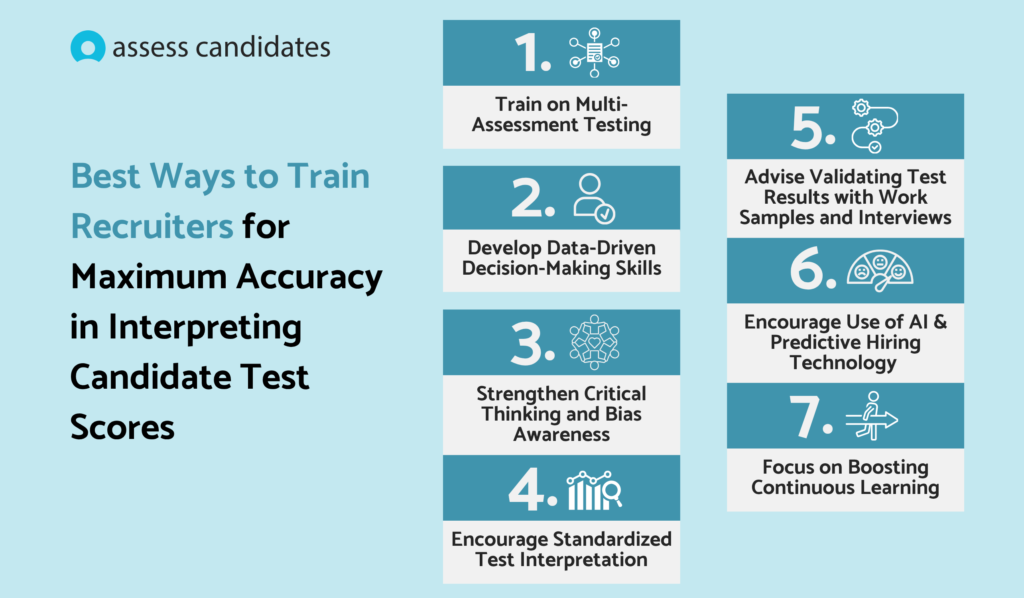
Here are some popular strategies to utilize multi-assessment testing for maximum accuracy in recruitment:
- Train Recruiters on Multi-Assessment Testing
Train recruiters in multi-assessment evaluation to help them understand how different tests complement each other. Incorporate hands-on exercises in workshops where recruiters compare candidate test scores with structured interview responses and work sample assessments to see how real-world performance aligns with test results.
Ensure your training sessions for candidate evaluation also use mock hiring scenarios. These further reinforce how multiple assessment tools create a complete candidate profile and prevent over-reliance on a single test.
- Develop Recruiters’ Data-Driven Decision-Making Skills
Train recruiters on tracking, analyzing, and interpreting test results in correlation with long-term employee performance. Include real-world hiring data reviews to identify patterns between test scores and probation success rates.
Hiring teams should also learn to utilize predictive hiring analytics to identify which test factors most closely correlate with the top performers. Incorporate Interactive training on bias-free decision-making to ensure recruiters balance test scores with job performance indicators rather than relying solely on numbers.
- Strengthen Recruiters’ Critical Thinking and Bias Awareness
Train hiring managers in critical thinking and structured decision-making. Conducting bias awareness workshops should involve blind hiring case studies, where recruiters assess anonymous test results and later compare their choices to actual employee performance data.
Employers should also practice structured evaluation methods, ensuring every candidate is assessed using the same criteria rather than subjective impressions. Bias detection tools help recruiters recognize and minimize favoritism in test interpretation.
- Encourage Standardized Test Interpretation with Scorecards and Frameworks
Train recruiters for candidate test evaluation in developing and using scorecards that combine test results, structured interview feedback, and work sample assessments to ensure holistic hiring decisions.
Conduct monthly recruiter calibration meetings to ensure all team members follow the same interpretation methods to reduce discrepancies in candidate selection.
- Train Recruiters to Validate Test Results with Work Samples and Interviews
Train recruiters in validating assessments through structured interviews and work sample tests. Training should involve competency-based interviews, where recruiters ask targeted questions based on a candidate’s test performance to verify their skills.
Conduct hands-on training to allow recruiters to upskill in analyzing practical job simulations, ensuring test scores align with actual task execution. Educate them on how to effectively utilize structured follow-up questioning to assess whether candidates understand their test responses or guessed answers.
- Train Recruiters to Use AI & Predictive Hiring Technology
Train the hiring managers in AI-driven hiring tools with hands-on learning to allow them to enhance test interpretation accuracy by identifying patterns in high-performing candidates. Teach them through real-time examples of how AI detects correlations between test scores, job success rates, and long-term employee retention.
Employers should also practice interpreting AI hiring recommendations to avoid over-relying on automated decisions while ensuring data-driven hiring strategies.
- Encourage Continuous Learning & Recruiter Certifications
Encouraging continuous learning in recruiters through certifications in hiring analytics, pre-employment testing, and bias-free hiring to strengthen their expertise. Providing access to industry webinars, HR technology summits, and AI-driven recruitment workshops to help them stay ahead of evolving hiring trends.
Organizations should focus on offering internal peer-to-peer training programs to allow experienced recruiters to mentor new hires for consistent skill development across teams.
Enhance your hiring process with objective talent assessment using our pre-employment tests. VIEW PLANS
Accurate interpretation also depends on which candidate assessment provider you choose. Let’s find out why top employers use us.
8. Why do top companies trust Assess Candidates’ pre-employment tests to hire?
At Assess Candidates, we specialize in a variety of pre-employment aptitude, psychometric tests, and video interview tool to ensure a holistic candidate evaluation for organizational culture and job role fit. With us, you can build a recruitment campaign tailored to meet the unique hiring needs of any organization.
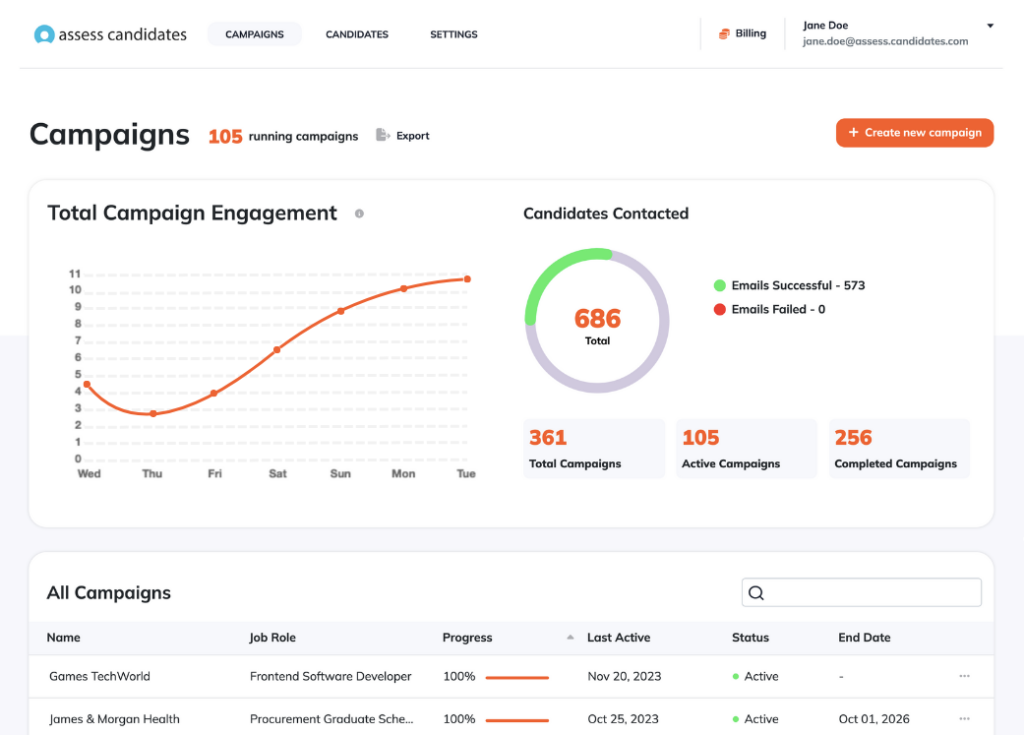
Below is an example of our campaign reporting dashboard available on Assess Candidates. This tool is accessible to hiring managers and talent acquisition professionals, providing valuable insights and easy-to-use sorting functions to streamline candidate assessment.
Here are the top four reasons why you should use Assess Candidates’ pre-employment assessments as part of your online pre-employment testing:
1. Scientifically Validated Design: Assess Candidates’ pre-employment aptitude tests are developed by Chartered Scientists, Psychologists, and Psychometricians with decades of experience designing assessment solutions for companies like SHL, IBM Kenexa. Our psychometric tests have undergone rigorous testing and validation to accurately measure candidates’ cognitive abilities and personality traits. These tests have consistently proven successful in selecting and hiring top talent across various organizations and industries.
2. Expert Reporting: Assess Candidates’ user-friendly and easy-to-navigate assessment platform enables employers to analyze candidate reports in detail and make informed hiring decisions based on flexible criteria. In practice, recruiters can easily view individual candidates’ performance on different aptitude and personality tests, and then filter, rank, and shortlist candidates. Additionally, our talent assessment platform also offers the option to integrate with your existing ATS for a seamless experience.
3. Positive Candidate Experience: Assess Candidates’ assessment platform is easily accessible from any device and features an aesthetic and easy-to-use interface for candidates. It provides clear assessment instructions and can be fully branded to match your organization. The tests are designed to require minimal clicks to complete, with the assessment automatically moving to the next question once answered. This consequently ensures a seamless and positive candidate experience, which they will associate with your brand.
4. Accessibility Support: Assess Candidates offers support for individuals with disabilities and visual impairments. All our assessments have the option to add extra time, include zoom functionalities, and ensure the use of accessible color schemes and images in compliance with Web Content Accessibility Guidelines (WCAG) to ensure compatibility with screen readers.
Assess Candidates is one of the major pre-employment aptitude test providers proven to help small, medium, and large employers successfully hire top, best-fit candidates. Why not explore Assess Candidates’ assessments and start hiring today!
Conclusion: Key Takeaway
Candidate assessment results are only valuable when interpreted within the broader hiring context. Employers that combine assessment data with interviews, work samples, behavioral insights, and structured decision-making frameworks are significantly more likely to make accurate and defensible hiring decisions.
Interested in getting the latest insights and advice on candidate assessment? Keep reading for frequently asked questions and to sign up with your email below to get started.
Frequently Asked Questions
How do predictive analytics work for hiring?
Predictive analytics in hiring works by allowing the recruiter to analyze past hiring data, test scores, and job performance trends to forecast which candidates will succeed in a role. It utilizes AI-driven platforms to assess patterns, skill gaps, and behavioral traits for data-driven decision-making.
Which training programs to refer for training recruiters in candidate evaluation?
Hiring teams should enroll in training programs such as LinkedIn Recruiter Learning Hub and SHRM Talent Acquisition Certification to train them in accurate candidate evaluation. These programs cover candidate evaluation, bias reduction, AI-driven hiring, and structured interview techniques.
What challenges do recruiters face when interpreting pre-employment test assessments?
Experienced recruiters often face challenges such as test misinterpretation, candidate test anxiety, skill assessment mismatches, and bias in scoring. Improper test designs fail to measure real-world job performance, while over-reliance on scores, ignoring soft skills, adaptability, and cultural fit, risks mis-hires.
Which traditional hiring tools do employers use to interpret candidate test scores?
Most organizations use traditional hiring tools such as structured interviews, manual resume screening, reference checks, academic qualifications, and written aptitude tests. These tools help validate candidate test results by comparing them with past performance, experience, and professional recommendations, ensuring well-rounded hiring decisions.
How can recruiters identify bias in their decision-making?
Recruiters should use proven tools such as Harvard Implicit Bias Tests, AI-driven candidate evaluations, structured interviews, and blind hiring tools to detect bias. Train in unconscious bias and fair hiring practices to ensure objective decision-making.


 English
  Arabic