
Top 10 Challenges Recruiters Face in Hiring and How to Overcome Them



Contents
- What are recruiters’ challenges in hiring?
- Top 10 challenges recruiters face in hiring
- The benefits of overcoming these challenges in recruitment
- The future of recruitment: Trends to watch
- Why do top companies trust Assess Candidates’ pre-employment tests to hire?
So, now let’s dive into the article, starting with defining what we mean by recruiters’ challenges.
1. What are recruiters’ challenges in hiring?
Recruiters’ hiring challenges are the obstacles talent acquisition teams face when sourcing, assessing, attracting, and retaining qualified candidates while balancing business objectives, hiring speed, candidate experience, and workforce demands.
Understanding these pain points is essential for improving hiring efficiency, reducing costs, and securing top talent before the competition does.
Overcome your hiring challenges with our reliable, science-backed candidate assessment platform. HIRE FOR FREE
Now, let’s explore in detail the top 10 challenges recruiters face in hiring and their solutions.

2. Top 10 challenges recruiters face in hiring
Recruitment has become increasingly complex due to talent shortages, rising candidate expectations, and rapid workplace change.
However, with the right strategies, hiring professionals can effectively overcome the challenges that come with hiring.
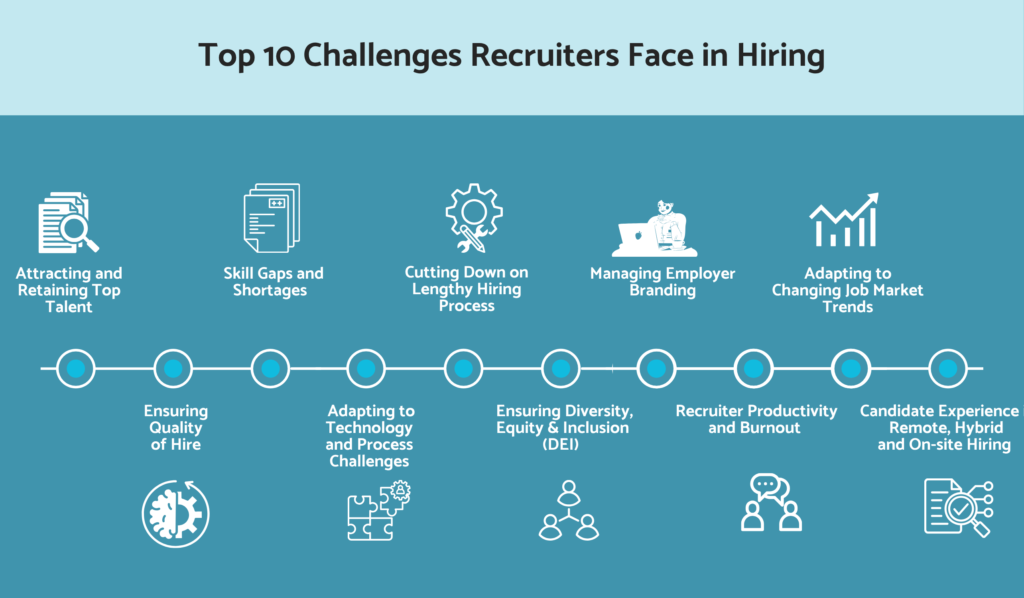
Here are the top 10 recruitment challenges recruiters face in hiring and how to overcome them:
1. Attracting and Retaining Top Talent
Competition for skilled talent remains intense, particularly in specialist fields such as healthcare and engineering where strong candidates often have multiple opportunities available at the same time.
Companies face high offer-drop rates from passive candidates due to a weaker employer brand and bottlenecks in the screening process.
How to attract and retain top talent?
- Balance Expectations: Ensure you and the candidate are on the same page from the start by providing a detailed and precise job description. Additionally, have an open discussion in the interview to clarify any candidate’s doubts and expectations for the role.
- Enhance Candidate Experience: Maintain a transparent and efficient recruitment process by leveraging the latest technology, including video interviews. Send timely updates and avoid ghosting.
- Boost your Employer Branding: Establish a strong and consistent brand presence across LinkedIn, Glassdoor, and your careers pages. Share employee testimonials and showcase your workplace culture to enhance your market presence.
Example: A tech startup competing with bigger firms can attract top engineers by highlighting its culture of innovation, flexible work schedules, and opportunities for rapid career growth.
2. Ensuring Quality of Hire
Recruiters face a significant challenge when hiring candidates, especially during graduate recruitment. Balancing speed and quality to ensure hires fit the role and culture is a crucial task, as bad hires increase turnover, costs, and team disruption. Therefore, recruiters must select an effective recruitment strategy to ensure a successful hiring process.
How to ensure quality of hire?
- Prioritize Skills-based Hiring: Incorporate skills-based assessments, such as psychometric tests, to evaluate candidates fairly and holistically. It will also provide strong candidates from non-traditional career paths and recent graduates with an opportunity to showcase their abilities.
- Update Your Recruitment Process: Ensure your hiring process is up-to-date with the latest job and market trends for the role.
- Look for Authentic Resumes: Use the latest ATS (Applicant Tracking System) for a complete evaluation of the candidate’s resumes for any inaccuracies or vague information. Address any red flags you find with the candidates in the subsequent hiring rounds.
- Evaluate Their Culture Fit: Ensure the candidate’s personality, behavioral tendencies, and career aspirations align with the company’s work culture, vision, and mission. This will avoid risking mis-hires due to contrasting and conflicting dynamics.
Example: An insurance company reduced new hire turnover by 25% after introducing “Day in the Life” videos during recruitment to set realistic expectations.
3. Skill Gaps and Shortages
Industries such as AI, healthcare, and cybersecurity are rapidly evolving, with new skills entering the market. These specialized skills are in high demand, while the available talent pool remains limited. Therefore, an efficient hiring and outreach process is crucial to securing the best-skilled talent for the company, especially when the job requires high-level precision and accuracy, such as that of an AI engineer or physician.
How to reduce skill gaps and talent shortages?
- Partner with educational institutes: This ensures you directly tap into the talent pool through recruitment or placement drives. It further helps you establish your brand as reliable and trustworthy.
- Invest in upskilling/reskilling programs: Focus on upskilling and reskilling your existing employees to help you save on time and hiring costs. This will help increase employee satisfaction and support long-term retention. Additionally, employees’ positive reviews about the role will further boost your brand reputation, thus attracting more potential talent.
- Boost your social media presence: Establish your brand on major social media platforms, such as Instagram, X, and LinkedIn, to effectively reach Gen Z and millennials. This will give your public presence and your employer’s brand reputation a major boost.
- Host career development opportunities: Organize workshops, hands-on training, and leadership programmes to boost your brand image, especially amongst Gen Z. This allows you to gain market traction as an employer brand that actively supports employees’ development goals and career plans.
Example: A cybersecurity firm partnered with universities to create internship-to-hire pipelines, proactively addressing the talent shortage.
4. Adapting to Technology and Process Challenges
In the era of continuously changing technology, keeping up with its fast pace becomes difficult for recruiters. This causes them to overly rely on outdated norms and recruitment methodologies such as manual interview scheduling, inconsistent candidate communication flow, and inefficient use of ATS and psychometric tools. Therefore, it is essential to address resistance to new hiring technologies and modern recruitment methods.
How to reduce technological and process challenges in hiring?
- Hear out the managers: Use a democratic leadership style to encourage openness to the perspectives of the managers. Focus on resolving their ambivalences regarding the recruitment technology with science.
- Back your approach with science: Use reliable and scientifically validated hiring tools to support their use in the recruitment process. Focus on the overall benefits that standardized assessments and tools serve in combination with conventional hiring tools such as interviews.
- Highlight the positives: Reiterate the benefits of combining the latest AI technology, such as video interviews, game assessments, and job simulations, in the hiring process. Discuss how these standardized assessments will help give objective insights into the candidate’s job potential quickly.
- Focus on the why: Highlight the role of the latest recruitment technology in boosting the efficiency, objectivity, and effectiveness of the hiring process. Additionally, iterate on how these engaging tools make the process more candidate-friendly and inclusive.
Example: A mid-sized retail company adopted an AI-driven video interviewing platform along with psychometric game-based assessments. Within 4 months, time-to-hire was reduced by 40%, candidate satisfaction improved by 25%, and hiring managers reported a sharper alignment between candidate skills and role requirements.
5. Cutting Down on Lengthy Hiring Process
While all-around candidate assessment for high-level roles is a must for recruiters, it comes at a major cost. Multiple interview rounds and assessment stages, though they boost the predictive validity of the hiring process, can render the process quite long and frustrating for the candidates. This risks losing out on potentially high-performing talent, especially if they can’t find the relevance of the process.
How to reduce a lengthy hiring process?
- Simplify the process: Streamline the recruitment process by reducing unnecessary interview rounds by using structured assessments such as job simulations and skills-based tests.
- Make the hiring engaging: Incorporate game-based assessments with other psychometric tests to make the process interactive. This will help boost candidate experience while reducing test fatigue and anxiety.
- Bring in the automation: Use AI automated tools, such as video interviews and the latest ATS software, to pre-screen candidates for high-stakes hiring stages such as assessment centers.
- Seek candidate feedback: Engage the candidates throughout the assessment process. This helps establish the candidate’s trust and, at the same time, helps you improve the hiring process.
Example: A SaaS firm cut its interview rounds from six to three and introduced same-day feedback, cutting time-to-hire by 45%.
6. Ensuring Diversity, Equity & Inclusion (DEI)
Ensuring diversity, equity, and inclusion in hiring goes beyond being a social responsibility as it directly impacts business performance and innovation. Yet, recruiters often fall into patterns of unconscious bias during the sourcing, resume screening, or interviewing process, leading to homogeneous teams. This not only restricts organizational creativity but can also discourage underrepresented groups from applying in the first place, thereby limiting access to top talent.
How to promote diversity, equity, and inclusion in hiring?
- Promote fair sourcing: Widen the talent pipeline by implementing blind resume screening and leveraging AI-driven tools that focus on skills over demographics. Actively source from diverse job boards, professional groups, and communities to reduce bias in the earliest stages.
- Standardize assessments: Build fairness into the process by using competency-based interviews, structured scoring rubrics, and scientifically validated psychometric tools. This minimizes subjectivity and ensures every candidate is evaluated on the same parameters.
- Foster inclusivity: Strengthen employer branding by highlighting diverse employee stories, inclusive policies, and equitable career growth opportunities. Representation signals belonging and encourages a broader range of candidates to apply.
- Train for awareness: Equip recruiters and hiring managers with training on unconscious bias and inclusive practices. Continuous culture sensitivity training and awareness programs ensure that fairness is sustained across sourcing, interviewing, and selection stages.
Example: A financial services firm implemented blind resume reviews and structured interview rubrics, which resulted in a 25% increase in female hires for technical roles and improved innovation scores in project teams.
7. Managing Employer Branding
In today’s competitive talent market, candidates research companies thoroughly before applying. A poor online presence, negative employee reviews, or weak employer branding can deter high-quality applicants and even lead current employees to disengage. A lack of transparency around growth opportunities or workplace culture further weakens trust in the organization, making it harder to attract and retain talent.
How to boost employer branding?
- Showcase authenticity: Share employee testimonials and real career journeys to present an honest picture of the workplace culture. Candidates value stories from peers more than corporate statements.
- Strengthen visibility: Keep professional networks like LinkedIn and Glassdoor updated with regular posts about company achievements, community initiatives, and learning opportunities. A consistent online presence builds credibility.
- Build trust with transparency: Clearly communicate career growth paths, diversity initiatives, and work-life balance policies. Transparency shows candidates that the company has nothing to hide and builds long-term trust.
- Engage employees as ambassadors: Encourage current employees to share positive experiences on social platforms. Empowering them as brand advocates extends reach and strengthens authenticity in employer branding.
Example: A logistics company struggling with negative perceptions transformed its employer image by launching a LinkedIn campaign featuring employee success stories and career growth testimonials. Within 6 months, candidate applications rose by 30%, and the company’s Glassdoor ratings improved significantly.
8. Recruiter Productivity and Burnout
Many recruiters manage competing priorities daily, from stakeholder demands to candidate engagement, making workload management increasingly challenging. This dual strain often leads to reduced screening quality, rushed hiring decisions, and eventually high turnover in recruitment teams. If left unchecked, burnout not only hurts recruiters but also undermines long-term hiring efficiency and candidate experience.
How to reduce recruiters’ burnout to boost their productivity?
- Streamline tasks: Automate routine activities like interview scheduling, resume parsing, and candidate updates using advanced ATS and AI tools. This allows recruiters to focus on strategic work such as candidate engagement and talent advisory.
- Balance workloads: Monitor recruiter capacity and set realistic hiring timelines. Redistribute requisitions when needed and use labor market data to help managers understand candidate availability and time-to-hire realities.
- Foster collaboration: Reduce recruiter-manager friction by holding regular check-ins, sharing pipeline dashboards, and jointly refining candidate profiles. This builds shared accountability and prevents last-minute conflicts.
- Support well-being: Promote wellness initiatives, flexible work arrangements, and open communication channels. A supportive environment keeps recruiters motivated, resilient, and better equipped to deliver quality outcomes.
Example: A leading retail chain eased recruiter burnout by automating scheduling and candidate communication, while introducing weekly alignment meetings with store managers. This reduced hiring bottlenecks during seasonal peaks and improved recruiter retention by 13%.
9. Adapting to Changing Job Market Trends
Few areas of business are changing as quickly as the labor market, forcing recruitment teams to continuously adapt their hiring strategies.
Failing to adapt can lead to outdated sourcing practices, missed opportunities, and a shrinking talent pool.
How to boost recruiters’ adaptability to market trends?
- Track industry trends: Stay updated through HR forums, labor market reports, and professional networks to anticipate shifts in skills demand.
- Adapt sourcing strategies: Use digital platforms, gig networks, and specialized job boards to access talent pools aligned with emerging roles.
- Offer flexibility: Attract modern candidates by providing hybrid work, flexible contracts, and project-based opportunities.
- Upskill recruiters: Train recruitment teams in digital-first hiring methods, AI-enabled assessments, and inclusive sourcing to stay competitive.
Example: A consulting firm improved hiring success by shifting to a remote-first model, widening its global talent pool, and filling niche roles faster.
10. Candidate Experience in Remote, Hybrid, and On-site Hiring
Candidate experience shapes employer brand, retention, and overall hiring success; however, expectations shift with work models. In remote or hybrid hiring, challenges such as time zone gaps, a lack of in-person connection, and cultural compatibility checks make engagement even more difficult. Long, unstructured processes can quickly disengage candidates and increase early attrition. Recruiters must strike a balance between personalization and automation, ensuring every candidate feels valued, regardless of their work setup.
How to boost candidate experience in hiring?
- Transparent communication: Keep candidates informed with clear timelines. Automated updates build consistency, while personalized check-ins from recruiters make the process feel human.
- Efficiency over complexity: Streamline by cutting unnecessary rounds. Use skills-based or project-based tasks that adapt well to remote/hybrid interviews.
- Trust through feedback: Share interview outcomes quickly. Even rejections delivered with clear reasons improve brand perception and reduce ghosting.
- Retention via onboarding: Strong onboarding prevents early exits. Pair new hires with mentors or buddies and reinforce cultural alignment from day one.
Example: A healthcare firm hiring hybrid roles reduced ghosting and early attrition by combining automated updates with recruiter check-ins and structured onboarding buddies.
Recruit global talent hassle-free with our top assessment tests. LEARN MORE
Now, let’s discover the major benefits for recruiters in overcoming challenges in recruitment.
Here are the top reasons why overcoming recruiters’ challenges is important:
3. The benefits of overcoming these challenges in recruitment
Organizations that address recruitment bottlenecks proactively are typically better positioned to secure high-quality talent ahead of competitors. Overcoming these challenges also helps to improve quality of hire, employer branding, productivity and job satisfaction in the long run.
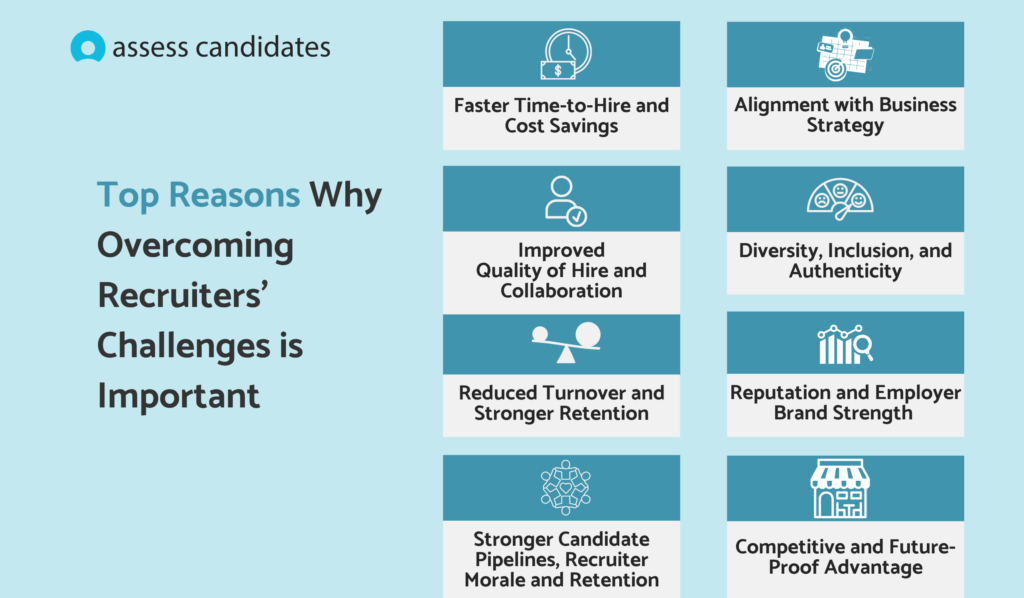
- Faster Time-to-Hire and Cost Savings
Vacant roles cost businesses money every day in lost productivity and added strain on teams. By streamlining recruiter workflows and reducing administrative burdens, companies cut down on delays, re-hiring expenses, and agency fees, therefore, making hiring both quicker and more cost-efficient.
- Improved Quality of Hire
When recruiters have the right tools and time to assess skills, validate resumes, and align expectations, they select candidates who perform better and fit the role. This results in higher-performing employees and long-term success for the company.
- Stronger Candidate Experience and Trust
Transparent communication, respectful treatment, and timely feedback make candidates feel valued, even if they don’t get the job. This boosts the company’s reputation, encourages referrals, and strengthens the employer brand in the wider talent community.
- Reduced Turnover and Stronger Retention
Addressing recruiter challenges ensures a better cultural fit between candidates and companies. Employees who feel aligned are more engaged, satisfied, and stay longer, which reduces the high costs of turnover and rehiring.
- Stronger Candidate Pipelines
With fewer bottlenecks, recruiters can nurture long-term talent pools. This ensures future openings can be filled faster and with better-quality candidates, giving the company a reliable pipeline of skilled professionals.
- Alignment with Business Strategy
Recruiters who aren’t bogged down by admin work can focus on strategic goals like supporting digital transformation, global expansion, or AI-driven roles. Hiring becomes a driver of growth rather than just a support function.
- Diversity, Inclusion, and Authenticity
By reducing bottlenecks, recruiters can source diverse talent and screen resumes more thoroughly for authenticity by incorporating skills-based tasks. This not only improves fairness and innovation but also protects the company from the risks of inflated credentials.
- Recruiter Morale and Retention
Recruiters themselves face burnout when overloaded. Supporting them with better tools, training, and collaboration improves satisfaction, loyalty, and productivity, thus reducing attrition within HR teams.
- Better Collaboration Across Teams
Recruitment challenges often come from mismatched expectations between hiring managers and candidates. Addressing these improves collaboration, communication, and understanding of people dynamics, leading to smoother processes.
- Reputation and Employer Brand Strength
Every candidate interaction shapes how the company is perceived. A streamlined, respectful process reduces ghosting and negative reviews, strengthening the employer brand and making the company more attractive to top talent.
- Competitive and Future-Proof Advantage
Organizations that empower recruiters with efficient platforms, ATS systems, and adaptive strategies gain a competitive edge in volatile markets. They can manage high application volumes, balance expectations, and adapt faster, ensuring the recruitment function is future-proof.
Future-proof your hiring process with science-backed pre-employment tests. HIRE FOR FREE
4. What is the future of recruitment?
Recruitment is entering a period of significant transformation driven by AI, changing workforce expectations, and persistent skills shortages.
Recruiters face growing pressure to bridge the widening skills gap, particularly in STEM-heavy industries such as IT, engineering, and healthcare. This challenge is intensified by economic uncertainty, where shifting business priorities make long-term workforce planning difficult. Recruiters must stay agile, balancing the need for speed with quality and realistic hiring manager expectations.
At the same time, technology and AI are transforming how recruiters work. While recruitment systems promise efficiency, many tools remain fragmented, requiring careful integration and specialist knowledge. The rise of AI will also reshape job markets dramatically, making transferable skills more important than traditional experience. Candidate experience and employer branding will remain critical differentiators, as long processes, ghosting, or poor feedback quickly damage reputation. Ethical recruitment, ensuring fairness, transparency, and unbiased practices, will gain greater importance as automation scales decision-making.
Evolving workplace trends such as hybrid and remote work and a renewed emphasis on DEI initiatives will also redefine the recruiter’s role. Cultural fit, retention, and inclusion will be harder to assess virtually, yet central to long-term success. Recruiters of the future must act as strategists, technologists, and ethical leaders, driving not just efficient hiring but also trust, fairness, and inclusivity.
Enhance your recruitment process with our talent assessment platform. LEARN MORE
So, why choose us?
5. Why do top companies trust Assess Candidates’ pre-employment tests to hire?
At Assess Candidates, we specialize in a variety of pre-employment aptitude, psychometric tests, and video interview tool to ensure a holistic candidate evaluation for organizational culture and job role fit. With us, you can build a recruitment campaign tailored to meet the unique hiring needs of any organization.
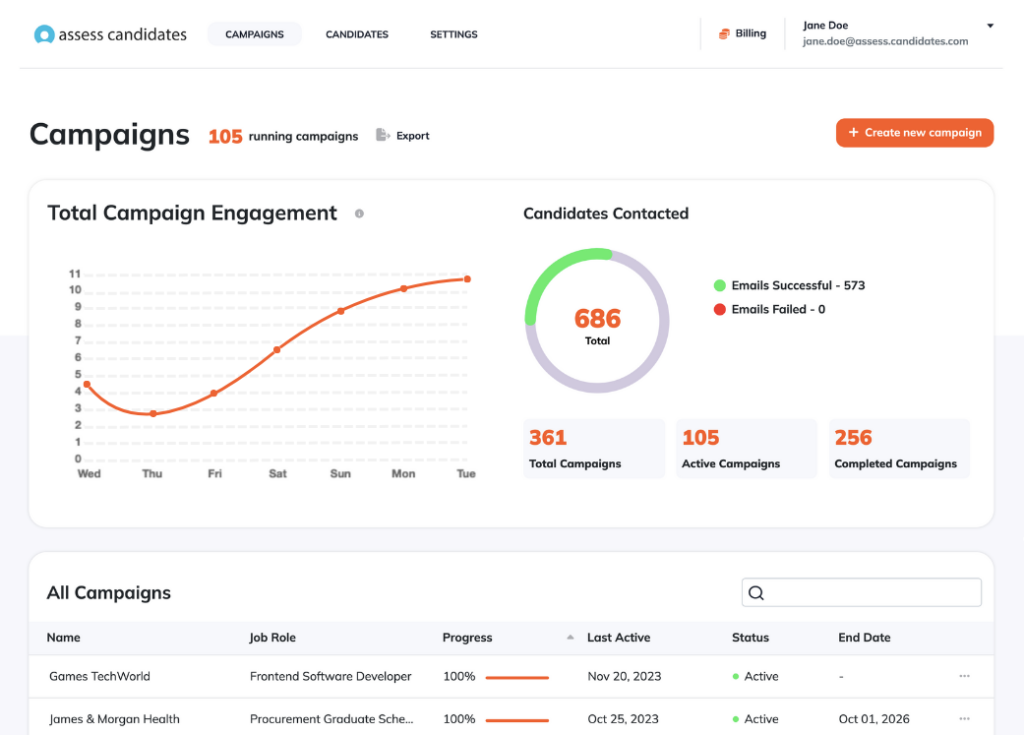
Below is an example of our campaign reporting dashboard available on Assess Candidates. This tool is accessible to hiring managers and talent acquisition professionals, providing valuable insights and easy-to-use sorting functions to streamline candidate assessment.
Here are the top four reasons why you should use Assess Candidates’ pre-employment assessments as part of your online pre-employment testing:
1. Scientifically Validated Design: Assess Candidates’ pre-employment aptitude tests are developed by Chartered Scientists, Psychologists, and Psychometricians with decades of experience designing assessment solutions for companies like SHL, IBM Kenexa. Our psychometric tests have undergone rigorous testing and validation to accurately measure candidates’ cognitive abilities and personality traits. These tests have consistently proven successful in selecting and hiring top talent across various organizations and industries.
2. Expert Reporting: Assess Candidates’ user-friendly and easy-to-navigate assessment platform enables employers to analyze candidate reports in detail and make informed hiring decisions based on flexible criteria. Recruiters can easily view individual candidates’ performance on different aptitude and personality tests, and then filter, rank, and shortlist candidates. Additionally, our talent assessment platform also offers the option to integrate with your existing ATS for a seamless experience.
3. Positive Candidate Experience: Assess Candidates’ assessment platform is easily accessible from any device and features an aesthetic and easy-to-use interface for candidates. It provides clear assessment instructions and can be fully branded to match your organization. The tests are designed to require minimal clicks to complete, with the assessment automatically moving to the next question once answered. This ensures a seamless and positive candidate experience, which they will associate with your brand.
4. Accessibility Support: Assess Candidates offers support for individuals with disabilities and visual impairments. All our assessments have the option to add extra time, include zoom functionalities, and ensure the use of accessible color schemes and images in compliance with Web Content Accessibility Guidelines (WCAG) to ensure compatibility with screen readers.
Assess Candidates is one of the major pre-employment aptitude test providers proven to help small, medium, and large employers successfully hire top, best-fit candidates. Why not explore Assess Candidates’ assessments and start hiring today!
Conclusion: Key Takeaway
Recruitment challenges will continue to evolve as technology, workforce expectations, and labor markets change. Organizations that invest in modern hiring processes, structured assessments, and strong candidate experiences will be better positioned to attract, hire, and retain top talent in 2026 and beyond.
Interested in learning more about effective candidate assessment? Continue reading for frequently asked questions, and sign up with your email to get started.
Frequently Asked Questions
Why should recruiters focus on improving hiring challenges?
Recruiters, when addressing hiring challenges head-on, help businesses by reducing the time to hire while also improving the diversity and quality of hires. This strategy helps improve the company’s reputation and brand in the long run by cutting down on employee turnover and thus building strong candidate pipelines. A well-growing organization, in return, also boosts the recruiter’s morale through a future-proof business that well-aligns with the company’s mission.
How can recruiters manage candidates’ expectations in recruitment?
Recruiters can manage expectations by ensuring clear, consistent, and transparent communication at every stage of the process. This includes outlining job roles, responsibilities, salary ranges, career growth opportunities, and timelines early on. Use personalized feedback and offer regular updates on hiring progress to avoid uncertainty, to build trust and credibility. This ensures higher candidate satisfaction and a stronger employer reputation.
How do recruiters match people’s dynamics while hiring?
Recruiters match people’s dynamics by assessing cultural fit, behavioral traits, and team compatibility alongside technical skills using advanced hiring tools with interviews. These include psychometric testing, assessments of emotional intelligence, and role-specific simulations to predict how candidates will interact with colleagues and align with the organizational culture. This ensures employers hire candidates while ensuring long-term employee engagement, collaboration, and retention, making the workforce more cohesive and resilient.
What major challenge did employers face after the COVID-19 pandemic in hiring?
After COVID-19, employers struggled to adapt to remote and hybrid work models while ensuring talent retention. Industries faced digital skill shortages as candidates prioritized flexibility, well-being, and work-life balance over traditional benefits. Maintaining engagement and culture in virtual settings proved difficult, and many lacked the infrastructure for digital hiring tools, creating a gap between employee expectations and organizational needs.
How do recruiters manage high-volume hiring with limited resources?
Recruiters manage high-volume hiring with limited resources by using AI-driven ATS to automate resume screening, scheduling, and assessments, while prioritizing roles based on business impact. To ensure retention and quality of hire, they emphasize cultural fit, give realistic job previews, and collaborate on onboarding. This balances speed with long-term success, reducing workload and early turnover.


 English
  Arabic