
Top Cultural Fit Questions Every Interviewer Should Ask



Cultural fit interview questions can help employers understand how candidates approach teamwork, communication, accountability, and workplace expectations. However, cultural fit should not mean hiring people who share the same personalities, backgrounds, or preferences as existing employees.
This guide covers 18 interview questions, examples of strong answers, potential concerns to explore, and practical ways to assess job-relevant behaviors consistently.
Contents
- How to assess cultural fit in interviews?
- What are the types of cultural fit interview questions?
- What are the common interview mistakes made when assessing cultural fit?
- Why do top companies use Assess Candidates for assessing cultural fit?
Now that we’ve summarized what this article covers, let’s explore how to assess cultural fit in interviews.
1. How to assess cultural fit in interviews?
To assess cultural fit in interviews, define the workplace values and behaviors relevant to the role before meeting candidates. Ask consistent, structured questions and score responses against observable criteria rather than personal preferences.
This helps employers assess alignment while remaining open to different perspectives and working styles.
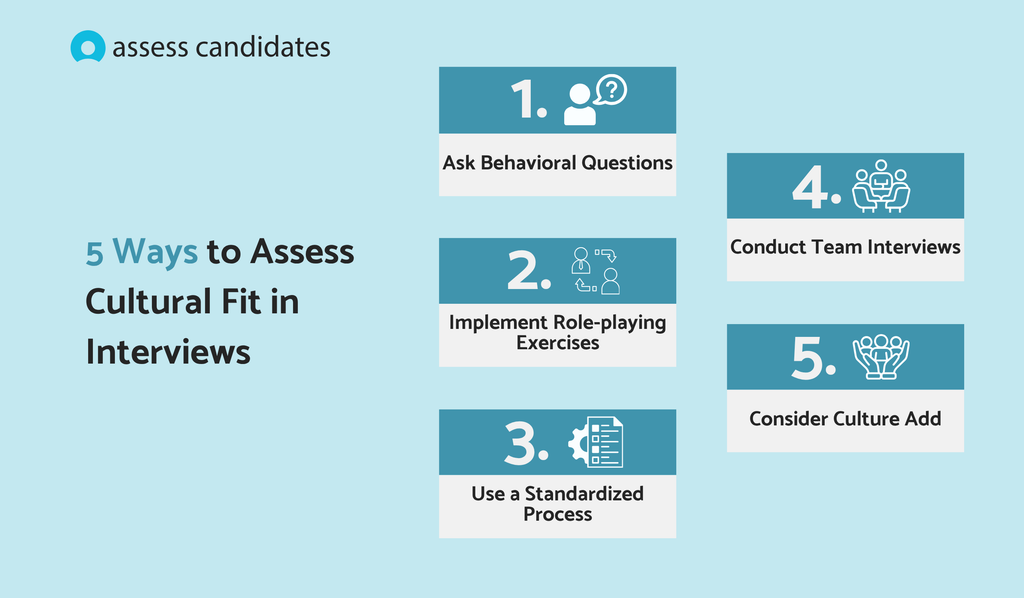
Below are the 5 major ways in which you can assess cultural fit in interviews.
1. Ask Behavioral Questions
Behavior-based questions help you understand a candidate’s past actions and decision-making processes in their previous jobs. Ask candidates about the real-world situations they have experienced and their way of handling them. This provides insights into their values and work style.
Example 1. “Tell me about a time you had a disagreement with your manager in a past job. What did you do to resolve it?”
2. Implement Role-playing Exercises
Using role-play exercises in your hiring process is another great way of observing candidates in action. Present them with a scenario that mirrors a real workplace and ask the candidates to participate. This can provide evidence into a candidate’s problem-solving, communication, and decision-making skills.
Example 2. “Focusing on the given scenario of an angry customer who was wrongly charged a fee, play the role of a bank manager. Resolve the issue while maintaining customer trust.”
3. Use a Standardized Process
Always assess candidates using a standardized interview process against the same predefined criteria. Conduct structured interviews and use the same set of questions for every candidate. This makes the comparisons more consistent and reduces bias.
4. Conduct Team Interviews
Team interviews can provide additional perspectives on a candidate’s job-relevant behaviors and give applicants an opportunity to meet potential colleagues. To limit group bias, interviewers should use agreed criteria, record their observations independently, and discuss evidence rather than relying on collective impressions.
5. Consider Culture Add
Don’t always focus on hiring candidates who resemble your existing team. Consider culture add and assess candidates depending on whether they can contribute to the company’s culture, including perspectives and approaches that are not yet discussed.
Did you know? According to Alex Moore, director of talent acquisition at Credera, “Culture add-aligned candidates have the will and skill to think differently. If you want your company to continue to grow and evolve, your culture must grow and evolve along with it.”
Hire the candidates suited to your role requirements with our pre-employment assessments. HIRE FOR FREE
This brings us to the most important topic: what types of cultural fit interview questions are there?

2. What are the types of cultural fit interview questions?
The following 18 cultural fit interview questions cover six areas: teamwork, communication, accountability, feedback, initiative, and culture contribution. For each question, look for specific examples and reasoning. Treat potential concerns as prompts for follow-up questions, not automatic reasons to reject a candidate.
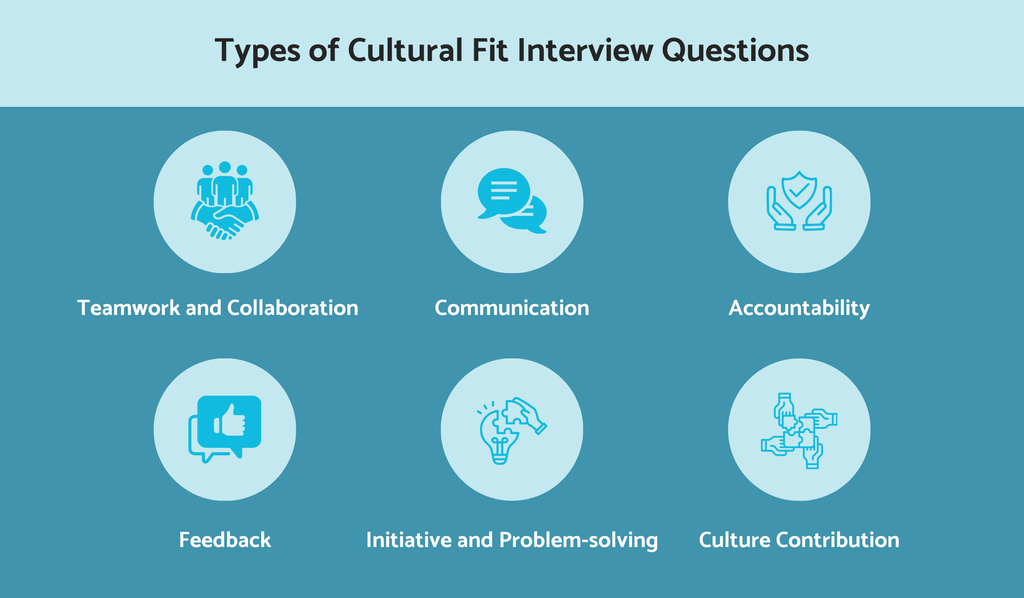
A strong cultural fit interview does not ask whether a candidate is like the existing team. It asks whether they can contribute to the work, uphold essential workplace values, and collaborate effectively with people who may think differently.
1. Teamwork and Collaboration
Teamwork and collaboration questions help assess how candidates work with colleagues to achieve shared goals. These questions also evaluate candidates’ communication skills, cooperation, and ability to work with different working styles.
Question: How do you resolve conflicts with a team member?
Strong answer: The candidate addresses the issue constructively, listens to the other’s perspective, identifies the root cause, and works towards a practical solution.
Potential concerns: The candidate avoids addressing the conflict, escalates the situation unnecessarily, gets into a heated argument instead of resolving the issue, and blames the other person. If overlooked, these behaviors could lead to strained workplace relationships, reduced team productivity, and unresolved disputes.
Question: Tell me about a time you helped your struggling teammate
Strong answer: The candidate helps the struggling teammate by providing specific support while also maintaining boundaries and accountability.
Potential concerns: The candidate shows no concern for their teammate or takes over their task completely. This weakens team cooperation, leads to unfair distribution of responsibilities, and creates dependency.
Question: What do you do to create a more positive and inclusive environment within your team?
Strong answer: The candidate talks about specific actions they take to make their colleagues feel comfortable contributing, heard, and respected.
Potential concerns: The candidate is unaware of actions that negatively affect the team, gives vague answers, and focuses only on socializing. If overlooked, this could lead to reduced employee engagement and fewer opportunities for team members to share ideas.
2. Communication
Communication questions help assess how candidates share information, clarify expectations, and handle complex conversations. They also reveal whether candidates communicate clearly across different situations and audiences.
Question: How do you respond to constructive feedback?
Strong answer: The candidate demonstrates that they listen without getting defensive, consider the feedback objectively, and use it to improve their work or approach.
Potential concerns: The candidate becomes defensive, dismisses constructive criticism, blames others, and does not act on the feedback they received. This could further lead to a communication gap between managers and colleagues and make performance improvement more difficult.
Question: What would you do if a miscommunication affected your work?
Strong answer: The candidate explains how they would take responsibility for the mistake, fix the issue, and take steps to prevent it from happening again.
Potential concerns: The candidate repeatedly avoids clarifying expectations or taking appropriate steps to resolve misunderstandings. Asking for clarification, identifying unclear instructions, or raising process issues should not be treated as evidence of poor accountability.
Question: Would you rather work alone or with a team?
Strong answer: The candidate explains their preference while showing that they can work effectively in both situations and adapt to the needs of the role.
Potential concerns: The candidate immediately rejects either collaborative or independent work, struggles to adapt their working style, and suggests they cannot work efficiently with others. This could create collaboration gaps and reduced flexibility.
3. Accountability
Accountability questions reveal how candidates react or respond when they are responsible for workplace situations, including when things go wrong. This helps analyze whether candidates can take responsibility for their actions.
Question: Tell me about a time you missed a deadline. How did you manage the situation?
Strong answer: The candidate describes exactly what happened, communicates early, and explains how they prevented a similar issue.
Potential concerns: The candidate tries to hide the delay, blames others, and shows no reflection for the mistake. If overlooked, this could lead to recurring missed deadlines and unreliable project planning.
Question: Tell me about a time you made a big mistake at work. How did you resolve it?
Strong answer: The candidate acknowledges their role in the mistake, identifies a solution for it, and takes it as a lesson.
Potential concerns: The candidate does not take accountability for their mistake, or gives an example of a situation where someone else made a mistake. This increases the likelihood of repeated errors and encourages blame-shifting.
Question: Tell me about a time you noticed a problem that wasn’t part of your responsibility. What did you do to address it?
Strong answer: The candidate alerts the person who made the mistake and helps resolve the issue without overstepping.
Potential concerns: The candidate ignores the problem because it wasn’t a part of their job or takes unnecessary control over it. This could further lead to unresolved workplace issues and limited initiative.
4. Feedback
Interview questions on feedback received by candidates at their previous workplaces help you assess their ability to respond to constructive criticism and feedback. They allow you to ascertain whether the candidates are open to learning and willing to improve.
Question: How did you deal with difficult feedback received at work?
Strong answer: The candidate discusses the feedback objectively and clearly explains how they responded to it.
Potential concerns: The candidate becomes defensive and claims that none of the previous managers provided constructive criticism. If overlooked, this could create friction during performance reviews and hinder professional development.
Question: How do you prefer to receive constructive criticism?
Strong answer: The candidate describes practical preferences while remaining open to different management styles.
Potential concerns: The candidate cannot explain how they respond constructively to reasonable feedback or provide examples of repeatedly dismissing relevant input. A preference for written, verbal, or scheduled feedback is not itself a negative indicator.
Question: Tell me about a time when feedback changed the way you worked.
Strong answer: The candidate provides a concrete example of applying the feedback and improving.
Potential concerns: The candidate does not give an answer that reflects any meaningful change resulting from feedback. This may indicate a limited willingness to learn and slow skill development.
5. Initiative and Problem-solving
Initiative and problem-solving questions assess whether candidates actively identify problems and look for solutions. They also reveal how candidates respond when they are met with challenges without an obvious solution.
Question: Tell me about a time you improved something at work without being asked
Strong answer: The candidate identified the problem, took appropriate action, and demonstrated a practical or measurable improvement.
Potential concerns: The candidate fails to provide an example or explains having taken action without considering its effects on others. This could result in repeated changes that disrupt the existing workflow and create unnecessary problems.
Question: Have you ever challenged a way something was being done? If yes, what was it?
Strong answer: The candidate explains the reasoning behind the challenge and proposes a constructive alternative.
Potential concerns: The candidate criticizes the existing processes without offering any alternative solution. This may create unnecessary resistance to change and limited progress in solving workplace problems.
Question: Talk about a time when you had to solve a problem with limited resources
Strong answer: The candidate explains how they evaluated the available options, prioritized them effectively, and found a solution.
Potential concerns: The candidate talks about relying entirely on someone else to solve the problem or gives up on the task immediately. This could further result in delayed projects and a reduction in the team’s ability to handle unexpected challenges.
6. Culture Contribution
Culture contribution questions explore how candidates could strengthen a team through their skills, approaches, and perspectives. Evaluate whether they can work constructively within essential workplace expectations while remaining open to different ways of achieving good outcomes.
Question: What type of work environment helps you work the best?
Strong answer: The candidate gives specific, job-related preferences and explains how they work effectively in different environments.
Potential concerns: The candidate has some expectations that directly conflict with the requirements of the role. This mismatch could contribute to dissatisfaction and reduced candidate performance.
Question: What does a healthy workplace culture look like to you?
Strong answer: The candidate describes concrete behaviors such as open communication, respect, collaboration, and accountability.
Potential concerns: The candidate defines culture mainly through perks, personal friendships, or having people with similar personalities. If overlooked, this could further lead to unrealistic workplace expectations and exclusionary attitudes.
Question: What is the one thing you would bring to our team that is not already there?
Strong answer: The candidate identifies and talks about a relevant perspective, approach, or skill without implying that the existing practices are inferior.
Potential concerns: The candidate fails to identify a unique skill, approach, or perspective that they can provide or build further within the team. This could signal difficulties with constructive criticism and potentially limit a candidate’s contribution to continued improvement.
Utilize our talent assessment platform for your cultural fit recruitment. LEARN MORE
Next up, let’s take a look at the common interview mistakes you can avoid when assessing cultural fit.
3. What are the common interview mistakes made when assessing cultural fit?
Cultural fit interviews can become subjective when employers rely on personal chemistry, vague questions, or inconsistent scoring. A stronger approach is to define what workplace values look like in practice and assess candidates against the same role-relevant expectations.
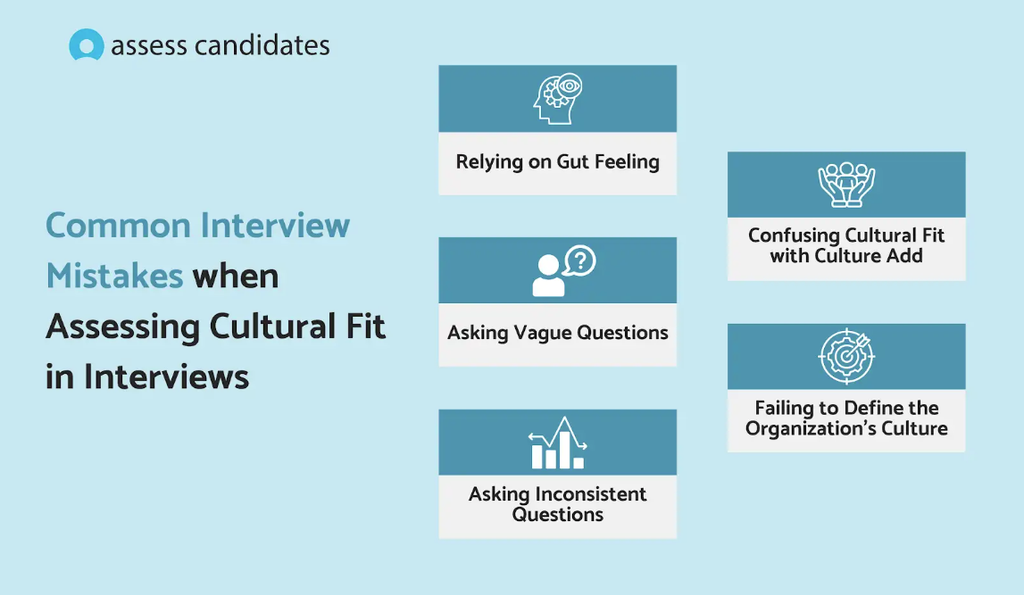
The following are some of the most common interview mistakes made while assessing cultural fit:
- Relying on Gut Feeling
One of the most common mistakes made when assessing cultural fit in an interview is relying on gut feeling. Deciding that a candidate is a good fit for the company based on their first impressions may create unconscious bias. This can increase the risk of inconsistent decisions.
Solution: Use predefined scoring criteria and score candidates against specific and observable behaviors.
- Asking Vague Questions
Asking vague questions that do not offer much useful evidence can easily lead to mis-hires. This is because candidates can provide socially desirable answers for such questions, instead of specific examples that can help identify their workplace behaviors and values.
Solution: Ask behavioral questions that require specific examples, such as, “How did you handle disagreement with a team member?”
- Asking Inconsistent Questions
Another common mistake made while taking interviews to assess cultural fit is asking different questions to different candidates. While interviewers might hold informal conversations with some candidates, they might follow a structured interview process for others. This makes it harder to compare candidates fairly.
Solution: Ask core cultural fit questions to every candidate and set consistent scoring criteria.
- Confusing Cultural Fit with Culture Add
Employers may often exclusively focus on whether a candidate fits the existing workplace culture. This can, however, discourage different perspectives and reinforce existing team dynamics.
Solution: Evaluate what candidates could contribute to the team’s culture while also aligning with its core values.
- Failing to Define the Organization’s Culture
Organizations often fail to describe what their values mean in practice. This further leads to interviewers evaluating teamwork and ownership differently, resulting in inconsistent candidate assessments, higher risk of mis-hires, and biased hiring decisions.
Solution: Convert each value into specific workplace behaviors that candidates can evaluate.
Strengthen your cultural fit hiring strategy with our video interview tool. LEARN MORE
Besides the benefits graduate assessments can bring into the workforce, they also come with some challenges.
4. Why do top companies use Assess Candidates for assessing cultural fit?
Assess Candidates provide standardized pre-employment assessments that can offer supporting evidence about relevant workplace competencies. Employers can combine appropriately selected assessments with structured interview questions to evaluate job-related behaviors consistently, without treating an assessment score as a definitive measure of cultural fit.
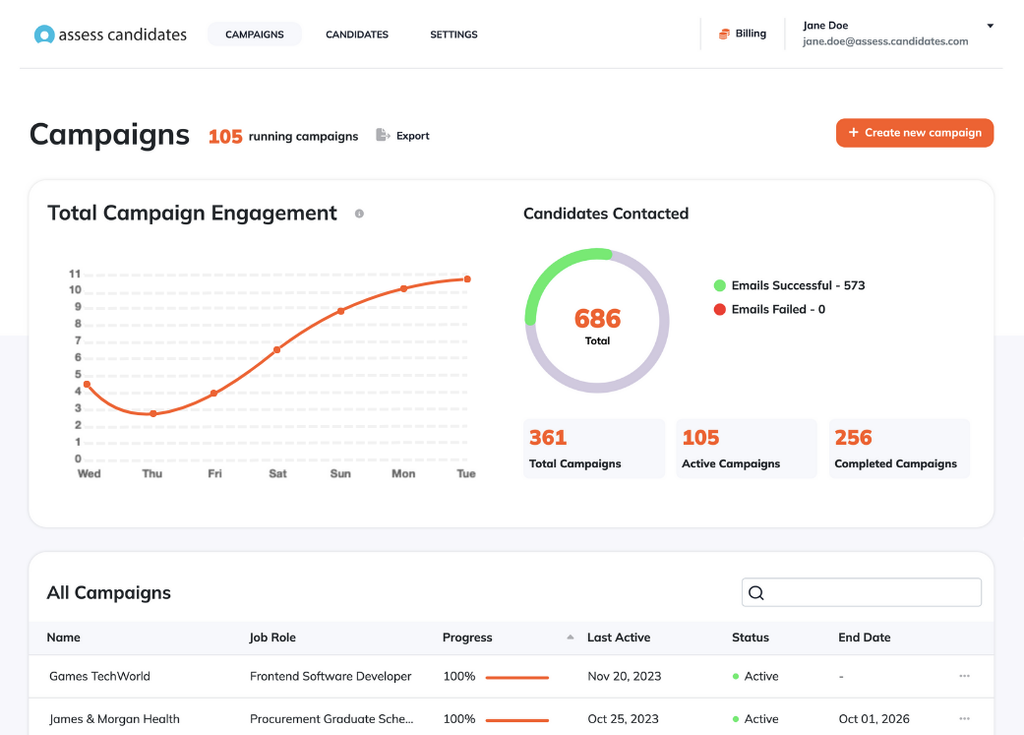
Here is an example of our campaign reporting dashboard, which helps recruiters manage and review candidate results in one place.
- Scientifically Designed Assessments: Assess Candidates’ assessments are developed by expert psychologists and psychometricians to evaluate relevant skills, competencies, and workplace behaviors. These scientifically validated assessments can give recruiters structured insights into how candidates approach situations that matter to the organization’s culture, helping them make more objective hiring decisions.
- Data-Driven Hiring Insights: Our intuitive platform helps recruiters evaluate candidates using objective reports based on cognitive abilities, workplace behaviors, and job-specific competencies. Recruiters can use structured data alongside interview responses to assess whether candidates demonstrate behaviors aligned with the organization’s values.
- Faster, More Consistent Screening: Assessing cultural fit can become subjective when every interviewer uses a different approach. Pre-employment assessments allow employers to evaluate candidates against consistent criteria before or alongside interviews, making it easier to compare candidates fairly and identify those who warrant further consideration.
- Candidates can complete role-relevant assessments online, while recruiters can use the results to support structured interview decisions. Custom branding options can also help organizations deliver a consistent candidate experience throughout the hiring process.
- Accessible and Scalable: Assess Candidates’ assessments are accessible, ATS-compatible, and designed to support fair and inclusive hiring practices. This makes the platform suitable for organizations assessing large candidate pools across different roles and locations while maintaining consistent evaluation standards.
- Assess Candidates provide science-based tools that can help recruiters evaluate workplace behaviors, apply consistent criteria, reduce subjective bias, and make more informed cultural fit decisions. Explore our full range of assessments to find solutions suited to your hiring needs.
- Not sure which assessments fit your cultural fit hiring strategy? Contact us for a free analysis of your role requirements.
Partner with Assess Candidates to use a range of role-specific assessments in your hiring process. VIEW PLANS
Conclusion: Key Takeaway
Cultural fit interviews are most useful when employers assess job-relevant behaviors rather than personal similarity. Structured questions, consistent scoring, and thoughtful follow-up can help hiring teams evaluate workplace expectations while remaining open to candidates who bring different perspectives and approaches.
Interested in learning more about effective candidate assessment? Continue reading for frequently asked questions, and sign up with your email to get started.
Frequently Asked Questions
How to assess cultural fit in interviews without creating bias?
You can assess cultural fit without creating bias by defining the behaviors that would represent your company’s culture before interviewing candidates. Ask candidates the same core questions and follow consistent scoring criteria. This will further help you evaluate candidates against the same job-related standards, reduce the influence of personal preferences , and make more consistent and objective hiring decisions.
What to look for in a strong cultural fit interview answer?
Look for specific examples rather than relying on the candidate’s socially acceptable claims like “being a team player” or “good communicator”. Strong answers will always explain the situation, the candidate’s actions, and the outcome. This helps explore candidates’ claims, understand their actual workplace behaviors, and make more informed hiring decisions.
How to distinguish cultural fit from hiring for similarity?
You can distinguish cultural fit from hiring for similarity by assessing whether candidates demonstrate the behaviors that align with your company’s values. Ask what novel perspectives candidates would bring to the team. This interviewing approach helps evaluate cultural alignment while identifying candidates who positively contribute to the workplace culture.
Can cultural fit questions be used with pre-employment assessments?
Yes, you can use cultural fit questions with pre-employment assessments. Choose assessments that measure job-relevant competencies, workplace behaviors, and problem-solving abilities aligned with the role’s requirements. Using both sources in the recruitment process can help make more consistent hiring decisions.
How can you tell whether a candidate will adapt to the company’s culture over time?
Look for evidence through candidate interviews on whether they have adapted to new teams, processes, managers, or workplace expectations before. Cultural fit interview questions can explore previous examples of adaptability, but they cannot establish with certainty how a candidate will respond to every future workplace change.


 English
 Arabic