
Are Cover Letters Still Relevant in Modern Hiring?
Cover letters have been part of the hiring process for decades. Candidates write them as introductions to explain their interest and show why they’re the right fit. Companies ask for them to learn more about applicants beyond what’s on their resumes.
In recent years, most job postings receive hundreds of applications, and recruitment teams are stretched thin. The first round of screening is automated, and off the record, many recruiters admit that they rarely read cover letters anymore.
This creates a dilemma for anyone involved in hiring. Do cover letters still serve a purpose in modern hiring, or are they just adding friction to your recruitment process?
In this guide, you will learn what cover letters mean for your hiring workflow. You will also be able to decide when to ask candidates to submit cover letters or when to completely ignore them.
Contents
- What is a cover letter?
- What were cover letters designed to do in the hiring process?
- How has hiring changed over the past two decades?
- How do recruiters review job applications?
- Do recruiters still read cover letters?
- When are cover letters useful in the hiring process?
- How do you know when cover letters don’t add value to your process?
- What are better alternatives to screening candidates?
- How to determine if your organization should keep using cover letters
Let’s start with the basics of what a cover letter is before we dive into whether you actually need one.
1. What is a Cover Letter?
A cover letter is a one-page document submitted by candidates along with their resume while applying for jobs. It allows the applicant to introduce themselves, describe their interest in the position, and discuss the relevant qualifications that make them a good fit.
Traditionally, cover letters provide context that resumes cannot. They explain career transitions, employment gaps, or why a person wants to work for your company. The format is usually formal business writing with an introduction, body, and closing.
Most cover letters follow a standard structure of opening with the position being applied for, explaining relevant experience and skills, demonstrating knowledge of the company, and ending with a call to action for an interview.
Understanding why cover letters were used in the past explains why they’re still around today.

2. What Were Cover Letters Designed to Do in the Hiring Process?
Cover letters made perfect sense in the pre-Internet era of hiring. The entire recruitment process worked differently, and cover letters fit naturally into how companies evaluated candidates.
Based on research by Glassdoor, the average corporate job opening receives 250 resumes, with certain positions attracting more than 1,000 resumes.
Before email and virtual assessments, candidates applied for jobs through physical mail. A cover letter was simply a professional courtesy. It introduced the resume and explained why the person was applying. Sending a resume by itself, without any introduction, would have seemed odd and abrupt.
Companies used cover letters as a basic filter for professionalism. If someone couldn’t take the time to write a proper introduction, it raised questions about their attention to detail. The cover letter showed respect for the employer’s hiring process and demonstrated basic business communication skills.
SHRM’s 2016 Talent Acquisition Benchmarking Report found that 26% of HR professionals found cover letters important in their screening decisions.
What hiring managers looked for in cover letters
Hiring managers wanted to see a genuine interest in the specific opportunity. A personalized cover letter that mentioned something about the company showed the candidate had done their homework. The cover letter also showed how well candidates could present themselves.
The next thing to consider is how dramatically the recruitment process has changed in the last few decades.
3. How Has Hiring Changed Over the Past Two Decades?
Walk into a recruiting department today, and you’ll find a completely different environment than what existed 20 years ago. Technology came into play, and application numbers exploded. The pressure to hire faster increased across every industry.
Jobscan says that more than 98% of Fortune 500 companies use Applicant Tracking Systems to filter and rank candidates before they are reviewed by human eyes.
What automation and applicant tracking systems did to hiring
Applicant Tracking Systems are software that automate and manage the hiring process for employers. ATS changed everything about how companies process candidates. These platforms handle hundreds or thousands of applications with almost no human involvement.
Another level of automation was introduced by AI screening tools. They use trends from your past successful hiring to analyze resumes. They examine job titles, competencies, educational background, and length of service. However, they are not designed to understand the content of cover letters.
Based on LinkedIn’s Global Talent Trends report, 79% of talent professionals say their most important recruitment metric is time to hire.
Why scale and speed changed the hiring process
Popular job postings now receive hundreds of applications in just a few days. This volume makes a thorough review physically impossible. If a recruiter spends only 5 minutes on each application, their examination of 500 candidates would take more than 40 hours. That’s a whole work week before one phone call or setting up any interviews.
Average application volumes by role type (2026):
- Entry-level positions: 200-400 applications for each posting
- Mid-level roles: 150-300 applications per posting
- Senior positions: 100 – 200 applications per posting
- Technical specialists: 150-350 applications per posting
- Executive roles: 50-150 applications per posting
Recruiting teams are also responsible for multiple open roles at the same time. A typical recruiter may be handling 15 or 20 different positions concurrently.
Now, let us look at how you and your hiring team process applications.
4. How Do Recruiters Review Job Applications
When you speak with recruiters about their actual workflow, a very clear picture is formed.
Most recruiters start their day by logging into their applicant tracking system and reviewing applications. They are sorted in newest-first order or by the relevance score the system determines.
According to eye-tracking research conducted by Ladders, during their first round of reviewing a resume, recruiters spend an average of 7.4 seconds scanning it.
The basic procedure when a recruiter is reviewing an application is as follows:
A ResumeGo study of 125,000 job applications found that callback rates increased by only 3% when people included a cover letter in their applications for most positions.
Replace your cover letter screening with our skills assessment to evaluate actual job capabilities. USE FOR FREE
This brings us to the critical question: do recruiters still read cover letters?
5. Do Recruiters Still Read Cover Letters?
The truth is, it all depends on the situation. Some recruiters read cover letters regularly. Others have not opened one in months. Understanding when and why makes all the difference.
When recruiters actually read cover letters
Senior positions and executive positions get a more thorough review. When you’re hiring a VP or a C-suite position, recruiters look through the entire application. They read cover letters to get to know the applicant’s career trajectory, leadership approach, and why the person is considering a move.
According to a survey conducted by ResumeLab, 83% of HR professionals and recruiters stated that cover letters aren’t needed in job applications.
Specialized roles where there are small candidate pools also get closer attention. If you’ll be hiring somebody with rare technical expertise or very specific qualifications, you’ll likely read their cover letter.
These are some of the roles you should read cover letters for:
- Executive and senior management roles
- Specialized positions having fewer than 30 qualified candidates
- Creative jobs (writers, content creators, marketing)
- Academic, nonprofit, and governmental positions
- Career transition candidates who must explain their transition
- Internal candidates & employee referrals
- Small companies getting manageable application volumes
When can you skip reading a cover letter?
High-volume positions using a cover letter review make no sense. Retail jobs, customer service occupations, sales jobs, and entry-level jobs receive hundreds of applicants. Recruiters work purely within the domain of screening resumes and move qualified candidates straight to assessments.
Technical positions with obvious skills requirements don’t require a cover letter. If you’re hiring a software developer, you’re interested in their knowledge of programming languages and frameworks and their experience working on projects. Their resume and technical assessments tell you what you need to know.
Streamline your hiring process with work sample tests designed for faster, fairer candidate evaluation. LEARN MORE
In this section, we will cover the specific situations in which cover letters are useful.
6. When Are Cover Letters Useful in the Hiring Process?
Cover letters are still relevant. The extra context and knowledge they offer are actually helpful in certain situations. Understanding people’s perspectives is crucial for leadership positions. A VP of Operations should be able to explain how they develop teams and improve systems. Cover letters demonstrate strategic thinking in a way that resumes cannot.
Evaluating cover letters is helpful for roles that involve a lot of writing. Technical writers, communications managers, and content strategists use cover letters to demonstrate their skills.
A National Association of Colleges and Employers survey found that 45% of employers screen job candidates based on their writing ability for communication-intensive jobs.
Client-facing jobs that involve relationships also benefit from cover letters. Business development managers, account executives, and consultants require good communication skills and emotional intelligence. The cover letter is the first evidence of these capabilities.
Non-standard backgrounds that benefit from cover letters:
- Career switching from unrelated industries
- Employment gaps that are 6 months or more
- International candidates with work authorization
- Non-traditional education (bootcamps, self-taught, online education)
- Unconventional career paths with various industry transitions
- Candidates with mostly freelance or contract experience
- People returning to work after a long break
International candidates often use cover letters to discuss things like work authorisation, relocation timelines, or visa status. This information helps you to evaluate whether the candidate is actually viable for the role before you put any time into an interview.
On the flip side, the next section below covers how you know when cover letters do not improve your recruitment process.
7. How Do You Know When Cover Letters Don’t Add Value To Your Process?
Cover letters are time-consuming and slow down the hiring process in certain cases. Here’s when you should skip them completely.
High-Volume and Technical Positions
Avoid using cover letters for the following positions:
- Software engineering and development: Code samples and technical assessments tell you all you need to know. A cover letter is not going to show problem-solving ability or coding skills.
- Customer service and call center roles: You need availability, reliability, and phone skills. Assessments and short interviews allow you to filter candidates faster than reading letters.
- Retail, warehouse, and hourly positions: Being available for shifts and possessing the basic qualifications are most important. In-person interviews and reference checks are better.
- Roles with strict requirements: If the job requires specific certifications, licenses or security clearances, candidates either have them or don’t have them. A cover letter can’t make up for a lack of credentials.
According to Hired’s State of Software Engineers report, 64% of developers say that they’re less likely to complete applications that require cover letters.
When you are processing 200+ applications for an entry-level position, dedicating two minutes to each cover letter adds more than six hours to your screening process. That time doesn’t help you make better hiring decisions.
Assessment-Driven and Referral-Based Hiring
- Skills assessments: Work samples, coding challenges, or job simulations provide you with direct evidence of ability. These assessments show what a cover letter only claims.
- Employee referral programs: The referring employee has already explained why the candidate is a fit. You should ask them further questions instead of asking for a cover letter.
- Structured interview processes: If you’re using standardized questions with scoring rubrics, then you’re already collecting similar data from all candidates.
Stack Overflow’s 2023 Developer Survey revealed that 73% of developers ranked cover letter requirements as a negative indicator of company culture.
The key question to ask is: does this cover letter tell me anything I can’t learn faster and better through other parts of my recruitment process?
If the answer is no, then you’re setting yourself up to do work you don’t need to do for yourself and your team.
According to a study published in the Journal of Applied Psychology, structured interviews are twice as predictive of job performance as are unstructured evaluation methods.
Why You Should Not Use Cover Letters to Evaluate Candidates?
There are more problems than solutions to using cover letters as a primary method of screening. The biggest issue is bias and consistency. Cover letters lead to unfair evaluation through:
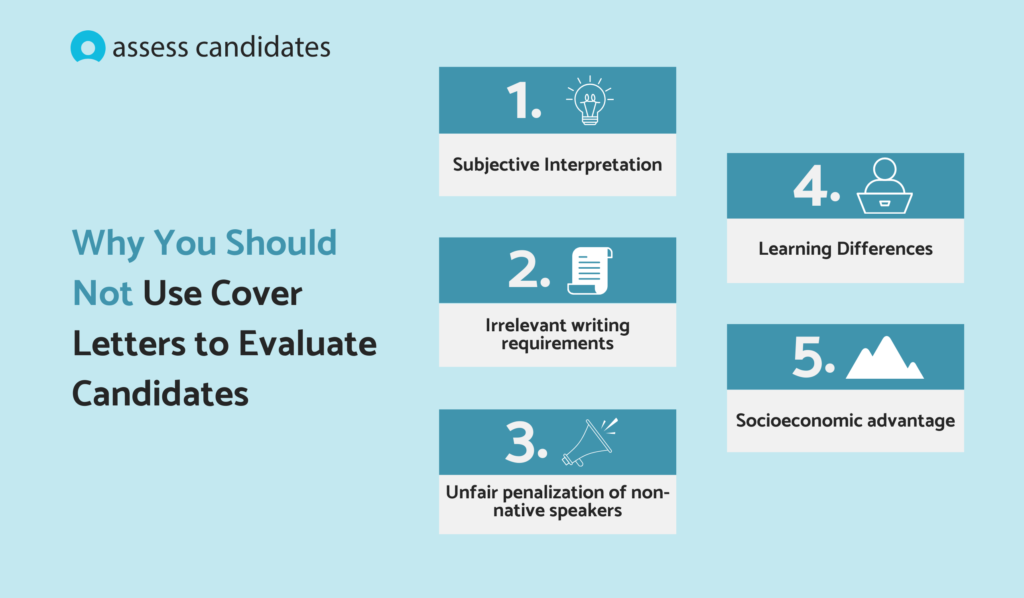
- Subjective interpretation: Two recruiters can read the same letter and come to different conclusions. This inconsistency makes it impossible to compare fairly.
- Irrelevant writing requirements: An exceptional operations manager or data analyst (for example) may write a shabby cover letter. If writing is not an integral part of the job, you’re screening out qualified candidates for reasons that are not relevant.
- Unfair penalization of non-native speakers: Someone who speaks English as a third language might be qualified but submit a less-impressive cover letter. You’re measuring language fluency, not the ability to do the job.
- Learning differences: Candidates with dyslexia or other learning differences have difficulty with formal writing. Their cover letter quality has nothing to do with their ability to do the job.
- Socioeconomic advantage: Candidates who have career coaches, mentors, or professional development resources write better letters. You’re giving preference to people who already have the network and support, but are not necessarily better performers.
A study by organizational psychologist Frank Schmidt showed that work sample tests have validity coefficients of 0.54, compared with reference checks at 0.26.
Build a bias-free screening process with our structured assessment platform and evaluation tools. LEARN MORE
So what should you use instead? Let’s explore more effective screening methods.
8. What are Better Alternatives to Screening Candidates
If cover letters are not effective screening tools for your company, what should you use instead? There are several options that provide much better information about candidate quality.
Work samples and skills assessments
Work sample tests are imitations of actual job tasks. Instead of requiring candidates to describe their abilities, you observe candidates performing relevant work. These assessments are direct measures of job-relevant capabilities.
Skills-based tests remove the guesswork from hiring. You get to see what candidates are capable of doing rather than making your assumptions.
According to an Aberdeen Group research, companies that use skills assessments experience 39% lower first-year turnover, in comparison to companies that use traditional screening methods.
Benefits of work samples over cover letters:
Structured assessments provide a level playing field. Every candidate does the same exercise with the same instructions. You judge performance based on consistent criteria. This structure decreases bias and increases the prediction of job success.
Screening questions & video interviews
Targeted screening questions help to collect the information you are really interested in. Instead of a free-form cover letter, ask specific questions such as “Describe your experience with project management software” or “What’s your availability to start?”
Knockout interview questions help filter the candidates efficiently in the early stages. If the job absolutely requires certain certifications or particular availability, be sure to ask immediately in the application. Candidates that don’t meet the criteria get automatically screened out, and it saves everyone time.
According to a Pymetrics research, game-based assessments can be used to assess cognitive and emotional characteristics, with 80-90% accuracy of job fit prediction.
Asynchronous video interviews are richer forms of information than cover letters. Candidates document their answers to your questions on their own time. You are more accurately able to evaluate communication skills, as well as personality and enthusiasm, than you could from cover letters.
These tools ensure that they remain efficient while collecting better data. Candidates provide answers once, and multiple stakeholders can review the answers without coordinating schedules.
The next step is creating a decision framework for your specific hiring needs.
9. How to Determine If Your Organization Should Use Cover Letters
Your decision regarding cover letters should reflect what your actual hiring needs are and your actual process capabilities. Don’t insist on them because you always have or because you think it is professional.
When to have cover letters in your hiring process
Make cover letters optional, rather than mandatory, in most cases. Candidates who need to explain something will take advantage of the opportunity.
Ask for cover letters only for roles where writing quality is directly related to the job. Content positions, communications jobs, and ones that require regular, written interaction with clients all fit this criteria.
Lever’s 2023 recruiting data found that removing cover letter requirements from applications increased completion rates by 365% for technical roles.
To recap:
How to analyse whether cover letters are helping your hiring
- Pull performance data on your last 50 hires
- Review their original applications
- Compare the quality of the cover letter with the actual job performance
- Look for the correlation between great cover letters and successful employees
- Survey your recruiting team
- Ask how often they read cover letters
- Find out which jobs never receive a cover letter review
- Identify where they’re slowing the process
- Track your application metrics
- Measure completion rates of applications
- Compare and contrast roles with/without cover letter requirements
- Look at the time to fill for various application processes
- Test optional cover letters
- Make them optional for 2-3 months
- Compare the quality of hire to the previous periods
- Measure changes in the size of the candidate pool
When you adopt skills assessments or work samples, remove cover letter requirements. If you’re using better predictive tools, then the cover letter is redundant. Your hiring process should remove duplication and emphasize the best signals of job performance.
Many qualified candidates give up on applications when they see cover letter requirements. They’re applying to multiple companies, and they’re going to apply to the easier applications first.
Let us wrap up by answering whether you still need to ask your applicant for cover letters.
Should You Keep Asking for Cover Letters?
The answer is not the same for every organization, but there are clear patterns. For most companies and most jobs, mandatory cover letters are more of a problem than a solution.
Cover letters moved from being essential to situational. They’re not totally obsolete, but they’re certainly not a universal best practice anymore. Their value depends totally on the specific role, your candidate pool, and your organization’s particular needs.
According to iCIMS research, 58% of job seekers have abandoned online applications because of the length and complexity, with cover letters being cited as a huge factor.
Hiring teams who effectively use cover letters are those who use them as one resource among many, and never as the primary evaluation tool.
Practical steps to take in your organization:
- Audit your existing process: Track cover letter reading rates by role type
- Analyze your data: Look at the correlation between cover letters and successful hires
- Pilot Optional cover letter: Test for 3 months high-volume roles
- Invest in better tools: Use work samples and structured assessments
- Train your team: Develop consistent criteria for evaluating cover letters if you are keeping cover letters
- Communicate clearly: Tell candidates what they’re being evaluated on and why
Remember that it is a competitive hiring process. Top candidates have choices and react to efficient, respectful processes. If your cover letter requirement is causing you to lose out on good applicants that opt for faster processes elsewhere, that’s a serious problem that you should be trying to solve.
The direction of modern hiring is towards skills-first, evidence-based evaluation. Cover letters are only appropriate in this direction when they have a well-defined, justifiable purpose. For everything else, it’s time to rethink whether you really need them.
Discover how our customizable skills assessments can replace cover letters in your hiring workflow. VIEW PLANS
Conclusion: Key takeaway
This conversation is a proxy for a bigger question about who controls the dynamics in the hiring process. For decades, employers had all the power and could demand whatever they wanted from applicants. That dynamic has fundamentally changed but many hiring processes have not caught up.
Today’s labor market rewards companies that understand that applicants are also evaluating them. Your application process is a product experience and candidates vote with their willingness to participate in your evaluation.
The solution to this is to use better evaluation methods. Skills assessments, work samples and structured screening questions provide direct evidence of a candidate’s capability. These tools are accurate predictors of job success and more fair in their evaluation.
This is where platforms such as Assess Candidates are critical. Instead of making assumptions about these skills, you can measure them using our customizable assessments suitable to your specific roles, and enhance your candidate experience.
The cover letter is simply the starting point. Once you demonstrate that you can substitute a less effective requirement with a higher-value assessment, you begin to see other improvements that are worth making to your hiring process.
Get expert insights on modern hiring practices and candidate evaluation strategies delivered to your inbox. Browse our FAQs and sign up below.
Frequently Asked Questions
Should I reject candidates who don’t send cover letters when it is required?
Not automatically. Many qualified candidates do not write cover letters even when they are asked to, especially in the competitive job market. Instead, try to determine whether or not the resume itself meets your requirements.
How do I teach recruiters to be fair in rating cover letters?
You have to create a rubric in terms of relevance to the job, ability to communicate, and evidence of company research. Also, do calibration sessions with your team to go over cover letters and discuss the rubrics as a way of eliminating bias as much as possible.
Can ATS be effective at screening cover letters for quality?
No. Most ATS platforms are unable to search for quality, tone, and real interest in cover letters, but instead only for keywords. They do not have the contextual understanding that humans have. You need to review the cover letters when the first ATS filtering is finished.
Should I tell candidates whether I will read their cover letters?
Yes. Transparency makes the candidate experience better and saves everybody time. If cover letters are optional or not extensively reviewed, then make it clear in your job posting.
What do I do with cover letters that look AI-generated?
Focus on substance and not style. A.I.-generated cover letters often lack specific examples and personalization. If the content is relevant to the role, then you can move on. Consider using screening questions or assessments to gauge authentic thinking and experience.


 English
  Arabic