
Best Strategies to Improve Talent Acquisition Efficiency in 2026/27



Improving talent acquisition efficiency means helping hiring teams find and assess suitable candidates without unnecessary delays, costs, or compromises in hiring quality. It requires clear role requirements, coordinated recruitment processes, relevant assessment methods, and a way to evaluate results over time.
According to Tribepad, about 42% of talent acquisition leaders say their companies lack an effective or active workforce plan.
This guide explores the challenges that slow talent acquisition and practical strategies employers can use to improve their hiring processes.
Contents
- What is talent acquisition and efficiency?
- What to consider when acquiring talent?
- What are the challenges of talent acquisition?
- Strategies to improve talent acquisition efficiency
- Why use Assess Candidates to acquire talent?
So, now without further ado, let’s begin by defining what talent acquisition actually is.
1. What is talent acquisition and efficiency?
What is talent acquisition?
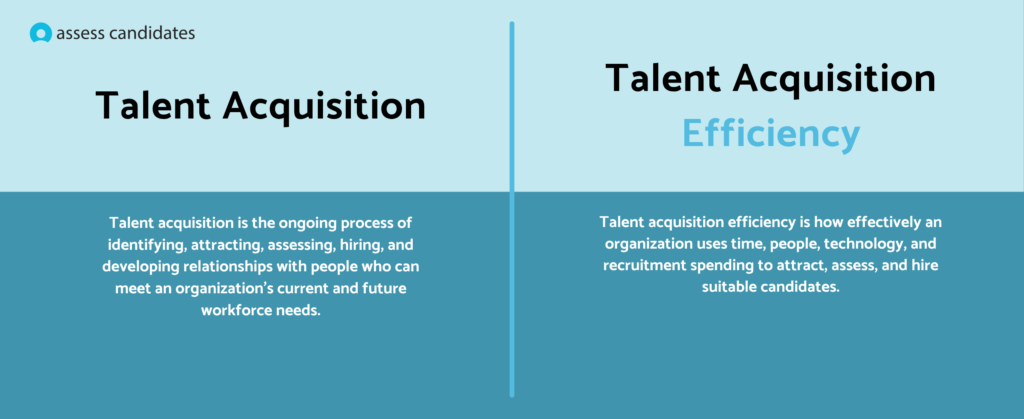
Talent acquisition is the ongoing process of identifying, attracting, assessing, hiring, and developing relationships with people who can meet an organization’s current and future workforce needs. It includes workforce planning, employer branding, talent pipelines, and recruitment, with a focus on aligning hiring activity with longer-term business goals.
What is talent acquisition efficiency?
Talent acquisition efficiency is how effectively an organization uses time, people, technology, and recruitment spending to attract, assess, and hire suitable candidates. It should be evaluated alongside hiring quality and candidate experience, rather than by speed or cost alone.
Hire skilled candidates with our pre-hire assessments. HIRE FOR FREE
Wondering what key things to consider when acquiring talent? Keep scrolling!

2. What to consider when acquiring talent?
According to SHRM, more companies are moving toward skills-based recruitment to close talent gaps and hire candidates with real-world skills and competencies.
Factors to consider when acquiring talent
1. Talent Pipelines
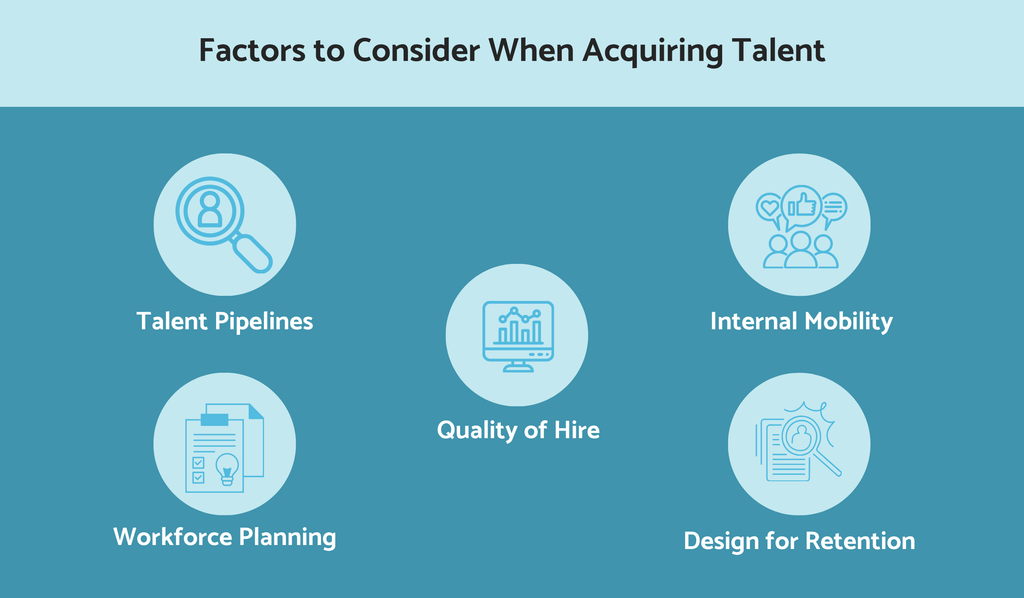
Before you can begin improving the efficiency of your talent pipeline, it is essential to understand the current process. Identify each step of the process, from the vacancy to the onboarding and integration process.
2. Workforce Planning
Then map out your recruitment decisions to where your business is going to be heading over the next few years, not just the gap that exists today. This helps you ensure that each candidate you aim to hire remains relevant as your team’s priorities evolve.
3. Quality of Hire
Review hiring outcomes using a combination of role-relevant measures, such as early performance, retention, and manager feedback. Interpret these results in context: onboarding quality, workload, management, and working conditions can all influence how a new employee performs after hiring.
4. Internal Mobility
Internal mobility and employee referrals can expand the available talent pool and, in some cases, reduce sourcing time. Evaluate these channels using the same role-relevant criteria as external applications, and monitor whether they produce suitable candidates without unnecessarily narrowing access to opportunities.
5. Design for Retention
Retention begins before your candidates accept an offer. The hiring process shapes expectations about the role, team, culture, workload, and growth opportunities. Realistic job previews, clear role descriptions, and honest discussions about challenges improve retention.
Recruit the best-fit talent with our assessment tool platform. LEARN MORE
You may be wondering if you face challenges in talent acquisition; we have solutions below!
3. What are the challenges of talent acquisition?
Talent acquisition can become inefficient when hiring demand changes faster than recruitment processes can respond. Common challenges include unclear role requirements, lengthy approval stages, inconsistent evaluation, limited recruiting capacity, and poor communication with candidates.
Challenges of talent acquisition
- Hiring Process Bottlenecks
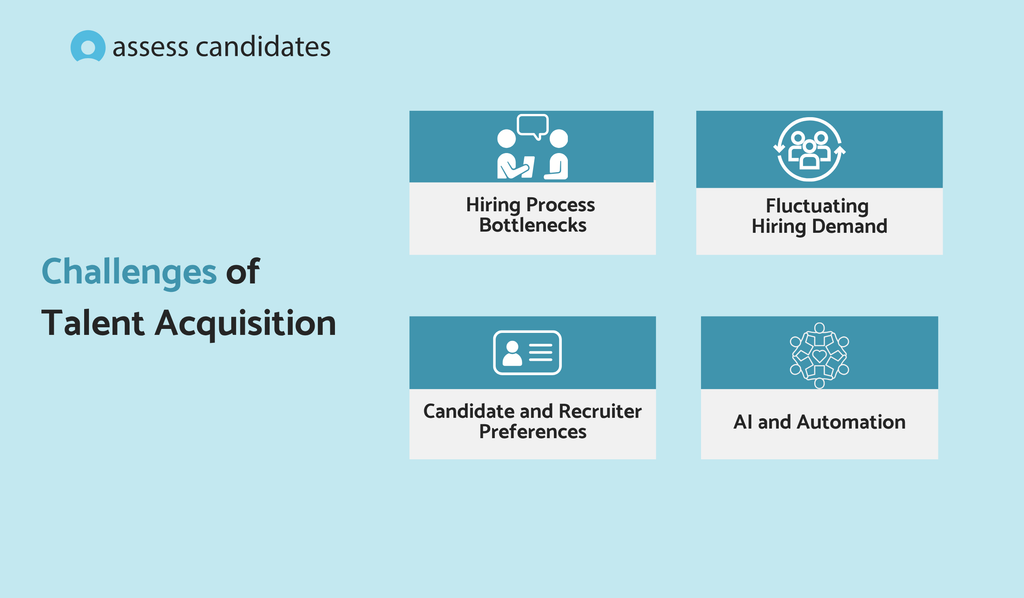
Bottlenecks can develop when candidates wait for screening, interviews, approvals, or feedback. Review the time spent at each stage and identify steps that do not add useful evidence to the decision. Set realistic timelines for different roles and communicate progress clearly to candidates.
Solution: Regularly audit your workflows to identify and remove friction points. Take practical actions such as reducing the number of interview rounds and using self–scheduling tools. Focus on moving qualified candidates from application to offer within as short an amount of time as feasible to improve your efficiency and candidate experience.
- Fluctuating Hiring Demand
Hiring requirements often fluctuate due to business cycles, economic conditions, or seasonal demand; as a result, application volumes also vary across roles, industries, and locations. Depending on high-or-low-volume periods, your staff may find themselves overwhelmed or struggle to find suitable candidates for vacant roles in your organization.
Solution: Efficient talent acquisition requires flexible resourcing, prioritization, and the ability to scale processes up or down without compromising quality. To do this, build talent pipelines and use AI and automation for high-volume tasks like initial screening and scheduling.
- Candidate and Recruiter Preferences
Due to the change in hiring trends, candidate expectations have also evolved, as they expect faster responses, inclusive recruitment processes, clear communication, and flexible working arrangements. This also affects your recruiting teams, as they are expected to hire faster, reduce costs, and improve diversity, all with limited resources.
Solution: Balance these competing demands by creating clear priorities, realistic timelines, and well-designed recruitment processes. We recommend defining what you are looking for and communicating this clearly to both your candidates and internal teams.
- AI and Automation
AI and automation may reduce administrative work in sourcing, scheduling, and initial application review. Before adopting a tool, assess its accuracy, the work required to review its outputs, its effect on candidate experience, and any fairness or privacy risks. Keep appropriate human oversight over consequential hiring decisions.
Solution: AI works best when it handles high-volume, repetitive tasks while your recruiting team remains responsible for final decisions. To ensure efficient talent acquisition, disclose AI use to your candidates, keep humans responsible for key decisions, monitor for bias, accuracy, and fairness, and integrate AI tools to avoid duplicate work.
Discover assessments created by Chartered Scientists to hire top candidates. VIEW PLANS
Now that you know how to avoid these challenges, check out strategies for talent acquisition!
4. Strategies to improve talent acquisition efficiency
The most useful improvements address a specific source of delay or inconsistency. Before changing a recruitment process, identify where candidates wait, where hiring teams repeat work, and whether faster decisions are still producing suitable hires.
According to Cogn–IQ’s research, skills-based recruitment is one of the biggest hiring trends for efficient talent acquisition. Employers that adopted skills-based recruitment reported fewer mis-hires and improved retention than with their previous hiring methods.
Top strategies to improve talent acquisition efficiency
1. Clearly Define the Role
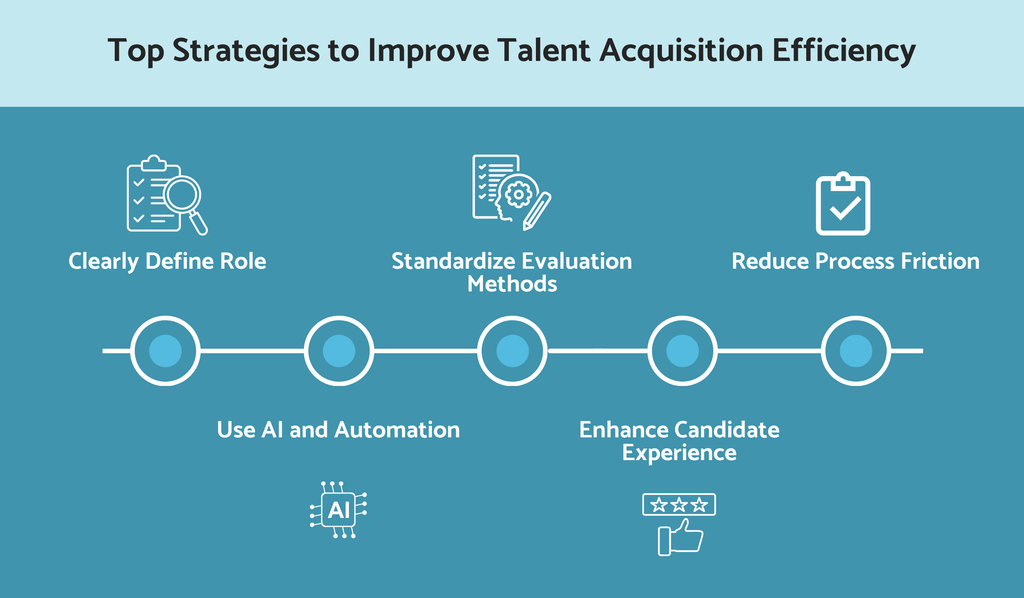
Unclear role requirements are one of the most common causes of a mishire. They risk reviewing unsuitable candidates or running multiple unnecessary interview rounds. This is because you didn’t define success criteria upfront. Clear requirements reduce confusion, speed up decision-making, and improve candidate fit.
2. Standardize Evaluation Methods
Use structured interviews with consistent questions and apply scorecards to rate candidates against defined criteria. Train your interviewers on fair, objective assessment, and reduce interview stages to only what is necessary. This helps you create comparable data across your candidates, supporting faster, more confident hiring decisions.
3. Reduce Process Friction
Regularly review your workflows to identify and remove friction, as every unnecessary step in the hiring process increases the risk of losing your skilled candidates. Take practical actions such as reducing the interview rounds, setting clear timelines for each stage, and communicating progress and next steps to candidates.
4. Use AI and Automation
AI and automation can help support human decision-making in your recruitment process rather than replace it. In talent acquisition, AI can draft and refine job descriptions, screen large volumes of applications, and identify potential candidates from talent pools. AI works best when it handles high-volume, repetitive tasks while you make the final decisions.
5. Enhance Candidate Experience
Candidate experience affects application quality, offer acceptance, and employer reputation, because a poor experience can stop future applicants and damage your employer’s brand. Candidates research companies before applying. Thus, audit your online presence, including review sites, social media, and how your recruiters communicate throughout the process.
Assess Candidates helps recruiters gather more reliable evidence of candidate ability through structured, job-relevant assessments and integrity controls. With our psychometric assessment tools, behavioral skills tests, and personality questionnaires, we can better accurately test your candidates for the skills they have.
Want to know how we help employers improve their talent acquisition efficiency? Keep looking!
5. Why use Assess Candidates to acquire talent?
The Assess Candidates platform brings standardized assessment directly into the hiring workflow, so teams can evaluate real skills rather than relying on resumes and gut instinct alone.
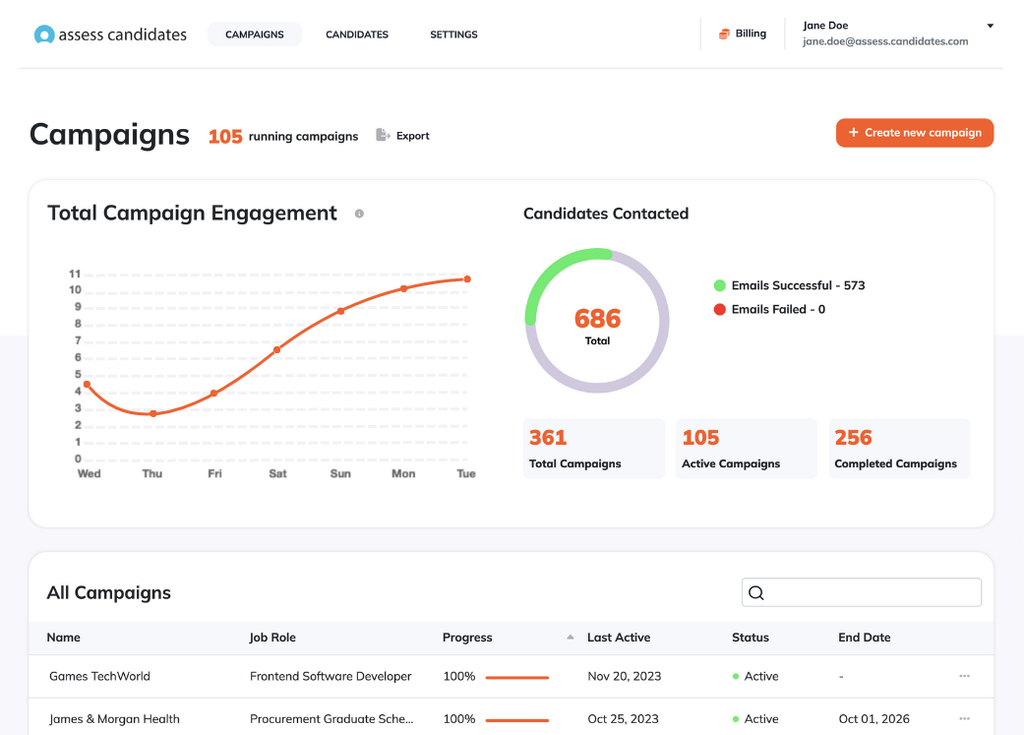
- Structured Psychometric Assessments: The Assess Candidates’ platform has a library of role-specific, skills-based assessments that plug directly into existing screening stages. This lets hiring teams avoid building evaluation requirements from scratch for every new role.
- Focused Personality Questionnaires: Our personality assessments reveal how your candidates approach work, communication, stress management, and collaboration. These reports help support better role fit, more informed onboarding, and clearer development conversations from day one.
- Fair Scoring: Assess Candidates applies the same scoring criteria to all candidates, reducing bias. Your recruiting teams can compare results objectively and make more confident decisions about who to progress in the hiring process.
- Scalable Assessment Delivery: Our assessments can be delivered to large candidate pools without requiring manual administration for each individual. This allows you to maintain a consistent candidate experience while improving speed and efficiency in high-volume hiring.
- Predicts Job Performance: Assess Candidates’ assessments provide an accurate understanding of the skills your candidates need for the role you are recruiting for. You can use the assessment tests to filter for top candidates and predict their performance in the role.
Hire your best-fit candidates with our assessment tool platform. LEARN MORE
Conclusion: Key Takeaway
Improving talent acquisition efficiency requires more than shortening the hiring cycle. Employers should define role requirements clearly, remove unnecessary process steps, assess candidates consistently, and review hiring outcomes over time. The aim is a recruitment process that uses resources effectively while maintaining a fair candidate experience and reliable hiring decisions.
Interested in enhancing your talent acquisition without compromising the quality of your recruited candidates? Keep reading to see our frequently asked questions, and enter your email to get started today.
Frequently Asked Questions
What is the difference between recruitment and talent acquisition?
Recruitment focuses on filling immediate vacancies in your organization, while talent acquisition takes a longer-term view, including workforce planning, employer branding, pipeline building, and retention. Talent acquisition is more strategic and aligned with business goals, whereas recruitment focuses on filling open positions in your company.
How often should a talent acquisition strategy be reviewed?
Most effective teams review time-to-fill, offer acceptance, and early retention quarterly, adjusting process steps as the labour market and business needs shift. Treating your talent acquisition as a one-time setup rather than an ongoing discipline is one of the most common ways efficiency deteriorates over time.
What are common bottlenecks in the hiring process?
Common bottlenecks include delayed resume screening, slow interview scheduling, lengthy approval processes, too many interview rounds, and poor candidate communication. Each unnecessary step increases the risk of losing strong candidates to competitors.
How can AI improve talent acquisition efficiency?
AI can improve efficiency by automating repetitive tasks such as resume screening, candidate outreach, and interview scheduling. It can also help you draft job descriptions, summarize assessment results, and identify potential candidates. However, we recommend using AI only to support human decision-making, not replace it.
How can I improve candidate experience?
You can improve the candidate experience by providing clear job descriptions and communicating transparently about the process and timelines. Clear communication, realistic timelines, and relevant assessments can improve candidate experience while supporting greater talent acquisition efficiency.


 English
  Arabic