
Spatial Reasoning Tests For Hiring: Everything Recruiters Need To Know In 2026



Are you a recruiter struggling to find candidates who can accurately visualize information, interpret technical drawings, or solve spatial problems? Do you need a reliable way to assess whether a candidate has the spatial thinking skills your role requires?
If these questions sound familiar, you are not alone! Many hiring teams are facing the same challenges today.
Spatial reasoning tests are becoming a popular way to evaluate how well candidates can rotate objects mentally, interpret diagrams, understand spatial relationships, and visualize solutions in 2D or 3D. These assessments provide valuable insight into a candidate’s technical potential, problem-solving skills, and real-world spatial judgment – all key predictors of job performance.
As competition for skilled talent intensifies and job requirements become more technically demanding, organizations increasingly rely on modern assessment tools, including spatial reasoning tests, cognitive ability assessments, and structured interviews, to streamline hiring and strengthen their decisions.
Did you know? According to Big 5 Assessments, psychometric testing used during recruitment reduces staff turnover by an average of 20%, thereby saving companies both valuable time and money.
Whether you’re a hiring manager or HR professional, you might find yourself asking questions like:
- Why is spatial reasoning important?
- What key skills do spatial reasoning tests measure?
- Are there drawbacks to using pre-employment spatial reasoning tests?
- When should I include a spatial reasoning test?
- Which industries benefit the most from spatial reasoning assessments?
This guide explores these questions in depth. Keep reading to learn how spatial reasoning testing tools can help you consistently hire the best talent for your role and organization.
Contents
- What is a spatial reasoning test?
- What skills does a pre-employment spatial reasoning test measure?
- How do spatial reasoning tests work?
- Why do employers use spatial reasoning tests for pre-employment screening?
- When are spatial reasoning assessments used in the hiring process?
- Best practices for integrating spatial reasoning tests into your recruitment strategy
- Which industries and roles should use spatial reasoning tests for hiring?
- Spatial reasoning tests: Client success story
- Why top companies choose Assess Candidates’ spatial reasoning tests to hire
Next, let’s start with the basics: what are spatial reasoning tests?
1. What is a spatial reasoning test ?
A spatial reasoning test, sometimes called a spatial awareness or spatial ability test, is a type of pre-employment psychometric test that assesses a candidate’s ability to interpret and manipulate spatial and visual information including 2D and 3D objects and shapes.
These tests focus on how candidates understand shapes, objects, and patterns when they are rotated, flipped, folded, or viewed from different angles. They help recruiters determine a candidate’s ability to visualize information in 2D and 3D, which is a key skill for many technical, problem-solving, and visually demanding roles.
Streamline your pre-employment hiring process with our scientifically validated spatial reasoning tests. HIRE FOR FREE
But you may be asking, what exactly is the meaning of spatial reasoning?
What is spatial reasoning?
Spatial reasoning is the ability to understand, visualize, and manipulate 2D and 3D objects in space. This can include simple tasks such as imagining how a flat shape folds into a cube or more complex work like visualizing how a 3D object would look after being folded in half or connected to a larger system.
Why are spatial reasoning skills important?
Spatial reasoning skills are becoming increasingly valuable in the modern workplace, especially for roles that require:
- Problem-solving
- Visual thinking
- Pattern and diagram recognition
- Understanding how objects and systems fit together
- Mentally rotating and manipulating objects or information.
Employers hiring in fields such as engineering, manufacturing, product design, 3D game development, and architecture heavily prioritize spatial reasoning ability. As a result, they often include spatial reasoning tests as part of their early candidate selection process.
Using spatial reasoning tests also helps streamline the hiring process by reducing the need for multiple interview rounds, extensive portfolio reviews, or manual screening. When combined with additional psychometric tools, such as numerical reasoning tests, situational judgment tests, and personality assessments, these tests help organizations build a more complete, objective picture of each candidate’s capabilities, behavioural traits, and job readiness.
Next up, we will take a look at the different skills measured by pre-employment spatial reasoning tests.

2. What skills does a pre-employment spatial reasoning test measure?
Spatial reasoning or spatial ability tests measure key skills like spatial perception, visualization, and mental rotation by assessing how well candidates can visualize objects from different perspectives, recognize patterns, and solve realistic problems involving spatial arrangements.
What specific skills do spatial ability tests measure?
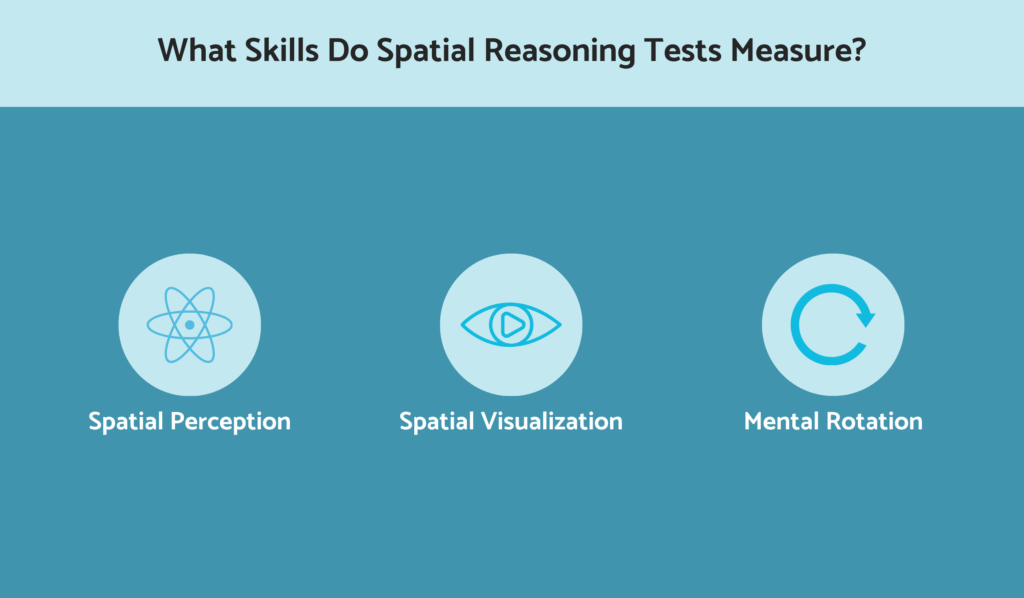
Spatial reasoning tests essentially measure the following 3 skills:
- Spatial Perception
This is the ability to understand object positioning and spatial relationships, especially in complex situations. In essence, spatial perception allows candidates to judge position, direction, and distance, navigate environments confidently, and interpret spatial layouts accurately.
This spatial skill is important in roles that involve map reading, construction, and machinery operation.
- Mental Rotation
Spatial reasoning tests evaluate how well candidates visualize a 2D or 3D object, rotate it mentally, and view it from different angles. This allows individuals to imagine the object’s orientation without a physical or a full 360-degree view.
This spatial skill is vital for roles such as engineering, piloting, and 3D modelling.
- Spatial Visualization
Spatial visualization is the ability to mentally transform objects, such as folding, flipping, rotating, or reconstructing 2D and 3D shapes. This skill allows candidates to predict how objects will change or appear.
This is vital in roles such as design, architecture, and robotics.
Select top candidates by including a high-quality spatial reasoning test in your recruitment process. LEARN MORE
In the following section, we will explore how spatial reasoning tests actually work in hiring.
3. How do spatial reasoning tests work?
Spatial awareness tests measure a candidate’s ability to mentally visualize and manipulate 2D and 3D objects. These tests are typically timed and administered online, often consisting of 10 to 20 multiple-choice questions.
But what are the types of spatial reasoning questions?
All spatial reasoning tests assess similar visual-thinking and problem-solving skills, but the question formats can vary. Each type follows the same core principles while presenting spatial information in different visual layouts or scenarios.
Below are the 5 main types of spatial reasoning questions you will find:
1. Organizing 2D Shapes
This question involves assembling and disassembling 2D shapes. Candidates are presented with a few 2D shapes and are asked to choose the option that represents the final shape when all of the given pieces are combined. Alternatively, the process may also be reversed.
The outcome reflects a candidate’s spatial reasoning, pattern recognition, and visual-construction skills.
Example 1: “Select the option that replaces the question mark.”
2. Transforming 2D Nets into 3D Shapes
This question type asks candidates to transform 2D nets into 3D shapes. Candidates will be required to choose which 3D shape the 2D net would form when folded, reflecting their spatial imagination, engineering thinking, and 3D visualization skills.
Example 2: “What would this 3D shape look like from above, assuming all small cubes are joined?”
3. Rotations and Reflections
This question evaluates candidates’ ability to mentally rotate or reflect, that is, mirror or flip, shapes or images to measure a candidate’s cognitive flexibility and spatial accuracy.
Example 3: “Which of the following images represents the same shape rotated 90° clockwise?”
4. Block Counting
Block counting requires candidates to count the number of blocks in the pile shown. The blocks will be stacked together and displayed in a 3D dimension. This measures a candidate’s spatial visualization, memory, and attention to detail skills.
Example 4: “How many cubes does this 3D shape consist of?”
5. Map Reading
This type of question measures a candidate’s sense of direction, spatial orientation, and ability to think quickly. Here, candidates are required to study a 2D map or layout and figure out the correct way to navigate it.
Example 5: “Which letter on the map marks your final position?”
Here’s a glimpse at an example of a spatial reasoning test question below:
Assess Candidates’ Spatial Reasoning Test Example Question:

This example comes from Assess Candidates’ off-the-shelf logical reasoning tests, which employers can also customize to match the specific demands of a role. Customization allows recruiters to evaluate candidates’ spatial reasoning skills in direct relation to job requirements.
Explore more sample spatial reasoning questions or get in touch with us to discuss tailored assessment options!
Leverage our pre-employment assessments to identify top talent with strong spatial thinking skills. HIRE FOR FREE
To get answers to the example question mentioned above, head down to the end of the article.
Next up, we will take a look at the reasons why employers incorporate spatial reasoning tests into their recruitment process.
4. Why do employers use spatial reasoning tests for pre-employment screening?
Employers use spatial reasoning tests for pre-employment screening to objectively assess applicants’ ability to understand spatial relationships, solve visual problems, and apply logical thinking in unfamiliar scenarios. These tests will offer you insight into how quickly candidates can learn, adapt, and perform in visually demanding roles.
Top benefits of using spatial reasoning tests for hiring
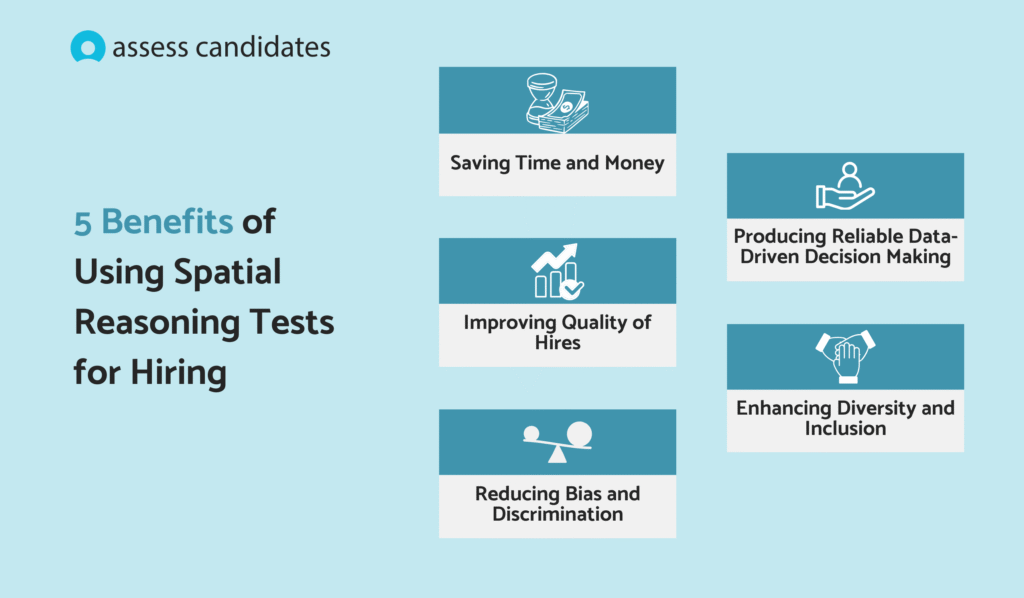
- Saving Time and Money
Employers administer spatial reasoning tests online and at scale to save time and streamline the hiring process. Instead of manually reviewing large volumes of applications, employers can assess thousands of candidates in minutes, with instant access to results. This makes it easy to identify suitable applicants early, reducing time spent interviewing candidates who do not meet the role requirements.
Spatial reasoning tests also lower recruitment costs, especially in high-volume hiring. This makes them an efficient and cost-effective screening method before moving applicants to more resource-intensive stages, such as interviews or assessment centers.
Did you know? According to CandiTech, pre-employment assessments can reduce “unnecessary interviews” by as much as 80% and cut hiring time by up to 50% in some cases.
- Improving the Quality of Hire
Spatial reasoning is a cognitive aptitude, which is one of the strongest predictors of long-term job performance. These tests help employers identify candidates with strong critical thinking, visual analysis, and problem-solving skills.
Hiring individuals with strong spatial reasoning abilities leads to improved performance, higher job satisfaction, and lower turnover, reducing the operational and financial impact of mis-hires.
Did you know? Spatial reasoning tests become even more predictive when used alongside other interviews and cognitive assessments, such as verbal or numerical reasoning. This combined testing approach will allow you to effortlessly shortlist candidates based on skill and potential, improving hiring accuracy and workforce quality.
- Reducing Bias and Discrimination
Spatial reasoning tests are standardized and objective, helping minimize conscious and unconscious biases during recruitment. Candidates are evaluated on ability, not education, language, gender, background, or socioeconomic status.
These tests are non-verbal and universally accessible, and hence, candidates from diverse backgrounds, including those who may underperform in traditional interviews, have an equal opportunity to demonstrate their potential. This supports ethical hiring practices and aligns with legal and diversity requirements.
- Producing Reliable Data-Driven Decision Making
Organizations aiming to make data-driven hiring decisions benefit significantly from spatial reasoning assessments. These tests generate measurable and comparable results, enabling employers to benchmark candidates and identify top performers with confidence. This data-driven approach reduces guesswork and lowers the risk of costly hiring errors.
Did you know? Aberdeen Group found that managers who use pre-employment assessments report 36% greater satisfaction with their hiring decisions compared to those who don’t.
- Enhancing Diversity and Inclusion
Online spatial reasoning assessments widen access to roles by removing location barriers and offering remote, flexible testing. Employers can adjust scoring thresholds to broaden talent pools and intentionally address skills gaps within teams. As a result, companies build more diverse, inclusive, and high-performing workforces.
While spatial reasoning tests offer many benefits, it’s equally important to consider certain factors before using them in the hiring process.
5 things to consider before using a spatial reasoning test for hiring
- Test Anxiety: Taking a spatial reasoning test can create stress or pressure, which may prevent candidates from demonstrating their true spatial awareness and problem-solving abilities.
Solution: Encourage candidates to practice spatial reasoning questions before the assessment. Familiarity with test formats, time limits, and question styles reduces anxiety and helps candidates perform closer to their natural ability.
- Limited Predictive Validity: Using a spatial reasoning test on its own may not provide a complete picture of a candidate’s capability. A high score does not automatically guarantee strong performance in the role.
Solution: Combine spatial reasoning assessments with complementary selection tools, such as numerical reasoning tests, situational judgment tests, structured interviews, or assessment centers. A blended approach increases predictive accuracy and ensures a well-rounded evaluation.
- Soft Skills Assessment: Assessing only spatial reasoning may overlook important behavioural and interpersonal traits, such as communication, teamwork, and adaptability.
Solution: Evaluate soft skills later in the hiring process using behavioural interviews, situational judgment tests, and group exercises. These tools complement spatial reasoning scores and help create a more balanced candidate profile.
- Cheating Concerns: Online spatial reasoning tests may create opportunities for candidates to cheat or receive external help, compromising fairness and data integrity.
Solution: Use assessment platforms that offer strong cheating-prevention measures. Many platforms, such as Assess Candidates, use proctoring tools, browser monitoring, and AI-driven integrity checks to detect misconduct and protect test reliability.
- Role Relevance Misalignment: Spatial reasoning may not be equally important across all jobs. Administering the test for roles that do not rely on spatial skills may create unnecessary hurdles or filter out otherwise capable applicants.
Solution: Conduct a job analysis to determine whether spatial reasoning is relevant and necessary for the role. Use cut scores and benchmarking only when the skill directly contributes to job performance or training success.
Optimize your recruitment strategy by incorporating a science-backed spatial reasoning test. LEARN MORE
Now, let’s explore the stages of the hiring process where spatial reasoning tests can be presented to candidates.
5. When are spatial reasoning assessments used in the hiring process?
Spatial reasoning tests can be implemented at various stages throughout the hiring process. However, these tests present the most effective results during early screening. These assessments provide a fast and reliable way to measure skills such as mental rotation, spatial awareness, problem–solving, and the ability to mentally visualize the transformation of 2D and 3D objects.
Candidates are sent a link to the talent assessment platform and receive a set timeframe, often a few days, to complete the spatial reasoning test.
Below is a detailed explanation of the various hiring stages in which spatial reasoning tests are used:
Hence, integrating spatial reasoning tests early in the hiring process helps filter qualified candidates faster, improving hiring accuracy and efficiency.

Now, we will take a look at the best practices for using spatial reasoning assessments in your recruitment process.
6. Best practices for integrating spatial reasoning tests into your recruitment strategy
Pre-hire spatial reasoning tests can significantly strengthen your recruitment process, but their impact depends on how effectively you implement them. By following best practices, you ensure the assessment remains fair, relevant, and accurate in identifying candidates with the spatial skills required for the role.
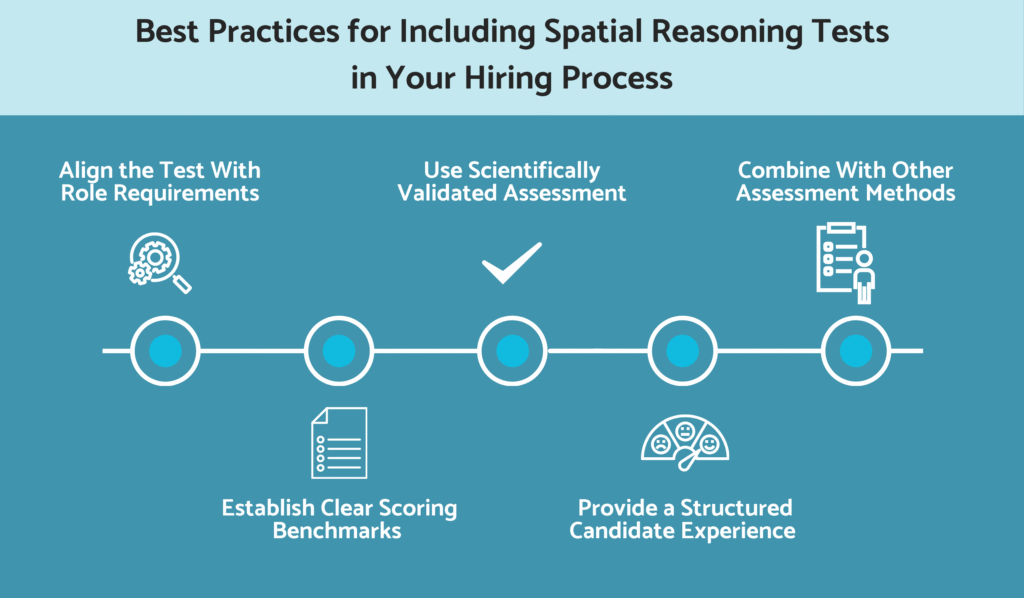
- Align the Test With Role Requirements
Ensure your chosen test directly reflects the skills needed for the position. Spatial reasoning assessments apply best to roles in engineering, architecture, technical design, and data-driven problem-solving.
Based on our experience supporting employers around the world through assessment-led recruitment, aligning assessments with role expectations increases relevance and reduces unnecessary testing.
- Use Scientifically Validated Assessments
Select tools backed by research and psychometric validation. At Assess Candidates, we design spatial reasoning tests in collaboration with Chartered Psychologists and experienced Psychometricians, ensuring accuracy, fairness, and consistency across diverse applicant groups.
- Combine With Other Assessment Methods
Adopt a multi-assessment approach to gain a well-rounded view of candidate potential. We regularly advise employers to combine spatial reasoning tests with structured interviews, cognitive assessments, or job-specific tasks to support stronger decision-making.
- Establish Clear Scoring Benchmarks
Set defined scoring ranges and interpret test results using standardized benchmarks. From our experience supporting employers worldwide, benchmarked scoring improves consistency, reduces bias, and supports more confident hiring decisions.
- Provide a Structured Candidate Experience
Communicate test expectations clearly and outline how results contribute to the hiring decision. We recommend offering clear instructions and, where suitable, optional practice items to help candidates feel prepared and reduce test anxiety.
Next up, we will take a look at the key industries and roles that should use spatial reasoning tests for hiring.
7. Which industries and roles should use spatial reasoning tests for hiring?
Spatial reasoning tests are beneficial in industries where employees need to visualize concepts, interpret technical drawings, mentally manipulate objects, or understand spatial relationships. While these assessments can enhance various recruitment processes, they deliver the most value in roles that require design thinking, technical accuracy, navigation, or 3D problem-solving.
Industries that use spatial reasoning tests for recruitment
The following are the top 5 industries that use spatial reasoning tests as a part of their pre-employment hiring process:
- Architecture and Engineering
Employers in architecture and engineering frequently use spatial reasoning tests because these roles require candidates to interpret blueprints, analyze technical challenges, visualize structures in 3D, and design complex systems.
Significant organizations like Foster + Partners, AECOM, and Siemens commonly use spatial reasoning tests to evaluate candidates.
- Technology
Many technology and IT roles demand strong spatial reasoning, particularly where candidates must visualize abstract systems, architecture, or user journeys. Spatial reasoning is especially valuable in fields like game development, software engineering, and UX/UI design.
Major tech companies such as Amazon, Microsoft, and NVIDIA use these assessments to evaluate technical thinking and visual problem-solving skills.
- Design
The design sector relies heavily on spatial skills to create effective layouts, prototypes, and visual compositions. Product designers, graphic designers, and interior designers use spatial awareness to shape user experience, form, and function.
Large design-focused companies, including BMW, IDEO, and Pentagram, regularly apply spatial reasoning tests when hiring.
- Aviation and Aerospace
Piloting and aerospace positions require candidates to navigate space mentally, interpret instrument layouts, and maintain situational awareness.
Employers, including Boeing, Airbus, and Rolls-Royce Aerospace, rely on spatial assessments as part of their selection process.
- Logistics and Supply Chain
Spatial ability plays a key role in route planning, warehouse optimization, stock organization, and transport coordination. Many logistics companies now use spatial reasoning tests to identify candidates who can efficiently manage movement, layout, and distribution at scale.
Leading employers such as DHL, FedEx, and Maersk increasingly use spatial reasoning tests to support more effective and data-driven hiring decisions.
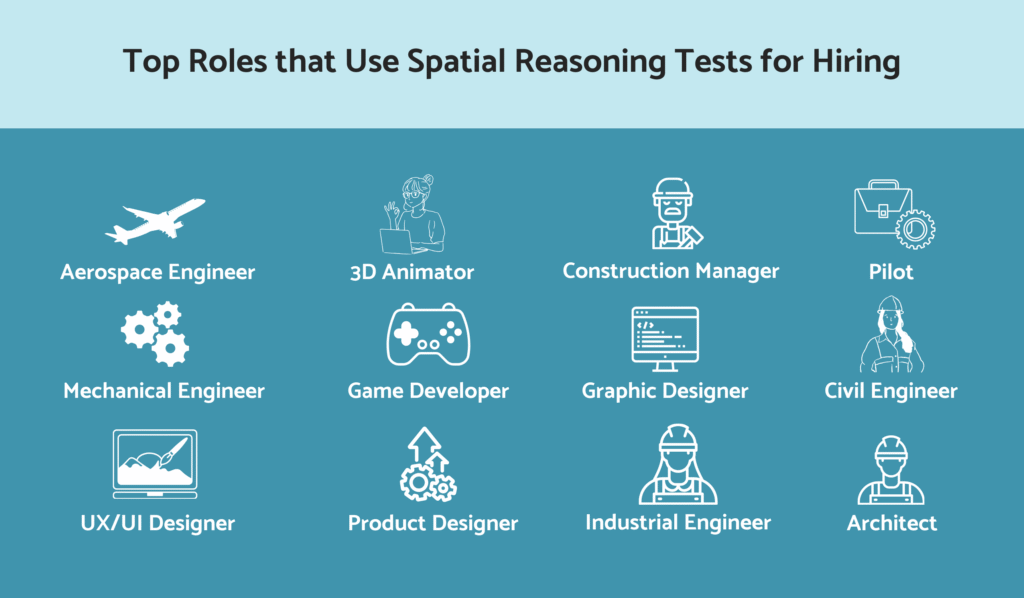
Roles that use spatial reasoning tests for hiring
- Aerospace Engineer
- 3D Animator
- Construction Manager
- Pilot
- Mechanical Engineer
- Game Developer
- Graphic Designer
- Civil Engineer
- UX/UI Designer
- Product Designer
- Industrial Engineer
- Architect
Let’s take a look at the leading employers who include spatial reasoning testing tools in their pre-employment recruitment process.
Which employers use spatial reasoning tests for hiring?
Many global organisations today widely use spatial reasoning tests in their hiring processes. Increasingly, small and medium-sized enterprises (SMEs) and startups are also adopting these assessments to enhance the quality, accuracy, and consistency of their recruitment decisions.
Here are some well-known companies that use spatial reasoning tests:
- NVIDIA
- AECOM
- Foster + Partners
- Siemens
- Rolls-Royce
- Deloitte
- Target
- Marks and Spencer
- Microsoft
- Accenture
- Amazon
- Airbus
- Barclays
- Shell
- Boeing
Discover how our talent assessment platform will help you identify top talent. LEARN MORE
8. Spatial Reasoning Tests: Client Success Story
Client Problem Statement
Imagine a global construction and infrastructure company struggling to recruit site planners, surveyors, and civil engineering trainees. Although the organisation attracts many applicants, its current hiring process does not accurately assess candidates’ ability to interpret blueprints, visualize structural layouts, or mentally manipulate spatial information. These skills are essential for safe and successful project execution.
As a result, hiring teams repeatedly advance candidates who perform well in interviews but struggle with spatial tasks once employed. This leads to costly errors, workflow delays, and reduced confidence among project managers.
The organisation needs a more objective and reliable way to measure candidates’ spatial reasoning, 3D visualisation abilities, and technical accuracy before hiring.
Assess Candidates’ Proposal
At Assess Candidates, we recommend integrating spatial reasoning tests early in the recruitment process. These assessments measure a candidate’s ability to interpret diagrams, mentally rotate objects, identify visual patterns, and understand spatial relationships, skills critical for roles in construction, engineering, aviation, design, and logistics.
Using the assessment at the screening stage enables hiring teams to quickly identify applicants with strong spatial skills before progressing them to technical assessments, practical tasks, or on-site evaluations.
Result
After introducing spatial reasoning testing, the company can identify applicants with the spatial awareness and visual problem-solving skills needed for success in technical and field-based roles. This structured and objective process improves hiring accuracy, reduces on-the-job training costs, and ensures new employees are better prepared for real-world spatial decision-making.
Ultimately, the organization strengthens its workforce by selecting candidates who can interpret plans accurately, make faster on-site decisions, and contribute to higher-quality projects, thereby supporting operational efficiency, safety, and long-term growth.
Partner with Assess Candidates for accurate, science-backed psychometric tests that streamline hiring. VIEW PLANS
9. Why top companies choose Assess Candidates’ spatial reasoning tests to hire
As mentioned earlier, spatial reasoning tests fall under the broader category of cognitive aptitude assessment. Many providers classify them as logical reasoning or abstract reasoning tests. At Assess Candidates, spatial reasoning assessments form a dedicated subcategory within our logical reasoning tests.
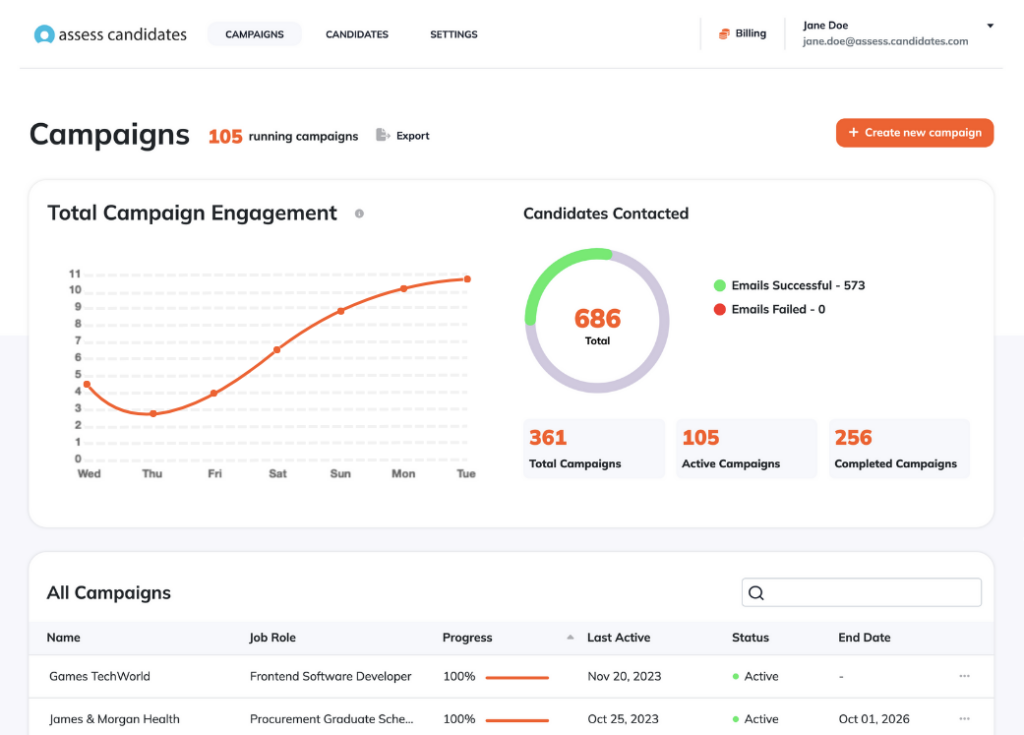
Here is an example of our campaign reporting dashboard available on Assess Candidates.
Here are the top 4 reasons why you should use Assess Candidates’ logical reasoning assessments for your pre-employment hiring process:
- Scientifically Validated by Expert Psychologists: Assess Candidates’ logical reasoning tests are developed by Chartered Psychologists, Scientists, and Psychometricians with decades of experience designing assessments for leading organisations, including SHL and IBM Kenexa.
Each assessment undergoes extensive validation to ensure it accurately measures key spatial abilities, including mental rotation, 2D–3D visualisation, spatial pattern recognition, and diagram interpretation. Our scientifically validated approach enables employers across multiple industries to confidently identify candidates with strong spatial reasoning skills essential for technical and design-driven roles.
- Expert Reporting: Our intuitive platform allows hiring teams to review and interpret test results quickly and efficiently. Recruiters can view detailed insights, compare candidate performance, filter and rank applicants, and create shortlists with ease. Our talent assessment platform also integrates seamlessly with existing ATS systems, ensuring spatial reasoning assessments fit naturally into your current recruitment workflow and support faster, evidence-based selection decisions.
- Positive Candidate Experience: Our logical reasoning assessments are mobile-friendly, visually clear, and easy to use. Candidates benefit from clear instructions, smooth navigation, and an engaging test format featuring diagrams, shapes, and interactive visual elements. Custom branding options allow employers to create a seamless and professional testing experience that strengthens their employer value proposition.
- Candidate Accessibility Support: We prioritize fairness and accessibility by offering features such as extended time settings, zoom functionality, screen reader support, and accessible colour contrast modes, all aligned with WCAG standards. These features ensure that candidates with disabilities or visual impairments can complete the logical reasoning test fairly and comfortably.
Assess Candidates is a trusted provider of pre-employment aptitude tests, delivering end-to-end solutions for employers of all sizes. Explore our logical reasoning tests today and start hiring the best-fit candidates with confidence.
Conclusion: Key Takeaway
- Spatial reasoning tests assess a candidate’s ability to visualize, manipulate, and interpret 2D and 3D objects.
- These tests are especially important for roles requiring visual thinking, problem–solving, and technical design skills.
- The skills measured by spatial reasoning tests include spatial perception, mental rotation, and spatial visualization.
- Different question types include real-world visual thinking tasks, such as organizing 2D shapes, rotations and reflections, block counting, and map reading.
- Using spatial reasoning tests early in the hiring streamlines candidate selection and reduces unnecessary interviews.
- Spatial reasoning tests offer the strongest value when combined with other psychometric and role-specific assessments.
Assess Candidates’ Spatial Reasoning Test Example Question:The correct answer is27
Interested in learning more about effective candidate assessment? Continue reading for frequently asked questions, and sign up with your email to get started.
Frequently Asked Questions
Why should I include spatial reasoning tests in my hiring process?
You should include spatial reasoning tests when a role demands strong visual thinking, problem-solving, or the ability to interpret technical layouts. These assessments help you identify candidates who accurately analyze spatial information and think in 2D and 3D. By using this test, you can streamline screening and select individuals with the right cognitive abilities for technical roles.
How do spatial reasoning tests support objective hiring decisions?
Spatial reasoning tests deliver standardized, measurable results that let you compare candidates based on skill rather than subjective judgement. The non-verbal format reduces bias related to communication style, education, or background. By using data instead of intuition, you create fairer shortlists and improve the consistency of hiring decisions.
Is a spatial reasoning test suitable for high-volume recruitment?
Yes. Spatial reasoning tests work extremely well for high-volume recruitment because they automate early screening and quickly identify candidates with strong technical aptitude. Using these tests helps your team concentrate on qualified applicants and reduces time spent on unsuitable CVs or unnecessary interview rounds.
How accurate are spatial reasoning tests in predicting job performance?
Spatial reasoning tests offer strong predictive value for roles that require spatial analysis, visual thinking, or problem-solving. You can increase hiring accuracy by combining test scores with structured interviews, technical assessments, or additional cognitive tests as part of a comprehensive evaluation process.
How should I interpret and use the test results?
You can use spatial reasoning scores to compare candidates against role-specific benchmarks and performance expectations. Higher scores indicate stronger spatial understanding, visual reasoning, and problem-solving ability.
Test results support shortlisting, inform interview planning, and help identify long-term potential. Results are most effective when paired with structured interviews and job-relevant assessments.


 English
  Arabic