
Understanding the Difference Between Candidate Experience and Employer Branding
Candidate experience and employer branding are closely linked, but they are not the same thing. Employer branding shapes how people perceive your company as a place to work, while candidate experience reflects how people are actually treated throughout the hiring process. Both influence whether candidates apply, stay engaged, and speak positively about your organization.
This guide explains the difference between candidate experience and employer branding, how they influence each other, and how employers can improve both.
Contents
- What is candidate experience?
- What is employer branding?
- How candidate experience and employer branding work together
- Differences between candidate experience and employer branding
- Best practices to align candidate experience with employer branding
- Common mistakes companies make with experience and branding
- Client success story of boosting candidate experience and employer branding
- What is the future of recruitment with candidate experience and employer branding?
- Why do employers use Assess Candidates for experience and branding recruitment?
First, let’s start with the basics: what each term actually means.
1. What is candidate experience?
Candidate experience is the overall impression a person forms of your hiring process, from first awareness of the role through application, assessment, interviewing, communication, and onboarding.
According to the CareerArc survey, 72% of job applicants are likely to share their negative candidate experiences, both virtually and in person, with friends and other candidates. While 50% have said they will not accept a job from a company with a poor reputation, regardless of pay.
Having seen the definition of a candidate experience, let us show you what employer branding means.

2. What is employer branding?
Employer branding is how your company presents and is perceived as a place to work. It includes your culture, values, growth opportunities, and the credibility of the promises you make to candidates and employees.
Begin your hiring process with our psychometric pre-employment assessments. HIRE FOR FREE
Interested in discovering how these two work together? Keep reading to find out!
3. How Candidate Experience and Employer Branding Work Together
Employer branding attracts attention. Candidate experience either confirms or undermines that promise. When the two align, trust increases. When they do not, candidates notice quickly.
According to Universum, 95% of unsuccessful applicants said they would consider reapplying to a company if they had a good candidate experience in the recruitment process.
Top 5 ways that employer branding works with candidate experience
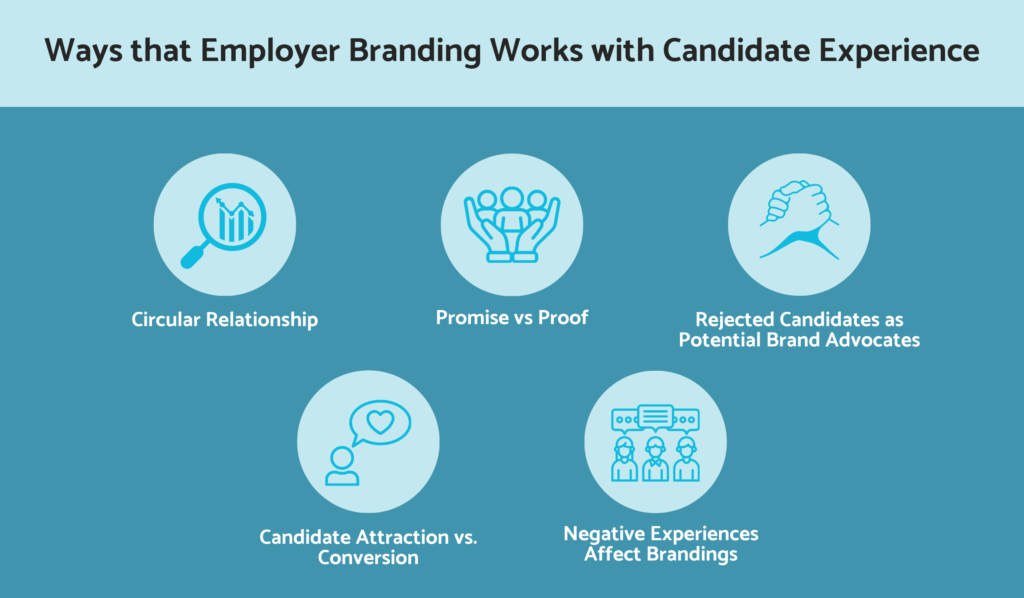
1. Circular Relationship
Building a strong employer brand will attract more candidates, giving you a larger pool of applicants to choose from. A good experience will transform these candidates into new hires who will advocate and promote your brand’s credibility in the workforce, attracting more quality candidates.
2. Promise vs Proof
Your brand informs the world what it is like to work with your company, and your candidate experience speaks to how you treat candidates from the start of the recruitment process through to the end.
3. Rejected Candidates as Potential Brand Advocates
Even if some candidates don’t pass the recruitment process, a positive candidate experience increases the likelihood that they will recommend the organization to others. This creates organic employer branding, benefiting companies of all sizes on social media and professional platforms such as LinkedIn and Glassdoor.
4. Candidate Attraction vs. Conversion
A strong employer brand may attract interest, but a poor candidate experience can still cause drop-off before hiring decisions are made.
5. Negative Experiences Affect the Brand Image
Building employer brands requires consistency, authenticity, and a social media presence, but it can crumble if a candidate shares a negative experience on Glassdoor or other social media platforms. This is because candidates often trust other candidates’ words more than your careers page.
Hire the perfect candidates with our assessment platform. LEARN MORE
Want to know more about the differences between employer branding and candidate experience? We have highlighted them below.
4. Differences Between Candidate Experience and Employer Branding
According to LinkedIn, candidate experience and employer branding are connected, as they both focus on promoting your company’s image to the public. These predetermined assumptions about your company shape how candidates interact with you during the recruitment process.
What are the differences between candidate experience and employer branding?
Knowing the difference between these two, let us continue with practices that align them!
5. Best practices to align candidate experience with employer branding
The strongest hiring organizations treat employer branding and candidate experience as connected parts of one talent strategy, not separate initiatives.
According to Manpower research, about 1 in 4 candidates is likely to consider your organization’s employer brand and reputation before they apply. This is because they view it as one of the top three significant factors in making a career decision.
Best practices to align candidate experience with employer branding
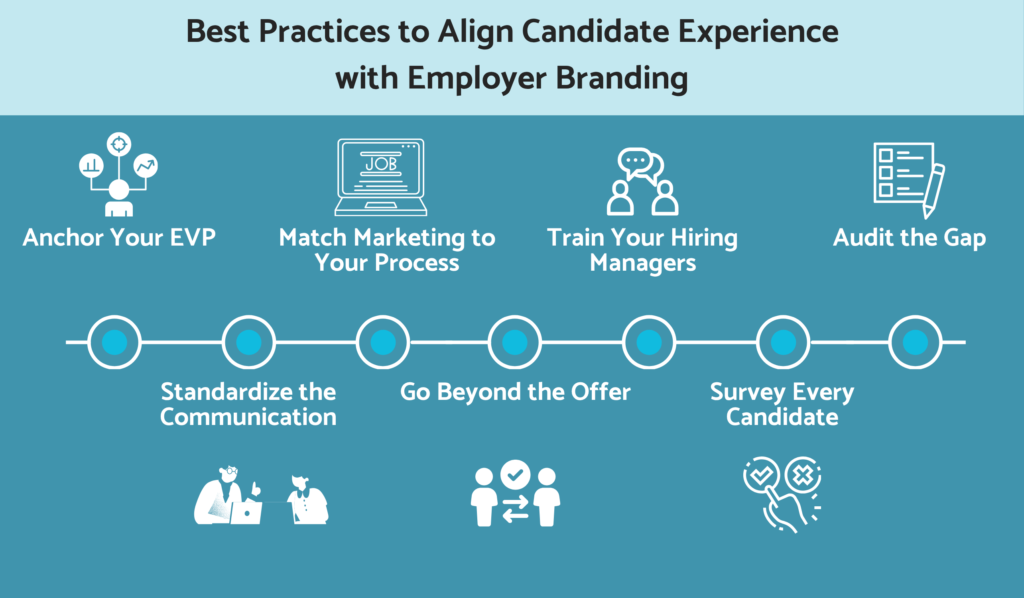
- Anchor Your EVP
Your Employee Value Proposition (EVP) is the foundation of both your candidate experience and employer brand. Therefore, every message that you put out and every recruiting process that you design must be in line with the same promises that you made to your candidates.
- Match Marketing to Your Process
If you are depicting a warm, collaborative, and client–first culture on your company’s career page, then your recruitment process also has to reflect this tone. The language you use, the structure of interviews, and your pace of communication should all feel like an extension of what your brand promises.
- Train Your Hiring Managers
Though your recruiters may deliver an excellent application process, your hiring managers can undermine it by being unprepared. If your hiring managers are dismissive or inconsistent with your organization’s stated values, your branding image could collapse. Train your hiring managers to understand that every interview is a brand moment and not just an assessment exercise.
- Audit the Gap
You should run an audit by pulling your brand messaging apart and mapping every candidate touchpoint in the hiring process. Ask whether the experience you deliver matches the brand you project online and everywhere else. Most companies find the disconnect at the application stage, interview feedback, or rejection communication.
- Standardize the Communication
Having an inconsistent communication pattern with your prospective candidates is one of the many ways that most brands and experiences often fall out of sync. We recommend that you build templated yet humanized messaging that checks in on the candidates for every stage of your hiring process.
- Go Beyond the Offer
The candidate experience does not have to end at the job offer. You can provide your candidates with pre–boarding communication, the first–day experience, and early onboarding, as these fall within the timeframe when candidates evaluate your brand promise.
- Survey Every Candidate
We suggest that you survey every candidate, both successful and unsuccessful, after they have participated in your recruitment process to gauge their experience throughout the process. Specifically ask whether the process aligned with their expectations, given what they knew about the company.
Design the perfect recruiting process for your candidates with our assessment gallery. HIRE FOR FREE
Ever worried about the common mistakes employers make with experience and branding?
The next section covers the mistakes that most often create a gap between brand promise and hiring reality.
6. Common mistakes companies make with experience and branding
Companies often weaken both candidate experience and employer branding when they focus on perception but neglect the reality of the hiring process.
Common mistakes employers make with experience and branding
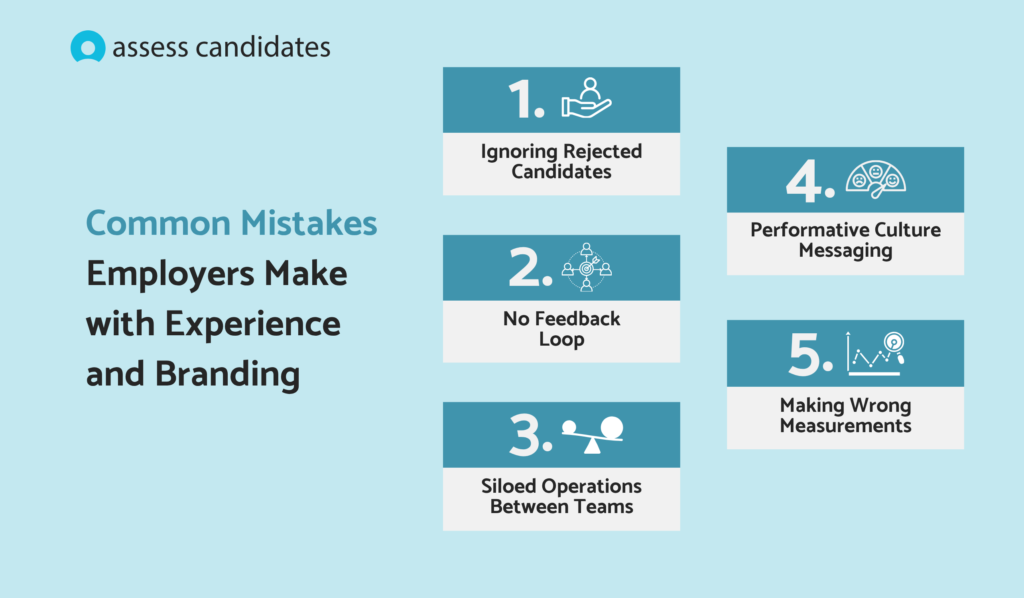
1. Ignoring Rejected Candidates
Many employers focus their attention on candidates who make it past the recruitment process while ignoring everyone else. However, the majority of the candidates who interacted with you were unsuccessful and also experienced your recruitment process. Sending these candidates a cold and automated rejection email is one of the most damaging brand mistakes companies make.
Solution: We recommend building a personalized, respectful rejection communication framework. This is because a well–written, templated rejection email sent to the unsuccessful candidates is much better than silence.
2. No Feedback Loop
Our experts have observed that companies rarely ask candidates for their opinions on what the hiring process was actually like. Without a structured post–process survey, you are likely unable to learn about where the process breaks down or what contradicts your brand promise.
Solution: We suggest implementing a short post-process survey for accepted and rejected candidates to gather feedback on areas where you may have fallen short. You should look into your communication skills, fairness, and whether their experience matched their expectations of your brand.
3. Siloed Operations Between Teams
When employer branding resides in the marketing department, and candidate experience sits with the recruiting team, these two seldom meet, let alone collaborate. Due to a lack of synchronization between the two teams, your company may be perceived as having a candidate experience that contradicts your brand image.
Solution: You should establish a cross–functional team with representatives from Marketing and HR. Schedule a monthly meeting where everyone shares feedback data and aligns with the organization’s recruiting goals.
4. Performative Culture Messaging
Candidates are starting to learn the difference between companies that are genuinely committed to their values and those that are performative in their hiring processes. This knowledge becomes public because candidates often share their experiences on the internet. If your brand claims to uphold diversity and inclusion but the interview process is homogeneous, your candidates will notice, and it may ruin your reputation.
Solution: We recommend internally stress–testing your brand claim before you publish it. To do this, you would need to ask your employees whether the claim reflects their lived experience. Examine the gap and close it before publicizing your brand claim.
5. Making Wrong Measurements
Most organizations often track the time-to-fill and cost-per-hire while ignoring the candidate Net Promoter Score (cNPS), offer acceptance rate, and drop-off rate. Without the proper metrics, you may be unable to identify problems or exhibit improvement over time.
Solution: Begin by expanding your recruitment dashboard to include experience–focused metrics alongside efficiency metrics. Draw an analysis of your candidate NPS (cNPS), application completion rate, offer acceptance rate, and withdrawal rate.
Build the perfect recruitment process for your candidates with our assessment gallery. HIRE FOR FREE
Are you looking to attract and hire talent in your company but unsure what pre-employment psychometric assessment tests to look for in 2026? Reach out to us for a full examination of your recruitment assessment design.
Up next, let us take a look at the client success stories of employers who considered experience and branding in their recruitment process.
7. Client success story of boosting candidate experience and employer branding
Different employers have narrated how they navigated their situations with candidates whose expectations of their brand image did not align with their candidate experience. Here, we will examine some real-world examples to see how these companies addressed their challenges.
1. Unilever
Challenge:
Unilever received over a million job applications annually, making it almost impossible to provide a personalized, consistent candidate experience at scale. The large volume of applications meant candidates would receive very little to no meaningful communication throughout the hiring process.
Solution:
The organization launched AI-powered video interviews and game-based assessment tests to replace the traditional CV screening. This helped minimize human bias and improve the early stages of recruitment.
Results:
- Time-to-hire reduced by 75%
- Candidate satisfaction scores increased exponentially as candidates reported a more engaging and fair recruiting process
- The organization saved approximately 100,000 hours of hiring time annually
2. Marriott International
Challenge:
Marriott struggled to attract and recruit younger talent who saw the hospitality industry as a low-growth and high-burnout career path. This was damaging the company’s employer brand among the demographic they needed.
Solution:
Marriott introduced a functioning employer brand that was focused on employee stories, career growth narratives, and behind-the-scenes content that humanized life at the company. They also invested heavily in social media and employee-generated content, enabling their workforce to speak on their behalf.
Results:
- Marriott became one of the highest-followed hospitality brands on LinkedIn, broadening their passive talent reach
- Graduate applications increased by 45% within 18 months of launching the program
- Employee-generated content performed better than company-produced content by over 300% in engagement
8. What is the future of recruitment with candidate experience and employer branding?
Candidate experience and employer branding, which were once seen as secondary concerns in recruitment and talent sourcing, are now at the forefront of almost every talent strategy. The rise of artificial intelligence and the increasing demand for transparency in the workforce have led employers to rewrite their recruiting strategies to continue attracting top talent and outpacing their competitors.
What is the future of recruitment with candidate experience and employer branding?
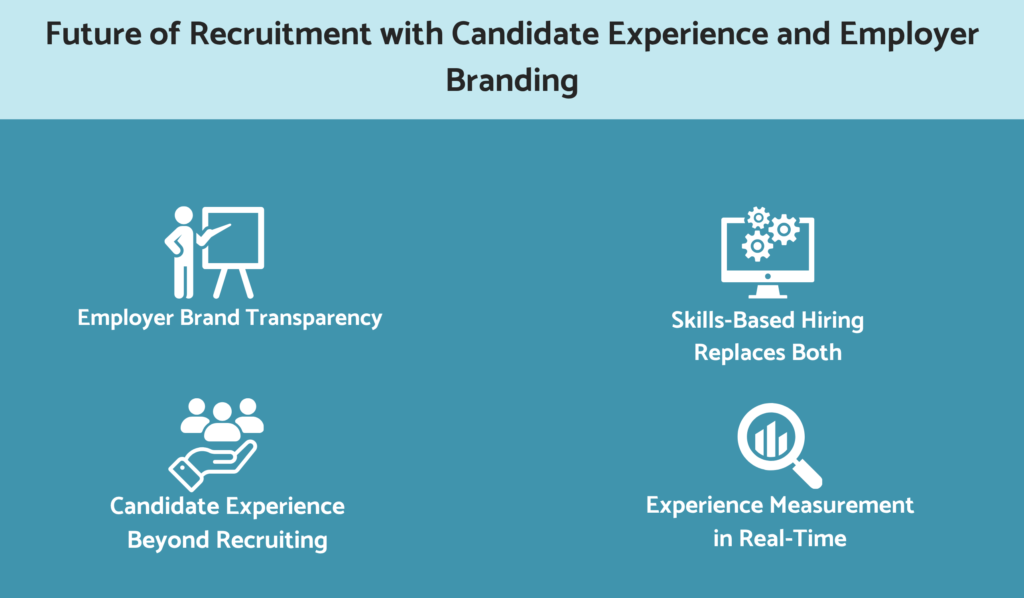
- Employer Brand Transparency
Since candidates already have more access to insider information about companies through online platforms like LinkedIn, Glassdoor, and social media, the future of recruitment will go beyond these. Now, candidates will have access to real–time sentiment data, employee–review aggregators, and AI–powered employer–reputation scores. These will help candidates in projecting a brand that reflects their internal reality.
- Candidate Experience Beyond Recruiting
The boundaries of the candidate experience are gradually expanding, and in the future, your candidates’ experiences will be evaluated not only from application to offer but also beyond. It will also start from your candidates’ first awareness of your brand and end in their first year as an employee. This means that recruiting and HR will have to collaborate further to deliver a seamless experience from the first stage through the first promotion.
- Skills-Based Hiring Replaces Both
There will be a transformation from credential-based to skills-based hiring as companies like Google, IBM, and Tesla are at the forefront of this push. From a brand perspective, organizations that prioritize skills-based recruitment will attract a larger, more diverse talent pool. From an experiential perspective, traditional interviews will be replaced by psychometric assessment tests, portfolios, and project-based examinations.
- Experience Measurement in Real-Time
The future of candidate experience measurement will be real–time, along with sentiment tools and surveys that capture your candidates’ feedback at every stage of the recruitment process. This will enable your recruiting teams to identify and rectify experience breakdowns quickly.
In practice, employers strengthen both candidate experience and employer branding when the assessment stage feels fair, clear, and professional.
Uncover our assessments created by Chartered Scientists to hire the top talent. VIEW PLANS
So, why choose Assess Candidates when recruiting for your organization?
9. Why do employers use Assess Candidates for experience and branding recruitment?
Assess Candidates helps employers deliver a more professional, fair, and consistent assessment process, which strengthens both candidate experience and employer brand credibility.
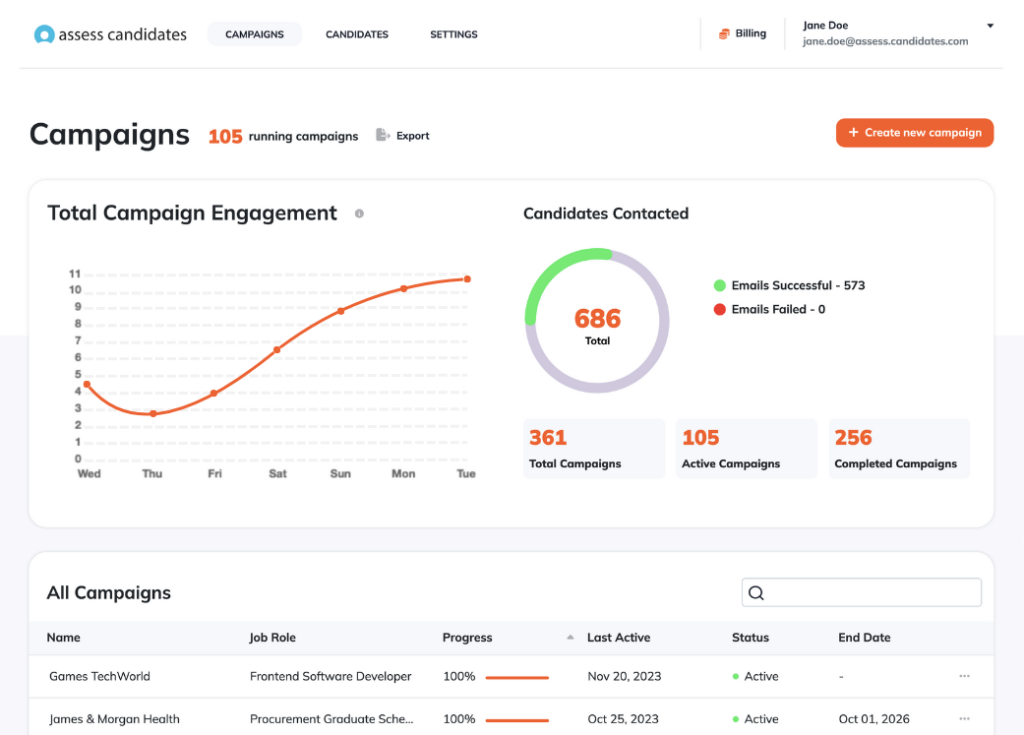
- Keeps Candidates Engaged: Assess Candidates provides your candidates with realistic workplace scenarios, shorter test times, and AI–driven technology. These will keep your candidates engaged and leave them impressed with a positive candidate experience.
- Minimizes Bias and Promotes Inclusivity: Our platform embeds fairness and inclusion in every assessment, reducing bias and giving candidates an equal opportunity to succeed. This is important for employer branding, as companies that promote Diversity and Inclusion need to reflect this in their recruitment process.
- Makes Accessibility a Standard: The Assess Candidates platform includes accessibility features, such as additional time, a zoom function, and screen reader compatibility. All these help in ensuring that candidates with disabilities have a seamless assessment process, which also promotes your candidate experience.
- Innovative Assessment Formats: Our platform offers a game-based assessment that evaluates your candidates’ behavioral and cognitive abilities. We also offer situational judgment tests that provide your candidates with a realistic job preview. The innovative assessment formats signal that your company is forward–thinking, invests in technology, and makes the experience engaging.
- Branded Professional Candidate Experience: Assess Candidates provides you with a fully branded platform that delivers a smooth, professional experience from start to finish. This is critical for employer branding, as the assessment stage reflects your professionalism.
Hire the top candidates with our assessment tool platform. LEARN MORE
Conclusion: Key Takeaway
Candidate experience and employer branding are different, but they work best when they reinforce each other. Strong branding brings candidates in. Strong experience gives them a reason to trust what they were promised.
Want to know more about using the assessment process to promote your employer branding, candidate experience, and hiring the top talent for your company? Keep scrolling to explore our frequently asked questions, and enter your email to get started today.
Frequently Asked Questions
How do you measure candidate experience?
Candidate experience can be measured by various factors, including but not limited to the candidate Net Promoter Score (cNPS), application completion rate, time-to-hire, offer acceptance rate, drop-off rate, and post-process rate. These metrics provide you with insight into where the experience is strong, weak, or in need of repair.
How do you measure employer brand effectiveness?
You can track your employer brand effectiveness through metrics like employer review ratings on professional platforms like Glassdoor and Indeed, growth in inbound applications, quality of hire over time, and employee Net Promoter Score (eNPS). You can also measure this through social media reach and the engagement on employer branding content.
What is an Employee Value Proposition (EVP), and why is it significant?
An Employee Value Proposition (EVP) is the package of benefits, career growth opportunities, culture, and skills that an organization offers to its employees in exchange for their skills, commitment, and time. This is the foundation of every employer brand, as brand content and every careers page message should trace back to the EVP.
How does a bad candidate experience affect my company’s reputation?
A bad candidate experience can have lasting damage to your company. This is because candidates who feel disrespected, ignored, or misled during the recruitment process may share their experiences on Glassdoor, LinkedIn, and other social media platforms.
What role do diversity and inclusivity play in employer branding?
Diversity and inclusion have become central to employer branding when recruiting, especially among Gen Z workers. Candidates are increasingly researching and assessing organizations that not only promote DEI but also have evidence of it. A brand that leads in its diversity and inclusion has a competitive advantage when attracting talent.


 English
  Arabic