
Selecting top banking talent: Why you need more than only cognitive ability tests



Recruitment in banking goes beyond assessing technical skills; it’s also about understanding each candidate’s motivations, goals, business judgment, and cultural fit.
The banking industry’s landscape is ever-evolving, with a 60-70% rise in investment banking recruitment at big firms like JP Morgan and Goldman Sachs. However, there is a significant shift towards a more multi-assessment hiring approach. Recruiters must identify individuals who not only meet current skill requirements but also show agility, adaptability, and a readiness to embrace emerging technologies.
According to a study by the UK Government, 48% of businesses in the UK Banking & Financial Services are already recruiting for roles that require advanced data skills beyond basic IT, such as data analysis.
Skills-based recruitment not only helps banks hire highly skilled candidates efficiently but also caters to Gen Z professionals, who value innovation, digital fluency, and continuous learning.
If you are asking questions such as:
- Which soft skills are essential to assess in banking candidates?
- How do business simulations help in banking recruitment?
- Which hard skills are important for finance roles?
Then, this guide is for you! We will explore the science behind modern candidate assessment in the banking industry. As a recruiter, you are not just seeking top-tier banking talent; you are shaping the future of banking itself.
So, let’s begin by examining which assessments enable a more holistic, data-driven approach to identifying exceptional banking talent. And why there has been a sharp rise in AI-driven hiring in finance recruitment.
Contents
- What is the banking industry?
- What cognitive skills do banks look for in top candidates?
- Why are cognitive ability tests not enough alone for hiring top banking talent?
- Which other tools should employers use for assessing finance candidates?
- What is the future of banking hiring assessments?
- Client success story
- Why do top companies prefer Assess Candidates for hiring?
So, let’s start our discussion by briefly describing what the banking industry entails.
1. What is the banking industry?
The banking industry comprises financial institutions that manage money, credit, and financial transactions for individuals, businesses, and governments. It includes various types of banks and financial entities that offer services such as deposits, loans, investments, and payment processing.
Transform your banking recruitment process with Assess Candidates’ psychometric tests. HIRE FOR FREE
What are the different components of the banking industry?
There are 7 major components of the banking industry globally. These include the following:
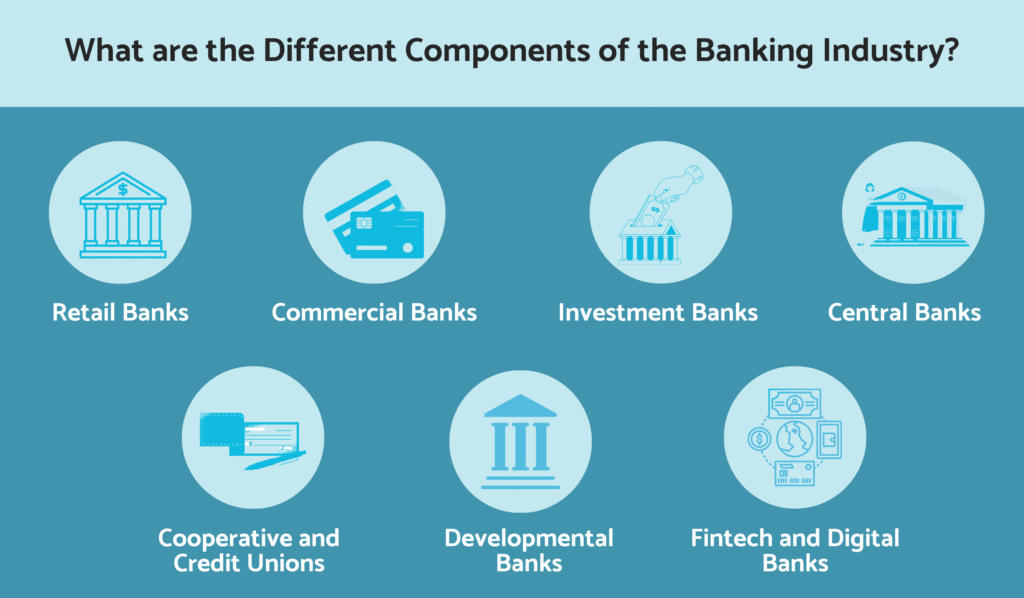
- Retail Banks: These banks provide financial services directly to individuals, which include savings accounts, personal loans, credit cards, and mortgages.
E.g.: HDFC Bank, HSBC, and Chase Bank
- Commercial Banks: These banks offer services to small and medium businesses, including business loans, treasury, and working capital.
E.g.: Barclays, Citibank, and Lloyds
- Investment Banks: These banks handle large financial transactions like mergers, acquisitions, and IPOs.
E.g.: Goldman Sachs, Morgan Stanley, and JP Morgan
- Central Banks: These banks control monetary policy, interest rates, and national currency issuance.
E.g.: Reserve Bank of India (RBI), Bank of England, and Federal Reserve
- Cooperative and Credit Unions: These are member-owned institutions that provide affordable credit and community banking.
E.g.: Navy Federal Credit Union, and Cooperative Bank
- Development Banks: These allow funding for long-term projects that support economic growth and infrastructure.
E.g.: World Bank and Asian Development Bank
- Fintech and Digital Banks: These tech-driven banks offer mobile and online banking services.
E.g.: Revolut, Monzo, and Paytm Bank
1.1 million people work in financial services in the UK. As per Zippia, the banking industry is expected to see a compound annual growth rate of 6% from 2020 to 2025, increasing its value from $20.49 trillion to $28.53 trillion.
So, what skills do banking employers look for in their candidates? Let’s find out below.

2. What cognitive skills do banks look for in top candidates?
Employers in the banking industry require candidates to have financial acumen, an analytical mindset, and proficiency in regulatory compliance. Beyond technical expertise, they value candidates who have excellent communication skills with a customer-focused mindset and can handle working with complex numerical data.
These qualities ensure that candidates not only perform well in analytical tasks but also thrive in high-stakes, client-facing environments.
Let’s discuss all the core skills required in the banking industry and how cognitive and psychometric assessments can be used to measure them effectively.
Which key cognitive skills do cognitive ability tests assess in banking candidates?
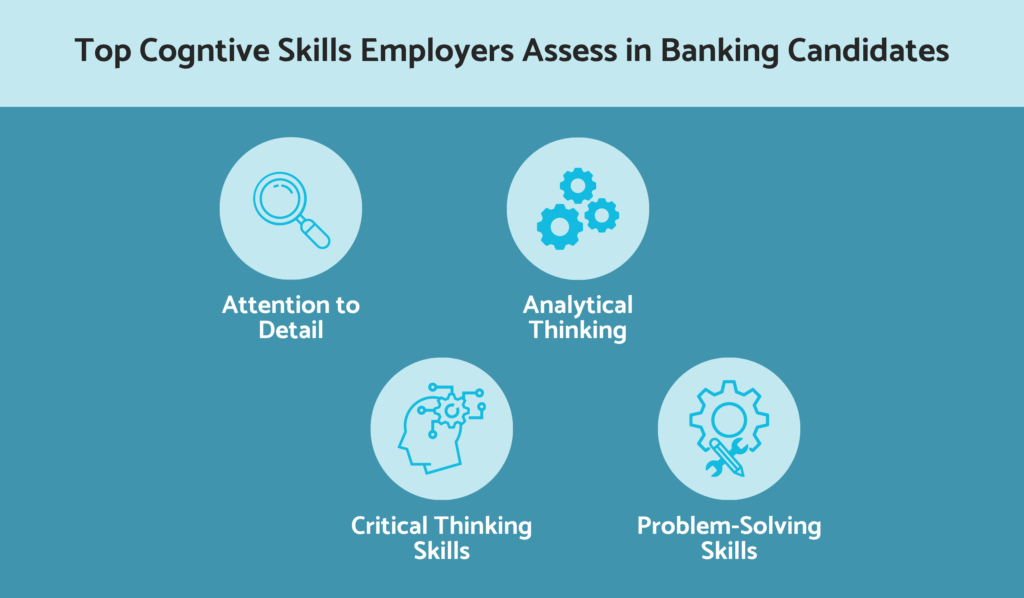
- Attention to Detail
Attention to detail in banking professionals is paramount, as small errors can have significant consequences. Cognitive tests that assess attention to detail help identify candidates who exhibit meticulousness in their work, reducing the likelihood of errors in financial calculations and documentation.
Cognitive tests used to measure: Error-checking tests which test concentration, error detection, and consistency in fast-paced or repetitive tasks.
- Analytical Thinking
Strong analytical skills are essential for evaluating market trends, assessing risks, and making data-driven decisions. Banking professionals must demonstrate the capacity to logically analyze intricate numerical and financial information, enabling them to devise effective strategies and mitigate potential risks.
Cognitive tests used to measure: Numerical reasoning tests and logical reasoning tests, which reveal how candidates analyze incomplete or complex data to make decisions under time constraints.
- Critical Thinking Skills
Critical thinking enables banking professionals to objectively evaluate information, challenge assumptions, and make decisions based on evidence rather than intuition or bias. Employers value candidates who can question incomplete or misleading data, detect inconsistencies in reports, and anticipate the consequences of financial strategies. Strong critical thinkers prevent errors, fraud, and poor investment decisions while enhancing problem-solving in complex scenarios.
Cognitive tests used to measure: Psychometric critical reasoning tests which assess how candidates evaluate conflicting information, identify logical flaws, and propose well-reasoned solutions.
- Problem-Solving Skills
Problem-solving is a critical cognitive skill for banking professionals, enabling them to analyze complex financial scenarios, identify issues, and develop effective solutions. Candidates who excel in problem-solving can navigate uncertainty, mitigate risks, and make sound decisions that impact both clients and the organization.
Cognitive tests used to measure: Scenario-based reasoning tests and numerical problem-solving tests, which evaluate how candidates approach complex problems, identify patterns, and apply logical solutions under pressure.
Hire top talent with our industry-standard cognitive ability assessments. LEARN MORE
Cognitive ability tests have long been a staple in banking and finance recruitment. However, recruiters are increasingly recognizing that these tests alone are not sufficient. To gain a complete picture of a candidate’s skills, competencies, personality, and potential, cognitive assessments should be combined with other pre-employment assessment methods.
But why is this combination so important?
3. Why are cognitive ability tests not enough alone for hiring top banking talent?
Cognitive aptitude tests are a popular scientific tool to evaluate banking candidates. However, these tests alone can’t assess candidates on the hard skills and soft skills necessary for success in the banking industry.
What hard skills do employers look for in their banking candidates?
Banking employers are actively seeking individuals with essential hard skills to navigate the complexities of dynamic financial landscapes:
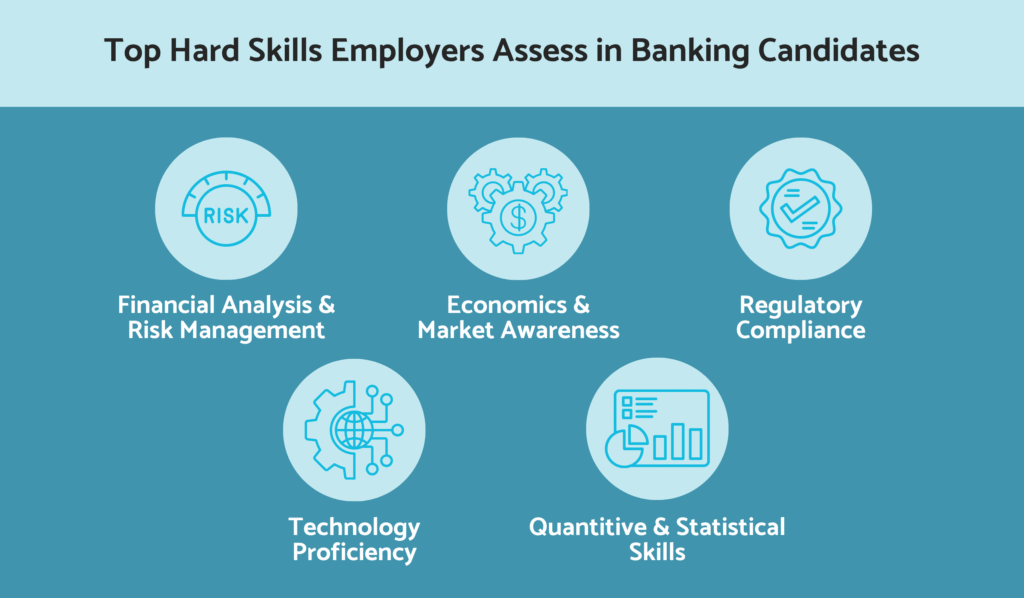
- Financial Analysis and Risk Management
Employers use this skill to assess a candidate’s ability to interpret complex financial statements, manage risks, and make sound investment or credit decisions. While cognitive ability tests can measure numerical logic and problem-solving, they don’t capture judgment under uncertainty, ethics, or composure under stress, which are critical for financial decisions that impact millions.
Combine case-based assessment centers, situational judgment tests (SJTs), and high-pressure simulations with reasoning tests. This testing approach helps you evaluate how candidates apply analytical insights ethically and practically in real-world financial scenarios.
- Economics and Market Awareness
Understanding how interest rates, inflation, geopolitical events, and market cycles influence client portfolios and product performance is vital. Cognitive tests reveal how quickly a candidate can process information, but not how they apply market insight with strategic judgment or client sensitivity.
Integrate business simulations, behavioral interviews, and role-play exercises with market data challenges to gauge candidates’ foresight, communication of insights, and decision-making under ambiguity.
- Regulatory Compliance
A solid understanding of regulatory frameworks, including AML, KYC, Basel III, GDPR, and ESG standards, is non-negotiable in banking. Top candidates must stay abreast of ever-changing regulations, ensuring that the bank operates within legal parameters and mitigates compliance risks. Cognitive tests fail to measure moral integrity, accountability, and adherence to rules—traits that directly affect.
Combine integrity and ethical judgment inventories, culture-fit assessments, and scenario-based interviews with cognitive testing to ensure candidates demonstrate both understanding and ethical alignment with compliance principles.
- Technology Proficiency
In an era of digital transformation, proficiency in financial technology (fintech) and a readiness to embrace emerging technologies are crucial. Employers favor banking professionals who can utilize new fintech tools, AI models, or blockchain systems, and analytics tools to turn technical analysis into readable visuals and reports. While cognitive tests can measure technical reasoning, they cannot assess tech curiosity, learning agility, or innovation readiness.
Pair tech-based skill assessments, simulation exercises, and learning agility questionnaires with cognitive tests. This helps reveal how effectively candidates adapt to emerging technologies and integrate them into banking workflows.
- Quantitative And Statistical Skills
Employers focus on banking candidates with effective financial forecasting and data-driven decision-making skills, such as numerical reasoning, budgeting, and risk assessment. These complement analytical skills useful in pricing, interest computations, and derivatives modeling. However, numerical reasoning tests alone don’t capture a candidate’s data interpretation accuracy, real-world application, or decision bias under pressure.
Blend data interpretation simulations, skills-based quantitative tasks, and assessment center exercises with cognitive evaluations. This helps assess both analytical depth and the ability to communicate findings clearly and strategically.
But do you know that soft skills are also key to a successful career in banking? Let’s find out below which soft skills banking employers assess.
Which top soft skills do recruiters assess in banking candidates?
As per Forbes, 89% of recruiters say bad hires typically lack soft skills. Therefore, they equally focus on soft skills assessment besides hard skills.
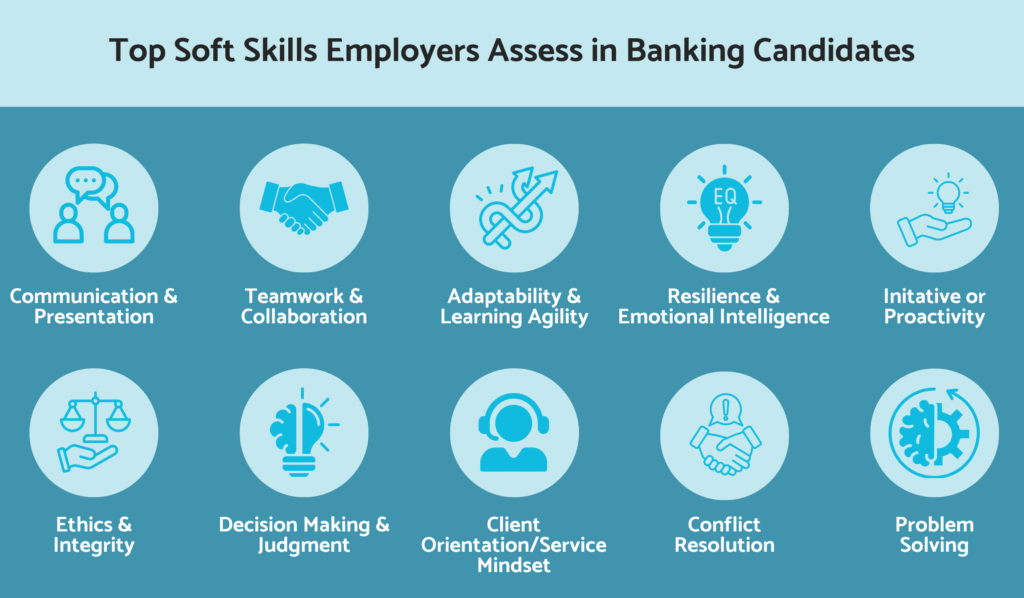
- Communication and Presentation Skills: Effective communicators in the banking sector can translate complex finance data into clear, persuasive reports or pitches to diverse audiences.
Tools used to measure: Video interviews, presentation exercises, and role plays assess clarity, structure, and engagement. These tools reveal how candidates apply analysis through impactful communication.
- Teamwork and Collaboration Skills: Banks operate in cross-functional teams where coordination affects operational efficiency and client outcomes. Collaborative candidates contribute effectively, resolve conflicts, and share knowledge.
Tools used to measure: Situational judgment tests (SJTs), group exercises, and assessment center simulations, assessing cooperative behavior and adaptability in team settings.
- Adaptability and Learning Agility: Agile learners drive transformation, quickly grasp new concepts and regulatory standards, and adapt to evolving circumstances. It is vital for the sustained success of a bank.
Tools used to measure: Learning agility psychometrics, behavioral interviews, and adaptive role-plays. They help identify candidates open to feedback, curiosity, and cross-functional flexibility.
- Resilience and Emotional Intelligence: Resilient banking candidates who can efficiently navigate through market fluctuations, regulatory shifts, and industry disruptions. This helps ensure long-term productivity and prevent burnout in high-stakes financial environments.
Tools used to measure: Emotional intelligence and personality inventories, such as i-EQ, and high-pressure job simulations. They test candidates on their emotional regulation and task performance under time-bound or stressful conditions.
- Initiative or Proactivity: Proactive banking employees anticipate issues, improve processes, and innovate solutions. This soft skill drives efficiency and strategic impact.
Tools used to measure: Behavioral interviews, psychometric inventories, and assessment center simulations. They allow evaluating candidates on their forward-thinking and solution-oriented behaviors.
- Ethics and Integrity: Banking employees must handle sensitive information responsibly and adhere to compliance rules. Ethical soft skills build trust and protect organizational reputation.
Tools used to measure: Integrity psychometric tests, ethical dilemma simulations, and culture-fit assessments. They help examine decision-making consistency and adherence to professional values.
- Decision Making and Judgment: Soft decision-making in banking involves evaluating options, considering stakeholder impact, and balancing risk with opportunity.
Tools used to measure: Situational judgment tests (SJT) and business scenario exercises. They help assess how candidates combine logic, ethics, and interpersonal factors in their choices.
- Client Orientation or Service Mindset: Banks value employees who understand client needs, deliver solutions, and maintain positive relationships.
Tools used to measure: Role-play exercises, behavioral interviews, and customer simulation assessments, testing empathy, problem-solving, and communication effectiveness.
- Conflict Resolution Skills: Resolving disputes between colleagues, clients, or stakeholders without escalation is crucial for banking professionals. This ensures smooth operations and relationship maintenance.
Tools used to measure: Group exercises, assessment center simulations, behavioral interviews, and personality questionnaires. They help in identifying candidates’ negotiation style, assertiveness, and compromise ability.
- Problem Solving: Top candidates should demonstrate the ability to identify root causes, analyze complex issues, and develop effective, practical solutions under pressure. In banking, this skill ensures employees can anticipate operational bottlenecks, resolve client challenges, and maintain performance consistency in high-stakes, data-heavy environments.
Tools used to measure: Combine Situational judgment tests (SJT) and business scenario exercises. They help recruiters get comprehensive candidates who apply logic under pressure and solve problems ethically and effectively in practical scenarios.
Choose Assess Candidates for a tailored approach to banking candidate assessments. HIRE FOR FREE
We have already suggested some other pre-employment tools that you can use to assess your banking candidates, but let’s explore them in more detail in the following section.
4. Which other tools should employers use for assessing banking candidates?
As employers realize the importance of skills-based recruitment, more and more recruiters are choosing to combine cognitive tests with other assessments. A strategic hiring approach helps avoid mis-hires, focus on upskilling and reskilling existing employees, and make recruitment more efficient and cost-effective.
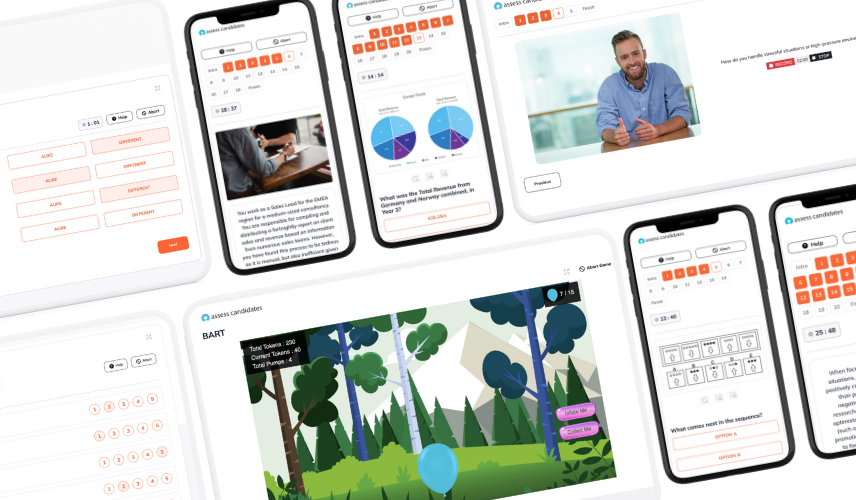
Top 12 tools employers use with cognitive tests for banking recruitment:
1. Situational Judgment Tests (SJTs): Help recruiters evaluate how candidates respond to realistic workplace dilemmas involving customer satisfaction, compliance, or teamwork. SJTs reveal judgment, prioritization, ethics, and emotional maturity in decision-making that are essential for client-facing and risk management roles.
Example question: “You notice a long-term client making a high-risk transaction that violates company policy. Do you stop it immediately, consult your manager, or alert compliance? You must choose the best and worst actions.”
2. Case Study Exercises: Allow recruiters to evaluate candidates on their analytical reasoning, commercial awareness, and strategic thinking by presenting real-life business or financial problems. It is helpful for managerial and analyst roles to assess decision-making under pressure.
Example question: “You receive data about a bank’s declining loan portfolio. You must identify the cause, recommend solutions, and summarize your analysis in a presentation to management.”
3. Business Simulations: Assess candidates using simulated banking operations or portfolio management experiences to assess leadership, adaptability, and teamwork. Candidates make sequential decisions and experience consequences dynamically.
Example question: “You manage a branch facing a liquidity crisis and must decide between raising interest rates, cutting costs, or requesting head-office support. Each decision affects profits and reputation.”
4. Group Discussion Exercises: Measure teamwork, listening, communication, assertiveness, and negotiation skills. Recruiters observe interpersonal dynamics and problem-solving ability in collaborative settings.
Example question: “A group of candidates decides how to distribute a limited marketing budget among three banking products”. Observers assess reasoning, influence, and cooperation.
5. Role-Play Exercises: Assess interpersonal effectiveness, persuasion, and empathy in client or conflict situations. It is helpful for relationship management and sales positions.
Example question: “You play a bank officer managing an upset client whose credit request was rejected. You must stay calm, explain the rationale, and suggest an alternative product professionally.”
6. Presentation Exercises: Evaluate structured thinking, confidence, and communication in presenting financial or strategic information. Common in leadership and client-facing roles.
Example question: “After reviewing a case on expanding digital loans, you deliver a ten-minute presentation proposing your market-entry plan to a panel of senior officers.”
7. Technical and Functional Assessments: Measure candidate knowledge and skill in finance, compliance, and analytics. These ensure candidates can apply theoretical understanding to practical job functions.
Example question: “For a credit analyst role, you’re given a balance sheet and must assess whether a loan should be approved, justifying your answer with financial ratios and risk indicators.”
8. Work Sample Tests: Evaluate real task performance rather than hypothetical answers. These are the strongest predictors of job success, focusing on quality, accuracy, and problem-solving.
Example question: You are given raw transaction records to reconcile within 20 minutes. Recruiters evaluate how accurately and efficiently you identify errors.
9. In-Tray or E-Tray Exercises: Assess time management, prioritization, and organization under time constraints by simulating an email inbox or task list.
Example question: “You receive 15 emails from clients and internal teams with varying urgency. You must prioritize, respond, and delegate tasks within 40 minutes.”
10. Video Interviews: Assess communication, reasoning, and professionalism through structured video or live interview formats using the competency-based approach. These ensure consistency and fairness in early candidate screening.
Example question: “Describe a time you managed customer dissatisfaction.” The recruiters used the AI-insights on the candidate’s logic, tone, initiative, integrity, accountability, and self-awareness.
11. Culture Fit Assessments: Assess the candidate’s alignment with the bank’s ethics, mission, and client-first principles. This helps ensure a positive work environment and higher employee cohesion and satisfaction.
Example question: “How would you respond if a colleague achieved high targets using unethical shortcuts?” The candidate’s reasoning reveals their ethical stance and loyalty to compliance.
12. Personality Questionnaires: Evaluate a candidate’s typical behavior, motivation, and interpersonal style to determine alignment with banking roles and organizational culture. They help identify traits such as integrity, emotional stability, and conscientiousness that predict long-term performance and ethical decision-making.
Example question: “Complete Assess Candidate’s SHL Personality OPQ assessment measuring how you react to workplace pressure.” Results show high conscientiousness and emotional control, indicating the candidate can handle compliance-heavy roles where precision and calm judgment are vital.
Hire top job-fit banking talent with our expert-styled assessments. VIEW PLANS
5. What is the future of banking hiring assessments?
Recruiters today focus on an overall candidate evaluation for both hard and soft skills. They choose candidates that are not just job-ready, cognitively flexible, and technically acumen, but also are culturally fit. In the future, there will be key hiring trends that will emerge and re-emerge, such as the following:
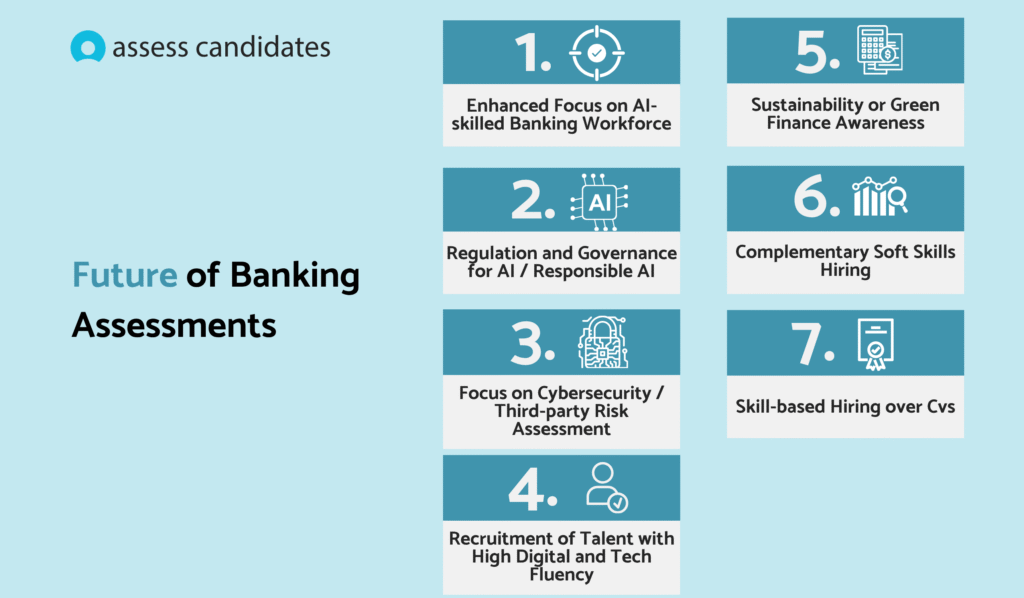
- Focus on AI-Skilled Banking Workforce: Banks are increasingly adopting AI and ML for fraud detection, credit scoring, customer service chatbots, and risk modelling. Even non-technical roles now need a basic understanding of AI to interact with automated systems and make informed decisions.
As per ZipDo, 82% of banking executives see AI/ML as key for the future workforce.
- Regulation and Governance for AI / Responsible AI: As banks deploy AI, regulators insist on oversight, fairness, and explainability. Skills in AI ethics, governance, and vendor risk management are increasingly required to ensure compliance and prevent bias.
As per Talentmash, dedicated responsible AI roles reached 138 people across 30 of the top 50 banks, up 21% in six months.
- Focus on Cybersecurity / Third-Party Risk Assessment: With more banking services going digital and involving multiple vendors, banks face higher exposure to cyber threats. Employees with skills in cyber risk management and supplier oversight are critical to protect assets and maintain trust.
As per WifiTalents, 60% of banks have integrated reskilling programs for cybersecurity roles.
- Recruitment of Talent with High Digital and Tech Fluency: Routine banking tasks are increasingly automated. Employees who can use, manage, or optimize automation tools and analyze data are highly valued. Python and data analytics skills are in high demand across banking operations.
As per WifiTalents, retail banking branches in North America require around 70% staff retraining for digital transformation.
- Sustainability / ESG / Green Finance Awareness: Climate change, net-zero commitments, and ESG reporting regulations mean banks require professionals who understand sustainability risks and green finance products. This is increasingly critical for investment, lending, and compliance decisions.
As per Financial Services Skills, 2x as many banking firms reported Net Zero/sustainability as impacting skills demand compared to AI incidents.
- Complementary Soft Skills Hiring: With AI and automation taking over repetitive tasks, human skills such as judgment, flexibility, creativity, and adaptability are more valuable. Banks need employees who can make decisions and solve problems where machines cannot.
As per PwC, 77% in financial services say critical thinking and emotional intelligence are crucial and higher than just digital skills.
- Skill-Based Hiring over CVs: Employers increasingly prioritize demonstrated skills and certifications over formal degrees, especially in tech or AI-adjacent banking roles. Urgent talent demand and skill shortages make practical competence more important than formal qualifications.
As per the study by arXiv, demand for AI roles rose 21% while degree requirements dropped 15% in UK AI/Green finance job postings between 2018-2024.
Hire top job-fit banking talent with us with our Talent Assessment platform. LEARN MORE
6. Client Success story
Client Problem Statement
A leading private bank faced difficulty accurately identifying top-performing candidates, despite attracting highly qualified applicants with strong cognitive scores. Many promising candidates were misaligned with practical banking demands, particularly in client interactions, risk management, and decision-making under pressure. Reliance on cognitive ability tests alone failed to capture interpersonal skills, ethical judgment, and real-world problem-solving, resulting in inconsistent performance and longer onboarding periods.
Assess Candidates’ Proposal
To address these challenges, the bank partnered with Assess Candidates to design a recruitment strategy that complemented cognitive assessments with a mix of targeted tools. The goal was to capture both intellectual capacity and applied skills, ensuring candidates could succeed in complex banking environments. Emphasis was placed on evaluating problem-solving, decision-making, adaptability, and interpersonal effectiveness in real-world scenarios.
How to Accurately Identify Top Banking Talent
- Situational Judgment Tests (SJT): Evaluate how candidates handle realistic banking dilemmas involving risk, compliance, or customer interactions, revealing judgment, prioritization, and ethical reasoning.
- Case Study Exercises: Assess analytical reasoning, commercial awareness, and strategic thinking through complex financial problems, simulating high-pressure scenarios like loan portfolio evaluation or market volatility response.
- Business Simulations: Test adaptability, leadership, and decision-making by immersing candidates in simulated banking operations where sequential choices have dynamic outcomes.
- Role-Play Exercises: Examine interpersonal effectiveness, persuasion, and empathy in client-facing situations, ensuring candidates can manage conflicts and maintain professional relationships.
- Work Sample and Technical Assessments: Validate that theoretical knowledge translates into practical performance, including credit analysis, financial modeling, and regulatory compliance.
- In-Tray/E-Tray Exercises: Assess prioritization, time management, and organization under realistic workflow pressures.
- Video Interviews & Presentation Exercises: Measure communication clarity, confidence, and ability to convey complex financial information to clients or stakeholders.
- Personality & Culture Fit Assessments: Identify traits like resilience, integrity, teamwork, and alignment with organizational values, complementing cognitive and technical skills.
Result
By combining cognitive tests with these targeted assessments, the bank achieved more accurate identification of candidates who could apply their intelligence in real-world banking contexts. Offer acceptance rates improved, onboarding was faster, and early attrition decreased. Hires demonstrated stronger problem-solving, decision-making, and client management capabilities. The integrated approach also strengthened the bank’s employer brand as an organization committed to hiring candidates holistically, not just based on intellectual aptitude.
7. Why do top companies prefer Assess Candidates for hiring?
At Assess Candidates, we don’t just support smarter hiring; we help you shape a strong, lasting impression on your talent pool from the very first interaction. Our tailored pre-employment assessment solutions are built to reflect your company’s values, strategic goals, and employee experience standards, ensuring every assessment touchpoint enhances your reputation as a forward-thinking employer.
Below is a preview of the campaign reporting dashboard available on the Assess Candidates platform.
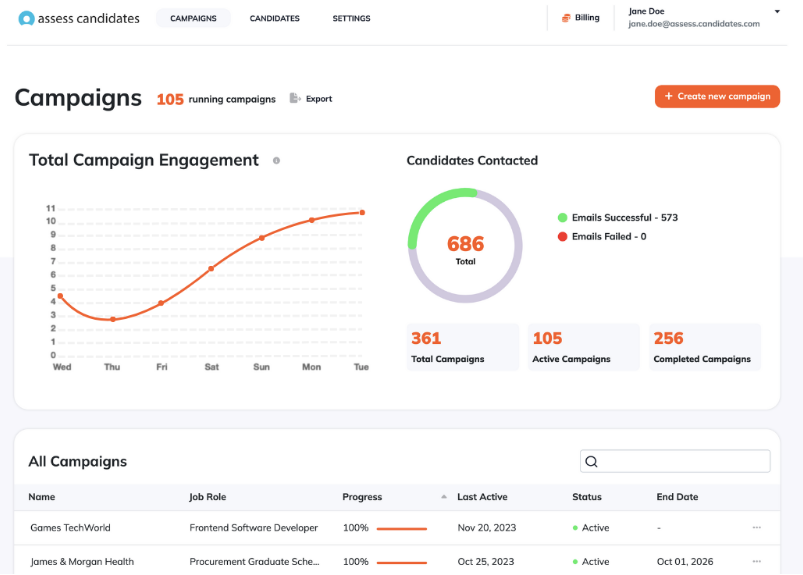
The top 4 reasons why you should use Assess Candidates for hiring
- Scientifically Developed and Expertly Crafted: The strongest assessment process offers a positive and engaging candidate experience with cognitive, behavioral, or role-specific skill testing. Doing this signals transparency, objectivity, and a commitment to fair hiring. Assess Candidates’ pre-employment assessments are built by Chartered Scientists, Psychologists, and Psychometricians with backgrounds at leading firms like SHL and IBM Kenexa. Each assessment is rigorously validated to accurately measure real-world capabilities and job-relevant competencies, helping you define precise requirements in your job descriptions that attract the right talent.
- Insightful Data to Shape Role Requirements: Our intuitive platform generates clear, detailed reports on skills and competencies, making it easier to identify must-have abilities for each position. These insights allow you to set specific, evidence-based criteria in your job descriptions, ensuring they reflect the true demands of the role and reduce irrelevant applications.
- Engaging Branded Candidate Experience: By integrating Assess Candidates’ mobile-optimized, interactive assessments into your recruitment process, you demonstrate your organization’s commitment to professional growth, fairness, and innovation. This encourages top candidates to apply and submit higher-quality, tailored resumes.
- Built for Accessibility and Inclusion: The Inclusive assessment process caters to a broader, more diverse pool of candidates. Our assessments are fully accessibility-compliant, offering features like extended time, zoom functionality, screen reader compatibility, and WCAG-compliant design. By embedding this commitment to accessibility into your job descriptions, you show applicants that your organization values equal opportunity and supports every individual’s success.
Assess Candidates is a leading provider of pre-employment assessment solutions that empowers organizations to create an effective recruitment process. With our scientifically validated assessments and customizable integration, you can take the next step toward smarter, more efficient recruitment today.
Not sure if pre-employment assessments are right for your hiring process? Get in touch with us for a free-of-charge analysis of your recruitment needs.
Interested in learning more about effective candidate assessment? Continue reading for frequently asked questions, and sign up with your email to get started.
Frequently Asked Questions
Are cognitive ability tests alone sufficient for identifying top talent in banking?
No. Cognitive ability tests measure reasoning, numerical aptitude, and abstract thinking, but they cannot capture real-world application. Combining them with work sample tests, technical and functional assessments, in-tray exercises, and case study exercises helps recruiters observe and evaluate the candidates holistically. They help assess candidates’ practical banking problem-solving ability, prioritize tasks, and demonstrate judgment under pressure, ensuring a complete evaluation.
What do gamified assessments add to the recruitment process for banking professionals?
Gamified assessments engage candidates in realistic banking challenges while testing focus, decision-making, and stress tolerance. When paired with business simulations, situational judgment tests (SJT), and role-play exercises, they show how candidates navigate dynamic environments, manage client demands, and resolve complex issues ethically. This combination reveals performance patterns beyond what traditional cognitive tests can capture.
Why is adaptability and resilience important in banking recruitment?
Adaptable and resilient candidates thrive in volatile markets and regulatory changes. Group discussion exercises, role-play exercises, and in-tray assessments evaluate how applicants adjust strategies, manage conflicts, and maintain productivity under stress. Combined with cognitive assessments, these methods measure flexibility, emotional stability, and collaborative problem-solving, providing insight into sustained performance in high-pressure banking roles.
How do video interviews enhance the assessment process for banking roles?
Video interviews evaluate communication, presentation, and professionalism, which are essential for client-facing positions. Coupling them with presentation exercises, culture and values fit assessments, and gamified assessments allows recruiters to assess clarity, persuasion, confidence, ethical alignment, and adaptability. This combination ensures candidates are judged on interpersonal effectiveness, reasoning, and fit within the bank’s environment, beyond intellectual skills alone.
What role do situational judgment tests play in banking recruitment?
Situational judgment tests (SJTs) assess problem-solving, ethics, prioritization, and judgment under realistic banking scenarios. When used alongside case study exercises, work-style personality questionnaires, and business simulations, recruiters can see how candidates apply analytical skills, collaborate with teams, and make decisions under pressure. This multifaceted approach captures potential performance more accurately than cognitive tests alone.
Why are work-style personality assessments important for banking professionals?
Personality and work-style questionnaires evaluate traits like integrity, emotional stability, and collaboration. When combined with role-play exercises, technical and functional assessments, and in-tray exercises, they reveal how candidates interact with clients, solve complex tasks, and align with organizational culture. This integrated approach ensures hires possess both technical and behavioral competencies for long-term success.


 English
  Arabic