
Best Group Discussion Exercise Practices for Recruitment in 2026/27



Group discussion exercises in assessment centers allow employers to observe how candidates communicate, collaborate, and approach shared decisions. Unlike individual interviews, these activities create opportunities to assess how candidates respond to different viewpoints and contribute to a group outcome.
This guide explains what group discussions measure, provides practical examples, and outlines how to design and score exercises fairly.
Contents
- What is a group discussion exercise?
- What skills do group discussion exercises measure?
- Why do employers use group discussion exercises?
- Examples of group discussion exercises
- Common challenges of group discussion exercises
- Strategies for recruiters using group discussion
Let us see what else lies beyond group discussion in assessment centers!
1. What are group discussion exercises?
A group discussion exercise is a structured recruitment activity in which several candidates work together on a shared task, scenario, or decision. Assessors observe individual contributions, such as communication, collaboration, reasoning, and initiative, using predefined job-relevant criteria. The aim is to evaluate observable behavior, not simply who speaks most confidently.
Recruit skilled candidates with our psychometric assessment tests. HIRE FOR FREE
Curious to know what skills group discussion exercises evaluate? Keep on scrolling to see them!

2. What skills do group discussion exercises measure?
According to the IILM Blog, group discussion is not just about memorizing facts but about constructing a habit of structured reasoning on unfamiliar subjects.
Group discussion skills measured in recruitment
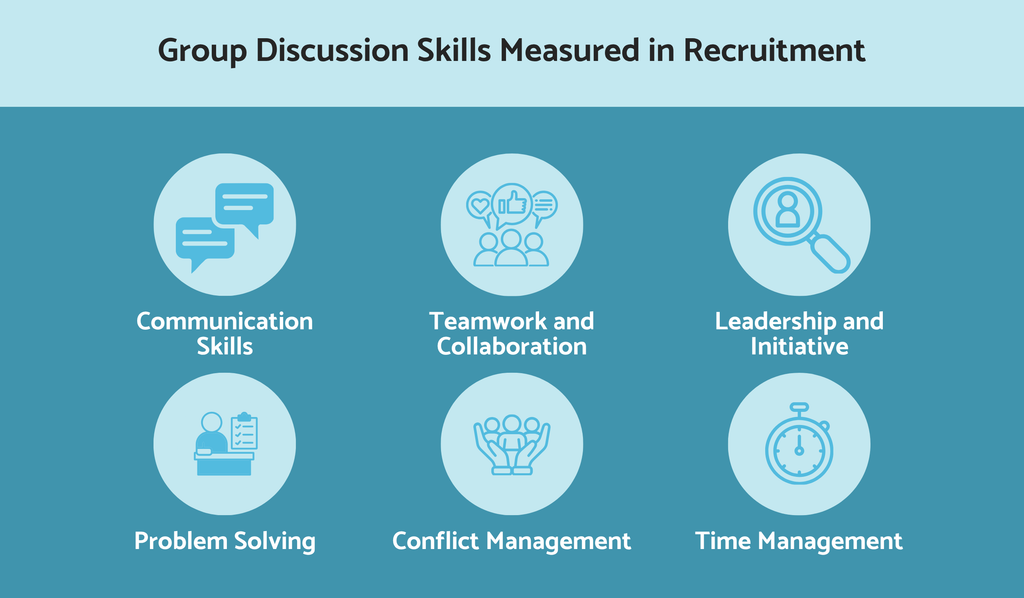
- Communication Skills
Communication skills are more than speaking clearly or confidently; in a group discussion, you will be assessing whether your candidates can explain their ideas concisely and clearly. Look out for candidates who will make relevant contributions and avoid repeating points the group has already considered.
- Teamwork and Collaboration
Group exercises show you how your candidates work toward a shared goal rather than focusing only on individual performance. Good candidates will be willing to share important information, encourage productive discussion, and respond respectfully when opinions differ.
- Leadership and Initiative
Group discussions can show how candidates take initiative, organize information, and help others make progress. Assessors should distinguish constructive leadership from simply speaking first or most often. A candidate who encourages participation and summarizes competing views may demonstrate stronger leadership behaviors than someone who dominates the discussion.
- Problem Solving
Candidates with problem-solving skills will be able to consider realistic options and help the group choose an appropriate solution. The results of your group discussions should reveal what actions your candidates took, why they were appropriate, and what risks may arise.
- Conflict Management
You can measure how your candidates respond when others disagree, when the group becomes stuck, or when one participant dominates the conversation. To choose the right candidates, look for those who are skilled at defusing disagreements during group exercises.
- Time Management
Candidates often have to work with a time limit. In a group exercise, you can observe whether they help the group prioritize tasks, manage the discussion, and reach a solution before time runs out.
Recruit the best-skilled talent with our assessment tool platform. LEARN MORE
The following section will enlighten you on why employers use group discussions. Keep reading!
3. Why do employers use group discussion exercises?
Various organizations use group discussion exercises to assess whatever skills they are looking for in their candidates. However, many of the employers use the exercise because individual interviews do not always reveal how a candidate behaves in a team setting.
Why recruiters use group discussion exercises?
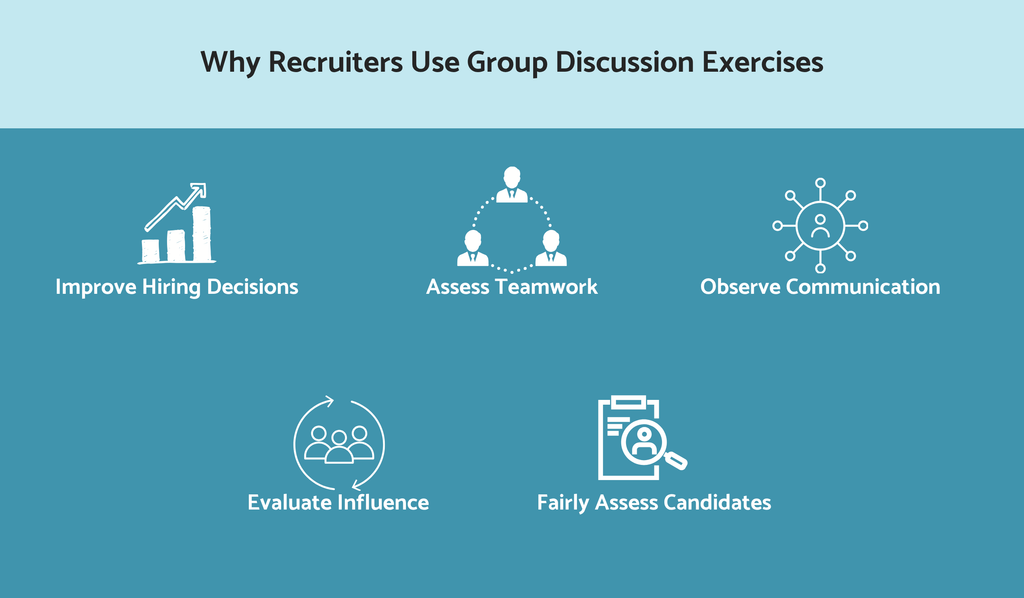
1. Improve Hiring Decisions
Employers should not use group discussion exercises to replace every other selection method in their recruitment process. However, these exercises can strengthen hiring decisions by providing evidence that CV screening, reasoning tests, and individual interviews may not reveal the same information when assessing candidates.
2. Assess Teamwork
A CV and a one-to-one interview can help you determine whether a candidate has the relevant experience for the role. However, these methods may not show you how a candidate works with others when sharing information, disagreeing constructively, building agreement, or contributing to a collective decision.
3. Observe Communication
You can use group exercises to assess how candidates communicate when time is short, and several people compete for a chance to speak. These exercises can show whether candidates explain their thoughts clearly, ask relevant questions, adapt their language, and make contributions that help the group progress.
4. Evaluate Influence
In many roles, employees need to influence others without direct authority. You can observe this ability when candidates convince colleagues to adopt a new process or secure agreement between departments with different priorities. Group discussion exercises allow you to assess candidates’ ability to influence others in these situations.
5. Fairly Assess Candidates
Standardized scenarios, preparation time, and scoring criteria can support fairer comparisons. However, employers should also consider group dynamics, accessibility needs, and whether each candidate has a reasonable opportunity to contribute. Assessors should score individual evidence rather than relying on the group’s overall outcome.
A useful group discussion creates a genuine decision for candidates to make.
The strongest scenarios provide competing priorities, limited resources, or differing stakeholder needs, giving assessors something meaningful to observe.
4. Examples of group discussion exercises
According to Coursera, inviting your candidates to have group discussions will help elevate their thinking as they reflect and formulate business insights that can improve your organization’s success.
Types of group discussion questions
- Prioritization Question
This question is used in industries like finance, consulting, and tech, and it focuses on assessing your candidates’ collaborative and prioritization skills.
Example: Your team has capacity to complete only three of six proposed projects this quarter. Review the project summaries and agree on which three should be prioritized.
- Budget Allocation Question
With a primary focus on finance and consulting, this question tests your candidates’ numerical reasoning, collaboration, and analytical thinking.
Example: Your organization must reduce its overall departmental budget by 15%. Review the spending proposals and agree on how the revised budget should be allocated across departments.
- Customer Service Question
Focusing on the sales, retail, and finance industries, the question assesses your candidates’ communication, analytical thinking, and customer service skills.
Example: Customer satisfaction has dropped from 82% to 68% over the last six months. Complaint data shows concerns about response times, inconsistent staff communication, and delayed deliveries. What actions should the company take first?
- Crisis Management Question
Here, your candidates’ logical and analytical thinking, as well as collaboration and communication skills, are tested in roles specific to industries such as finance, tech, consulting, and legal.
Example: A major client has posted a negative complaint on social media about a service failure. The post is gaining attention, and the client is threatening to end the contract. As a group, decide what should happen in the next 24 hours.
- Initiative Measurement Question
Industries like finance, consulting, tech, and marketing often use this question to evaluate candidates’ logical and analytical thinking and leadership skills.
Example: Your organization has a limited budget to support one community initiative this year. The options are a school-support program, an environmental cleanup project, a youth-employment scheme, or a local health campaign. Agree on which initiative should receive funding and explain how its impact will be measured.
Recruit the best-fit talent with our assessment tool platform. LEARN MORE
There have been some challenges with group discussions, and we have the solutions below!
5. Common challenges of group discussion exercises
Group discussion exercises can be affected by dominant participants, unclear instructions, inconsistent scoring, and differences in communication style. These challenges do not make the method unsuitable, but they need to be addressed during assessment design and delivery.
Challenges of group discussion exercises
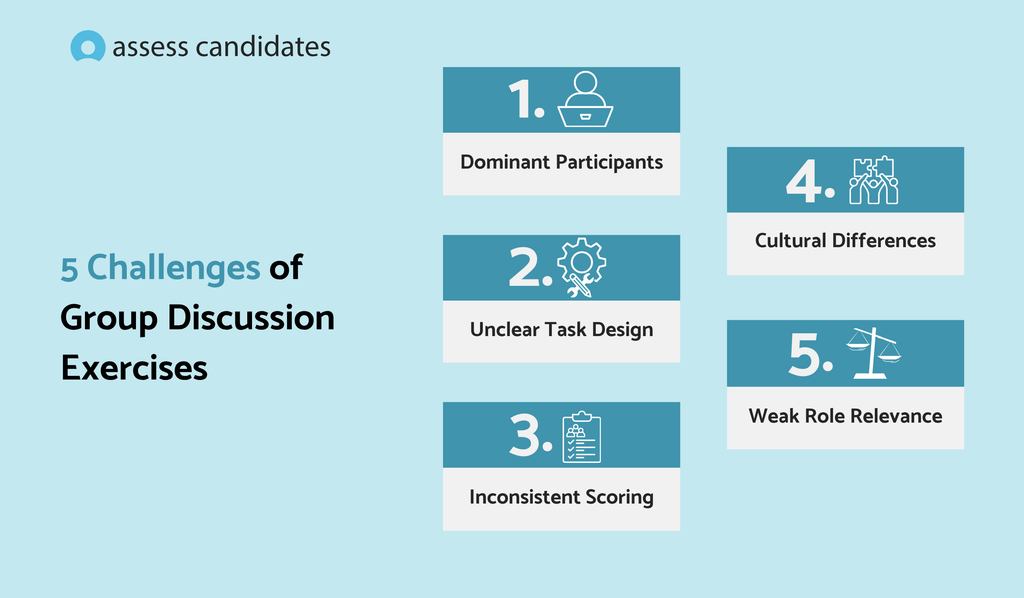
1. Dominant Participants
A confident, outspoken candidate could likely take over the group discussion exercise. They may interrupt others, repeat their own points, or push the group toward a decision before all relevant information has been considered. Having dominant candidates can reduce the opportunity for quieter candidates to demonstrate their skills.
Solution: At the start of the assessment center, you can tell candidates that interviewers assess individual behaviors, not simply who speaks the most during the exercise. Focus on whether candidates create space for others, build on colleagues’ ideas, and help the group reach a shared outcome.
2. Unclear Task Design
When you give candidates a vague or poorly structured brief, they may spend time trying to understand the task. If candidates do not understand what the task requires, you may end up measuring their tolerance for ambiguity rather than the intended competency.
Solution: We recommend that you clearly state the problem, available information, time limit, and expected results. You can also tell candidates whether they must reach a consensus, vote on options, write a recommendation, or present their final decision.
3. Inconsistent Scoring
Your recruiters may interpret candidates’ behaviours differently. One recruiter might view a candidate’s quietness as poor engagement, while another might recognise that the candidate listened carefully and made useful contributions. In recruitment, inconsistent scoring can undermine fairness and weaken the rationale for hiring decisions.
Solution: Use a structured scoring rubric that you develop before the exercise. Define the competencies you want to assess and include behavioral indicators for strong, acceptable, and weak performance. Train your hiring managers to take evidence-based notes and distinguish observations from personal interpretations.
4. Cultural Differences
Your candidates will come from different cultural backgrounds and hold different expectations regarding interruption, disagreement, self-promotion, and authority. Recruiters may interpret a candidate’s preference for reflecting before responding as a lack of assertiveness, even when the candidate demonstrates thoughtfulness and collaboration.
Solution: Train your recruiters to focus on job-relevant behaviors rather than one preferred communication style. Evaluate how candidates contribute constructively, explain their reasoning, respect others, and help the group reach an outcome.
5. Weak Role Relevance
Setting up a common group exercise may be stress-free, but it will yield weak evidence for recruitment if it does not reflect the real challenges of the role you are hiring for.
Solution: Work with hiring managers and successful employees to identify the decisions, stakeholder issues, and business problems most relevant to the role. Assessment center exercises provide the most useful evidence when they measure job-related behaviors through realistic simulations.
Discover assessments created by Chartered Scientists to hire top candidates. VIEW PLANS
A group discussion should not reward the loudest person in the room. Clear instructions, trained assessors, and job-relevant scoring criteria help employers recognize contributions that might otherwise be overlooked.
6. Strategies for recruiters using group discussion
Group discussion exercises are often most effective for organizations when they are structured, role-relevant, and used as part of an assessment process.
According to Recruit CRM, the group discussion exercise is an opportunity for many companies to assess candidates’ ability to clearly articulate their thoughts in front of a panel.
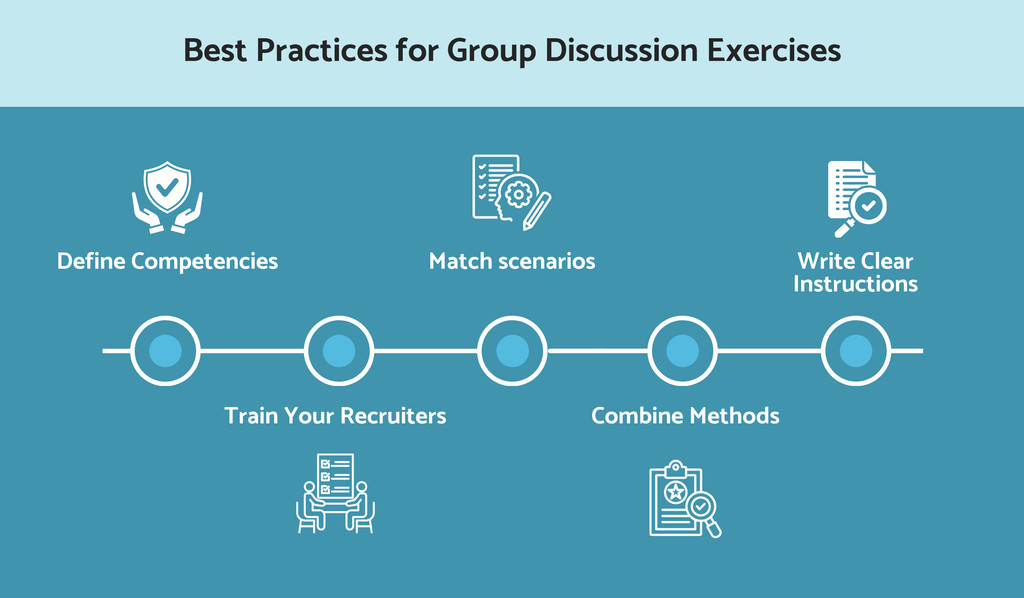
Best practices for group discussion exercises
- Define Competencies
Start by identifying the specific competencies the group discussion should measure. Focus on a manageable number of job-relevant behaviors, such as collaboration, communication, and decision-making. Trying to assess every possible skill in one exercise makes scoring less reliable and can distract assessors from the evidence that matters.
For example, an assessor may use the following standardized and structured scoring system:
Assessors should use predefined scoring anchors, such as 1–4, for each competency.
- Match scenarios
When designing your assessment center, the scenario should reflect the type of challenges your candidates will face in the role. Focusing on role relevance will improve the quality of the recruitment evidence and make your group exercise more credible to candidates.
- Write Clear Instructions
You can write clear instructions to create fairer conditions for your candidates. These candidates should know what information they have, what they must decide, how much time they have, and what result is expected from their exercise. You should also mention whether your candidates are expected to reach agreement, present a group recommendation, or simply discuss.
- Train Your Recruiters
Your recruiters should know the difference between observation and interpretation when assessing your candidates in a group discussion exercise. Train your recruiters to understand the task given, skills assessed, and scoring criteria. When multiple recruiters are involved, hold a training session before the assessment to ensure everyone applies the same standard.
- Combine Methods
You can combine group discussions with structured interviews, reasoning tests, situational judgment tests, personality questionnaires, and other assessment center exercises where relevant. Each assessment method should provide a unique source of information and not duplicate the same competency.
Hire your best-fit candidates with our assessment tool platform. LEARN MORE
Conclusion: Key Takeaway
Group discussion exercises provide useful evidence of how candidates communicate, collaborate, and approach shared decisions. Their value depends on realistic tasks, consistent scoring, and fair opportunities to contribute. Combine group discussions with other job-relevant assessments to build a more complete picture of each candidate’s suitability.
Interested in using group discussion exercises to evaluate job-relevant collaboration and communication skills? Explore the frequently asked questions and learn how structured assessments can support your recruitment process.
Frequently Asked Questions
What makes a good group discussion topic?
A good topic is important to the role, should be understandable without specialist knowledge unless such knowledge is required, and should be complex enough to encourage discussion. It should present a realistic trade-off, decision, or problem rather than a question with an obvious answer.
How should I score group discussion exercises?
Use a structured scorecard that sets out the assessed skills and describes strong, acceptable, and weak behaviors. You can also record specific evidence during the exercise, score your candidates independently, and then compare your observations about them during a debrief.
What is the difference between a group discussion and a group interview?
A group interview usually involves several candidates answering questions from one or more interviewers, during which candidates introduce themselves and respond to the same questions. Whereas a group discussion exercise is more interactive, and candidates are given a task to solve together while you observe how they communicate, collaborate, and make decisions with one another.
Will candidates compete against each other in a group exercise?
Your candidates can be assessed alongside each other, but they should not be scored solely on who is much louder and more visible than others. We suggest that you examine each of your candidates against your predefined skill criteria.
Can group discussion exercises be conducted online?
Group discussion exercises can be conducted online using video-conferencing platforms. Employers should test the technology, provide accessible instructions, establish clear participation rules, and apply the same job-relevant scoring criteria used in face-to-face exercises.


 English
 Arabic