
How to Use Assessment Data After Recruitment



Assessment data can remain useful after recruitment, but hiring teams need a clear plan for how to use it. Results that inform a selection decision may also help managers identify onboarding priorities, discuss development needs, and review whether the hiring process is producing relevant evidence.
This guide explains how to use assessment data after hiring while keeping its original purpose, limitations, and appropriate use in view.
Contents
- What is assessment data?
- Best strategies to use assessment data after recruitment
- How should teams collaborate when using assessment data after recruitment?
- How can Assess Candidates help with assessment data?
First, let’s understand what assessment data means.
1. What is assessment data?
Assessment data is information collected through structured evaluations, such as skills tests, reasoning assessments, personality questionnaires, work samples, and interviews. After hiring, relevant results may inform onboarding and development discussions, provided employers interpret them in context and use them appropriately for the new purpose.
According to Gallup, only about 12% of employees say their companies do a good job of onboarding. This complements the statistic that nearly 1 in 5 candidates say they had a poor onboarding experience or none at all.
Hire skilled candidates with our pre-hire assessments. HIRE FOR FREE
Staying ahead with your assessment data doesn’t have to be difficult; keep scrolling to learn the best strategies to use assessment data.

2. Best strategies to use assessment data after recruitment
The transition from recruitment to employment is an opportunity to put relevant assessment findings into context. Hiring managers can review results alongside the new employee’s experience, role requirements, and early workplace observations to identify useful onboarding and development priorities.
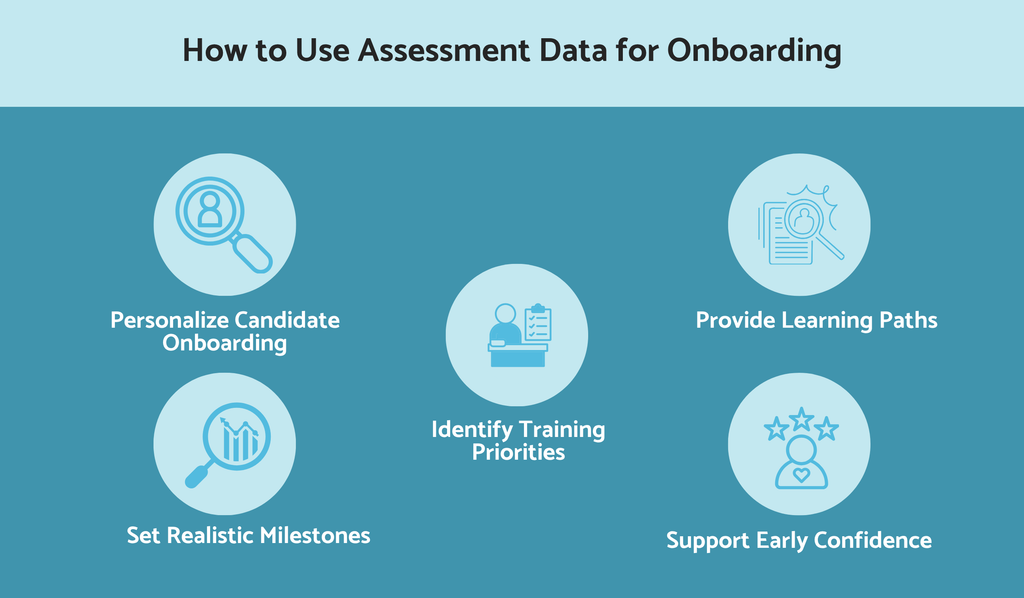
How to use assessment data for onboarding
1. Personalize Candidate Onboarding
Assessment results may help managers identify topics to explore during onboarding. For example, a role-relevant skills result could suggest an area for early practice or support. Discuss the findings with the new hire and review them alongside their experience, current work, and feedback before adapting the onboarding plan.
2. Set Realistic Milestones
Assessment data can help your teams in setting early goals that are challenging but achievable. A new hire may need more time to learn an unfamiliar system, while another may be ready to take on complex work sooner.
3. Identify Training Priorities
Your assessment results may prove that your new hire has strong verbal reasoning but needs more support with numerical interpretation. Whereas another may demonstrate strong problem–solving ability but lack familiarity with a specific software system. With this, your recruiting team can then combine formal training, peer support, job shadowing, and practical exercises to close the gap.
4. Provide Learning Paths
Having a targeted learning path will give your employees a clearer route to competence. Learning paths may include required modules, practice tasks, a mentor, regular check–ins, and a date to review progress.
5. Support Early Confidence
New recruits will join your organization and need time to build confidence, since they will be new to the team and work environment. Your assessment data will help in understanding where additional reassurance, feedback, or practice may be useful.
Hire the perfect candidates with our assessment tool platform. LEARN MORE
Onboarding is only the starting point. Once managers have observed how a new hire performs in the role, they can revisit relevant assessment findings and decide whether those findings still offer useful development context.
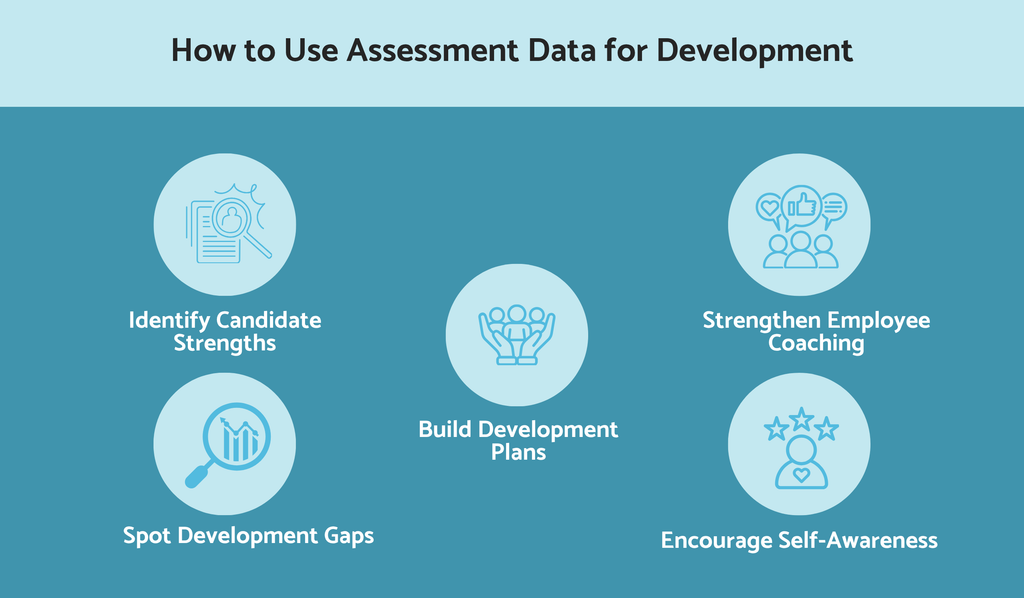
How to use assessment data for development
- Identify Candidate Strengths
You can use your assessment data to help your employees and hiring managers recognize strengths that may not be immediately visible in daily work activities. These strengths can include attention to detail, logical reasoning, communication, resilience, learning agility, or decision–making.
- Spot Development Gaps
Data from your hiring process can help identify areas where employees may need development. These gaps could be in their practical skills, behavioral tendencies, cognitive capabilities, or confidence with certain types of work. We recommend that you do not treat a gap as a weakness or a reason to limit an employee’s opportunities, but as a development priority.
- Build Development Plans
Your assessment data will help you create a more relevant personal development plan. Therefore, your plan should combine your employee’s current role requirements, career interests, performance feedback, and assessment insights.
- Strengthen Employee Coaching
Coaching conversations can become more useful when you train your hiring managers to have objective information to discuss. Rather than offering vague advice, managers can focus on specific behaviors, work preferences, and development goals.
- Encourage Self-Awareness
Your assessment data can also help your employees understand their own working style, strengths, and development priorities. When they see their results and discuss them with their managers, they may recognize patterns. This includes insights into how they approach tasks, respond to pressure, and collaborate with others.
After using the data for employee development, you can then use it for retention. Here’s how!
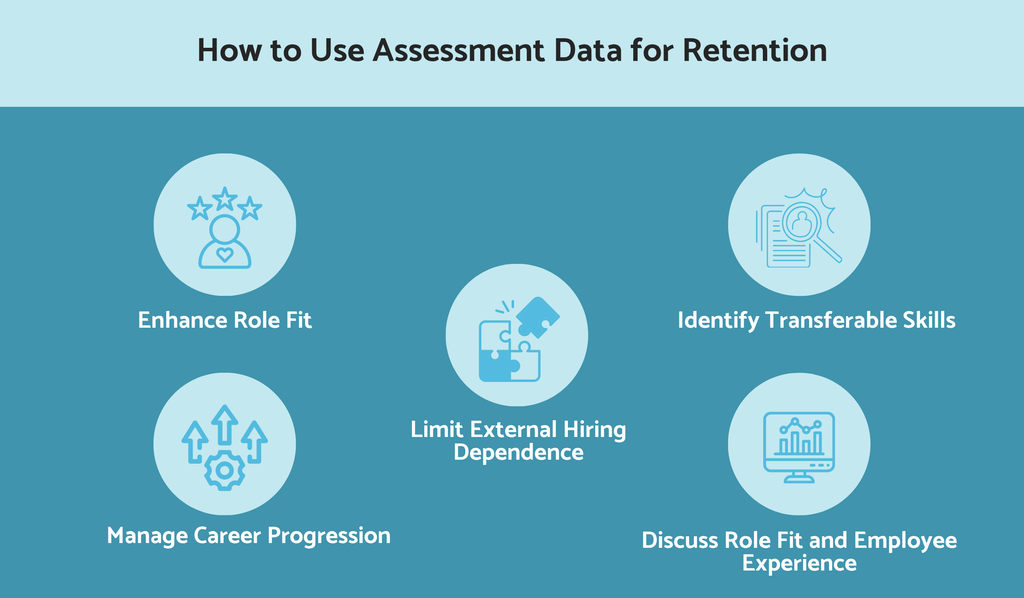
How to use assessment data for retention
1. Enhance Role Fit
An employee may have the skills to perform a role but still feel underused, overwhelmed, or disconnected from the work. Your assessment data can help you understand whether your employee’s responsibilities match their strengths and development needs.
2. Manage Career Progression
Pre-hire assessment results may provide background for career-development discussions, but they should not determine readiness for promotion or a different role. Use current performance, employee interests, demonstrated skills, and the requirements of the prospective position to guide those decisions.
3. Limit External Hiring Dependence
Internal mobility can help your company fill roles faster and retain the existing workforce, reducing your recruitment costs. Therefore, focusing on how to use the information gathered in your hiring process can also improve retention by giving your employees clear opportunities to grow.
4. Identify Transferable Skills
Your employees may have skills that are valuable outside their current role. A customer service representative may have strong communication, judgment, and problem–solving skills that suit a sales, operations, or training role.
5. Discuss Role Fit and Employee Experience
Pre-hire assessment results should not be used to predict whether an individual employee will resign. If a manager notices a mismatch between the employee’s responsibilities and their interests or strengths from their assessment results, they should discuss it directly with the employee and consider current workplace evidence before making changes.
Discover assessments created by Chartered Scientists to hire top candidates. VIEW PLANS
So, how do you handle cross-department collaboration during recruitment? Keep reading!
3. How should teams collaborate when using assessment data after recruitment?
Assessment data becomes more valuable when it does not sit only with the recruitment team. Teams should understand what data they can access, why, and how to best use it.
According to a 2026 SHRM session on quality of hire, real gains come from getting hiring managers and leadership to agree on shared success metrics before the first interview.
Best strategies to create synergy across departments
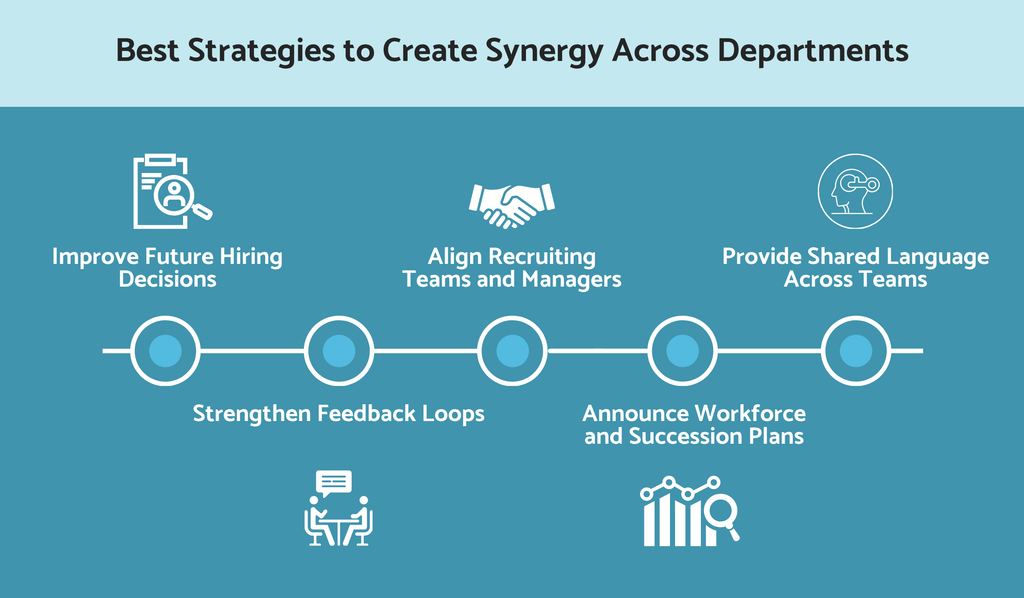
- Improve Future Hiring Decisions
HR teams can review whether assessment results show a meaningful relationship with later, role-relevant outcomes. Interpret any patterns carefully, account for differences between roles and employee circumstances, and use the findings to review assessment design rather than treating a single score as proof of future performance.
- Align Recruiting Teams and Managers
Recruiters can often share relevant assessment reports with hiring managers after an employee accepts an offer. The reports could include information about role–based strengths, development priorities, and areas to explore during onboarding. Doing this will create continuity between recruitment and employment instead of treating the hire date as a complete handover.
- Provide Shared Language Across Teams
Your assessment data can offer your hiring teams and managers a common language for discussing strengths, working styles, and development needs. Rather than relying on vague descriptions such as “good communicator” or “needs more confidence,” your teams can point to specific, observable behaviors and capabilities.
- Strengthen Feedback Loops
Your recruitment teams can learn from post-hire performance data to improve their future hiring decisions. Whereas your managers should be able to share feedback on how assessment reports matched real on–the–job behavior. Then your HR can use this feedback to refine which assessments they use, how they share results, and how they design onboarding plans.
- Announce Workforce and Succession Plans
When you calculate your assessment data across your candidates and departments, you will discover that your HR and leadership teams can identify broader capability patterns. They may notice workforce-wide strengths, recurring development needs, or gaps in critical skills.
Assess Candidates helps recruiters gather more reliable evidence of candidate ability through structured, job-relevant assessments and integrity controls. With our psychometric assessment tools, behavioral skills tests, and personality questionnaires, we can accurately test your candidates for the skills they have.
So, how can Assess Candidates help?
4. How can Assess Candidates help with assessment data?
Assess Candidates helps companies move from scattered assessment results to clearer, more usable recruitment data.
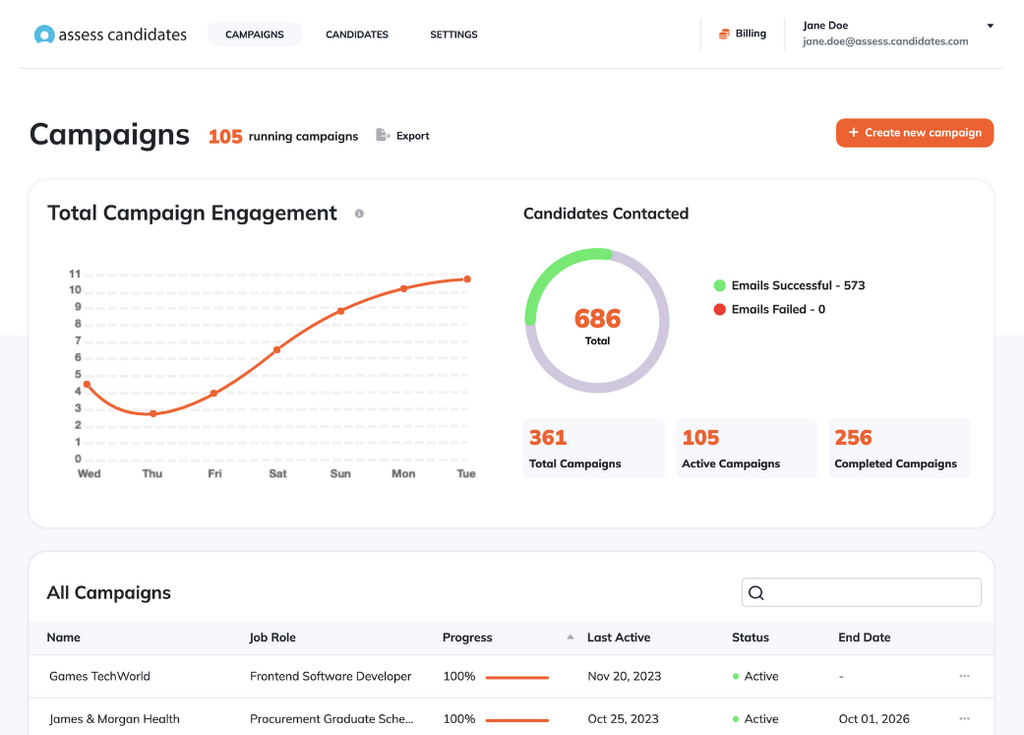
- Simplified Reporting: The Assess Candidates platform offers you assessment results in a clear format. This format helps recruiters, hiring managers, and HR teams understand candidates’ strengths and areas for development. Rather than reviewing raw scores alone, simplified reports will help you make a smooth handover from recruitment to onboarding.
- Consistent Decision–Making: Our standardized assessments create a consistent evidence base across candidates. This helps your teams compare results fairly and reduces reliance on subjective impressions. After recruitment, you can use the same data in employee development discussions.
- Talent Visibility: When your assessment results are organized clearly, your HR teams gain improved visibility into the strengths and skill patterns across your workforce. This structure can encourage internal mobility, succession planning, and wider workforce development decisions.
- Development–Focused Results: Your candidates’ assessment information can help your managers identify areas that require coaching, training, and practical development. It can also support conversations about strengths and future opportunities. The data should not replace manager judgment or observed performance, but it should help managers ask better questions and provide more relevant assistance.
- Fair and Consistent Scoring: The platform applies the same scoring criteria to all candidates, reducing bias in digital skills evaluation. Your hiring teams can compare results objectively and make more confident decisions about the right candidates required for the role.
Hire your perfect candidates with our assessment tool platform. LEARN MORE
Conclusion: Key Takeaway
Using assessment data after recruitment works best when recruiters and managers agree on what the results can and cannot show. Share relevant findings during the hiring handover, use them to inform onboarding and development conversations, and review them against the employee’s actual experience and performance. Assessment results should support decisions, not become a permanent label attached to a new hire.
Interested in knowing more about using assessment data to enhance your candidate retention after recruitment? Keep reading to see our frequently asked questions, and enter your email to get started today.
Frequently Asked Questions
Can you reuse pre-hire assessment data for onboarding?
Pre-hire assessment data lets you reuse the same skills and competency data collected during hiring to personalize early training. This way, new hires get assistance in the areas their assessment already flagged, rather than a one-size-fits-all induction.
Can assessment data help reduce early employee turnover?
Assessment data can help when used to create better onboarding, clearer early goals, and more targeted support. Employees who feel understood and supported in their first months are more likely to stay.
What if an employee disagrees with their assessment results?
We recommend encouraging employees to share their perspective because assessment data is not a verdict; it is one input among many. Your managers can discuss where the results align or differ from observed behavior and ensure that decisions are based on a broader evidence base.
How long should assessment data be kept and used?
There is no single retention period that suits every employer or assessment. Set and document a retention period based on the purpose for which the data is needed and applicable data-protection requirements. Review whether continued use is necessary, restrict access appropriately, and delete or anonymize information when it is no longer required.
What counts as assessment data after hiring?
Assessment data includes scores and reports from pre-employment assessment tests and structured interviews. When using assessment data after recruitment, employers should interpret these results alongside current workplace evidence and the purpose for which each assessment was designed.


 English
  Arabic