
Predictive Index (PI) Assessment: What It Is and How It Works



Have you ever hired someone who looked strong on paper but struggled once they joined the team? Often, the issue is not experience alone. It is whether their work style, pace, communication preferences, and comfort with structure actually match the role.
The Predictive Index (PI) can help employers assess those patterns more clearly. It provides insight into workplace behavior and learning agility, helping teams make more structured hiring decisions.
In this guide, we will explain what a Predictive Index (PI) assessment is, how it works, what it measures, how it is used in recruitment, and more.
Contents
- What is a Predictive Index Test?
- What does the Predictive Index Assessment measure?
- How does the Predictive Index work?
- How is the Predictive Index used in recruitment?
- How does the Predictive Index compare with other personality assessments?
- What are the best practices to implement the Predictive Index in the recruitment process?
- Predictive Index: Client Success Story
Let’s start with what the Predictive Index (PI) personality assessment is.
1. What is a Predictive Index (PI)?
The Predictive Index (PI) is a workplace assessment system that includes a behavioral assessment and a cognitive assessment. Together, they help employers evaluate workplace drives, learning agility, and job fit more consistently.
Evaluate cognitive ability and behavior using our range of psychometric assessments. HIRE FOR FREE
Let’s take a closer look at what the Predictive Index Personality (PI) Test measures.

2. What does the Predictive Index Assessment measure?
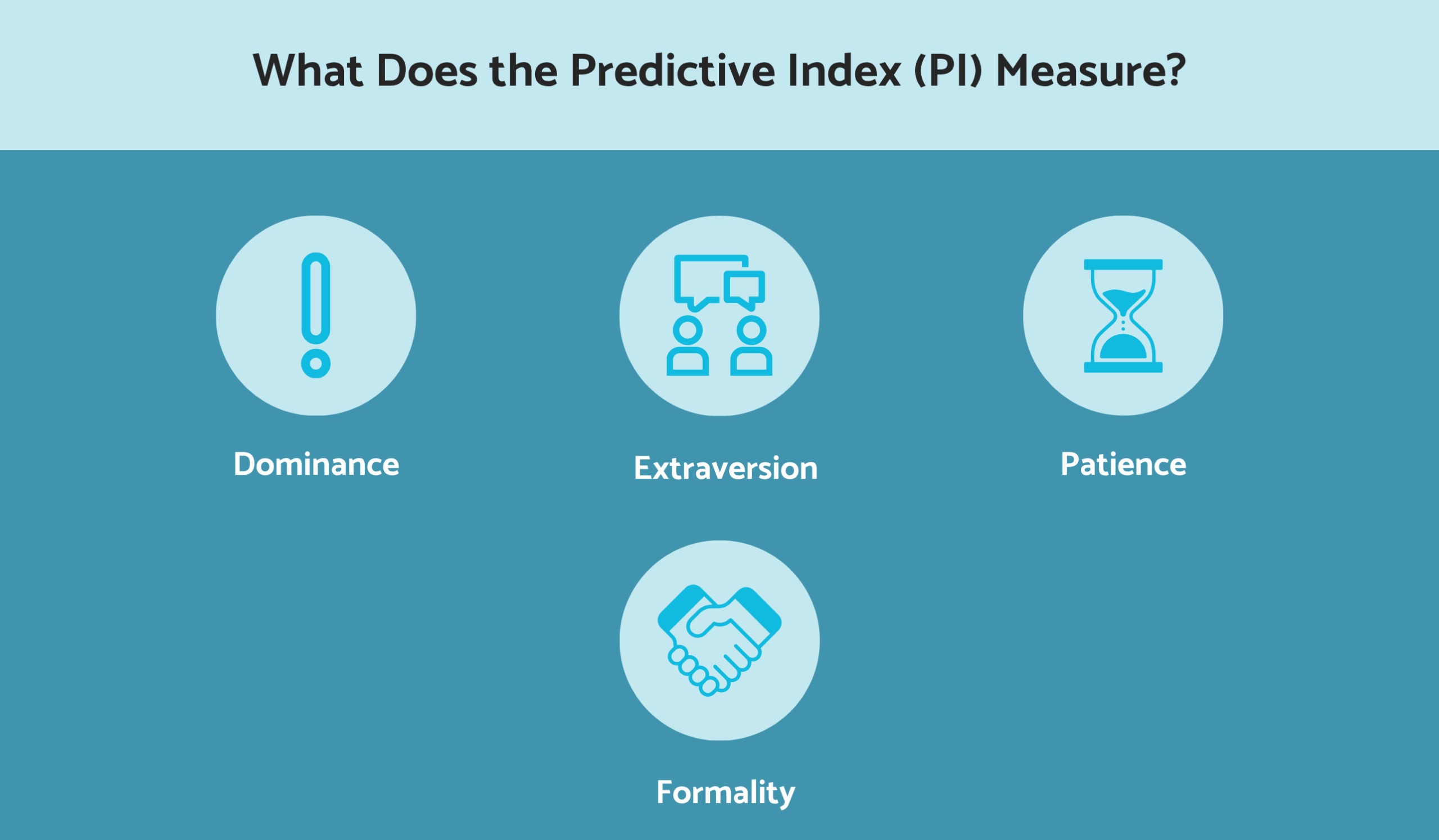
The PI Cognitive Assessment measures general cognitive ability, including verbal, numerical, and abstract reasoning. The PI Behavioral Assessment measures 4 primary workplace drives: dominance, extraversion, patience, and formality.
These 4 primary behavioral workplace drives involve:
1. Dominance
Dominance evaluates how a candidate naturally approaches control, decision-making, and independence on the job. A higher dominance usually points to a more assertive and result-focused work style.
2. Extraversion
Extraversion showcases how an applicant communicates, persuades, and engages with others. This measure, however, has no link to how social an individual is in their personal life. High extraversion in candidates often suggests that they will be comfortable in people-facing roles.
3. Patience
Patience measures how an applicant manages their time, pace, and change in a fast-paced and varied workplace environment. A lower level of patience often aligns with dynamic roles that involve variety, quick decisions, and frequent change.
4. Formality
Formality evaluates how strongly a candidate seeks structure, rules, and precision in their work environment. Higher formality often suggests that candidates will be comfortable in roles involving precision and consistency.
The next step is understanding how the assessment works in practice.
3. How does the Predictive Index work?
The Predictive Index (PI) includes two assessments, namely the PI Behavioral Assessment and the PI Cognitive Assessment.
PI Behavioral Assessment
The PI Behavioral Assessment is a 2-question, 6-minute adjective survey. Participants select adjectives that describe how they feel expected to behave at work and adjectives that describe how they see themselves.
Scoring
The Predictive Index Behavioral Assessment is not scored using numerical marks or right-or-wrong answers. Instead, the assessment analyzes the patterns of candidates based on the adjectives they select and places them across four workplace drives:
- Dominance: drive to exercise influence on people or events
- Extraversion: drive for social interaction with others
- Patience: drive to have consistency and security
- Formality: drive to conform to rules and structure
Based on the candidate’s responses, the system will generate a behavioral profile and help predict workplace fit and team compatibility.
Example Questions
There are no questions on the Predictive Index Behavioral Assessment, only adjectives. Given below are the sample adjectives for each factor:
- Dominance: Compliant, Supportive, Collaborative, Determined, Assertive, Forceful.
- Extraversion: Private, Reflective, Sociable, Influential.
- Patience: Rushed, Tense, Easy-going, Calm
- Formality: Impulsive, Flexible, Serious, Strict, Vigilant.
PI Cognitive Assessment
The PI Cognitive Assessment is a 12-minute, 50-question assessment that measures a person’s capacity to learn, adapt, and grasp new concepts. These questions cover numerical, verbal, and abstract reasoning.
Scoring
The Predictive Index Cognitive Assessment uses a 100-450 scaled score with an average of 250, which roughly corresponds to 20 correct answers. It also uses a percentile rank, which indicates how a candidate has performed compared to the other test-takers.
For instance, a candidate who receives a scaled score of 280 is suitable for jobs with a target of 280.
Example Questions
Some of the sample questions of a Predictive Index Cognitive Assessment include:
- Example 1.
Assumptions:
“Sally laughs every time the bell rings.
The bell rang twice yesterday.”
Conclusion:
“Sally laughed only twice yesterday.”
- If the assumptions are true, is the conclusion:
- Correct
- Incorrect
- Cannot be determined based on the information available?
- Example 2.
“What is the next number in the sequence below?”
1, 3, 5, 7
Uncover how workplace personality tests could fit into your structured hiring process. LEARN MORE
In the following section, we will analyze how the Predictive Index (PI) assessment is used in recruitment.
4. How is the Predictive Index used in recruitment?
In recruitment, the PI is typically used to define role targets, structure interview follow-up, compare candidates more consistently, and add behavioral and cognitive data to hiring decisions. PI’s own hiring guidance also links the assessments to role fit and interview question generation.
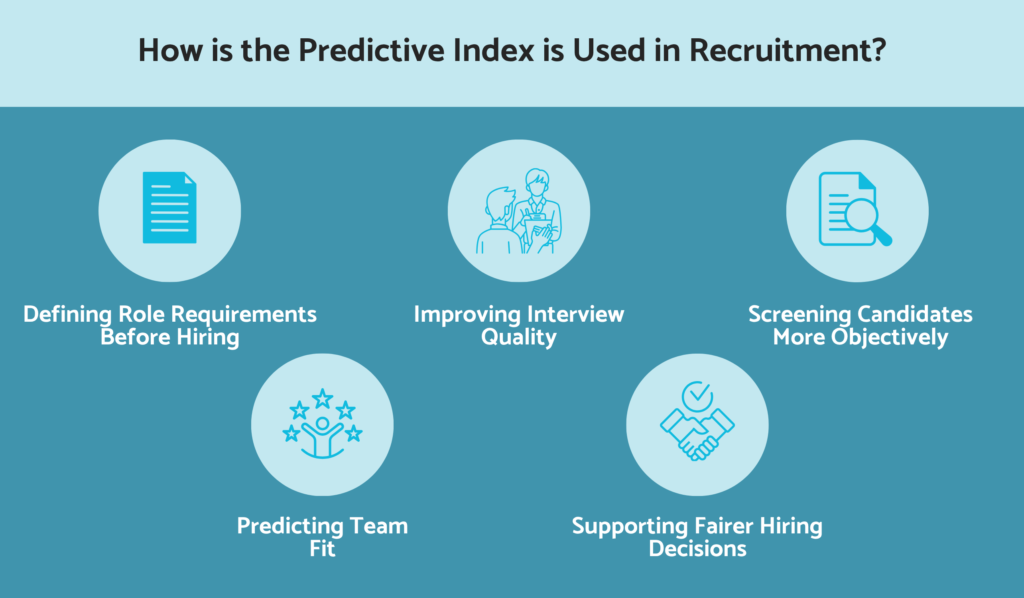
Given below are the top ways in which the PI Assessment is used in recruitment:
- Defining Role Requirements before Hiring
The PI Assessment helps you understand what success looks like even before the hiring process begins. Through these assessments, you can easily identify the behavioral traits a position requires, align expectations with hiring managers, and create an understanding of the ideal candidate profile.
This further reduces guesswork and helps implement the recruitment process with a structured approach.
- Improving Interview Quality
The Predictive Index results can help you hold more focused and meaningful interview conversations. It helps you explore how candidates approach teamwork, handle challenges, and make decisions in real workplace situations.
- Screening Candidates More Objectively
The PI Behavioral Assessment helps you understand how candidates prefer to work, collaborate with team members, and respond to change and structure. The PI Cognitive Assessment, on the other hand, gives you insights into how fast candidates can learn new information, adapt to new responsibilities, and solve problems.
Together, these assessments bring structure and consistency to early-stage evaluation, helping you screen candidates based on data-driven insights and not resumes and interviews alone.
- Predicting Team Fit
The Predictive Index (PI) Assessment will also help you analyze whether a candidate’s natural working style aligns with the demands of the role and matches your existing team dynamics. This further helps in making confident decisions regarding long-term engagement, productivity, and overall team compatibility.
- Supporting Fairer Hiring Decisions
The PI Assessments support fairer hiring decisions by using standardized behavioral and cognitive insights. It allows you to compare candidates using job-relevant data, reduces unconscious bias in the recruitment process, and creates a more reliable and evidence-based hiring strategy.
Explore how a work personality test completes a structured, science-backed hiring process. HIRE FOR FREE
Next, let’s take a look at how the PI Personality assessment compares to other workplace personality tests.
5. How Does the Predictive Index Compare with Other Personality Assessments?
Compared with broader personality frameworks such as the MBTI, the Predictive Index is more directly designed for workplace use and hiring contexts, especially when employers want behavioral and cognitive data in one system.
Strengths of the Predictive Index (PI) Assessment
1 . Designed for Workplace Decisions
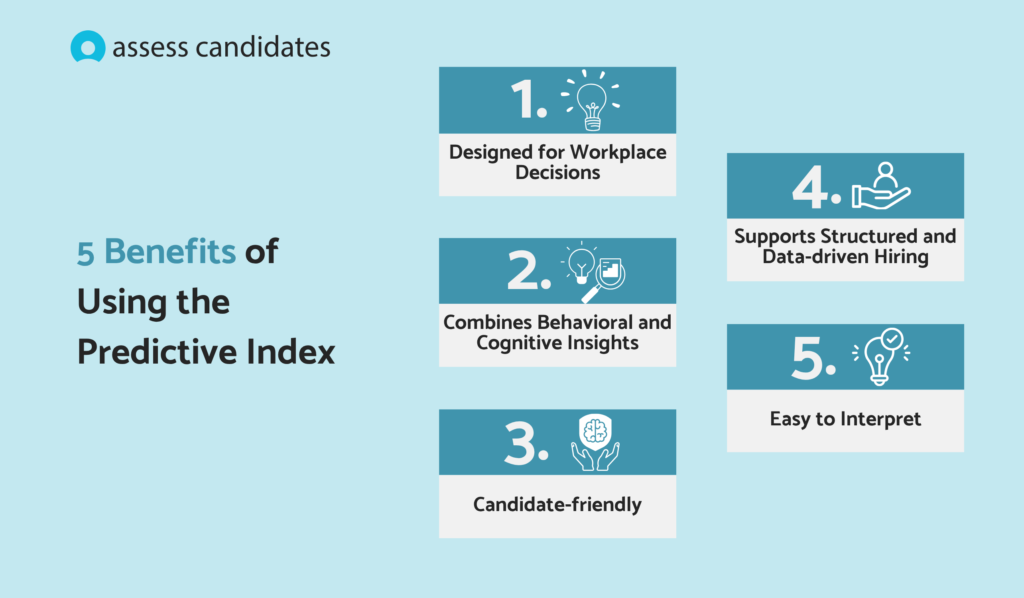
The Predictive Index assessment is mainly built for hiring and talent management. These tests help you directly connect behavioral patterns with role requirements, team dynamics, and performance expectations.
2 . Combines Behavioral and Cognitive Insights
The PI assessments stand out among other personality tests because they includes both behavioral and cognitive assessments. This will give you a broader evaluation framework.
3 . Candidate-friendly
Both the PI Behavioral Assessment and the PI Cognitive Assessment take 8–12 minutes to complete. This will make it easier for you to easily include it in workflows without disrupting the candidate experience.
4 . Supports Structured and Data-driven Hiring
The Predictive Index (PI) assessment also supports structured, data-driven hiring by helping define job fit before screening, consistently comparing candidates, and guiding interview questions with evidence-based insights.
5 . Easy to Interpret
The Predictive Index results are easy to interpret, especially for hiring managers. This is because, compared to other academic personality frameworks, PI uses a practical format that recruiters can quickly interpret and understand.
Even though the Predictive Index is more workplace-focused than many broader personality frameworks, there are still some limitations to keep in mind.
Limitations of the Predictive Index (PI) Assessment
The PI works best when paired with interviews, skills assessments, and clear role benchmarking. It is not a pass/fail hiring tool and should not be used in isolation.
1 . Focuses Mainly on Workplace Behavior
The Predictive Index assessment measures job-related behavioral drives. It does not measure deeper personality tests like emotional stability, openness, or motivation in non-work settings. However, personality tests like the Big Five Personality Traits provide broader psychological coverage.
2 . Works Best When Paired with Other Assessments
The PI assessment alone cannot measure technical expertise, job knowledge, depth of a candidate’s experience, and values alignment. It works best when you combine it with other assessments, including interviews, structured assessments, and skills tests.
3 . Requires Thoughtful Role Benchmarking
A PI assessment offers the most value when you provide clearly defined success profiles for each role. However, without this alignment, the results will be harder to interpret.
4 . Not Suitable as a Pass or Fail Selection Tool
Unlike some other aptitude tests, the Predictive Index does not give a qualified or unqualified outcome for candidates. It mainly supports decision-making alongside other hiring inputs.
5 . Results Require Trained Interpretation
The Predictive Index assessment can be used most effectively when hiring managers understand what a candidate’s behavioral drives actually indicate in a role context. Without proper interpretation, teams may oversimplify results.
Select the right work personality assessment for your hiring needs from our extensive library. LEARN MORE.
Let’s now take a look at the Predictive Index (PI) assessment best practices.
6. What are the best practices to implement the Predictive Index in the recruitment process?
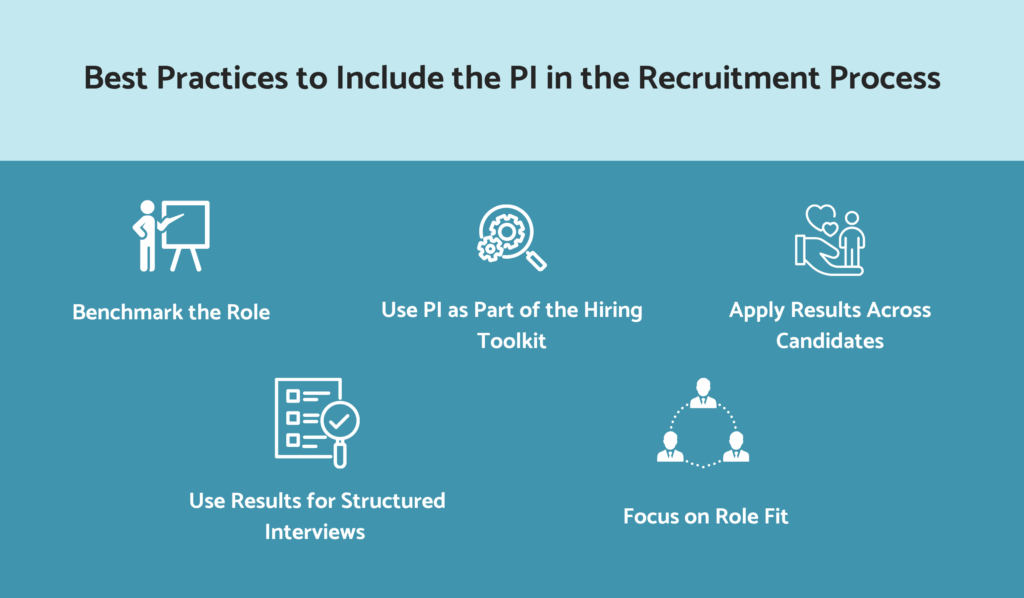
To get the most value from PI, employers should benchmark the role first, apply the assessment consistently, and use the results to inform structured interviews rather than replace them.
The following are some of the best practices to implement the PI assessment in your hiring process:
- Benchmark the Role
The most important step before implementing the PI assessment is to clearly define what success looks like in the role. Identify the behavioral drives the position requires, including collaboration level, attention to structure, pace of work, or decision-making. This makes the PI results more meaningful and actionable.
- Use PI as Part of the Hiring Toolkit
The best way to incorporate the Predictive Index assessment into your recruitment process is to combine it with interviews, skills tests, and experience evaluations. This will help you understand the way a candidate works, leading to making stronger hiring decisions.
- Apply Results Across Candidates
To maintain fairness in the hiring process, it is important to make sure all the candidates applying for the role complete the assessment under similar conditions.
- Use Results for Structured Interviews
Another best practice for incorporating the Predictive Index assessment effectively is by using results to conduct structured interviews and ask better interview questions. This will help you validate insights through real examples.
- Focus on Role Fit
Instead of searching for a single perfect personality profile, evaluate how each candidate’s behavioral drives align with the demands of the role. This further helps make strong hiring decisions.
7. Predictive Index: Client Success Story
Client Problem Statement
Imagine a rapidly expanding SaaS company hiring team leads for its growing customer success and account management functions. While many candidates bring relevant experience, recruiters find it challenging to determine who can naturally take initiative, collaborate effectively with cross-functional teams, and maintain consistency in a fast-changing work environment.
Hence, the organization needs a reliable way to understand candidates’ workplace behavioral drives, leadership tendencies, and alignment with the role’s pace and structure requirements.
Assess Candidates’ Proposal
At Assess Candidates, we recommend implementing the Predictive Index as part of the leadership hiring process. This scientifically validated behavioral assessment will help evaluate candidates’ natural work styles, communication preferences, decision–making approach, and comfort with structure and change. This will further allow the organization to match candidates more accurately with role expectations and team dynamics.
Result
By incorporating the PI assessment, the organization will be able to confidently shortlist candidates whose behavioral patterns align with leadership responsibilities and customer-facing collaboration needs. This will further result in stronger team alignment, improved managerial effectiveness, and better long-term retention in critical customer success roles.
Partner with Assess Candidates to successfully incorporate the right workplace personality tests. VIEW PLANS
Conclusion: Key Takeaway
- The Predictive Index assessment measures both behavioral drives and cognitive ability to improve hiring decisions.
- It evaluates four key workplace drives, including dominance, extraversion, patience, and formality.
- The PI Behavioral Assessment predicts how candidates are likely to behave at work.
- The PI Cognitive Assessment measures learning speed and problem-solving ability.
- PI helps define role requirements and create clearer ideal candidate profiles before hiring begins.
- It supports more structured, objective, and evidence-based candidate evaluation.
- Compared to many personality tests, PI provides more job-relevant and actionable insights.
- The assessment is quick, candidate-friendly, and easy for hiring managers to interpret.
When used well, the Predictive Index (PI) assessment can improve hiring decisions by adding structured behavioral and cognitive insight to role-based selection.
Interested in learning more about effective candidate assessment? Continue reading for frequently asked questions, and sign up with your email to get started.
Frequently Asked Questions
Does the Predictive Index help make better hiring decisions?
Yes, the PI assessment will help you make better hiring decisions by revealing how candidates naturally approach work, collaboration, pace, and structure. This will further make it easier for you to match candidates with role expectations and improve the accuracy of your hiring decision.
Does the Predictive Index replace interviews in recruitment?
No, the PI works best when used alongside interviews. It will help you structure better interview questions and explore candidates’ workplace behaviors more effectively. By combining both methods, you can also create a more balanced and evidence-based hiring process.
Can the PI assessment improve team fit during hiring?
Yes, the Predictive Index improves team fit during the hiring process by helping you understand how candidates are likely to interact with teammates and respond to workplace expectations. This will further help you identify candidates who complement existing work styles and contribute positively to collaboration and productivity.
Is the Predictive Index useful beyond the hiring stage?
Yes, you can use the PI assessment beyond the hiring stage. PI insights can support onboarding, communication planning, and manager-employee alignment. The results will further help you understand how new hires prefer to work and collaborate.
How does the Predictive Index support fair hiring decisions?
The PI Behavioral assessment gives you behavioral insights that help you evaluate candidates consistently. Using this test, you can compare candidates through structured data aligned with role requirements. This makes the hiring process more objective and transparent.


 English
  Arabic