
Everything You Need to Know About Assessing and Hiring Graduates
While some graduates settle into professional roles immediately, others take longer to adjust. What sets them apart is how well they are trained to apply their skills in real-world workplace situations.
This is why most employers rely on structured graduate assessment processes. By integrating practical exercises, you can get a picture of how candidates perform in job-related situations.
In this guide, we will explore the best practices to successfully assess and hire graduates in your organization.
Contents
- Who is a graduate?
- What skills to look out for when hiring graduates?
- What are the best assessment methods for hiring graduates?
- How to effectively hire a graduate?
- Real-world examples of successful graduate recruitment
- Assessing and Hiring a Graduate Assessment Center: Client Success Story
- Why top companies choose Assess Candidates to successfully assess and hire a graduate
Now that we’ve summarized what this article covers, let’s start with the basics: who is a graduate
1. Who is a graduate?
A graduate is an individual who has recently completed a formal education program and earned a degree, diploma, or certificate for the same. This may include a bachelor’s degree, a master’s degree, or a diploma from a college or university.
Evaluate a graduate’s true potential using our science-backed pre-employment tests. HIRE FOR FREE
What are the graduate schemes?
Graduate schemes are 1 to 4-year, structured, entry-level training programs offered to recent graduates. These programs primarily focus on training employees by providing real-world experience, paid work, formal training, mentoring, and rotation across diverse departments. Major firms offering graduate schemes include Deloitte, PwC, EY, KPMG, and Unilever.
Let’s take a closer look at what makes hiring graduates different from traditional recruitment.
Why is hiring different for graduates?
The hiring process for graduates is different because graduates are recruited based on potential and not always on experience.
Top 5 reasons why hiring is different for graduates:
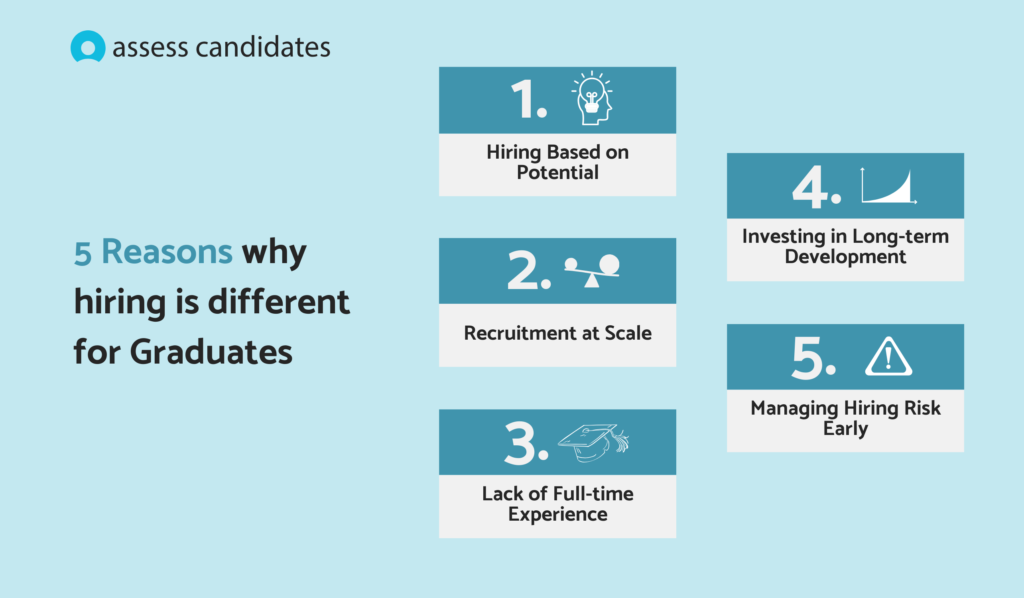
- Hiring Based on Potential
Graduate candidates are hired based on their learning ability, motivation, and mindset, and not on professional work experience. During graduate hiring, you will recruit candidates who can grow into future roles.
- Recruitment at Scale
Most companies hire a large number of graduates at once. Hence, you will be using standardized tests, group exercises, and structured interviews to handle the volume. This leads to a different hiring procedure than the one used for professionals.
- Lack of Full-time Experience
Hiring teams focus primarily on transferable skills, including communication and problem-solving, during the graduate hiring process. As most graduates lack full-time experience, you will assess how graduates approach tasks and adapt to new situations.
- Investing in Long-term Development
During the graduate hiring season, organizations provide training, mentoring, and rotations, and select and hire candidates who demonstrate long-term potential.
- Managing Hiring Risk Early
Hiring risk is managed early by using standardized assessments to predict performance. These assessments help identify graduates who fit both the role and the company culture.
Let’s now analyze the skills you should look for when hiring graduates.

2. What skills to look out for when hiring graduates?
When hiring graduates, you should primarily focus on less experience and more on transferable, future-ready skills. This is because it helps easily identify their ability to learn quickly, adapt to change, think critically, and apply knowledge in real-world situations.
Given below are the major skills to look out for when hiring graduates:
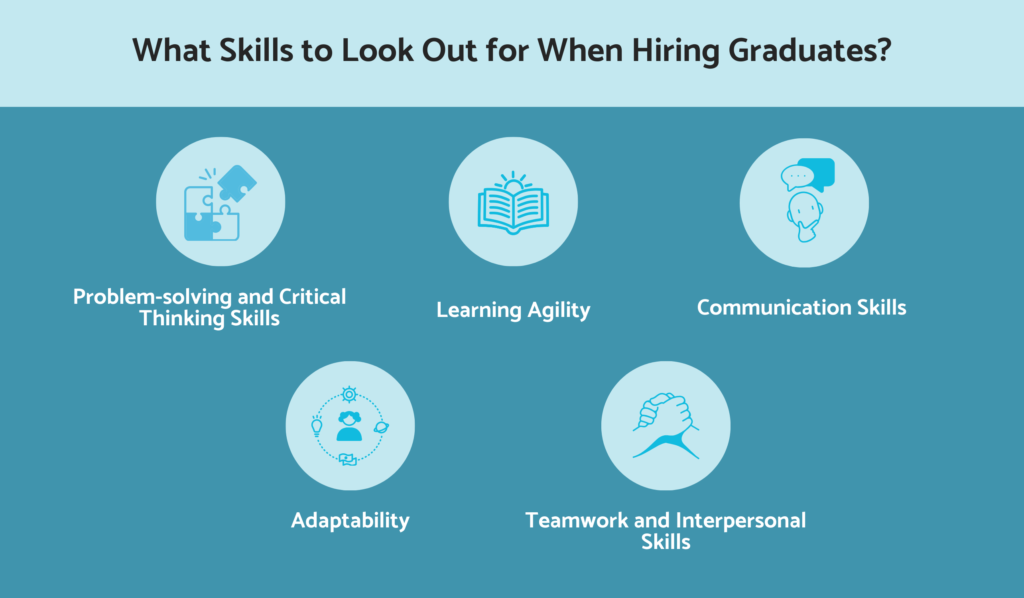
- Problem-solving and Critical Thinking Skills
One of the most important skills to look for when hiring graduates is problem-solving and critical thinking skills. As most graduates lack hands-on experience, you will be evaluating how they think through challenges, analyze information, and arrive at logical solutions.
- Learning Agility
Since most graduates are freshers, they lack in-depth knowledge of the role they are hired for. Hence, it is necessary to assess how fast they learn. Recruit candidates who display curiosity, ask thoughtful questions, and demonstrate the ability to pick up new skills efficiently.
- Communication Skills
Another key skill to assess when hiring graduates is communication. Recruit graduates who clearly express their ideas both verbally and in writing, as strong communication skills help them collaborate effectively, understand instructions, and present their thoughts clearly.
- Adaptability
Since work environments constantly change it’s important to measure how graduates respond to uncertainty and pressure. Recruit graduates who stay composed under pressure and adjust their approach when necessary. This is because candidates who display flexibility and resilience often transition smoothly into professional roles.
- Teamwork and Interpersonal Skills
In most in-office roles, graduates will be required to work in a team. Therefore, you should evaluate how well they collaborate with others, handle feedback, and manage interpersonal dynamics. Recruit graduates who demonstrate emotional intelligence, professionalism, and respect during group exercises or interviews.
Discover our scientifically validated psychometric tests for designing graduate assessment. LEARN MORE
In the following section, we will delve into the top assessment methods used to recruit graduates.
3. What are the best assessment methods for hiring graduates?
Graduate assessments measure a plethora of core competencies in candidates that will help you to not only analyze their true potential but also understand how they will perform in real-life workplace situations.
The following are the top 6 assessment methods used for hiring graduates:
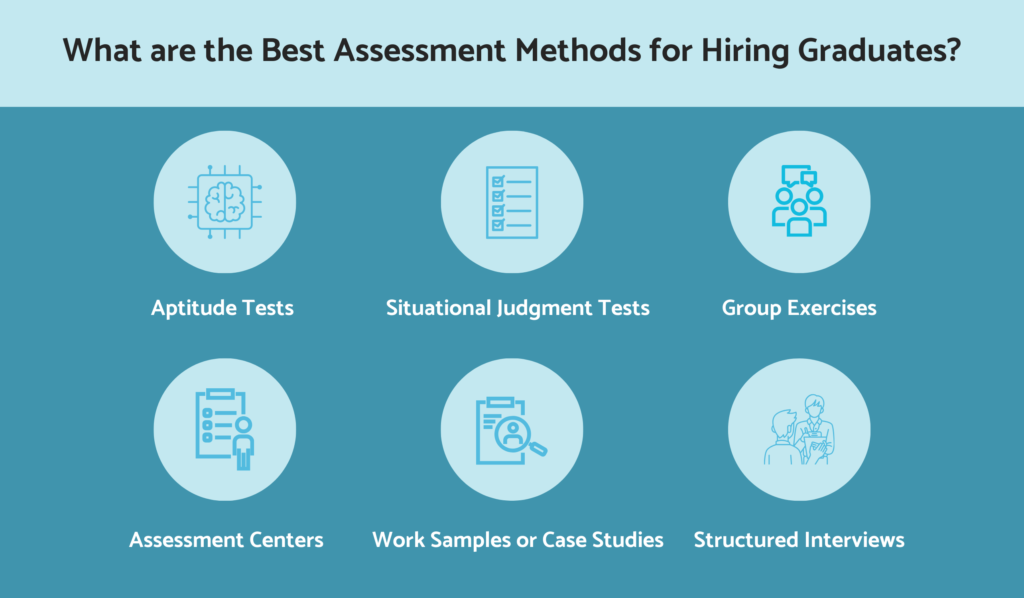
1. Aptitude Tests
Aptitude tests or cognitive ability tests help assess problem-solving, numerical reasoning, logical reasoning, and verbal skills in graduates. These tests specifically help you understand how candidates think, especially when they lack professional experience.
Example 1: “A store sold 120 units of a product in January and 150 units in February. What was the percentage increase in sales from January to February?”
2. Situational Judgment Tests
Situational judgment tests demonstrate how graduates respond to real workplace scenarios. These tests help you measure a candidate’s decision-making skills, professionalism, and behavioral fit by asking them to choose or rank in practical situations.
Example 2: “You notice two team members are constantly disagreeing, which is affecting team morale and productivity. How would you handle this situation?
Options:
- Ignore the conflict and focus only on your own tasks.
- Bring both members together to discuss openly and find common ground.
- Immediately report the issue to your manager without attempting to address it yourself.
- Speak to each member individually, then mediate a joint resolution.”
3. Group Exercises
Group exercises let you observe candidates in action. Using these exercises, you can directly evaluate a graduate’s teamwork, communication, leadership, and adaptability by assessing how they collaborate, share ideas, and manage disagreements.
Example 3: “Your team is tasked with planning a company event within a limited budget and timeline. Collaborate to divide responsibilities, prioritize tasks, and create a detailed plan.”
4. Assessment Centers
Assessment centers are generally used to assess a candidate’s competencies, skills, and overall suitability for a specific role. They combine multiple methods, including tests, group tasks, case studies, and interviews, into one structured process, giving you a well-rounded view of each candidate.
Example 4: “You are the CEO of a company considering a merger. What key factors would you evaluate before deciding whether to proceed?”
5. Work Samples or Case Studies
Work samples or case studies simulate real-job tasks, such as analyzing a problem or presenting a solution. These tests help you assess a candidate’s practical thinking, creativity, and task approach, even without them having work experience.
Example 5: “What are the key issues reflected in the data, and what steps would you recommend to improve customer satisfaction?”
6. Structured Interviews
Structured interviews are usually conducted towards the end of the recruitment process. They use the same questions and scoring criteria for every candidate, ensuring a fair and consistent hiring process. This also helps you evaluate a candidate’s motivation, communication, cultural fit, and long-term potential.
Example 6: “What excites you about this position, and how does it align with your career goals?”
Explore the potential of graduate assessments and improve your hiring accuracy. HIRE FOR FREE
Next, let’s take a look at the step-by-step process of successfully hiring a graduate.
4. How to effectively hire a graduate?
Graduate recruitment requires a structured approach that focuses on a candidate’s potential rather than work experience. A clear hiring process will help you hire candidates who can grow into long-term roles.
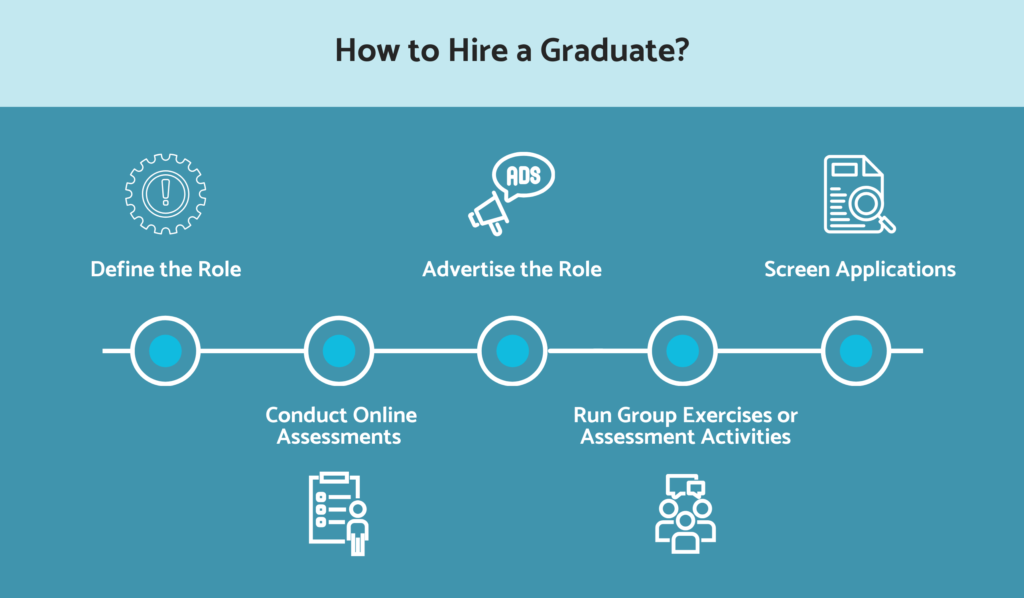
Given below is the step-by-step process of hiring a graduate:
- Define the Role
The most important step when recruiting a graduate is outlining the job responsibilities and skills you expect of them. Since most graduates usually lack experience, focus on assessing potential, transferable skills, and learning agility.
- Advertise the Role
Promote the graduate role by advertising it through job portals, your company’s career page, social media channels, and campus recruitment platforms. Clearly communicate the eligibility criteria, responsibilities, development opportunities, and application deadlines. This helps attract motivated candidates who align with your role expectations.
- Screen Applications
Review applications carefully and shortlist suitable candidates. Assess graduates’ academic qualifications, communication clarity, and their interest in the said role. Make use of this step to filter candidates who meet your role requirements and show signs of motivation and potential.
- Conduct Online Assessments
Conduct online assessments, including aptitude tests or cognitive assessments, or situational judgment tests, to measure problem-solving abilities, reasoning skills, and workplace behavior. These assessments allow you to compare candidates objectively and efficiently, especially while managing a large volume of applicants.
- Run Group Exercises or Assessment Activities
Invite shortlisted candidates to participate in group discussions, case studies, or collaborative exercises. Observe and assess how they communicate, contribute ideas, respond to feedback, and handle disagreement. This helps evaluate teamwork, leadership potential, and interpersonal effectiveness in real time.
Discover our candidate assessment platform to easily and quickly identify top graduates. LEARN MORE
Next up, we will take a look at some successful graduate recruitment case studies.
5. Real-world examples of successful graduate recruitment
Leading employers invest in effective graduate recruitment strategies to attract, assess, and develop graduate talent effectively.
Below are some standout examples of companies using these strategies successfully to drive top graduate talent.
Deloitte: Building Future Talent through Skill-first Hiring
Deloitte redesigned its graduate recruitment program to focus on skills, mindset, and potential rather than relying solely on academic background. The organization introduced structured online assessments, situational judgment tests, and immersive assessment centers to evaluate real workplace behavior and learning agility.
This helped Deloitte expand its talent pool, improve diversity, and strengthen long-term employee performance.
Unilever: Redefining Graduate Hiring with a Digital-first Approach
Unilever redefined graduate recruitment by replacing the traditional CV screening with a fully digital graduate hiring process. This process included online games, AI-driven assessments, and structured interviews. This approach helped Unilever reduce hiring bias, accelerate time-to-hire, and identify graduates with strong cognitive and interpersonal skills.
PwC: Developing Graduates through Structured Assessment
PwC developed a graduate program that combines assessment centers, structured interviews, mentoring, and formal learning pathways. They graduated with early responsibility alongside continuous training and coaching from experienced professionals. This helped them improve graduate retention, accelerate workplace readiness, and build a strong internal leadership pipeline.
Let’s now take a look at the step-by-step process of designing a successful graduate assessment center.
Utilize our pre-employment assessments and design a successful graduate hiring process. HIRE FOR FREE
6. Assessing and Hiring a Graduate Assessment Center: Client Success Story
Client Problem Statement
Imagine a fast-growing retail technology company planning to onboard a large number of graduates for customer operations and business support roles. Although many applicants demonstrate strong academic backgrounds, it becomes difficult for recruiters to evaluate how well candidates communicate under pressure, collaborate in teams, and handle real workplace situations.
Hence, the organization needs a reliable way to assess candidates’ interpersonal skills, decision-making ability, and readiness for fast-paced environments.
Assess Candidates’ Proposal
At Assess Candidates, we recommend implementing a structured graduate assessment program that combines situational judgment tests, group exercises, aptitude tests, and structured interviews. This data-driven approach will offer consistent, objective insights into each graduate’s potential, behavioral strengths, and alignment with company values.
Result
By implementing a structured graduate assessment program, the organization will be able to confidently shortlist candidates who demonstrate strong communication, adaptability, and customer-focused thinking. This will further result in smoother onboarding, improved early performance, and higher retention among graduate hires.
Partner with Assess Candidates to successfully assess and hire top graduates. VIEW PLANS
7. Why top companies choose Assess Candidates to successfully assess and hire a graduate
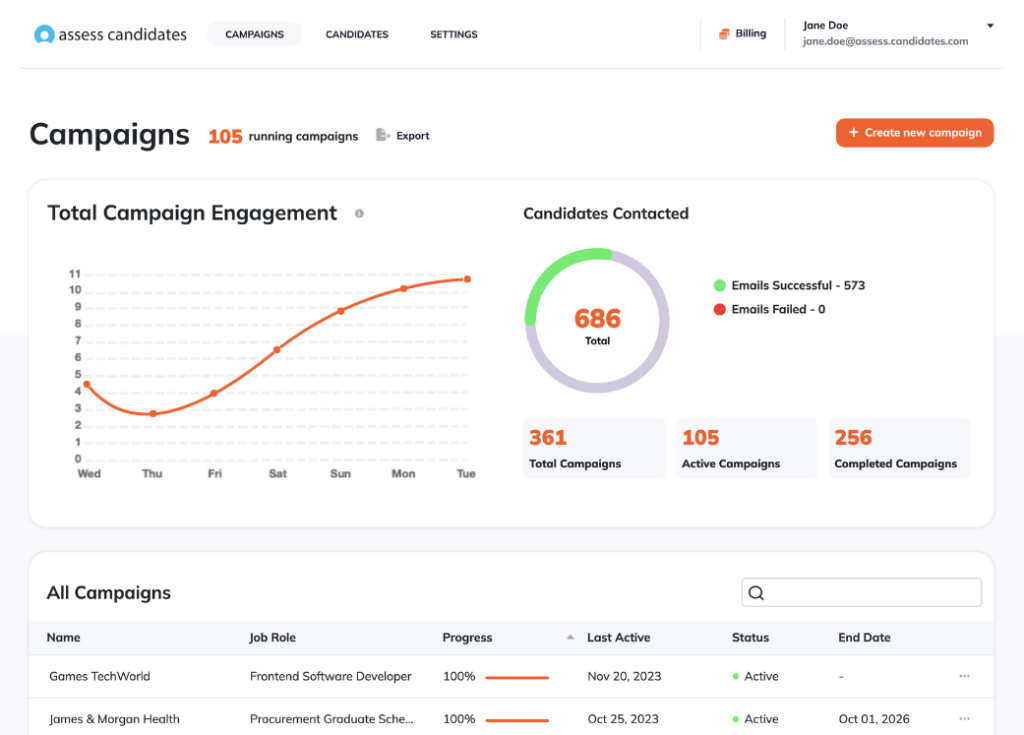
At Assess Candidates, we offer a wide range of graduate assessment tests and create recruitment campaigns customized to each organization’s unique hiring needs.
Here is an example of our campaign reporting dashboard available on Assess Candidates.
Here are 4 reasons why you should use Assess Candidates for successfully assessing and hiring a graduate:
- Scientifically Designed by Expert Psychologists: Assess Candidates develops graduate assessments in collaboration with experienced psychologists and psychometricians who specialize in building hiring solutions for global organizations. Our experts design every exercise to measure essential graduate competencies such as communication, problem-solving, adaptability, and decision-making.
Through rigorous validation, we ensure each assessment delivers reliable results, helping employers confidently identify high-potential graduates with strong learning ability and workplace readiness
- Advanced Reporting: Our intuitive platform provides clear, easy-to-interpret reports that highlight candidate performance across competencies, behavioral indicators, and overall assessment outcomes. Recruiters can quickly compare applicants, rank results, and make informed hiring decisions using objective insights. With seamless ATS integration, teams streamline scoring and shortlisting while maintaining consistency across large graduate cohorts.
- Positive Candidate Experience: We design graduate assessment exercises to feel engaging, intuitive, and fully compatible across devices. Candidates receive clear instructions and move smoothly between activities, allowing them to focus on demonstrating their skills instead of navigating complex systems. Custom branding options also help organizations strengthen their employer identity and deliver a professional, cohesive assessment journey.
- Candidate Accessibility Support: We prioritize inclusivity by offering accessibility features such as extended time options, screen-reader compatibility, accessible color contrast, and remote assessment capabilities. Our tools comply with WCAG accessibility standards, ensuring every graduate receives a fair opportunity to perform at their best, regardless of individual needs.
Explore our full suite of graduate hiring tools to start identifying candidates with high potential and development readiness.
Not sure how to structure your graduate assessment center? Contact us for a free consultation and tailored hiring recommendations.
Conclusion: Key Takeaway
- Graduate hiring prioritizes potential, mindset, and learning ability over professional experience.
- Companies use structured graduate schemes and assessment centers to develop future-ready talent through training and real-world exposure.
- Employers hire graduates at scale using standardized tests, group exercises, and structured interviews to maintain consistency and quality.
- Transferable skills like problem-solving, communication, adaptability, and teamwork drive graduate hiring decisions.
- Graduate assessment centers reveal real workplace behavior, not just academic qualifications.
- Combining aptitude tests, SJTs, group tasks, and interviews helps employers predict performance and reduce hiring risk early.
- A structured hiring process enables organizations to identify high-potential graduates and build long-term talent pipelines.
Interested in learning more about effective candidate assessment? Continue reading for frequently asked questions, and sign up with your email to get started.
Frequently Asked Questions
How to assess graduates with little to no work experience?
You can assess graduates with little to no work experience by focusing on their potential rather than past roles. This can be done using structured assessments like aptitude tests, situational judgment tests, and structured interviews. These tests will also further help you evaluate the problem-solving, communication, and learning ability of graduates.
How to hire graduates at scale without compromising quality?
Graduates can be hired at scale without compromising quality by combining online assessments, group exercises, and structured interviews to manage the high volume of applications. This structured approach will allow you to compare candidates objectively, reduce bias, and maintain consistency.
How to create a positive candidate experience during graduate recruitment?
You can create a positive candidate experience during graduate recruitment by designing clear application journeys, providing simple instructions, and offering engaging assessments that work across various devices. You can also communicate timelines transparently and allow candidates to showcase their strengths without any difficulties.
How to identify long-term potential in graduate candidates?
You can identify long-term potential in graduate candidates by evaluating their learning ability, communication skills, adaptability, and motivation. This can be done through simulations, interviews, and behavioral assessments.
How to support graduates after hiring?
To support graduates after hiring, provide them with structured training, mentoring, and clear performance expectations. Assign managers early, encourage continuous feedback, and provide upskilling or learning opportunities to accelerate development.


 English
  Arabic