
Written Exercises in Assessment Centers: Recruitment Strategies



Written exercises in assessment centers help employers evaluate how candidates communicate, analyze information, and produce work-related documents. Depending on the role, candidates may be asked to draft an email, prioritize an inbox, interpret data, or prepare a recommendation.
This guide explains what written exercises measure, provides practical examples, and outlines how to design and score them fairly.
Contents
- What is a written exercise?
- What do written exercises measure?
- Why do employers use written exercises?
- Examples of written exercises
- What are the challenges of written exercises?
- Strategies to implement written exercises
First, let’s explore what written exercises are and their roles in assessment centers.
1. What is a written exercise?
A written exercise is a structured recruitment task in which candidates produce a written response to a job-related brief. Tasks may involve emails, reports, recommendations, or information analysis. Employers assess the submission against predefined criteria, such as clarity, accuracy, reasoning, and relevance to the role.
Hire skilled candidates with our range of pre-employment assessments. HIRE FOR FREE
What are employers looking for in written exercises?
Continue reading as we explore what written exercises measure.

2. What do written exercises measure?
Written exercises often allow companies to assess candidates on several skills at once. These reveal how they process information, structure their thinking, and communicate under time pressure.
According to OPM, written exercises are used by recruiters to evaluate multiple candidates simultaneously. They are designed to simulate the real challenges of the actual work in an organization.
Skills assessed by written exercises
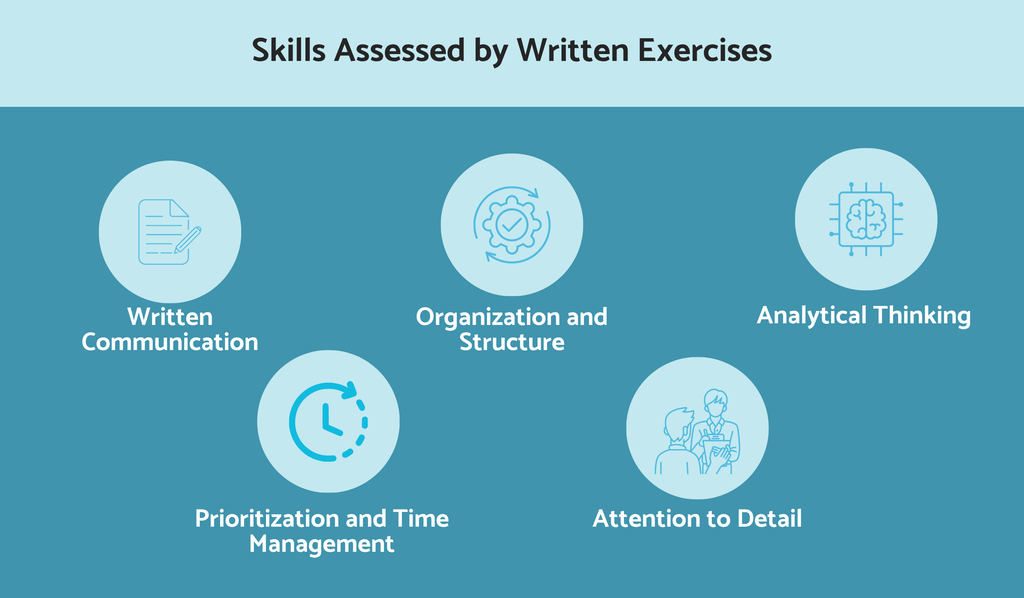
- Written Communication
Written communication assesses how your candidates can express their ideas clearly, logically, and appropriately for their intended audience. Skilled candidates use clear headings and short paragraphs, avoid unnecessary words, and ensure that the purpose of the task is clear.
- Organization and Structure
Written exercises focus on your candidates’ organizational skills as they measure how well they can arrange information so the reader is able to follow the argument. A well-structured document often includes a clear purpose, logical sections, and a conclusion or recommendation.
- Analytical Thinking
Analytical thinking involves identifying the main issue, separating relevant from less relevant information, and drawing logical conclusions. The written exercises assess whether your candidates can identify patterns, recognize gaps, and use evidence to support their conclusions.
- Prioritization and Time Management
Timed written exercises can show how candidates prioritize information and organize their response within a defined period. However, performance on one timed task should not be treated as a complete measure of time management. Employers should consider whether speed is genuinely important for the role.
- Attention to Detail
Written exercises can help reveal whether candidates notice errors, inconsistencies, or missing information. A good candidate is expected to correct factual mistakes, identify contradictory instructions, or flag data that does not align with other evidence.
Recruit the best-skilled talent with our assessment tool platform. LEARN MORE
Read on as we explore why employers use written exercises in recruitment.
3. Why do employers use written exercises?
Employers use written exercises to observe how candidates approach realistic work tasks rather than relying solely on interview descriptions of their abilities. Well-designed exercises can provide comparable evidence of writing, analysis, judgment, and prioritization when these competencies matter for the role.
Why employers use written exercises
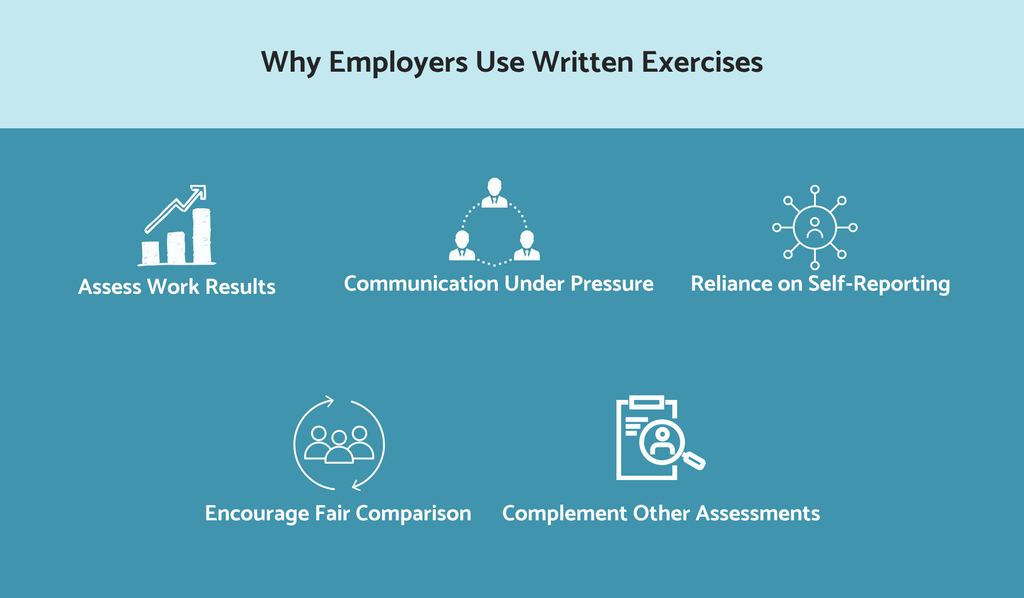
1. Assess Work Results
Written exercises simulate tasks that your employees will likely complete regularly, such as drafting emails, writing reports, summarizing policies, or responding to customers. This provides you with insight into whether your candidates can produce work that meets your organization’s standards.
2. Communication Under Pressure
When recruiting for a role, many employers require candidates to communicate clearly, even when they are busy or under time pressure. Written exercises allow you to observe how your candidates structure their thoughts, prioritize information, and maintain clarity within a fixed time limit.
3. LAssess Skills Beyond Self-Reports
Written exercises provide direct evidence of how candidates approach a specific task. Rather than relying only on descriptions of previous experience, employers can review the quality, structure, and accuracy of a candidate’s work against consistent criteria.
4. Encourage Fair Comparison
When candidates receive equivalent briefs, instructions, resources, and appropriate adjustments, written exercises can provide a more consistent basis for comparison. Assessors should use predefined scoring criteria and record evidence supporting their judgments.
5. Complement Other Assessments
Written exercises should not be used to replace every other assessment method in your recruitment process. However, you can use them to strengthen your hiring decision by gathering evidence that interviews or reasoning tests may not provide.
The best written exercise resembles something the successful candidate will actually do at work. A customer service applicant might draft a complaint response, while an analyst might interpret data and recommend a course of action.
Discover our pre-employment assessments to identify talent with key competencies. HIRE FOR FREE
4. Examples of written exercises
There are many variations of written exercises; however, the questions set by employers depend on the industry and role they are recruiting for. The exercises are designed to assess your candidates’ verbal reasoning, spoken communication, and writing skills, competencies that are likely vital for the role you are hiring for.
For each exercise, ensure to provide your candidates with the required data and documentation to complete the tasks presented to them.
Types of written exercises
- In-Tray Prioritization Question
With this question, you will be looking to assess your candidates’ prioritization skills in the finance, consulting, and legal industries.
Example: You have just returned from leave and found 10 emails in your inbox. You have 30 minutes to review them, decide which require immediate action, and write short responses to the three most urgent items.
- Customer Service Question
This question allows you to see how your candidates handle conflict resolution skills in customer service roles in retail and sales industries.
Example: A long-standing client has sent a complaint about a delayed delivery and poor communication. Write an email response that addresses their concerns, explains what happened, and offers a practical solution.
- Data Interpretation Question
With a data interpretation question, you evaluate your candidates’ ability to interpret and analyze data and provide solutions in the finance, consulting, and marketing industries.
Example: Review the customer satisfaction data for the last six months. Identify the main trend, possible causes, and recommend two actions the company should take. Write a short report summarizing your findings.
- Process Proposal Question
You will be testing your candidates’ written communication and analytical skills, as it may be a core part of the role in finance, consulting, legal, and tech industries.
Example: A team is experiencing delays in processing their customer orders. Review the process notes and data, identify the main bottleneck, and write a short proposal for improvement.
- Email Communication Question
This question tests communication skills by assessing the ability to communicate with stakeholders and make a convincing point in finance, consulting, tech, and legal industries.
Example: A project is running behind schedule due to a supplier delay. Write an email to key stakeholders explaining the situation, the impact, and the steps being taken to address it.
Recruit the best-fit talent with our assessment tool platform. LEARN MORE
Written exercises come with challenges. Here’s how to overcome them!
5. What are the challenges of written exercises?
Some employers looking to include written exercises in their assessment process have spoken up about the challenges they could encounter when using them.
Here, we will provide you with solutions to each challenge you could come across in your recruitment process.
Challenges of written exercises
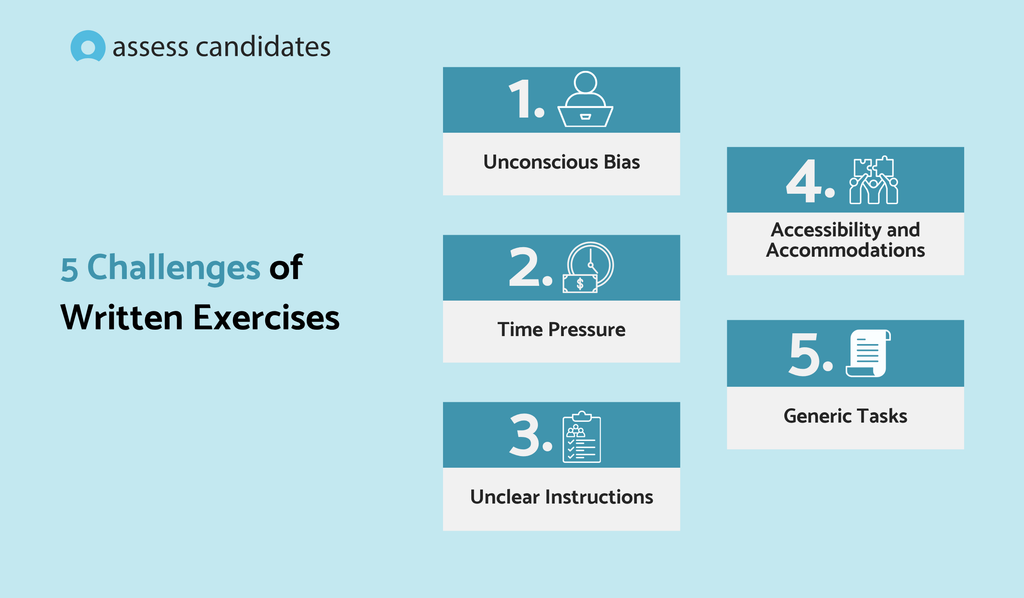
1. Unconscious Bias
Your interviewers could unconsciously prefer certain writing styles, tones, or cultural expressions over others in the recruitment process. This can be disadvantageous to other candidates from different backgrounds or those who communicate differently.
Solution: Train your hiring managers to focus on job-relevant criteria such as clarity, structure, reasoning, and professionalism. Avoid penalizing your candidates for their accent, dialect, or cultural differences unless these directly affect the role’s requirements. You can use multiple hiring managers where possible and compare their scores against your organization’s rubric.
2. Time Pressure
If the set time limit is too short, your written exercise will measure your candidate’s speed rather than their quality. The candidates could rush and produce work that does not reflect their true capability within the given time.
Solution: You can match your time limit to the difficulty level of the task and the level of the role. A short email could require less time, while a briefing note could need more. Ensure your candidates have enough time to read, plan, write, and review their work before submission.
3. Unclear Instructions
Your candidates may find it difficult if the task, expected result, or time limit is not clearly explained to them before they begin. This can lead to confusion, inconsistent performance, and unfair assessment.
Solution: To address this, you can provide a written brief that outlines the scenario, available information, time limit, expected outcome, and any constraints they may encounter. Include an example of the format if helpful, and you can pilot the exercise with your employees to ensure the instructions are clear and achievable within the set time.
4. Accessibility and Accommodations
You may find that some candidates are diagnosed with dyslexia, visual impairments, or other conditions that require some adjustments. Failing to provide these can create unnecessary barriers and reduce fairness in your hiring process.
Solution: Ask your candidates in advance whether they require any accommodations to make the recruitment process convenient. Provide extra time, assistive technology, larger fonts, or alternative formats where appropriate. You can also ensure that the written exercise assesses the intended competency rather than creating avoidable accessibility barriers.
5. Generic Tasks
Having a generic writing task may not reflect the role’s actual demands. For instance, asking all your candidates to write a random essay may not prove to you whether they can handle job-specific communication.
Solution: Design your tasks and make sure that they resemble real work. A customer service role may require a complaint response, an operations role may require a process summary, and a graduate role may require a data-based recommendation. Role relevance improves the quality of the evidence for your hiring decision.
Uncover exercises created by chartered scientists to hire top candidates. VIEW PLANS
A realistic task alone does not make an assessment fair. Employers also need clear instructions, consistent scoring, and enough time for candidates to demonstrate the skills being assessed.
6. Strategies to implement written exercises
Effective written exercises start with a clear assessment purpose. Employers should choose realistic tasks, define scoring criteria in advance, provide appropriate adjustments, and interpret results alongside other job-relevant evidence.
Top practices for written exercises
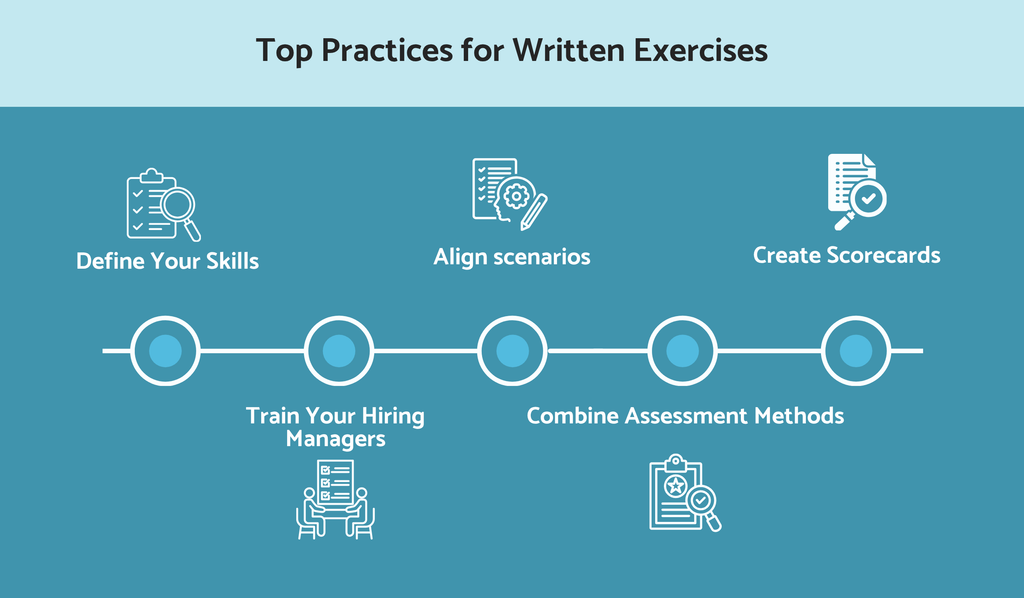
- Define Your Skills
When designing your assessment center, start by deciding exactly what the written exercise should measure. Your task might seek to assess communication, structure, analysis, judgment, prioritization, or attention to detail. Trying to evaluate every possible skill in a single task can make your scoring unclear and lead to a mis-hire or the loss of talented candidates.
- Train Hiring Managers
Your hiring managers should understand the task, the skills assessed, the scoring criteria, and the usual sources of bias. They should know the difference between observation and interpretation. Where several recruiters are involved, you can hold a training session before the hiring process begins. This helps ensure that everyone applies the same standard to all candidates consistently.
- Align Scenarios
The scenario you create should reflect the type of writing your candidates will do in the role they will be filling. Role relevance improves the quality of your candidates and makes the exercise more credible and engaging for them. Your hiring managers can work with high-performing employees and line managers to identify common writing tasks that should inform the exercise.
- Combine Assessment Methods
A written exercise should not be the only basis for your hiring decision. Though it provides you with results on communication and reasoning, it may not adequately assess motivation, interpersonal skills, or technical capability. We suggest that you combine written exercises with other psychometric assessment tests, along with video interviews and other assessment center exercises.
- Create Scorecards
You can prepare a scoring rubric before setting the written exercise in the assessment process. It should identify each skill, describe behavioral indicators, and separate strong performance from average or weak performance. These scorecards help you compare evidence and make it easier to explain and defend your hiring decisions if necessary.
For example, your scorecard could look like the following, scoring each criterion on a predefined scale, such as 1–4, with behavioral descriptions for each score:
Hire your best-fit candidates with our assessment tool platform. LEARN MORE
Conclusion: Key Takeaway
Written exercises in assessment centers provide useful evidence of how candidates communicate, analyze information, and complete job-relevant writing tasks. Their value depends on realistic briefs, consistent scoring, and fair assessment conditions. Employers should combine the results with other relevant evidence rather than relying on a single written submission.
Interested in using written exercises to evaluate job-relevant skills more consistently? Explore our frequently asked questions and discover how structured assessments can support your hiring process.
Frequently Asked Questions
Can I use written exercises for every role?
You cannot use written exercises for all vacant positions because they are most useful for roles that involve written communication, structure, analysis, or documentation. You could use other assessment center exercises along with psychometric and cognitive tests to gain insight into your candidates’ skills.
How long should a written exercise take?
The duration of your written exercise depends on the task and role you are recruiting for. For example, a short email or customer response could be set to take between 10 and 15 minutes, and a briefing note or data-based report could be 30 to 45 minutes. The time limit should match the complexity of the task and the level of the role that you are setting for your candidates.
Should I allow candidates to use AI during a written exercise?
You can decide whether or not to allow your candidates to use AI during a written exercise before it begins, but explain the rules clearly. If AI use is allowed, state which tools candidates can use, what information they may enter, and whether they must disclose AI assistance.
How is a written exercise different from a case study?
A written exercise focuses on producing a written response, such as an email, report, or recommendation. A case study typically presents a broader problem for analysis and may require a written report, presentation, or discussion. The two methods can overlap, but they are not interchangeable.
Can written exercises be used for internal promotions?
Written exercises can be used for internal mobility, leadership assessment, succession planning, and promotion decisions. They can help you confirm whether your employee is ready to handle more complex communication, analysis, or stakeholder updates.


 English
 Arabic