
How to Successfully Design a Graduate Assessment Center



Are you thinking of hiring graduates this recruitment season but don’t know where to start?
A well-designed graduate assessment center helps you identify high-potential graduates based on observed behaviour.
In today’s fast-changing workplace, organizations need graduates who can communicate clearly, solve problems, quickly adapt, and collaborate effectively. Yet, traditional screening methods like CVs and unstructured interviews rarely reveal how early-career candidates truly behave under pressure or contribute to a team. They highlight qualifications, not true potential, and for graduates with limited work experience, that distinction is critical.
This is where structured graduate assessment centers make the difference. By simulating real-world work situations through group exercises, case studies, written tasks, and interviews, they provide deeper insight into how graduates collaborate, make decisions, and respond under pressure.
In this guide, you’ll learn the best practices for designing and implementing a successful graduate assessment center that identifies genuine performance and long-term potential.
Contents
- What is a graduate assessment center?
- How does a graduate assessment center work?
- What key competencies do graduate assessment centers assess?
- Common graduate assessment center exercises and interview questions
- How does a graduate assessment center differ from a general assessment center?
- What is the importance of a graduate assessment center in hiring?
- How to design a successful graduate assessment center?
- Designing a graduate assessment center: Client success story
- Why top companies choose Assess Candidates
1. What is a graduate assessment center?
A graduate assessment center is a structured hiring method used to evaluate multiple candidates at once for entry-level roles or internships. It combines realistic, job-relevant exercises such as group tasks, case studies, aptitude tests, and individual interviews to assess communication, problem-solving, teamwork, and leadership potential.
Did you know? According to Wikipedia, 34% of employers use assessment centers when recruiting graduates, managers, and professionals.
Include science-backed pre-employment assessments in your graduate assessment center. HIRE FOR FREE
Let’s now dive into how graduate assessment centers actually work.

2. How does a graduate assessment center work?
A graduate assessment center works by assessing multiple candidates through structured, job-relevant exercises conducted in one session. Recruiters observe behavior, teamwork, decision-making, and communication skills using standardized scoring frameworks which ensure objective comparison.
Below is a step-by-step overview of how a graduate assessment center typically works:
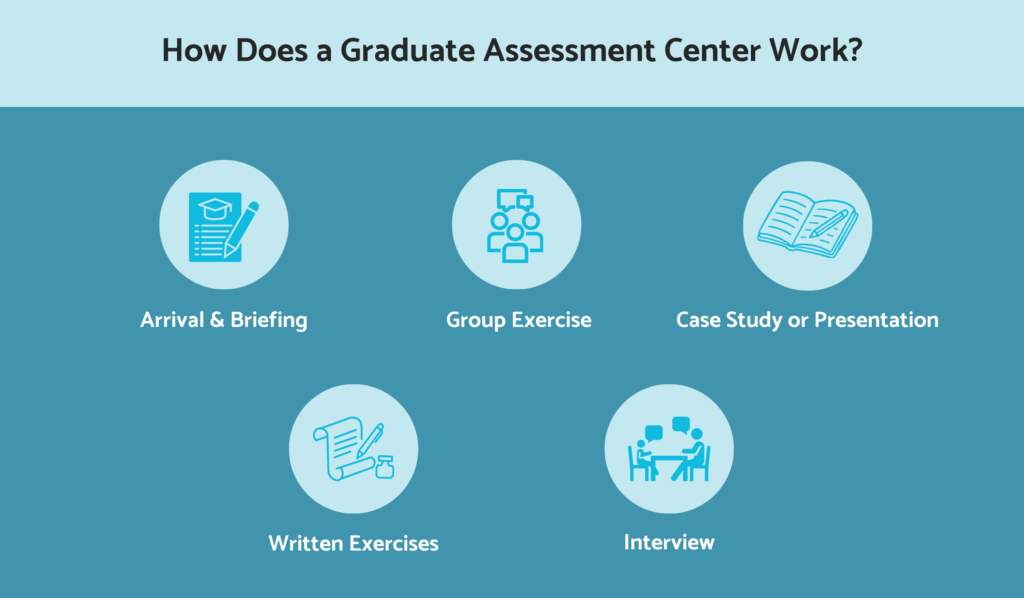
1. Arrival and Briefing
A graduate assessment center begins with candidate arrival and a briefing. Introduce them to the recruitment team and walk them through the competencies you will evaluate.
This further ensures transparency and creates a fair, structured evaluation environment for all candidates.
2. Group Exercise
Group exercise is usually the next step, where you assign candidates to a group task or discussion topic. Here, you will observe how candidates communicate, collaborate, and contribute their ideas to collective decision-making.
As a result, you can accurately measure a candidate’s ability to listen carefully, express their ideas clearly, and support team progress.
Did you know? According to AssessmentDay, 92% of the candidates faced a group exercise as a part of their assessment center.
3. Case Study or Presentation
Present candidates with a real-world business scenario, either as a group exercise or an individual task, and ask them to analyze and present their suggestions within a given timeframe. Here, you will assess their analytical thinking, problem–solving approach, and decision-making ability.
4. Written Exercises
Recruiters administer aptitude tests or written exercises to measure candidates’ reasoning skills and ability to process information accurately. Here, you will assess a candidate’s numerical reasoning, verbal ability, situational judgment, and attention to detail skills.
5. Interview
You typically conduct structured individual interviews at the end of the assessment process to explore each candidate’s experience, motivation, and alignment with the organization’s goals. Ask mostly competency-based questions to assess their past experiences and behaviors.
Discover our scientifically validated psychometric tests for your graduate assessment centers. LEARN MORE
But what different competencies can you assess with graduate assessment center exercises?
3. What key competencies do graduate assessment centers assess?
Graduate assessment centers assess a wide range of core competencies in candidates. These help you not just analyze the candidates’ true potential but also their ability to perform in real-life workplace situations.
Top 5 competencies graduate assessment centers measure:
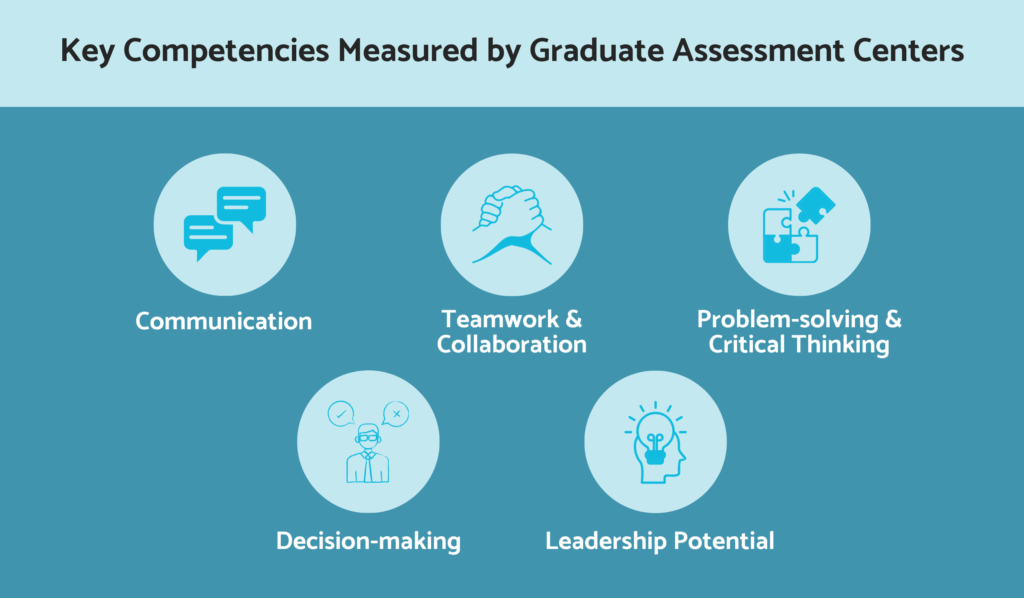
- Communication
Graduate assessment centers measure a candidate’s communication skills by observing how clearly they express their ideas and listen carefully. This includes their ability to actively participate in group discussions, presentations, and interviews.
- Teamwork & Collaboration
Many graduate assessment center exercises like group discussion and presentations also evaluate a candidate’s teamwork and collaboration skills by observing how they contribute to group goals, respect diverse perspectives, and support other teammates during team exercises. This helps identify candidates who engage constructively, encourage participation, and move tasks forward without overpowering conversations.
- Problem-solving and Critical Thinking
One of the most important competencies that graduate assessment centers assess is a candidate’s problem-solving and critical thinking skills. It evaluates how candidates analyze information, identify key issues, and develop logical solutions during case study or presentation tasks.
- Decision-making
They also measure a candidate’s decision-making skills, observing how candidates prioritize tasks, weigh alternatives, and make sound judgments under time constraints.
- Leadership Potential
Through a graduate assessment center, you can assess a candidate’s leadership potential. It assesses whether candidates take initiative, guide discussions productively, and encourage or motivate others when required.
Discover our candidate assessment platform to easily and quickly identify top graduates. LEARN MORE
Next, let’s take a look at the difference between a graduate assessment centre and a general assessment center.
4. Common graduate assessment center exercises and interview questions
Graduate assessment center exercises are designed to simulate real workplace scenarios and assess how candidates behave under pressure. These exercises evaluate communication, teamwork, analytical thinking, and decision-making using structured scoring frameworks.
Graduate Assessment Center Group Exercise Example
A typical graduate assessment center group exercise example involves assigning candidates a business scenario, such as launching a new product or solving an operational challenge, and asking them to reach a collective decision within a set timeframe.
Assessors observe how each candidate:
- Communicates ideas clearly
- Listens and responds to others
- Influences discussion constructively
- Manages time and priorities
- Supports or challenges viewpoints professionally
Unlike interviews, group exercises reveal real-time behaviour in collaborative settings.
Assessment Centre Case Study Examples
Assessment centre case study examples usually require candidates to analyze business data, identify key issues, and present structured recommendations.
These tasks assess:
- Critical thinking
- Commercial awareness
- Problem-solving ability
- Logical reasoning
- Presentation skills
In graduate hiring, case studies are often simplified but still designed to test structured thinking and clarity under time pressure.
Graduate Assessment Center Interview Questions
Graduate assessment center interview questions are typically competency-based and focus on behavioural evidence rather than technical depth.
Common examples include:
- “Tell me about a time you worked in a team to overcome a challenge.”
- “Describe a situation where you had to analyse information quickly.”
- “How do you prioritise tasks under tight deadlines?”
These questions help assess motivation, adaptability, self-awareness, and cultural alignment.
Graduate Assessment Tests and Online Assessments
Many graduate assessment centers also incorporate structured online assessment tests, including numerical reasoning, verbal reasoning, and situational judgement tests.
These graduate assessment tests provide objective data to complement observational exercises. When combined, they create a balanced, evidence-based evaluation framework.
5. How does a graduate assessment center differ from a general assessment center?
Graduate assessment centers and general assessment centers serve different hiring purposes and target different experience levels.
Below are some of the major differences between a graduate assessment center and a general assessment center:
Before designing your assessment center, it’s important to understand why this method improves hiring outcomes.
6. What is the importance of a graduate assessment center in hiring?
A graduate assessment center plays a vital role in the recruitment process by allowing you to assess candidates through structured, job-specific exercises. It further helps in identifying high-potential graduates for the organization.
5 major benefits offered by a graduate assessment center during the hiring process

1. Provides Real Insights into Candidate Potential
Graduate assessment centers allow you to observe how candidates think, communicate, and behave in realistic workplace scenarios. This provides more practical insight into a candidate’s true potential, capabilities, strengths, and areas for improvement.
2. Offers Fair and Objective Comparison
During an assessment center, you evaluate all candidates based on the same standardized, structured exercises and competency frameworks. This ensures consistency across evaluations, reduces unconscious bias, and makes evidence-based hiring decisions based on candidate performance.
3. Identifies Future-ready Talent
You can identify future-ready talent who are destined for long-term success at your company by assessing graduates’ adaptability, learning agility, motivation, and cultural fit.
4. Reduces Hiring Risk
Graduate assessment centers use multiple assessment methods, including group exercises, case studies, written exercises, and interviews, to provide a well-rounded view of each candidate. Multi-assessment hiring reduces the risk of poor hires and improves hiring quality as it provides a broader evidence base for decision-making.
5. Develops a Stronger Graduate Talent Pipeline
Assessment centers help select candidates with high growth potential and readiness for development, creating a reliable entry-level talent pool. This further supports succession planning, improves retention, and strengthens the organization’s future workforce.
If you’re currently relying only on interviews, this is where structured assessments create measurable improvement.
Unlock the benefits of administering assessment center exercises and improve your hiring accuracy. HIRE FOR FREE
Let’s now take a look at the step-by-step process of designing effective graduate assessment centre exercises.
7. How to design a successful graduate assessment center?
Designing a successful graduate assessment center requires clarity, structure, and alignment with real job demands.
Step-by-step guide to designing a successful graduate assessment center
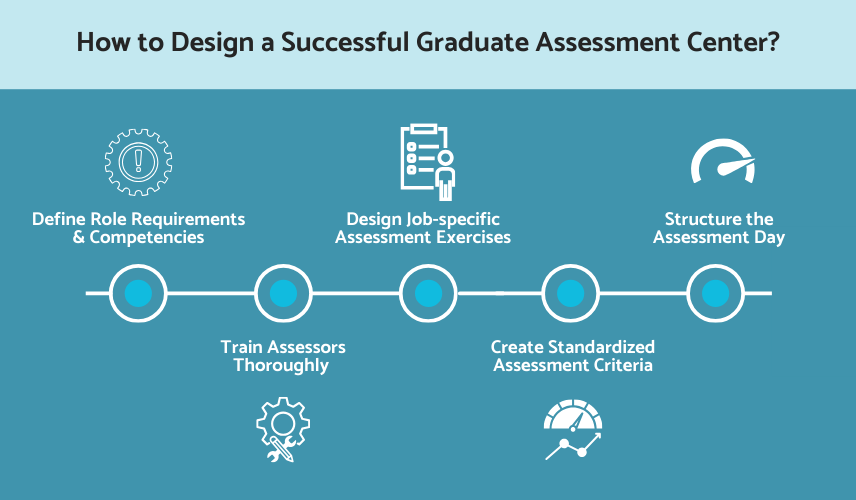
- Define Role Requirements and Competencies
Begin by identifying skills, behaviors, and attributes that are of utmost importance in your graduate roles. Focus on core competencies for evaluation, including communication, teamwork, problem–solving, and adaptability.
Make sure to base competencies on real job requirements and limit your list of competencies to avoid over-assessment. Moreover, align your list with organizational goals and future workforce needs.
- Design Job-specific Assessment Exercises
At Assess Candidates, we create and design exercises that reflect realistic workplace situations. Combine multiple assessments, including group exercises, presentations, written exercises, and interviews, to evaluate candidates thoroughly.
- Structure the Assessment Day
In practice, careful planning of assessment day logistics significantly improves both candidate engagement and scoring accuracy. A structured agenda ensures candidates remain engaged whilst assessors capture meaningful behavioral data rather than relying on impressions.
- Train Assessors Thoroughly
Training assessors thoroughly is one of the most important steps in designing successful graduate assessment center exercises. Hence, ensure recruiters and hiring managers are prepared to observe behavior objectively and score candidates consistently.
Use standardized scoring rubrics to avoid unconscious bias during the hiring process.
- Create Standardized Assessment Criteria
At Assess Candidates, we always recommend developing structured scoring frameworks for every exercise. Use numerical rating scales with clear benchmarks and combine scores across all exercises for the final evaluation. This further ensures fairness and enables meaningful comparisons.
Utilize our pre-employment assessments and design a successful graduate assessment center. HIRE FOR FREE
8. Designing a Graduate Assessment Center: Client Success Story
Client Problem Statement
Consider a mid-sized consulting firm hiring large volumes of graduates for entry-level roles. While candidates perform well in interviews, the company struggles to identify candidates who can truly collaborate, think critically, and adapt to real workplace challenges.
The organization needs a structured way to evaluate graduates’ communication skills, problem-solving ability, and workplace behavior before making hiring decisions.
Assess Candidates’ Proposal
At Assess Candidates, we recommend designing a graduate assessment center that combines multiple evaluation methods, including group exercises, case studies, aptitude tests, and structured interviews. These job-relevant activities allow recruiters to observe how candidates communicate, collaborate, manage time, and respond to realistic workplace scenarios.
This approach will provide consistent and evidence-based insights into a candidate’s adaptability, potential, and cultural fit.
Result
By implementing a well-designed graduate assessment center, the consulting firm can identify high-potential candidates who exhibit strong teamwork, analytical thinking, and professional behavior. Within 6 months, the firm reduced early attrition and improved hiring consistency across graduate cohorts.
Partner with Assess Candidates to integrate graduate assessment center exercises into your hiring process. VIEW PLANS
9. Why top companies choose Assess Candidates
At Assess Candidates, we offer a wide range of graduate assessment center tests and create recruitment campaigns customized to each organization’s unique hiring needs.
Here is an example of our campaign reporting dashboard available on Assess Candidates.
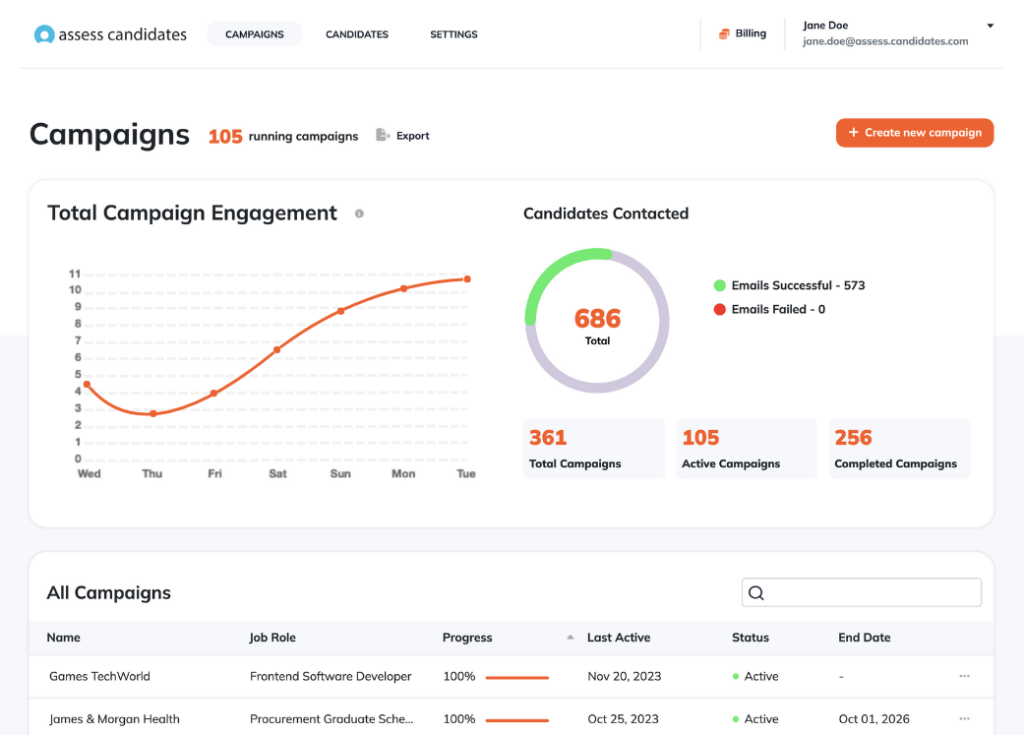
Here are 4 reasons why you should use Assess Candidates for designing a successful graduate assessment center:
- Scientifically Designed by Expert Psychologists: Assess Candidates develops graduate assessment exercises in collaboration with experienced psychologists and psychometricians.
Each exercise undergoes rigorous validation to ensure it measures core competencies such as communication, problem-solving, adaptability, and decision-making. This enables recruiters to identify high-potential graduates with workplace readiness.
- Advanced Reporting: Our intuitive platform delivers detailed yet easy-to-interpret reports that highlight each candidate’s competency performance, behavioural indicators, and overall assessment outcomes. Recruiters can quickly compare candidates, rank results, and make data-driven hiring decisions using objective insights. With seamless ATS integration, scoring and shortlisting become faster, more efficient, and highly consistent across graduate cohorts.
- Positive Candidate Experience: We design graduate assessment center exercises to feel engaging, intuitive, and fully device-compatible. Candidates receive clear instructions and move smoothly between exercises, allowing them to focus on showcasing their abilities rather than navigating complex systems. Custom branding options also help organizations reinforce their employer identity and deliver a professional, cohesive assessment journey.
- Candidate Accessibility Support: We prioritize inclusivity through accessibility features such as extended time options, screen reader compatibility, accessible color contrast, and remote assessment capabilities. Our tools comply with WCAG standards, helping ensure every graduate has a fair opportunity to perform at their best.
Assess Candidates delivers reliable, science-backed assessment solutions that help organizations design effective graduate assessment centers, reduce hiring risk, and build future-ready talent pipelines. Explore our full suite of graduate hiring tools to start identifying candidates with strong potential and development readiness.
Not sure how to structure your graduate assessment center? Contact us for a free consultation and tailored hiring recommendations. A well-designed graduate assessment center ensures you identify adaptable, high-performing graduates with confidence.
Conclusion: Key Takeaway
- Graduate assessment centers evaluate multiple candidates simultaneously through structured, real-world exercises.
- They reveal true candidate potential by observing behavior across 5 key competencies: communication, teamwork, problem-solving, leadership potential, and decision-making.
- Core exercises include group exercises, case studies, written tests, and structured interviews.
- Unlike general assessment centers, graduate assessment centers focus on potential and foundational skills.
- They enable fair, objective comparison through standardized exercises and scoring frameworks.
Continue exploring our expert guides on assessment centres and graduate hiring to build a more accurate, data-driven recruitment process. Sign up with your email to get started.
Frequently Asked Questions
What makes a graduate assessment center successful?
A graduate assessment center becomes successful through relevance and structure. Hence, you should focus on designing exercises that mirror real-world workplace situations and clearly map each activity to the specific competencies. This will help you gain insights into how candidates think, collaborate, and adapt in a workplace.
How long should a graduate assessment center last?
A graduate assessment center usually lasts for half a day or a full day. This provides enough time to evaluate candidates across multiple skills while also keeping them engaged. Include breaks, vary activity types, and share the agenda of the assessment center in advance to ensure an unbiased hiring process.
How do we ensure fairness during a graduate assessment center?
You can ensure fairness during a graduate assessment center by using standardized scoring frameworks and training assessors to rate behavior objectively. Make sure to always assess candidates against the same competencies using structured scoring rubrics. This further reduces bias and improves hiring quality.
How to measure success after running a graduate assessment center?
You can measure success after running a graduate assessment center by tracking new-hire performances, analyzing retention rates, and collecting candidate feedback. Tracking post-hire performance, retention trends, and candidate feedback allows you to refine future assessment design. Over time, this creates a measurable link between graduate assessment outcomes and business performance.
Is experience important in graduate hiring?
Experience is not always the primary factor in graduate hiring. For entry-level roles, performance in structured, job-related exercises often provides more reliable insight than prior work experience alone.


 English
  Arabic