
How To Detect AI-assisted Candidate Work in Recruitment



AI-assisted candidate work is becoming increasingly common in recruitment, with candidates using generative AI to edit CVs, prepare applications, and support other stages of the hiring process.
According to Washington State University, many job seekers are turning to artificial intelligence (AI) for assistance in creating and updating their CVs and resumes to meet today’s recruitment standards.
In this guide, we will explore how to identify AI-assisted candidate work, the risks involved, and how to manage AI use during recruitment.
Contents
- What is AI-assisted candidate work?
- What does AI-assisted candidate work look like?
- What are the top signs to look for when hiring?
- What are the risks of AI-assisted candidate work?
- How to detect AI use in hiring?
- Tips on managing AI-assisted work
- Why use Assess Candidates to verify candidate ability?
To understand more about AI-assisted candidate work in recruitment, let’s dive in!
1. What is AI-assisted candidate work?
AI-assisted candidate work refers to application materials or assessment responses that candidates create, edit, or substantially revise using generative AI tools. The level of assistance can vary considerably, from grammar and sentence-level editing to generating complete CVs, cover letters, interview responses, code, or written tasks.
Hire skilled candidates with our pre-hire assessments. HIRE FOR FREE
Up next, we will explore what AI–assisted work looks like in the recruitment process.

2. What does AI-assisted candidate work look like?
Employers may accept different levels of AI assistance depending on the role and stage of recruitment. The key issue is whether AI use prevents employers from accurately evaluating the candidate’s own skills, experience, reasoning, or communication.
According to the U.S. Chamber of Commerce, about 20% of employers have claimed to reject applications from job seekers who use AI-generated resumes or cover letters. Meanwhile, 14.5% of hiring managers believe candidates should not use AI at any stage of the job application process.
Examples of AI-assisted candidate work
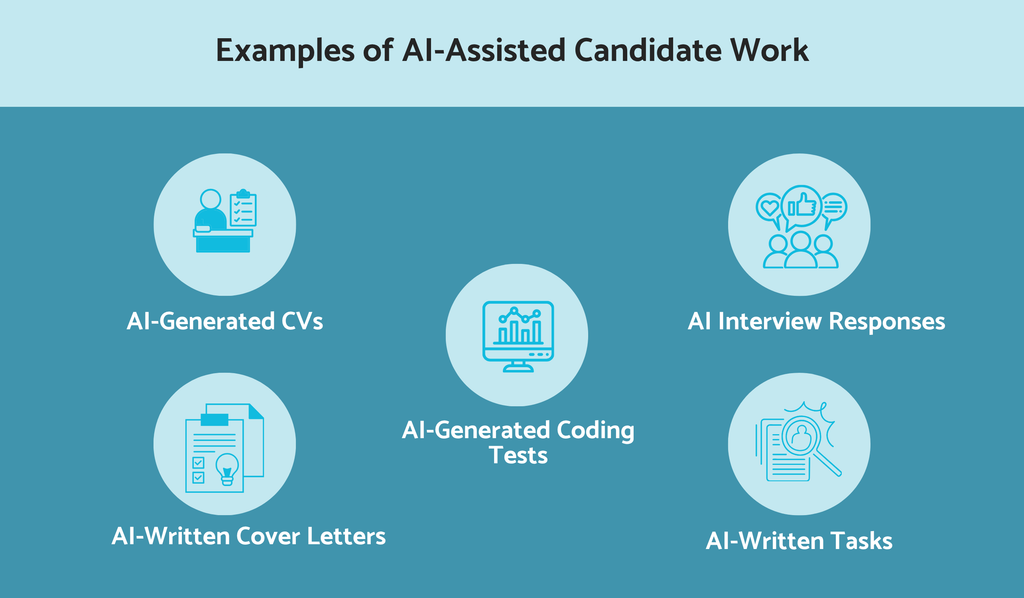
1. AI-Generated CVs
Candidates may use artificial intelligence to structure CVs, rewrite descriptions of their experience, or tailor applications to job descriptions. This can improve clarity, but employers should verify significant claims where the wording does not provide clear evidence of the candidate’s actual responsibilities or achievements.
2. AI-Written Cover Letters
Candidates use generative AI platforms like ChatGPT, Claude, and Gemini to produce cover letters that look professional and closely match the language of job descriptions. However, the letters, being usually generic, tend to mention the employer’s values without proving that the candidates understand the organization. They also tend to make claims about soft skills like leadership, collaboration, and communication without evidence.
3. AI-Generated Coding
Candidates may use AI to write, debug, or explain code during technical assessments. Whether this is acceptable depends on the assessment rules and what the exercise is intended to measure. If independent coding ability is being assessed, undisclosed AI assistance could undermine the validity of the result.
4. AI Interview Responses
Some candidates use AI to prepare answers before an interview, using a script or real-time tools during the interview. This makes their responses sound polished and limits your ability to assess candidates’ spontaneous reasoning and behavior.
5. AI-Written Tasks
Candidates use AI to make reports, presentations, marketing copy, analysis, or other written exercises that you require in your recruitment process. Though seemingly coherent, these documents often lack originality and include inaccurate information or recommendations that job seekers cannot explain.
So, what are the major AI use signs to look out for when hiring? Let’s find out below.
3. What are the top signs of AI use to look for when hiring?
No single writing pattern can reliably prove that a candidate has used AI. Instead, employers should treat unusual patterns or inconsistencies as prompts for further verification through follow-up questions, work samples, or additional assessments.
According to Prospects Luminate (2025), about 43% of graduate job seekers in the United Kingdom used AI to edit their CVs and cover letters. 35% used AI to write whole CVs and cover letters from scratch.
Top 5 signals of AI use by candidates
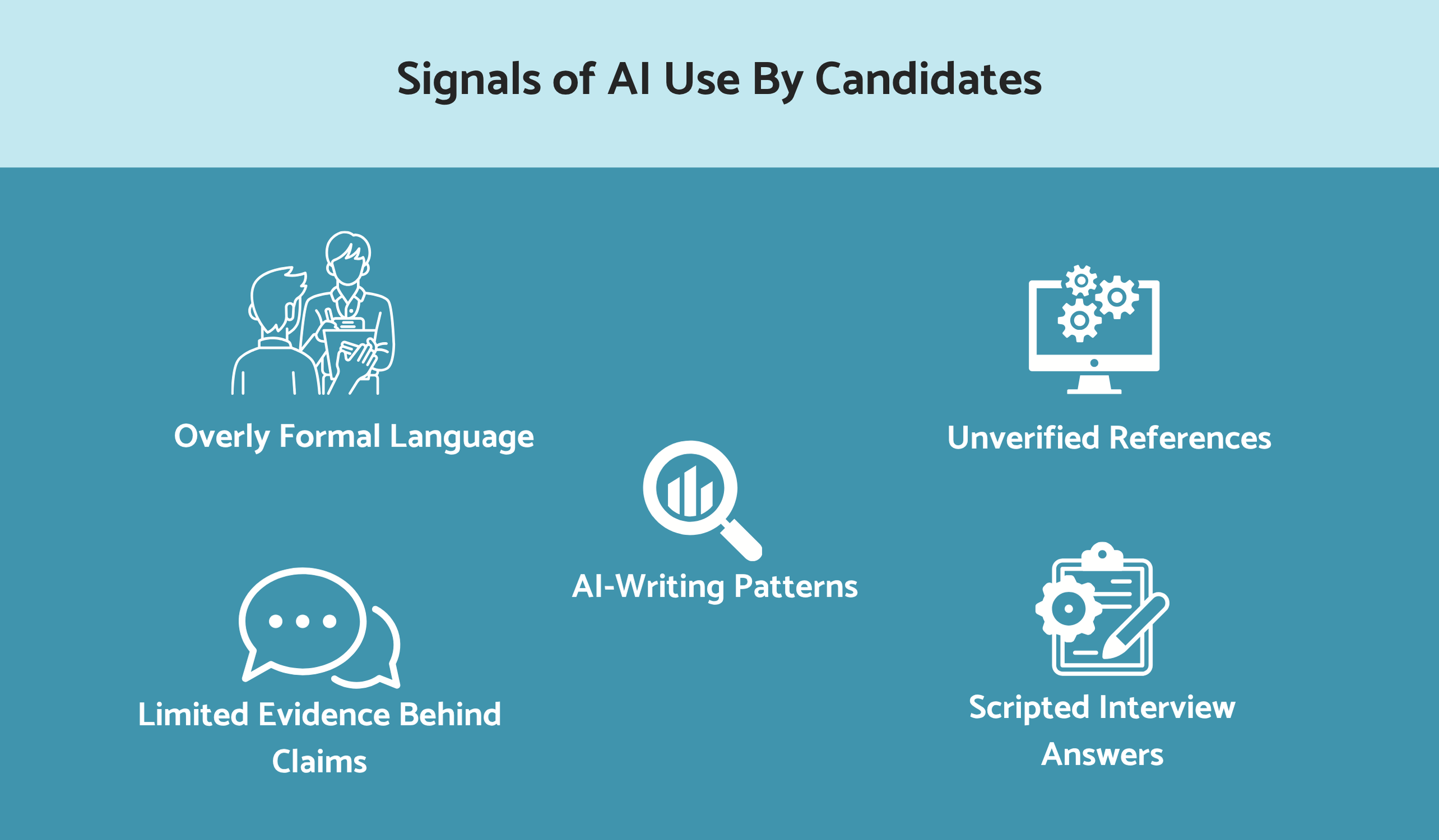
- Overly Formal Language
While formal or highly polished writing is not evidence of AI use on its own, it may warrant closer attention if it does not match the candidate’s communication style. Use any discrepancy as a prompt for further verification with the candidate, not as proof of misconduct.
- Limited Evidence Behind Claims
Look beyond grammatical quality and assess whether candidates provide specific evidence for their claims. Generic descriptions of responsibilities without decisions, challenges, actions, or measurable outcomes can justify follow-up questions, regardless of whether AI was involved.
- AI-Writing Patterns
Certain applications may contain repetitive structures, generic transitions, or formulaic conclusions. However, these patterns are not reliable evidence of AI use. What matters more is whether candidates can explain, defend, and apply the ideas or experiences presented in their submission.
- Unverified References
AI tools can provide unsupported information or invent sources that are unfounded, and these are often seen in candidates’ applications. A candidate’s written task during the recruitment may include studies, links, and citations that do not exist or do not fit the topic. Cross-check the references and ask your candidates to explain the evidence behind their recommendations.
- Scripted Interview Answers
Your candidates may seem to be reading their answers from a script during the interview process. To identify this, watch out for their unusually long and perfectly structured answers that may seem disconnected from your interview questions. Such candidates may also struggle to provide a coherent answer when interviewers ask an unexpected follow-up question.
Start your hiring process with our top assessments. HIRE FOR FREE
Once you know the signals, let us show you how to build detection into your hiring process.
4. Best strategies to avoid skills gaps
According to First Intuition, excessive use of AI in their applications makes recruiters less likely to believe that even a well-constructed application accurately reflects the candidates behind it.
Top 5 risks of AI-assisted candidate work
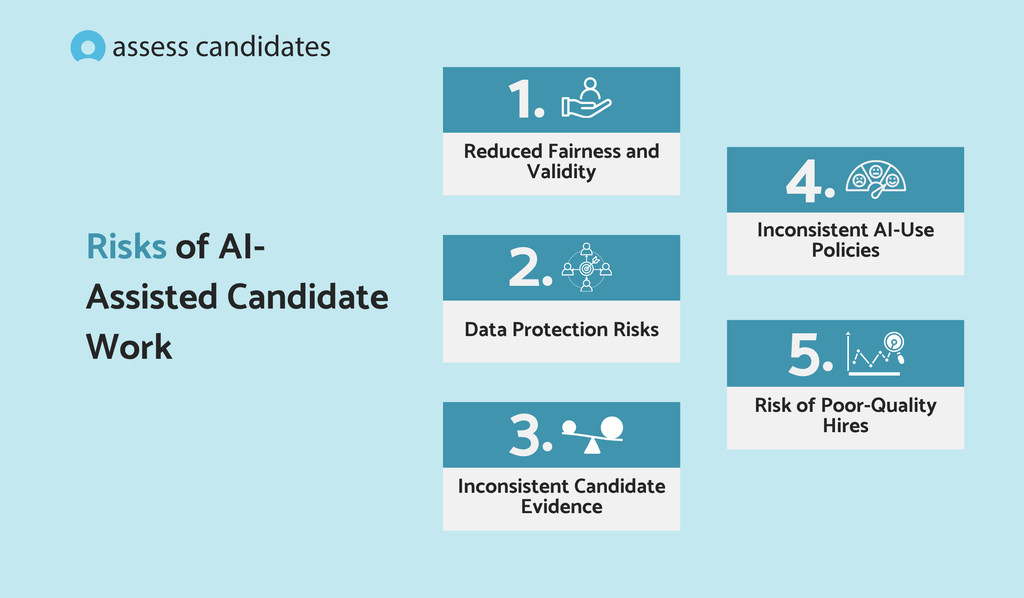
1. Reduced Fairness and Validity
Candidates likely have unequal access to AI tools, with some using free tools, while others use paid ones with better technical knowledge and devices. This risks losing the validity of the assessments if they tend to only measure how effectively candidates can use AI rather than the skills they require for the role. Thus, ensuring job relevance and fairness of the recruitment process requires proper documentation.
Solution: Establish clear AI–use rules before your assessment process begins. Ensure to apply the same rules to everyone and provide reasonable adjustments where necessary. Make sure that the assessment measures skills that are genuinely relevant to the role.
2. Data Protection Risks
Candidates can upload confidential assessment questions, customer information, or company documents to public AI tools. This risks a security breach, leading to data protection and intellectual property risks.
Solution: Give your candidates clear instructions about what they must not upload to external AI tools and avoid including real customer information, confidential business data, or sensitive internal documents in take–home assessments. Review the privacy and data–handling practices of any AI or assessment platform used in your recruitment process.
3. Inconsistent Candidate Evidence
AI-assisted work often creates huge differences between your candidate’s application, assessment, interview, and live performance. While a CV may describe advanced experience, the candidate may struggle to explain and perform basic responsibilities.
Solution: Treat the inconsistencies as a reason to investigate and not an automatic reason to reject the candidate. Clarify by asking neutral and specific follow–up questions about the work and their experience.
4. Inconsistent AI-Use Policies
If your hiring team or managers apply different rules in each recruitment process with AI, your candidates may get evaluated under unequal conditions. While some interviewers may welcome the idea of AI–assisted preparation, others may find the act to be misconduct.
Solution: We suggest creating a standard AI–use policy for every stage of the hiring process. Train your hiring managers on the policy and attach the rules to assessment instructions and candidate communications. Always keep a record of how your policy was applied so that decisions can be reviewed consistently.
5. Risk of Poor-Quality Hires
A candidate could perform well in an AI-assisted process but may find it hard to perform assigned tasks after joining your company. This may affect productivity, team performance, training requirements, and customer service.
Solution: We recommend using multiple assessment methods before making a recruitment decision. Combine written tasks with structured interviews, live work samples, skills assessments, and role–specific follow–up questions. You can also request that your candidates complete a realistic task without AI assistance if initiative is important for the role.
Recruit your top candidates with our pre-employment assessment platform. LEARN MORE
Once you know the risks, let us show you how to build AI detection into your hiring process.
5. How to detect AI use in hiring?
With artificial intelligence becoming mainstream and integrating with nearly every industry, it is no surprise that candidates are using AI tools to apply for jobs.
Rather than trying to identify AI from writing style alone, build verification into the hiring process. Timed assessments, structured follow-up questions, work samples, and comparisons across different forms of candidate evidence can help establish whether candidates possess the skills their application suggests.
According to Canditech (2025), candidates are using AI to edit and write CVs and cover letters, as well as to complete take-home assessments.
Ways to detect AI usage in recruitment
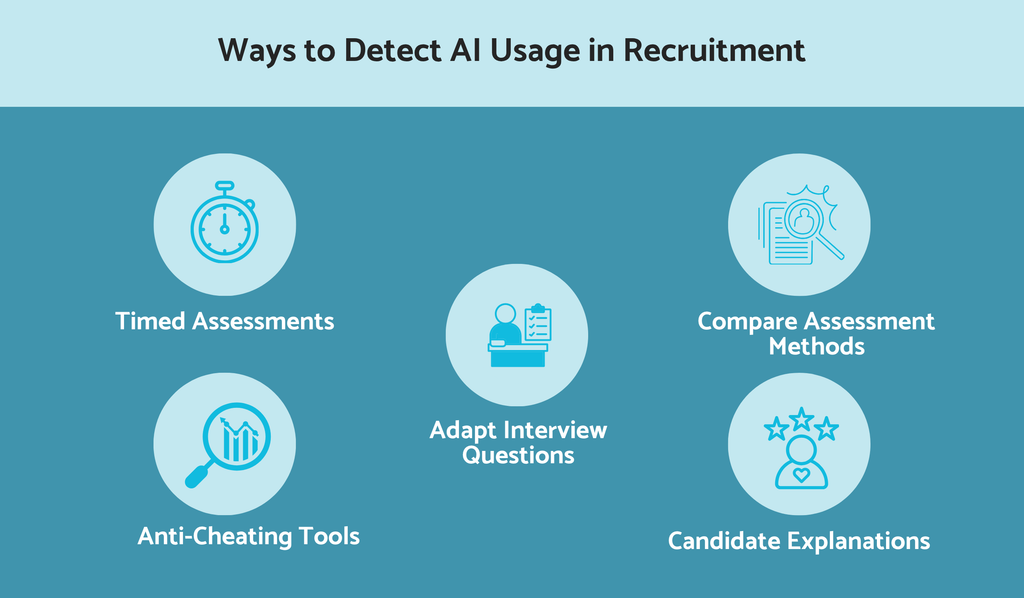
1. Timed Assessments
Using platforms like Assess Candidates, SHL, and TestTrick can help recruiters time the assessment process, showing how the candidates think and respond within a defined period. Timed assessments help in reducing the opportunity to repeatedly generate, edit, and research answers. The time limit on assessment platforms should remain realistic and appropriate for the role, without being disadvantageous to candidates who require adjustments.
2. Anti-Cheating Tools
Use cheat detection platforms that can detect copied content, tab switching, and suspicious response patterns during the online test. However, candidates should have an opportunity to explain any unusual results before you make a final decision.
3. Adapt Interview Questions
When interviewing your candidates, use their responses to ask follow–up questions so they must provide genuine answers on the spot. Asking specific questions is more integral to your hiring decisions than directly asking whether or not your candidates used AI in the recruitment process.
4. Compare Assessment Methods
Ensure that your hiring managers diligently compare the candidates’ CVs, interview responses, and assessment results when making hiring decisions. Doing this helps you see how the candidates communicate differently in their writing and conversations.
5. Candidate Explanations
Ask your candidates how they approached the task, their decisions, the alternatives considered, difficulties faced, and what they would change with more time. These questions will reveal their understanding, problem–solving, reflection, and communication skills.
Want to attract and retain top candidates with genuine skills? Are you unsure which pre-employment psychometric tests to use for successful hiring? Contact us for a detailed review of your assessment methods, and we’ll help you identify the perfect candidates.
Discover assessments created by Chartered Scientists to hire top candidates. VIEW PLANS
Detecting AI isn’t enough; here is how to manage AI use in your hiring process.
6. Tips on managing AI-assisted work
As generative AI becomes a standard workplace tool, employers need clear rules for when candidates may use it during recruitment. The goal should not simply be to detect AI, but to ensure that each assessment still provides valid evidence of the skills it is designed to measure.
Best practices on how to manage AI-assisted work
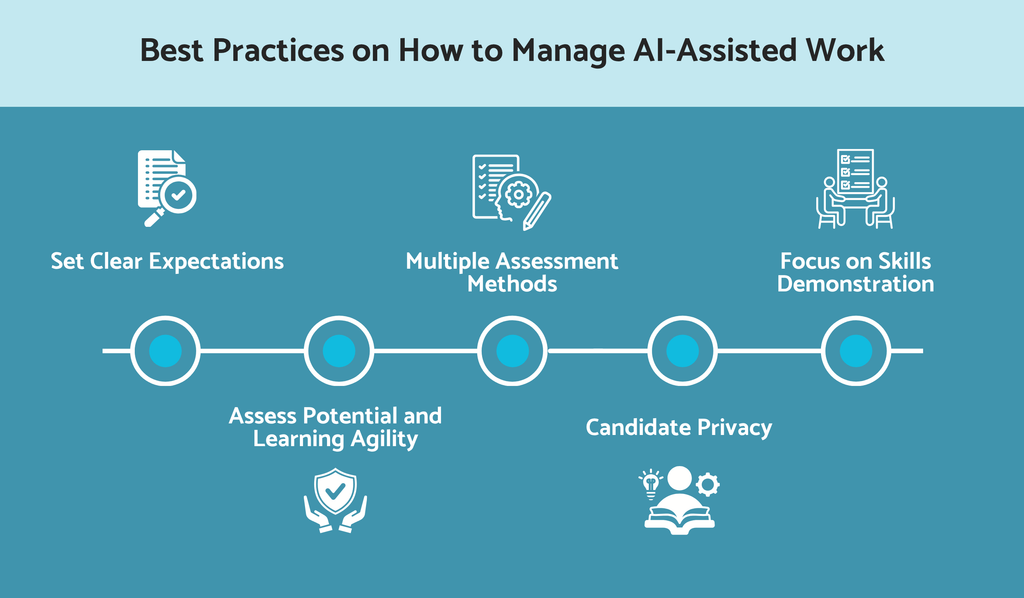
- Set Clear Expectations
Tell your candidates specifically what AI use is and is not acceptable at each stage of the recruitment process, rather than leaving the crucial information ambiguous. Candidates should understand what they can use, what they cannot use, and what may happen if they break the rules. These details should also be provided at the start of your recruitment process.
- Multiple Assessment Methods
Using a single method will not fully capture the genuineness of a candidate’s work, which is why combining structured interviews, skills tests, and situational judgment tests in your recruitment process may work better for your hiring process. This approach makes it more difficult for AI-polished application materials to dominate your hiring decision.
- Focus on Skills Demonstration
We recommend giving your candidates a realistic opportunity to show the skills they possess for the role they are applying for. Evaluate how they analyze information, solve problems, prioritize work, communicate with others, and respond to new information. These demonstrations will provide you with stronger evidence than a highly polished application.
- Assess Potential and Learning Agility
Candidates who effectively use AI as a genuine productivity tool and can clearly explain and justify their reasoning might still be strong candidates. When evaluating how a candidate used AI, we suggest prioritizing adaptability and learning agility alongside the quality of their output.
- Candidate Privacy
Ensure that you inform your candidates that their data will be collected and how it will be used during and after the recruitment process. Use only the level of surveillance that is required to protect the integrity of your assessment.
Assess Candidates helps recruiters gather more reliable evidence of candidate ability through structured, job-relevant assessments and integrity controls. With our psychometric assessment tools, behavioral skills tests, and personality questionnaires, we can accurately test your candidates for the skills they have.
So, how does Assess Candidates help you verify candidate ability?
7. Why use Assess Candidates to verify candidate ability?
Assess Candidates helps employers evaluate genuine on–the–job ability using scientifically validated, monitored assessments.
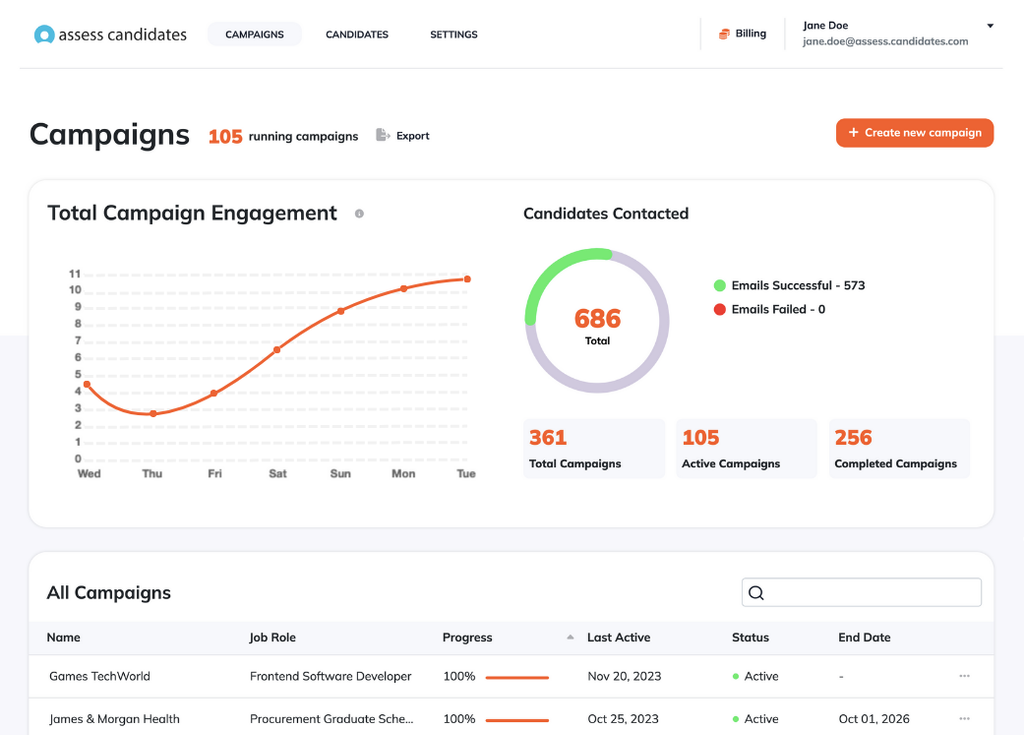
- Monitored and Timed Assessments: Assess Candidates provides monitoring with realistic time limits. This reduces the window in which candidates can lean on AI tools during live or take-home testing.
- Data–Driven Reporting: Our platform offers recruiters intuitive reports and ranked candidate scores, making it easier to identify inconsistencies between assessment performance and live interview follow–up.
- Unbiased and Accessible Platform: Our assessments reduce candidate reliance on CVs and written self–reports. Assess Candidates’ platform also includes accessibility features, such as extended time and screen reader compatibility, to ensure a fair experience.
- Wide Range of Assessment Tools: Our platform provides employers with access to a wide range of tools that are tailored to different aspects of the role. These assessment tests include numerical, verbal, and logical reasoning tests, video interviews, situational judgment tests, game-based assessments, and error–checking tests.
- Behavioral and situational assessments: Assess Candidates offers behavioral competency assessment tests that can help you predict on–the–job performance with an interactive test that engages candidates and assesses their competencies. Our tests simulate pressure–based and real–world scenarios rather than asking candidates to self-report how they would cope in them.
Hire the perfect candidates with our assessment tool platform. LEARN MORE
Conclusion: Key Takeaway
AI-assisted candidate work is becoming more common across recruitment as candidates continue to use AI to improve their applications. As recruiters, the goal is not to eliminate AI from recruitment. It is to prevent AI use from obscuring the candidates’ abilities. Set clear rules for acceptable AI assistance, use job-relevant assessments, and verify important evidence through structured follow-up. This gives candidates clearer expectations and organizations stronger evidence for hiring decisions.
Want to know more about how to detect AI use and how to identify skilled candidates for your company? Keep reading to see our frequently asked questions, and enter your email to get started today.
Frequently Asked Questions
Do employers know when a CV is written by AI?
Most employers may notice common signals such as generic language, exaggerated claims, repeated phrases, or a writing style that differs significantly from the candidate’s other responses. These signals do not prove that AI was used. If authenticity matters to the role, verify the candidate’s underlying experience through structured follow-up questions, work samples, or skills assessments rather than relying on an AI detector alone.
Should I reject a candidate for using AI?
Rejecting a candidate solely for using AI in the recruitment process may depend on how the AI was used and whether that usage was disclosed or prohibited. Simple editing assistance is very different from a fully AI-generated submission that is presented as the candidate’s original work.
Should AI be banned during recruitment?
AI does not need to be banned in recruitment, as it may be suitable for assessments intended to measure a candidate’s AI literacy skills, and having skilled candidates with this knowledge can be helpful. However, clear rules for acceptable AI assistance should be set early in the hiring process.
What should an AI-use policy for recruitment look like?
The AI use policy you should have in your recruitment process should include an explanation of which tools candidates may use, which tools are restricted, when AI use is allowed, whether candidates must disclose it, and what happens if the rules are broken. The policy should also explain how your assessment information must be kept confidential.
Are AI detection tools accurate?
We believe that AI detection tools should be used with caution because they may sometimes produce incorrect results and should not be used as the sole basis for making a hiring decision. For this reason, employers should combine AI-detection signals with interviews, skills assessments, and other job-relevant evidence rather than using an AI detector as the sole basis for a hiring decision.


 English
  Arabic