
Best Practices to Recruit Top Energy Talent in 2026



The energy industry is experiencing one of the fastest hiring transformations in decades. As investment in renewable energy accelerates and experienced workers retire, employers face growing competition for skilled professionals.
According to a United Nations report, for most countries to fully reach Net Zero by 2050, they would have to create over 30 million renewable jobs worldwide by 2030.
In this text, we will show you everything you need to begin recruiting top candidates in the energy industry.
Contents
- What is the energy industry?
- Skills to measure when hiring top energy talent
- Top tools to recruit energy candidates
- Common challenges in energy talent recruitment
- Top hiring practices for the energy sector
- Roles that employers hire for in the energy industry
- Client success stories of hiring energy candidates
- Future of recruitment in the energy industry
- Why do companies use Assess Candidates to hire energy talent?
Without further ado, let us see what it takes to recruit in the energy industry!
1. What is the energy industry?
The energy industry encompasses all sectors involved in the production, production, transmission, distribution, and consumption of energy, including fuel extraction, manufacturing, refining, and distribution.
Start your energy hiring process with our top assessments. HIRE FOR FREE
Understanding which skills to assess when recruiting candidates in the energy sector helps reduce mis-hires. Keep reading!

2. Skills to measure when hiring top energy talent
Recruiting top candidates in the energy sector requires more than technical know–how if you are seeking talent to boost productivity and improve your company’s work environment. To ensure your energy talent aligns with your values and cultural fit, consider these vital soft skills to evaluate during the hiring process.
According to the IEA, in 2024, continued support and investment in energy infrastructure led to a 2.2% rise in employment, surpassing job gains in the broader economy for the third year in a row.
Top skills to measure when hiring energy talent
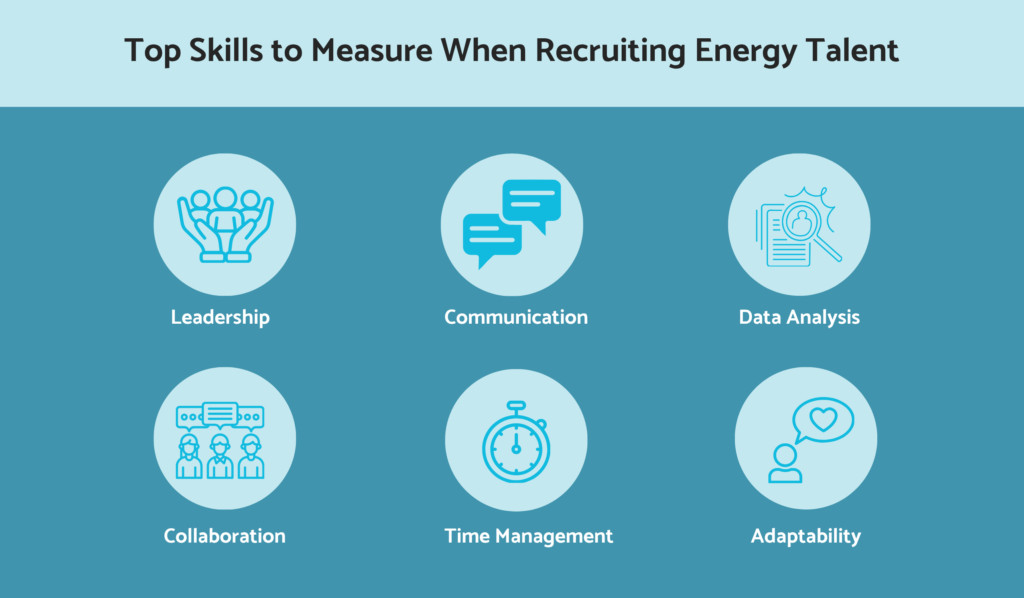
- Leadership
Your candidates must demonstrate leadership skills during your recruitment process by taking initiative, guiding their colleagues, and remaining accountable. Leadership skills matter in the energy sector because employers need someone to step up, even in non-management roles.
- Communication
Identify candidates who can clearly explain ideas, write reports, and convey information to both technical and non-technical audiences. Hiring candidates with poor communication skills risk potential mistakes, delays, and safety issues in your organization.
- Data Analysis
When recruiting, look for candidates who can work with numbers, make useful connections, and spot patterns in issues that may arise in your company. Recruiting in the energy sector relies heavily on data analysis for forecasting, performance monitoring, and efficiency.
- Collaboration
Your energy candidates must be able to work well with colleagues across different roles and departments in your company. This matters because energy projects often require engineers, technicians, and managers to collaborate to ensure the projects are successfully completed.
- Time Management
Ensure that you recruit applicants in the energy sector who can prioritize tasks, meet deadlines, and remain composed under pressure. Time management skills are critical in the energy industry because delays in projects and tasks can affect your company’s operations, compliance, and cost.
- Adaptability
You should look for candidates who can adapt to change, new tools, and new rules in your organization. Adaptability skills are important for your candidates because the energy sector is dynamic and can change quickly due to policy shifts, market pressures, and technological advancements.
Next, let’s examine the tools you can use to recruit your energy candidates.
3. Top tools to recruit energy candidates
Recruiting candidates in the energy sector can be challenging when you do not know the right tools and methods to assess their skills and ensure you do not make any mis-hires.
According to the 2025 National Solar Jobs Census, the energy industry’s workforce is on track to meet the United States’ clean energy goal by 2035, which will require increasing the workforce to over 900,000 skilled professionals.
6 Top tools to use in hiring energy candidates
1. Applicant Tracking System (ATS)
Applicant tracking systems like Greenhouse, Lever, and Workable are useful tools in energy recruitment, as they help you with job postings, organizing your candidates, monitoring your progress, and managing your recruitment stages on a single platform. ATS platforms are helpful for high–volume hiring and keep the process structured.
2. AI Sourcing Tools
AI sourcing tools like LinkedIn Recruiter, Entelo, and HireEZ help recruiters find the perfect candidates faster by searching their profiles, qualifications, and relevant experience across various channels.
3. Skills Assessment Platforms
Skills–based assessment platforms such as Assess Candidates, SHL, and TestGorilla help energy employers assess candidates’ skills rather than their CVs. These platforms assess your candidates’ technical knowledge, role–specific competencies, and, often, safety judgments through cognitive and psychometric assessments.
4. Psychometric Assessment Tests
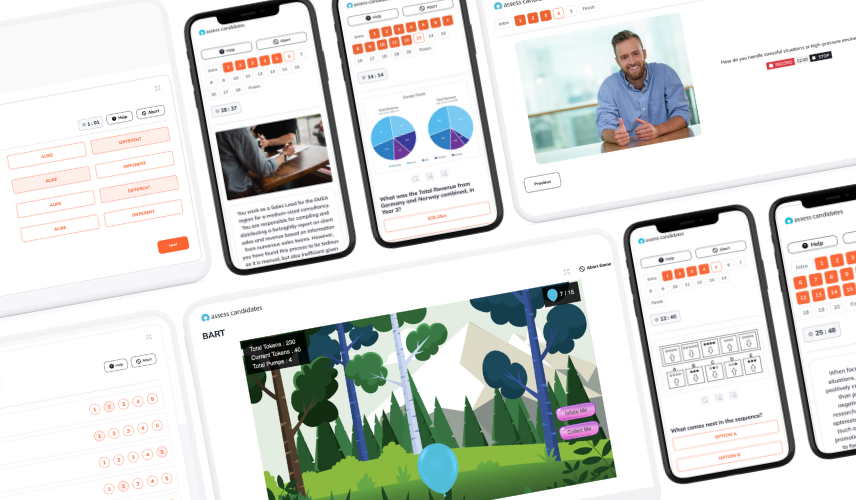
Energy recruiters use psychometric assessment platforms such as Assess Candidates, SHL, and Pymetrics to evaluate candidates’ cognitive abilities and workplace behavioral tendencies. The tests ensure that your candidates can perform common energy industry tasks that align with their talents.
Some of the assessment tests that you should use to assess your candidates in the energy sector are:
- Verbal Reasoning Test
- Numerical Reasoning Test
- Logical Reasoning Test
- Critical Reasoning Test
- Game-Based Assessments
5. Video Interviewing Tools
Assess Candidates, HireVue, and Metaview offer recruiters in the energy industry unbiased video–interviewing platforms. The platform ensures that prospective candidates receive the same interview questions and scoring criteria, boosting the fairness and consistency in your recruitment process.
Types of Interview Questions to Ask an Energy Talent
- What interests you about working in the energy sector?
- Describe a project where you worked with a team to achieve a common objective.
- Describe a time when you had to adapt to critical changes in a project.
- Why do you want to work for our company in energy talent?
- How do you approach enforcing safety policies and procedures when a colleague is facing a tight deadline?
6. Candidate Communication Tools
Tools like Paradox, Gem, and Workable allow energy recruiters to automate emails, texts, and follow–ups so that your candidates remain informed throughout your recruitment process. Using these messaging platforms helps improve the candidate experience and reduce drop–offs in your hiring process.
Recruit the ideal energy talent with our assessment platform. LEARN MORE
The following section will further explain the energy hiring challenges and how to avoid them.
4. Common challenges in energy talent recruitment
The world is gradually looking towards renewable energy and sustainability, and this demand is creating a need for skilled professionals in the energy sector.
According to WRS, finding skilled candidates in the global energy industry is increasingly challenging due to a widening skills gap, technological shifts, and policy changes.
Top 5 challenges of hiring in the energy industry
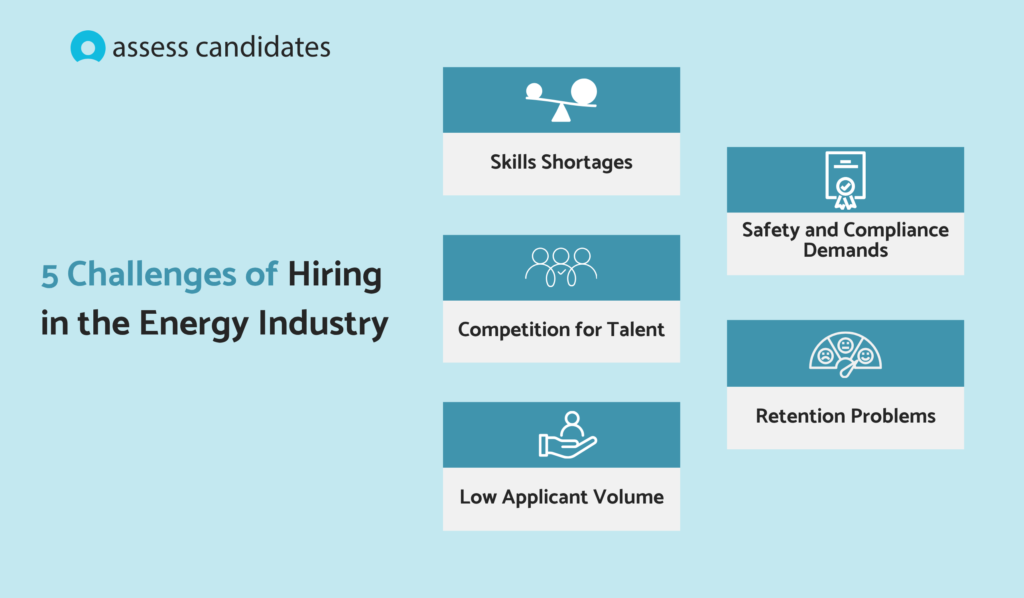
- Skills Shortages
Many energy roles often require highly specialized engineering, operational, and technical skills, but the pool of prospective talent is small. Energy recruiters have complained that this has made recruiting challenging for them because when new technologies or regulations emerge in the industry, the pipelines are unable to keep up.
Solution: We suggest establishing stronger talent pipelines through internships, graduate programs, and apprenticeships. Doing this will help ensure that your candidates are adequately skilled before the recruitment process, rather than waiting for the ideal match.
- Competition for Talent
Employers in the energy sector are constantly competing for talent, making it difficult to attract, recruit, and retain the best candidates, who are in high demand across other industries.
Solution: To combat this challenge, we recommend improving your value proposition by highlighting your candidates’ career growth, long–term stability, and compensation. Having a stronger employer brand will help energy companies stand out when candidates are applying.
- Low Applicant Volume
Many energy job postings do not attract enough applications from interested candidates, particularly in niche and highly technical roles. Recruiters simply posting their job vacancies is not enough to motivate candidates to apply because the ideal candidates may not be actively searching.
Solution: We suggest using active sourcing, employee referrals, niche job boards, and specialist recruiters to reach passive candidates. You can also write clearer, more targeted job descriptions to attract the right people in the energy sector.
- Safety and Compliance Demands
Energy recruitment is connected to operational, technical, and safety risks. Candidates with strong technical skills may not be suitable for the role you are hiring for if they do not understand compliance laws and cannot abide by them.
Solution: To avoid this, employers should use safety–oriented assessments, compliance checks, and scenario–based interviews during the recruitment process. You can also provide your candidates with structured onboarding and ongoing safety training to ensure expectations are clear from the beginning.
- Retention Problems
Recruiting skilled energy candidates is expensive, but retaining them is even more difficult for companies. If your employees feel overworked, underpaid, or that they have no career growth, they may leave for better opportunities.
Solution: Companies can focus on retention tactics through competitive pay, clear career paths, strong management, and consistent development opportunities. To do this, you can offer simple actions, flexible work, and internal mobility.
Take a look at the top practices to implement when hiring energy talent!
5. Top hiring practices for the energy sector
Recruiting energy candidates requires focusing on unique, creative methods to attract, hire, and retain top talent in the industry.
Top recruiting strategies in the energy industry
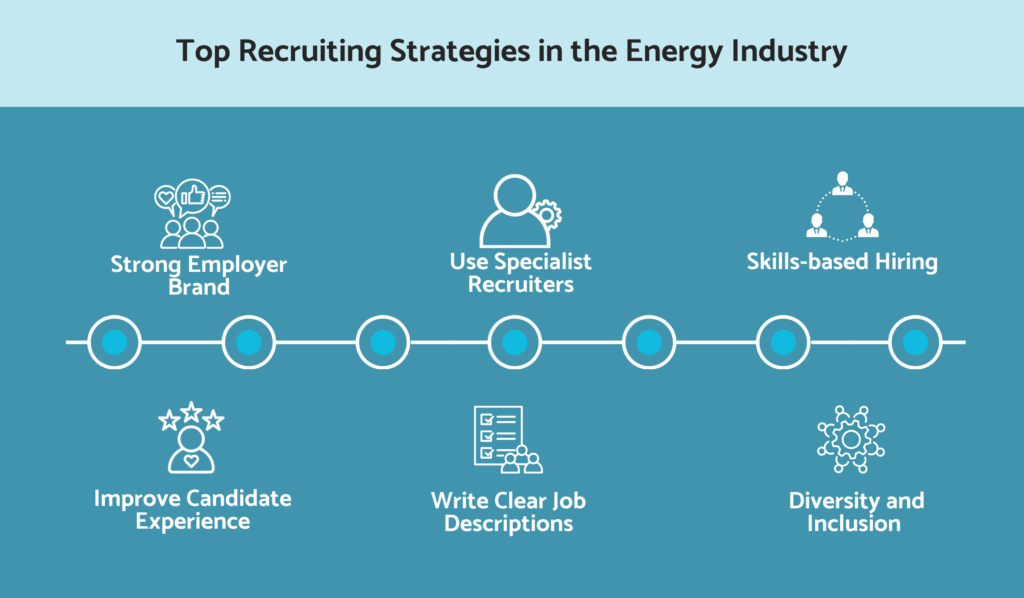
1. Strong Employer Brand
Skilled candidates in the energy sector are curious and want to know why they should choose your company over others in the industry. Having a strong employer brand would help highlight their career growth within your organization, as well as your organization’s innovation, sustainability, stability, and impact on the sector. This helps because it makes your company more attractive in a competitive market and gives your candidates a reason to choose you over competitors.
2. Use Specialist Recruiters
Working with recruiters who already know the energy market and the talent your organization requires is a step toward hiring the perfect candidates. Enlisting their services in your recruitment process can help you source faster, screen better, and reach passive candidates that general recruiters may miss.
3. Skills-based Hiring
You can evaluate your candidates by using practical tests, case studies, and scenario–based interviews rather than relying on their CVs and job titles. Doing this will help you filter the unqualified candidates from the skilled ones by revealing their abilities and competencies.
4. Improve Candidate Experience
Keep your recruitment process fast, clear, and respectful by providing prompt feedback to your candidates along with realistic timelines. This helps your company retain skilled candidates interested in participating in your recruitment process and stops them from dropping off.
5. Write Clear Job Descriptions
Ensure that your job descriptions are accurate and inclusive, as the first interaction your candidates have with your energy company is your job description. Use appropriate language and keywords, and consider soft skills as essential in the energy sector.
6. Diversity and Inclusion
Broaden your talent–sourcing scope to include skilled candidates beyond your hiring region. Diversity and inclusion in your organization will motivate prospective candidates to apply to your company when they see representation and believe you are aligned with their values.
Explore assessments created by Chartered Scientists to hire perfect energy candidates. VIEW PLANS
There are various roles that employers often look for in the energy industry. Let us take a look at some!
6. Roles that employers hire for in the energy industry
According to the US Department of Energy (2025), there are 8.5 million energy jobs, and 5.4% of all jobs in the United States of America are in energy.
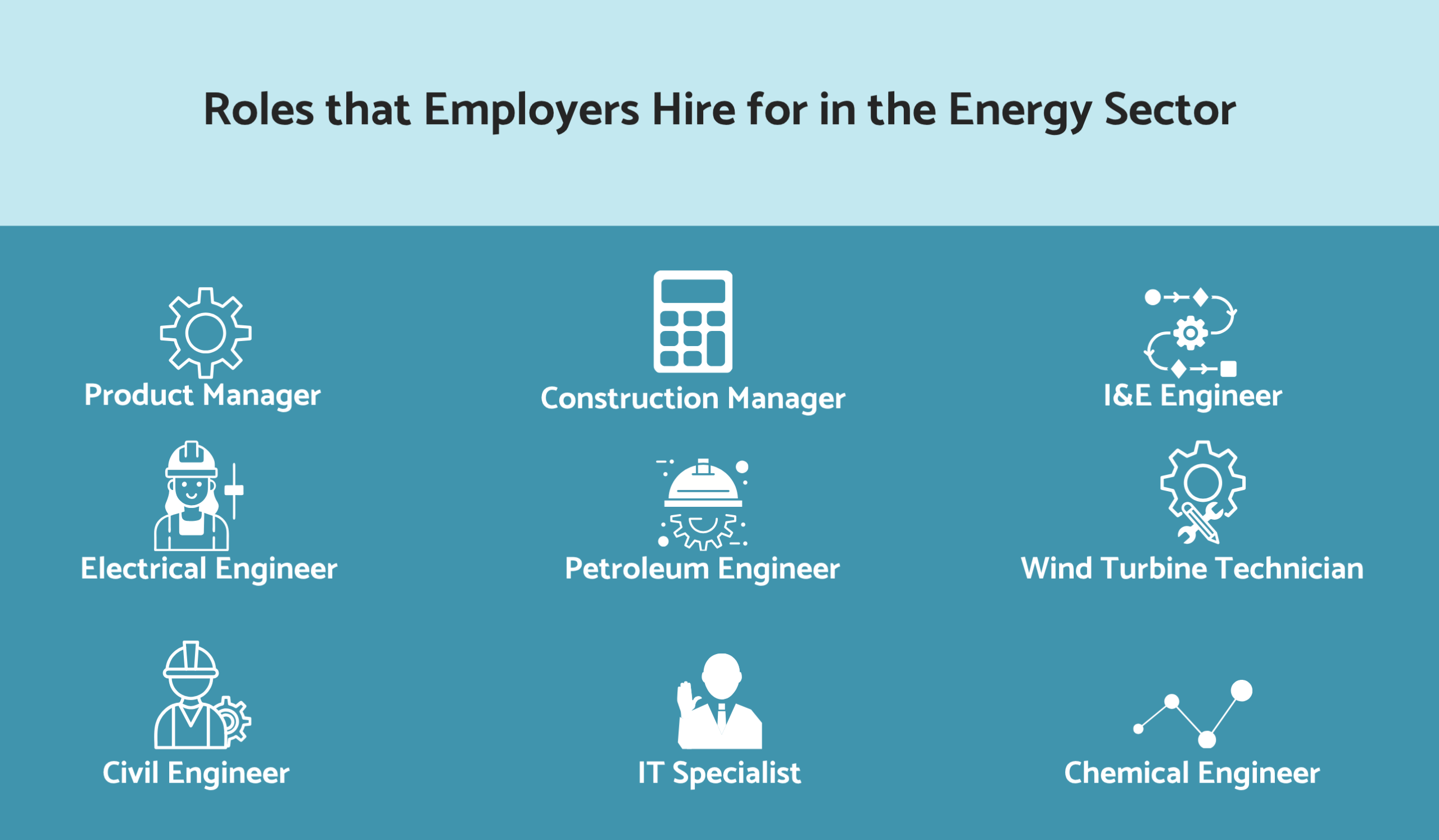
Roles that Employers Hire for in the Energy Sector
- Product Manager
- Electrical Engineer
- Civil Engineer
- Construction Manager
- Petroleum Engineer
- IT Specialist
- I&E Engineer
- Wind Turbine Technician
- Chemical Engineer
Want to attract and recruit top energy candidates? Are you unsure which pre-employment psychometric tests to use for successful hiring? Contact us for a detailed review of your assessment methods, and we’ll help you identify the top energy candidates.
Top Employers that hire energy talent
- Shell
- ExxonMobil
- Chevron
- Tesla
- Exelon
- Sunrun
Curious to find out what employers have to say about overcoming their recruitment challenges?
7. Client success stories of hiring energy candidates
Many employers in the energy sector have shared their experiences with recruiting candidates, the challenges they face, and the methods they use to overcome them.
1. Akuo Energy
Challenge:
Akuo Energy was looking to fill specialized renewable energy roles within the company, but the talent pool was limited and the requirements were technical. The recruitment process also had to remain aligned with the company’s growth plans and project timelines.
Solution:
The company used a targeted search strategy focused on renewable energy professionals with the right technical backgrounds, enabling the hiring team to refine the role profile. Akuo Energy also kept the hiring process tight and responsive, so the skilled candidates did not drop out.
Results:
- Filled roles much faster than they were used to
- Improved the quality of shortlisted candidates by 40%
- Supported the project delivery without having recruitment delays
2. Shell
Challenge:
Shell was facing difficulty attracting qualified engineers and technical specialists across its global operations, as demand for skilled energy candidates exceeded supply in a competitive market. However, lengthy hiring processes were causing the organization to lose its top talent to faster-moving competitors.
Solution:
The company introduced an integrated digital hiring platform that combines AI–powered screening, skills–based tests, and video interviews to speed up the recruitment process without compromising candidate quality. Doing this allowed Shell’s recruitment team to assess a high volume of technical candidates within a short time.
Results:
- Minimized time-to-hire for engineering roles by 38%
- Improved the quality of hire by 32%
- Achieved a 25% reduction in hiring costs
This is where Assess Candidates comes in: we help ensure your candidates are competent, as our pre-employment psychometric assessments evaluate skills and provide data-driven analytics to inform your hiring decisions.
8. Future of recruitment in the energy industry
Recruiting in the energy industry requires looking out for candidates who possess soft skills and align with your culture and values.
What is the future of recruitment in the energy industry?
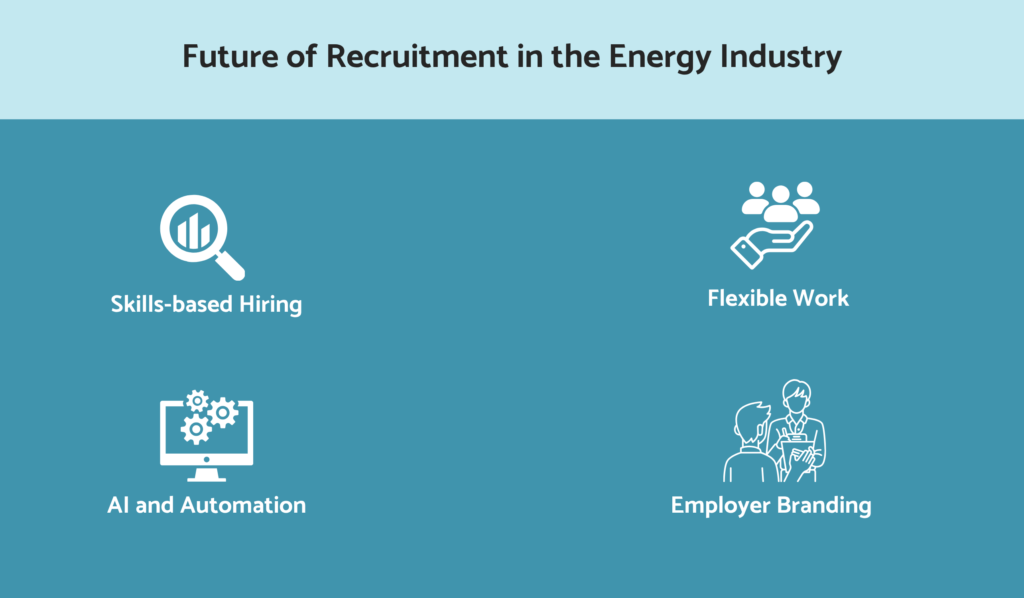
- Skills-based Hiring
Energy recruiters are increasingly seeking candidates with adaptable technical, data, and business skills rather than those with traditional backgrounds. The future of recruitment in the energy sector will shift toward skills–based recruitment, as employers focus on talent and skills rather than certifications.
- AI and Automation
AI and automation will play a huge role in the future of recruitment, as hiring teams will use AI to source, screen, and manage candidates more efficiently. However, human judgment and input will still be required to make the final hiring decisions. AI and automation are used to reduce manual work and speed up the recruitment process, allowing recruiters to focus on other critical matters.
- Flexible Work
Energy candidates now value flexible work models, and to stay on top of the hiring trend, employers will have to offer hybrid, remote, and more adaptable scheduling where possible. This will be especially significant for attracting Gen Z talent, as well as professionals with other options across industries.
- Employer Branding
Energy companies will have to highlight their purpose, sustainability impact, and innovation in order to attract, recruit, and hire the right candidates who care about the company’s vision. Having a strong employer brand will help organizations stand out in a market where candidates are comparing many employers at once.
So, why use Assess Candidates to hire your energy candidates in 2026?
9. Why do companies use Assess Candidates to hire energy talent?
Assess Candidates enables energy employers to make data–driven hiring decisions by offering accurate insights into candidates’ assessment results, helping remove unqualified candidates from the skilled applicant pool.
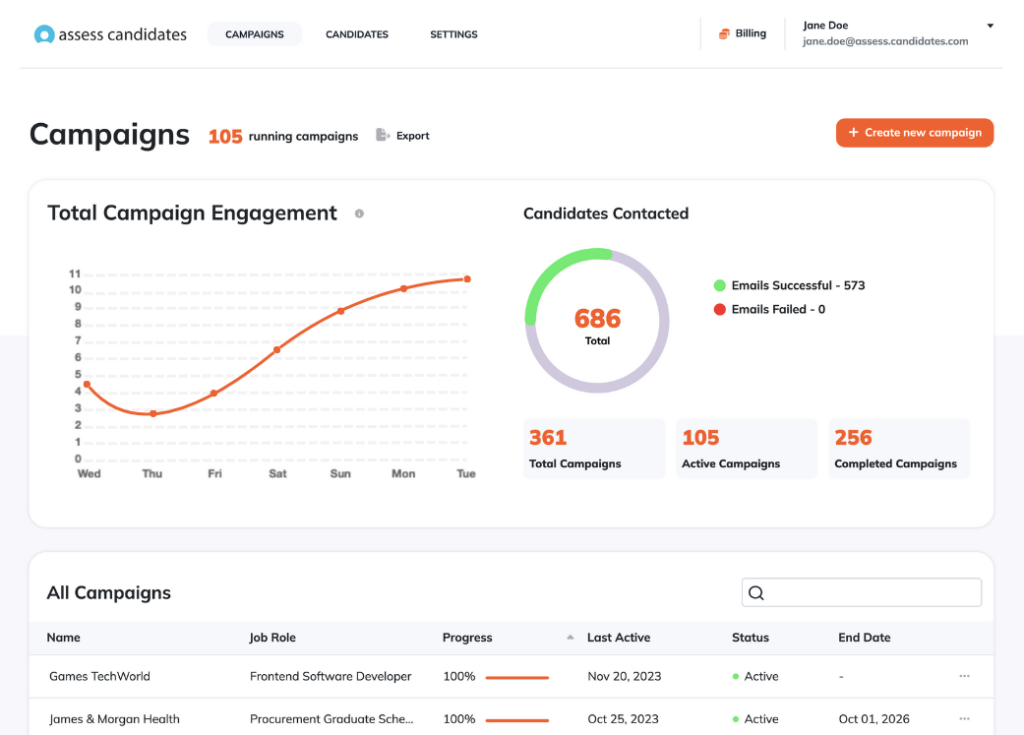
- Grounded in Rigorous Science: Assess Candidates offers industry-leading psychometric assessment tests, AI–powered video interviews, behavioral skills, and game–based assessments that are developed by chartered psychologists. This means that every hiring decision is backed by validated and reliable data.
- Predicts Job Performance: Our platform’s pre–employment assessments offer you accurate insight into candidates’ abilities that are required for the role you are recruiting for. These can be used to filter through the candidates and highlight only the qualified ones for your vacant role.
- Inclusive and Bias–Free Hiring: Our platform reduces bias and provides every energy candidate with equal opportunity to succeed regardless of their background. We also offer the candidates additional time, accessibility features, and screen reader compatibility to ensure a smooth candidate experience during the recruitment process.
- Positive Candidate Experience: Our pre–hire assessment tests are designed to feel simple, smooth, and engaging to your candidates from the invitation to the finish. In a competitive energy market where skilled candidates have multiple options, a respectful candidate experience is necessary to not lose your top talent.
- Integrates with Existing Process: Assess Candidates seamlessly integrates with your existing hiring processes to provide a user–friendly experience and a streamlined recruitment workflow.
Hire the right energy talent with our assessment tool platform. LEARN MORE
Conclusion: Key Takeaway
Successful energy recruitment depends on combining technical assessments with structured hiring, faster decision-making, and a compelling employer value proposition. Organisations that modernise their hiring process will be best positioned to secure scarce engineering and renewable energy talent.
Interested in knowing more about using psychometric tests to hire the top candidates in the energy sector? Keep reading to see our frequently asked questions, and enter your email to get started today.
Frequently Asked Questions
What makes hiring in the energy industry different?
Recruiting in the energy industry is more specialized because various roles often require your candidates to possess technical and regulatory knowledge. The energy talent pool is smaller than that of other industries, which makes employers take a more guided approach when recruiting.
What skills matter most when recruiting in the energy sector?
When recruiting candidates in the energy industry, you should look out for technical competence, communication, collaboration, time management, adaptability, and safety awareness. Depending on the role you are recruiting for, you may also require that your candidates possess data analysis skills.
What are the best strategies to attract energy candidates?
To attract the top candidates in your organization, you can improve your employer branding, ensure that you provide a positive candidate experience, practice skills-based hiring, and post language-inclusive job descriptions on platforms.
How can I reduce time-to-hire in my recruitment process?
To reduce time-to-hire in your recruitment process, we suggest improving your hiring strategies, using active sourcing, streamlining interview stages, and responding quickly to candidates. Having a slow hiring process will lead to the loss of your potential candidates.
How can I improve my retention after recruiting candidates?
To improve your retention rate after recruiting candidates in the energy industry, we recommend offering them a clear career path, effective onboarding, training, and a supportive work environment. Your retention is likely to improve when your candidates feel valued and see long-term growth in your organization.


 English
  Arabic